REVIEW 4 major objections 5 minor 71 references
The one-dimensional Kardar-Parisi-Zhang and Kuramoto-Sivashinsky universality class: limit distributions
T0 review · 4 major / 5 minor · reviewed 2026-08-14 · deepseek-v4-flash
Pith's one-line read Height fluctuations in a deterministic chaotic equation match KPZ's universal laws.
desk verdict KS may be in the KPZ universality class, but the case is weakened by an inconsistent amplitude parameter and overfitted collapses. read the letter →
The pith
A machine-rendered reading of the paper's core claim, the machinery that carries it, and where it could break.
The reading
What carries the argument
The load-bearing object is the one-point height-fluctuation relation Eq. (1) of the 1D KPZ class, applied to the deterministic Kuramoto-Sivashinsky equation (2), $\partial_t h + \Delta h + \Delta^2 h + \tfrac12(\nabla h)^2 = 0$. The argument is carried by pseudospectral direct numerical simulation with a fourth-order exponential time-differencing scheme at $L = 2^{20}$, a set of initial conditions crafted to mimic wedge, flat, stationary, and mixed interface geometries, and the rescaling $\chi = (h(x,t)-v_\infty t)/(\Gamma t)^{1/3}$, with $v_\infty$ and $\Gamma$ extracted from the same runs. The distributions being matched are the Tracy-Widom laws from the largest-eigenvalue statistics of GOE and GUE random matrices and the Baik-Rains $F_0$ distribution.
What would settle it
Take the same IC1-IC3 runs at a larger linear size, for example $L = 2^{21}$, extend $t_{\max}$ beyond $4\times 10^5$, and re-extract $v_\infty$ and $\Gamma$ from the data; if the rescaled height PDF moves away from the Tracy-Widom and Baik-Rains curves in the tails, the claimed matches were finite-size or fitting artifacts.
Extended reading notes
Core claim
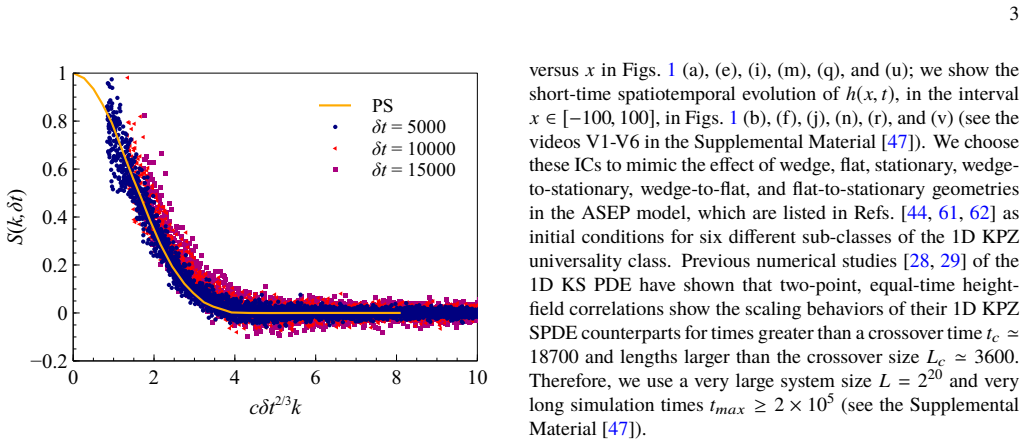
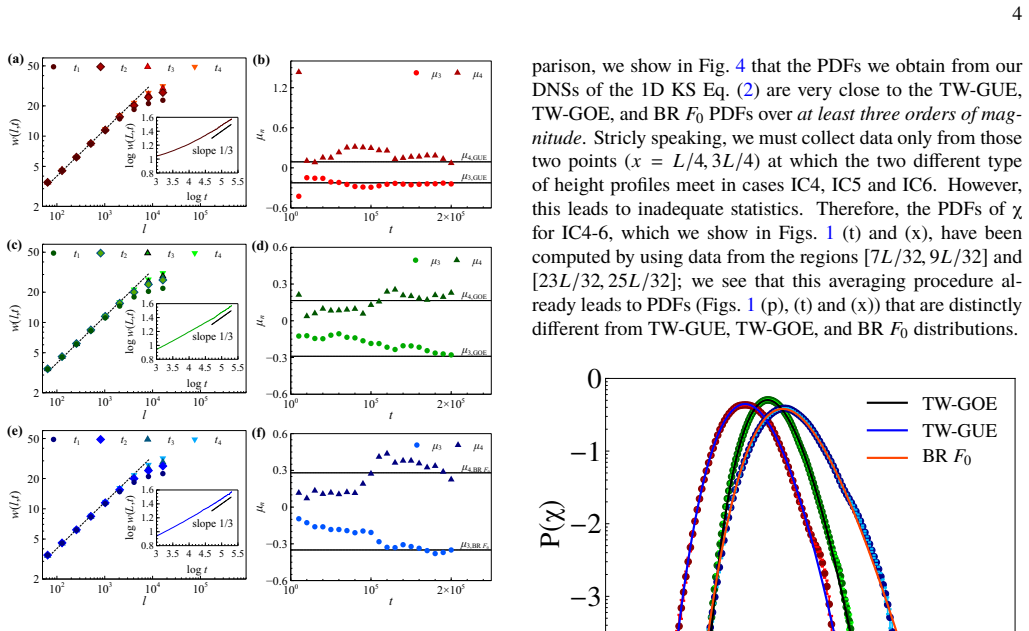
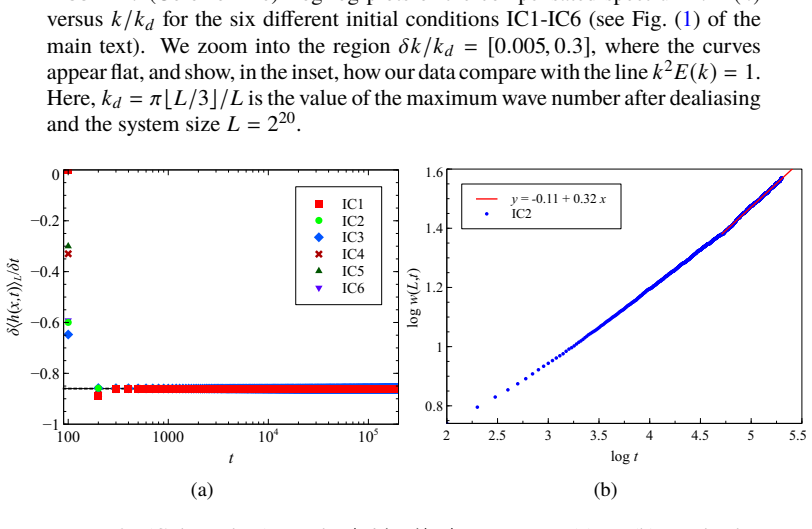
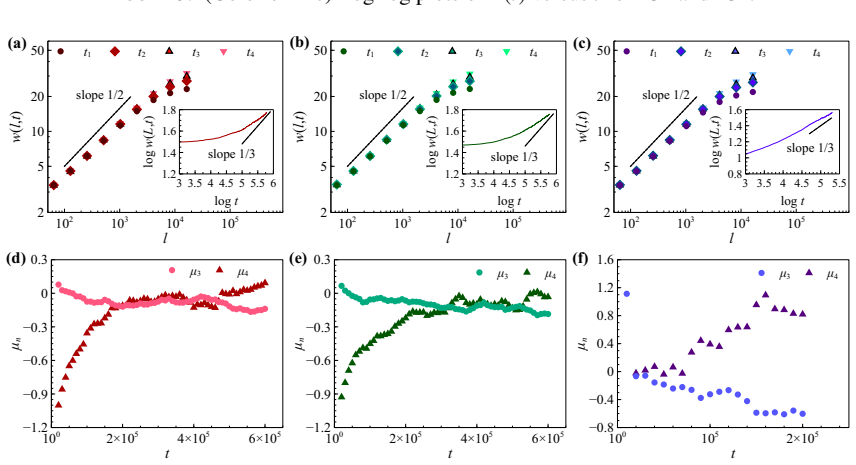
On the paper's own terms, the central discovery is that the spatiotemporally chaotic nonequilibrium steady state of the deterministic 1D KS PDE lies in the 1D KPZ universality class in the strong sense of Eq. (1): $h(x,t)-h(x,0) = v_\infty t + (\Gamma t)^{1/3}\chi_\beta + o(t^{1/3})$. By choosing six initial conditions IC1-IC6 to mimic the wedge, flat, stationary, and mixed geometries studied in the asymmetric simple exclusion process, and running pseudospectral simulations at linear size $L = 2^{20}$ to times $t_{\max} \geq 2 \times 10^5$, the authors obtain rescaled height PDFs that collapse onto TW-GUE (IC1), TW-GOE (IC2), and BR $F_0$ (IC3) over more than three orders of magnitude, with skewness and kurtosis approaching the corresponding random-matrix values. They also report the compensated spectrum, interface-width scaling with $\beta \simeq 0.32$, and a time-dependent two-point correlation function $S(k,\delta t)$ consistent with the analytic 1D KPZ scaling form. This is presented as the first observation of these limit distributions in a spatiotemporally chaotic steady state of a deterministic PDE.
Load-bearing premise
The load-bearing premise is that the chosen initial conditions impose the same long-time interface geometries—wedge, flat, stationary—that select the Tracy-Widom and Baik-Rains laws in stochastic growth models; if the chaotic equation does not preserve those geometries, the observed distribution matches would be coincidental.
Editorial extensions
If this is right
- The 1D KS equation can serve as a deterministic laboratory for probing 1D KPZ universality, since the same limit distributions arise without averaging over stochastic noise realizations.
- The initial-condition geometry, not the presence of noise, is what selects the Tracy-Widom GUE, GOE, or Baik-Rains law in this class.
- The correspondence between the deterministic and stochastic systems extends beyond exponents to the complete scaling form of the time-dependent two-point correlation function.
- The authors conjecture that the phase-chaos regime of the one-dimensional complex Ginzburg-Landau equation will show the same KPZ limit distributions.
Reading between the lines
- A testable extension would be to measure the large-deviation tails of $P(\chi)$ for the KS equation; the paper's formal free-energy argument suggests a third-order phase transition in the deterministic height field, which would connect deterministic chaos to random-matrix large-deviation theory.
- If the claim holds generally, other deterministic chaotic equations whose height variable is governed by the same combination of nonlinear advection-like growth and dissipation should display the same limit distributions, making the laws a property of chaotic dynamics rather than of stochastic forcing.
- For the mixed initial conditions IC4-IC6, the PDFs were assembled from spatial patches near the two meeting points; a sharper test would sample exactly at those points across many independent runs and compare with the predicted mixtures such as $(F_{\rm GOE})^2$.
Signed reviews
Editorial analysis
A structured set of objections, weighed in public.
Referee Report
Summary. The paper claims that height fluctuations in the spatiotemporally chaotic nonequilibrium steady state (NESS) of the deterministic one-dimensional Kuramoto-Sivashinsky (KS) equation obey the same limit distributions as the one-dimensional Kardar-Parisi-Zhang (KPZ) stochastic PDE. Specifically, for six initial conditions chosen to mimic wedge, flat, stationary, and mixed geometries of the ASEP/PNG models, the rescaled fluctuations χ = (h − v∞ t)/(Γ t)^{1/3} are reported to follow TW-GUE (IC1), TW-GOE (IC2), BR F0 (IC3), and other sub-universality distributions (IC4–IC6). The evidence is drawn from extensive GPU pseudospectral DNS at L = 2^20 with t up to 2–6×10^5, and includes semilog PDF comparisons, skewness/kurtosis plateaus, Family-Vicsek scaling, and a collapse of the two-point time-dependent correlation S(k,δt) against the Prähofer-Spohn prediction.
Significance. If the result holds, it would extend the KPZ universality class to the NESS of a deterministic chaotic PDE, going beyond the usual stochastic settings and establishing that the entire limit-distribution structure, not just scaling exponents, is universal. The numerical effort is substantial and the S(k,δt) comparison is new. However, as written the central claim is undercut by an internal inconsistency in the extracted amplitude Γ, and by missing specification of the initial conditions and quantitative goodness-of-fit tests.
major comments (4)
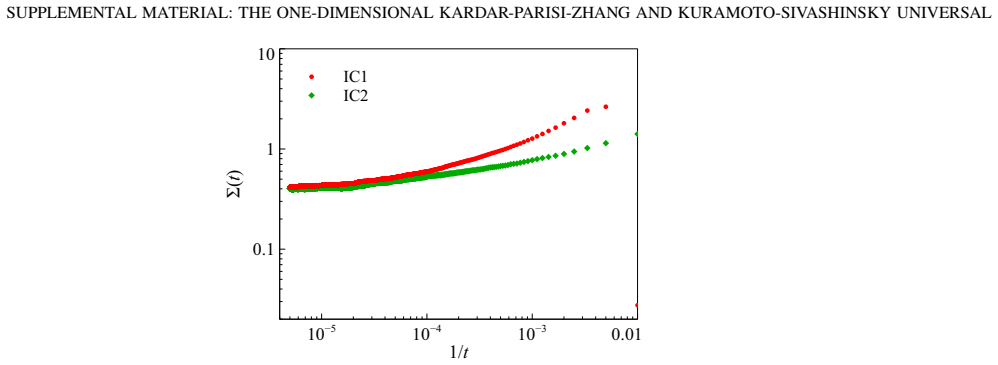
- [Supplement §2 (Fig. 3) and Eq. (1)] The reported values Γ≈0.358 for IC1 and Γ≈0.496 for IC2 violate the single-amplitude requirement of Eq. (1), where v∞ and Γ are model-dependent constants independent of the initial condition. Under a common Γ, the ratio of the raw variances of (h−v∞t)/t^{1/3} for IC1 and IC2 should equal Var(TW-GUE)/Var(TW-GOE) ≈ 0.813/0.638 ≈ 1.27. The quoted Γs imply a raw variance ratio of only (0.358/0.496)^{2/3} × 1.27 ≈ 1.03, meaning the GOE/GUE identification is achieved only by allowing an extra IC-dependent amplitude. This internal check directly bears on whether Eq. (1) in the KPZ sense holds. The authors must reconcile this, e.g., by showing that Γ converges to a common value at longer times or by explicitly reformulating Eq. (1) to permit IC-dependent Γ and discussing how that is compatible with the KPZ universality claim.
- [Main text, initial conditions IC1–IC6 (Fig. 1)] The functional forms of IC1–IC6 are never specified. The text states that these initial conditions are chosen to mimic wedge, flat, stationary, wedge-to-stationary, wedge-to-flat, and flat-to-stationary geometries, but no formulas, tables, or precise descriptions of h(x,0) are given in either the main text or the Supplemental Material. Because the assignment of each IC to a particular sub-universality distribution (TW-GUE, TW-GOE, BR F0, etc.) depends on those forms, the comparison cannot be reproduced or critically evaluated. Please provide explicit definitions for all six initial conditions.
- [Figs. 1(d,h,l) and Fig. 4; text near Eq. (4)] The paper provides no quantitative goodness-of-fit test for the PDF comparisons. Given the stated sample size (≈5×10^8 data points), the reported error bars are smaller than the symbols, so visual agreement over three decades does not establish that deviations from TW/BR are statistically negligible. Furthermore, the text says the PDFs are computed when the skewness and kurtosis are 'close to their standard values,' which is a selection criterion; the authors should demonstrate that the PDF shape is stable over a range of times and report, for example, Kolmogorov-Smirnov statistics or chi-square values for each IC.
- [Figs. 1(p,t,x); text near 'Stricly speaking'] The claims for IC4–IC6 are not supported by comparisons to the relevant predicted distributions. For IC4 the text mentions a comparison with (FGOE)^2, but no such plot is shown for IC5 and IC6, and the spatial averaging over the intervals [7L/32,9L/32] and [23L/32,25L/32] is an inadequate substitute for sampling exactly at the meeting points, as the authors admit. If the central claim includes these mixed-geometry sub-classes, the evidence for them must be strengthened or the claim narrowed accordingly.
minor comments (5)
- [Throughout] There are numerous typographical errors: 'Stricly speaking' appears in both the main text and the Supplemental Material; 'unversal limit distributions' appears in the Conclusion; 'couterparts' appears in the Introduction; and 'the the Kardar-Parisi-Zhang' appears in the Introduction. These should be corrected.
- [Conclusion (last paragraph)] The sentence 'the skewness and kurtosis shown in Fig. 2' should refer to Fig. 3, not Fig. 2, since Fig. 2 displays S(k,δt) while the skewness/kurtosis are plotted in Fig. 3.
- [Eq. (10)] The free-energy function F(h) is defined with F(χ,t) without a clear specification of the cumulative distribution used; the relation to the TW large-deviation functions would be clearer if the notation were defined explicitly and a reference to the KPZ large-deviation literature were added.
- [Supplemental Material, §3 (Fig. 4)] The Family-Vicsek plots for IC4–IC6 in the Supplemental Material show regimes labeled 'slope 1/2' in addition to 'slope 1/3', but this is not explained in the text. It would be helpful to clarify whether these are expected sub-leading corrections or artefacts of the spatial averaging procedure.
- [Supplemental Material, §2 (Fig. 3)] The plots of Σ(t) versus t in the Supplemental Material do not show the saturation plateaus from which Γ is extracted. Adding the plateau lines and error estimates would make the determination of Γ more transparent and would allow readers to assess the claimed convergence.
Circularity Check
No significant circularity: the central distribution claim is benchmarked against external Tracy-Widom and Baik-Rains distributions, with only standard location-scale calibration.
full rationale
The paper's central claim—that KS height fluctuations in the NESS follow the KPZ limit distributions—is tested against external, parameter-free benchmarks: the Tracy-Widom GUE/GOE and Baik-Rains F0 distributions. The velocity v∞ and amplitude Γ are fitted from the same DNS data, which is a standard calibration step, not a circular reduction. The variance of the rescaled variable is forced by the fit, but the full PDF shape, skewness, kurtosis, and the S(k,δt) scaling form provide independent constraints that are not derived from the fit. The IC-to-geometry mapping is an openly stated assumption, not a self-imported uniqueness theorem. The reported IC-dependent Γ values (0.358 for IC1, 0.496 for IC2) are a potential consistency concern for the single-amplitude statement in Eq. (1), but this is a correctness issue, not circularity: the distribution shape comparison remains nontrivial. No specific equation reduces to its own inputs, and no load-bearing self-citation chain is used. Therefore, no circular step is exhibited.
Assumptions & free parameters
free parameters (6)
- v_infty =
-0.86
- Gamma (IC1) =
0.358
- Gamma (IC2) =
0.496
- c =
1.6
- alpha (roughness exponent) =
0.46 +/- 0.07
- beta (width exponent) =
0.32
assumptions (5)
- domain assumption The 1D KS PDE reaches a statistically steady, spatiotemporally chaotic NESS in which time averages and one-point statistics converge.
- domain assumption The six initial conditions IC1-IC6 reproduce the asymptotic initial-condition geometries (wedge, flat, stationary, and mixed) that define KPZ subuniversality classes in ASEP and PNG models.
- standard math The Tracy-Widom distributions, the Baik-Rains distribution, and the Prähofer-Spohn scaling function from the cited literature are exact external benchmarks.
- ad hoc to paper The pseudospectral scheme with 2/3 dealiasing and ETDRK4 time stepping at dt = 0.01 resolves the KS dynamics accurately for t up to 2-6 times 10^5 on a domain of size 2^20.
- domain assumption The crossover time tc approximately 18700 and crossover length Lc approximately 3600 obtained in earlier KS studies [28,29] remain valid for L = 2^20 and for all six initial conditions.
Cite this review
Pith. "Pith review of The one-dimensional Kardar-Parisi-Zhang and Kuramoto-Sivashinsky universality class: limit distributions." pith.science (2026). https://pith.science/paper/MS75RJVE
@misc{pith2026190806007,
  author       = {Pith},
  title        = {Pith review of: The one-dimensional Kardar-Parisi-Zhang and Kuramoto-Sivashinsky universality class: limit distributions},
  year         = {2026},
  howpublished = {\url{https://pith.science/paper/MS75RJVE}},
  note         = {Machine review of arXiv:1908.06007}
}
abstract
Tracy-Widom and Baik-Rains distributions appear as universal limit distributions for height fluctuations in the one-dimensional Kardar-Parisi-Zhang (KPZ) \textit{stochastic} partial differential equation (PDE). We obtain the same universal distributions in the spatiotemporally chaotic, nonequilibrium, but statistically steady state (NESS) of the one-dimensional Kuramoto-Sivashinsky (KS) \textit{deterministic} PDE, by carrying out extensive pseudospectral direct numerical simulations to obtain the spatiotemporal evolution of the KS height profile $h(x,t)$ for different initial conditions. We establish, therefore, that the statistical properties of the 1D KS PDE in this state are in the 1D KPZ universality class.
Figures

Figures from the paper (4 more)

Reference graph
Works this paper leans on
-
[1]
author author S. F. \ Edwards ,\ 10.1017/S0022112064000180 journal journal Journal of Fluid Mechanics \ volume 18 ,\ pages 239 ( year 1964 ) NoStop
-
[2]
author author D. Forster , author D. R. \ Nelson , \ and\ author M. J. \ Stephen ,\ 10.1103/PhysRevA.16.732 journal journal Phys. Rev. A \ volume 16 ,\ pages 732 ( year 1977 ) NoStop
-
[3]
author author C. DeDominicis \ and\ author P. C. \ Martin ,\ 10.1103/PhysRevA.19.419 journal journal Phys. Rev. A \ volume 19 ,\ pages 419 ( year 1979 ) NoStop
-
[4]
author author J. D. \ Fournier \ and\ author U. Frisch ,\ 10.1103/PhysRevA.28.1000 journal journal Phys. Rev. A \ volume 28 ,\ pages 1000 ( year 1983 ) NoStop
-
[5]
author author V. Yakhot \ and\ author S. A. \ Orszag ,\ 10.1007/BF01061452 journal journal Journal of Scientific Computing \ volume 1 ,\ pages 3 ( year 1986 ) NoStop
-
[6]
author author C.-Y. \ Mou \ and\ author P. B. \ Weichman ,\ 10.1103/PhysRevE.52.3738 journal journal Phys. Rev. E \ volume 52 ,\ pages 3738 ( year 1995 ) NoStop
-
[7]
author author J. K. \ Bhattacharjee ,\ 10.1088/0305-4470/21/10/003 journal journal Journal of Physics A: Mathematical and General \ volume 21 ,\ pages L551 ( year 1988 ) NoStop
-
[8]
author author L. T. \ Adzhemyan , author N. V. \ Antonov , \ and\ author A. N. \ Vasiliev ,\ 10.1070/pu1996v039n12abeh000183 journal journal Physics-Uspekhi \ volume 39 ,\ pages 1193 ( year 1996 ) NoStop
Show all 71 references
-
[9]
author author L. T. \ Adzhemyan , author N. V. \ Antonov , \ and\ author A. N. \ Vasiliev ,\ @noop title Field Theoretic Renormalization Group in Fully Developed Turbulence \ ( publisher Gordon and Breach Science Publishers ,\ year 1999 ) NoStop
1999
-
[10]
Sain , author Manu , \ and\ author R
author author A. Sain , author Manu , \ and\ author R. Pandit ,\ 10.1103/PhysRevLett.81.4377 journal journal Phys. Rev. Lett. \ volume 81 ,\ pages 4377 ( year 1998 ) NoStop
1998 doi
-
[11]
Biferale , author M
author author L. Biferale , author M. Cencini , author A. S. \ Lanotte , author M. Sbragaglia , \ and\ author F. Toschi ,\ 10.1088/1367-2630/6/1/037 journal journal New Journal of Physics \ volume 6 ,\ pages 37 ( year 2004 ) NoStop
2004 doi
-
[12]
author author A. N. \ Kolmogorov ,\ @noop journal journal Dokl. Akad. Nauk SSSR \ volume 30 ,\ pages 301 ( year 1941 a ) NoStop
1941
-
[13]
author author A. N. \ Kolmogorov ,\ @noop journal journal Dokl. Akad. Nauk SSSR \ volume 31 ,\ pages 538 ( year 1941 b ) NoStop
1941
-
[14]
Frisch ,\ @noop title Turbulence: The Legacy of A.N
author author U. Frisch ,\ @noop title Turbulence: The Legacy of A.N. Kolmogorov \ ( publisher Cambridge University Press ,\ year 1995 ) NoStop
1995
-
[15]
Enrico Fermi
@noop title Proceed. Intern. School of Physics E. Fermi, 1983, Varenna, Italy 8487 ,\ Proceedings of the International School of Physics "Enrico Fermi" ; course 88\ ( publisher Amsterdam; New York : North-Holland ,\ year 1985 ) NoStop
1983
-
[16]
Benzi , author G
author author R. Benzi , author G. Paladin , author G. Parisi , \ and\ author A. Vulpiani ,\ 10.1088/0305-4470/17/18/021 journal journal Journal of Physics A: Mathematical and General \ volume 17 ,\ pages 3521 ( year 1984 ) NoStop
1984 doi
-
[17]
Benzi \ and\ author U
author author R. Benzi \ and\ author U. Frisch ,\ 10.4249/scholarpedia.3439 journal journal Scholarpedia \ volume 5 ,\ pages 3439 ( year 2010 ) NoStop
2010 doi
-
[18]
Meneveau \ and\ author K
author author C. Meneveau \ and\ author K. R. \ Sreenivasan ,\ 10.1017/S0022112091001830 journal journal Journal of Fluid Mechanics \ volume 224 ,\ pages 429 ( year 1991 ) NoStop
1991 doi
-
[19]
Kuramoto \ and\ author T
author author Y. Kuramoto \ and\ author T. Tsuzuki ,\ 10.1143/PTP.55.356 journal journal Progress of Theoretical Physics \ volume 55 ,\ pages 356 ( year 1976 ) NoStop
1976 doi
-
[20]
Sivashinsky ,\ https://doi.org/10.1016/0094-5765(77)90096-0 journal journal Acta Astronautica \ volume 4 ,\ pages 1177 ( year 1977 ) NoStop
author author G. Sivashinsky ,\ https://doi.org/10.1016/0094-5765(77)90096-0 journal journal Acta Astronautica \ volume 4 ,\ pages 1177 ( year 1977 ) NoStop
1977 doi
-
[21]
author author G. I. \ Sivashinsky \ and\ author D. M. \ Michelson ,\ 10.1143/PTP.63.2112 journal journal Progress of Theoretical Physics \ volume 63 ,\ pages 2112 ( year 1980 ) NoStop
1980 doi
-
[22]
Ruyer-Quil \ and\ author P
author author C. Ruyer-Quil \ and\ author P. Manneville ,\ 10.1007/s100510050550 journal journal The European Physical Journal B - Condensed Matter and Complex Systems \ volume 6 ,\ pages 277 ( year 1998 ) NoStop
1998 doi
-
[23]
@noop title Macroscopic Modelling of Turbulent Flows ,\ series Lecture Notes in Physics , Vol.\ volume 230 \ ( publisher Springer-Verlag Berlin Heidelberg ,\ year 1985 ) NoStop
1985
-
[24]
\ Chen \ and\ author H.-C
author author L.-H. \ Chen \ and\ author H.-C. \ Chang ,\ https://doi.org/10.1016/0009-2509(86)80033-1 journal journal Chemical Engineering Science \ volume 41 ,\ pages 2477 ( year 1986 ) NoStop
1986 doi
-
[25]
Grinstein , author C
author author G. Grinstein , author C. Jayaprakash , \ and\ author R. Pandit ,\ https://doi.org/10.1016/0167-2789(95)00036-4 journal journal Physica D: Nonlinear Phenomena \ volume 90 ,\ pages 96 ( year 1996 ) NoStop
1996 doi
-
[26]
Yakhot ,\ 10.1103/PhysRevA.24.642 journal journal Phys
author author V. Yakhot ,\ 10.1103/PhysRevA.24.642 journal journal Phys. Rev. A \ volume 24 ,\ pages 642 ( year 1981 ) NoStop
1981 doi
-
[27]
author author J. M. \ Hyman , author B. Nicolaenko , \ and\ author S. Zaleski ,\ https://doi.org/10.1016/0167-2789(86)90136-3 journal journal Physica D: Nonlinear Phenomena \ volume 23 ,\ pages 265 ( year 1986 ) NoStop
1986 doi
-
[28]
Sneppen , author J
author author K. Sneppen , author J. Krug , author M. H. \ Jensen , author C. Jayaprakash , \ and\ author T. Bohr ,\ 10.1103/PhysRevA.46.R7351 journal journal Phys. Rev. A \ volume 46 ,\ pages R7351 ( year 1992 ) NoStop
1992 doi
-
[29]
Hayot , author C
author author F. Hayot , author C. Jayaprakash , \ and\ author C. Josserand ,\ 10.1103/PhysRevE.47.911 journal journal Phys. Rev. E \ volume 47 ,\ pages 911 ( year 1993 ) NoStop
1993 doi
-
[30]
Jayaprakash , author F
author author C. Jayaprakash , author F. Hayot , \ and\ author R. Pandit ,\ 10.1103/PhysRevLett.71.12 journal journal Phys. Rev. Lett. \ volume 71 ,\ pages 12 ( year 1993 ) NoStop
1993 doi
-
[31]
author author B. M. \ Boghosian , author C. C. \ Chow , \ and\ author T. Hwa ,\ 10.1103/PhysRevLett.83.5262 journal journal Phys. Rev. Lett. \ volume 83 ,\ pages 5262 ( year 1999 ) NoStop
1999 doi
-
[32]
Kalogirou , author E
author author A. Kalogirou , author E. E. \ Keaveny , \ and\ author D. T. \ Papageorgiou ,\ 10.1098/rspa.2014.0932 journal journal Proceedings of the Royal Society A: Mathematical, Physical and Engineering Sciences \ volume 471 ,\ pages 20140932 ( year 2015 ) NoStop
2014
-
[33]
Kardar , author G
author author M. Kardar , author G. Parisi , \ and\ author Y.-C. \ Zhang ,\ 10.1103/PhysRevLett.56.889 journal journal Phys. Rev. Lett. \ volume 56 ,\ pages 889 ( year 1986 ) NoStop
1986 doi
-
[34]
Halpin-Healy \ and\ author Y.-C
author author T. Halpin-Healy \ and\ author Y.-C. \ Zhang ,\ https://doi.org/10.1016/0370-1573(94)00087-J journal journal Physics Reports \ volume 254 ,\ pages 215 ( year 1995 ) NoStop
1995 doi
-
[35]
Halpin-Healy \ and\ author K
author author T. Halpin-Healy \ and\ author K. A. \ Takeuchi ,\ 10.1007/s10955-015-1282-1 journal journal Journal of Statistical Physics \ volume 160 ,\ pages 794 ( year 2015 ) NoStop
2015 doi
-
[36]
Quastel \ and\ author H
author author J. Quastel \ and\ author H. Spohn ,\ 10.1007/s10955-015-1250-9 journal journal Journal of Statistical Physics \ volume 160 ,\ pages 965 ( year 2015 ) NoStop
2015 doi
-
[37]
author author K. A. \ Takeuchi , author M. Sano , author T. Sasamoto , \ and\ author H. Spohn ,\ 10.1038/srep00034 journal journal Scientific Reports \ volume 1 ( year 2011 ),\ 10.1038/srep00034 NoStop
2011 doi
-
[38]
author author K. A. \ Takeuchi \ and\ author M. Sano ,\ 10.1007/s10955-012-0503-0 journal journal Journal of Statistical Physics \ volume 147 ,\ pages 853 ( year 2012 ) NoStop
2012 doi
-
[39]
author author K. A. \ Takeuchi ,\ 10.1103/PhysRevLett.110.210604 journal journal Phys. Rev. Lett. \ volume 110 ,\ pages 210604 ( year 2013 ) NoStop
2013 doi
-
[40]
Pr\"ahofer \ and\ author H
author author M. Pr\"ahofer \ and\ author H. Spohn ,\ 10.1103/PhysRevLett.84.4882 journal journal Phys. Rev. Lett. \ volume 84 ,\ pages 4882 ( year 2000 ) NoStop
-
[41]
Sasamoto \ and\ author H
author author T. Sasamoto \ and\ author H. Spohn ,\ 10.1103/PhysRevLett.104.230602 journal journal Phys. Rev. Lett. \ volume 104 ,\ pages 230602 ( year 2010 ) NoStop
2010 doi
-
[42]
Calabrese \ and\ author P
author author P. Calabrese \ and\ author P. Le Doussal ,\ 10.1103/PhysRevLett.106.250603 journal journal Phys. Rev. Lett. \ volume 106 ,\ pages 250603 ( year 2011 ) NoStop
2011 doi
-
[43]
Imamura \ and\ author T
author author T. Imamura \ and\ author T. Sasamoto ,\ 10.1103/PhysRevLett.108.190603 journal journal Phys. Rev. Lett. \ volume 108 ,\ pages 190603 ( year 2012 ) NoStop
2012 doi
-
[44]
Corwin ,\ 10.1142/S2010326311300014 journal journal Random Matrices: Theory and Applications \ volume 01 ,\ pages 1130001 ( year 2012 ) NoStop
author author I. Corwin ,\ 10.1142/S2010326311300014 journal journal Random Matrices: Theory and Applications \ volume 01 ,\ pages 1130001 ( year 2012 ) NoStop
2012 doi
-
[45]
Halpin-Healy \ and\ author Y
author author T. Halpin-Healy \ and\ author Y. Lin ,\ 10.1103/PhysRevE.89.010103 journal journal Phys. Rev. E \ volume 89 ,\ pages 010103 ( year 2014 ) NoStop
2014 doi
-
[46]
author author A. A. \ Saberi , author H. Dashti-Naserabadi , \ and\ author J. Krug ,\ 10.1103/PhysRevLett.122.040605 journal journal Phys. Rev. Lett. \ volume 122 ,\ pages 040605 ( year 2019 ) NoStop
2019 doi
-
[47]
@noop journal See the Supplemental Material \ NoStop
-
[48]
journal author author C. A. \ Tracy \ and\ author H. Widom ,\ 10.1007/BF02100489 journal journal Communications in Mathematical Physics \ volume 159 ,\ pages 151 ( year 1994 ) NoStop
1994 doi
-
[49]
Baik \ and\ author E
author author J. Baik \ and\ author E. M. \ Rains ,\ 10.1023/A:1018615306992 journal journal Journal of Statistical Physics \ volume 100 ,\ pages 523 ( year 2000 ) NoStop
-
[50]
Pr \"a hofer \ and\ author H
author author M. Pr \"a hofer \ and\ author H. Spohn ,\ 10.1023/B:JOSS.0000019810.21828.fc journal journal Journal of Statistical Physics \ volume 115 ,\ pages 255 ( year 2004 ) NoStop
2004
-
[51]
author author J. M. \ Hyman \ and\ author B. Nicolaenko ,\ https://doi.org/10.1016/0167-2789(86)90166-1 journal journal Physica D: Nonlinear Phenomena \ volume 18 ,\ pages 113 ( year 1986 ) NoStop
1986 doi
-
[52]
author author I. G. \ Kevrekidis , author B. Nicolaenko , \ and\ author J. C. \ Scovel ,\ 10.1137/0150045 journal journal SIAM Journal on Applied Mathematics \ volume 50 ,\ pages 760 ( year 1990 ) NoStop
1990 doi
-
[53]
Collet , author J.-P
author author P. Collet , author J.-P. \ Eckmann , author H. Epstein , \ and\ author J. Stubbe ,\ @noop journal journal Communications in Mathematical Physics \ volume 152 ,\ pages 203 ( year 1993 ) NoStop
1993
-
[54]
Jolly , author I
author author M. Jolly , author I. Kevrekidis , \ and\ author E. Titi ,\ https://doi.org/10.1016/0167-2789(90)90046-R journal journal Physica D: Nonlinear Phenomena \ volume 44 ,\ pages 38 ( year 1990 ) NoStop
1990 doi
-
[55]
Conte \ and\ author M
author author R. Conte \ and\ author M. Musette ,\ http://stacks.iop.org/0305-4470/22/i=2/a=006 journal journal Journal of Physics A: Mathematical and General \ volume 22 ,\ pages 169 ( year 1989 ) NoStop
1989
-
[56]
Canuto \ and\ author A
author author C. Canuto \ and\ author A. Quarteroni ,\ 10.1007/BF02576357 journal journal CALCOLO \ volume 18 ,\ pages 197 ( year 1981 ) NoStop
1981 doi
-
[57]
Canuto , author M
author author C. Canuto , author M. Y. \ Hussaini , author A. Quarteroni , \ and\ author T. A. \ Zang ,\ 10.1007/978-3-540-30726-6 title Spectral Methods \ ( publisher Springer-Verlag Berlin Heidelberg ,\ year 2006 ) NoStop
2006 doi
-
[58]
author author L. N. \ Trefethen ,\ https://people.maths.ox.ac.uk/trefethen/spectral.html title Spectral Methods in MATLAB \ ( publisher SIAM, Philadelphia ,\ year 2000 ) NoStop
2000
-
[59]
\ Kassam \ and\ author L
author author A.-K. \ Kassam \ and\ author L. N. \ Trefethen ,\ 10.1137/S1064827502410633 journal journal SIAM Journal on Scientific Computing \ volume 26 ,\ pages 1214 ( year 2005 ) NoStop
2005 doi
-
[60]
Cox \ and\ author P
author author S. Cox \ and\ author P. Matthews ,\ https://doi.org/10.1006/jcph.2002.6995 journal journal Journal of Computational Physics \ volume 176 ,\ pages 430 ( year 2002 ) NoStop
2002
-
[61]
Borodin , author P
author author A. Borodin , author P. L. \ Ferrari , \ and\ author T. Sasamoto ,\ 10.1002/cpa.20234 journal journal Communications on Pure and Applied Mathematics \ volume 61 ,\ pages 1603 ( year 2008 ) NoStop
2008 doi
-
[62]
Corwin , author P
author author I. Corwin , author P. L. \ Ferrari , \ and\ author S. P \'e ch \'e ,\ 10.1007/s10955-010-9995-7 journal journal Journal of Statistical Physics \ volume 140 ,\ pages 232 ( year 2010 ) NoStop
2010 doi
-
[63]
author author S. F. \ Edwards \ and\ author D. Wilkinson ,\ @noop journal journal Proceedings of the Royal Society of London. A. Mathematical and Physical Sciences \ volume 381 ,\ pages 17 ( year 1982 ) NoStop
1982
-
[64]
Family \ and\ author T
author author F. Family \ and\ author T. Vicsek ,\ http://stacks.iop.org/0305-4470/18/i=2/a=005 journal journal Journal of Physics A: Mathematical and General \ volume 18 ,\ pages L75 ( year 1985 ) NoStop
1985
-
[65]
author author S. N. \ Majumdar \ and\ author G. Schehr ,\ http://stacks.iop.org/1742-5468/2014/i=1/a=P01012 journal journal Journal of Statistical Mechanics: Theory and Experiment \ volume 2014 ,\ pages P01012 ( year 2014 ) NoStop
2014
-
[66]
Agarwal , author M
author author S. Agarwal , author M. Kulkarni , \ and\ author A. Dhar ,\ @noop journal arXiv:1903.09380 \ NoStop
1903 arXiv
-
[67]
Cox and P.C
S.M. Cox and P.C. Matthews. Exponential time differencing for stiff systems. Journal of Computational Physics , 176(2):430 -- 455, 2002
2002
-
[68]
Hayot, C
F. Hayot, C. Jayaprakash, and Ch. Josserand. Long-wavelength properties of the kuramoto-sivashinsky equation. Phys. Rev. E , 47:911--915, Feb 1993
1993
-
[69]
Trefethen
Aly-Khan Kassam and Lloyd N. Trefethen. Fourth-order time-stepping for stiff pdes. SIAM Journal on Scientific Computing , 26(4):1214--1233, 2005
2005
-
[70]
Universal distributions for growth processes in 1+1 dimensions and random matrices
Michael Pr\"ahofer and Herbert Spohn. Universal distributions for growth processes in 1+1 dimensions and random matrices. Phys. Rev. Lett. , 84:4882--4885, May 2000
2000
-
[71]
Sneppen, J
K. Sneppen, J. Krug, M. H. Jensen, C. Jayaprakash, and T. Bohr. Dynamic scaling and crossover analysis for the kuramoto-sivashinsky equation. Phys. Rev. A , 46:R7351--R7354, Dec 1992
1992
Reviewed August 14, 2026 · model on record in the stance chip above.
Discussion (0). Continue with ORCID to comment.