REVIEW 2 major objections 4 minor 30 references
mPOLICE: Provable Enforcement of Multi-Region Affine Constraints in Deep Neural Networks
T0 review · 2 major / 4 minor · reviewed 2026-08-09 · deepseek-v4-flash
Pith's one-line read mPOLICE assigns each disjoint convex input region a unique neuron activation sign pattern, provably making the network affine inside each region and stopping affine behavior from spilling over the regions' convex hull.
desk verdict Useful practical extension of POLICE, but the proof of localized affine behavior overreaches; the method likely still works empirically. read the letter →
The pith
A machine-rendered reading of the paper's core claim, the machinery that carries it, and where it could break.
The reading
What carries the argument
The load-bearing object is the global activation sign pattern $\mathrm{sign}^{(i,\ell)}_n \in \{+1,-1\}$ assigned to every region $R_i$, neuron $n$, and layer $\ell$, together with the uniqueness condition that no two regions share the same pattern. The companion mechanism is the per-neuron quadratic program that minimally adjusts a neuron's weight and bias so that every vertex of every region satisfies its assigned halfspace, with margin $\delta$. The sign pattern pins each region into a single affine polytope; the uniqueness condition blocks the convex-hull problem; and the QP, by changing both weights and biases, supplies flexibility that bias-only signs cannot. Theorem 1 is the identity that carries the proof: consistent signs imply single-polytope containment, and differing signs imply distinct polytopes.
What would settle it
Run the full mPOLICE procedure on a pre-trained ReLU network with two disjoint convex regions, then recompute every pre-activation at every vertex of both regions. If any vertex has a pre-activation whose sign disagrees with its assigned pattern in any layer, the claimed containment in distinct affine polytopes is broken. Alternatively, construct a neuron whose per-neuron quadratic program has no feasible weight-and-bias update satisfying all required signs across all vertices; such an infeasible instance would show the enforcement step cannot always succeed without changing network architecture or capacity.
Extended reading notes
Core claim
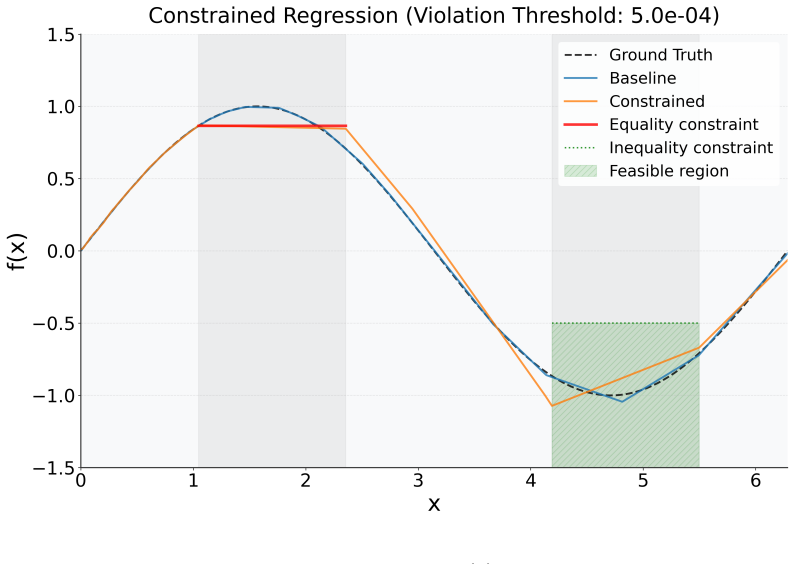
mPOLICE's central claim is that assigning a unique global activation sign pattern to each constrained convex region $R_i$ provably places each region inside its own affine polytope of the network's piecewise affine decomposition. With a fixed sign pattern, every neuron's pre-activation is non-negative or non-positive across the whole convex region, so no ReLU boundary cuts through the region; with no two regions sharing a full pattern, no two regions can lie in the same polytope. Consequently $f_\theta$ becomes affine on each $R_i$ individually and not on the convex hull of several regions, which reduces affine constraint satisfaction to a finite check over vertices. Theorem 1 in the appendix proves this by induction over layers, and the paper shows that bias-only adjustment, as in the single-region POLICE algorithm, is provably insufficient for conflicting multi-region signs, so both weights and biases are updated through minimal-norm quadratic programs per neuron.
Load-bearing premise
The argument assumes that, after a unique sign pattern is chosen, every neuron's constraints over all region vertices are simultaneously satisfiable by some weight-and-bias update, and that enforcing signs layer by layer never destroys a pattern already enforced in an earlier layer; the paper offers heuristics and explicitly says they are practical but not foolproof.
Editorial extensions
If this is right
- If a region $R_i$ lies inside its own affine polytope, an affine constraint such as $E_i f_\theta(x)=f^i$ holds everywhere in $R_i$ exactly when it holds at the region's vertices.
- Multiple disjoint regions can be constrained simultaneously without the affine behavior that previously leaked over the convex hull of the union.
- Because enforcement changes only weights and biases offline, inference remains a standard forward pass with zero runtime overhead.
- The training loop can start from any pre-trained MLP and periodically re-enforce signs, letting task performance and constraint satisfaction be balanced through a penalty weight.
- Non-convex constrained regions can be approximated by decomposing them into closely packed convex sub-regions, each with its own enforced pattern.
Reading between the lines
- The theorem's guarantee is conditional on the sign assignment being feasible; nothing in the paper characterizes when a feasible unique assignment exists, so a natural next step would be to prove existence conditions or to detect infeasible patterns before enforcement.
- Requiring uniqueness of the full global pattern is sufficient but possibly stronger than needed; a weaker condition, such as each pair of regions being separated by at least one neuron at some layer, might already prevent convex-hull affine leakage while lowering the combinatorial cost.
- Since the timing study shows enforcement time grows sharply with vertex count, width, and depth, parallelizing or batching the per-neuron quadratic programs would be a direct way to scale the method beyond the small regions tested here.
Editorial analysis
A structured set of objections, weighed in public.
Referee Report
Summary. The paper introduces mPOLICE, an extension of the POLICE algorithm for enforcing affine equality and inequality constraints on multiple disjoint convex input regions of a ReLU network. The core idea is to assign a distinct global pre-activation sign pattern to each constrained region, then adjust the network's weights and biases, layer by layer via small quadratic programs, so that each region lies inside its own activation polytope and the network is affine on each region. A training algorithm alternates task-loss minimization with re-enforcement of the sign pattern map, and experiments cover safety-critical RL, implicit 3D shape representation, fluid dynamics, and illustrative regression/classification tasks. The paper claims zero inference overhead and a provable guarantee that affine behavior is strictly localized to each region, preventing unwanted affine extension over the convex hull of multiple regions.
Significance. If the main theoretical claim were correct in full, mPOLICE would be a practically valuable method: it provides a constructive way to enforce multiple local affine constraints with no runtime overhead, and the paper demonstrates encouraging empirical results across three distinct applications. The proof that a consistent sign pattern over a convex region implies affine behavior on that region (Theorem 1, Part 1) is sound and well explained. However, the central claimed result—that unique sign patterns strictly localize affine behavior and prevent affine extension over the convex hull—is not established by the proof; distinct activation polytopes can carry identical affine maps. This overreach is load-bearing for the paper's stated contribution, although it may be repairable by weakening the claim or adding a non-degeneracy condition. The absence of a feasibility or convergence proof for the layer-wise QP enforcement is a second gap in the theoretical framing. The empirical study is a genuine strength, as is the clarity of the algorithmic presentation, but the central theoretical guarantee needs revision before the paper can be accepted.
major comments (2)
- [Section 2.3 and Appendix A, Theorem 1 Part 2] The theorem claims that assigning unique global activation sign patterns to each region Ri prevents 'unintended affine behavior over the convex hull of combinations of these regions.' The proof only establishes that Ri and Rj lie in different affine polytopes of the ReLU decomposition. It does not establish that the affine maps on those polytopes differ, nor that f is non-affine on conv(Ri ∪ Rj). A minimal counterexample is a one-neuron network f(x) = w2·ReLU(w1·x + b1) + b2 with w2 = 0, R1 = [-2,-1], R2 = [1,2], w1 = 1, b1 = 0. The pre-activation signs are negative on R1 and positive on R2 (so the sign patterns are distinct), yet f ≡ b2 is affine on all of R, including conv(R1 ∪ R2). The QP enforcement in Section 2.6 does not rule out such degenerate downstream weights. The claim should be weakened to 'each region lies in a distinct affine polytope' or augmented with a condition that the affine forms on the distinct polytopes differ; otherwise the stated guarantee does not follow from the theorem's hypotheses.
- [Section 2.6, Eq. (8) and the per-neuron QP] The enforcement step solves a QP for each neuron using vertex positions v_p^(i,ell) computed after the previous layers, but those vertex positions change whenever an earlier layer is adjusted. The manuscript provides no proof that the sequential layer-wise procedure preserves sign patterns already enforced in later layers, nor that each per-neuron QP is feasible. The limitations section states that the heuristics are 'practical but not foolproof,' but Sections 2.3–2.7 present the method as provably enforcing the sign pattern map. This is a gap in the theoretical guarantee: a feasibility condition (e.g., sufficient network width or margin conditions) or an explicit statement that the theorem assumes the QPs are feasible is needed.
minor comments (4)
- [Table 2] There are formatting errors in the table: '0 .00±0.00' should be '0.00±0.00', and '2.60×10⁻⁶ ±8.9×10⁻⁷' is missing a space before the plus-minus sign; also '34 .19±6.70' should be '34.19±6.70'.
- [Appendix A, proof of Part 1] In the inductive step, the proof says 'By the same argument as the base case,' but the base case exploited linearity of the pre-activation, whereas in the inductive step the pre-activation is only affine in x. The argument still works because affine functions preserve convex combinations, but this should be stated explicitly for clarity.
- [Section 3.2, Table 1 caption] The caption defines 'FineTune%' as mPOLICE fine-tuning time relative to initial training, but the table column is used differently in other tables; please define the metric consistently across all tables or state the difference.
- [Appendix C, Figure 4 caption] The phrase 'within ten times machine precision' is ambiguous; it would be clearer to state the actual distance or the scale relative to the input domain.
Circularity Check
No significant circularity: the core theorem restates the standard ReLU activation-polytope property and is not derived from its own conclusion; the only self-citation (XLB) is not load-bearing.
full rationale
The central theoretical claim, Theorem 1, is a standard and essentially definitional property of ReLU networks: consistent pre-activation signs over a convex region place that region inside a single activation polytope, making the network affine there. The proof uses convexity and induction and does not assume the conclusion it is trying to establish. The multi-region part follows from the definition of a polytope as the set of points sharing a sign pattern: distinct sign patterns yield distinct polytopes. This is near-tautological but not circular, because the theorem is not used as evidence for the QP enforcement procedure's feasibility; rather, the procedure attempts to realize the assumed sign consistency. The paper's claim that distinct polytopes prevent affine behavior over the convex hull of two regions is not actually proven by the quoted argument, since two distinct polytopes can carry the same affine map. That is a correctness gap or overclaim, not a circularity, because no fitted parameter is relabeled as a prediction and no external result is being invoked to close the argument. The only self-citation is the XLB library for generating fluid dynamics data; it is used as a data source for an experiment and is not load-bearing for the theoretical derivation. The layer-wise sequential QP enforcement also assumes vertex positions remain valid after earlier layers are adjusted, with no feasibility or convergence proof; this is again a limitation or correctness risk, not a circular derivation. Overall, the paper's derivation chain is self-contained against external benchmarks, and no step reduces by construction to its own inputs.
Assumptions & free parameters
free parameters (3)
- Margin delta for sign constraints =
0.0 in experiments
- Constraint penalty weight lambda_constraint =
1.0 initial, max 100, multiplier 1.5
- Assignments of sign patterns sign(i,ell)_n =
Majority voting or mean-based per pre-activations, with flips for uniqueness
assumptions (4)
- standard math A ReLU or Leaky-ReLU MLP is continuous piecewise affine, partitioned into convex polytopes with fixed activation patterns.
- standard math For a convex region, if an affine function's pre-activations have consistent sign at all vertices, they have that sign throughout the region.
- domain assumption After adjusting weights and biases per neuron with minimal-norm QPs, the network's task performance remains acceptable and previously enforced sign patterns are not disrupted.
- ad hoc to paper For each neuron, a single weight and bias update can satisfy the assigned signs at all vertices of all regions simultaneously.
Cite this review
Pith. "Pith review of mPOLICE: Provable Enforcement of Multi-Region Affine Constraints in Deep Neural Networks." pith.science (2026). https://pith.science/paper/MSYIG6XJ
@misc{pith2026250202434,
  author       = {Pith},
  title        = {Pith review of: mPOLICE: Provable Enforcement of Multi-Region Affine Constraints in Deep Neural Networks},
  year         = {2026},
  howpublished = {\url{https://pith.science/paper/MSYIG6XJ}},
  note         = {Machine review of arXiv:2502.02434}
}
read the original abstract
Deep neural networks are increasingly used in safety-critical domains such as robotics and scientific modeling, where strict adherence to output constraints is essential. Methods like POLICE, which are tailored for single convex regions, face challenges when extended to multiple disjoint regions, often leading to constraint violations or unwanted affine behavior across regions. This paper proposes mPOLICE, a new approach that generalizes POLICE to provably enforce affine constraints over multiple disjoint convex regions. At its core, mPOLICE assigns distinct neuron activation patterns to each constrained region, enabling localized affine behavior and avoiding unintended generalization. This is implemented through a layer-wise optimization of the network parameters. Additionally, we introduce a training algorithm that incorporates mPOLICE into conventional deep learning pipelines, balancing task-specific performance with constraint enforcement using periodic sign pattern enforcement. We validate the flexibility and effectiveness of mPOLICE through experiments across various applications, including safety-critical reinforcement learning, implicit 3D shape representation with geometric constraints, and fluid dynamics simulations with boundary condition enforcement. Importantly, mPOLICE incurs no runtime overhead during inference, making it a practical and reliable solution for constraint handling in deep neural networks.
Figures


Figures from the paper (6 more)


Reference graph
Works this paper leans on
-
[1]
XLB : A differentiable massively parallel lattice Boltzmann library in python
Mohammadmehdi Ataei and Hesam Salehipour. XLB : A differentiable massively parallel lattice Boltzmann library in python. Computer Physics Communications, 300: 0 109187, 2024
work page 2024
-
[2]
Police : Provably optimal linear constraint enforcement for deep neural networks
Randall Balestriero and Yann LeCun. Police : Provably optimal linear constraint enforcement for deep neural networks. In ICASSP 2023 - 2023 IEEE International Conference on Acoustics, Speech and Signal Processing (ICASSP), pages 1--5, June 2023. doi:10.1109/ICASSP49357.2023.police
-
[3]
Applied dynamic programming, volume 2050
Richard E Bellman and Stuart E Dreyfus. Applied dynamic programming, volume 2050. Princeton university press, 2015
work page 2015
-
[4]
Enforcing analytic constraints in neural networks emulating physical systems
Tom Beucler, Michael Pritchard, Stephan Rasp, Jordan Ott, Pierre Baldi, and Pierre Gentine. Enforcing analytic constraints in neural networks emulating physical systems. Phys. Rev. Lett., 126: 0 098302, Mar 2021. doi:10.1103/PhysRevLett.126.098302. URL https://link.aps.org/doi/10.1103/PhysRevLett.126.098302
-
[5]
Learning to Provably Satisfy High Relative Degree Constraints for Black-Box Systems
Jean-Baptiste Bouvier, Kartik Nagpal, and Negar Mehr. Learning to provably satisfy high relative degree constraints for black-box systems. arXiv preprint arXiv:2407.20456, 2024 a
work page Pith review arXiv 2024
-
[6]
Jean-Baptiste Bouvier, Kartik Nagpal, and Negar Mehr. POLICEd RL : Learning closed-loop robot control policies with provable satisfaction of hard constraints. arXiv preprint arXiv:2403.13297, 2024 b
arXiv 2024
-
[7]
Neural networks with physics-informed architectures and constraints for dynamical systems modeling
Franck Djeumou, Cyrus Neary, Eric Goubault, Sylvie Putot, and Ufuk Topcu. Neural networks with physics-informed architectures and constraints for dynamical systems modeling. In Roya Firoozi, Negar Mehr, Esen Yel, Rika Antonova, Jeannette Bohg, Mac Schwager, and Mykel Kochenderfer, editors, Proceedings of The 4th Annual Learning for Dynamics and Control Co...
work page 2022
-
[8]
Addressing function approximation error in actor-critic methods
Scott Fujimoto, Herke Hoof, and David Meger. Addressing function approximation error in actor-critic methods. In International conference on machine learning, pages 1587--1596. PMLR, 2018
2018
Show all 30 references
-
[9]
Aligning optimization trajectories with diffusion models for constrained design generation
Giorgio Giannone, Akash Srivastava, Ole Winther, and Faez Ahmed. Aligning optimization trajectories with diffusion models for constrained design generation. Advances in Neural Information Processing Systems, 36: 0 51830--51861, 2023
2023
-
[10]
Exact visualization of deep neural network geometry and decision boundary
Ahmed Imtiaz Humayun, Randall Balestriero, and Richard Baraniuk. Exact visualization of deep neural network geometry and decision boundary. In NeurIPS 2022 Workshop on Symmetry and Geometry in Neural Representations, 2022
2022
-
[11]
Splinecam: Exact visualization and characterization of deep network geometry and decision boundaries
Ahmed Imtiaz Humayun, Randall Balestriero, Guha Balakrishnan, and Richard Baraniuk. Splinecam: Exact visualization and characterization of deep network geometry and decision boundaries. In Proceedings of the IEEE/CVF Conference on Computer Vision and Pattern Recognition, 2023
2023
-
[12]
CGD : Constraint-guided diffusion policies for UAV trajectory planning
Kota Kondo, Andrea Tagliabue, Xiaoyi Cai, Claudius Tewari, Olivia Garcia, Marcos Espitia-Alvarez, and Jonathan P How. CGD : Constraint-guided diffusion policies for UAV trajectory planning. arXiv preprint arXiv:2405.01758, 2024
2024 arXiv
-
[13]
Imposing star-shaped hard constraints on the neural network output
Andrei Konstantinov, Lev Utkin, and Vladimir Muliukha. Imposing star-shaped hard constraints on the neural network output. Mathematics, 12 0 (23): 0 3788, 2024
2024
-
[14]
Learning constrained optimization with deep augmented lagrangian methods
James Kotary and Ferdinando Fioretto. Learning constrained optimization with deep augmented lagrangian methods. arXiv preprint arXiv:2403.03454, 2024
2024 arXiv
-
[15]
End-to-end constrained optimization learning: A survey
James Kotary, Ferdinando Fioretto, Pascal Van Hentenryck, and Bryan Wilder. End-to-end constrained optimization learning: A survey. arXiv preprint arXiv:2103.16378, 2021
2021 arXiv
-
[16]
Characterizing possible failure modes in physics-informed neural networks
Aditi Krishnapriyan, Amir Gholami, Shandian Zhe, Robert Kirby, and Michael W Mahoney. Characterizing possible failure modes in physics-informed neural networks. In M. Ranzato, A. Beygelzimer, Y. Dauphin, P.S. Liang, and J. Wortman Vaughan, editors, Advances in Neural Informati...
2021
-
[17]
Chong Li and C. J. Richard Shi. Constrained optimization based low-rank approximation of deep neural networks. In Proceedings of the European Conference on Computer Vision (ECCV), September 2018
2018
-
[18]
Lillo, M.H
W.E. Lillo, M.H. Loh, S. Hui, and S.H. Zak. On solving constrained optimization problems with neural networks: a penalty method approach. IEEE Transactions on Neural Networks, 4 0 (6): 0 931--940, 1993. doi:10.1109/72.286888
1993 doi
-
[19]
Lu Lu, Rapha\" e l Pestourie, Wenjie Yao, Zhicheng Wang, Francesc Verdugo, and Steven G. Johnson. Physics-informed neural networks with hard constraints for inverse design. SIAM Journal on Scientific Computing, 43 0 (6): 0 B1105--B1132, 2021. doi:10.1137/21M1397908
2021 doi
-
[20]
On the number of linear regions of deep neural networks
Guido F Montufar, Razvan Pascanu, Kyunghyun Cho, and Yoshua Bengio. On the number of linear regions of deep neural networks. Advances in neural information processing systems, 27, 2014
2014
-
[21]
Transformers can do bayesian inference
Samuel M \"u ller, Noah Hollmann, Sebastian Pineda Arango, Josif Grabocka, and Frank Hutter. Transformers can do bayesian inference. arXiv preprint arXiv:2112.10510, 2021
2021 arXiv
-
[22]
Generative optimization: A perspective on AI -enhanced problem solving in engineering
Cyril Picard, Lyle Regenwetter, Amin Heyrani Nobari, Akash Srivastava, and Faez Ahmed. Generative optimization: A perspective on AI -enhanced problem solving in engineering. arXiv preprint arXiv:2412.13281, 2024
2024
-
[23]
Constrained optimization to train neural networks on critical and under-represented classes
Sara Sangalli, Ertunc Erdil, Andeas H\" o tker, Olivio Donati, and Ender Konukoglu. Constrained optimization to train neural networks on critical and under-represented classes. In M. Ranzato, A. Beygelzimer, Y. Dauphin, P.S. Liang, and J. Wortman Vaughan, editors, Advances in ...
2021
-
[24]
Provable editing of deep neural networks using parametric linear relaxation
Zhe Tao and Aditya V Thakur. Provable editing of deep neural networks using parametric linear relaxation. Advances in Neural Information Processing Systems, 37: 0 113846--113883, 2024
2024
-
[25]
Architecture-preserving provable repair of deep neural networks
Zhe Tao, Stephanie Nawas, Jacqueline Mitchell, and Aditya V Thakur. Architecture-preserving provable repair of deep neural networks. Proceedings of the ACM on Programming Languages, 7 0 (PLDI): 0 443--467, 2023
2023
-
[26]
Rayen: Imposition of hard convex constraints on neural networks
Jesus Tordesillas, Jonathan P How, and Marco Hutter. Rayen: Imposition of hard convex constraints on neural networks. arXiv preprint arXiv:2307.08336, 2023
2023 arXiv
-
[27]
Leung, and Jun Wang
Youshen Xia, H. Leung, and Jun Wang. A projection neural network and its application to constrained optimization problems. IEEE Transactions on Circuits and Systems I: Fundamental Theory and Applications, 49 0 (4): 0 447--458, 2002. doi:10.1109/81.995659
2002 doi
-
[28]
Physics-specialized neural network with hard constraints for solving multi-material diffusion problems
Yuchen Xie, Honghang Chi, Yahui Wang, and Yu Ma. Physics-specialized neural network with hard constraints for solving multi-material diffusion problems. Computer Methods in Applied Mechanics and Engineering, 430: 0 117223, 2024. ISSN 0045-7825. doi:https://doi.org/10.1016/j.cm...
2024
-
[29]
Fast and accurate bayesian optimization with pre-trained transformers for constrained engineering problems
Rosen Yu, Cyril Picard, and Faez Ahmed. Fast and accurate bayesian optimization with pre-trained transformers for constrained engineering problems. CoRR, 2024
2024
-
[30]
Neural fields with hard constraints of arbitrary differential order
Fangcheng Zhong, Kyle Fogarty, Param Hanji, Tianhao Wu, Alejandro Sztrajman, Andrew Spielberg, Andrea Tagliasacchi, Petra Bosilj, and Cengiz Oztireli. Neural fields with hard constraints of arbitrary differential order. arXiv preprint arXiv:2306.08943, 2023
2023 arXiv
Reviewed August 9, 2026 · model on record in the stance chip above.
Discussion (0). Continue with ORCID to comment.