Long-time asymptotics of a full arbitrary-genus dark soliton gas for the defocusing nonlinear Schrodinger equation
Pith reviewed 2026-06-26 09:35 UTC · model grok-4.3
The pith
The full arbitrary-genus dark soliton gas for the defocusing NLS asymptotes to an N-dimensional Riemann-theta finite-gap solution with sector-dependent error rates.
A machine-rendered reading of the paper's core claim, the machinery that carries it, and where it could break.
Core claim
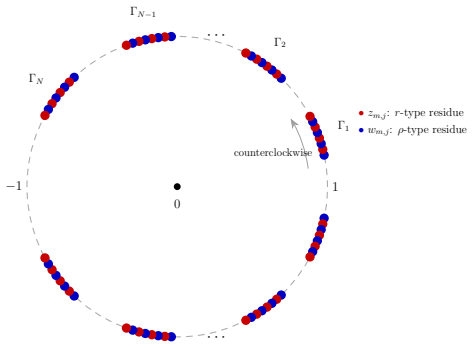
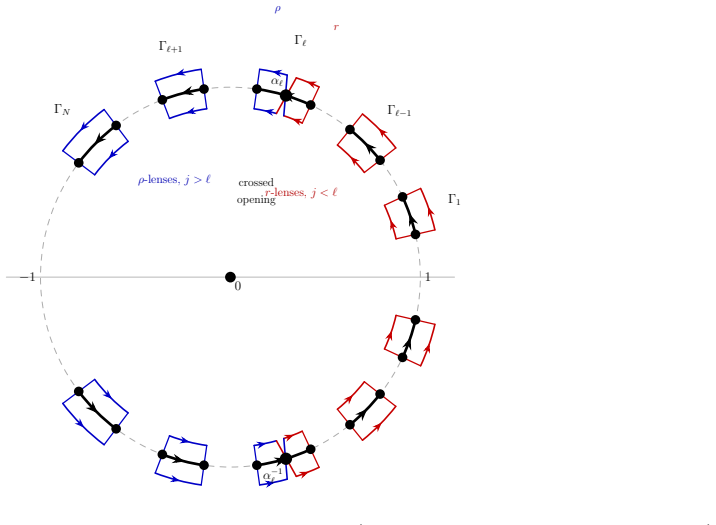
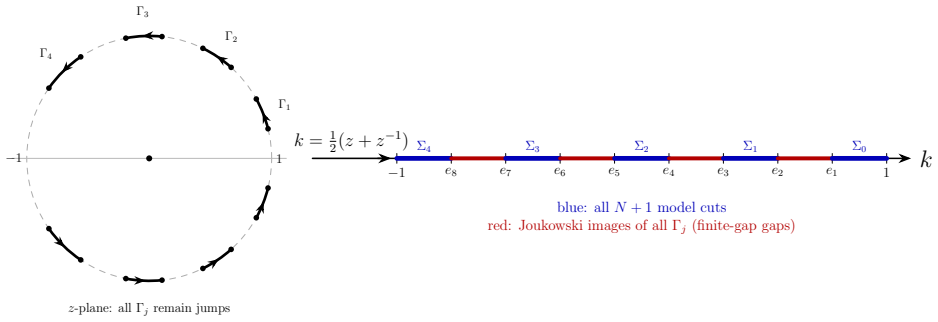
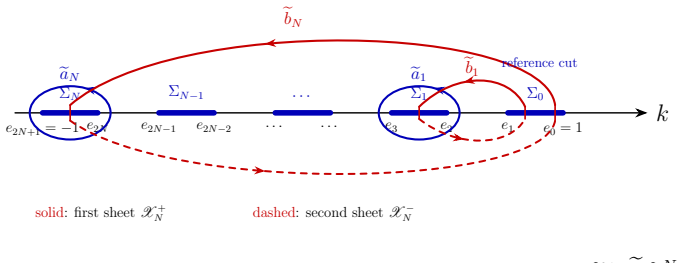
Starting from a generalized meromorphic Riemann-Hilbert problem with alternating residues, the thermodynamic limit produces a jump matrix with two nonzero continuum densities on each arc. The resulting problem is analyzed by nonlinear steepest descent on a fixed genus-N spectral curve, where mixed sectors have stationary factorization points that split the active arc. After opening lenses around all arcs, the model retains the full set of N arcs. A zero-counting argument on the quotient curve establishes the ordering of velocities, dividing the line into 2N+1 sectors. The leading asymptotic is therefore the N-dimensional Riemann-theta finite-gap solution, with O(t^{-1}) error in pure sectors
What carries the argument
The limiting Riemann-Hilbert problem with two nonzero continuum densities on the spectral arcs, solved via Deift-Zhou nonlinear steepest descent on a fixed genus-N curve to extract the finite-gap solution.
If this is right
- The self-similar line is divided into 2N+1 nonempty sectors with distinct asymptotic behaviors.
- Strict monotonicity and global ordering of all endpoint velocities hold via the quotient-curve argument.
- Every spectral arc carries both oscillatory exponentials, unlike the half-gas case.
- The model contour retains all N spectral arcs in every self-similar sector after lens removal.
Where Pith is reading between the lines
- If the unique solvability holds, similar asymptotics may apply to other soliton gas models in integrable systems.
- Numerical simulations for small fixed N could directly test the predicted transition between pure and mixed sector error rates.
- The velocity ordering implies that density profiles of the gas exhibit distinct long-time regimes separated by critical rays.
Load-bearing premise
The limiting Riemann-Hilbert problem whose jump matrix contains two nonzero continuum densities is uniquely solvable.
What would settle it
Numerical computation of the defocusing NLS solution at large t in a mixed sector that deviates from the predicted N-dimensional Riemann-theta function by more than O(t^{-1/2}).
Figures
read the original abstract
We introduce a full arbitrary-genus dark soliton gas for the defocusing nonlinear Schr\"odinger equation with finite-density boundary conditions. Starting from a generalized meromorphic Riemann--Hilbert problem with two alternating residue families on each unit-circle arc, we derive an exact thermodynamic limit whose jump matrix contains two nonzero continuum densities. The limiting Riemann--Hilbert problem is uniquely solvable. In contrast with the half dark-soliton gas, every spectral arc of the full gas carries both oscillatory exponentials. We analyze the resulting problem by the Deift--Zhou nonlinear steepest-descent method on a fixed genus-$N$ spectral curve. The moving point in each mixed sector is a stationary factorization-switching point, not a branch point. The active arc is split into two parts and opened crosswise, while lenses are opened around every remaining arc. After removal of exponentially small lens jumps, the model contour therefore retains all $N$ spectral arcs in every self-similar sector. A quotient-curve zero-counting argument proves strict monotonicity of the characteristic velocity and the global ordering of all endpoint velocities, so the self-similar line is divided into $2N+1$ nonempty sectors. The leading term is an $N$-dimensional Riemann-theta finite-gap solution. The error is $O(t^{-1})$ in the $N+1$ pure sectors and $O(t^{-1/2})$ in the $N$ mixed sectors, uniformly away from the critical rays.
Editorial analysis
A structured set of objections, weighed in public.
Referee Report
Summary. The paper introduces a full arbitrary-genus dark soliton gas for the defocusing nonlinear Schrödinger equation with finite-density boundary conditions. Starting from a generalized meromorphic Riemann-Hilbert problem with two alternating residue families, it derives an exact thermodynamic limit whose jump matrix contains two nonzero continuum densities on each arc. The limiting RH problem is asserted to be uniquely solvable. Deift-Zhou steepest-descent analysis is then applied on a fixed genus-N spectral curve, dividing the self-similar line into 2N+1 sectors via a quotient-curve zero-counting argument. The leading term is an N-dimensional Riemann-theta finite-gap solution, with error O(t^{-1}) in the N+1 pure sectors and O(t^{-1/2}) in the N mixed sectors, uniformly away from critical rays.
Significance. If the central claims hold, the work extends prior half dark-soliton gas results to the full case where every spectral arc carries both oscillatory exponentials, providing explicit long-time asymptotics and error rates for this generalized soliton gas. The use of a fixed-genus model problem and the monotonicity proof for characteristic velocities are technically notable contributions to the asymptotic analysis of integrable soliton gases.
major comments (1)
- [Thermodynamic limit / limiting RH problem (abstract and corresponding section)] The thermodynamic limit section asserts that 'the limiting Riemann-Hilbert problem is uniquely solvable' for the jump matrix containing two nonzero continuum densities, but provides no explicit argument such as a vanishing lemma, Fredholm index calculation, or small-norm estimate. This assertion is load-bearing, as it is invoked immediately to justify the subsequent Deift-Zhou contour deformations, lens openings, and the derivation of the O(t^{-1}) and O(t^{-1/2}) error rates.
minor comments (1)
- The abstract states that the moving point in each mixed sector is a 'stationary factorization-switching point, not a branch point,' but a brief clarification or reference to the precise location of this point on the contour would improve readability.
Simulated Author's Rebuttal
We thank the referee for their careful reading and constructive comments on our manuscript. We address the major comment below.
read point-by-point responses
-
Referee: [Thermodynamic limit / limiting RH problem (abstract and corresponding section)] The thermodynamic limit section asserts that 'the limiting Riemann-Hilbert problem is uniquely solvable' for the jump matrix containing two nonzero continuum densities, but provides no explicit argument such as a vanishing lemma, Fredholm index calculation, or small-norm estimate. This assertion is load-bearing, as it is invoked immediately to justify the subsequent Deift-Zhou contour deformations, lens openings, and the derivation of the O(t^{-1}) and O(t^{-1/2}) error rates.
Authors: We agree that the manuscript asserts unique solvability of the limiting RH problem without supplying an explicit argument (vanishing lemma or otherwise) in the thermodynamic limit section. This is a valid observation, and the claim is indeed load-bearing for the error estimates. In the revised version we will insert a short dedicated paragraph (or subsection) immediately after the statement of the limiting RH problem that applies a standard vanishing lemma: the jump matrix has positive continuum densities on each arc, the contour is oriented consistently with the finite-gap curve, and the resulting homogeneous problem admits only the zero solution by the usual L^2 argument on the unit circle. This establishes uniqueness directly and justifies the subsequent steepest-descent analysis. revision: yes
Circularity Check
No circularity; derivation uses standard RH thermodynamic limit and Deift-Zhou analysis without reduction to inputs
full rationale
The paper begins from an explicit generalized meromorphic RH problem with alternating residues, derives the thermodynamic limit jump matrix with two continuum densities, states unique solvability of that limit, and applies the Deift-Zhou steepest-descent method on the fixed genus-N curve to extract the N-dimensional theta-function leading term plus explicit error bounds. No equation or claim reduces a final prediction to a fitted parameter by construction, no ansatz is smuggled via self-citation, and no uniqueness theorem is imported from the authors' prior work as an external fact. The derivation chain therefore remains independent of its target result.
Axiom & Free-Parameter Ledger
axioms (2)
- domain assumption The generalized meromorphic Riemann-Hilbert problem with two alternating residue families on each unit-circle arc admits a thermodynamic limit with two nonzero continuum densities.
- standard math The Deift-Zhou nonlinear steepest-descent method applies on the fixed genus-N spectral curve after contour deformation and lens opening.
invented entities (1)
-
full arbitrary-genus dark soliton gas
no independent evidence
Reference graph
Works this paper leans on
-
[1]
Bendahmane, G
A. Bendahmane, G. Xu, M. Conforti, A. Kudlinski, A. Mussot, and S. Trillo, The piston Riemann problem in a photon superfluid,Nature Commun.13(2022), 3137
2022
-
[2]
Arbitrary-genus dark soliton gases in the defocusing nonlinear Schr\"{o}dinger hydrodynamics
M. Bertola, D.-S. Wang, P. Yan, and D. Zhu, Arbitrary-genus dark soliton gases in the defocusing nonlinear Schr¨ odinger hydrodynamics, arXiv:2605.18651 [math-ph] (2026)
work page internal anchor Pith review Pith/arXiv arXiv 2026
-
[3]
Biondini, S
G. Biondini, S. Li, and D. Mantzavinos, Long-time asymptotics for the focusing nonlinear Schr¨ odinger equation with nonzero boundary conditions in the presence of a discrete spectrum,Comm. Math. Phys.382(2021), 1495–1577
2021
-
[4]
Biondini and D
G. Biondini and D. Mantzavinos, Long-time asymptotics for the focusing nonlinear Schr¨ odinger equation with nonzero boundary conditions at infinity and asymptotic stage of modulational instability,Comm. Pure Appl. Math.70(2017), 2300–2365
2017
-
[5]
Boutet de Monvel, J
A. Boutet de Monvel, J. Lenells, and D. Shepelsky, The focusing NLS equation with step-like oscillating background: scenarios of long-time asymptotics,Comm. Math. Phys. 383(2021), 893–952
2021
-
[6]
Boutet de Monvel, J
A. Boutet de Monvel, J. Lenells, and D. Shepelsky, The focusing NLS equation with step-like oscillating background: the genus 3 sector,Comm. Math. Phys.390(2022), 1081–1148
2022
-
[7]
Boutet de Monvel, A
A. Boutet de Monvel, A. Its, and V. Kotlyarov, Long-time asymptotics for the focusing nonlinear Schr¨ odinger equation with time-periodic boundary condition on the half-line, Comm. Math. Phys.290(2009), 479–522
2009
-
[8]
Burger, K
S. Burger, K. Bongs, S. Dettmer, W. Ertmer, K. Sengstock, A. Sanpera, G. V. Shlyapnikov, and M. Lewenstein, Dark solitons in Bose–Einstein condensates,Phys. Rev. Lett.83(1999), 5198–5201. 37
1999
-
[9]
Congy, G
T. Congy, G. A. El, and G. Roberti, Soliton gas in bidirectional dispersive hydrodynamics, Phys. Rev. E103(2021), 042201
2021
-
[10]
Cuccagna and R
S. Cuccagna and R. Jenkins, On the asymptotic stability of N-soliton solutions of the defocusing nonlinear Schr¨ odinger equation,Comm. Math. Phys.343(2016), 921–969
2016
-
[11]
Deift, A
P. Deift, A. Its, and X. Zhou, A Riemann–Hilbert approach to asymptotic problems arising in the theory of random matrix models, and also in the theory of integrable statistical mechanics,Ann. of Math.146(1997), 149–235
1997
-
[12]
Deift and X
P. Deift and X. Zhou, A steepest descent method for oscillatory Riemann–Hilbert problems. Asymptotics for the mKdV equation,Ann. of Math.137(1993), 295–368
1993
-
[13]
Deift and X
P. Deift and X. Zhou, Perturbation theory for infinite-dimensional integrable systems on the line. A case study,Acta Math.188(2002), 163–262
2002
-
[14]
Dyachenko, D
S. Dyachenko, D. Zakharov, and V. Zakharov, Primitive potentials and bounded solutions of the KdV equation,Physica D333(2016), 148–156
2016
-
[15]
G. A. El, The thermodynamic limit of the Whitham equations,Phys. Lett. A311(2003), 374–383
2003
-
[16]
G. A. El, V. V. Geogjaev, A. V. Gurevich, and A. L. Krylov, Decay of an initial discontinuity in the defocusing NLS hydrodynamics,Physica D87(1995), 186–192
1995
-
[17]
G. A. El and A. M. Kamchatnov, Kinetic equation for a dense soliton gas,Phys. Rev. Lett. 95(2005), 204101
2005
-
[18]
G. A. El, A. M. Kamchatnov, M. V. Pavlov, and S. A. Zykov, Kinetic equation for a soliton gas and its hydrodynamic reductions,J. Nonlinear Sci.21(2011), 151–191
2011
-
[19]
G. A. El and A. Tovbis, Spectral theory of soliton and breather gases for the focusing nonlinear Schr¨ odinger equation,Phys. Rev. E101(2020), 052207
2020
-
[20]
L. D. Faddeev and L. A. Takhtajan,Hamiltonian Methods in the Theory of Solitons, Springer, Berlin, 1987
1987
-
[21]
H. M. Farkas and I. Kra,Riemann Surfaces, 2nd ed., Springer, New York, 1992
1992
-
[22]
J. D. Fay,Theta Functions on Riemann Surfaces, Lecture Notes in Mathematics 352, Springer, Berlin, 1973
1973
-
[23]
D. J. Frantzeskakis, Dark solitons in atomic Bose–Einstein condensates: from theory to experiments,J. Phys. A43(2010), 213001. 38
2010
-
[24]
D. Yan, X. Geng, and M. Jia, Long-time asymptotics of a full Camassa–Holm soliton gas, arXiv:2606.10727 [nlin.SI] (2026)
work page internal anchor Pith review Pith/arXiv arXiv 2026
-
[25]
X. Geng, D. Yan, and M. Jia, Large-space and large-time asymptotics of the Camassa–Holm soliton gas,J. Differential Equations444(2025), 113581
2025
-
[26]
X. Geng, K. Wang, and M. Chen, Long-time asymptotics for the spin-1 Gross–Pitaevskii equation,Comm. Math. Phys.382(2021), 585–611
2021
-
[27]
Girotti, T
M. Girotti, T. Grava, R. Jenkins, and K. D. T.-R. McLaughlin, Rigorous asymptotics of a KdV soliton gas,Comm. Math. Phys.384(2021), 733–784
2021
-
[28]
Girotti, T
M. Girotti, T. Grava, R. Jenkins, K. D. T.-R. McLaughlin, and A. Minakov, Soliton versus the gas: Fredholm determinants, analysis, and the rapid oscillations behind the kinetic equation,Comm. Pure Appl. Math.76(2023), 3233–3299
2023
-
[29]
Gkogkou, G
A. Gkogkou, G. Mazzuca, and K. D. T.-R. McLaughlin, The formation of a soliton gas condensate for the focusing nonlinear Schr¨ odinger equation,J. Nonlinear Waves1(2025), e14
2025
- [30]
-
[31]
T. Grava, R. Jenkins, X. Zhang, and Z. Zhang, Inverse scattering for the focusing nonlin- ear Schr¨ odinger equation with elliptic background and full soliton gas, arXiv:2606.08321 [math.AP] (2026)
work page internal anchor Pith review Pith/arXiv arXiv 2026
-
[32]
Grava and A
T. Grava and A. Minakov, On the long-time asymptotic behavior of the modified Korteweg– de Vries equation with step-like initial data,SIAM J. Math. Anal.52(2020), 5892–5993
2020
-
[33]
Grunert and G
K. Grunert and G. Teschl, Long-time asymptotics for the Korteweg–de Vries equation via nonlinear steepest descent,Math. Phys. Anal. Geom.12(2009), 287–324
2009
-
[34]
X. Han, X. Zhang, and H. Dong, Large- x asymptotics of the soliton gas for the nonlinear Schr¨ odinger equation,Stud. Appl. Math.154(2025), e70027
2025
-
[35]
Jenkins, Regularization of a sharp shock by the defocusing nonlinear Schr¨ odinger equation,Nonlinearity28(2015), 2131–2144
R. Jenkins, Regularization of a sharp shock by the defocusing nonlinear Schr¨ odinger equation,Nonlinearity28(2015), 2131–2144
2015
-
[36]
P. G. Kevrekidis, D. J. Frantzeskakis, and R. Carretero-Gonz´ alez,The Defocusing Non- linear Schr¨ odinger Equation: From Dark Solitons to Vortices and Vortex Rings, SIAM, Philadelphia, 2015. 39
2015
-
[37]
Y. S. Kivshar and G. P. Agrawal,Optical Solitons: From Fibers to Photonic Crystals, Academic Press, San Diego, 2003
2003
-
[38]
Kotlyarov and A
V. Kotlyarov and A. Minakov, Step-initial function to the mKdV equation: hyperelliptic long-time asymptotics of the solution,J. Math. Phys. Anal. Geom.8(2012), 38–62
2012
-
[39]
A. B. J. Kuijlaars, K. D. T.-R. McLaughlin, W. Van Assche, and M. Vanlessen, The Riemann–Hilbert approach to strong asymptotics for orthogonal polynomials on [ −1, 1], Adv. Math.188(2004), 337–398
2004
-
[40]
C. D. Levermore, The hyperbolic nature of the zero dispersion KdV limit,Comm. Partial Differential Equations13(1988), 495–514
1988
-
[41]
P. V. Nabelek, Algebro-geometric finite-gap solutions to the Korteweg–de Vries equation as primitive solutions,Physica D414(2020), 132709
2020
-
[42]
Pitaevskii and S
L. Pitaevskii and S. Stringari,Bose–Einstein Condensation, Oxford University Press, Oxford, 2003
2003
-
[43]
Sprenger, M
P. Sprenger, M. A. Hoefer, and G. A. El, Hydrodynamic optical soliton tunneling,Phys. Rev. E97(2018), 032218
2018
-
[44]
A. Tovbis and F. Wang, Spectral theory of soliton gases for the defocusing NLS equation, arXiv:2503.01132 [nlin.SI] (2025)
-
[45]
Tsuzuki, Nonlinear waves in the Pitaevskii–Gross equation,J
T. Tsuzuki, Nonlinear waves in the Pitaevskii–Gross equation,J. Low Temp. Phys.4 (1971), 441–457
1971
-
[46]
Wang and P
D.-S. Wang and P. Yan, Rigorous asymptotic analysis for the Riemann problem of the defocusing nonlinear Schr¨ odinger hydrodynamics,Nonlinearity38(2025), 125006
2025
-
[47]
D.-S. Wang, D. Zhu, and X. Zhu, Genus two KdV soliton gases and their long-time asymptotics,Forum Math. Sigma14(2026), e57
2026
-
[48]
G. Xu, M. Conforti, A. Kudlinski, A. Mussot, and S. Trillo, Dispersive dam-break flow of a photon fluid,Phys. Rev. Lett.118(2017), 254101
2017
-
[49]
D. Yan, X. Geng, and W. Jiao, Large-space and large-time asymptotics for the focusing nonlinear Schr¨ odinger soliton gas, arXiv:2605.21091 [nlin.SI] (2026)
work page internal anchor Pith review Pith/arXiv arXiv 2026
-
[50]
D. Yan, X. Geng, and K. Wang, Large-space and large-time asymptotics for the mKdV soliton gas with any odd genus, arXiv:2605.19934 [nlin.SI] (2026)
work page internal anchor Pith review Pith/arXiv arXiv 2026
-
[51]
D. Yan, X. Geng, and J. Wei, Large-time asymptotics of a new KdV soliton gas, arXiv:2606.10721 [nlin.SI] (2026). 40
work page internal anchor Pith review Pith/arXiv arXiv 2026
-
[52]
V. E. Zakharov, Kinetic equation for solitons,Sov. Phys. JETP33(1971), 538–541
1971
-
[53]
V. E. Zakharov and A. B. Shabat, Interaction between solitons in a stable medium,Sov. Phys. JETP37(1973), 823–828
1973
-
[54]
Zhang and L
X. Zhang and L. Ling, A modified Korteweg–de Vries equation soliton gas on a nonzero background,Physica D482(2025), 134890
2025
-
[55]
Zhou, The Riemann–Hilbert problem and inverse scattering,SIAM J
X. Zhou, The Riemann–Hilbert problem and inverse scattering,SIAM J. Math. Anal.20 (1989), 966–986. 41
1989
discussion (0)
Sign in with ORCID, Apple, or X to comment. Anyone can read and Pith papers without signing in.