REVIEW 4 major objections 4 minor 9 references
Symmetrizing the signal distribution of radio emission from inclined air showers
T0 review · 4 major / 4 minor · reviewed 2026-08-14 · deepseek-v4-flash
Pith's one-line read Inclined air-shower radio signals can be symmetrized and integrated to give cosmic-ray energies with under 3 percent spread.
desk verdict A useful proof-of-principle for symmetrizing inclined air-shower radio signals, but the sub-3% energy claim is in-sample and assumes the true shower maximum, so it should be treated as a solid starting point rather than a finished reconstruction. read the letter →
The pith
A machine-rendered reading of the paper's core claim, the machinery that carries it, and where it could break.
The reading
What carries the argument
The carrying object is a three-stage analytic symmetrization. First, an early-late correction moves each antenna position to the shower plane along the line of sight to a point source at the shower maximum and rescales the energy fluence by the inverse-square of the distance, so that the shower-plane footprint becomes symmetric in the radial direction. Second, a universal parameterization of the charge-excess fraction $a=\sin^2\alpha\, f_{\mathrm{ce}}/f_{\mathrm{geo}}$, depending only on axis distance, distance to shower maximum, and air density at the maximum, is combined with the known linear polarization of geomagnetic emission to compute the pure geomagnetic fluence at each antenna. Third, the resulting rotationally symmetric distribution is fit with $f_{ABCD}(r)=A\exp(-Br-Cr^{2}-Dr^{3})$, a one-dimensional exponential of a cubic polynomial, whose area integral defines the radiation energy. The charge-excess parameterization is the piece that converts a two-dimensional asymmetric footprint into a single radial profile.
What would settle it
Split the 3111 CoREAS simulations in half: fit the charge-excess parameterization and energy calibration on one half, run the full symmetrization and integration on the other, and check whether the corrected geomagnetic radiation energy still has a spread below 3 percent and no bias. If the spread grows, the claimed universal accuracy comes from in-sample tuning rather than from the model itself.
Extended reading notes
Core claim
On the paper's own terms, the discovery is a complete, closed-form recipe for turning the asymmetric radio signal distribution of an inclined air shower into a rotationally symmetric one. The early-late effect is corrected by projecting antenna positions onto the shower plane along the line of sight to a point source at the shower maximum and rescaling fluences by inverse-square distance; then a universal parameterization of the charge-excess fraction (as a function of axis distance, distance to shower maximum, and air density there) is used to isolate the pure geomagnetic fluence at each antenna. The symmetrized distribution is fit with a one-dimensional exponential-of-a-cubic lateral distribution function, and its integral over area yields a corrected geomagnetic radiation energy that follows the electromagnetic cascade energy through a quadratic power law. On 3111 CoREAS simulations of proton and iron showers with energies from $10^{18.4}$ to $10^{20.2}$ eV and zenith angles from $65^\circ$ to $80^\circ$, this estimator is reported to be unbiased with a spread below 3%.
Load-bearing premise
The load-bearing premise is that the radio emission from an inclined shower can be modeled as originating from a single point at the shower maximum, and that the charge-excess formula tuned on one simulation library remains valid when applied to real showers or other simulation conditions.
Editorial extensions
If this is right
- Radio reconstruction of inclined air showers can be done with a one-dimensional fit, so sparse antenna arrays with a small number of stations may be sufficient for energy measurement.
- The energy estimator is unbiased for both proton and iron primaries over $10^{18.4}$ to $10^{20.2}$ eV, making it a possible basis for energy assignment at large-scale radio observatories.
- Because the method isolates the geomagnetic component, the derived electromagnetic energy can be combined with muon counters to probe the primary mass composition of inclined cosmic rays.
- Where the signal in the $v\times v\times B$ polarization is strong, the charge-excess fraction can be measured directly from the data instead of using the parameterization, making the symmetrization self-calibrating in high-signal regions.
- The closed-form, analytically documented nature of the model allows fast, reproducible event reconstruction suitable for real-time or offline pipelines.
Reading between the lines
- We infer that a fieldable reconstruction chain must supply an estimate of the shower-maximum depth for the early-late correction, because the paper's validation uses the true value; testing with realistic shower-maximum uncertainties would show how much of the 3 percent spread is reserved for ideal conditions.
- We infer that the universal charge-excess parameterization is in-sample by construction, since it is fitted to the same CoREAS library used for the performance evaluation; an independent simulation set with a different magnetic-field geometry or atmosphere would be needed to establish universality.
- We infer that the same symmetrization idea might extend to less inclined showers, where early-late effects are weaker but geomagnetic and charge-excess asymmetries persist; the paper only demonstrates the method for zenith angles above 65 degrees.
- We infer that if the density-at-maximum factor in the charge-excess function correlates with primary composition, the energy estimator could carry a weak composition dependence that would only show up when residuals are separated by primary species; the paper reports the joint spread but does not split it that way.
Signed reviews
Editorial analysis
A structured set of objections, weighed in public.
Referee Report
Summary. The manuscript presents a reconstruction model for radio emission from inclined air showers (zenith angles above 60°). The method consists of three steps: a geometrical early-late correction that projects ground-plane antenna positions into the shower plane along the line of sight to a point source at the shower maximum and applies an inverse-square fluence correction; a parameterization of the charge-excess fraction a(r, dmax, ρmax) (Eq. 3.3) used to isolate the pure geomagnetic fluence (Eq. 4.1); and a rotationally symmetric lateral distribution function (Eq. 5.1) whose area integral gives the geomagnetic radiation energy, corrected for geomagnetic angle and atmospheric density (Eqs. 6.1–6.2) and calibrated to the electromagnetic shower energy (Eq. 6.2). The model is evaluated on 3111 CoREAS simulations for proton and iron primaries at the Pierre Auger site, with energies from 10^18.4 to 10^20.2 eV, zenith angles from 65° to 80°, and eight azimuth angles. The central claim is that the resulting electromagnetic-energy estimator has negligible bias and a spread below 3%.
Significance. If the claimed performance could be established out of sample and without assuming knowledge of Xmax, the method would be a valuable, computationally light tool for inclined-shower radio reconstruction, complementary to muon-based measurements. The manuscript's strengths are its fully analytic and explicitly documented model, the transparent definition of all fit functions, and the use of a large CoREAS simulation set spanning wide ranges of energy and geometry. However, the current evidence is in-sample: the charge-excess parameterization and the energy-calibration relation are fitted to and evaluated on the same simulations, and the early-late correction is validated with the true shower-maximum depth. These issues do not invalidate the conceptual framework, but they mean the quoted <3% spread is not yet a demonstrated property of a complete reconstruction pipeline.
major comments (4)
- [Sec. 2, Eq. (2.1), Figs. 2–3] The early-late correction is validated using the true depth of the shower maximum, and both the projection geometry and the inverse-square correction assume a point source located at Xmax. In an actual reconstruction Xmax is not known a priori. The paper does not quantify the sensitivity of the corrected fluences, the fitted lateral-distribution parameters, or the integrated radiation energy to errors in Xmax, nor does it propose an iterative Xmax-estimation scheme. Because Eq. (3.3) also depends on dmax and ρmax, an incorrect Xmax would bias both the symmetrization and the final energy estimator. Please provide a sensitivity scan (e.g., ±50 g/cm²) or an explicit self-consistent reconstruction loop.
- [Secs. 3, 4, 6, Eq. (3.3), Eq. (6.2), Table 1] The charge-excess parameterization in Eq. (3.3) is fitted to the same 3111 CoREAS simulations on which the symmetrization quality and the energy-reconstruction spread are then evaluated. Similarly, the joint fit of Eqs. (6.1)–(6.2) with parameters in Table 1 uses all of these simulations. The quoted '<3% spread' is therefore a measure of the fit quality on the training set, not an unbiased estimate of reconstruction performance. An out-of-sample evaluation is needed, for example via cross-validation per energy/zenith bin or comparison with an independent CoREAS set.
- [Sec. 3, Eq. (3.3); Sec. 6, Table 1] The claimed 'universal' parameterization is established for a single site: the Pierre Auger atmosphere, magnetic-field configuration, and observer altitude. The parameterization was intentionally reformulated using dmax and ρmax to be transferable, but no test with a different atmospheric model or magnetic-field strength is shown, and the analysis excludes geomagnetic angles below 20°. Please either restrict the universality claim to the tested configuration or add concrete transferability tests.
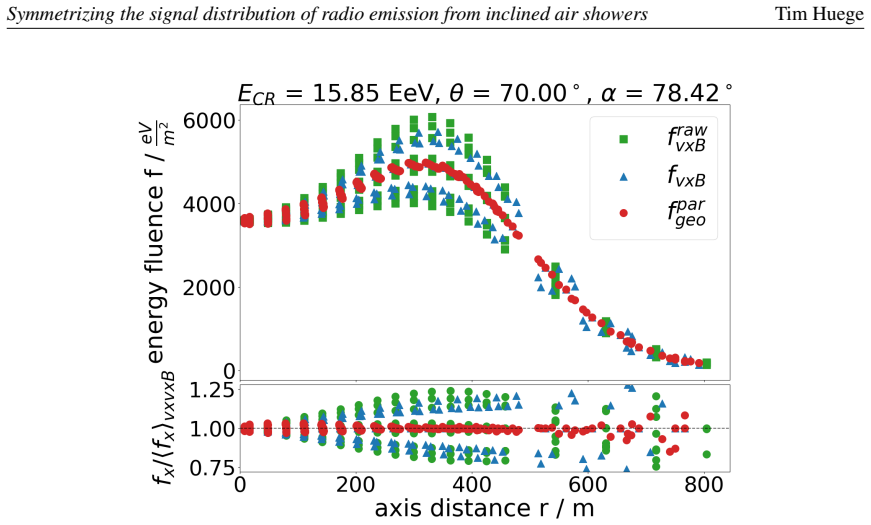
- [Sec. 4, Figs. 5–6] The paper acknowledges that the symmetrization is not fully successful in the inner region, where the parameterization tends to overestimate the charge-excess fraction, and that small asymmetries within concentric rings remain. The effect of these residual asymmetries on the fitted parameters A–D in Eq. (5.1) and on the integrated radiation energy is not quantified. Since the energy estimator is derived from that integral, the impact of these known residuals should be estimated or bounded.
minor comments (4)
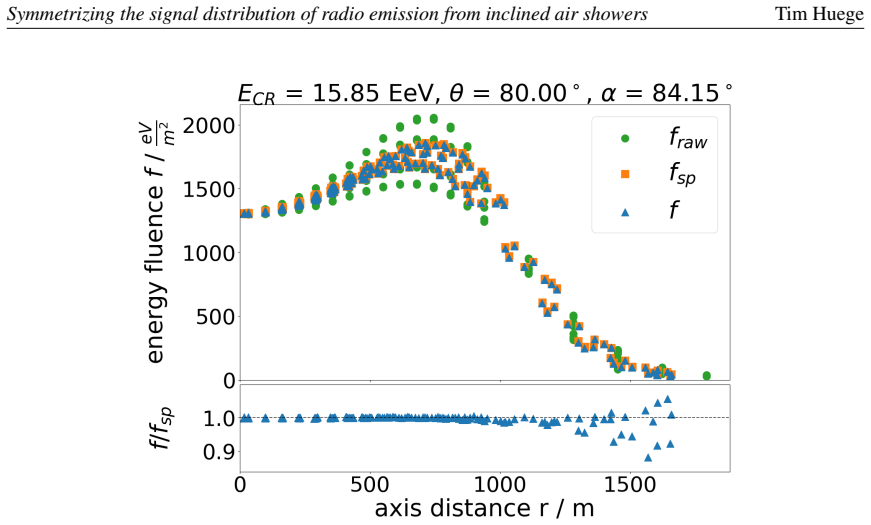
- [Figs. 2, 3, 6, 8] The comparisons shown in these figures have no statistical uncertainties; adding error bars or confidence bands would make the claimed 2–3% agreement easier to assess.
- [Eq. (3.3)] The reference value ⟨ρmax⟩ = 0.4 kg/m³ is introduced without stating whether it is the mean over the simulation set or a fixed atmospheric reference value; please clarify.
- [Eq. (2.1)] The variable x in R ≡ R0 + x is not defined precisely in the text; a sentence defining x and its sign relative to the shower axis would improve reproducibility.
- [Sec. 5] The phrase 'we are still investigating alternative functions' indicates that the choice of fit function is not yet settled; this is acceptable for a proceedings paper but should be flagged as ongoing optimization rather than a final model recommendation.
Circularity Check
The <3% energy-resolution claim is an in-sample fit residual: the charge-excess parameterization and the radiation-energy calibration are both fitted to the same 3111 CoREAS simulations used to evaluate the method.
-
fitted input called prediction
[Sec. 3, Eq. (3.3); Sec. 6, Eqs. (6.1)-(6.2); Sec. 7]
"Fitting the data of all individual simulated positions in one go, we then find the following parameterization: ... (3.3). ... Simulations for all energies, zenith and azimuth angles and both proton and iron primaries are included in the fit. ... Integration over this function and correction for well-known geometrical and density effects yields an estimator for the energy of the electromagnetic cascade of an air shower with negligible bias and a spread of less than 3%."
Both Eq. (3.3) (charge-excess fraction) and the calibration Eqs. (6.1)-(6.2) (S19, gamma, p0, p1) are fitted to all 3111 CoREAS simulations, and the same full set is then used to evaluate the reconstructed electromagnetic energy. The quoted '<3% spread' is therefore the scatter of the fitted model around its own training data, i.e., a goodness-of-fit residual rather than an independent predictive test. No cross-validation or withheld test set is presented, so the central performance claim in Sec. 7 is statistically forced by the fits and does not independently validate the model.
full rationale
The paper is not circular in the sense that the symmetrization functions are derived from the measured signal itself: the early-late correction is a geometrical projection tested against direct shower-plane simulations using the true Xmax, and the charge-excess fraction can be obtained at each antenna from the known polarization decomposition (Eq. 3.2) without invoking the fitted parameterization. The lateral distribution fit (Eq. 5.1) and its area integration are also applied to the data. However, the headline result that the energy estimator has negligible bias and <3% spread is established only on the same 3111 CoREAS simulations that were used to fit both the charge-excess parameterization (Eq. 3.3) and the energy calibration (Eqs. 6.1-6.2). The spread is thus an in-sample measure of the joint fit quality, not an out-of-sample prediction. In addition, the early-late correction and charge-excess parameterization both depend on dmax and rho_max, i.e., on the shower-maximum depth, which is assumed known in this simulation-based study; the sensitivity to Xmax errors in a real experiment is not quantified. This is a limitation on applicability rather than a circular reduction, but it reinforces the in-sample character of the performance claim. The self-citations to Refs. [5] and [8] are not themselves load-bearing circularity because the present paper re-derives and tests the early-late correction, and the density/geomagnetic-angle scaling is an external parameterization.
Assumptions & free parameters
free parameters (9)
- Charge-excess normalization factor 0.373 =
0.373
- Radial exponential scale 762.6 m =
762.6 m
- Density exponential scale 0.149 kg/m3 =
0.149 kg/m3
- Density offset -0.189 =
-0.189
- Lateral distribution function parameters A, B, C, D (per event) =
per event
- Energy-relation amplitude S19 =
1.408 GeV
- Energy-relation exponent gamma =
1.995
- Density scaling parameter p0 =
0.394
- Density scaling parameter p1 =
-2.370 m^3/kg
assumptions (5)
- domain assumption CoREAS simulations provide a faithful model of radio emission from air showers.
- domain assumption The signal is a superposition of geomagnetic and charge-excess components with known polarizations.
- ad hoc to paper The charge-excess fraction is a function only of r, dmax, and rho_max as parameterized in eq. (3.3).
- domain assumption The early-late effect can be corrected by projecting antenna positions along lines of sight to a point source at the shower maximum.
- domain assumption The Pierre Auger site atmosphere and magnetic field are representative of the intended application.
Cite this review
Pith. "Pith review of Symmetrizing the signal distribution of radio emission from inclined air showers." pith.science (2026). https://pith.science/paper/MTGLD6VP
@misc{pith2026190807840,
  author       = {Pith},
  title        = {Pith review of: Symmetrizing the signal distribution of radio emission from inclined air showers},
  year         = {2026},
  howpublished = {\url{https://pith.science/paper/MTGLD6VP}},
  note         = {Machine review of arXiv:1908.07840}
}
read the original abstract
Radio detection of inclined air showers currently receives special attention. It can be performed with very sparse antenna arrays and yields a pure measurement of the electromagnetic air-shower component, thus delivering information that is highly complementary to the measurement of the muonic component using particle detectors. However, radio-based reconstruction of inclined air showers is challenging in light of asymmetries induced in the radio-signal distribution by early-late effects as well as the superposition of geomagnetic and charge-excess radiation. We present a model for the signal distribution of radio emission from inclined air showers which allows explicit compensation of these asymmetries. In a first step, geometrical early-late asymmetries are removed. Secondly, a universal parameterization of the charge-excess fraction as a function of the air-shower geometry, the atmospheric density profile and the lateral distance from the shower axis is used to compensate for the charge-excess contribution to the signal. The resulting signal distribution of the pure geomagnetic emission is then fit with a rotationally symmetric lateral distribution function, the area integration of which yields the radiation energy as an estimator for the cosmic-ray energy. We present the details and performance of our model, which lays the foundation for robust and precise reconstruction of inclined air showers from radio measurements.
Figures


Figures from the paper (5 more)



Reference graph
Works this paper leans on
- [1]
- [2]
- [3]
-
[4]
D. Kostunin, P.A. Bezyazeekov, R. Hiller, et al., Astropart. Phys. 74 (2015) 79
work page 2015
- [5]
-
[6]
Gottowik for the Pierre Auger Collaboration, PoS(ICRC2019)274 (2019)
M. Gottowik for the Pierre Auger Collaboration, PoS(ICRC2019)274 (2019)
work page 2019
- [7]
- [8]
Show all 9 references
-
[9]
Pont for the Pierre Auger Collaboration, PoS(ICRC2019)395 (2019) 7
B. Pont for the Pierre Auger Collaboration, PoS(ICRC2019)395 (2019) 7
2019
Reviewed August 14, 2026 · model on record in the stance chip above.
Discussion (0). Continue with ORCID to comment.