Role of polarity in the growth of cubic GaN within silicon inverted pyramids
Pith reviewed 2026-07-01 01:12 UTC · model grok-4.3
The pith
Polarity reduces four-fold template symmetry to two-fold and forces polarity inversions at two h-GaN to c-GaN boundaries.
A machine-rendered reading of the paper's core claim, the machinery that carries it, and where it could break.
Core claim
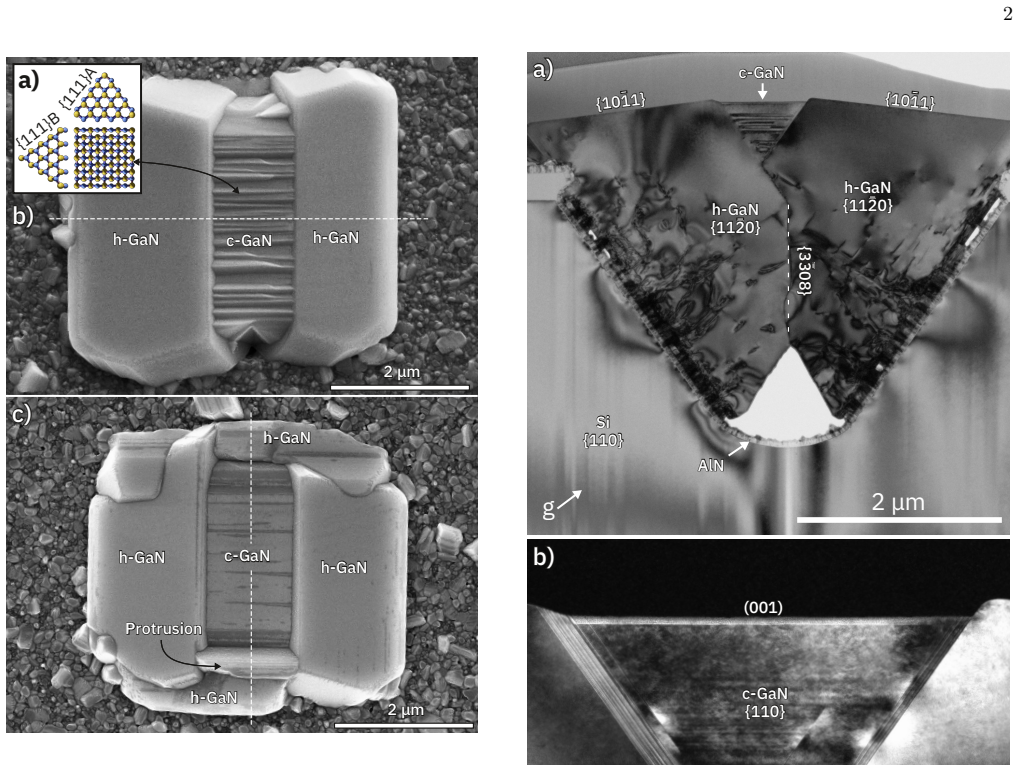
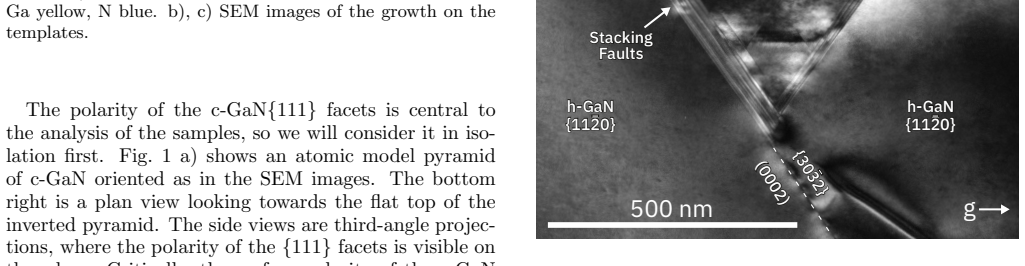
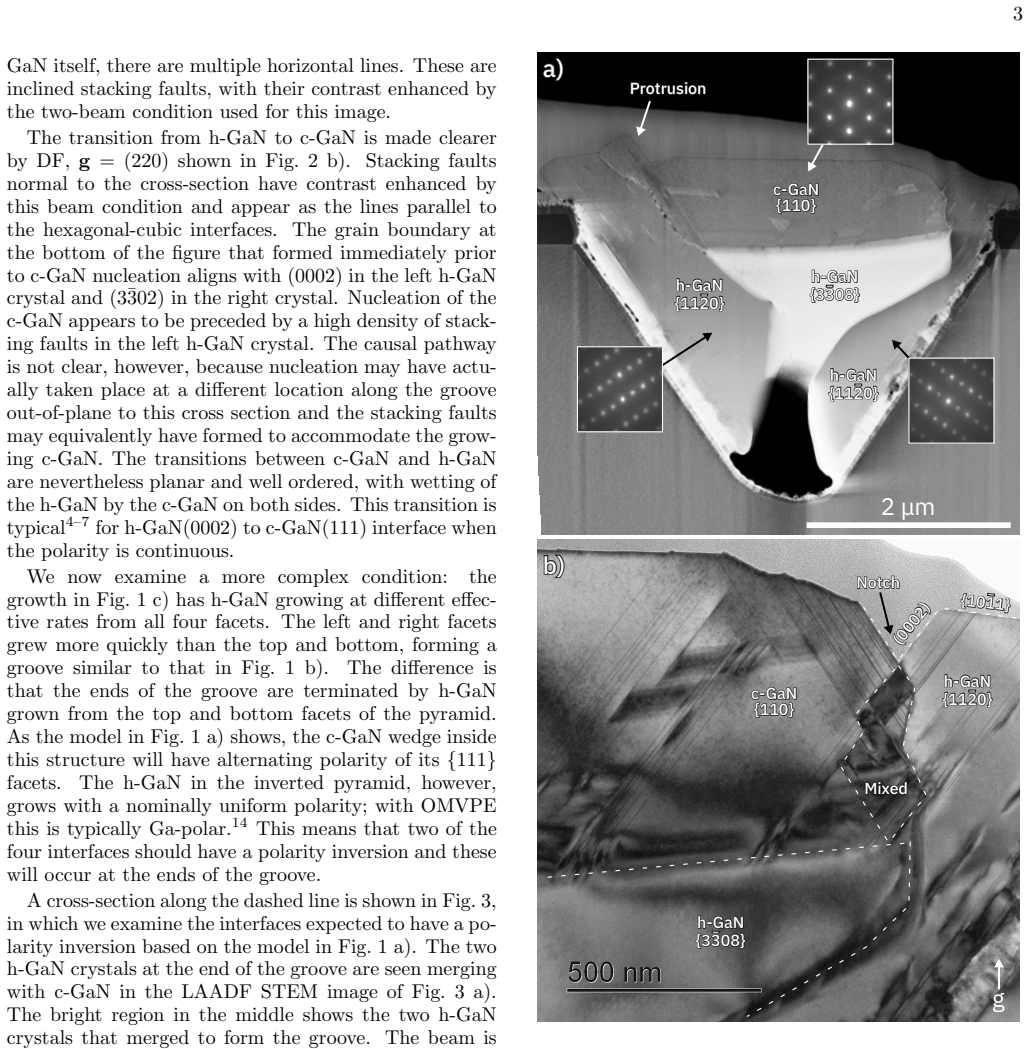
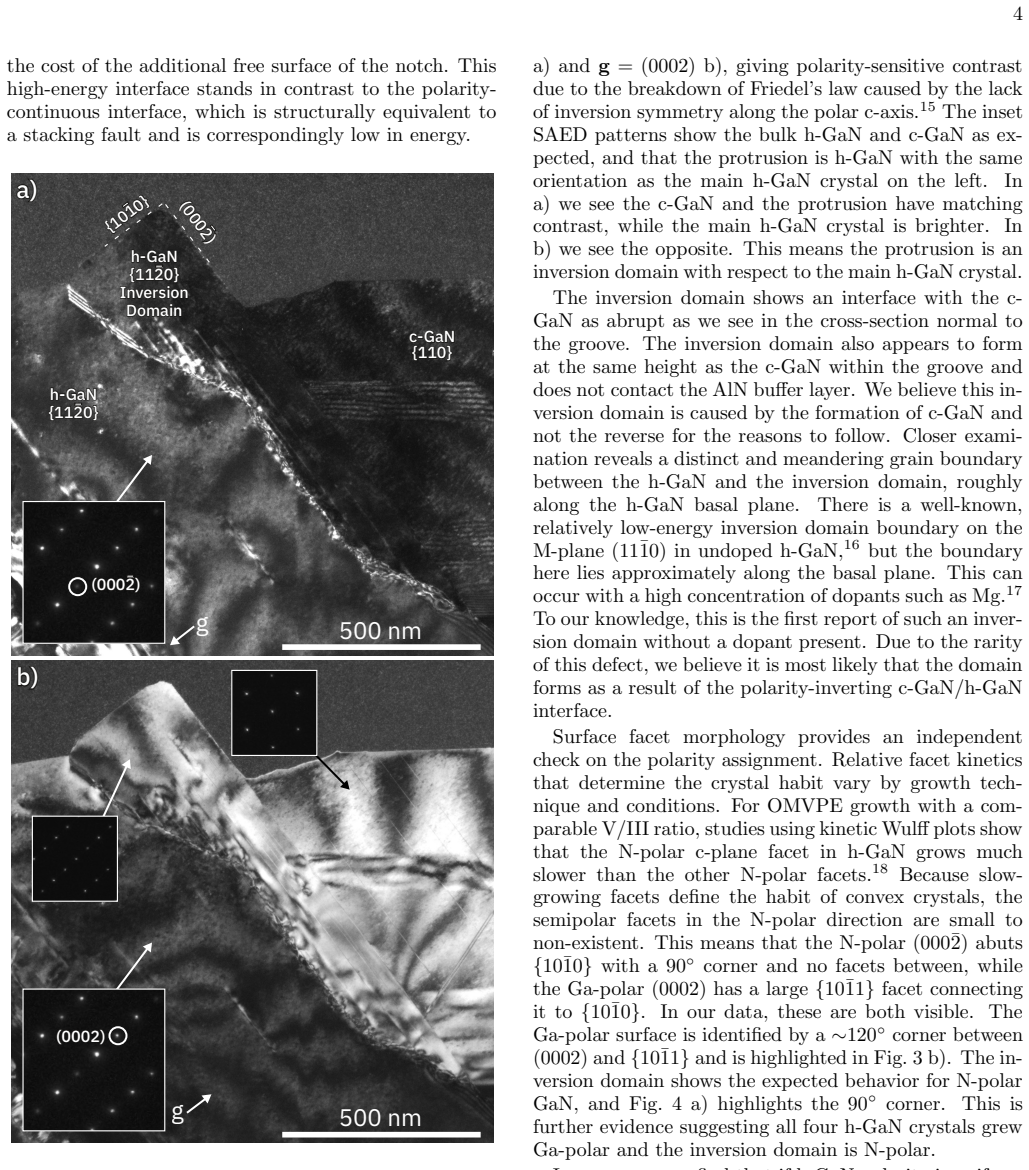
In typical growth conditions where the underlying h-GaN polarity is uniform, the c-GaN inside the four-fold symmetric template has its symmetry reduced by polarity to two-fold; this implies that two h-GaN to c-GaN grain boundaries will have a polarity inversion. Two different structures are observed at these inverting boundaries, including a previously unreported inversion domain boundary along the basal plane of the undoped h-GaN.
What carries the argument
Polarity inversion at h-GaN to c-GaN grain boundaries inside four-fold inverted-pyramid templates, which breaks the expected symmetry and produces distinct boundary structures.
If this is right
- Polarity-inverting interfaces must be prevented for small devices such as micro-LEDs.
- Suppression of h-GaN growth on two facets of the template can avoid the inversions.
- Local control of h-GaN polarity on the template can eliminate the inverting boundaries.
- The symmetry reduction from four-fold to two-fold is a direct consequence of uniform polarity in the four-sided geometry.
Where Pith is reading between the lines
- Preventing the reported basal-plane boundary may require changes in doping or growth temperature on specific facets.
- The same polarity-driven symmetry reduction could appear in other polar materials grown inside symmetric nonpolar templates.
- Electronic transport across the two observed inverting-boundary types may differ and could be measured in fabricated devices.
Load-bearing premise
The underlying h-GaN polarity remains uniform across all template facets and TEM contrast reliably distinguishes both phase and polarity direction at the boundaries.
What would settle it
Cross-sectional TEM images of GaN grown in inverted pyramids under standard conditions that show uniform polarity but no polarity-inversion boundaries, or that identify different boundary structures than the two reported.
Figures
read the original abstract
A lack of spontaneous internal polarization makes cubic GaN (c-GaN) a well-suited material for emerging micro-LED-based short-range communication, where c-GaN promises increased speed over conventional hexagonal GaN (h-GaN). Although c-GaN is metastable, there are well-established methods for growing it in Si V- or U-grooves; the logical step is to truncate these grooves to wedges or inverted pyramids for small devices. There are limited reports of GaN grown in inverted pyramid templates, and the results are contradictory. To study this process, we perform selective area growth of GaN using organometallic vapor phase epitaxy (OMVPE) on Si inverted pyramidal templates and analyze our samples by cross-sectional TEM. We find that polarity is critical to understanding the growth of c-GaN in this four-fold geometry, in contrast to the growth in long grooves. This effect fits within the broader set of challenges of polar-on-nonpolar heteroepitaxy; the c-GaN inside the four-fold symmetric template has its symmetry reduced by polarity to be two-fold. In typical growth conditions -- where the underlying h-GaN polarity is uniform -- we find this implies that two h-GaN to c-GaN grain boundaries will have a polarity inversion. We observe two different structures at these inverting boundaries, including a previously unreported inversion domain boundary along the basal plane of the undoped h-GaN. These findings show that for small devices -- such as micro-LEDs -- the polarity-inverting interfaces must be prevented, for example by suppressing the growth of h-GaN on two facets of the template or by locally controlling the h-GaN polarity.
Editorial analysis
A structured set of objections, weighed in public.
Referee Report
Summary. The paper reports selective-area OMVPE growth of GaN on Si inverted-pyramid templates and uses cross-sectional TEM to examine the resulting c-GaN and h-GaN regions. It claims that, when the underlying h-GaN polarity is uniform across the four {111} facets, two of the four h-GaN/c-GaN grain boundaries must be polarity-inverting; two distinct boundary structures are observed at these inverting interfaces, one of which is a previously unreported basal-plane inversion domain boundary in undoped h-GaN. The work concludes that polarity-inverting interfaces must be avoided for micro-LED-scale devices.
Significance. If the TEM phase and polarity assignments are robust, the result supplies concrete, geometry-specific guidance on how four-fold symmetry interacts with the polar character of GaN, extending earlier groove-based studies and directly informing defect control in small-area polar-on-nonpolar heteroepitaxy.
major comments (2)
- [TEM results] TEM results section (and associated methods): the central claim that two h-to-c boundaries exhibit polarity inversion rests on the interpretation of bright-field/dark-field and high-resolution contrast. No diffraction conditions, exact zone axis, specimen thickness, or defocus values are stated for the labeled boundaries, nor is CBED or multiple-zone diffraction used to confirm polarity direction; standard GaN contrast can be consistent with multiple phase/polarity combinations, leaving non-inverting interpretations viable.
- [Abstract and discussion] Abstract and discussion: the polarity-inversion implication is stated to hold only when h-GaN polarity is uniform across all four template facets, yet no facet-specific polarity maps, growth-rate comparisons, or independent verification (e.g., convergent-beam patterns on each {111} face) are supplied to rule out facet-to-facet polarity variation.
minor comments (2)
- [Figures] Figure captions should explicitly list the diffraction vector or zone axis used for each labeled boundary image.
- [Methods] A short methods paragraph on sample preparation (ion milling parameters, thickness estimation) would aid reproducibility of the contrast interpretations.
Simulated Author's Rebuttal
We thank the referee for the careful reading of the manuscript and for the positive evaluation of its potential significance. We address each major comment below with clarifications and indicate the revisions that will be incorporated.
read point-by-point responses
-
Referee: [TEM results] TEM results section (and associated methods): the central claim that two h-to-c boundaries exhibit polarity inversion rests on the interpretation of bright-field/dark-field and high-resolution contrast. No diffraction conditions, exact zone axis, specimen thickness, or defocus values are stated for the labeled boundaries, nor is CBED or multiple-zone diffraction used to confirm polarity direction; standard GaN contrast can be consistent with multiple phase/polarity combinations, leaving non-inverting interpretations viable.
Authors: We agree that the TEM section would benefit from explicit documentation of imaging parameters. In the revised manuscript we will add the diffraction conditions (including the specific reflections used for dark-field imaging), the zone axes employed for each labeled boundary, estimated specimen thicknesses from EELS, and the defocus values for the high-resolution images. Although CBED was not performed owing to the limited thickness and geometry of the inverted-pyramid specimens, multiple dark-field conditions with both GaN and Si reflections were used to cross-check polarity assignments; the observed contrast reversals are incompatible with non-inverting boundary models. A supplementary paragraph will be added explaining why alternative phase/polarity combinations fail to reproduce the full set of BF/DF/HR observations simultaneously. revision: yes
-
Referee: [Abstract and discussion] Abstract and discussion: the polarity-inversion implication is stated to hold only when h-GaN polarity is uniform across all four template facets, yet no facet-specific polarity maps, growth-rate comparisons, or independent verification (e.g., convergent-beam patterns on each {111} face) are supplied to rule out facet-to-facet polarity variation.
Authors: The manuscript already presents the polarity-inversion conclusion as conditional on uniform h-GaN polarity across the four {111} facets. We will revise the abstract and discussion to cite prior literature on polarity uniformity for OMVPE growth on Si{111} facets under the same precursor and temperature conditions used here. In addition, we will note that the repeated observation of the same two distinct inverting-boundary structures in multiple cross-sections is consistent with uniform polarity; facet-to-facet polarity reversal would be expected to produce a different statistical distribution of boundary types, which was not seen. Direct per-facet CBED mapping would require a separate experimental campaign and is therefore outside the scope of the present study, but the conditional framing already limits the claim appropriately. revision: partial
Circularity Check
No circularity: purely observational experimental report with no derivations or fitted predictions
full rationale
The paper reports selective-area OMVPE growth of GaN on Si inverted-pyramid templates followed by cross-sectional TEM characterization. It contains no equations, no parameter fitting, no 'predictions' derived from data, and no load-bearing self-citations or uniqueness theorems. The central statements are direct observations of grain-boundary structures under stated growth conditions; the logical implication about polarity inversion follows from the four-fold template geometry and the assumption of uniform h-GaN polarity, without any reduction to fitted inputs or self-referential loops. The derivation chain is therefore empty and self-contained against external benchmarks.
Axiom & Free-Parameter Ledger
axioms (2)
- domain assumption Cross-sectional TEM contrast can reliably distinguish cubic from hexagonal GaN and determine local polarity direction.
- domain assumption h-GaN polarity is uniform across the four facets of the inverted-pyramid template under the growth conditions used.
Reference graph
Works this paper leans on
-
[1]
Applied Physics Reviews , author =
Cubic. Applied Physics Reviews , author =. 2022 , pages =. doi:10.1063/5.0097558 , abstract =
-
[2]
Efficiency droop in zincblende. Nanoscale , author =. 2024 , note =. doi:10.1039/D4NR00812J , number =
-
[3]
Applied Physics Letters , author =
Green-emitting cubic. Applied Physics Letters , author =. 2024 , pages =. doi:10.1063/5.0179477 , abstract =
-
[4]
Applied Physics Letters , author =
Green cubic. Applied Physics Letters , author =. 2013 , pages =. doi:10.1063/1.4841555 , abstract =
-
[5]
Zinc-blende–wurtzite polytypism in semiconductors , volume =. Physical Review B , author =. 1992 , pages =. doi:10.1103/PhysRevB.46.10086 , number =
-
[6]
Applied Physics Letters , author =
Spatial phase separation of. Applied Physics Letters , author =. 2004 , pages =. doi:10.1063/1.1687456 , abstract =
-
[7]
IEEE Journal of Quantum Electronics , author =
Nanoscale spatial phase modulation of. IEEE Journal of Quantum Electronics , author =. 2005 , pages =. doi:10.1109/JQE.2005.843605 , abstract =
-
[8]
Advanced Functional Materials , author =
Cubic. Advanced Functional Materials , author =. 2014 , pages =. doi:10.1002/adfm.201304062 , abstract =
-
[9]
Applied Physics Letters , author =
Maximizing cubic phase gallium nitride surface coverage on nano-patterned silicon (100) , volume =. Applied Physics Letters , author =. 2016 , pages =. doi:10.1063/1.4960005 , abstract =
-
[10]
Crystal Growth & Design , author =
Atomic-. Crystal Growth & Design , author =. 2016 , pages =. doi:10.1021/acs.cgd.5b01845 , abstract =
-
[11]
Electronic structure of zinc-blende-wurtzite interfaces:. Physical Review B , author =. 1980 , pages =. doi:10.1103/PhysRevB.22.2060 , number =
-
[12]
Applied Physics Letters , author =
Pyramidal shape four. Applied Physics Letters , author =. 2022 , pages =. doi:10.1063/5.0084836 , abstract =
-
[13]
MRS Internet Journal of Nitride Semiconductor Research , author =
The. MRS Internet Journal of Nitride Semiconductor Research , author =. 1998 , pages =. doi:10.1557/S1092578300000831 , abstract =
-
[14]
Journal of Vacuum Science & Technology A: Vacuum, Surfaces, and Films , author =
Growth optimization and characterization of. Journal of Vacuum Science & Technology A: Vacuum, Surfaces, and Films , author =. 2015 , pages =. doi:10.1116/1.4933201 , abstract =
-
[15]
Initial stage of cubic. Nanotechnology , author =. 2019 , pages =. doi:10.1088/1361-6528/aae9a2 , abstract =
-
[16]
Journal of Applied Physics , author =
Understanding nonpolar. Journal of Applied Physics , author =. 2008 , pages =. doi:10.1063/1.3009969 , abstract =
-
[17]
Physical Review Letters , author =
Inversion. Physical Review Letters , author =. 1996 , pages =. doi:10.1103/PhysRevLett.77.103 , number =
-
[18]
Applied Physics Letters , author =
Magnesium incorporation at (0001) inversion domain boundaries in. Applied Physics Letters , author =. 2003 , pages =. doi:10.1063/1.1565707 , abstract =
-
[19]
Journal of Applied Physics , author =
Crystallographically tilted and partially strain relaxed. Journal of Applied Physics , author =. 2013 , pages =. doi:10.1063/1.4856275 , abstract =
-
[20]
Crystal Growth & Design , author =
Elastic. Crystal Growth & Design , author =. 2019 , pages =. doi:10.1021/acs.cgd.9b00339 , abstract =
-
[21]
Journal of Applied Physics , author =
Investigation of (mis-)orientation in zincblende. Journal of Applied Physics , author =. 2025 , pages =. doi:10.1063/5.0244438 , abstract =
-
[22]
Benyahya, Kaoutar and Diaz, Ariel Gomez and Liu, Junyi and Lyutsarev, Vassily and Pantouvaki, Marianna and Shi, Kai and Siew, Shawn Yohanes and Ballani, Hitesh and Burridge, Thomas and Cletheroe, Daniel and Karagiannis, Thomas and Robertson, Brian and Rowstron, Ant and Yang, Mengyang and Costa, Paolo , month = sep, year =. Mosaic:. Proceedings of the. doi...
-
[23]
Antiphase disorder in. Micron , author =. 2000 , keywords =. doi:10.1016/S0968-4328(99)00086-4 , abstract =
-
[24]
Journal of Crystal Growth , author =
Fabrication of a. Journal of Crystal Growth , author =. 2009 , pages =. doi:10.1016/j.jcrysgro.2009.01.075 , abstract =
-
[25]
Crystal Growth & Design , author =
Polarity-. Crystal Growth & Design , author =. 2016 , pages =. doi:10.1021/acs.cgd.5b00910 , abstract =
-
[26]
Journal of Crystal Growth , author =
Polar-on-nonpolar epitaxy , volume =. Journal of Crystal Growth , author =. 1987 , pages =. doi:10.1016/0022-0248(87)90391-5 , abstract =
-
[27]
physica status solidi (b) , author =
Friedel's. physica status solidi (b) , author =. 1973 , note =. doi:10.1002/pssb.2220580127 , abstract =
discussion (0)
Sign in with ORCID, Apple, or X to comment. Anyone can read and Pith papers without signing in.