REVIEW 3 major objections 5 minor 42 references
Per-Stroke Temporal Control for Text-to-Motion via Action Units and Action-Detection Guidance
T0 review · 3 major / 5 minor · reviewed 2026-08-01 · deepseek-v4-flash
Pith's one-line read Action Units make a frozen text-to-motion model place each stroke's count, side, order, and impact frame as prompted.
desk verdict New per-stroke control primitive with a solid but unverifiable quantitative core; the AU representation is the real contribution, and the detector-defined evaluation is the main thing to probe in review. read the letter →
The pith
A machine-rendered reading of the paper's core claim, the machinery that carries it, and where it could break.
The reading
What carries the argument
The central object is the Action Unit (AU)—a typed temporal event that names one stroke's body track, action class, time window, and core frame. The argument is carried by two injection streams into the frozen denoiser: per-stroke AU tokens, which supply the discrete layout (how many strokes, which sides, in what order, and where), and a per-frame phase channel, a count-normalized superposition of Gaussian bumps centered on each active stroke's core frame, which supplies continuous within-window and co-active execution. The gated attention plus gated per-frame residual are zero-initialized, making the adapter collapse exactly to the frozen backbone without AUs. At inference, Action-Detection
What would settle it
Run StrokeBench with an independent evaluator whose labels come from a different source—human perceptual judgments of the generated clips, say, or a detector trained on an external action-labeling corpus rather than the authors' audit—and check whether the reported placement scores and ranking survive. Separately, prompt core frames at the extremes of the window (0.1 and 0.9 instead of the corpus-typical median fraction) for kick and catch; kick's slope should continue or plateau, and catch should remain flat, which would confirm the axis is real rather than an artifact of training-time timing
Extended reading notes
Core claim
On its own terms, the paper establishes that per-stroke temporal control can be added to a frozen text-to-motion backbone through a small trained interface plus a training-free correction. Each stroke becomes an Action Unit carrying its track, class, window, and core frame; per-stroke tokens supply the layout, and a per-frame phase channel superposes count-normalized bumps on co-active core frames. Both streams enter every frozen transformer block through zero-initialized gates, so the unconditional backbone returns exactly when no Action Unit is given. At inference, Action-Detection Guidance reads a frozen frame-level detector on the clean-motion estimate and ascends a recall term minus a l
Load-bearing premise
Everything—both the ADG steering signal and every StrokeBench score—depends on a frozen detector trained on the authors' own audited labels being a faithful reader of 'a stroke of the prompted class landed on the prompted track at the prompted time'; if those labels are biased, the guide and the scorer inherit the bias together and the benchmark cannot see it.
Editorial extensions
If this is right
- Per-stroke authoring—count, ordering, laterality, and core placement—can be layered onto a frozen text-to-motion model by training only a small adapter, so the gains do not require retraining the generator or stitching clips.
- The per-frame phase channel is the decisive component for concurrency: removing it costs 0.11 F1 AU on overlap prompts (0.77→0.66), nearly three times the cost of removing the AU tokens, because co-active strokes deposit their content into shared frames together.
- The core frame is an emergent steering axis: prompting it at 0.3/0.5/0.7 of a fixed window moves the realized impact instant for kick (slope 0.90), hop (0.77), and throw (0.48), while catch stays pinned (0.02), with tight fits (R²≥0.95).
- The same adapter ports to a stronger frozen transformer backbone that already has a per-frame text interface, improving per-stroke F1 AU from 0.759 to 0.814 on six stroke classes while improving FID (23.8→21.9) over that backbone's native interface.
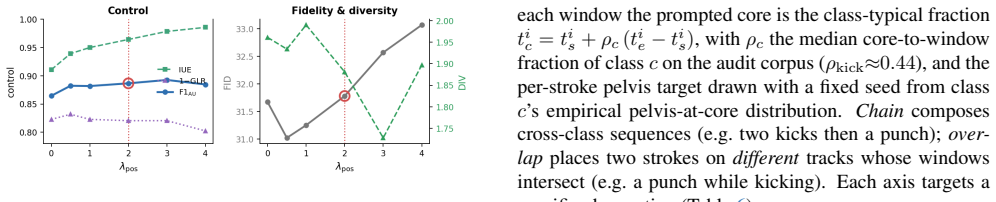
- ADG's control–fidelity trade-off is monotone and gentle: in-window recall rises with the recall weight while FID holds near its floor up to the chosen operating point, then climbs, giving a clear knee rather than a collapse.
Reading between the lines
- A natural next test is whether AU grounding transfers across motion representations: the paper's port to a second frozen backbone still shares the same 263-dimensional kinematic feature space, so a latent-level or autoregressive backbone with a different internal representation would test whether the gated-injection recipe is representation-agnostic or tied to this feature layout.
- Because both the ADG steering signal and the StrokeBench scores derive from detectors trained on the authors' self-audited labels, an independent check—human perceptual ratings of whether each stroke lands in-window on the right track, or a detector trained from an independent label source—would separate genuine placement gains from label-scheme bias, especially on the weak classes (hop, catch).
- The core-frame result was measured at the corpus's median core-to-window fraction; prompting cores at extreme positions (e.g., 0.1 or 0.9 of the window) would reveal whether the Gaussian phase bump or the detector read-out caps the steerable range, a boundary the paper leaves open.
Editorial analysis
A structured set of objections, weighed in public.
Referee Report
Summary. The paper introduces Action Units (AUs), a typed per-stroke temporal condition that specifies a stroke's body track, action class, time window, and core frame. The authors build an audited AU corpus from HumanML3D and FrankenMotion, split into a training partition (AUC-T) and a held-out evaluation partition (AUC-E). They then ground a frozen MDM text-to-motion backbone with a lightweight gated adapter that injects per-stroke tokens and a per-frame phase channel, and at inference apply Action-Detection Guidance (ADG), a training-free classifier gradient from a frozen frame-level detector, to fill under-filled windows and suppress off-window leakage. Per-stroke control is evaluated on StrokeBench, which measures count, ordering, laterality, and within-window placement. Reported results show large gains over prior interfaces (F1 AU 0.898 vs. 0.800 for UniMotion) with best-in-class placement metrics, and the prompted core frame emerges as a steerable axis for five of six non-postural classes.
Significance. If the reported numbers hold, this is a meaningful advance in controllable text-to-motion generation: it makes the individual stroke an addressable primitive without retraining a frozen generator, and it provides a benchmark that separates count, leakage, and within-window placement failure modes. The paper has several genuine strengths: it uses separate architectures for the ADG guide (C2F-TCN) and the StrokeBench evaluator (ASFormer), trains them on disjoint partitions (AUC-T vs. AUC-E), reports 3-seed standard deviations, includes extensive component ablations, demonstrates portability to a second frozen backbone (UniMotion), and provides an external rank-correlation check against segmental F1@.25. The central risk is that all quantitative evidence -- both the steering signal and the evaluation -- descends from a single self-audited label protocol, so the benchmark cannot detect systematic bias in the audit. This is fixable with additional independent validation, but it is load-bearing for the headline claim.
major comments (3)
- [§3.5, Supp. C/D, §4.2] The per-stroke control metrics (F1 AU, IUE, IUR, GLR, F1@.25) and the ADG steering signal are all derived from detectors trained on the authors' own audited AU labels. Although the ADG guide (C2F-TCN, AUC-T) and the StrokeBench evaluator (ASFormer, AUC-E) differ in architecture and training data, they share the same label ontology and the same human-audit protocol. Any systematic bias in window boundaries, laterality assignment, or core-frame annotation is therefore inherited by both the optimizer and the evaluator, and the benchmark cannot detect it. The F1@.25 cross-check (Supp. H, ρ=0.92) is not independent because it is computed from the same evaluator's chunks. This is load-bearing for the central claim in Table 3 (F1 AU 0.898 vs. 0.800). I recommend adding an independent validation: (a) a human annotation study of window/side/count on a sample of generated motions, or (b) a second
- [§4.5, Table 5, Supp. I] The core-frame controllability claim is based on a velocity-peak proxy whose class-typical offset δ_g is estimated from the same audited corpus. The offset-free slope analysis is careful and the fits are tight, but the proxy is validated only on the audit corpus, not on generated motions. Since the core frame is a distinct contribution, the paper should confirm that the slope reflects the load-bearing instant (impact/apex) rather than a proxy artifact. A small human rating of perceived impact/apex timing on generated samples, or an independent kinematic criterion such as contact events, would substantiate the claim.
- [§4.2, Supp. H] The IUE metric counts a window as filled if any target-class chunk overlaps it, with no minimum overlap requirement, and GLR charges only chunks that overlap no window at all. A stroke placed mostly in a gap but dipping one frame into the window would count as in-window and not as leakage, potentially inflating F1 AU. The paper should quantify sensitivity to the overlap criterion (e.g., requiring a minimum overlap fraction or frame count) and report whether the method ordering in Table 3 is stable under such a requirement.
minor comments (5)
- [Table 3 vs. Table 4] The 'Full' FID in Table 4a is 29.60, while Table 3 reports Ours FID as 27.80. Please clarify which seed and reference set each number uses, since the table captions imply the same configuration.
- [Eq. (1) and Supp. B] In Eq. (1), the notation φ(t_s^i)∥φ(t_c^i)∥φ(t_e^i) is used before φ is defined; please define the Fourier expansion of fractional frame indices at first use and clarify whether the times are normalized absolute frame indices or window-relative fractions.
- [Supp. M / Table 3 caption] The oracle keypoints given to OmniControl and Kimodo are described in Supp. M, but not in the main text. Because these baselines receive per-stroke keyframe information, this should be stated in or near the Table 3 caption so the FID comparison is not over-read.
- [Introduction / Supp. A] The paper repeatedly says the corpus 'will be released' but provides no link or availability statement. Please include a concrete release statement or a data-availability section in the final version.
- [Fig. 4 / Supp. I] The green 'expected proxy' line uses class-typical δ_g from the audit corpus. Please state explicitly in the figure caption that δ_g is a class-level average, not a per-sample offset, to avoid implying per-sample ground truth.
Circularity Check
No construction-level circularity; only a minor overclaim that the F1@.25 cross-check is external when it reuses the same detector's chunks.
-
other
[Supp. H (StrokeBench: Unit-level axes and external check)]
"As an external check, across Table 3's ten methods the unit F1 AU rank-correlates strongly with the established segmental F1@.25 (Spearman ρ=0.92): the bespoke axes agree with a standard segmentation metric, while additionally separating the count (IUE) and off-window-leak (GLR) failure modes that a single IoU match folds together."
Both F1 AU and F1@.25 are read off the same held-out ASFormer detector's chunks (§4.2, Supp. H); F1@.25 is a different aggregation of the same detections, not an independent label source. Calling this an 'external check' therefore does not validate the detector-defined ground truth; it only shows two scoring functions over one detector agree. This is a minor validation overclaim, not a construction-level reduction of the main result.
full rationale
The central derivation chain is not circular by construction. AUG trains a gated adapter on a frozen backbone using the backbone's denoising loss plus explicit off-window and loft priors; ADG steers with a frozen C2F-TCN trained on the AUC-T partition; StrokeBench is scored by a separate ASFormer trained on the disjoint AUC-E partition (§3.5, Supp. D). The paper therefore deliberately avoids the strongest circularity: the network that steers generation is not the network that scores it, and the partitions are disjoint. The remaining shared component is the human-audited AU label ontology and the HumanML3D feature representation. That is a benchmark-validity risk, not a circular reduction: the labels come from external human annotation rather than from the method's own outputs, and the evaluator is held out from both adapter and ADG-guide training. The only concrete overstatement is the 'external check' in Supp. H, where F1@.25 is computed from the same held-out detector's chunks as F1 AU; the ρ=0.92 agreement validates the metric's aggregation formula but not the detector-defined ground truth independently. There is no load-bearing self-citation, no imported uniqueness theorem, and no fitted parameter renamed as a prediction. The core result—that a frozen text-to-motion backbone can be grounded to honor per-stroke conditions—stands on an independent training/evaluation split, with the shared-label issue being a correctness/validity concern rather than a derivation-level circularity.
Assumptions & free parameters
free parameters (8)
- off-window prior weight λ_offwin =
0.8
- loft prior weight λ_loft =
5.0
- loft hinge margin m =
0.10 m
- phase-bump width factor κ =
0.30
- ADG guidance strengths (λ_pos, λ_neg) =
(2.0, 1.5)
- StrokeBench evaluator chunk threshold τ =
0.5
- class-typical core fraction ρ_c (per class) =
e.g., ρ_kick≈0.44
- CFG scale for AU stream =
2.5
assumptions (5)
- domain assumption A frozen MDM denoiser can faithfully host per-stroke conditioning through a small gated adapter without weight updates.
- domain assumption Detector outputs (C2F-TCN guide and ASFormer evaluator) are faithful multi-label readings of 'a stroke of class c on track g occurs at frame t'.
- domain assumption Velocity peaks on the responsible joint are a valid proxy for the annotated core frame, with class-typical offset δ_g.
- ad hoc to paper Two-leg jumps are represented as two coincident AUs (one per ankle track) sharing one window.
- domain assumption The HumanML3D 263-d feature space transfers to out-of-HumanML3D (AMASS/SMPL) clips via SMPL forward kinematics and canonicalization.
Cite this review
Pith. "Pith review of Per-Stroke Temporal Control for Text-to-Motion via Action Units and Action-Detection Guidance." pith.science (2026). https://pith.science/paper/MTYCQN6R
@misc{pith2026260715717,
  author       = {Pith},
  title        = {Pith review of: Per-Stroke Temporal Control for Text-to-Motion via Action Units and Action-Detection Guidance},
  year         = {2026},
  howpublished = {\url{https://pith.science/paper/MTYCQN6R}},
  note         = {Machine review of arXiv:2607.15717}
}
read the original abstract
Text-to-motion models are competent at the action a prompt names but unreliable at when each stroke lands: four punches alternating left and right rarely return four separable strokes. We introduce typed temporal events called Action Units (AUs) that make the individual stroke -- its body track, action class, time window, and impact timing -- an explicit conditioning signal. We ground a frozen text-to-motion backbone on the AU set through a lightweight gated adapter injecting two streams (per-stroke tokens and a per-frame phase channel), and at inference close residual timing errors with a training-free classifier gradient from a frozen frame-level detector. We measure per-stroke control on StrokeBench, whose prompts specify count, ordering, track, and core-frame placement, paired with an audited stroke corpus. AU grounding markedly raises the rate of correctly placed single strokes over the strongest prior interface, at the best motion quality among text-, interval-, and frame-level baselines. The prompted core frame emerges as a further steerable axis.
Figures


Figures from the paper (3 more)


Reference graph
Works this paper leans on
-
[1]
MS-TCN: Multi-stage temporal convolutional network for action segmentation
Yazan Abu Farha and J ¨urgen Gall. MS-TCN: Multi-stage temporal convolutional network for action segmentation. In IEEE Conference on Computer Vision and Pattern Recogni- tion (CVPR), 2019. 3, 10
2019
-
[2]
Black, and G¨ul Varol
Nikos Athanasiou, Mathis Petrovich, Michael J. Black, and G¨ul Varol. TEACH: Temporal action composition for 3D humans. InInternational Conference on 3D Vision (3DV),
-
[3]
Executing your commands via motion diffusion in latent space.arXiv preprint, 2023
Xin Chen, Biao Jiang, Wen Liu, Zilong Huang, Bin Fu, Tao Chen, and Gang Yu. Executing your commands via motion diffusion in latent space.arXiv preprint, 2023. 1, 2, 3
2023
-
[4]
Mccann, Marc L
Hyungjin Chung, Jeongsol Kim, Michael T. Mccann, Marc L. Klasky, and Jong Chul Ye. Diffusion posterior sam- pling for general noisy inverse problems. InInternational Conference on Learning Representations (ICLR), 2023. 2, 5, 11
2023
-
[5]
Flexible motion in-betweening with diffusion models
Setareh Cohan, Guy Tevet, Daniele Reda, Xue Bin Peng, and Michiel van de Panne. Flexible motion in-betweening with diffusion models. InSIGGRAPH, 2024. 2, 3
2024
-
[6]
MoFusion: A frame- work for denoising-diffusion-based motion synthesis
Rishabh Dabral, Muhammad Hamza Mughal, Vladislav Golyanik, and Christian Theobalt. MoFusion: A frame- work for denoising-diffusion-based motion synthesis. In IEEE/CVF Conference on Computer Vision and Pattern Recognition (CVPR), 2023. 2
2023
-
[7]
Diffusion models beat GANs on image synthesis
Prafulla Dhariwal and Alexander Nichol. Diffusion models beat GANs on image synthesis. InAdvances in Neural In- formation Processing Systems (NeurIPS), 2021. 2
2021
-
[8]
Generating diverse and natural 3D human motions from text.arXiv preprint, 2022
Chuan Guo, Shihao Zou, Xinxin Zuo, Sen Wang, Wei Ji, Xingyu Li, and Li Cheng. Generating diverse and natural 3D human motions from text.arXiv preprint, 2022. 1, 3, 5, 10
2022
Show all 42 references
-
[9]
MoMask: Generative masked model- ing of 3D human motions
Chuan Guo, Yuxuan Mu, Muhammad Gohar Javed, Sen Wang, and Li Cheng. MoMask: Generative masked model- ing of 3D human motions. InIEEE Conference on Computer Vision and Pattern Recognition (CVPR), 2024. 1, 2, 3
2024
-
[10]
SALAD: Skeleton-aware la- tent diffusion for text-driven motion generation and editing
Seokhyeon Hong, Chaelin Kim, Serin Yoon, Junghyun Nam, Sihun Cha, and Junyong Noh. SALAD: Skeleton-aware la- tent diffusion for text-driven motion generation and editing. arXiv preprint, 2025. 1, 2, 3
2025
-
[11]
MotionGPT: Human motion as a foreign lan- guage
Biao Jiang, Xin Chen, Wen Liu, Jingyi Yu, Gang Yu, and Tao Chen. MotionGPT: Human motion as a foreign lan- guage. InAdvances in Neural Information Processing Sys- tems (NeurIPS), 2023. 2
2023
-
[12]
Act as you wish: Fine-grained con- trol of motion diffusion model with hierarchical semantic graphs
Peng Jin, Yang Wu, Yanbo Fan, Zhongqian Sun, Wei Yang, and Li Yuan. Act as you wish: Fine-grained con- trol of motion diffusion model with hierarchical semantic graphs. InAdvances in Neural Information Processing Sys- tems (NeurIPS), 2023. 2
2023
-
[13]
GMD: Controllable human motion synthesis via guided diffusion models
Korrawe Karunratanakul, Konpat Preechakul, Supasorn Suwajanakorn, and Siyu Tang. GMD: Controllable human motion synthesis via guided diffusion models. InIEEE In- ternational Conference on Computer Vision (ICCV), 2023. 2, 3
2023
-
[14]
FLAME: Free- form language-based motion synthesis and editing
Jihoon Kim, Jiseob Kim, and Sungjoon Choi. FLAME: Free- form language-based motion synthesis and editing. InAAAI Conference on Artificial Intelligence, 2023. 2
2023
-
[15]
Flynn, Ren ´e Vidal, Austin Reiter, and Gregory D
Colin Lea, Michael D. Flynn, Ren ´e Vidal, Austin Reiter, and Gregory D. Hager. Temporal convolutional networks for ac- tion segmentation and detection. InIEEE Conference on Computer Vision and Pattern Recognition (CVPR), 2017. 5, 12
2017
-
[16]
Unimotion: Unifying 3d human motion synthesis and understanding
Chuqiao Li, Julian Chibane, Yannan He, Naama Pearl, An- dreas Geiger, and Gerard Pons-Moll. Unimotion: Unifying 3d human motion synthesis and understanding. InInterna- tional Conference on 3D Vision (3DV), 2025. 1, 2, 3, 5, 6, 14, 16
2025
-
[17]
FrankenMotion: Part-level hu- man motion generation and composition.arXiv preprint arXiv:2601.10909, 2026
Chuqiao Li, Xianghui Xie, Yong Cao, Andreas Geiger, and Gerard Pons-Moll. FrankenMotion: Part-level hu- man motion generation and composition.arXiv preprint arXiv:2601.10909, 2026. 1, 2, 3, 5, 6, 16 8
2026
-
[18]
GLIGEN: Open-set grounded text-to-image generation
Yuheng Li, Haotian Liu, Qingyang Wu, Fangzhou Mu, Jian- wei Yang, Jianfeng Gao, Chunyuan Li, and Yong Jae Lee. GLIGEN: Open-set grounded text-to-image generation. In IEEE Conference on Computer Vision and Pattern Recogni- tion (CVPR), 2023. 2, 4, 10
2023
-
[19]
Kimodo: Scaling controllable human motion generation.arXiv preprint arXiv:2603.15546, 2026
NVIDIA Spatial Intelligence Lab. Kimodo: Scaling controllable human motion generation.arXiv preprint arXiv:2603.15546, 2026. 3, 5, 6, 16
2026
-
[20]
Black, G¨ul Varol, Xue Bin Peng, and Davis Rempe
Mathis Petrovich, Or Litany, Umar Iqbal, Michael J. Black, G¨ul Varol, Xue Bin Peng, and Davis Rempe. Multi-track timeline control for text-driven 3D human motion genera- tion. InIEEE Conference on Computer Vision and Pattern Recognition (CVPR), pages 1911–1921, 2024. 1, 2, 3,...
1911
-
[21]
BAMM: Bidirectional autoregressive motion model
Ekkasit Pinyoanuntapong, Muhammad Usama Saleem, Pu Wang, Minwoo Lee, Srijan Das, and Chen Chen. BAMM: Bidirectional autoregressive motion model. InEuropean Conference on Computer Vision (ECCV), 2024. 2
2024
-
[22]
MMM: Generative masked motion model
Ekkasit Pinyoanuntapong, Pu Wang, Minwoo Lee, and Chen Chen. MMM: Generative masked motion model. InIEEE/CVF Conference on Computer Vision and Pattern Recognition (CVPR), 2024. 2
2024
-
[23]
The KIT motion-language dataset.Big Data, 4(4):236–252,
Matthias Plappert, Christian Mandery, and Tamim Asfour. The KIT motion-language dataset.Big Data, 4(4):236–252,
-
[24]
Punnakkal, Arjun Chandrasekaran, Nikos Athanasiou, Alejandra Quiros-Ramirez, and Michael J
Abhinanda R. Punnakkal, Arjun Chandrasekaran, Nikos Athanasiou, Alejandra Quiros-Ramirez, and Michael J. Black. BABEL: Bodies, action and behavior with english labels.arXiv preprint, 2021. 3, 10
2021
-
[25]
FineXtrol: Controllable motion generation via fine-grained text
Keming Shen, Bizhu Wu, Junliang Chen, Xiaoqin Wang, and Linlin Shen. FineXtrol: Controllable motion generation via fine-grained text. InAAAI Conference on Artificial Intelli- gence, 2026. 2, 3
2026
-
[26]
C2F- TCN: A framework for semi- and fully-supervised temporal action segmentation.IEEE Transactions on Pattern Analysis and Machine Intelligence, 2023
Dipika Singhania, Rahul Rahaman, and Angela Yao. C2F- TCN: A framework for semi- and fully-supervised temporal action segmentation.IEEE Transactions on Pattern Analysis and Machine Intelligence, 2023. 5, 11
2023
-
[27]
Pseudoinverse-guided diffusion models for inverse problems
Jiaming Song, Arash Vahdat, Morteza Mardani, and Jan Kautz. Pseudoinverse-guided diffusion models for inverse problems. InInternational Conference on Learning Repre- sentations (ICLR), 2023. 2
2023
-
[28]
KV-Control: Parameter-efficient key/value injection for trajectory- controlled text-to-motion.arXiv preprint arXiv:2606.05624,
Sun, Fang, Zhan, Guo, Fu, Cai, and Kim. KV-Control: Parameter-efficient key/value injection for trajectory- controlled text-to-motion.arXiv preprint arXiv:2606.05624,
-
[29]
Guy Tevet, Sigal Raab, Brian Gordon, Yonatan Shafir, Daniel Cohen-Or, and Amit H. Bermano. Human motion diffusion model.arXiv preprint, 2023. 1, 2, 3, 4, 5, 6, 16
2023
-
[30]
InstanceDiffusion: Instance-level control for image generation
Xudong Wang, Trevor Darrell, Sai Saketh Rambhatla, Rohit Girdhar, and Ishan Misra. InstanceDiffusion: Instance-level control for image generation. InIEEE Conference on Com- puter Vision and Pattern Recognition (CVPR), 2024. 4
2024
-
[31]
OmniControl: Control any joint at any time for human motion generation.arXiv preprint, 2024
Yiming Xie, Varun Jampani, Lei Zhong, Deqing Sun, and Huaizu Jiang. OmniControl: Control any joint at any time for human motion generation.arXiv preprint, 2024. 2, 3, 5, 6, 16
2024
-
[32]
ASFormer: Transformer for action segmentation
Fangqiu Yi, Hongyu Wen, and Tingting Jiang. ASFormer: Transformer for action segmentation. InBritish Machine Vi- sion Conference (BMVC), 2021. 5, 11
2021
-
[33]
FreeDoM: Training-free energy-guided condi- tional diffusion model
Jiwen Yu, Yinhuai Wang, Chen Zhao, Bernard Ghanem, and Jian Zhang. FreeDoM: Training-free energy-guided condi- tional diffusion model. InIEEE/CVF International Confer- ence on Computer Vision (ICCV), 2023. 2
2023
-
[34]
PhysDiff: Physics-guided human motion diffusion model
Ye Yuan, Jiaming Song, Umar Iqbal, Arash Vahdat, and Jan Kautz. PhysDiff: Physics-guided human motion diffusion model. InIEEE/CVF International Conference on Computer Vision (ICCV), 2023. 2
2023
-
[35]
T2M-GPT: Generating human motion from textual descriptions with discrete representations.arXiv preprint,
Jianrong Zhang, Yangsong Zhang, Xiaodong Cun, Shaoli Huang, Yong Zhang, Hongwei Zhao, Hongtao Lu, and Xi Shen. T2M-GPT: Generating human motion from textual descriptions with discrete representations.arXiv preprint,
-
[36]
Adding conditional control to text-to-image diffusion models
Lvmin Zhang, Anyi Rao, and Maneesh Agrawala. Adding conditional control to text-to-image diffusion models. In IEEE International Conference on Computer Vision (ICCV),
-
[37]
Re- MoDiffuse: Retrieval-augmented motion diffusion model
Mingyuan Zhang, Xinying Guo, Liang Pan, Zhongang Cai, Fangzhou Hong, Huirong Li, Lei Yang, and Ziwei Liu. Re- MoDiffuse: Retrieval-augmented motion diffusion model. arXiv preprint, 2023. 1, 2, 3
2023
-
[38]
FineMoGen: Fine-grained spatio- temporal motion generation and editing.arXiv preprint,
Mingyuan Zhang, Huirong Li, Zhongang Cai, Jiawei Ren, Lei Yang, and Ziwei Liu. FineMoGen: Fine-grained spatio- temporal motion generation and editing.arXiv preprint,
-
[39]
MotionDif- fuse: Text-driven human motion generation with diffusion model.arXiv preprint, 2024
Mingyuan Zhang, Zhongang Cai, Liang Pan, Fangzhou Hong, Xinying Guo, Lei Yang, and Ziwei Liu. MotionDif- fuse: Text-driven human motion generation with diffusion model.arXiv preprint, 2024. 1, 2, 3
2024
-
[40]
DartControl: A diffusion-based autoregressive motion model for real-time text-driven motion control
Kaifeng Zhao, Gen Li, and Siyu Tang. DartControl: A diffusion-based autoregressive motion model for real-time text-driven motion control. InInternational Conference on Learning Representations (ICLR), 2025. 1, 2, 3, 5, 6, 16
2025
-
[41]
AttT2M: Text-driven human motion generation with multi- perspective attention mechanism
Chongyang Zhong, Lei Hu, Zihao Zhang, and Shihong Xia. AttT2M: Text-driven human motion generation with multi- perspective attention mechanism. InIEEE/CVF Interna- tional Conference on Computer Vision (ICCV), 2023. 2
2023
-
[42]
<side> <action>
Wentao Zhu, Xiaoxuan Ma, Dongwoo Ro, Hai Ci, Jinlu Zhang, Jiaxin Shi, Feng Gao, Qi Tian, and Yizhou Wang. Human motion generation: A survey.IEEE Transactions on Pattern Analysis and Machine Intelligence, 2024. 1 9 Per-Stroke Temporal Control for Text-to-Motion via Action Units...
2024
Reviewed August 1, 2026 · model on record in the stance chip above.
Discussion (0). Sign in to comment.