REVIEW 3 major objections 7 minor 32 references
CASPER: A Large Scale Spontaneous Speech Dataset
T0 review · 3 major / 7 minor · reviewed 2026-08-07 · deepseek-v4-flash
Pith's one-line read CASPER, a new dataset of 102 hours of unscripted conversations between acquaintances, shows that state-of-the-art ASR and diarization systems make many more errors on spontaneous speech than on scripted corpora.
desk verdict Solid new spontaneous-speech dataset with a reproducible collection pipeline; the diarization numbers rest on unvalidated WhisperX-derived references and need a manual check before being taken at face value. read the letter →
The pith
A machine-rendered reading of the paper's core claim, the machinery that carries it, and where it could break.
The reading
What carries the argument
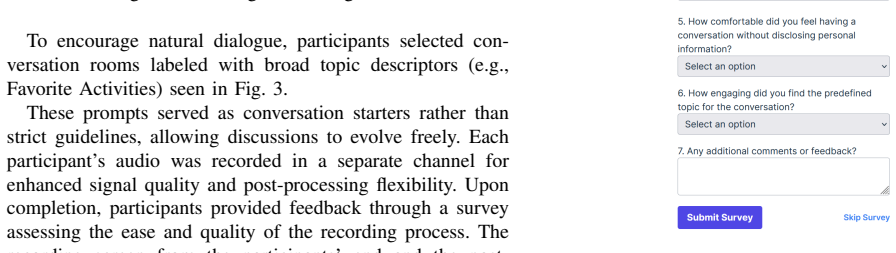
The load-bearing mechanism is the web-based recording pipeline built on Daily.co and Firebase: it pairs acquainted peers, offers topic prompts as conversation starters, records each participant's audio on a separate channel, and stores metadata in a SQL database. This per-channel design is what makes per-speaker ASR, diarization, and overlap analysis possible, while the acquaintance pairing is what keeps conversations natural. Post-processing, including Silero VAD for speech detection, WhisperX for word-level timestamps, and de-identification by replacing identifying names with silence, turns the raw recordings into a usable dataset.
What would settle it
Take a random 10-hour sample of the released conversations, have human annotators label speaker turns and overlaps on the combined two-channel audio, and recompute DER and JER against this manual reference. If the human-referenced DER for pyannote and NeMo falls well below the reported 25.93% and 30.77%, the central claim that CASPER is especially hard for diarization would be disproven; if it stays in the same range, the claim would survive.
Extended reading notes
Core claim
The central discovery is a reproducible pipeline that elicits natural conversations at scale: pairs of participants who already know each other register on a web platform, pick a broad topic prompt, and record a two-channel conversation from their own devices, with each channel captured separately. The released subset contains 102 hours of speech from 208 participants, with demographic metadata, train/test splits, and partial human transcriptions. On a 1.95-hour manually transcribed sample, Whisper-large-v3 reaches 0.31 WER and SeamlessM4T-large 0.53; on automatic diarization of the full release, pyannote.audio-v3.1 scores 25.93% DER and NeMo 30.77%. The paper interprets these results as evidence that spontaneous conversation is underrepresented in current training data and that CASPER can serve as a benchmark and resource for improving ASR, diarization, and speech-language models.
Load-bearing premise
The diarization error rates are only as trustworthy as the automatic WhisperX word-level timestamps used as ground truth; if those timestamps mislabel or miss overlapping speech, the reported difficulty of the dataset is not a reliable measure.
Editorial extensions
If this is right
- If CASPER delivers what it claims, training and evaluating ASR on it should lower word error rates on unscripted conversational speech, since the dataset contains exactly the disfluencies and turn-taking patterns that current models miss.
- The diarization baselines (DER roughly 26–31%) show clear headroom, making CASPER a public benchmark with fixed train/test splits for improving diarization under overlap and variable device acoustics.
- The per-channel recordings and speaker metadata enable research on speaker-conditional recognition, accent-robust ASR, and analysis of long-context dialogue coherence.
- The reproducible pipeline can be reused to grow the corpus toward the announced 1,000-hour goal and to collect spontaneous speech in other languages or settings.
Reading between the lines
- Because the diarization reference labels are generated by WhisperX timestamps per channel rather than by human annotation of the mixed conversation, the reported DER/JER may not be an accurate measure of true difficulty, especially in overlaps; a human-labeled diarization subset would settle this.
- The per-channel recording format makes CASPER a natural testbed for target-speaker extraction and source-separation methods, which the paper does not evaluate.
- The 'callback' long-context dependencies could be turned into a benchmark for discourse coherence and dialogue-state tracking, an extension beyond the paper's ASR and diarization focus.
- The acquaintance-recruitment method could be compared against crowdsourced stranger recruitment on measures of naturalness and engagement, offering a direct test of the paper's claim that familiarity drives conversational quality.
Editorial analysis
A structured set of objections, weighed in public.
Referee Report
Summary. The paper introduces CASPER, a spontaneously spoken English conversation dataset collected from pairs of acquaintances via a web-based platform with per-participant audio channels. The authors report 200 hours of recorded audio, 158 hours of estimated speech, and a public release of 102 hours with train/test splits, speaker metadata, and partial transcriptions. They describe their collection pipeline, de-identification method, metadata statistics, and baseline experiments: ASR (Whisper-large-v3 and SeamlessM4T-large) on a 1.95-hour manually transcribed subset, and speaker diarization (pyannote.audio v3.1 and NeMo) on the full 102-hour release using a WhisperX-generated reference. Baseline WERs are 0.31 and 0.53; DER ranges from 25.93% (pyannote) to 30.77% (NeMo), with corresponding JER values. The paper argues that these error rates show CASPER is challenging for current systems and valuable for spontaneous-speech research.
Significance. If the dataset and its baselines are reliable, CASPER addresses a real scarcity of large-scale spontaneous conversational speech with a reproducible collection framework, per-speaker channels, and rich self-reported metadata. Releasing the pipeline and the first 102 hours is a concrete contribution to the community. The strongest assets are the scale relative to existing spontaneous-speech resources, the recording of acquainted pairs (which plausibly increases naturalness), and the open availability. However, the paper's evidence that CASPER is a difficult benchmark rests on two evaluation pillars: a small ASR sample and a machine-generated diarization reference. The diarization reference in particular has not been validated against human annotation, so the magnitude of the reported difficulty is uncertain. These issues are fixable with additional analyses and should be addressed before the dataset's benchmark claims are accepted.
major comments (3)
- [IV.C.2 (Diarization)] The diarization reference labels are generated automatically by WhisperX forced alignment on each participant's isolated channel and then mapped onto the combined recording. This is not a human-annotated ground truth. DER/JER computed against such a reference measure agreement with WhisperX's word-level timestamps, not with true speaker activity. On spontaneous speech with disfluencies, crosstalk, and overlaps, WhisperX alignment is known to exhibit boundary drift, missed words, and spurious insertions, all of which would inflate the reported error rates. Because Table IV is the paper's primary evidence that CASPER is challenging for diarization systems, the central claim is contingent on the accuracy of an unvalidated reference. I request a manual validation subset (e.g., 30–60 minutes stratified across conversations) in which segment boundaries and speaker labels are annotated by humans, allowing computation of reference-quality metrics and corrected DER/JER. Without this, the reported 25.93–33.87% error rates cannot be interpreted as measuring the difficulty of CASPER.
- [IV.C.1 (ASR)] Table III reports WER on a 1.95-hour sample of the dataset. This is less than 2% of the released audio, and the paper gives no information about how many conversations or speakers are included, how the sample was stratified (or not) across accent, device, or recording conditions, or any confidence intervals. For conversational speech with high per-conversation variability, a sample of this size makes the claim that CASPER 'highlights the challenges of spontaneous speech' statistically fragile. The authors should report the sample composition (number of conversations, speakers, gender/accent distribution), compute confidence intervals by bootstrap across conversations, and ideally enlarge the evaluation set or show that the WER is stable across random subsamples. This does not require new data collection, only more care in reporting the existing manual transcript effort.
- [III.D (De-Identification)] The de-identification procedure replaces occurrences of participant-provided names with silence based on WhisperX word-level timestamps. This introduces artificial silent gaps into the released audio. The paper does not quantify what fraction of the audio is affected, nor does it discuss how these gaps interact with the downstream evaluations. For ASR, if the reference transcripts omit the silenced regions, the WER is computed on a modified signal that no longer reflects fully natural speech. For diarization, the WhisperX-derived reference is generated after the same silencing, so consistency is preserved operationally, but the resulting reference—and the benchmark—depend on the de-identification implementation. At minimum, the paper should state the proportion of audio replaced by silence, describe how the reference transcripts treat these regions, and discuss whether the silence replacement could bias the naturalness or the error rates.
minor comments (7)
- [III.A/D and IV] The paper states that 'a significant portion' of conversations occurred between acquaintances but never reports the actual fraction. Since this is a claimed differentiator from crowdsourced datasets, a count or percentage in Table I or the text would be more informative.
- [IV.C.1] Please clarify whether the 1.95-hour ASR sample is drawn from the held-out 20% test split or from the full dataset, and specify the number of conversations and speakers included.
- [Table I] The accent category 'CMN English' is used without definition; please spell out that it refers to English influenced by Mandarin Chinese (Mandarin in ISO 639-3 is 'cmn').
- [III.C] There are typographical and spacing issues throughout, e.g., 'CAsualSpeech inPeerEngagement' in the introduction, 'V AD' for voice activity detection in Section III.C, and inconsistent spacing around citation markers. A thorough copyedit is needed.
- [References/Footnotes] The code link is given through an anonymous.4open.science URL, which is appropriate for anonymized review but should be replaced with a permanent public repository before publication. The HuggingFace dataset link should also be listed as a resource in the conclusion.
- [IV.B.2] The 'naturalness' claim is supported only by a single transcript excerpt. Adding simple quantitative measures—such as filler-word rate, restart frequency, or overlap ratio—would strengthen the characterization of spontaneous speech without requiring additional annotation.
- [IV.C.2] The sentence 'We evaluated the 102 hours of publicly available conversations' is ambiguous about whether this is 102 hours of total audio or 102 hours of speech after VAD. Please clarify.
Circularity Check
No significant circularity: the dataset paper reports external benchmark measurements, and the WhisperX-based diarization reference is a validity concern, not a circular derivation.
full rationale
CASPER is a data collection and benchmarking paper; there is no formal derivation whose conclusion is reused as an input. The central claim, that the released corpus is large-scale, spontaneous, and challenging for current ASR and diarization systems, is supported by the collection procedure, transcript examples, and benchmark results. The ASR baselines (Whisper-large-v3 and SeamlessM4T-large) and diarization baselines (pyannote.audio-v3.1 and NeMo) were trained on external data and are not fitted or tuned on CASPER, so the reported WER, DER, and JER are genuine out-of-domain measurements rather than predictions forced by the dataset. The only substantive caveat is in Section IV.C.2, where reference speech segments for diarization are generated by WhisperX word-level timestamps on each participant's channel rather than by manual annotation of the combined conversation. This could make Table IV measure agreement with WhisperX's alignments rather than true speaker activity, but that is a benchmark-validity issue, not circularity: the evaluated diarization systems are distinct from WhisperX, and the numbers are not derived from the paper's own claims. No equation is reused as its own premise, no fitted parameter is renamed a prediction, and no load-bearing argument rests on a self-citation. The paper is therefore self-contained with respect to circularity concerns, and the honest finding is no significant circularity with score 0.
Assumptions & free parameters
free parameters (2)
- Minimum conversation duration threshold =
10 seconds
- ASR benchmark subset size =
1.95 hours
assumptions (5)
- domain assumption Pairs of acquaintances produce more natural, spontaneous conversations than strangers.
- domain assumption Broad topic prompts work as conversation starters without steering the dialogue into scripted content.
- domain assumption Self-reported demographic metadata (age, accent, native language, device) is accurate.
- domain assumption WhisperX word-level timestamps per channel yield a correct reference for diarization when mapped onto the combined audio.
- domain assumption The 1.95-hour randomly sampled subset is representative of the full 102-hour release for ASR evaluation.
Cite this review
Pith. "Pith review of CASPER: A Large Scale Spontaneous Speech Dataset." pith.science (2026). https://pith.science/paper/MTZBYOIC
@misc{pith2026250600267,
  author       = {Pith},
  title        = {Pith review of: CASPER: A Large Scale Spontaneous Speech Dataset},
  year         = {2026},
  howpublished = {\url{https://pith.science/paper/MTZBYOIC}},
  note         = {Machine review of arXiv:2506.00267}
}
read the original abstract
The success of large language models has driven interest in developing similar speech processing capabilities. However, a key challenge is the scarcity of high-quality spontaneous speech data, as most existing datasets contain scripted dialogues. To address this, we present a novel pipeline for eliciting and recording natural dialogues and release our dataset with 100+ hours of spontaneous speech. Our approach fosters fluid, natural conversations while encouraging a diverse range of topics and interactive exchanges. Unlike traditional methods, it facilitates genuine interactions, providing a reproducible framework for future data collection. This paper introduces our dataset and methodology, laying the groundwork for addressing the shortage of spontaneous speech data. We plan to expand this dataset in future stages, offering a growing resource for the research community.
Figures


Figures from the paper (2 more)

Reference graph
Works this paper leans on
-
[1]
Llama 2: Open foundation and fine-tuned chat models,
H. Touvron, L. Martin, K. Stone, P. Albert, A. Almahairi, Y . Babaei, N. Bashlykov, S. Batra, P. Bhargava, S. Bhosaleet al., “Llama 2: Open foundation and fine-tuned chat models,”arXiv preprint arXiv:2307.09288, 2023
arXiv 2023
-
[2]
A. Dubey, A. Jauhri, A. Pandey, A. Kadian, A. Al-Dahle, A. Letman, A. Mathur, A. Schelten, A. Yang, A. Fanet al., “The llama 3 herd of models,”arXiv preprint arXiv:2407.21783, 2024
arXiv 2024
-
[3]
Prompted llms as chatbot modules for long open-domain conversation,
Y . K. Singh, D. Pant, S. M. Askari, and S. K. Pandey, “Prompted llms as chatbot modules for long open-domain conversation,” inEmerging Trends in Computer Science and Its Application. CRC Press, 2025, pp. 437–443
work page 2025
-
[4]
Y . Chen, X. Xing, J. Lin, H. Zheng, Z. Wang, Q. Liu, and X. Xu, “Soulchat: Improving llms’ empathy, listening, and comfort abilities through fine-tuning with multi-turn empathy conversations,” inFindings of the Association for Computational Linguistics: EMNLP 2023, 2023, pp. 1170–1183
work page 2023
-
[5]
X. Zhang, H. Liu, K. Xu, Q. Zhang, D. Liu, B. Ahmed, and J. Epps, “When llms meets acoustic landmarks: An efficient approach to integrate speech into large language models for depression detection,”arXiv preprint arXiv:2402.13276, 2024
work page Pith review arXiv 2024
-
[6]
Qwen-audio: Advancing universal audio understanding via unified large-scale audio-language models,
Y . Chu, J. Xu, X. Zhou, Q. Yang, S. Zhang, Z. Yan, C. Zhou, and J. Zhou, “Qwen-audio: Advancing universal audio understanding via unified large-scale audio-language models,”arXiv preprint arXiv:2311.07919, 2023
arXiv 2023
-
[7]
Z. Du, Q. Chen, S. Zhang, K. Hu, H. Lu, Y . Yang, H. Hu, S. Zheng, Y . Gu, Z. Maet al., “Cosyvoice: A scalable multilingual zero-shot text-to-speech synthesizer based on supervised semantic tokens,”arXiv preprint arXiv:2407.05407, 2024
arXiv 2024
-
[8]
Cosyvoice 2: Scalable streaming speech synthesis with large language models,
Z. Du, Y . Wang, Q. Chen, X. Shi, X. Lv, T. Zhao, Z. Gao, Y . Yang, C. Gao, H. Wanget al., “Cosyvoice 2: Scalable streaming speech synthesis with large language models,”arXiv preprint arXiv:2412.10117, 2024
arXiv 2024
Show all 32 references
-
[9]
Librispeech: an asr corpus based on public domain audio books,
V . Panayotov, G. Chen, D. Povey, and S. Khudanpur, “Librispeech: an asr corpus based on public domain audio books,” in2015 IEEE international conference on acoustics, speech and signal processing (ICASSP). IEEE, 2015, pp. 5206–5210
2015
-
[10]
Gigaspeech: An evolving, multi- domain asr corpus with 10,000 hours of transcribed audio,
G. Chen, S. Chai, G. Wang, J. Du, W.-Q. Zhang, C. Weng, D. Su, D. Povey, J. Trmal, J. Zhanget al., “Gigaspeech: An evolving, multi- domain asr corpus with 10,000 hours of transcribed audio,”arXiv preprint arXiv:2106.06909, 2021
2021 arXiv
-
[11]
Switchboard: Telephone speech corpus for research and development,
J. J. Godfrey, E. C. Holliman, and J. McDaniel, “Switchboard: Telephone speech corpus for research and development,” inAcoustics, speech, and signal processing, ieee international conference on, vol. 1. IEEE Computer Society, 1992, pp. 517–520
1992
-
[12]
Speechgpt: Empowering large language models with intrinsic cross- modal conversational abilities,
D. Zhang, S. Li, X. Zhang, J. Zhan, P. Wang, Y . Zhou, and X. Qiu, “Speechgpt: Empowering large language models with intrinsic cross- modal conversational abilities,” inFindings of the Association for Computational Linguistics: EMNLP 2023, 2023, pp. 15 757–15 773
2023
-
[13]
Generative spoken dialogue language modeling,
T. A. Nguyen, E. Kharitonov, J. Copet, Y . Adi, W.-N. Hsu, A. Elkahky, P. Tomasello, R. Algayres, B. Sagot, A. Mohamedet al., “Generative spoken dialogue language modeling,”Transactions of the Association for Computational Linguistics, vol. 11, pp. 250–266, 2023
2023
-
[14]
Audi- olm: a language modeling approach to audio generation,
Z. Borsos, R. Marinier, D. Vincent, E. Kharitonov, O. Pietquin, M. Shar- ifi, D. Roblek, O. Teboul, D. Grangier, M. Tagliasacchiet al., “Audi- olm: a language modeling approach to audio generation,”IEEE/ACM transactions on audio, speech, and language processing, vol. 31, pp. 2...
2023
-
[15]
On gener- ative spoken language modeling from raw audio,
K. Lakhotia, E. Kharitonov, W.-N. Hsu, Y . Adi, A. Polyak, B. Bolte, T.-A. Nguyen, J. Copet, A. Baevski, A. Mohamedet al., “On gener- ative spoken language modeling from raw audio,”Transactions of the Association for Computational Linguistics, vol. 9, pp. 1336–1354, 2021
2021
-
[16]
Moshi: a speech-text foundation model for real-time dialogue,
A. D ´efossez, L. Mazar ´e, M. Orsini, A. Royer, P. P ´erez, H. J ´egou, E. Grave, and N. Zeghidour, “Moshi: a speech-text foundation model for real-time dialogue,”arXiv preprint arXiv:2410.00037, 2024
2024 arXiv
-
[17]
Callhome american english transcripts,
P. Kingsbury, S. Strassel, C. McLemore, and R. McIntyre, “Callhome american english transcripts,” Philadelphia, 1997, lDC Catalog No.: LDC97T14, ISBN: 1-58563-112-4, ISLRN: 707-070-566-734-1. [Online]. Available: https://catalog.ldc.upenn.edu/LDC97T14
1997
-
[18]
Santa barbara corpus of spoken american english,
J. W. Du Bois, “Santa barbara corpus of spoken american english,” Linguistic Data Consortium, 2000
2000
-
[19]
The hcrc map task corpus,
A. H. Anderson, M. Bader, E. G. Bard, E. Boyle, G. Doherty, S. Garrod, S. Isard, J. Kowtko, J. McAllister, J. Milleret al., “The hcrc map task corpus,”Language and speech, vol. 34, no. 4, pp. 351–366, 1991
1991
-
[20]
The casual conversations v2 dataset,
B. Porgali, V . Albiero, J. Ryda, C. C. Ferrer, and C. Hazirbas, “The casual conversations v2 dataset,” inProceedings of the IEEE/CVF Conference on Computer Vision and Pattern Recognition, 2023, pp. 10– 17
2023
-
[21]
Scalable spontaneous speech dataset (SSSD): Crowdsourcing data collection to promote dialogue research,
Z. Sheikh, S. Shimizu, S. Arora, J. Shi, S. Cornell, X. Li, and S. Watan- abe, “Scalable spontaneous speech dataset (SSSD): Crowdsourcing data collection to promote dialogue research,” inInterspeech 2025, 2025
2025
-
[22]
Silero models: pre-trained enterprise-grade stt / tts models and benchmarks,
S. Team, “Silero models: pre-trained enterprise-grade stt / tts models and benchmarks,” https://github.com/snakers4/silero-models, 2021
2021
-
[23]
Robust speech recognition via large-scale weak supervision,
A. Radford, J. W. Kim, T. Xu, G. Brockman, C. McLeavey, and I. Sutskever, “Robust speech recognition via large-scale weak supervision,” 2022. [Online]. Available: https://arxiv.org/abs/2212.04356
2022 arXiv
-
[24]
Whisperx: Time-accurate speech transcription of long-form audio,
M. Bain, J. Huh, T. Han, and A. Zisserman, “Whisperx: Time-accurate speech transcription of long-form audio,”INTERSPEECH 2023, 2023
2023
-
[25]
Seamlessm4t: Massively multilingual & multimodal machine translation,
S. Communication, L. Barrault, Y .-A. Chung, M. C. Meglioli, D. Dale, N. Dong, P.-A. Duquenne, H. Elsahar, H. Gong, K. Heffernan, J. Hoffman, C. Klaiber, P. Li, D. Licht, J. Maillard, A. Rakotoarison, K. R. Sadagopan, G. Wenzek, E. Ye, B. Akula, P.-J. Chen, N. E. Hachem, B. El...
2023 arXiv
-
[26]
wav2vec 2.0: A framework for self-supervised learning of speech representations,
A. Baevski, H. Zhou, A. Mohamed, and M. Auli, “wav2vec 2.0: A framework for self-supervised learning of speech representations,” CoRR, vol. abs/2006.11477, 2020. [Online]. Available: https://arxiv.org/ abs/2006.11477
2006 arXiv
-
[27]
pyannote.audio 2.1 speaker diarization pipeline: principle, benchmark, and recipe,
H. Bredin, “pyannote.audio 2.1 speaker diarization pipeline: principle, benchmark, and recipe,” inProc. INTERSPEECH 2023, 2023
2023
-
[28]
Powerset multi-class cross entropy loss for neural speaker diarization,
A. Plaquet and H. Bredin, “Powerset multi-class cross entropy loss for neural speaker diarization,” inProc. INTERSPEECH 2023, 2023
2023
-
[30]
End-to-End Neural Speaker Diarization with Permutation-free Objec- tives,
Y . Fujita, N. Kanda, S. Horiguchi, K. Nagamatsu, and S. Watanabe, “End-to-End Neural Speaker Diarization with Permutation-free Objec- tives,” inInterspeech, 2019, pp. 4300–4304
2019
-
[31]
Titanet: Neural model for speaker representation with 1d depth-wise separable convolutions and global context,
N. R. Koluguri, T. Park, and B. Ginsburg, “Titanet: Neural model for speaker representation with 1d depth-wise separable convolutions and global context,” 2021. [Online]. Available: https: //arxiv.org/abs/2110.04410
2021 arXiv
-
[32]
Marblenet: Deep 1d time- channel separable convolutional neural network for voice activity detection,
F. Jia, S. Majumdar, and B. Ginsburg, “Marblenet: Deep 1d time- channel separable convolutional neural network for voice activity detection,” 2021. [Online]. Available: https://arxiv.org/abs/2010.13886
2021 arXiv
-
[2019]
Available: http://arxiv.org/abs/1909.09577
[Online]. Available: http://arxiv.org/abs/1909.09577
1909 arXiv
Reviewed August 7, 2026 · model on record in the stance chip above.
Discussion (0). Sign in to comment.