REVIEW 4 major objections 4 minor 98 references
Typical star-forming galaxies at z≈5.5 escape less than 32% of their Lyman-alpha photons, an H-alpha-selected JWST sample finds.
Reviewed by Pith at T0; open to challenge. T0 means a machine referee read the full paper against a public rubric. the ladder, T0–T4 →
T0 review · deepseek-v4-flash
2026-08-01 01:27 UTC pith:MUB63TWO
load-bearing objection A genuinely Lyα-unbiased Hα-selected sample at z≈5.5, but the headline escape fraction is not reproducible from the printed table and the galaxy count is inconsistent; worth refereeing after those are fixed. the 4 major comments →
Lyα Escape in JWST/NIRCam F430M-Selected Hα Emitters at zsimeq5.5
The pith
A machine-rendered reading of the paper's core claim, the machinery that carries it, and where it could break.
Core claim
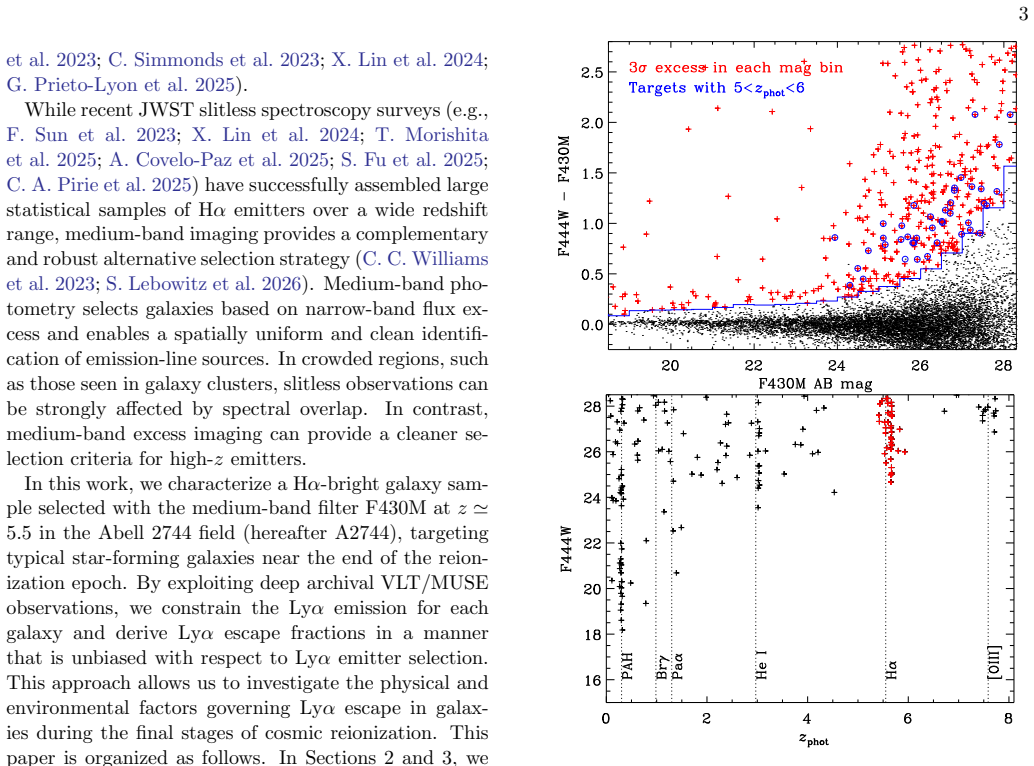
The paper claims that among H-alpha-selected star-forming galaxies at z≈5.5, Lyman-alpha escape is rare and inefficient: the population-averaged escape fraction is conservatively bounded by ⟨f_esc⟩ < 0.32, with only about 30% of galaxies showing detectable Lyman-alpha. Lyman-alpha detections occur preferentially in dust-free systems, while the escape fraction does not track star-formation rate, pointing to a stochastic, environment-dependent escape process. Three of the four detected sources lie in a known overdense structure at z≈5.66, hinting that local ionizing radiation may open transparent channels for Lyman-alpha photons.
What carries the argument
The central identity is f_esc^Lyα = L_obs(Lyα) / (8.7 × L_int(Hα)), where the intrinsic H-alpha luminosity is derived from the F430M medium-band excess and corrected for dust using a standard attenuation law with a fixed stellar-to-nebular reddening ratio; non-detections are converted to 3σ upper limits assuming a 200 km/s line width, and the population average uses a survival-analysis estimator that handles censored data. This converts a JWST medium-band photometric excess into an absolute Lyman-alpha escape fraction without ever selecting on Lyman-alpha itself.
Load-bearing premise
The whole calculation rests on assuming that intrinsic Lyman-alpha luminosity is exactly 8.7 times the dust-corrected H-alpha luminosity, an assumption that depends on the adopted dust correction and on Case B recombination.
What would settle it
Measure the actual Lyman-alpha line widths of the non-detected galaxies (or obtain Balmer-decrement dust corrections): if typical lines are broader than the assumed 200 km/s, the 3σ flux limits are underestimated and the population average could rise above 0.32; if deeper observations still find no Lyman-alpha in those systems, the bound is strengthened.
If this is right
- Typical galaxies at z≈5.5 are not efficient Lyman-alpha leakers; Lyα-selected samples over-represent a minority of favorable systems.
- Dust content, rather than star-formation rate, is the main internal gate for Lyman-alpha escape in this population.
- The overdensity association implies local environment—possibly ionized bubbles—can boost Lyα transmission, complicating interpretations of Lyα as a pure reionization probe.
- The H-alpha-selected framework is transferable to other redshifts via other NIRCam medium-band filters, enabling a systematic, less biased measurement of how f_esc evolves.
Where Pith is reading between the lines
- If the low average escape fraction holds, estimates of the star-formation rate density at z≈5.5 from Lyman-alpha luminosity functions may be undercounted by a factor of several.
- The single cluster field leaves cosmic variance open; repeating this measurement in several independent fields would show whether the overdensity association is a general environmental effect or a chance alignment.
- A sensitivity flag: the paper's non-detection limits assume a representative 200 km/s line width; if actual Lyα lines are broader, those 3σ upper limits—and the <0.32 average—could shift upward.
- A manuscript inconsistency: the abstract reports 3 detections out of 12 galaxies, while the body and Table 1 list 4 detections out of 13; the quoted escape-fraction bound uses the 13-galaxy sample.
Editorial analysis
A structured set of objections, weighed in public.
Referee Report
Summary. The paper constructs an Hα-selected sample of 41 galaxies at z~5.5 in the Abell 2744 field using JWST/NIRCam F430M medium-band excess, and analyzes the 13 objects covered by archival VLT/MUSE data to measure or limit Lyα emission. The intrinsic Lyα production is anchored to dust-corrected Hα under Case B (Lyα/Hα = 8.7), and individual escape fractions f_esc^Lyα are derived from Eq. (4). Lyα is reported in four of the 13 MUSE-covered entries, two of which are lensed images of the same galaxy (IDs 22444 and 27262). Combining detections and 3σ upper limits, the paper claims a conservative population-averaged upper limit <f_esc^Lyα> < 0.32 (Eq. 5), and interprets the results as evidence that efficient Lyα escape is restricted to a minority of low-dust systems, with a possible environmental enhancement in a known overdensity at z~5.66.
Significance. The Hα-selected, Lyα-unbiased approach is a genuinely useful complement to LAE-selected and UV-selected samples, and the combination of JWST medium-band imaging with archival MUSE spectroscopy is scalable to other fields and redshifts. If the headline upper limit survives a transparent recalculation, it would provide a meaningful constraint on the Lyα escape fraction of typical star-forming galaxies near the end of reionization. The study is observational, uses standard external calibrations (Case B, Calzetti attenuation, Kennicutt & Evans SFR), and does not introduce fitted parameters into the f_esc definition; these are strengths. However, the small sample size and the internal inconsistencies described below currently prevent verification of the central quantitative claim.
major comments (4)
- [§3, Eq. (5), Table 1] The headline bound <f_esc^Lyα> < 0.32 is not reproducible from the data as presented. Directly substituting the Table 1 entries into Eq. (5) — summing the observed Lyα luminosities and the 3σ upper limits over all 13 entries and dividing by Σ 8.7×L_int_Hα — yields approximately 0.19, not <0.32. The text states that the mean Lyα luminosity is estimated with the Kaplan–Meier estimator (Appendix B), but Eq. (5) as written is a simple ratio of sums, and the connection between these two procedures is not shown. Because the two lensed images give f_esc values that differ at the ~4σ level (0.50±0.03 and 0.38±0.01), the final number depends on how the duplicate is collapsed. Please provide an explicit, step-by-step calculation with a well-defined unique-object sample, a clear censoring rule, and an uncertainty estimate on the upper bound.
- [Abstract vs. §§2.5, 3, 4] The sample definition is inconsistent across the manuscript. The abstract states Lyα is detected in 3 out of 12 galaxies, while Sections 2.5 and 3 state 4 out of 13 Hα emitters with MUSE coverage, and Section 4 refers to '3 unique systems'. Since IDs 22444 and 27262 are multiple images of the same source, there are 12 unique galaxies but 13 entries. The detection fraction is either 4/13 (entries) or 3/12 (unique objects), and the ~30% detection rate quoted in Section 3 is not invariant to this choice. Please adopt a single convention, define 'galaxy' versus 'detection' explicitly, and apply it consistently in the abstract, main text, tables, and figure captions.
- [§4, Figure 11] The environmental claim is confounded by the lensed duplicate. The sentence 'The association of 3 (out of 4) Lyα detections (corresponding to 3 unique systems; see Section 2.2)' is incorrect if the three overdensity detections include both 22444 and 27262, because those two entries are one unique system. If instead the three detections are three different unique systems, then the 'remaining source projected close to it' must be a duplicate of one of them, and the text should say so. The claimed environmental enhancement depends on how this duplicate is counted; please specify which entries lie in the overdense region and re-express the result in terms of unique systems.
- [§2.4, Eq. (2)] The dust correction uses a fixed nebular-to-stellar reddening ratio f = 0.44. For sources with A_V ~ 0.5–0.8 (e.g., IDs 32191 and 62119), Eq. (2) gives A_Hα ~ 1.0–1.5 mag, corresponding to a factor ~2.5–4 in the inferred L_int_Hα and hence in f_esc. The statement that 'adopting different values of f would not significantly affect the inferred Hα luminosities' is not self-evident from the sample properties. Please provide a sensitivity test (e.g., recompute <f_esc^Lyα> for f = 0.44 ± 0.1 or using the SED-derived reddening directly) to show that the headline bound is robust.
minor comments (4)
- [§3] The sentence 'stacking analyses are limited by the small number of spectroscopic targets (six in total)' is unclear: the MUSE sample has 13 entries, and it is not obvious which six objects are meant. Please specify the subsample and the purpose of the stacking.
- [Appendix B] The Kaplan–Meier estimator is described for survival data with right censoring, but non-detections here are upper limits (left censoring). Please explain the adaptation to upper limits, or use an estimator appropriate for left-censored data, and clarify how the resulting mean luminosity enters Eq. (5).
- [Table 1] The table note states that f_esc differs at ~4σ between the two lensed images, but it is not clear whether this comparison is before or after correcting for differential magnification. Please state explicitly the convention used for f_esc in the table and in the note.
- [Figure 7] Red diamonds and red upper limits are used for this work; in the printed caption they may be hard to distinguish from other red symbols in the same figure. Consider using distinct shapes or a small legend panel.
Circularity Check
No significant circularity: the f_esc measurement is a standard observational ratio with no fitted parameters; the inner self-citations are not load-bearing.
full rationale
The paper's derivation chain is, at bottom, an observational measurement rather than a predictive or first-principles derivation. Equation (4) defines f_esc^Lyα = L_obs^Lyα / (8.7 × L_int^Hα), and every quantity entering it is either directly measured (MUSE Lyα flux, F430M excess converted to Hα flux) or converted through an external, parameter-free Case B recombination ratio (Lyα/Hα = 8.7, cited to Dopita & Sutherland 2003 and Osterbrock & Ferland 2006). The dust correction uses the Calzetti attenuation law with f = 0.44, an external calibration, and the paper explicitly states the result is insensitive to changing f because the sample has very low A_V. No parameter is fitted to the Lyα data and then renamed as a prediction. Equation (5) defines the population average as a luminosity-weighted ratio; substituting 3σ upper limits for non-detections makes the resulting number an upper bound, and the paper labels it as a conservative upper bound rather than an unbiased estimate, so the construction matches the claim. The self-citations present — Cheng et al. (2025) for the F430M selection strategy, Jiang et al. (2024) for NIRSpec aperture-loss limitations, and Sun et al. (2025) for consistency of the f = 0.44 dust ratio — are methodological or contextual. None is used to force the headline f_esc value, which depends on the MUSE and JWST measurements and the external Case B conversion. The reviewer-noted issues of reproducibility (naive Table 1 substitution giving ~0.19 rather than 0.32; dual counting of the lensed pair IDs 22444/27262; the terse Kaplan-Meier appendix) are transparency and statistical-definition concerns, not circularity: they do not make Eq. 4 or Eq. 5 equal to their inputs by construction. The central claim is therefore self-contained against external benchmarks, and no circular step can be quoted from the paper.
Axiom & Free-Parameter Ledger
free parameters (3)
- Nebular-to-stellar reddening ratio f =
0.44
- Assumed Lyα line width for non-detections =
200 km/s
- Case B Lyα/Hα ratio =
8.7
axioms (3)
- domain assumption Intrinsic Lyα production is proportional to dust-corrected Hα under Case B recombination.
- domain assumption The Calzetti attenuation law with f=0.44 accurately describes dust attenuation in these high-redshift galaxies.
- domain assumption The F430M excess is dominated by Hα and contamination from [NII]/[SII] is negligible.
Cite this review
Pith. "Pith review of Ly$\alpha$ Escape in JWST/NIRCam F430M-Selected H$\alpha$ Emitters at $z\simeq5.5$." pith.science (2026). https://pith.science/paper/MUB63TWO
@misc{pith2026260725801,
  author       = {Pith},
  title        = {Pith review of: Ly$\alpha$ Escape in JWST/NIRCam F430M-Selected H$\alpha$ Emitters at $z\simeq5.5$},
  year         = {2026},
  howpublished = {\url{https://pith.science/paper/MUB63TWO}},
  note         = {Machine review of arXiv:2607.25801}
}
read the original abstract
We study the Ly$\alpha$ escape fraction ($f_{\rm esc}$) in an H$\alpha$-selected sample of star-forming galaxies at $z\simeq5.5$, identified via JWST/NIRCam F430M excess and covered by archival VLT/MUSE data. By anchoring the intrinsic Ly$\alpha$ production to H$\alpha$ emission, our approach provides a direct and Ly$\alpha$-unbiased probe of the escape of Ly$\alpha$ photons in galaxies with SFR $\gtrsim 0.1\,M_\odot\,{\rm yr^{-1}}$ at this epoch. Ly$\alpha$ emission is detected in 3 out of 12 galaxies covered by VLT/MUSE. Combining detections and upper limits, we place a conservative upper bound of $\langle f_{\rm esc}^{\rm Ly\alpha} \rangle < 0.32$ on the population-averaged Ly$\alpha$ escape fraction. We find that Ly$\alpha$ detections are preferentially associated with nearly dust-free systems, while no clear correlation between SFR and $f_{\rm esc}$, suggesting a stochastic picture of Ly$\alpha$ escape. Interestingly, three of the four Ly$\alpha$-detected galaxies reside within a known overdense structure, suggesting that local environment may further facilitate Ly$\alpha$ photons escape. Our H$\alpha$-selected approach establishes a general and scalable framework for probing Ly$\alpha$ escape by combining JWST medium- or narrow-band imaging with ground-based spectroscopic data, enabling systematic and less biased studies of Ly$\alpha$ visibility in typical star-forming galaxies during the post-reionization era.
Figures


Reference graph
Works this paper leans on
-
[1]
Ajiki , M., Taniguchi , Y., Fujita , S. S., et al. 2003, title A Subaru Search for Ly Emitters at Redshift 5.7 , , 126, 2091, 10.1086/378481
-
[2]
An , F. X., Zheng , X. Z., Hao , C.-N., Huang , J.-S., & Xia , X.-Y. 2017, title Extinction Correction Significantly Influences the Estimate of the Ly Escape Fraction , , 835, 116, 10.3847/1538-4357/835/2/116
-
[3]
Astropy Collaboration , Robitaille , T. P., Tollerud , E. J., et al. 2013, title Astropy: A community Python package for astronomy , , 558, A33, 10.1051/0004-6361/201322068
-
[4]
Astropy Collaboration , Price-Whelan , A. M., Sip o cz , B. M., et al. 2018, title The Astropy Project: Building an Open-science Project and Status of the v2.0 Core Package , , 156, 123, 10.3847/1538-3881/aabc4f
-
[5]
Astropy Collaboration , Price-Whelan , A. M., Lim , P. L., et al. 2022, title The Astropy Project: Sustaining and Growing a Community-oriented Open-source Project and the Latest Major Release (v5.0) of the Core Package , , 935, 167, 10.3847/1538-4357/ac7c74
-
[6]
Atek , H., Furtak , L. J., Oesch , P., et al. 2022, title The star formation burstiness and ionizing efficiency of low-mass galaxies , , 511, 4464, 10.1093/mnras/stac360
-
[7]
Atek , H., Kunth , D., Schaerer , D., et al. 2009, title Empirical estimate of Ly escape fraction in a statistical sample of Ly emitters , , 506, L1, 10.1051/0004-6361/200912787
-
[8]
Atek , H., Labb \'e , I., Furtak , L. J., et al. 2024, title Most of the photons that reionized the Universe came from dwarf galaxies , , 626, 975, 10.1038/s41586-024-07043-6
-
[9]
2023, title New high-precision strong lensing modeling of Abell 2744
Bergamini , P., Acebron , A., Grillo , C., et al. 2023, title New high-precision strong lensing modeling of Abell 2744. Preparing for JWST observations , , 670, A60, 10.1051/0004-6361/202244575
-
[10]
1996, title SExtractor: Software for source extraction
Bertin , E., & Arnouts , S. 1996, title SExtractor: Software for source extraction. , , 117, 393, 10.1051/aas:1996164
-
[11]
Bezanson , R., Labbe , I., Whitaker , K. E., et al. 2024, title The JWST UNCOVER Treasury Survey: Ultradeep NIRSpec and NIRCam Observations before the Epoch of Reionization , , 974, 92, 10.3847/1538-4357/ad66cf
-
[12]
2025, title Ly with SPICE: interpreting Ly emission at z > 5 , , 542, 128, 10.1093/mnras/staf1121
Bhagwat , A., Napolitano , L., Pentericci , L., Ciardi , B., & Costa , T. 2025, title Ly with SPICE: interpreting Ly emission at z > 5 , , 542, 128, 10.1093/mnras/staf1121
-
[13]
Blanc , G. A., Adams , J. J., Gebhardt , K., et al. 2011, title The HETDEX Pilot Survey. II. The Evolution of the Ly Escape Fraction from the Ultraviolet Slope and Luminosity Function of 1.9 < z < 3.8 LAEs , , 736, 31, 10.1088/0004-637X/736/1/31
-
[14]
Burnham , E., Wang , B., Leja , J., et al. 2026, title It's More Complicated Than You Think: A Forward Model to Infer the Recent Star Formation History, Bursty or Not, of Galaxy Populations , arXiv e-prints, arXiv:2601.20930, 10.48550/arXiv.2601.20930
-
[16]
Calzetti , D., Armus , L., Bohlin , R. C., et al. 2000, title The Dust Content and Opacity of Actively Star-forming Galaxies , , 533, 682, 10.1086/308692
doi:10.1086/308692 2000
-
[17]
Carnall , A. C., McLure , R. J., Dunlop , J. S., & Dav \'e , R. 2018, title Inferring the star formation histories of massive quiescent galaxies with BAGPIPES: evidence for multiple quenching mechanisms , , 480, 4379, 10.1093/mnras/sty2169
-
[18]
Carnall , A. C., McLure , R. J., Dunlop , J. S., et al. 2019, title The VANDELS survey: the star-formation histories of massive quiescent galaxies at 1.0 < z < 1.3 , , 490, 417, 10.1093/mnras/stz2544
-
[19]
Chen , Z., Stark , D. P., Mason , C., et al. 2024, title JWST spectroscopy of z 5-8 UV-selected galaxies: new constraints on the evolution of the Ly escape fraction in the reionization era , , 528, 7052, 10.1093/mnras/stae455
-
[20]
Cheng , C., Wang , X., Liang , P., et al. 2025, title Probing Obscured Star Formation in Galaxy Clusters Using JWST Medium-band Images: 3.3 m PAH Emitter Sample in A2744 , , 279, 43, 10.3847/1538-4365/ade147
-
[21]
Covelo-Paz , A., Giovinazzo , E., Oesch , P. A., et al. 2025, title An H view of galaxy buildup in the first 2 Gyr: Luminosity functions at z 4 - 6.5 from NIRCam/grism spectroscopy , , 694, A178, 10.1051/0004-6361/202452363
-
[22]
de Graaff , A., Brammer , G., Weibel , A., et al. 2025, title RUBIES: A complete census of the bright and red distant Universe with JWST/NIRSpec , , 697, A189, 10.1051/0004-6361/202452186
-
[23]
2014, title Ly Emitting Galaxies as a Probe of Reionisation , , 31, e040, 10.1017/pasa.2014.33
Dijkstra , M. 2014, title Ly Emitting Galaxies as a Probe of Reionisation , , 31, e040, 10.1017/pasa.2014.33
-
[24]
Dopita , M. A., & Sutherland , R. S. 2003, Astrophysics of the diffuse universe , 10.1007/978-3-662-05866-4
-
[25]
Downes , D., Solomon , P. M., & Radford , S. J. E. 1995, title New Observations and a New Interpretation of CO(3--2) in IRAS F10214+4724 , , 453, L65, 10.1086/309754
-
[26]
Duval , F., Schaerer , D., \"O stlin , G., & Laursen , P. 2014, title Lyman line and continuum radiative transfer in a clumpy interstellar medium , , 562, A52, 10.1051/0004-6361/201220455
-
[27]
Feigelson , E. D., & Nelson , P. I. 1985, title Statistical methods for astronomical data with upper limits. I. Univariate distributions. , , 293, 192, 10.1086/163225
doi:10.1086/163225 1985
-
[28]
Fox , C., Mahler , G., Sharon , K., & Remolina Gonz \'a lez , J. D. 2022, title The Strongest Cluster Lenses: An Analysis of the Relation between Strong Gravitational Lensing Strength and the Physical Properties of Galaxy Clusters , , 928, 87, 10.3847/1538-4357/ac5024
-
[29]
Fu , S., Sun , F., Jiang , L., et al. 2025, title Medium-band Astrophysics with the Grism of NIRCam In Frontier Fields (MAGNIF): Spectroscopic Census of H Luminosity Functions and Cosmic Star Formation at z 4.5 and 6.3 , , 987, 186, 10.3847/1538-4357/adddb1
-
[30]
Garel , T., Blaizot , J., Rosdahl , J., et al. 2021, title Ly as a tracer of cosmic reionization in the SPHINX radiation-hydrodynamics cosmological simulation , , 504, 1902, 10.1093/mnras/stab990
-
[31]
Goovaerts , I., Thai , T. T., Pello , R., et al. 2024, title Charting the Lyman- escape fraction in the range 2.9 < z < 6.7 and consequences for the LAE reionisation contribution , , 690, A302, 10.1051/0004-6361/202451432
-
[32]
1999, title Models for Dusty Ly Emitters at High Redshift , , 518, 138, 10.1086/307276
Haiman , Z., & Spaans , M. 1999, title Models for Dusty Ly Emitters at High Redshift , , 518, 138, 10.1086/307276
doi:10.1086/307276 1999
-
[33]
2015, title Lyman Alpha Emitting Galaxies in the Nearby Universe , , 32, e027, 10.1017/pasa.2015.25
Hayes , M. 2015, title Lyman Alpha Emitting Galaxies in the Nearby Universe , , 32, e027, 10.1017/pasa.2015.25
-
[34]
Hayes , M., Schaerer , D., \"O stlin , G., et al. 2011, title On the Redshift Evolution of the Ly Escape Fraction and the Dust Content of Galaxies , , 730, 8, 10.1088/0004-637X/730/1/8
-
[35]
Hayes , M., \"O stlin , G., Schaerer , D., et al. 2010, title Escape of about five per cent of Lyman- photons from high-redshift star-forming galaxies , , 464, 562, 10.1038/nature08881
-
[36]
E., Watson , D., Brammer , G., et al
Heintz , K. E., Watson , D., Brammer , G., et al. 2024, title Strong damped Lyman- absorption in young star-forming galaxies at redshifts 9 to 11 , Science, 384, 890, 10.1126/science.adj0343
-
[37]
Hezaveh , Y. D., Marrone , D. P., & Holder , G. P. 2012, title Size Bias and Differential Lensing of Strongly Lensed, Dusty Galaxies Identified in Wide-Field Surveys , , 761, 20, 10.1088/0004-637X/761/1/20
-
[38]
Hu , E. M., Cowie , L. L., Barger , A. J., et al. 2010, title An Atlas of z = 5.7 and z = 6.5 Ly Emitters , , 725, 394, 10.1088/0004-637X/725/1/394
-
[39]
Hu , E. M., Cowie , L. L., Capak , P., et al. 2004, title The Luminosity Function of Ly Emitters at Redshift z -0.5ex 5.7 , , 127, 563, 10.1086/381302
-
[40]
Hu , E. M., Cowie , L. L., McMahon , R. G., et al. 2002, title A Redshift z=6.56 Galaxy behind the Cluster Abell 370 , , 568, L75, 10.1086/340424
doi:10.1086/340424 2002
-
[41]
Hu , E. M., McMahon , R. G., & Cowie , L. L. 1999, title An Extremely Luminous Galaxy at Z = 5.74 , , 522, L9, 10.1086/312205
-
[42]
Hu , W., Wang , J., Zheng , Z.-Y., et al. 2019, title The Ly Luminosity Function and Cosmic Reionization at z 7.0: A Tale of Two LAGER Fields , , 886, 90, 10.3847/1538-4357/ab4cf4
-
[43]
Hu , W., Papovich , C., Shen , L., et al. 2026, title Using Ly α Transmitted Spectrum to Probe IGM Transmission and Identify Ionized Structures in Cosmic Reionization , arXiv e-prints, arXiv:2605.02539, 10.48550/arXiv.2605.02539
work page internal anchor Pith review Pith/arXiv arXiv doi:10.48550/arxiv.2605.02539 2026
-
[44]
Jaskot , A. E. 2025, title Ionizing Radiation Escape from Low-Redshift Galaxies and Its Connection to Cosmic Reionization , , 63, 45, 10.1146/annurev-astro-111324-074935
-
[45]
Jiang , H., Wang , X., Cheng , C., et al. 2024, title The Ly Nondetection by JWST NIRSpec of a Strong Ly Emitter at z = 5.66 Confirmed by MUSE , , 972, 121, 10.3847/1538-4357/ad61db
-
[46]
Jiang , L., Wu , J., Bian , F., et al. 2018, title A giant protocluster of galaxies at redshift 5.7 , Nature Astronomy, 2, 962, 10.1038/s41550-018-0587-9
-
[47]
Kakiichi , K., Jin , X., Wang , F., et al. 2025, title JWST ASPIRE: How Did Galaxies Complete Reionization? Evidence for Excess IGM Transmission around [O\, III ] Emitters during Reionization , arXiv e-prints, arXiv:2503.07074, 10.48550/arXiv.2503.07074
-
[48]
Kaplan, E. L., & Meier, P. 1958, title Nonparametric Estimation from Incomplete Observations, Journal of the American Statistical Association, 53, 457. http://www.jstor.org/stable/2281868
arXiv 1958
-
[49]
Kashino , D., Lilly , S. J., Matthee , J., et al. 2026, title EIGER. VII. The Evolving Relationship between Galaxies and the Intergalactic Medium in the Final Stages of Reionization , , 997, 280, 10.3847/1538-4357/ae2799
-
[50]
Kennicutt , R. C., & Evans , N. J. 2012, title Star Formation in the Milky Way and Nearby Galaxies , , 50, 531, 10.1146/annurev-astro-081811-125610
-
[51]
Kikuta , S., Ouchi , M., Shibuya , T., et al. 2023, title SILVERRUSH. XIII. A Catalog of 20,567 Ly Emitters at z = 2-7 Identified in the Full-depth Data of the Subaru/HSC-SSP and CHORUS Surveys , , 268, 24, 10.3847/1538-4365/ace4cb
-
[52]
Kneib , J.-P., Bonnet , H., Golse , G., et al. 2011, LENSTOOL: A Gravitational Lensing Software for Modeling Mass Distribution of Galaxies and Clusters (strong and weak regime) ,, Astrophysics Source Code Library, record ascl:1102.004 1102.004
2011
-
[53]
Konno , A., Ouchi , M., Shibuya , T., et al. 2018, title SILVERRUSH. IV. Ly luminosity functions at z = 5.7 and 6.6 studied with 1300 Ly emitters on the 14-21 deg ^ 2 sky , , 70, S16, 10.1093/pasj/psx131
-
[54]
Kornei , K. A., Shapley , A. E., Erb , D. K., et al. 2010, title The Relationship between Stellar Populations and Ly Emission in Lyman Break Galaxies , , 711, 693, 10.1088/0004-637X/711/2/693
-
[55]
Kroupa , P., & Boily , C. M. 2002, title On the mass function of star clusters , , 336, 1188, 10.1046/j.1365-8711.2002.05848.x
arXiv 2002
-
[56]
Laursen , P., Sommer-Larsen , J., & Razoumov , A. O. 2011, title Intergalactic Transmission and Its Impact on the Ly Line , , 728, 52, 10.1088/0004-637X/728/1/52
-
[57]
Lebowitz , S., Hainline , K. N., Juneau , S., et al. 2026, title Spatially Resolved AGN Ionization and Star Formation at Cosmic Noon with JWST/JEMS , arXiv e-prints, arXiv:2604.01271, 10.48550/arXiv.2604.01271
-
[58]
2017, title The MUSE Hubble Ultra Deep Field Survey
Leclercq , F., Bacon , R., Wisotzki , L., et al. 2017, title The MUSE Hubble Ultra Deep Field Survey. VIII. Extended Lyman- haloes around high-z star-forming galaxies , , 608, A8, 10.1051/0004-6361/201731480
-
[59]
Lin , X., Cai , Z., Wu , Y., et al. 2024, title Quantifying the Escape of Ly at z 5 6: A Census of Ly Escape Fraction with H -emitting Galaxies Spectroscopically Confirmed by JWST and VLT/MUSE , , 272, 33, 10.3847/1538-4365/ad3e7d
-
[60]
M., Koekemoer , A., Coe , D., et al
Lotz , J. M., Koekemoer , A., Coe , D., et al. 2017, title The Frontier Fields: Survey Design and Initial Results , , 837, 97, 10.3847/1538-4357/837/1/97
-
[61]
A., Treu , T., Dijkstra , M., et al
Mason , C. A., Treu , T., Dijkstra , M., et al. 2018 a , title The Universe Is Reionizing at z 7: Bayesian Inference of the IGM Neutral Fraction Using Ly Emission from Galaxies , , 856, 2, 10.3847/1538-4357/aab0a7
-
[62]
A., Treu , T., de Barros , S., et al
Mason , C. A., Treu , T., de Barros , S., et al. 2018 b , title Beacons into the Cosmic Dark Ages: Boosted Transmission of Ly from UV Bright Galaxies at z 7 , , 857, L11, 10.3847/2041-8213/aabbab
-
[63]
Meneghetti , M., Natarajan , P., Coe , D., et al. 2017, title The Frontier Fields lens modelling comparison project , , 472, 3177, 10.1093/mnras/stx2064
-
[64]
Mesinger , A., Aykutalp , A., Vanzella , E., et al. 2015, title Can the intergalactic medium cause a rapid drop in Ly emission at z > 6? , , 446, 566, 10.1093/mnras/stu2089
-
[65]
A., Roberts-Borsani , G., Oesch , P
Meyer , R. A., Roberts-Borsani , G., Oesch , P. A., & Ellis , R. S. 2025, title Probing patchy reionization with JWST: IGM opacity constraints from the Lyman forest of galaxies in legacy extragalactic fields , , 542, 1952, 10.1093/mnras/staf1312
-
[66]
Meyer , R. A., Kakiichi , K., Bosman , S. E. I., et al. 2020, title The role of galaxies and AGN in reionizing the IGM - III. IGM-galaxy cross-correlations at z 6 from eight quasar fields with DEIMOS and MUSE , , 494, 1560, 10.1093/mnras/staa746
-
[67]
Morishita , T., Liu , Z., Stiavelli , M., et al. 2025, title Accelerated Emergence of Evolved Galaxies in Early Overdensities at z 5.7 , , 982, 153, 10.3847/1538-4357/adb30f
-
[68]
P., Matthee , J., Kramarenko , I., et al
Naidu , R. P., Matthee , J., Kramarenko , I., et al. 2024, title All the Little Things in Abell 2744: > 1000 Gravitationally Lensed Dwarf Galaxies at z=0-9 from JWST NIRCam Grism Spectroscopy , arXiv e-prints, arXiv:2410.01874, 10.48550/arXiv.2410.01874
-
[69]
Napolitano , L., Pentericci , L., Santini , P., et al. 2024, title Peering into cosmic reionization: Ly visibility evolution from galaxies at z = 4.5-8.5 with JWST , , 688, A106, 10.1051/0004-6361/202449644
-
[70]
Ning , Y., Cai , Z., Jiang , L., et al. 2023, title An H Impression of Ly Galaxies at z ≃ 6 with Deep JWST/NIRCam Imaging , , 944, L1, 10.3847/2041-8213/acb26b
-
[71]
Ning , Y., Jiang , L., Zheng , Z.-Y., & Wu , J. 2022, title The Magellan M2FS Spectroscopic Survey of High-z Galaxies: Ly Emitters at z 6.6 and the Evolution of Ly Luminosity Function over z 5.7-6.6 , , 926, 230, 10.3847/1538-4357/ac4268
-
[72]
E., & Ferland , G
Osterbrock , D. E., & Ferland , G. J. 2006, Astrophysics of gaseous nebulae and active galactic nuclei
2006
-
[73]
2024, title The intrinsic distribution of Lyman- halos , , 690, A343, 10.1051/0004-6361/202451318
Pharo , J., Wisotzki , L., Urrutia , T., et al. 2024, title The intrinsic distribution of Lyman- halos , , 690, A343, 10.1051/0004-6361/202451318
-
[74]
Pirie , C. A., Best , P. N., Duncan , K. J., et al. 2025, title The JWST Emission Line Survey (JELS): an untargeted search for H emission line galaxies at z > 6 and their physical properties , , 541, 1348, 10.1093/mnras/staf1006
-
[75]
H., Bezanson , R., Labbe , I., et al
Price , S. H., Bezanson , R., Labbe , I., et al. 2025, title The UNCOVER Survey: First Release of Ultradeep JWST/NIRSpec PRISM Spectra for 700 Galaxies from z 0.3 13 in A2744 , , 982, 51, 10.3847/1538-4357/adaec1
-
[76]
Prieto-Lyon , G., Mason , C. A., Strait , V., et al. 2025, title Lyman-alpha emission at the end of reionization: line strengths and profiles from MMT and JWST observations at z -0.5ex 5-6 , arXiv e-prints, arXiv:2509.18302, 10.48550/arXiv.2509.18302
-
[77]
Schmitt , J. H. M. M. 1985, title Statistical analysis of astronomical data containing upper bounds: general methods and examples drawn from X-ray astronomy. , , 293, 178, 10.1086/163224
-
[78]
Shapley , A. E., Reddy , N. A., Sanders , R. L., Topping , M. W., & Brammer , G. B. 2023, title JWST/NIRSpec Measurements of the Relationships between Nebular Emission-line Ratios and Stellar Mass at z 3-6 , , 950, L1, 10.3847/2041-8213/acd939
-
[79]
Shimizu , S., Kashikawa , N., Kikuta , S., et al. 2025, title Age dependence of Ly escape fraction of Ly emitters and their significant role in cosmic reionization , , 542, 3125, 10.1093/mnras/staf1377
-
[80]
Simmonds , C., Tacchella , S., Maseda , M., et al. 2023, title The ionizing photon production efficiency at z 6 for Lyman-alpha emitters using JEMS and MUSE , , 523, 5468, 10.1093/mnras/stad1749
-
[81]
Songaila , A., Cowie , L. L., Barger , A. J., Hu , E. M., & Taylor , A. J. 2024, title A Spectral Atlas of Ly Emitters at z = 5.7 and z = 6.6 , , 971, 136, 10.3847/1538-4357/ad5674
discussion (0)
Sign in with ORCID, Apple, or X to comment. Anyone can read and Pith papers without signing in.