REVIEW 4 major objections 6 minor 40 references
PosNeg-Balanced Anchors with Aligned Features for Single-Shot Object Detection
T0 review · 4 major / 6 minor · reviewed 2026-08-14 · deepseek-v4-flash
Pith's one-line read A single-shot detector closes the gap to two-stage accuracy by promoting positive anchors and aligning features, reaching 40.0% mAP on MS COCO at 28.6 fps.
desk verdict Solid single-shot detector paper with a genuine module-design insight; the main gap is that the headline ResNet-101 result lacks a no-module baseline. read the letter →
The pith
A machine-rendered reading of the paper's core claim, the machinery that carries it, and where it could break.
The reading
What carries the argument
The Anchor Promotion Module (APM) and Feature Alignment Module (FAM). APM predicts a per-anchor positive score and regresses location and shape adjustments, so training the detection head sees many more and better-aligned positive boxes while easy negatives are discarded via a score threshold $\theta = 0.01$. FAM then applies deformable convolution, with offsets computed as a shared scalar translation $c$ learned from the location-change features plus a residual vector $\Delta s$ learned from the shape-change features (a "disentangled" decomposition), so that the features sampled for classification and regression correspond to the promoted anchors rather than the original grid. The two modules sit on an encoder-decoder backbone with skip connections, attaching to each decoder level.
What would settle it
Re-run Table 2's ablation (baseline, +APM_C, +APM_R, +APM, +APM+FAM) on ResNet-101 with 512×512 input on COCO minival: if the FAM increment over APM is well below 5.2 mAP, or if the full model falls short of 40.0% on test-dev, the scale-transfer assumption fails. A sharper check is to replace the disentangled offset ($c + \Delta s$) with the concatenated $F(X_l; X_s)$ at the full scale and compare the gap with the 0.7 mAP gap reported at 384×384.
Extended reading notes
Core claim
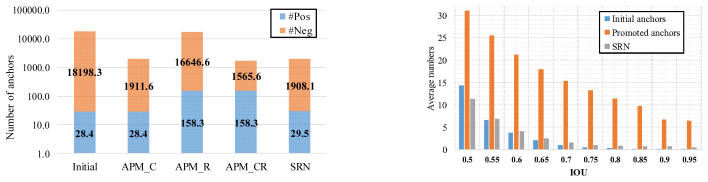
The central claim is that a dense single-shot detector can be made substantially more accurate by treating anchor boxes as editable entities: an Anchor Promotion Module (APM) scores each anchor's probability of being positive and regresses offsets to its center and size, turning some negative anchors into positive ones and improving the IoU of existing positives; this lifts the positive-to-negative ratio from roughly 1:625 to 1:10 during training. Because the promoted anchors no longer sit at original feature-grid locations, the paper introduces a Feature Alignment Module (FAM) that pools features using deformable convolution whose offsets are computed disentangled—a shared translation from the location-change branch and a per-kernel residual from the shape-change branch—rather than implicitly or by concatenating the two cues. On MS COCO test-dev the combined system reaches 40.0% mAP with ResNet-101 at 512×512 input and 28.6 fps, and ablation shows FAM contributes a 5.2 mAP gain over APM alone.
Load-bearing premise
The component-wise gains are measured only with VGG-16 at 384×384 input; the headline 40.0% mAP uses ResNet-101 at 512×512 with no per-component ablation, so the paper assumes APM and FAM transfer their gains to the heavier backbone and larger input unchanged.
Editorial extensions
If this is right
- At 384×384 with VGG-16, adding FAM on top of APM raises mAP from 31.7% to 34.8%, showing that alignment is what makes promoted anchors usable.
- On MS COCO test-dev, the ResNet-101 512×512 model reaches 40.0% mAP at 28.6 fps, outperforming RetinaNet-101-800 (37.8 mAP, ~5 fps) with several times the speed.
- Anchor promotion nearly quadruples small-object mAP in the ablation setting (12.1% to 18.6%), suggesting the method specifically addresses the recall problem that hurts small objects in dense detectors.
- Discarding low-score negatives at inference (scores below $\theta = 0.01$) means the promoted anchors and their scores are used end-to-end, not just as a training-time sampling trick.
- The ratio of positives to negatives during training improves from roughly 1:625 to 1:10, which is the direct mechanism the paper credits for easing the class imbalance.
Reading between the lines
- The "promote positives" recipe should transfer to anchor-free detectors: replacing grid points with predicted object-center candidates, then sampling features with the same disentangled offsets, could recover the small-object recall gains without dense anchor tiling.
- The disentangled offset decomposition—shared translation plus per-kernel residual—is a general way to inject known geometric transformations into deformable convolution; it could be applied to tracking or instance segmentation where motion or shape priors are available explicitly.
- The paper's own observation that gains shrink at IoU > 0.7 suggests that a cascade of promotion-and-alignment stages, trained at progressively higher IoU thresholds, might extend the method toward high-quality detection the way cascade R-CNN does for two-stage detectors.
- The ablation indicates the scoring branch (APM_C, +1.4 mAP) carries more weight than the regression branch alone (APM_R, +1.0 mAP), but the biggest jump comes from combining both and then aligning features, implying the two functions are complementary rather than redundant.
Signed reviews
Editorial analysis
A structured set of objections, weighed in public.
Referee Report
Summary. This manuscript proposes PADet, a single-shot object detector that combines an Anchor Promotion Module (APM) and a Feature Alignment Module (FAM). APM predicts the probability that each anchor is positive and adjusts its location and shape, thereby increasing the number of high-quality positive anchors while suppressing easy negatives. FAM uses the location and shape transformation information from APM to compute disentangled offsets for deformable convolution, aligning features to the promoted anchors. The detector uses an encoder-decoder backbone and is evaluated on MS COCO and PASCAL VOC with both VGG-16 and ResNet-101. The headline result is 40.0% mAP on MS COCO test-dev with ResNet-101 at 512×512 input at 28.6 fps. The ablations, all on VGG-16 at 384×384, show that APM and FAM together improve mAP from 29.6% to 34.8% on the COCO minival set.
Significance. The paper addresses a genuine problem in one-stage detection—foreground/background imbalance—by actively promoting positive anchors rather than only down-weighting easy negatives, which is a useful and timely direction. The FAM design is thoughtful, and the systematic comparison of offset-learning variants in Table 1 and component ablations in Table 2 are strengths. The method is evaluated on the external MS COCO benchmark, and the reported gains do not reduce by construction to the target metric. The release of code and the additional PASCAL VOC comparison add credibility. The main limitation is that all component analysis is confined to one backbone/input configuration, while the headline uses a different configuration, and the speed comparison is not controlled. If the transfer of APM/FAM gains across backbone and input scale can be demonstrated and the ResNet-101 configuration fully specified, the contribution would be solid.
major comments (4)
- [Section 4 and Table 6] All ablations in Tables 1–4 and the anchor statistics in Figures 1–2 are computed with VGG-16 at 384×384, while the headline 40.0 mAP (abstract and Table 6) is obtained with ResNet-101 at 512×512. No ResNet-101 baseline or component-wise ablation is reported, so the central claim that APM and FAM are responsible for the headline improvement rests on the untested assumption that the +2.1 mAP from APM and +3.1 mAP from FAM (Table 2) transfer when both the backbone and input resolution change. Because anchor stride, anchor density, and matching statistics depend on these settings, please add component ablations for ResNet-101 at 384 and 512 against a ResNet-101 encoder-decoder baseline, or at least verify that the VGG-16 gains persist at 512×512 before attributing the headline numbers to the modules.
- [Section 3, Backbone Network] The architecture description covers only the reduced VGG-16 backbone. Table 6 reports 'Ours ResNet-101 384×384' and 'Ours ResNet-101 512×512', but the paper never specifies how the encoder-decoder is adapted to ResNet-101: which ResNet stages are used, what strides and channels the decoder levels have, what anchor settings are used, and whether the training schedule differs from the VGG-16 setting. This missing specification prevents reproduction and verification of the central result. Please provide the full ResNet-101 configuration and any implementation differences.
- [Section 4.2, Table 6] The speed comparison is not controlled: the authors' FPS is measured on a GTX 1080 Ti with PyTorch 0.4.1, while the comparison values are quoted from other papers and libraries using different hardware and software. The abstract's claim of running at 28.6 fps and being 'faster' than alternatives is therefore not directly supported, and the '7.5× faster than RetinaNet-101-800' statement in Section 1 has the same issue. Several comparison rows also lack FPS values entirely (e.g., SSD ResNet-101, GA-RetinaNet, FSAF). Please either measure the comparison methods in the same environment or explicitly frame the speed numbers as indicative and soften the implied controlled comparison.
- [Section 3.1 and Section 4] The threshold θ=0.01 is central to the method's design, since it controls the positive/negative balance during training and the filtering of detections at inference, but no sensitivity analysis is reported, and all mAP values come from single runs. Because the main claimed gains are 2–3 mAP, it is important to know the effect of θ on the balance and final mAP, and ideally the variance across seeds. Please add a θ sweep (including θ=0) and, if possible, repeated runs for the main configurations in Tables 2 and 6.
minor comments (6)
- [Section 4.2] The sentence claiming results are obtained 'without multi-scale training and any testing tricks' is inconsistent with Section 3.3, which applies soft-NMS at inference; soft-NMS is generally considered a post-processing/testing technique and should be disclosed in that sentence.
- [Section 3.2] The text describes c as 'a scalar' in the disentangled offset formulation, but the module outputs 2 channels for c (an x,y translation) and 2K channels for Δs; please correct the terminology to avoid confusion.
- [Table 2 and Section 4.1] The text says adding the feature alignment module 'improves the performance by 5.2% mAP', but the table shows the full model (APM+FA) at 34.8 versus the APM-only model at 31.7, a 3.1-point gain; the 5.2-point figure appears to be the total gain from the 29.6 baseline. Please clarify which comparison is intended.
- [Section 1] There is a typo: 'RestinaNet-101-800' should be 'RetinaNet-101-800'.
- [Figure 5 and text after it] The text refers to 'Figure 5 (b∗)' but the figure panels are labeled (a), (b), and (c); please align the references with the panel labels.
- [Section 4.1, Table 4] The paper acknowledges that small-object improvements decrease rapidly with IoU and attributes this to only 34.3% of small ground-truth objects having more than 2×2 pixels at stride 8; this limitation is stated clearly, but it would be helpful to also report the number of small objects at each IoU range so the reader can assess the statistics.
Circularity Check
No significant circularity: the central mAP claims are benchmarked on external MS COCO data, and the APM/FAM gains are measured by standard evaluation rather than derived from their own definitions.
full rationale
Walked the claimed derivation chain: the paper's central claim is that the proposed PADet detector with APM and FAM reaches 40.0% mAP on MS COCO test-dev (abstract, Table 6). This is evaluated against an external benchmark with a fixed protocol, not against any quantity fitted by the model. The component analyses in Tables 1-4 measure mAP on the COCO minival set, and the differences (e.g., 31.7 to 34.8 mAP in Table 2) are empirical results of training with the stated losses in Section 3.3, whose targets are ground-truth boxes and class labels. No fitted parameter is renamed as a prediction, and no external result is invoked through a self-citation chain. The paper contains no self-citations; all references are to prior external work (SSD, RetinaNet, RefineDet, Deformable ConvNets, soft-NMS, etc.), and no uniqueness theorem or ansatz is imported from the authors' own prior papers. The anchor-promotion statistics in Figures 1-2 are diagnostics: since the APM regressor is optimized with smooth-L1 loss toward ground-truth boxes and positivity is defined by an IoU threshold, the observed increase in positive-anchor count is expected from the training objective. However, that statistic is not the main result, and the mAP improvements do not reduce by construction to that objective. The mismatch between VGG-16/384 ablations and the ResNet-101/512 headline result is a generalizability concern, not a circularity issue.
Assumptions & free parameters
free parameters (4)
- theta threshold =
0.01
- matching IoU thresholds =
0.5 positive, 0.3 negative
- DCN kernel size =
9
- soft-NMS parameters =
sigma=0.5, Nt=0.3
assumptions (4)
- domain assumption APM scores reliably rank anchor quality (IoU with ground truth).
- ad hoc to paper Disentangled offsets (location scalar c plus shape residual Delta s) are superior to concatenated or implicit offsets for feature alignment.
- domain assumption The encoder-decoder backbone (DSSD-like) provides sufficient semantic and detail information at every decoded level for both APM and detection.
- domain assumption Deformable convolution can effectively sample features at arbitrary shifted locations.
Cite this review
Pith. "Pith review of PosNeg-Balanced Anchors with Aligned Features for Single-Shot Object Detection." pith.science (2026). https://pith.science/paper/MUQRPDKP
@misc{pith2026190803295,
  author       = {Pith},
  title        = {Pith review of: PosNeg-Balanced Anchors with Aligned Features for Single-Shot Object Detection},
  year         = {2026},
  howpublished = {\url{https://pith.science/paper/MUQRPDKP}},
  note         = {Machine review of arXiv:1908.03295}
}
read the original abstract
We introduce a novel single-shot object detector to ease the imbalance of foreground-background class by suppressing the easy negatives while increasing the positives. To achieve this, we propose an Anchor Promotion Module (APM) which predicts the probability of each anchor as positive and adjusts their initial locations and shapes to promote both the quality and quantity of positive anchors. In addition, we design an efficient Feature Alignment Module (FAM) to extract aligned features for fitting the promoted anchors with the help of both the location and shape transformation information from the APM. We assemble the two proposed modules to the backbone of VGG-16 and ResNet-101 network with an encoder-decoder architecture. Extensive experiments on MS COCO well demonstrate our model performs competitively with alternative methods (40.0\% mAP on \textit{test-dev} set) and runs faster (28.6 \textit{fps}).
Figures


Figures from the paper (2 more)


Reference graph
Works this paper leans on
-
[1]
Rich feature hierarchies for accurate object detection and semantic segmentation
Ross Girshick, Jeff Donahue, Trevor Darrell, and Jitendra Malik. Rich feature hierarchies for accurate object detection and semantic segmentation. In CVPR, pages 580–587, 2014
2014
- [2]
-
[3]
Faster R-CNN: towards real-time object detection with region proposal networks
Shaoqing Ren, Kaiming He, Ross Girshick, and Jian Sun. Faster R-CNN: towards real-time object detection with region proposal networks. TPAMI, pages 1137–1149, 2017
work page 2017
-
[4]
Feature pyramid networks for object detection
Tsung-Yi Lin, Piotr Dollár, Ross Girshick, Kaiming He, Bharath Hariharan, and Serge Belongie. Feature pyramid networks for object detection. In CVPR, 2017
2017
-
[5]
Kaiming He, Georgia Gkioxari, Piotr Dollár, and Ross Girshick. Mask R-cnn. In ICCV, pages 2980–2988, 2017
work page 2017
-
[6]
RON: Reverse connection with objectness prior networks for object detection
Tao Kong, Fuchun Sun, Anbang Yao, Huaping Liu, Ming Lu, and Yurong Chen. RON: Reverse connection with objectness prior networks for object detection. In CVPR, pages 5244–5252, 2017
work page 2017
-
[7]
Focal loss for dense object detection
Tsung-Yi Lin, Priya Goyal, Ross Girshick, Kaiming He, and Piotr Dollár. Focal loss for dense object detection. In ICCV, pages 2980–2988, 2017
2017
-
[8]
Shifeng Zhang, Longyin Wen, Xiao Bian, Zhen Lei, and Stan Z. Li. Single-shot refinement neural network for object detection. In CVPR, 2018
work page 2018
Show all 40 references
-
[9]
Selective refinement network for high performance face detection
Cheng Chi, Shifeng Zhang, Junliang Xing, Zhen Lei, Stan Z Li, and Xudong Zou. Selective refinement network for high performance face detection. arXiv preprint arXiv:1809.02693, 2018
2018 arXiv
-
[10]
U-net: Convolutional networks for biomedical image segmentation
Olaf Ronneberger, Philipp Fischer, and Thomas Brox. U-net: Convolutional networks for biomedical image segmentation. In International Conference on Medical image computing and computer-assisted intervention, pages 234–241. Springer, 2015
2015
-
[11]
Microsoft COCO: Common objects in context
Tsung-Yi Lin et al. Microsoft COCO: Common objects in context. In ECCV, pages 740–755, 2014
2014
-
[12]
Spatial pyramid pooling in deep convolutional networks for visual recognition
Kaiming He, Xiangyu Zhang, Shaoqing Ren, and Jian Sun. Spatial pyramid pooling in deep convolutional networks for visual recognition. IEEE transactions on pattern analysis and machine intelligence, 37(9):1904–1916, 2015
1904
-
[13]
R-FCN: Object detection via region-based fully convolutional networks
Jifeng Dai, Yi Li, Kaiming He, and Jian Sun. R-FCN: Object detection via region-based fully convolutional networks. In NIPS, pages 379–387, 2016
2016
-
[14]
Deformable convolutional networks
Jifeng Dai, Haozhi Qi, Yuwen Xiong, Yi Li, Guodong Zhang, Han Hu, and Yichen Wei. Deformable convolutional networks. In ICCV, 2017
2017
-
[15]
Uijlings, K.E.A
J.R.R. Uijlings, K.E.A. van de Sande, T. Gevers, and A.W.M. Smeulders. Selective search for object recognition. IJCV, pages 154–171, 2013
2013
-
[16]
Mark Everingham, S. M. Ali Eslami, Luc Van Gool, Christopher K. I. Williams, John Winn, and Andrew Zisserman. The pascal visual object classes challenge: A retrospective. IJCV, pages 98–136, 2015
2015
-
[17]
Deep residual learning for image recognition
Kaiming He, Xiangyu Zhang, Shaoqing Ren, and Jian Sun. Deep residual learning for image recognition. In CVPR, pages 770–778, 2016
2016
-
[18]
Aggregated residual transformations for deep neural networks
Saining Xie, Ross Girshick, Piotr Dollár, Zhuowen Tu, and Kaiming He. Aggregated residual transformations for deep neural networks. arXiv preprint arXiv:1611.05431, 2016
2016 arXiv
-
[19]
You only look once: Unified, real-time object detection
Joseph Redmon, Santosh Divvala, Ross Girshick, and Ali Farhadi. You only look once: Unified, real-time object detection. In CVPR, pages 779–788, 2016
2016
-
[20]
Redmon and A
J. Redmon and A. Farhadi. Yolo9000: Better, faster, stronger. In CVPR, pages 6517–6525, 2017. 9
2017
-
[21]
Batch normalization: Accelerating deep network training by reducing internal covariate shift
Sergey Ioffe and Christian Szegedy. Batch normalization: Accelerating deep network training by reducing internal covariate shift. In International Conference on Machine Learning, pages 448–456, 2015
2015
-
[22]
Wei Liu, Dragomir Anguelov, Dumitru Erhan, Christian Szegedy, Scott Reed, Cheng-Yang Fu, and Alexander C. Berg. SSD: Single shot multibox detector. In ECCV, pages 21–37, 2016
2016
-
[23]
Receptive field block net for accurate and fast object detection
Songtao Liu, Di Huang, and Yunhong Wang. Receptive field block net for accurate and fast object detection. In ECCV, 2018
2018
-
[24]
Rapid object detection using a boosted cascade of simple features
Paul Viola, Michael Jones, et al. Rapid object detection using a boosted cascade of simple features. CVPR (1), 1:511–518, 2001
2001
-
[25]
Object detection via a multi-region and semantic segmentation-aware cnn model
Spyros Gidaris and Nikos Komodakis. Object detection via a multi-region and semantic segmentation-aware cnn model. In ICCV, pages 1134–1142, 2015
2015
-
[26]
Cascade r-cnn: Delving into high quality object detection
Zhaowei Cai and Nuno Vasconcelos. Cascade r-cnn: Delving into high quality object detection. In Proceedings of the IEEE Conference on Computer Vision and Pattern Recognition, pages 6154–6162, 2018
2018
-
[27]
Revisiting rcnn: On awakening the classification power of faster rcnn
Bowen Cheng, Yunchao Wei, Honghui Shi, Rogerio Feris, Jinjun Xiong, and Thomas Huang. Revisiting rcnn: On awakening the classification power of faster rcnn. In Proceedings of the European Conference on Computer Vision (ECCV), pages 453–468, 2018
2018
-
[28]
Region proposal by guided anchoring
Jiaqi Wang, Kai Chen, Shuo Yang, Chen Change Loy, and Dahua Lin. Region proposal by guided anchoring. arXiv preprint arXiv:1901.03278, 2019
1901 arXiv
-
[29]
Large kernel matters– improve semantic segmentation by global convolutional network
Chao Peng, Xiangyu Zhang, Gang Yu, Guiming Luo, and Jian Sun. Large kernel matters– improve semantic segmentation by global convolutional network. In Proceedings of the IEEE conference on computer vision and pattern recognition, pages 4353–4361, 2017
2017
-
[30]
Exfuse: Enhancing feature fusion for semantic segmentation
Zhenli Zhang, Xiangyu Zhang, Chao Peng, Xiangyang Xue, and Jian Sun. Exfuse: Enhancing feature fusion for semantic segmentation. In Proceedings of the European Conference on Computer Vision (ECCV), pages 269–284, 2018
2018
-
[31]
A simple pooling-based design for real-time salient object detection
Jiang-Jiang Liu, Qibin Hou, Ming-Ming Cheng, Jiashi Feng, and Jianmin Jiang. A simple pooling-based design for real-time salient object detection. In IEEE CVPR, 2019
2019
-
[32]
Very deep convolutional networks for large-scale image recognition
Karen Simonyan and Andrew Zisserman. Very deep convolutional networks for large-scale image recognition. In ICLR, 2015
2015
-
[33]
Deep sparse rectifier neural networks
Xavier Glorot, Antoine Bordes, and Yoshua Bengio. Deep sparse rectifier neural networks. In Proceedings of the fourteenth international conference on artificial intelligence and statistics, pages 315–323, 2011
2011
-
[34]
Deformable convnets v2: More deformable, better results
Xizhou Zhu, Han Hu, Stephen Lin, and Jifeng Dai. Deformable convnets v2: More deformable, better results. In IEEE CVPR, 2019
2019
-
[35]
Delving deep into rectifiers: Surpassing human-level performance on imagenet classification
Kaiming He, Xiangyu Zhang, Shaoqing Ren, and Jian Sun. Delving deep into rectifiers: Surpassing human-level performance on imagenet classification. In Proceedings of the IEEE international conference on computer vision, pages 1026–1034, 2015
2015
-
[36]
Soft-nms–improving object detection with one line of code
Navaneeth Bodla, Bharat Singh, Rama Chellappa, and Larry S Davis. Soft-nms–improving object detection with one line of code. In Proceedings of the IEEE International Conference on Computer Vision, pages 5561–5569, 2017
2017
-
[37]
Dssd: Deconvolutional single shot detector
Cheng-Yang Fu, Wei Liu, Ananth Ranga, Ambrish Tyagi, and Alexander C Berg. Dssd: Deconvolutional single shot detector. arXiv preprint arXiv:1701.06659, 2017
2017 arXiv
-
[38]
Parallel feature pyramid network for object detection
Seung-Wook Kim, Hyong-Keun Kook, Jee-Young Sun, Mun-Cheon Kang, and Sung-Jea Ko. Parallel feature pyramid network for object detection. In ECCV, 2018
2018
-
[39]
Cornernet: Detecting objects as paired keypoints
Hei Law and Jia Deng. Cornernet: Detecting objects as paired keypoints. In Proceedings of the European Conference on Computer Vision (ECCV), pages 734–750, 2018
2018
-
[40]
Feature selective anchor-free module for single-shot object detection
Chenchen Zhu, Yihui He, and Marios Savvides. Feature selective anchor-free module for single-shot object detection. In IEEE CVPR, 2019. 10
2019
Reviewed August 14, 2026 · model on record in the stance chip above.
Discussion (0). Continue with ORCID to comment.