REVIEW 5 major objections 6 minor 47 references
DomainSiam: Domain-Aware Siamese Network for Visual Object Tracking
T0 review · 5 major / 6 minor · reviewed 2026-08-14 · deepseek-v4-flash
Pith's one-line read DomainSiam claims that a Siamese tracker with a ridge-regression channel selector and a differentiable dynamic loss reaches state-of-the-art accuracy and robustness on five tracking benchmarks while running at 53 FPS.
desk verdict The paper's state-of-the-art claim is contradicted by its own Table 1, and the missing OTB results and unablated channel selection make it unpublishable as written. read the letter →
The pith
A machine-rendered reading of the paper's core claim, the machinery that carries it, and where it could break.
The reading
What carries the argument
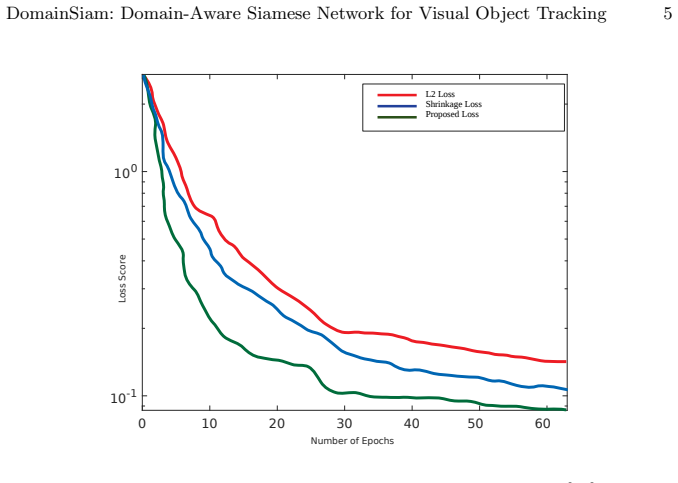
The load-bearing object is the ridge-regression network attached to the target branch: two convolutional layers followed by global average pooling, trained with the proposed loss $L(x,\alpha)=\frac{|\alpha-2|}{\alpha}e^{ay}\big((\frac{x^2}{|\alpha-2|}+1)^{\alpha/2}-1\big)$, a form adapted from a general robust loss that reduces to $e^{ay}x^2/2$ at $\alpha=2$ and to an $L_1$-type expression at $\alpha=1$. The gradient of the loss with respect to $\alpha$ is claimed to be nonnegative, which makes the loss monotonic in $\alpha$ and useful for non-convex optimization; the paper also claims faster convergence than $L_2$ and shrinkage losses. The network's output is a per-channel importance score $\delta_i=\mathrm{GAP}(\partial L/\partial F_i)$, and the top 100 channels define the Domain-Aware features that go into the correlation layer.
What would settle it
Train the same densely connected Siamese backbone with the same dynamic loss but skip the channel-selection step, keeping all channels for the correlation layer; if accuracy and robustness on VOT2018 and VOT2017 stay within noise of DomainSiam, the claimed gain from domain-aware channel selection is unsupported. Alternatively, evaluate $\partial L/\partial\alpha$ numerically across the training range of $\alpha$; a negative value would refute the stated monotonicity property.
Extended reading notes
Core claim
The central claim is that channel-wise gradients of a dynamic regression loss provide a reliable signal for domain-aware tracking: computing $\delta_i = \mathrm{GAP}(\partial L/\partial F_i)$ for each feature channel and keeping the 100 channels with the highest scores yields a compact, less sparse feature representation that transfers from classification pretraining to generic object tracking. The paper states that this removes unnecessary computation, reduces overfitting, and improves generalization, and supports it with tables showing higher accuracy, robustness, and expected average overlap than the compared trackers on five benchmarks at 53 FPS. The claim also includes a faster-converging loss that automatically adjusts its robustness during training through the parameter $\alpha$.
Load-bearing premise
The approach assumes that channel-importance scores computed from gradients of the training loss select the same channels that remain useful for tracking unseen objects at test time; this link is asserted and never separately ablated.
Editorial extensions
If this is right
- If the reported numbers hold, a real-time tracker at 53 FPS can exceed slower state-of-the-art trackers on both short-term VOT benchmarks and large-scale LaSOT, TrackingNet, and GOT10k.
- Because the ridge-regression network is trained separately from the Siamese backbone, the domain-aware component can be attached to an already trained backbone without retraining it from scratch, lowering the adoption cost.
- The dynamic loss is continuous in $\alpha$ and reduces to $L_1$ or $L_2$, so the same training recipe can be reused for other regression outputs in tracking pipelines without changing the architecture.
- The reported robustness improvements on VOT2018 (0.221 versus 0.276 for the second-best tracker) imply fewer target losses and reinitializations, which is the property that matters most in deployed tracking.
Reading between the lines
- The paper does not ablate channel selection separately; an experiment that keeps all channels but uses the dynamic loss would isolate whether the gain comes from the loss or from dropping channels, and the paper gives no such breakdown.
- The monotonicity claim $\partial L/\partial\alpha \ge 0$ is asserted without proof; a numerical sweep over the training range of $\alpha$ would either confirm it or show the loss is not monotonic even if the tracker still performs well.
- The same gradient-based channel scoring could be tested on object detection or semantic segmentation heads, where the paper hints the loss should transfer, but that transfer claim is left as a suggestion rather than a demonstrated result.
Signed reviews
Editorial analysis
A structured set of objections, weighed in public.
Referee Report
Summary. The paper proposes DomainSiam, a Siamese visual object tracker that augments the DensSiam backbone with a ridge regression network intended to select the most discriminative feature channels (the 'Domain-Aware' feature space) using gradient-based importance scores. The ridge regression problem is trained with a 'differentiable weighted-dynamic loss function' that the authors claim to be novel, monotonic, and adaptive. The method is evaluated on VOT2017, VOT2018, TrackingNet, LaSOT, and GOT10k, with OTB2013 and OTB2015 mentioned as validation sets, and the paper claims state-of-the-art performance at 53 FPS. The central empirical claim, the novelty of the loss, and the validity of the channel-selection mechanism are the main points at issue.
Significance. If the claims held, DomainSiam would be a practically useful real-time tracker outperforming prior work on several benchmarks, and the channel-selection idea could be of interest. The paper does evaluate on multiple large-scale benchmarks and reports runtime, which is a strength. However, the paper's own Table 1 contradicts the headline state-of-the-art claim, the promised OTB validation results are absent, and the proposed loss is a minor modification of Barron's robust loss with no comparison to that baseline. The core channel-selection mechanism is not ablated. These issues are load-bearing for the claimed contributions, so the work as presented is not yet a reliable contribution to the tracking literature.
major comments (5)
- [Section 4.2, Table 1] The claim that 'DomainSiam outperforms the state-of-the-art trackers listed in both tables' is directly contradicted by Table 1: DomainSiam has EAO 0.374 on VOT2017, while two listed trackers, SiamDCF (0.473) and ECOhc (0.435), have higher EAO. Since VOT rankings are based on EAO, the paper's central empirical claim fails as written. The table needs correction, or the claim needs to be restated to reflect the actual ranking.
- [Abstract and Section 4] The abstract and Section 4 state that OTB2013 and OTB2015 are used as a validation set, but no OTB results appear anywhere in the paper. The authors should either provide the promised OTB results or explicitly remove that claim from the abstract and experimental description.
- [Section 3.2, Eq. (6)] Equation (6) is Barron's general robust loss (Ref. [2]) multiplied by an extra factor e^{ay}. Since Barron's loss already includes the L2/L1/Lorentzian limits and adaptive robustness, the novelty reduces to the weighting term. The paper provides no comparison against Barron's original loss; Figure 2 compares only L2, shrinkage loss, and the proposed loss, so the claimed faster convergence is not evidential for the new element. An ablation with Barron's loss without the e^{ay} factor is needed to substantiate the contribution.
- [Section 3.2, Eq. (10)] The assertion that ∂L/∂α ≥ 0 is stated without proof. For Barron-type robust losses, the derivative with respect to α is not guaranteed to be nonnegative for all x and α; it can change sign as a function of the residual. Since the 'monotonic' property is listed as a contribution, this claim must either be proven or corrected, and the consequences for optimization should be discussed.
- [Section 4.1 and Section 3.1] The core mechanism of the paper is the selection of the top-100 channels using δ_i = GAP(∂L/∂F_i), but this selection is never ablated. There is no experiment showing that the gradient-based criterion outperforms random channel selection, that 100 is the right number of channels, or that the ridge regression network's learned mapping is necessary. Without such validation, the central architectural contribution is unverified.
minor comments (6)
- [Abstract and Section 4] The abstract says 'five tracking benchmarks' but lists seven datasets (OTB2013, OTB2015, VOT2017, VOT2018, LaSOT, TrackingNet, GOT10k). Please reconcile the count.
- [Table 4] The table title contains the typo 'LaSOt'; it should be 'LaSOT'.
- [Section 3.2, Eq. (6)] The variable y is used both for the regression target in Eq. (6) and for the Gaussian label map Y(i,j) in Eq. (2); this dual use should be clarified or renamed.
- [Section 4.1] The choice of 100 selected channels is not justified; please explain how this number was determined or cite a principled selection criterion.
- [References] References [7] and [9] are the same ECO paper, and [23] and [24] are the same SiamRPN paper; these duplicates should be merged.
- [Footnote 1] The link to the results page should be checked for accessibility, and the paper should state whether code will be released, not only results.
Circularity Check
No material circularity: the benchmark claims are externally evaluated and no test-set parameter is fitted and renamed a prediction.
full rationale
DomainSiam's headline results are measured on external benchmarks (VOT2017, VOT2018, LaSOT, TrackingNet, GOT10k) with standard toolkits; the channel-selection mechanism (Eq. 4) is trained on ILSVRC15 and then applied at test time, so no benchmark output is used to construct the predictor. The proposed loss (Eq. 6) is a weighted variant of Barron's general adaptive robust loss [2] and at a=0 coincides with it, which is an attribution/novelty problem rather than a circular derivation; the paper cites [2] as its inspiration. The monotonicity claim (Eq. 10) and the channel-selection benefit are asserted without ablation or proof, but these are validation gaps, not reductions of the prediction to its inputs. The internal contradiction in Table 1, where SiamDCF (EAO 0.473) and ECOhc (EAO 0.435) exceed DomainSiam (EAO 0.374) on VOT2017 while Section 4.2 claims superiority over all listed trackers, is a factual inconsistency in the presented evidence, not an instance of circular reasoning. The DensSiam backbone is cited from a separately published system and is not used as a self-referential uniqueness theorem. No step in the claimed derivation chain is equivalent by construction to the outputs it predicts.
Assumptions & free parameters
free parameters (5)
- λ ridge regularization
- α robustness parameter =
not stated
- a weighting exponent =
not stated
- Number of selected channels =
100
- σ Gaussian kernel width =
not stated
assumptions (5)
- standard math The closed-form ridge regression solution in Eq. (3) requires X^T X + λI to be invertible.
- domain assumption Gradients of the training loss with respect to feature channels (Eq. 4) indicate channel importance that transfers from classification pre-training to generic tracking.
- ad hoc to paper The proposed loss in Eq. (6) with weighting e^{ay} is beneficial for tracking despite being Barron's loss with an extra factor.
- ad hoc to paper The monotonicity claim ∂L/∂α ≥ 0 in Eq. (10) is true.
- domain assumption DensSiam pre-trained on ILSVRC15 provides a good backbone and its features contain transferable semantic and objectness information.
invented entities (1)
-
Domain-Aware feature space (top-100 selected channels)
Cite this review
Pith. "Pith review of DomainSiam: Domain-Aware Siamese Network for Visual Object Tracking." pith.science (2026). https://pith.science/paper/MUVKCVCD
@misc{pith2026190807905,
  author       = {Pith},
  title        = {Pith review of: DomainSiam: Domain-Aware Siamese Network for Visual Object Tracking},
  year         = {2026},
  howpublished = {\url{https://pith.science/paper/MUVKCVCD}},
  note         = {Machine review of arXiv:1908.07905}
}
read the original abstract
Visual object tracking is a fundamental task in the field of computer vision. Recently, Siamese trackers have achieved state-of-the-art performance on recent benchmarks. However, Siamese trackers do not fully utilize semantic and objectness information from pre-trained networks that have been trained on the image classification task. Furthermore, the pre-trained Siamese architecture is sparsely activated by the category label which leads to unnecessary calculations and overfitting. In this paper, we propose to learn a Domain-Aware, that is fully utilizing semantic and objectness information while producing a class-agnostic using a ridge regression network. Moreover, to reduce the sparsity problem, we solve the ridge regression problem with a differentiable weighted-dynamic loss function. Our tracker, dubbed DomainSiam, improves the feature learning in the training phase and generalization capability to other domains. Extensive experiments are performed on five tracking benchmarks including OTB2013 and OTB2015 for a validation set; as well as the VOT2017, VOT2018, LaSOT, TrackingNet, and GOT10k for a testing set. DomainSiam achieves state-of-the-art performance on these benchmarks while running at 53 FPS.
Figures

Reference graph
Works this paper leans on
-
[2]
In: Proceedings of the IEEE Conference on Computer Vision and Pattern Recognition
Barron, J.T.: A general and adaptive robust loss function. In: Proceedings of the IEEE Conference on Computer Vision and Pattern Recognition. pp. 4331–4339 (2019)
work page 2019
-
[1]
In: Computer Vision Workshop (ICCVW), 2015 IEEE International Conference on
Alahari, K., Berg, A., Hager, G., Ahlberg, J., Kristan, M., Matas, J., Leonardis, A., Cehovin, L., Fernandez, G., Vojir, T., et al.: The thermal infrared visual object tracking vot-tir2015 challenge results. In: Computer Vision Workshop (ICCVW), 2015 IEEE International Conference on. pp. 639–651. IEEE (2015)
work page 2015
-
[3]
In: Proceedings of the IEEE conference on computer vision and pattern recognition
Bertinetto, L., Valmadre, J., Golodetz, S., Miksik, O., Torr, P.H.: Staple: Comple- mentary learners for real-time tracking. In: Proceedings of the IEEE conference on computer vision and pattern recognition. pp. 1401–1409 (2016)
work page 2016
-
[4]
In: European conference on computer vision
Bertinetto, L., Valmadre, J., Henriques, J.F., Vedaldi, A., Torr, P.H.: Fully- convolutional siamese networks for object tracking. In: European conference on computer vision. pp. 850–865. Springer (2016)
work page 2016
-
[5]
Computer vision and image understanding63(1), 75–104 (1996)
Black, M.J., Anandan, P.: The robust estimation of multiple motions: Parametric and piecewise-smooth flow fields. Computer vision and image understanding63(1), 75–104 (1996)
work page 1996
-
[6]
In: Advances in neural information processing systems
Bromley, J., Guyon, I., LeCun, Y., S¨ ackinger, E., Shah, R.: Signature verification using a” siamese” time delay neural network. In: Advances in neural information processing systems. pp. 737–744 (1994)
work page 1994
-
[7]
Danelljan, M., Bhat, G., Khan, F.S., Felsberg, M.: Eco: Efficient convolution op- erators for tracking. In: Proceedings of the 2017 IEEE Conference on Computer Vision and Pattern Recognition (CVPR), Honolulu, HI, USA. pp. 21–26 (2017)
work page 2017
-
[8]
In: Proceedings of the IEEE Conference on Computer Vision and Pattern Recognition
Danelljan, M., Bhat, G., Khan, F.S., Felsberg, M.: Atom: Accurate tracking by overlap maximization. In: Proceedings of the IEEE Conference on Computer Vision and Pattern Recognition. pp. 4660–4669 (2019)
work page 2019
Show all 47 references
-
[9]
In: CVPR (2017)
Danelljan, M., Bhat, G., Shahbaz Khan, F., Felsberg, M.: Eco: Efficient convolution operators for tracking. In: CVPR (2017)
2017
-
[10]
In: Proceedings of the IEEE Interna- tional Conference on Computer Vision Workshops
Danelljan, M., Hager, G., Shahbaz Khan, F., Felsberg, M.: Convolutional features for correlation filter based visual tracking. In: Proceedings of the IEEE Interna- tional Conference on Computer Vision Workshops. pp. 58–66 (2015)
2015
-
[11]
In: Proceedings of the IEEE Inter- national Conference on Computer Vision
Danelljan, M., Hager, G., Shahbaz Khan, F., Felsberg, M.: Learning spatially reg- ularized correlation filters for visual tracking. In: Proceedings of the IEEE Inter- national Conference on Computer Vision. pp. 4310–4318 (2015)
2015
-
[12]
In: Proceedings of the IEEE Conference on Computer Vision and Pattern Recognition
Fan, H., Lin, L., Yang, F., Chu, P., Deng, G., Yu, S., Bai, H., Xu, Y., Liao, C., Ling, H.: Lasot: A high-quality benchmark for large-scale single object tracking. In: Proceedings of the IEEE Conference on Computer Vision and Pattern Recognition. pp. 5374–5383 (2019)
2019
-
[13]
In: Proceedings of the 2017 IEEE Conference on Computer Vision and Pattern Recognition (CVPR), Honolulu, HI, USA
Galoogahi, H.K., Fagg, A., Lucey, S.: Learning background-aware correlation filters for visual tracking. In: Proceedings of the 2017 IEEE Conference on Computer Vision and Pattern Recognition (CVPR), Honolulu, HI, USA. pp. 21–26 (2017)
2017
-
[14]
In: Proc
Guo, Q., Feng, W., Zhou, C., Huang, R., Wan, L., Wang, S.: Learning dynamic siamese network for visual object tracking. In: Proc. IEEE Int. Conf. Comput. Vis. pp. 1–9 (2017)
2017
-
[15]
In: Proceedings of the IEEE Conference on Computer Vision and Pattern Recognition
He, A., Luo, C., Tian, X., Zeng, W.: A twofold siamese network for real-time object tracking. In: Proceedings of the IEEE Conference on Computer Vision and Pattern Recognition. pp. 4834–4843 (2018)
2018
-
[16]
IEEE Transactions on Pattern Analysis and Machine Intelligence 37(3), 583–596 (2015) 12 M
Henriques, J.F., Caseiro, R., Martins, P., Batista, J.: High-speed tracking with kernelized correlation filters. IEEE Transactions on Pattern Analysis and Machine Intelligence 37(3), 583–596 (2015) 12 M. H. Abdelpakey et al
2015
-
[17]
arXiv preprint arXiv:1810.11981 (2018)
Huang, L., Zhao, X., Huang, K.: Got-10k: A large high-diversity benchmark for generic object tracking in the wild. arXiv preprint arXiv:1810.11981 (2018)
2018 arXiv
-
[18]
In: Computer Vision (ICCV), 2015 IEEE Inter- national Conference on
Kendall, A., Grimes, M., Cipolla, R.: Posenet: A convolutional network for real- time 6-dof camera relocalization. In: Computer Vision (ICCV), 2015 IEEE Inter- national Conference on. pp. 2938–2946. IEEE (2015)
2015
-
[19]
In: Proceedings of the European Conference on Computer Vision (ECCV)
Kristan, M., Leonardis, A., Matas, J., Felsberg, M., Pflugfelder, R., Cehovin Zajc, L., Vojir, T., Bhat, G., Lukezic, A., Eldesokey, A., et al.: The sixth visual object tracking vot2018 challenge results. In: Proceedings of the European Conference on Computer Vision (ECCV). pp....
2018
-
[20]
In: Proceedings of the IEEE International Conference on Computer Vision
Kristan, M., Leonardis, A., Matas, J., Felsberg, M., Pflugfelder, R., Cehovin Zajc, L., Vojir, T., Hager, G., Lukezic, A., Eldesokey, A., et al.: The visual object tracking vot2017 challenge results. In: Proceedings of the IEEE International Conference on Computer Vision. pp. 1...
2017
-
[21]
In: Advances in neural information processing systems
Krizhevsky, A., Sutskever, I., Hinton, G.E.: Imagenet classification with deep con- volutional neural networks. In: Advances in neural information processing systems. pp. 1097–1105 (2012)
2012
-
[22]
In: Proceedings of the IEEE Conf
Lenc, K., Vedaldi, A.: Understanding image representations by measuring their equivariance and equivalence. In: Proceedings of the IEEE Conf. on Computer Vision and Pattern Recognition (CVPR) (2015)
2015
-
[23]
In: Proceedings of the IEEE Conference on Com- puter Vision and Pattern Recognition
Li, B., Yan, J., Wu, W., Zhu, Z., Hu, X.: High performance visual tracking with siamese region proposal network. In: Proceedings of the IEEE Conference on Com- puter Vision and Pattern Recognition. pp. 8971–8980 (2018)
2018
-
[24]
In: The IEEE Conference on Computer Vision and Pattern Recognition (CVPR) (June 2018)
Li, B., Yan, J., Wu, W., Zhu, Z., Hu, X.: High performance visual tracking with siamese region proposal network. In: The IEEE Conference on Computer Vision and Pattern Recognition (CVPR) (June 2018)
2018
-
[25]
In: Proceedings of the IEEE Confer- ence on Computer Vision and Pattern Recognition
Li, F., Tian, C., Zuo, W., Zhang, L., Yang, M.H.: Learning spatial-temporal regu- larized correlation filters for visual tracking. In: Proceedings of the IEEE Confer- ence on Computer Vision and Pattern Recognition. pp. 4904–4913 (2018)
2018
-
[26]
In: Pro- ceedings of the IEEE Conference on Computer Vision and Pattern Recognition
Li, X., Ma, C., Wu, B., He, Z., Yang, M.H.: Target-aware deep tracking. In: Pro- ceedings of the IEEE Conference on Computer Vision and Pattern Recognition. pp. 1369–1378 (2019)
2019
-
[27]
In: European Conference on Computer Vision
Li, Y., Zhu, J.: A scale adaptive kernel correlation filter tracker with feature in- tegration. In: European Conference on Computer Vision. pp. 254–265. Springer (2014)
2014
-
[28]
In: Proceedings of the European Conference on Computer Vision (ECCV)
Lu, X., Ma, C., Ni, B., Yang, X., Reid, I., Yang, M.H.: Deep regression tracking with shrinkage loss. In: Proceedings of the European Conference on Computer Vision (ECCV). pp. 353–369 (2018)
2018
-
[29]
In: Proceedings of the IEEE Conference on Computer Vision and Pattern Recognition
Lukezic, A., Vojir, T., Zajc, L.C., Matas, J., Kristan, M.: Discriminative correlation filter with channel and spatial reliability. In: Proceedings of the IEEE Conference on Computer Vision and Pattern Recognition. vol. 2 (2017)
2017
-
[30]
In: Advances in Visual Computing: 13th In- ternational Symposium, ISVC 2018, Las Vegas, NV, USA, November 19–21, 2018, Proceedings
Mohamed, M.M.: Denssiam: End-to-end densely-siamese network with self- attention model for object tracking. In: Advances in Visual Computing: 13th In- ternational Symposium, ISVC 2018, Las Vegas, NV, USA, November 19–21, 2018, Proceedings. vol. 11241, p. 463. Springer (2018)
2018
-
[31]
In: Proceedings of the IEEE Conference on Computer Vision and Pattern Recognition
Molchanov, P., Yang, X., Gupta, S., Kim, K., Tyree, S., Kautz, J.: Online detection and classification of dynamic hand gestures with recurrent 3d convolutional neural network. In: Proceedings of the IEEE Conference on Computer Vision and Pattern Recognition. pp. 4207–4215 (2016)
2016
-
[32]
In: Proc
Mueller, M., Smith, N., Ghanem, B.: Context-aware correlation filter tracking. In: Proc. IEEE Conf. Comput. Vis. Pattern Recognit.(CVPR). pp. 1396–1404 (2017) DomainSiam: Domain-Aware Siamese Network for Visual Object Tracking 13
2017
-
[33]
In: Proceedings of the European Conference on Computer Vision (ECCV)
Muller, M., Bibi, A., Giancola, S., Alsubaihi, S., Ghanem, B.: Trackingnet: A large- scale dataset and benchmark for object tracking in the wild. In: Proceedings of the European Conference on Computer Vision (ECCV). pp. 300–317 (2018)
2018
-
[34]
In: Proceedings of the IEEE Conference on Computer Vision and Pattern Recognition
Nam, H., Han, B.: Learning multi-domain convolutional neural networks for visual tracking. In: Proceedings of the IEEE Conference on Computer Vision and Pattern Recognition. pp. 4293–4302 (2016)
2016
-
[35]
PyTorch: Tensors and dynamic neural networks in Python with strong GPU acceleration 6 (2017)
Paszke, A., Gross, S., Chintala, S., Chanan, G.: Pytorch: Tensors and dynamic neural networks in python with strong gpu acceleration. PyTorch: Tensors and dynamic neural networks in Python with strong GPU acceleration 6 (2017)
2017
-
[36]
International Journal of Computer Vision 115(3), 211–252 (2015)
Russakovsky, O., Deng, J., Su, H., Krause, J., Satheesh, S., Ma, S., Huang, Z., Karpathy, A., Khosla, A., Bernstein, M., et al.: Imagenet large scale visual recog- nition challenge. International Journal of Computer Vision 115(3), 211–252 (2015)
2015
-
[37]
In: Proceedings of the IEEE International Conference on Computer Vision
Selvaraju, R.R., Cogswell, M., Das, A., Vedantam, R., Parikh, D., Batra, D.: Grad- cam: Visual explanations from deep networks via gradient-based localization. In: Proceedings of the IEEE International Conference on Computer Vision. pp. 618– 626 (2017)
2017
-
[38]
In: Proceedings of the IEEE Conference on Computer Vision and Pattern Recognition
Song, Y., Ma, C., Wu, X., Gong, L., Bao, L., Zuo, W., Shen, C., Lau, R.W., Yang, M.H.: Vital: Visual tracking via adversarial learning. In: Proceedings of the IEEE Conference on Computer Vision and Pattern Recognition. pp. 8990–8999 (2018)
2018
-
[39]
In: Computer Vision and Pattern Recognition (CVPR), 2016 IEEE Conference on
Tao, R., Gavves, E., Smeulders, A.W.: Siamese instance search for tracking. In: Computer Vision and Pattern Recognition (CVPR), 2016 IEEE Conference on. pp. 1420–1429. IEEE (2016)
2016
-
[40]
In: Computer Vision and Pattern Recognition (CVPR), 2017 IEEE Conference on
Valmadre, J., Bertinetto, L., Henriques, J., Vedaldi, A., Torr, P.H.: End-to-end representation learning for correlation filter based tracking. In: Computer Vision and Pattern Recognition (CVPR), 2017 IEEE Conference on. pp. 5000–5008. IEEE (2017)
2017
-
[41]
Pattern Recognition Letters 49, 250–258 (2014)
Vojir, T., Noskova, J., Matas, J.: Robust scale-adaptive mean-shift for tracking. Pattern Recognition Letters 49, 250–258 (2014)
2014
-
[42]
In: Proceedings of the IEEE Conference on Computer Vision and Pattern Recognition
Wang, Q., Zhang, L., Bertinetto, L., Hu, W., Torr, P.H.: Fast online object tracking and segmentation: A unifying approach. In: Proceedings of the IEEE Conference on Computer Vision and Pattern Recognition. pp. 1328–1338 (2019)
2019
-
[43]
In: Proceedings of the IEEE conference on computer vision and pattern recognition
Wu, Y., Lim, J., Yang, M.H.: Online object tracking: A benchmark. In: Proceedings of the IEEE conference on computer vision and pattern recognition. pp. 2411–2418 (2013)
2013
-
[44]
IEEE Transactions on Pattern Analysis and Machine Intelligence 37(9), 1834–1848 (2015)
Wu, Y., Lim, J., Yang, M.H.: Object tracking benchmark. IEEE Transactions on Pattern Analysis and Machine Intelligence 37(9), 1834–1848 (2015)
2015
-
[45]
In: Proceedings of the European conference on computer vision (ECCV)
Zhang, Y., Wang, L., Qi, J., Wang, D., Feng, M., Lu, H.: Structured siamese network for real-time visual tracking. In: Proceedings of the European conference on computer vision (ECCV). pp. 351–366 (2018)
2018
-
[46]
In: The IEEE Conference on Computer Vision and Pattern Recognition (CVPR) (June 2016)
Zhou, B., Khosla, A., Lapedriza, A., Oliva, A., Torralba, A.: Learning deep features for discriminative localization. In: The IEEE Conference on Computer Vision and Pattern Recognition (CVPR) (June 2016)
2016
-
[47]
In: Proceedings of the European Conference on Computer Vision (ECCV)
Zhu, Z., Wang, Q., Li, B., Wu, W., Yan, J., Hu, W.: Distractor-aware siamese networks for visual object tracking. In: Proceedings of the European Conference on Computer Vision (ECCV). pp. 101–117 (2018)
2018
Reviewed August 14, 2026 · model on record in the stance chip above.
Discussion (0). Continue with ORCID to comment.