Spontaneous translation of charged droplets during evaporation on dry surfaces
Pith reviewed 2026-06-27 11:38 UTC · model grok-4.3
The pith
Charged droplets on dry passive polymers spontaneously translate when evaporation concentrates their charge.
A machine-rendered reading of the paper's core claim, the machinery that carries it, and where it could break.
Core claim
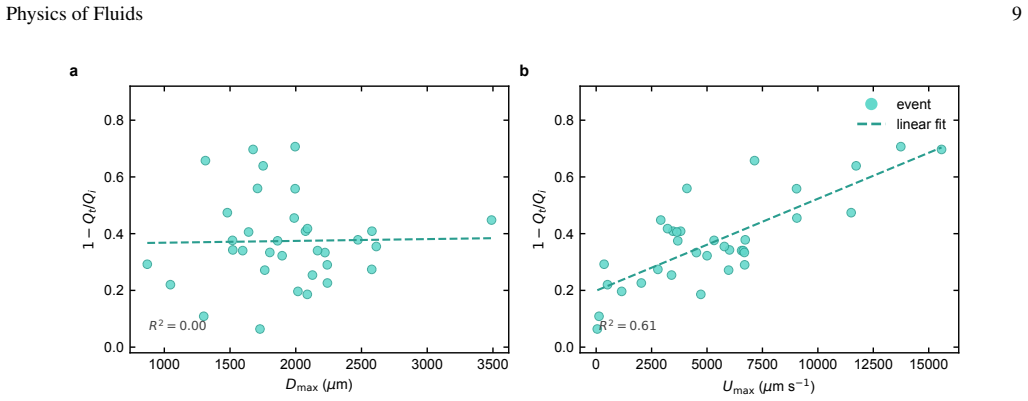
On electrostatically passive dry substrates such as PMP, evaporating charged droplets preserve initial charge until reaching a high electro-pinning state, after which charge collapse triggers spontaneous lateral translation governed by contact-line dynamics rather than jetting or breakup. A Rayleigh-normalized analysis with spherical-cap stress correction shows motion begins only after evaporation drives the droplet into this state. High-speed imaging and kinematic analysis indicate that total travel distance depends on dry-surface pinning while peak velocity reflects discharge strength.
What carries the argument
Rayleigh-normalized analysis with spherical-cap stress correction and contact-angle retention scale that identifies the high electro-pinning state leading to whole-droplet translation as the charge-release pathway.
If this is right
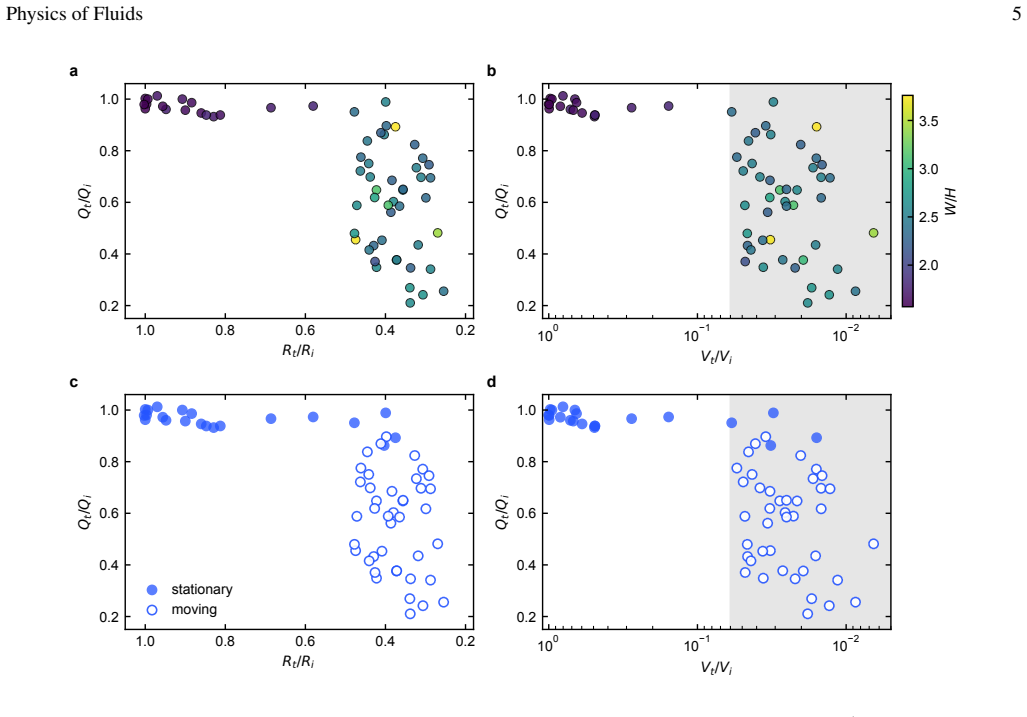
- Charge remains nearly constant during early evaporation on PMP then decreases abruptly at small volume.
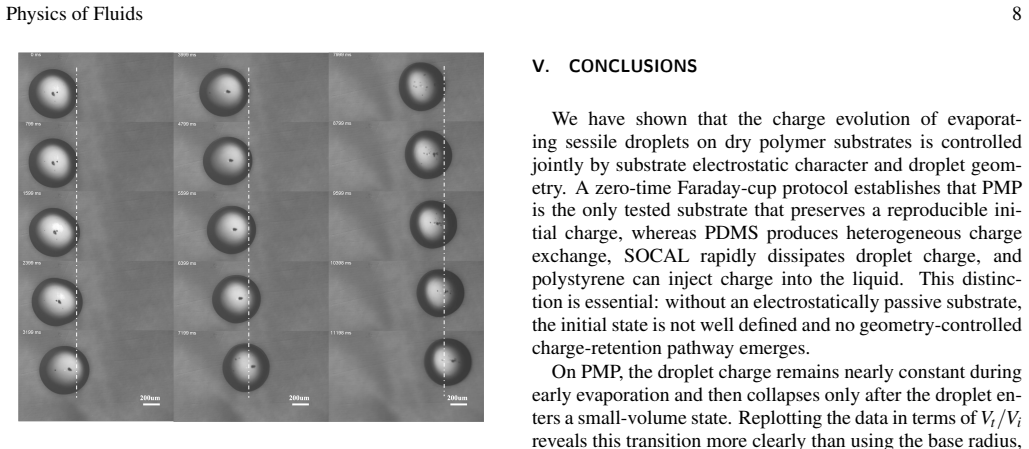
- Spontaneous lateral translation coincides with charge collapse rather than jetting or breakup.
- Total distance traveled depends strongly on dry-surface pinning while peak velocity indicates discharge strength.
- Substrate electrostatic passivity enables charge retention and selects translation as the relaxation mode.
Where Pith is reading between the lines
- Similar translation could occur on other charge-preserving insulators once a sufficient initial charge is present.
- The process offers a route to move droplets on dry surfaces without external fields or lubrication.
- Varying initial charge or surface roughness could map the threshold for entering the translating regime.
Load-bearing premise
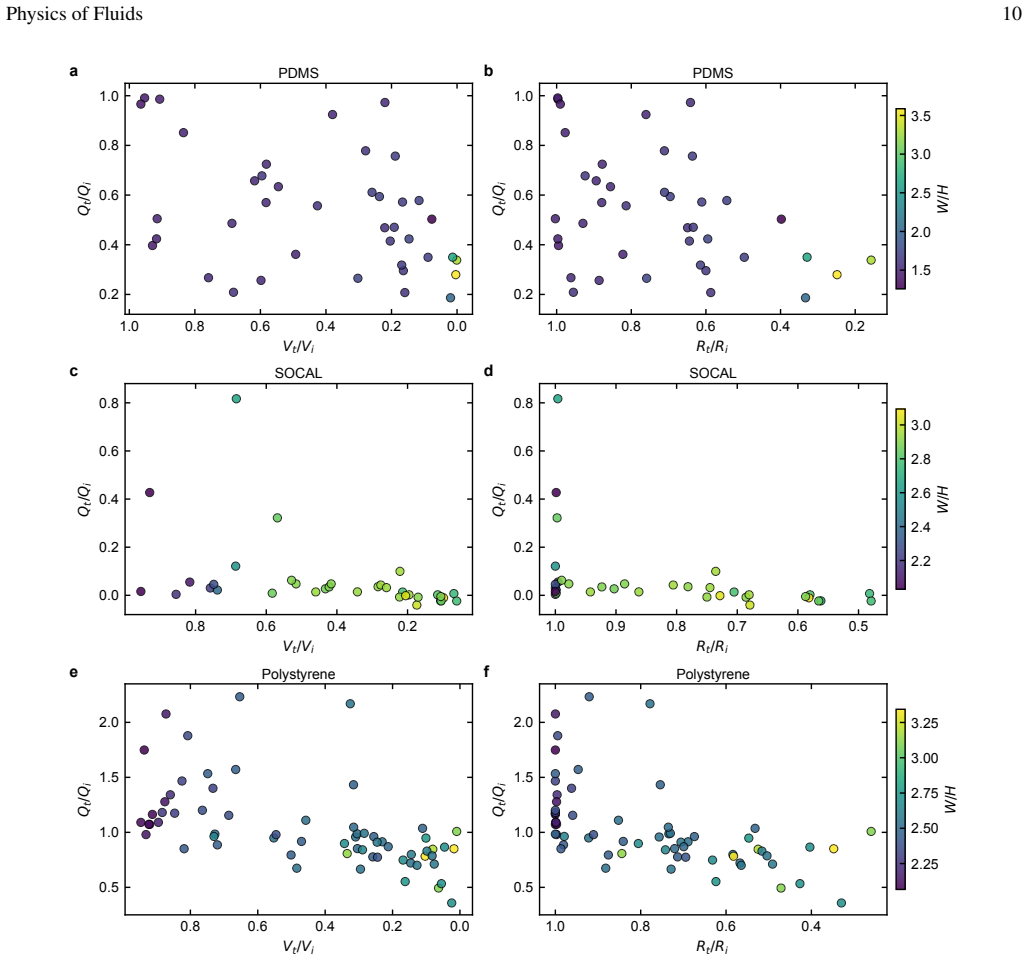
The polymer substrates such as PMP preserve the droplet's charge without exchange, dissipation, or injection upon initial contact.
What would settle it
Direct charge measurement showing immediate loss or gain on PMP right after droplet placement, or high-speed videos showing no lateral translation despite reaching the small-volume state.
Figures


read the original abstract
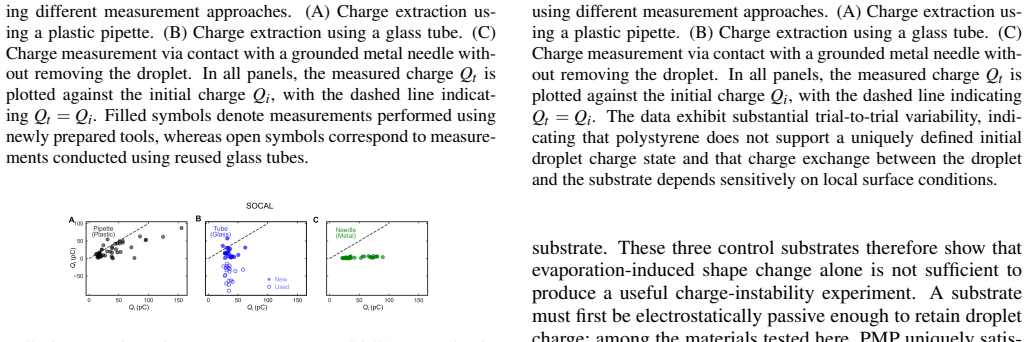
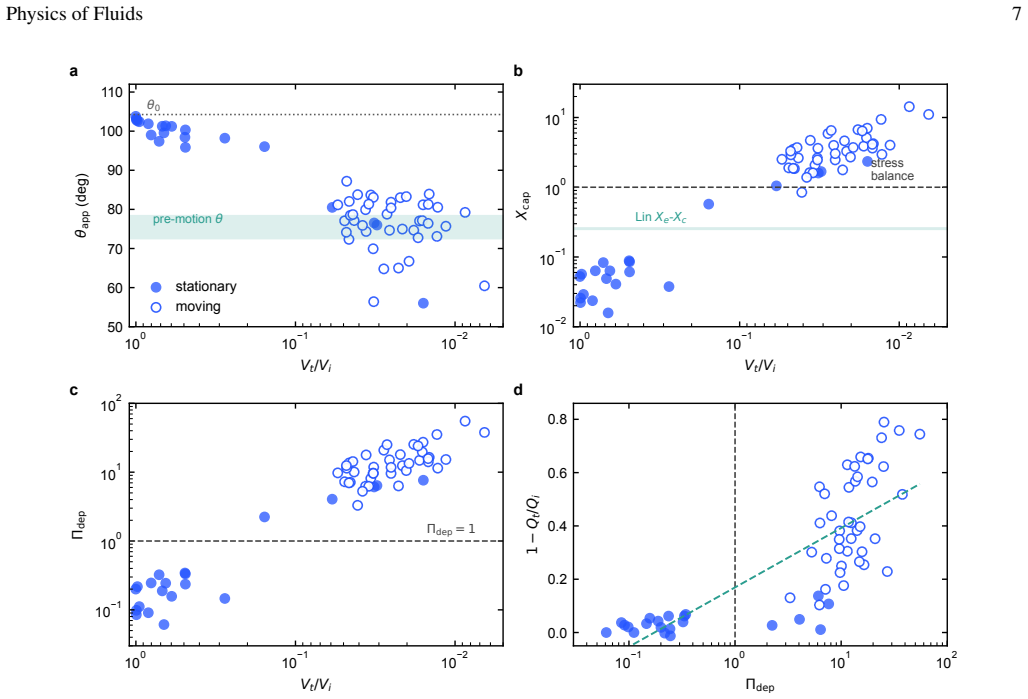
Evaporating sessile droplets are usually treated as capillary objects, but droplets generated by routine handling can carry tens to hundreds of picocoulombs of electric charge. Here we combine Faraday-cup charge measurements with optical imaging to determine how such charge evolves as water droplets evaporate on dry polymer substrates. A zero-time protocol shows that a reproducible initial charge is preserved on poly(methylpentene) (PMP), whereas PDMS, SOCAL-coated surfaces, and polystyrene either exchange, dissipate, or inject charge on contact. On PMP, ensemble-resolved measurements reveal two regimes: the charge remains nearly constant during early evaporation and then decreases abruptly once the droplet reaches a small-volume state. This charge collapse coincides with spontaneous lateral translation rather than jetting or breakup. A Rayleigh-normalized analysis, including a spherical-cap stress correction and measured contact-angle retention scale, shows that motion occurs only after evaporation drives the droplet into a high electro-pinning state. High-speed imaging and kinematic analysis support a picture in which the subsequent motion is governed by repeated contact-line depinning and re-pinning: the total distance traveled is strongly affected by dry-surface pinning, whereas the peak translational velocity serves as a more robust indicator of the discharge strength. These results identify a dry-substrate mode of evaporation-driven electrostatic relaxation, distinct from Coulomb fission on lubricated surfaces, in which substrate electrostatic passivity enables charge retention, droplet geometry selects the instability onset, and whole-droplet translation provides the charge-release pathway.
Editorial analysis
A structured set of objections, weighed in public.
Referee Report
Summary. The manuscript reports that water droplets carrying tens to hundreds of picocoulombs of charge retain that charge during early evaporation on poly(methylpentene) (PMP) substrates but undergo abrupt charge collapse once a small-volume state is reached; this collapse coincides with spontaneous lateral translation rather than jetting or breakup. Faraday-cup measurements combined with optical imaging and a Rayleigh-normalized analysis (with spherical-cap correction and measured contact-angle retention) are used to argue that motion occurs only after the droplet enters a high electro-pinning state, with subsequent kinematics governed by repeated contact-line depinning on the dry surface.
Significance. If the central observations hold, the work identifies a dry-substrate mode of evaporation-driven electrostatic relaxation that is distinct from Coulomb fission on lubricated surfaces. The emphasis on substrate electrostatic passivity enabling charge retention, geometry selecting instability onset, and whole-droplet translation as the release pathway adds a new experimental regime to the literature on charged sessile droplets.
major comments (2)
- [Abstract] The central attribution of the abrupt charge collapse to a geometry-driven electro-pinning instability (rather than substrate-mediated discharge) requires that PMP remains electrostatically passive throughout the constant-charge window. The abstract states that a zero-time protocol yields reproducible initial charge on PMP while other polymers exchange or dissipate charge, yet provides no quantitative bound on possible slow leakage rates or contact-angle-dependent injection at the three-phase line during evaporation; this assumption is load-bearing for the reported mechanism.
- [Abstract] Ensemble-resolved measurements are invoked to establish the two-regime charge evolution and its coincidence with translation, but the provided text contains no raw data, error bars, sample sizes, or exclusion criteria. Without these, the statistical robustness of the claimed coincidence between volume reduction and charge collapse cannot be assessed.
minor comments (1)
- [Abstract] The description of the Rayleigh-normalized analysis would benefit from an explicit statement of the spherical-cap stress correction formula and how the measured contact-angle retention scale enters the normalization.
Simulated Author's Rebuttal
We thank the referee for their thoughtful review and for recognizing the distinction between our dry-substrate regime and prior lubricated-surface work. We address each major comment below. Where the manuscript is incomplete on quantitative bounds or explicit statistical reporting, we will revise accordingly.
read point-by-point responses
-
Referee: [Abstract] The central attribution of the abrupt charge collapse to a geometry-driven electro-pinning instability (rather than substrate-mediated discharge) requires that PMP remains electrostatically passive throughout the constant-charge window. The abstract states that a zero-time protocol yields reproducible initial charge on PMP while other polymers exchange or dissipate charge, yet provides no quantitative bound on possible slow leakage rates or contact-angle-dependent injection at the three-phase line during evaporation; this assumption is load-bearing for the reported mechanism.
Authors: We agree that electrostatic passivity of PMP is central and that the abstract alone does not supply a numerical leakage bound. The manuscript already contrasts PMP with PDMS, SOCAL, and polystyrene, where charge changes immediately upon contact, and shows that PMP charge remains constant until the small-volume state. To strengthen the claim, we will add (i) long-term Faraday-cup retention data on PMP without evaporation to bound leakage rates and (ii) a brief discussion of why three-phase-line injection is inconsistent with the observed contact-angle retention throughout the constant-charge window. revision: yes
-
Referee: [Abstract] Ensemble-resolved measurements are invoked to establish the two-regime charge evolution and its coincidence with translation, but the provided text contains no raw data, error bars, sample sizes, or exclusion criteria. Without these, the statistical robustness of the claimed coincidence between volume reduction and charge collapse cannot be assessed.
Authors: The full manuscript presents the ensemble data in Figures 2–4 (charge vs. volume, translation events, Rayleigh-normalized analysis) with error bars (standard deviation) and states N = 20 droplets per substrate/condition in the Methods and figure captions; exclusion criteria (e.g., droplets showing premature pinning or substrate defects) are listed in the supplementary information. We will revise the abstract to reference these statistics explicitly and add a summary table of sample sizes and exclusion rates in the main text. revision: yes
Circularity Check
No significant circularity; experimental measurements drive the claims
full rationale
The manuscript is primarily experimental, reporting Faraday-cup charge measurements and optical imaging of evaporating droplets on polymer substrates. The central observations (constant charge on PMP followed by abrupt collapse coinciding with translation) are presented as direct data, with the Rayleigh-normalized analysis explicitly incorporating measured contact-angle retention scale and observed kinematics rather than deriving outcomes from parameters fitted to the target result. No equations or steps reduce by construction to self-defined inputs, no self-citation chains are invoked as load-bearing uniqueness theorems, and the electrostatic passivity of PMP is treated as an empirical precondition verified by the zero-time protocol, not derived from the collapse itself. The derivation chain is therefore self-contained against external benchmarks.
Axiom & Free-Parameter Ledger
axioms (1)
- domain assumption Certain polymer surfaces can be treated as electrostatically passive, preserving droplet charge on contact without exchange or dissipation.
Reference graph
Works this paper leans on
-
[1]
Journal of Colloid and Interface Science , volume =
The evaporation of sessile or pendant drops in still air , author =. Journal of Colloid and Interface Science , volume =
-
[2]
Nature , volume =
Capillary flow as the cause of ring stains from dried liquid drops , author =. Nature , volume =. 1997 , doi =
1997
-
[3]
Physical Review E , volume =
Contact line deposits in an evaporating drop , author =. Physical Review E , volume =
-
[4]
Journal of Physical Chemistry B , volume =
Evaporation of a sessile droplet on a substrate , author =. Journal of Physical Chemistry B , volume =. 2002 , doi =
2002
-
[5]
Physical Review E , volume =
Evaporative deposition patterns: Spatial dimensions of the deposit , author =. Physical Review E , volume =. 2005 , doi =
2005
-
[6]
Physics of Fluids , volume =
On the lifetimes of evaporating droplets with related initial and receding contact angles , author =. Physics of Fluids , volume =. 2015 , doi =
2015
-
[7]
Annual Review of Fluid Mechanics , volume =
Evaporation of sessile droplets , author =. Annual Review of Fluid Mechanics , volume =. 2023 , doi =
2023
-
[8]
Science , volume =
The mosaic of surface charge in contact electrification , author =. Science , volume =
-
[9]
Scientific Reports , volume =
Spontaneous electrical charging of droplets by conventional pipetting , author =. Scientific Reports , volume =
-
[10]
Nature Communications , volume =
Electrification at water--hydrophobe interfaces , author =. Nature Communications , volume =
-
[11]
Nature Physics , volume =
Spontaneous charging affects the motion of sliding drops , author =. Nature Physics , volume =. 2022 , doi =
2022
-
[12]
Journal of Physics D: Applied Physics , volume =
Contact electrification of insulating materials , author =. Journal of Physics D: Applied Physics , volume =. 2011 , doi =
2011
-
[13]
Chemical Reviews , volume =
Contact electrification at the liquid--solid interface , author =. Chemical Reviews , volume =. 2022 , doi =
2022
-
[14]
Physics of Fluids , volume =
Self-generated electrostatic forces of drops rebounding from hydrophobic surfaces , author =. Physics of Fluids , volume =. 2023 , doi =
2023
-
[15]
Physics of Fluids , volume =
Electrohydrodynamic effect on sessile droplet evaporation: A review , author =. Physics of Fluids , volume =. 2026 , doi =
2026
-
[16]
Philosophical Magazine , volume =
On the equilibrium of liquid conducting masses charged with electricity , author =. Philosophical Magazine , volume =
-
[17]
Physics of Fluids , volume =
Charge and fission of droplets in electrostatic sprays , author =. Physics of Fluids , volume =
-
[18]
Nature , volume =
Rayleigh jets from levitated microdroplets , author =. Nature , volume =
-
[19]
and Li, Oscar and Arunachalam, Sankara and Daniel, Dan , journal =
Lin, Marcus and Zhang, Peng and Ratschow, Aaron D. and Li, Oscar and Arunachalam, Sankara and Daniel, Dan , journal =. Spontaneous. 2026 , doi =
2026
-
[20]
Furmidge, C. G. L. , journal =. Studies at phase interfaces
-
[21]
Reviews of Modern Physics , volume =
Wetting: statics and dynamics , author =. Reviews of Modern Physics , volume =
-
[22]
Journal of Chemical Physics , volume =
A model for contact angle hysteresis , author =. Journal of Chemical Physics , volume =. 1984 , doi =
1984
-
[23]
Colloid and Polymer Science , volume =
Contact angle hysteresis: a review of fundamentals and applications , author =. Colloid and Polymer Science , volume =. 2013 , doi =
2013
-
[24]
Reviews of Geophysics and Space Physics , volume =
Measurement of electric charge of cloud droplets, drizzle, and raindrops , author =. Reviews of Geophysics and Space Physics , volume =. 1973 , doi =
1973
-
[25]
Journal of the Atmospheric Sciences , volume =
Effects of image charges on the scavenging of aerosol particles by cloud droplets and on droplet charging and possible ice nucleation processes , author =. Journal of the Atmospheric Sciences , volume =. 2000 , doi =
2000
-
[26]
IEEE Transactions on Plasma Science , volume =
Enhanced growth of single droplet by control of equivalent charge on droplet , author =. IEEE Transactions on Plasma Science , volume =. 2016 , doi =
2016
-
[27]
Journal of Chemical Physics , volume =
On the evaporation of small ions from charged droplets , author =. Journal of Chemical Physics , volume =. 1976 , doi =
1976
-
[28]
Journal of the American Society for Mass Spectrometry , volume =
Ion formation from charged droplets: Roles of geometry, energy, and time , author =. Journal of the American Society for Mass Spectrometry , volume =. 1993 , doi =
1993
-
[29]
Analytica Chimica Acta , volume =
On the mechanisms by which the charged droplets produced by electrospray lead to gas phase ions , author =. Analytica Chimica Acta , volume =. 2000 , doi =
2000
-
[30]
Angewandte Chemie International Edition , volume =
Solid-to-liquid charge transfer for generating droplets with tunable charge , author =. Angewandte Chemie International Edition , volume =. 2016 , doi =
2016
-
[31]
Nature Communications , volume =
Electrostatic charging of jumping droplets , author =. Nature Communications , volume =. 2013 , doi =
2013
-
[32]
Nature Materials , volume =
Surface charge printing for programmed droplet transport , author =. Nature Materials , volume =. 2019 , doi =
2019
-
[33]
Physics of Fluids , volume =
Impact dynamics of a charged droplet onto different substrates , author =. Physics of Fluids , volume =. 2021 , doi =
2021
-
[34]
Journal of Colloid and Interface Science , volume =
Electrical charging of a conducting water droplet in a dielectric fluid on the electrode surface , author =. Journal of Colloid and Interface Science , volume =. 2008 , doi =
2008
-
[35]
Analytical Chemistry , volume =
Electrophoresis of a charged droplet in a dielectric liquid for droplet actuation , author =. Analytical Chemistry , volume =. 2011 , doi =
2011
-
[36]
Langmuir , volume =
Discrete electrostatic charge transfer by the electrophoresis of a charged droplet in a dielectric liquid , author =. Langmuir , volume =. 2012 , doi =
2012
-
[37]
Langmuir , volume =
Charge limits on droplets during evaporation , author =. Langmuir , volume =. 2005 , doi =
2005
-
[38]
Journal of Physical Chemistry A , volume =
Charge separation in the aerodynamic breakup of micrometer-sized water droplets , author =. Journal of Physical Chemistry A , volume =. 2008 , doi =
2008
discussion (0)
Sign in with ORCID, Apple, or X to comment. Anyone can read and Pith papers without signing in.