REVIEW 3 major objections 4 minor 1 cited by
FAMNet: Frequency-aware Matching Network for Cross-domain Few-shot Medical Image Segmentation
T0 review · 3 major / 4 minor · reviewed 2026-08-11 · deepseek-v4-flash
Pith's one-line read The paper claims that matching support and query features in the frequency domain, while suppressing the low and high bands and fusing the mid band, lets a few-shot medical image segmenter work across CT, MRI, and institution boundaries.
desk verdict FAMNet introduces a genuinely new frequency-aware mechanism for cross-domain few-shot medical segmentation, but the SOTA claims are not yet statistically grounded. read the letter →
The pith
A machine-rendered reading of the paper's core claim, the machinery that carries it, and where it could break.
The reading
What carries the argument
The load-bearing machinery is the frequency-band decomposition of foreground features combined with asymmetric attention. Foreground features are resized to a fixed pixel count, transformed by a two-dimensional FFT, split into three bands by a band-pass filter with a fixed $3{:}4{:}3$ low:mid:high ratio, and transformed back to the spatial domain. The FAM module computes one cosine-similarity attention matrix per band; the mid band is enhanced with the attention, while the low and high bands are suppressed with inverse attention. The MSF module applies cross-attention with the mid band as the query to pull domain-invariant content out of the low and high bands. The fixed band ratio and the assumption that mid frequencies are domain-agnostic are what make the whole pipeline work; the appendix reports that performance varies by up to about three Dice points as the ratio changes.
What would settle it
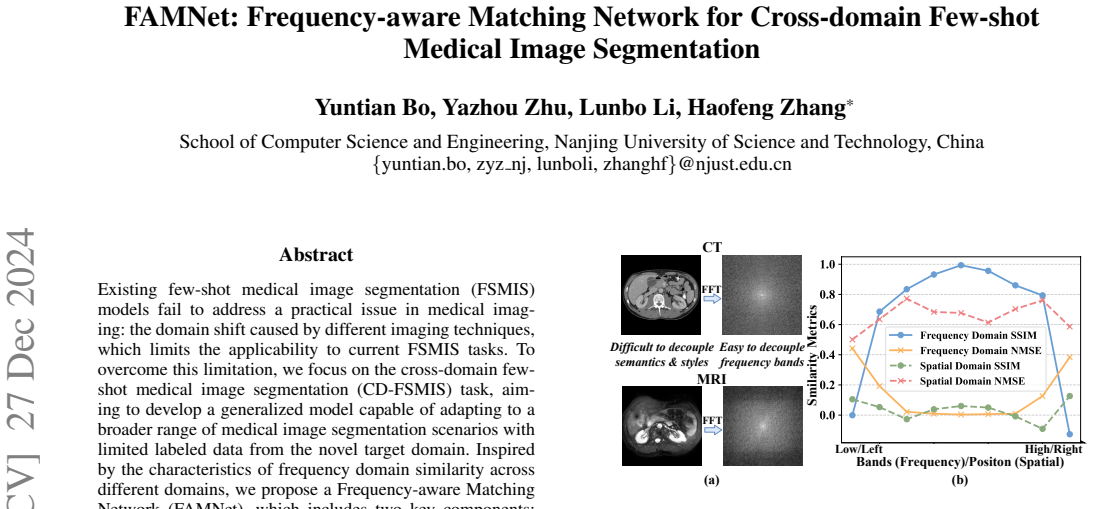
On a held-out modality pair such as T1-weighted versus T2-weighted MRI, compute per-band SSIM or NMSE between registered support and query slices after the same FFT split; if the mid-band similarity is no better than the low and high bands, the assumption fails and FAMNet-style suppression would discard transferable information. An even simpler check is to train with only the mid-frequency band: if performance drops to near baseline, the mid band alone does not carry the cross-domain structure the paper claims.
Extended reading notes
Core claim
FAMNet's core claim is that support-query matching should be done in the frequency domain, treating mid-frequency components as domain-agnostic and low- and high-frequency components as domain-variant. The FAM module converts foreground features with an FFT, separates them into low, mid, and high bands using a band-pass filter with a $3{:}4{:}3$ ratio, and computes a cosine-similarity attention matrix for each band. The mid band is weighted directly with the attention, while the low and high bands are weighted with the inverse attention matrix, deliberately suppressing the parts of the support and query that look similar in the domain-specific bands. The MSF module then uses the mid-band fused feature as the cross-attention query to extract residual domain-invariant information from the low- and high-band features, sums the three refined bands, and the resulting prototype is compared with the query feature to produce the final mask. The paper argues that this two-step decouple-and-fuse design reduces both support-query bias within a domain and the cross-domain gap, and reports that it outperforms prior few-shot medical and cross-domain few-shot segmentation methods on all tested directions.
Load-bearing premise
The premise that low- and high-frequency bands are consistently domain-variant while the mid-frequency band is domain-agnostic, with the fixed $3{:}4{:}3$ split, carries the whole method; if a new modality pair has domain shift present in the mid band, the module would suppress useful signal.
Editorial extensions
If this is right
- One-shot segmentation across CT-MRI, LGE-bSSFP, and cross-institution prostate MRI becomes feasible without any target-domain labels, with reported Dice gains of 2.78 to 10.14 points over the strongest prior method in the main directions.
- Because FAM and MSF operate on extracted foreground features rather than on a task-specific encoder, the modules can be inserted into other prototypical backbones.
- The reported results imply that the frequency-band treatment of domain shift yields improvements beyond what prior few-shot medical and cross-domain few-shot segmentation methods achieve, even when those methods explicitly target cross-domain generalization.
- In the one-shot setting, FAMNet's joint-space matching and mid-band guidance reduce the influence of a poorly representative support prototype, correcting support-query bias within a domain.
Reading between the lines
- The same band decomposition could be applied to other dense prediction tasks with domain shift, such as cross-scanner histopathology segmentation, where the mid-band structure hypothesis has not been tested.
- Because the optimal band ratio varies across organ pairs in the appendix, a learnable frequency-band mask or a ratio estimator might improve robustness on unseen modality pairs beyond the fixed $3{:}4{:}3$ split; this is an extension the paper does not explore.
- If the mid-band-domain-agnostic assumption holds broadly, then frequency-domain style transfer applied only to low and high bands should produce more effective cross-domain augmentation than full-image style transfer, a testable prediction.
Signed reviews
Editorial analysis
A structured set of objections, weighed in public.
Referee Report
Summary. The paper proposes FAMNet, a frequency-aware matching network for cross-domain few-shot medical image segmentation (CD-FSMIS). FAMNet consists of a Frequency-aware Matching (FAM) module that decouples support and query foreground features into low, mid, and high frequency bands, applies direct attention to the mid band and inverse attention to the low/high bands, and a Multi-Spectral Fusion (MSF) module that uses cross-attention with the mid band as query to refine the low/high bands. The authors report state-of-the-art Dice scores on three cross-domain settings (CT↔MRI, cardiac LGE↔b-SSFP, prostate UCLH↔NCI) and provide ablations for the modules, attention mechanisms, band ratios, and foreground pixel counts. The code is publicly available.
Significance. If the empirical claims are sustained, the paper introduces a novel and plausible frequency-domain mechanism for cross-domain few-shot medical image segmentation, with potential value for cross-modality, cross-sequence, and cross-institution generalization. The paper's strengths include the release of code, the clear architecture description, and the extensive ablation study that probes the frequency-band assumptions. However, the central SOTA claim currently rests on single-run evaluations without error bars, and the main configuration appears inconsistent with the paper's own supplementary analyses. These issues must be resolved before the contribution can be fully assessed.
major comments (3)
- [Quantitative and Qualitative Results (Tables 1, 2, 5)] All reported Dice scores are single-run values with no standard deviations, number of evaluation episodes, or seeds. In episode-based few-shot segmentation, the choice of support scan and query slices can shift mean Dice by several points; the reported margins over the second-best method (2.78% in Table 1 CT→MRI, 1.33% in Table 2 b-SSFP→LGE, and 2.27%/3.18% in Table 5) may therefore be within run-to-run variability. The paper should report mean ± std over at least 3–5 seeds with identical episode configuration, and perform a significance test (e.g., paired bootstrap or Wilcoxon) for the key comparisons.
- [Implementation Details vs Supplementary Table 4] The main text fixes the low:mid:high band ratio at 3:4:3, yet Supplementary Table 4 shows that 3.5:3:3.5 achieves a higher mean Dice (66.29% vs 65.79%) on CT→MRI, and the same table states that mid-frequency proportions above 30% degrade performance. The chosen 3:4:3 ratio gives a 40% mid band, contradicting the paper's own analysis. The authors should either adopt the empirically best ratio, justify the choice of 3:4:3 with a principled criterion, or demonstrate that the SOTA claim is insensitive to this choice across all three datasets.
- [FAM module (Eqs. 9–10) and MSF module (Eq. 13)] The method's core assumption is that low and high frequency bands are domain-variant (DSFBs) and the mid band is domain-agnostic (DAFB). This assumption is load-bearing because Eqs. (9)–(10) apply inverse attention to low/high bands and Eq. (13) uses the mid band as the clean query. However, the paper itself states in the MSF section that frequency decomposition does not completely decouple domain-variant and domain-invariant information, and the sensitivity of performance to the band ratio (Supplementary Table 4) indicates that the boundary is not universal. The authors should provide direct evidence that the mid band is consistently domain-invariant across the three cross-domain settings (e.g., per-dataset frequency-domain similarity analysis), or show that the model's performance is robust to the exact placement of the boundary.
minor comments (4)
- [Implementation Details] The sentence "the output size N for the adaptive average pooling in FAM is set to 302" should read "30²" (i.e., 900), consistent with Eq. (4) and the appendix; as written, N=302 is not a perfect square, making the reshape in Eq. (4) undefined.
- [Contributions] The phrase "archives the state-of-the-art performance" should be "achieves the state-of-the-art performance".
- [Implementation Details] There is a duplicated article in "a a decay factor"; it should be "a decay factor".
- [Figure 1] The label "Difficult to decouplesemantics & styles" is missing a space; also consider defining DAFB and DSFB at first use in the main text, as they appear before the MSF section that introduces them.
Circularity Check
No circularity: the method is an empirical design with hyperparameters tuned by ablation; no prediction reduces to a fitted input.
full rationale
I walked the claimed derivation chain. The central claim is an empirical SOTA comparison; no equation is fitted to the target test results. The FAM and MSF modules are defined by Eqs. (3)-(16); their frequency-band split (3:4:3) is a hyperparameter set in Implementation Details and ablated in Supplementary Table 4, which is standard tuning rather than a fitted input renamed as prediction. The motivation that low/high-frequency bands are domain-variant while mid-frequency is domain-agnostic is an assumption tested by experiments, not a quantity derived from the outcome. Citations to prior work by overlapping authors (e.g., Zhu et al. 2023, RPT; Cheng et al. 2024, GMRD) appear in related work and in an appendix explanation of edge information, but the central architecture does not depend on an unverified self-cited uniqueness theorem or on a claim whose only support is that citation. No circular step could be exhibited with the paper's own equations, so the derivation is self-contained with respect to its empirical inputs.
Assumptions & free parameters
free parameters (2)
- Frequency band division ratio (low:mid:high) =
3:4:3
- Foreground pixel number N =
302
assumptions (4)
- domain assumption Low and high frequency bands carry domain-variant information while the mid-frequency band is domain-agnostic in cross-domain medical images.
- domain assumption The coarse query mask from CPG (Eq. 2) is a sufficiently accurate foreground estimate for FAM feature extraction and loss computation.
- standard math Standard properties of FFT/IFFT and band-pass filtering preserve the information needed for segmentation.
- domain assumption The adapted pseudo-masks from supervoxel clustering (Hansen et al. 2022) provide adequate supervision for meta-training.
Cite this review
Pith. "Pith review of FAMNet: Frequency-aware Matching Network for Cross-domain Few-shot Medical Image Segmentation." pith.science (2026). https://pith.science/paper/MVEZHAXQ
@misc{pith2026241209319,
  author       = {Pith},
  title        = {Pith review of: FAMNet: Frequency-aware Matching Network for Cross-domain Few-shot Medical Image Segmentation},
  year         = {2026},
  howpublished = {\url{https://pith.science/paper/MVEZHAXQ}},
  note         = {Machine review of arXiv:2412.09319}
}
read the original abstract
Existing few-shot medical image segmentation (FSMIS) models fail to address a practical issue in medical imaging: the domain shift caused by different imaging techniques, which limits the applicability to current FSMIS tasks. To overcome this limitation, we focus on the cross-domain few-shot medical image segmentation (CD-FSMIS) task, aiming to develop a generalized model capable of adapting to a broader range of medical image segmentation scenarios with limited labeled data from the novel target domain. Inspired by the characteristics of frequency domain similarity across different domains, we propose a Frequency-aware Matching Network (FAMNet), which includes two key components: a Frequency-aware Matching (FAM) module and a Multi-Spectral Fusion (MSF) module. The FAM module tackles two problems during the meta-learning phase: 1) intra-domain variance caused by the inherent support-query bias, due to the different appearances of organs and lesions, and 2) inter-domain variance caused by different medical imaging techniques. Additionally, we design an MSF module to integrate the different frequency features decoupled by the FAM module, and further mitigate the impact of inter-domain variance on the model's segmentation performance. Combining these two modules, our FAMNet surpasses existing FSMIS models and Cross-domain Few-shot Semantic Segmentation models on three cross-domain datasets, achieving state-of-the-art performance in the CD-FSMIS task.
Figures


Figures from the paper (1 more)

Forward citations
Cited by 1 Pith paper
-
SS-DC: Spatial-Spectral Decoupling and Coupling Across Visible-Infrared Gap for Domain Adaptive Object Detection
SS-DC improves RGB-to-infrared domain-adaptive object detection by spectrally decoupling domain-invariant from domain-specific features and coupling them with spatial features.
Reference graph
Works this paper leans on
-
[1]
Chen, H.; Dong, Y.; Lu, Z.; Yu, Y.; and Han, J. 2024. Pixel Matching Network for Cross-Domain Few-Shot Segmentation. In WACV, 978--987
work page 2024
-
[2]
Cheng, Z.; Wang, S.; Xin, T.; Zhou, T.; Zhang, H.; and Shao, L. 2024. Few-Shot Medical Image Segmentation via Generating Multiple Representative Descriptors. IEEE Transactions on Medical Imaging, 43(6): 2202 -- 2214
work page 2024
-
[3]
Choyke, P.; Turkbey, B.; Pinto, P.; Merino, M.; and Wood, B. 2016. Data from PROSTATE-MRI. The Cancer Imaging Archive
work page 2016
-
[4]
Demir, I.; Koperski, K.; Lindenbaum, D.; Pang, G.; Huang, J.; Basu, S.; Hughes, F.; Tuia, D.; and Raskar, R. 2018. DeepGlobe 2018: A Challenge to Parse the Earth through Satellite Images. In CVPR, 172--17209
work page 2018
-
[5]
Dickinson, L.; Ahmed, H.; Kirkham, A.; Allen, C.; Freeman, A.; Barber, J.; Hindley, R.; Leslie, T.; Ogden, C.; Persad, R.; Winkler, M.; and Emberton, M. 2013. A multi-centre prospective development study evaluating focal therapy using high intensity focused ultrasound for localised prostate cancer: The INDEX study. Contemporary Clinical Trials, 36(1): 68--80
work page 2013
-
[6]
Ding, H.; Sun, C.; Tang, H.; Cai, D.; and Yan, Y. 2023. Few-shot Medical Image Segmentation with Cycle-resemblance Attention. In WACV, 2487--2496
work page 2023
-
[7]
Feng, R.; Zheng, X.; Gao, T.; Chen, J.; Wang, W.; Chen, D. Z.; and Wu, J. 2021. Interactive Few-Shot Learning: Limited Supervision, Better Medical Image Segmentation. IEEE Transactions on Medical Imaging, 40(10): 2575--2588
work page 2021
-
[8]
Guha Roy, A.; Siddiqui, S.; Pölsterl, S.; Navab, N.; and Wachinger, C. 2019. ’Squeeze & Excite’ Guided Few-Shot Segmentation of Volumetric Images. Medical Image Analysis, 59: 101587
work page 2019
Show all 42 references
-
[9]
A.; Hu, Y.; Rodell, R.; Villarini, B.; Bonmati, E.; Tranter, P.; Punwani, S.; Sidhu, H
Hamid, S.; Donaldson, I. A.; Hu, Y.; Rodell, R.; Villarini, B.; Bonmati, E.; Tranter, P.; Punwani, S.; Sidhu, H. S.; Willis, S.; van der Meulen , J.; Hawkes, D.; McCartan, N.; Potyka, I.; Williams, N. R.; Brew-Graves, C.; Freeman, A.; Moore, C. M.; Barratt, D.; Emberton, M.; a...
2019
-
[10]
Hamming, R. W. 1977. Digital Filters . Signal Processing Series. Englewood Cliffs: Prentice--Hall
1977
-
[11]
Hansen, S.; Gautam, S.; Jenssen, R.; and Kampffmeyer, M. 2022. Anomaly detection-inspired few-shot medical image segmentation through self-supervision with supervoxels. Medical Image Analysis, 78: 102385
2022
-
[12]
He, K.; Zhang, X.; Ren, S.; and Sun, J. 2016. Deep Residual Learning for Image Recognition. In CVPR, 770--778
2016
-
[13]
He, W.; Zhang, Y.; Zhuo, W.; Shen, L.; Yang, J.; Deng, S.; and Sun, L. 2024. APSeg: Auto-Prompt Network for Cross-Domain Few-Shot Semantic Segmentation. In CVPR, 23762--23772
2024
-
[14]
Herzog, J. 2024. Adapt Before Comparison: A New Perspective on Cross-Domain Few-Shot Segmentation. In CVPR, 23605--23615
2024
-
[15]
Huang, J.; Guan, D.; Xiao, A.; and Lu, S. 2021. FSDR: Frequency Space Domain Randomization for Domain Generalization. In CVPR, 6891--6902
2021
-
[16]
E.; Gezer, N
Kavur, A. E.; Gezer, N. S.; Barış, M.; Aslan, S.; Conze, P.-H.; Groza, V.; Pham, D. D.; Chatterjee, S.; Ernst, P.; Özkan, S.; Baydar, B.; Lachinov, D.; Han, S.; Pauli, J.; Isensee, F.; Perkonigg, M.; Sathish, R.; Rajan, R.; Sheet, D.; Dovletov, G.; Speck, O.; Nürnberger, A.; M...
2021
-
[17]
Landman, B.; Xu, Z.; Igelsias, J.; Styner, M.; Langerak, T.; and Klein, A. 2015. Miccai multi-atlas labeling beyond the cranial vault--workshop and challenge. In MICCAI Workshop, 12
2015
-
[18]
Lei, S.; Zhang, X.; He, J.; Chen, F.; Du, B.; and Lu, C.-T. 2022. Cross-Domain Few-Shot Semantic Segmentation. In ECCV, 73--90
2022
-
[19]
J.; Yang, Q.; Min, Z.; Saeed, S
Li, Y.; Fu, Y.; Gayo, I. J.; Yang, Q.; Min, Z.; Saeed, S. U.; Yan, W.; Wang, Y.; Noble, J. A.; Emberton, M.; et al. 2023. Prototypical few-shot segmentation for cross-institution male pelvic structures with spatial registration. Medical Image Analysis, 90: 102935
2023
-
[20]
Lin, T.-Y.; Maire, M.; Belongie, S.; Hays, J.; Perona, P.; Ramanan, D.; Doll \'a r, P.; and Zitnick, C. L. 2014. Microsoft COCO: Common Objects in Context. In ECCV, 740--755
2014
-
[21]
Lin, Y.; Chen, Y.; Cheng, K.-T.; and Chen, H. 2023. Few Shot Medical Image Segmentation with Cross Attention Transformer. In MICCAI, 233--243
2023
-
[22]
Liu, S.; Qi, L.; Qin, H.; Shi, J.; and Jia, J. 2018. Path Aggregation Network for Instance Segmentation. In CVPR, 8759--8768
2018
-
[23]
C.; and Lu, S
Nie, J.; Xing, Y.; Zhang, G.; Yan, P.; Xiao, A.; Tan, Y.-P.; Kot, A. C.; and Lu, S. 2024. Cross-Domain Few-Shot Segmentation via Iterative Support-Query Correspondence Mining. In CVPR, 3380--3390
2024
-
[24]
Ouyang, C.; Biffi, C.; Chen, C.; Kart, T.; Qiu, H.; and Rueckert, D. 2022. Self-Supervised Learning for Few-Shot Medical Image Segmentation. IEEE Transactions on Medical Imaging, 41(7): 1837--1848
2022
-
[25]
Ouyang, C.; Chen, C.; Li, S.; Li, Z.; Qin, C.; Bai, W.; and Rueckert, D. 2021. Causality-Inspired Single-Source Domain Generalization for Medical Image Segmentation. IEEE Transactions on Medical Imaging, 42: 1095--1106
2021
-
[26]
Shen, Q.; Li, Y.; Jin, J.; and Liu, B. 2023. Q-Net: Query-Informed Few-Shot Medical Image Segmentation. In Arai, K., ed., Intelligent Systems and Applications, 610--628
2023
-
[27]
A.; Ahmed, H
Simmons, L. A.; Ahmed, H. U.; Moore, C. M.; Punwani, S.; Freeman, A.; Hu, Y.; Barratt, D.; Charman, S. C.; Van der Meulen , J.; and Emberton, M. 2014. The PICTURE study — Prostate Imaging (multi-parametric MRI and Prostate HistoScanning™) Compared to Transperineal Ultrasound g...
2014
-
[28]
Su, J.; Fan, Q.; Pei, W.; Lu, G.; and Chen, F. 2024. Domain-Rectifying Adapter for Cross-Domain Few-Shot Segmentation. In CVPR, 24036--24045
2024
-
[29]
Su, Z.; Yao, K.; Yang, X.; Huang, K.; Wang, Q.; and Sun, J. 2023. Rethinking Data Augmentation for Single-Source Domain Generalization in Medical Image Segmentation. In AAAI, 2366--2374
2023
-
[30]
Sun, L.; Li, C.; Ding, X.; Huang, Y.; Chen, Z.; Wang, G.; Yu, Y.; and Paisley, J. 2022. Few-shot medical image segmentation using a global correlation network with discriminative embedding. Computers in Biology and Medicine, 140: 105067
2022
-
[31]
H.; Zou, Y.; Zhou, D.; and Feng, J
Wang, K.; Liew, J. H.; Zou, Y.; Zhou, D.; and Feng, J. 2019. PANet: Few-Shot Image Semantic Segmentation With Prototype Alignment. In ICCV, 9196--9205
2019
-
[32]
Wang, Z.; Bovik, A.; Sheikh, H.; and Simoncelli, E. 2004. Image quality assessment: from error visibility to structural similarity. IEEE Transactions on Image Processing, 13(4): 600--612
2004
-
[33]
P.; Tai, Y.-W.; and Tang, C.-K
Wei, T.; Li, X.; Chen, Y. P.; Tai, Y.-W.; and Tang, C.-K. 2019. FSS-1000: A 1000-Class Dataset for Few-Shot Segmentation. In CVPR, 2866--2875
2019
-
[34]
Xu, Y.; Xie, S.; Reynolds, M.; Ragoza, M.; Gong, M.; and Batmanghelich, K. 2022. Adversarial Consistency for Single Domain Generalization in Medical Image Segmentation. In MICCAI, 671--681
2022
-
[35]
Zhou, Z.; Qi, L.; Yang, X.; Ni, D.; and Shi, Y. 2022. Generalizable Cross-modality Medical Image Segmentation via Style Augmentation and Dual Normalization. In CVPR, 20856--20865
2022
-
[36]
Zhu, Y.; Wang, S.; Xin, T.; and Zhang, H. 2023. Few-Shot Medical Image Segmentation via a Region-Enhanced Prototypical Transformer. In MICCAI, 271--280. Springer
2023
-
[37]
M.; Lekadir, K.; Vesal, S.; RaviKumar, N.; Liu, Y.; Luo, G.; Chen, J.; Li, H.; Ly, B.; Sermesant, M.; Roth, H.; Zhu, W.; Wang, J.; Ding, X.; Wang, X.; Yang, S.; and Li, L
Zhuang, X.; Xu, J.; Luo, X.; Chen, C.; Ouyang, C.; Rueckert, D.; Campello, V. M.; Lekadir, K.; Vesal, S.; RaviKumar, N.; Liu, Y.; Luo, G.; Chen, J.; Li, H.; Ly, B.; Sermesant, M.; Roth, H.; Zhu, W.; Wang, J.; Ding, X.; Wang, X.; Yang, S.; and Li, L. 2022. Cardiac segmentation ...
2022
-
[38]
, " * write output.state after.block = add.period write newline
ENTRY address archivePrefix author booktitle chapter edition editor eid eprint howpublished institution isbn journal key month note number organization pages publisher school series title type volume year label extra.label sort.label short.list INTEGERS output.state before.all...
-
[39]
write newline
" write newline "" before.all 'output.state := FUNCTION n.dashify 't := "" t empty not t #1 #1 substring "-" = t #1 #2 substring "--" = not "--" * t #2 global.max substring 't := t #1 #1 substring "-" = "-" * t #2 global.max substring 't := while if t #1 #1 substring * t #2 gl...
-
[40]
Bernhardt, P.; Batz, L.; Ruhrnschopf, E.-P.; and Hoheisel, M. 2005. Spatial frequency-dependent signal-to-noise ratio as a generalized measure of image quality. In Medical Imaging 2005: Physics of Medical Imaging, volume 5745, 407--418. SPIE
2005
-
[41]
Tang, J.; Peli, E.; and Acton, S. 2003. Image enhancement using a contrast measure in the compressed domain. IEEE Signal Processing Letters, 10(10): 289--292
2003
-
[42]
Van der Maaten, L.; and Hinton, G. 2008. Visualizing data using t-SNE. Journal of machine learning research, 9(11)
2008
Reviewed August 11, 2026 · model on record in the stance chip above.
Discussion (0). Continue with ORCID to comment.