REVIEW 2 major objections 5 minor 1 cited by
Schur Connections: Chord Counting, Line Operators, and Indices
T0 review · 2 major / 5 minor · reviewed 2026-08-15 · deepseek-v4-flash
Pith's one-line read The paper establishes that Schur half-indices with Wilson lines are q-oscillator vacuum expectation values, proved by diagonalizing the commuting Wilson-line operators in a q-Whittaker basis.
desk verdict A real SU(N) generalization of the Schur/DSSYK story, with the central identity proven at the endpoints of the Dynkin diagram but only asserted for the middle representations; referee it, but require that the intermediate Toda identifications be filled in. read the letter →
The pith
A machine-rendered reading of the paper's core claim, the machinery that carries it, and where it could break.
The reading
What carries the argument
The load-bearing object is the $q$-oscillator representation of the Schur algebra $\mathcal{A}_{\text{Schur}}$. For $SU(N)$ one takes $N-1$ decoupled $q$-deformed oscillators satisfying $[a_i,a_i^\dagger]_q=1$, and maps each Wilson line $W_{R_r}$ to an operator $T_{R_r}$ by substituting characters: $v_i \to (1-q)^{1/2}a_i^\dagger$ and $v_i^{-1}\to (1-q)^{1/2}a_i$. This map produces operators that commute for different $r$ and are Hermitian-conjugate under charge conjugation. The proof is carried by identifying the difference operators in the eigenvalue equations for $T_{R_r}$ with the Hamiltonians $H'_r$ of the relativistic open Toda chain, whose common eigenfunctions are the $q$-Whittaker polynomials; the orthogonality and completeness of that basis against the Schur measure is what converts a VEV into the half-index integral.
What would settle it
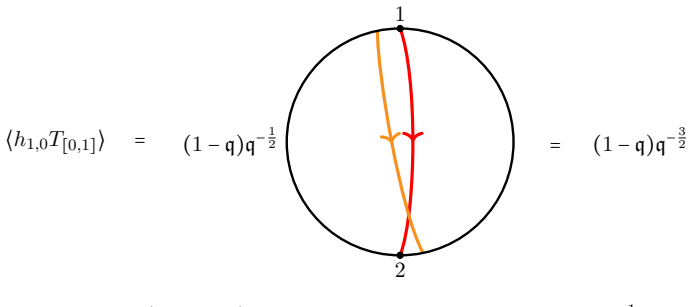
For $SU(4)$, take the antisymmetric (rank-1) Wilson line $T_{[0,1,0]}$ and act with it on the q-Whittaker polynomial $W_{(1,0,0)}(z;q)$; if the result is not $\chi_{[0,1,0]}(z)\,W_{(1,0,0)}(z;q)$, then the identification $T_R=H'_r$ fails for an intermediate representation and the spectral proof of the index-VEV identity does not go through. The same check can be repeated numerically for the $SU(4)$ index with two antisymmetric Wilson lines.
Extended reading notes
Core claim
The central claim is the identity in Eqs. (5.1) and (5.29): the Schur half-index of pure $SU(N)$ $N=2$ SYM with insertions of Wilson lines in representations $R_r$ equals the vacuum expectation value of the corresponding $q$-oscillator operators, $I^{(N)}_{W^{k_1}_{R_1},...}=\langle T^{k_1}_{R_1}\cdots\rangle$. The proof goes through the commuting family of Wilson-line transfer matrices $T_{R_r}$. These are shown to coincide with the $N-1$ Hamiltonians of the relativistic open Toda chain of type $su(N)$ (proved explicitly for the fundamental and antifundamental and asserted for the intermediate representations), so they share a common eigenbasis given by $q$-Whittaker polynomials $W_{\vec{n}}(z;q)$. The eigenvalue of $T_{R_r}$ on that basis is the $SU(N)$ character $\chi_{R_r}(z)$, and the $q$-Whittaker polynomials are orthogonal with respect to exactly the measure appearing in the half-index integral (2.4). Inserting the completeness relation of this basis into the oscillator VEV reproduces the integral formula for the half-index, completing the proof.
Load-bearing premise
The identification of the transfer matrices with the Toda Hamiltonians is shown explicitly only for the fundamental and antifundamental Wilson lines; for the $N-3$ intermediate representations the paper asserts the same calculation works, and the full spectral proof needs all $N-1$ commuting operators to be diagonalized simultaneously.
Editorial extensions
If this is right
- Every Schur half-index with Wilson lines in the $N-1$ fundamental representations (and products) is determined by the joint spectrum of the Toda Hamiltonians; no separate gauge-theory integral is needed.
- The $q$-Whittaker expansion gives exact closed forms for Wilson-line indices, and in the $q\to 1$ limit the Wilson-line operators reduce to the conserved charges of the classical open Toda chain, with differences of transfer matrices producing the higher charges.
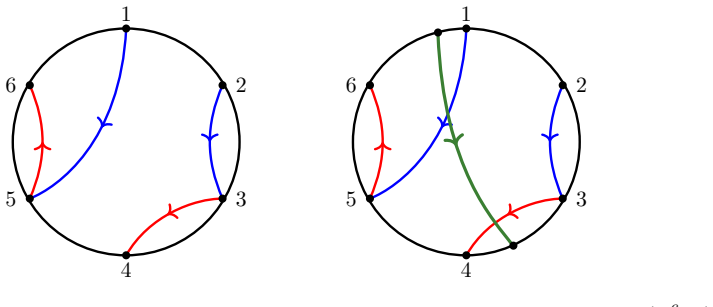
- The chord-counting formulation yields a finite combinatorial algorithm for $SU(N)$: $N-1$ chord colors, same-color intersections weight $q$, cross-color weight $1$, and boundary vertex weights fixed by the transfer matrix terms.
- The matter-chord calculation proves that inserting $q^{-\Delta \sum j n_j}$ into a Wilson-line VEV reproduces the half-index of two $SU(N)$ SYM copies joined by a 3d $N=2$ domain wall with a bifundamental chiral and determinant superpotential.
- For $N=2$ all of this collapses to $q$-Hermite polynomials and ordinary chord counting, recovering the previously conjectured $SU(2)$ correspondence.
Reading between the lines
- A direct way to close the paper's stated gap is to write out $H'_r$ for $r=2,\dots,N-2$ from the appendix formulas and verify the action on $W_{n_1,\dots,n_{N-1}}$; the paper's claim predicts the result equals the action of the character-to-oscillator operator $T_{R_r}$.
- If the central identity survives for all intermediate representations, the $SU(N)$ correspondence is not an ensemble/random-matrix duality like the $SU(2)$ case but a deterministic isospectral statement; a higher-spin gravitational dual would then be governed by the classical Toda chain rather than Schwarzian/JT dynamics.
- The chord rules suggest a testable hierarchy: $q\to 0$ counts $N$-dimensional Catalan walks while $q\to 1$ counts partitions into $N$-tuples; confirming these limits for $N\geq 4$ at higher orders would provide independent combinatorial evidence for the transfer-matrix rules.
- The failure to find a generalized SYK model may be structural; the colored, oriented chords with color-changing vertices point toward a free-fermion/chiral description, so a Hamiltonian whose double-scaled limit produces these chords might need complex fermions with a conserved color charge.
Signed reviews
Editorial analysis
A structured set of objections, weighed in public.
Referee Report
Summary. This paper studies the Schur half-index of 4d N = 2 pure SU(N) super Yang-Mills theory with insertions of line operators on a hemisphere, and develops three equivalent reformulations of it. First, the paper derives the algebra of line operators ASchur in q-Weyl-algebra variables for general SU(N), works out the SU(3) relations including dyonic lines, and then gives a representation of the Wilson (and, for SU(3), dyonic) lines in terms of N − 1 decoupled q-deformed oscillators in which the half-index becomes a vacuum expectation value (Secs. 2–3). Second, it extracts from the oscillator representation a generalized colored chord-counting problem, with explicit boundary weights, bulk intersection weights (q for equal colors, 1 for different colors), and matter chords that realize dyonic lines and 3d N = 2 domain walls (Sec. 4). Third, it proposes a spectral solution of the Wilson-line transfer matrices: the transfer matrices T_{R_r} are identified with the N − 1 commuting Hamiltonians of the relativistic open su(N) Toda chain, whose joint eigenfunctions are the q-Whittaker polynomials with eigenvalues equal to the SU(N) characters χ_{R_r}(z); orthogonality and completeness then yield the identity (5.29) between oscillator VEVs and the matrix-integral form of the half-index (Sec. 5). A q → 1 limit recovers the classical open Toda chain and its conserved charges.
Significance. If fully established, the central identity (5.1)/(5.29) is a significant result: it reduces the exact computation of Schur half-indices with arbitrary Wilson-line insertions to the spectral theory of the q-Toda chain, generalizes the SU(2)/DSSYK correspondence of Gaiotto–Verlinde to all SU(N), and produces explicit, falsifiable combinatorial predictions (e.g., the sequences 1, 5, 42, 462 and 1, 10, 280, 15400 in (4.10)–(4.11)). Strengths that I want to credit explicitly: the q-oscillator constructions in Sec. 3 are completely explicit and checked at low order for SU(3), SU(4), and SU(5); the q-Whittaker summation identity (5.33) is proved in Appendix B and correct; the orthogonality measure (5.26) indeed coincides with the index measure; and Sec. 6 is honest about what the correspondence does not yet deliver (no SYK-like model for N > 2, no reconciled Toda-field-theory chord counting). The proof strategy is sound and uses standard, correctly cited q-Toda technology; there is no circularity, since the eigenvalues are characters by standard integrable-system results rather than by fitting.
major comments (2)
- [Sec. 5.1, Eq. (5.17)] The identity H'_r = T_{R_r} is proven explicitly only for r = 1 ((5.7)–(5.16)) and r = N − 1 ((5.18)–(5.23)). For the N − 3 intermediate representations R_2, ..., R_{N−2}, the sentence after (5.17) says that 'the other cases work similarly but are more complicated', without supplying the calculation. This is a load-bearing gap for the central claim (5.1)/(5.29): the derivation inserts the completeness relation (5.28) and then applies (5.25) to each factor T^{k_r}_{R_r}, which requires every T_{R_r} to be simultaneously diagonalized by the q-Whittaker basis with eigenvalue χ_{R_r}(z). Without the intermediate identifications, the spectral proof does not cover, e.g., the SU(4) antisymmetric Wilson line (3.61), whose VEV-index identity is checked only to low order in (3.63). I note that the eigenvalue statement itself is standard — χ_{R_r}(z) is the r-th elementary symmetric polynomial e_r(z) on the SU(N) torus — so the missing input is the operator identity. Please provide the explicit computation of T_{R_r} on the Fock-space basis for general r, or a general argument (e.g., showing that both T_{R_r} and H'_r have the same matrix elements on |n⟩, or that T_{R_r} equals the r-th quantum-determinant character of the Toda transfer matrix).
- [Sec. 5.1, Eqs. (5.3), (5.6), (5.14)–(5.15), (5.18), (5.20), (5.22)] The displayed formulas of the spectral derivation contain a systematic index error. With n_i = p_{i+1} − p_i from (5.9), the coefficient in (5.7) is 1 − q^{n_i+1}, but (5.14) and (5.15) print 1 − q^{n_{i+1}}, and the same wrong coefficient appears in (5.3), (5.6), and (5.20). Direct computation from the oscillator representation (3.55)/(5.2) confirms the intended value: the term W_{n_1,...,n_i+1,n_{i+1}−1,...} in (5.6) must carry the coefficient (1 − q)[n_i + 1]_q = 1 − q^{n_i+1}, because the preimage state has occupation n_i + 1 in the lowered mode. As printed, the right-hand side of (5.15) is not the eigenvalue equation of T_fund, so the identification (5.16) is not established as written; furthermore, (5.14) is ill-defined for N = 2 because the variable n_2 does not exist. Separately, the final term of (5.18) and (5.22) is printed as W_{n_1+1,n_2,...,n_{N−1}−1}, whereas application of T_{[0,...,0,1]} from (3.55) gives (1 − q^{n_1+1}) W_{n_1+1,n_2,...,n_{N−1}}; I verified this for N = 3 directly from (3.21) and for general N from the matrix elements of the similarity-transformed transfer matrix S^{−1} T S with S = (1 − q)^{Σn/2}. These errors are evidently correctable — the intended formulas agree with the standard q-Toda Hamiltonian (B.12) — but as printed the derivation is internally inconsistent and must be corrected and re-verified in full.
minor comments (5)
- [Sec. 3.3, Eq. (3.68)] The displayed identity ⟨W^5_{[0,0,1,0]}⟩ = I^{(5)}_{W^2_{[0,1,0]}} mixes the two labels; the middle expression should presumably read I^{(5)}_{W^5_{[0,0,1,0]}}.
- [Sec. 5.1, text after (5.3)] In the second bullet of the explanation of (5.3), the prefactor is stated as 1 − q^{n_{i+1}}; this carries the same index error as the displayed equations and should read 1 − q^{n_i+1}.
- [Sec. 5.1, Eq. (5.32)] The summation is over ⃗n, but the weight is written with m_j (q^{Δ Σ j m_j}); please unify the notation.
- [Sec. 3.3, Eq. (3.56)] Commutativity of the transfer matrices T_{R_r} is asserted with 'one can show' and checked only for N = 3, 4, 5; a proof of (5.17) would settle it, but otherwise a general argument should be supplied.
- [Sec. 3.2.4, Eq. (3.51)] The identity I^{(N)}_L = ⟨π(L)⟩ is stated for arbitrary line operators, but the q-oscillator representation of dyonic lines is constructed only for SU(3) (§3.2.3); for N > 3 the statement should be flagged as conditional.
Circularity Check
No circularity: the VEV–index identity is derived from the external q-Whittaker/Toda spectral theory, not from its own inputs.
full rationale
The central identity (5.1)/(5.29) is proven by diagonalizing the commuting transfer matrices T_{R_r} in the q-Whittaker basis, whose eigenvalues are the SU(N) characters chi_{R_r}(z) by the standard relativistic open Toda theory [26-30]. The paper identifies T_{R_1} with H'_1 in (5.16) and T_{R_{N-1}} with H'_{N-1} in (5.23); the orthogonality measure (5.26) and completeness (5.28) reproduce the Schur half-index integrand (2.4) without fitting. The q-oscillator representation of Wilson lines is a proposed ansatz, but it is checked against direct low-order index computations and then given an independent spectral derivation; the generalized chord rules are read off from the oscillator transfer matrices, so the combinatorial description is a reformulation rather than independent evidence, but it is not circular. The only substantive caveat is a proof gap, not circularity: Eq. (5.17) asserts H'_r = T_{R_r} for all r, while only r=1 and r=N-1 are shown and the text says "the other cases work similarly but are more complicated"; without those intermediate identifications, (5.29) is not fully established for representations R_2,...,R_{N-2}. This is an omitted verification, not a reduction of the target identity to its own assumptions.
Assumptions & free parameters
assumptions (5)
- domain assumption The Schur half-index of pure SU(N) SYM with Wilson lines is given by the matrix integral (2.4)/(2.6).
- domain assumption Positivity of the Schur half-index for 0<q<1, enabling the GNS Hilbert space construction of [17].
- domain assumption The q-Weyl algebra description of line operators given in Section 2.2, following [17].
- standard math q-Whittaker polynomials are a complete orthogonal basis diagonalizing the relativistic open Toda Hamiltonians with character eigenvalues.
- standard math The recursion (5.3) properly defines the action of the transfer matrix T_{[1,0,...,0]} on the q-oscillator Fock space.
Cite this review
Pith. "Pith review of Schur Connections: Chord Counting, Line Operators, and Indices." pith.science (2026). https://pith.science/paper/MVGI3JAR
@misc{pith2026250617384,
  author       = {Pith},
  title        = {Pith review of: Schur Connections: Chord Counting, Line Operators, and Indices},
  year         = {2026},
  howpublished = {\url{https://pith.science/paper/MVGI3JAR}},
  note         = {Machine review of arXiv:2506.17384}
}
abstract
Recently, an intriguing correspondence was conjectured in arXiv:2409.11551 between Schur half-indices of pure 4d $SU(2)$ $\mathcal{N}=2$ supersymmetric Yang-Mills (SYM) theory with line operator insertions and partition functions of the double scaling limit of the Sachdev-Ye-Kitaev model (DSSYK). Motivated by this, we explore a generalization to $SU(N)$ $\mathcal{N}=2$ SYM theories. We begin by deriving the algebra of line operators, $\mathcal{A}_{\text{Schur}}$, representing it both in terms of the $\mathfrak{q}$-Weyl algebra and $\mathfrak{q}$-deformed harmonic oscillators, respectively. In the latter framework, the half-index admits a natural description as an expectation value in the Fock space of the oscillators. This $\mathfrak{q}$-oscillator perspective further suggests an interpretation in terms of generalized colored chord counting, and maps the half-index to a purely combinatorial quantity. Finally, we establish a connection with the quantum Toda chain, which is an integrable model whose commuting Hamiltonians can be identified with the Wilson lines of the $SU(N)$ SYM, and their eigenfunctions correspond to the function basis appearing in the half-index.
Figures


Figures from the paper (18 more)






Forward citations
Cited by 1 Pith paper
-
q-Askey Deformations of Double-Scaled SYK
q-Askey deformations of DSSYK produce transfer matrices from basic orthogonal polynomials whose chord numbers map to ER bridge lengths and signal geometric transitions with discrete spectra in sine dilaton gravity.
Reference graph
Works this paper leans on
-
[1]
SYK-Schur duality: Double scaled SYK correlators from N = 2 supersymmetric gauge theory,
D. Gaiotto and H. Verlinde, “SYK-Schur duality: Double scaled SYK correlators from N = 2 supersymmetric gauge theory,” arXiv:2409.11551 [hep-th]
-
[2]
Liouville Correlation Functions from Four-dimensional Gauge Theories,
L. F. Alday, D. Gaiotto, and Y. Tachikawa, “Liouville Correlation Functions from Four-dimensional Gauge Theories,” Lett. Math. Phys. 91 (2010) 167–197, arXiv:0906.3219 [hep-th]
arXiv 2010
-
[3]
Gauge Theories Labelled by Three-Manifolds,
T. Dimofte, D. Gaiotto, and S. Gukov, “Gauge Theories Labelled by Three-Manifolds,” Commun. Math. Phys. 325 (2014) 367–419, arXiv:1108.4389 [hep-th]
arXiv 2014
-
[4]
Quantization of Integrable Systems and Four Dimensional Gauge Theories,
N. A. Nekrasov and S. L. Shatashvili, “Quantization of Integrable Systems and Four Dimensional Gauge Theories,” in 16th International Congress on Mathematical Physics , pp. 265–289. 2010. arXiv:0908.4052 [hep-th]
arXiv 2010
-
[5]
Teschner, Exact results on N=2 supersymmetric gauge theories
J. Teschner, Exact results on N=2 supersymmetric gauge theories. , pp. 1–30. 2016. arXiv:1412.7145 [hep-th]
arXiv 2016
-
[6]
A slow review of the AGT correspondence,
B. Le Floch, “A slow review of the AGT correspondence,” J. Phys. A 55 no. 35, (2022) 353002, arXiv:2006.14025 [hep-th]
arXiv 2022
-
[7]
A Panorama Of Physical Mathematics c. 2022,
I. Bah, D. S. Freed, G. W. Moore, N. Nekrasov, S. S. Razamat, and S. Schafer-Nameki, “A Panorama Of Physical Mathematics c. 2022,” arXiv:2211.04467 [hep-th]
arXiv 2022
- [8]
Show all 105 references
-
[9]
A(N-1) conformal Toda field theory correlation functions from conformal N = 2 SU(N) quiver gauge theories,
N. Wyllard, “A(N-1) conformal Toda field theory correlation functions from conformal N = 2 SU(N) quiver gauge theories,” JHEP 11 (2009) 002, arXiv:0907.2189 [hep-th]
2009 arXiv
-
[10]
Gapless spin-fluid ground state in a random quantum heisenberg magnet,
S. Sachdev and J. Ye, “Gapless spin-fluid ground state in a random quantum heisenberg magnet,” Physical Review Letters 70 no. 21, (May, 1993) 3339–3342
1993
-
[11]
A simple model of quantum holography (part 1),
A. Kitaev, “A simple model of quantum holography (part 1),” 2015. http://online.kitp.ucsb.edu/online/entangled15/kitaev/
2015
-
[12]
A simple model of quantum holography (part 2),
A. Kitaev, “A simple model of quantum holography (part 2),” 2015. http://online.kitp.ucsb.edu/online/entangled15/kitaev2/
2015
-
[13]
Remarks on the Sachdev-Ye-Kitaev model,
J. Maldacena and D. Stanford, “Remarks on the Sachdev-Ye-Kitaev model,” Phys. Rev. D 94 no. 10, (2016) 106002, arXiv:1604.07818 [hep-th]
2016 arXiv
-
[14]
Holomorphic reduction of N=2 gauge theories, Wilson-’t Hooft operators, and S-duality,
A. Kapustin, “Holomorphic reduction of N=2 gauge theories, Wilson-’t Hooft operators, and S-duality,” arXiv:hep-th/0612119
-
[15]
The 4d Superconformal Index from q-deformed 2d Yang-Mills,
A. Gadde, L. Rastelli, S. S. Razamat, and W. Yan, “The 4d Superconformal Index from q-deformed 2d Yang-Mills,” Phys. Rev. Lett. 106 (2011) 241602, arXiv:1104.3850 [hep-th]
2011 arXiv
-
[16]
Gauge Theories and Macdonald Polynomials,
A. Gadde, L. Rastelli, S. S. Razamat, and W. Yan, “Gauge Theories and Macdonald Polynomials,” Commun. Math. Phys. 319 (2013) 147–193, arXiv:1110.3740 [hep-th]
2013 arXiv
-
[17]
Schur Quantization and Complex Chern-Simons theory,
D. Gaiotto and J. Teschner, “Schur Quantization and Complex Chern-Simons theory,” arXiv:2406.09171 [hep-th]
-
[18]
Infrared Computations of Defect Schur Indices,
C. Cordova, D. Gaiotto, and S.-H. Shao, “Infrared Computations of Defect Schur Indices,” JHEP 11 (2016) 106, arXiv:1606.08429 [hep-th]
2016 arXiv
-
[19]
A cordial introduction to double scaled SYK,
M. Berkooz and O. Mamroud, “A cordial introduction to double scaled SYK,” Rept. Prog. Phys. 88 no. 3, (2025) 036001, arXiv:2407.09396 [hep-th]
2025 arXiv
-
[20]
Chord diagrams, exact correlators in spin glasses and black hole bulk reconstruction,
M. Berkooz, P. Narayan, and J. Simon, “Chord diagrams, exact correlators in spin glasses and black hole bulk reconstruction,” JHEP 08 (2018) 192, arXiv:1806.04380 [hep-th] . 86
2018 arXiv
-
[21]
Towards a full solution of the large N double-scaled SYK model,
M. Berkooz, M. Isachenkov, V. Narovlansky, and G. Torrents, “Towards a full solution of the large N double-scaled SYK model,” JHEP 03 (2019) 079, arXiv:1811.02584 [hep-th]
2019 arXiv
-
[22]
The bulk Hilbert space of double scaled SYK,
H. W. Lin, “The bulk Hilbert space of double scaled SYK,” JHEP 11 (2022) 060, arXiv:2208.07032 [hep-th]
2022 arXiv
-
[23]
Black Holes and Random Matrices,
J. S. Cotler, G. Gur-Ari, M. Hanada, J. Polchinski, P. Saad, S. H. Shenker, D. Stanford, A. Streicher, and M. Tezuka, “Black Holes and Random Matrices,” JHEP 05 (2017) 118, arXiv:1611.04650 [hep-th] . [Erratum: JHEP 09, 002 (2018)]
2017 arXiv
-
[24]
Chaos in AdS 2 Holography,
K. Jensen, “Chaos in AdS 2 Holography,” Phys. Rev. Lett. 117 no. 11, (2016) 111601, arXiv:1605.06098 [hep-th]
2016 arXiv
-
[25]
Conformal symmetry and its breaking in two dimensional Nearly Anti-de-Sitter space,
J. Maldacena, D. Stanford, and Z. Yang, “Conformal symmetry and its breaking in two dimensional Nearly Anti-de-Sitter space,” PTEP 2016 no. 12, (2016) 12C104, arXiv:1606.01857 [hep-th]
2016 arXiv
-
[26]
Relativistic toda systems,
S. N. M. Ruijsenaars, “Relativistic toda systems,” Commun. Math. Phys. 133 (1990) 217–247
1990
-
[27]
A new class of symmetric functions.,
I. G. Macdonald, “A new class of symmetric functions.,” S´ eminaire Lotharingien de Combinatoire [electronic only] 20 (1988) B20a–41
1988
-
[28]
Whittaker functions on quantum groups and q-deformed Toda operators,
P. Etingof, “Whittaker functions on quantum groups and q-deformed Toda operators,” arXiv Mathematics e-prints (Jan., 1999) math/9901053, arXiv:math/9901053 [math.QA]
1999 arXiv
-
[29]
On q-deformed gl(l+1)-Whittaker function,
A. Gerasimov, D. Lebedev, and S. Oblezin, “On q-deformed gl(l+1)-Whittaker function,” arXiv e-prints (Mar., 2008) arXiv:0803.0145, arXiv:0803.0145 [math.RT]
2008 arXiv
-
[30]
On q-deformed gl(l+1)-Whittaker function II,
A. Gerasimov, D. Lebedev, and S. Oblezin, “On q-deformed gl(l+1)-Whittaker function II,” Communications in Mathematical Physics 294 no. 1, (Feb., 2010) 97–119, arXiv:0803.0970 [math.RT]
2010 arXiv
-
[31]
Integrability and Seiberg-Witten exact solution,
A. Gorsky, I. Krichever, A. Marshakov, A. Mironov, and A. Morozov, “Integrability and Seiberg-Witten exact solution,” Phys. Lett. B 355 (1995) 466–474, arXiv:hep-th/9505035
1995 arXiv
-
[32]
Semi-chiral operators in 4d N = 1 gauge theories,
K. Budzik, D. Gaiotto, J. Kulp, B. R. Williams, J. Wu, and M. Yu, “Semi-chiral operators in 4d N = 1 gauge theories,” JHEP 05 (2024) 245, arXiv:2306.01039 [hep-th]
2024 arXiv
-
[33]
Framed BPS States,
D. Gaiotto, G. W. Moore, and A. Neitzke, “Framed BPS States,” Adv. Theor. Math. Phys. 17 no. 2, (2013) 241–397, arXiv:1006.0146 [hep-th]
2013 arXiv
-
[34]
3-Manifolds and 3d Indices,
T. Dimofte, D. Gaiotto, and S. Gukov, “3-Manifolds and 3d Indices,” Adv. Theor. Math. Phys. 17 no. 5, (2013) 975–1076, arXiv:1112.5179 [hep-th]
2013 arXiv
-
[35]
Line Operator Index on S1×S3,
D. Gang, E. Koh, and K. Lee, “Line Operator Index on S1×S3,” JHEP 05 (2012) 007, arXiv:1201.5539 [hep-th]
2012 arXiv
-
[36]
Line operators on S1× R3 and quantization of the Hitchin moduli space,
Y. Ito, T. Okuda, and M. Taki, “Line operators on S1× R3 and quantization of the Hitchin moduli space,” JHEP 04 (2012) 010, arXiv:1111.4221 [hep-th] . [Erratum: JHEP 03, 085 (2016)]
2012 arXiv
-
[37]
5d gauge theories on orbifolds and 4d ‘t Hooft line indices,
N. Mekareeya and D. Rodriguez-Gomez, “5d gauge theories on orbifolds and 4d ‘t Hooft line indices,” JHEP 11 (2013) 157, arXiv:1309.1213 [hep-th]
2013 arXiv
-
[38]
The N = 4 Schur index with Polyakov loops,
N. Drukker, “The N = 4 Schur index with Polyakov loops,” JHEP 12 (2015) 012, arXiv:1510.02480 [hep-th]
2015 arXiv
-
[39]
On ’t Hooft defects, monopole bubbling and supersymmetric quantum mechanics,
T. D. Brennan, A. Dey, and G. W. Moore, “On ’t Hooft defects, monopole bubbling and supersymmetric quantum mechanics,” JHEP 09 (2018) 014, arXiv:1801.01986 [hep-th]
2018 arXiv
-
[40]
ABCD of ’t Hooft operators,
H. Hayashi, T. Okuda, and Y. Yoshida, “ABCD of ’t Hooft operators,” JHEP 04 (2021) 241, arXiv:2012.12275 [hep-th] . 87
2021 arXiv
-
[41]
Exact N = 2∗ Schur line defect correlators,
Y. Hatsuda and T. Okazaki, “Exact N = 2∗ Schur line defect correlators,” JHEP 06 (2023) 169, arXiv:2303.14887 [hep-th]
2023 arXiv
-
[42]
N=2 N=2 Schur index and line operators,
Z. Guo, Y. Li, Y. Pan, and Y. Wang, “N=2 N=2 Schur index and line operators,” Phys. Rev. D 108 no. 10, (2023) 106002, arXiv:2307.15650 [hep-th]
2023 arXiv
-
[43]
Large N and large representations of Schur line defect correlators,
Y. Hatsuda and T. Okazaki, “Large N and large representations of Schur line defect correlators,” JHEP 01 (2024) 096, arXiv:2309.11712 [hep-th]
2024 arXiv
-
[44]
Excitations of bubbling geometries for line defects,
Y. Hatsuda and T. Okazaki, “Excitations of bubbling geometries for line defects,” Phys. Rev. D 109 no. 6, (2024) 066013, arXiv:2311.13740 [hep-th]
2024 arXiv
-
[45]
Giant Graviton Expansions for the Line Operator Index,
Y. Imamura, “Giant Graviton Expansions for the Line Operator Index,” PTEP 2024 no. 6, (2024) 063B03, arXiv:2403.11543 [hep-th]
2024 arXiv
-
[46]
Schur line defect correlators and giant graviton expansion,
M. Beccaria, “Schur line defect correlators and giant graviton expansion,” JHEP 06 (2024) 088, arXiv:2403.14553 [hep-th]
2024 arXiv
-
[47]
Brane expansions for anti-symmetric line operator index,
Y. Imamura and M. Inoue, “Brane expansions for anti-symmetric line operator index,” JHEP 08 (2024) 020, arXiv:2404.08302 [hep-th]
2024 arXiv
-
[48]
Leading large N giant graviton correction to Schur correlators in large representations,
M. Beccaria, “Leading large N giant graviton correction to Schur correlators in large representations,” Nucl. Phys. B 1006 (2024) 116638, arXiv:2404.12690 [hep-th]
2024 arXiv
-
[49]
Giant graviton expansion for general Wilson line operator indices,
Y. Imamura, A. Sei, and D. Yokoyama, “Giant graviton expansion for general Wilson line operator indices,” JHEP 09 (2024) 202, arXiv:2406.19777 [hep-th]
2024 arXiv
-
[50]
N = 4 SYM line defect Schur index and semiclassical string,
M. Beccaria, “ N = 4 SYM line defect Schur index and semiclassical string,” JHEP 10 (2024) 046, arXiv:2407.06900 [hep-th]
2024 arXiv
-
[51]
The Algebra of Wilson-’t Hooft operators,
A. Kapustin and N. Saulina, “The Algebra of Wilson-’t Hooft operators,” Nucl. Phys. B 814 (2009) 327–365, arXiv:0710.2097 [hep-th]
2009 arXiv
-
[52]
Wall-crossing, Hitchin systems, and the WKB approximation,
D. Gaiotto, G. W. Moore, and A. Neitzke, “Wall-crossing, Hitchin systems, and the WKB approximation,” Adv. Math. 234 (2013) 239–403, arXiv:0907.3987 [hep-th]
2013 arXiv
-
[53]
Gauge Theory Loop Operators and Liouville Theory,
N. Drukker, J. Gomis, T. Okuda, and J. Teschner, “Gauge Theory Loop Operators and Liouville Theory,” JHEP 02 (2010) 057, arXiv:0909.1105 [hep-th]
2010 arXiv
-
[54]
Loop and surface operators in N=2 gauge theory and Liouville modular geometry,
L. F. Alday, D. Gaiotto, S. Gukov, Y. Tachikawa, and H. Verlinde, “Loop and surface operators in N=2 gauge theory and Liouville modular geometry,” JHEP 01 (2010) 113, arXiv:0909.0945 [hep-th]
2010 arXiv
-
[55]
Commuting Line Defects At qN = 1,
D. Gaiotto, G. W. Moore, A. Neitzke, and F. Yan, “Commuting Line Defects At qN = 1,” Commun. Math. Phys. 406 no. 6, (2025) 144, arXiv:2307.14429 [hep-th]
2025 arXiv
-
[56]
Renormalization Group flow in Schur quantization,
F. Ambrosino and D. Gaiotto, “Renormalization Group flow in Schur quantization,” arXiv:2503.16685 [hep-th]
-
[57]
Factorisation of N = 2 Theories on the Squashed 3-Sphere,
S. Pasquetti, “Factorisation of N = 2 Theories on the Squashed 3-Sphere,” JHEP 04 (2012) 120, arXiv:1111.6905 [hep-th]
2012 arXiv
-
[58]
Partition Functions of N = (2, 2) Gauge Theories on S 2 and Vortices,
F. Benini and S. Cremonesi, “Partition Functions of N = (2, 2) Gauge Theories on S 2 and Vortices,” Commun. Math. Phys. 334 no. 3, (2015) 1483–1527, arXiv:1206.2356 [hep-th]
2015 arXiv
-
[59]
Exact Results in D=2 Supersymmetric Gauge Theories,
N. Doroud, J. Gomis, B. Le Floch, and S. Lee, “Exact Results in D=2 Supersymmetric Gauge Theories,” JHEP 05 (2013) 093, arXiv:1206.2606 [hep-th]
2013 arXiv
-
[60]
Holomorphic Blocks in Three Dimensions,
C. Beem, T. Dimofte, and S. Pasquetti, “Holomorphic Blocks in Three Dimensions,” JHEP 12 (2014) 177, arXiv:1211.1986 [hep-th]
2014 arXiv
-
[61]
Factorisation and holomorphic blocks in 4d,
F. Nieri and S. Pasquetti, “Factorisation and holomorphic blocks in 4d,” JHEP 11 (2015) 155, arXiv:1507.00261 [hep-th] . 88
2015 arXiv
-
[62]
Holomorphic blocks and the 5d AGT correspondence,
S. Pasquetti, “Holomorphic blocks and the 5d AGT correspondence,” J. Phys. A 50 no. 44, (2017) 443016, arXiv:1608.02968 [hep-th]
2017 arXiv
-
[63]
The Virtue of Defects in 4D Gauge Theories and 2D CFTs,
N. Drukker, D. Gaiotto, and J. Gomis, “The Virtue of Defects in 4D Gauge Theories and 2D CFTs,” JHEP 06 (2011) 025, arXiv:1003.1112 [hep-th]
2011 arXiv
-
[64]
Gluing II: boundary localization and gluing formulas,
M. Dedushenko, “Gluing II: boundary localization and gluing formulas,” Lett. Math. Phys. 111 no. 1, (2021) 18, arXiv:1807.04278 [hep-th]
2021 arXiv
-
[65]
Applications of the Superconformal Index for Protected Operators and q-Hypergeometric Identities to N=1 Dual Theories,
F. A. Dolan and H. Osborn, “Applications of the Superconformal Index for Protected Operators and q-Hypergeometric Identities to N=1 Dual Theories,” Nucl. Phys. B 818 (2009) 137–178, arXiv:0801.4947 [hep-th]
2009 arXiv
-
[66]
R-Twisting and 4d/2d Correspondences,
S. Cecotti, A. Neitzke, and C. Vafa, “R-Twisting and 4d/2d Correspondences,” arXiv:1006.3435 [hep-th]
-
[67]
Schur Indices, BPS Particles, and Argyres-Douglas Theories,
C. Cordova and S.-H. Shao, “Schur Indices, BPS Particles, and Argyres-Douglas Theories,” JHEP 01 (2016) 040, arXiv:1506.00265 [hep-th]
2016 arXiv
-
[68]
Reading between the lines of four-dimensional gauge theories,
O. Aharony, N. Seiberg, and Y. Tachikawa, “Reading between the lines of four-dimensional gauge theories,” JHEP 08 (2013) 115, arXiv:1305.0318 [hep-th]
2013 arXiv
-
[69]
Generalized Global Symmetries,
D. Gaiotto, A. Kapustin, N. Seiberg, and B. Willett, “Generalized Global Symmetries,” JHEP 02 (2015) 172, arXiv:1412.5148 [hep-th]
2015 arXiv
-
[70]
On the imbedding of normed rings into the ring of operators on a Hilbert space,
I. M. Gelfand and M. A. Naimark, “On the imbedding of normed rings into the ring of operators on a Hilbert space,” Matematicheskii Sbornik 12 (1943) 197–217
1943
-
[71]
Irreducible representations of operator algebras,
I. E. Segal, “Irreducible representations of operator algebras,” Bull. Am. Math. Soc. 53 (1947) 73–88
1947
-
[72]
The encyclopedia of integer sequences,
N. Sloane, “The encyclopedia of integer sequences,” vol. 41. 06, 2012
2012
-
[73]
Applications of antilexicographic order. i. an enumerative theory of trees,
P. L. Erd˝ os and L. Sz´ ekely, “Applications of antilexicographic order. i. an enumerative theory of trees,” Advances in Applied Mathematics 10 no. 4, (1989) 488–496
1989
-
[74]
Compactifying 5d superconformal field theories to 3d,
M. Sacchi, O. Sela, and G. Zafrir, “Compactifying 5d superconformal field theories to 3d,” JHEP 09 (2021) 149, arXiv:2105.01497 [hep-th]
2021 arXiv
-
[75]
On the 3d compactifications of 5d SCFTs associated with SU(N + 1) gauge theories,
M. Sacchi, O. Sela, and G. Zafrir, “On the 3d compactifications of 5d SCFTs associated with SU(N + 1) gauge theories,” JHEP 05 (2022) 053, arXiv:2111.12745 [hep-th]
2022 arXiv
-
[76]
Duality walls and defects in 5d N = 1 theories,
D. Gaiotto and H.-C. Kim, “Duality walls and defects in 5d N = 1 theories,” JHEP 01 (2017) 019, arXiv:1506.03871 [hep-th]
2017 arXiv
-
[77]
G2-manifolds from 4d N=1 theories, part I: Domain walls,
A. P. Braun, E. Sabag, M. Sacchi, and S. Schafer-Nameki, “ G2-manifolds from 4d N=1 theories, part I: Domain walls,” SciPost Phys. 17 no. 4, (2024) 102, arXiv:2304.01193 [hep-th]
2024 arXiv
-
[78]
Dual boundary conditions in 3d SCFT’s,
T. Dimofte, D. Gaiotto, and N. M. Paquette, “Dual boundary conditions in 3d SCFT’s,” JHEP 05 (2018) 060, arXiv:1712.07654 [hep-th]
2018 arXiv
-
[79]
Double-scaled SYK, chords and de Sitter gravity,
H. Verlinde, “Double-scaled SYK, chords and de Sitter gravity,” JHEP 03 (2025) 076, arXiv:2402.00635 [hep-th]
2025 arXiv
-
[80]
Complex Sachdev-Ye-Kitaev model in the double scaling limit,
M. Berkooz, V. Narovlansky, and H. Raj, “Complex Sachdev-Ye-Kitaev model in the double scaling limit,” JHEP 02 (2021) 113, arXiv:2006.13983 [hep-th]
2021 arXiv
-
[81]
A symmetry algebra in double-scaled SYK,
H. W. Lin and D. Stanford, “A symmetry algebra in double-scaled SYK,” SciPost Phys. 15 no. 6, (2023) 234, arXiv:2307.15725 [hep-th]
2023 arXiv
-
[82]
Sachdev–Ye–Kitaev model as Liouville quantum mechanics,
D. Bagrets, A. Altland, and A. Kamenev, “Sachdev–Ye–Kitaev model as Liouville quantum mechanics,” Nucl. Phys. B 911 (2016) 191–205, arXiv:1607.00694 [cond-mat.str-el] . 89
2016 arXiv
-
[83]
The Factorization Problem in Jackiw-Teitelboim Gravity,
D. Harlow and D. Jafferis, “The Factorization Problem in Jackiw-Teitelboim Gravity,” JHEP 02 (2020) 177, arXiv:1804.01081 [hep-th]
2020 arXiv
-
[84]
Fermionic Localization of the Schwarzian Theory,
D. Stanford and E. Witten, “Fermionic Localization of the Schwarzian Theory,” JHEP 10 (2017) 008, arXiv:1703.04612 [hep-th]
2017 arXiv
-
[85]
Solving the Schwarzian via the Conformal Bootstrap,
T. G. Mertens, G. J. Turiaci, and H. L. Verlinde, “Solving the Schwarzian via the Conformal Bootstrap,” JHEP 08 (2017) 136, arXiv:1705.08408 [hep-th]
2017 arXiv
-
[86]
The Quantum Gravity Dynamics of Near Extremal Black Holes,
Z. Yang, “The Quantum Gravity Dynamics of Near Extremal Black Holes,” JHEP 05 (2019) 205, arXiv:1809.08647 [hep-th]
2019 arXiv
-
[87]
Menagerie of AdS 2 boundary conditions,
D. Grumiller, R. McNees, J. Salzer, C. Valc´ arcel, and D. Vassilevich, “Menagerie of AdS 2 boundary conditions,” JHEP 10 (2017) 203, arXiv:1708.08471 [hep-th]
2017 arXiv
-
[88]
The Schwarzian theory — origins,
T. G. Mertens, “The Schwarzian theory — origins,” JHEP 05 (2018) 036, arXiv:1801.09605 [hep-th]
2018 arXiv
-
[89]
Fine Structure of Jackiw-Teitelboim Quantum Gravity,
A. Blommaert, T. G. Mertens, and H. Verschelde, “Fine Structure of Jackiw-Teitelboim Quantum Gravity,” JHEP 09 (2019) 066, arXiv:1812.00918 [hep-th]
2019 arXiv
-
[90]
The Schwarzian Theory - A Wilson Line Perspective,
A. Blommaert, T. G. Mertens, and H. Verschelde, “The Schwarzian Theory - A Wilson Line Perspective,” JHEP 12 (2018) 022, arXiv:1806.07765 [hep-th]
2018 arXiv
-
[91]
JT gravity as a matrix integral,
P. Saad, S. H. Shenker, and D. Stanford, “JT gravity as a matrix integral,” arXiv:1903.11115 [hep-th]
1903 arXiv
-
[92]
An exact quantization of Jackiw-Teitelboim gravity,
L. V. Iliesiu, S. S. Pufu, H. Verlinde, and Y. Wang, “An exact quantization of Jackiw-Teitelboim gravity,” JHEP 11 (2019) 091, arXiv:1905.02726 [hep-th]
2019 arXiv
-
[93]
Towards a bulk description of higher spin SYK,
H. A. Gonz´ alez, D. Grumiller, and J. Salzer, “Towards a bulk description of higher spin SYK,” JHEP 05 (2018) 083, arXiv:1802.01562 [hep-th]
2018 arXiv
-
[94]
An Index for 4 dimensional super conformal theories,
J. Kinney, J. M. Maldacena, S. Minwalla, and S. Raju, “An Index for 4 dimensional super conformal theories,” Commun. Math. Phys. 275 (2007) 209–254, arXiv:hep-th/0510251
2007 arXiv
-
[95]
Counting chiral primaries in N = 1, d=4 superconformal field theories,
C. Romelsberger, “Counting chiral primaries in N = 1, d=4 superconformal field theories,” Nucl. Phys. B 747 (2006) 329–353, arXiv:hep-th/0510060
2006 arXiv
-
[96]
The supersymmetric index in four dimensions,
L. Rastelli and S. S. Razamat, “The supersymmetric index in four dimensions,” J. Phys. A 50 no. 44, (2017) 443013, arXiv:1608.02965 [hep-th]
2017 arXiv
-
[97]
Lectures on the Superconformal Index,
A. Gadde, “Lectures on the Superconformal Index,” J. Phys. A 55 no. 6, (2022) 063001, arXiv:2006.13630 [hep-th]
2022 arXiv
-
[98]
Superconformal Index with Duality Domain Wall,
D. Gang, E. Koh, and K. Lee, “Superconformal Index with Duality Domain Wall,” JHEP 10 (2012) 187, arXiv:1205.0069 [hep-th]
2012 arXiv
-
[99]
Indices for Superconformal Field Theories in 3,5 and 6 Dimensions,
J. Bhattacharya, S. Bhattacharyya, S. Minwalla, and S. Raju, “Indices for Superconformal Field Theories in 3,5 and 6 Dimensions,” JHEP 02 (2008) 064, arXiv:0801.1435 [hep-th]
2008 arXiv
-
[100]
Superconformal Indices for N = 6 Chern Simons Theories,
J. Bhattacharya and S. Minwalla, “Superconformal Indices for N = 6 Chern Simons Theories,” JHEP 01 (2009) 014, arXiv:0806.3251 [hep-th]
2009 arXiv
-
[101]
The Complete superconformal index for N=6 Chern-Simons theory,
S. Kim, “The Complete superconformal index for N=6 Chern-Simons theory,” Nucl. Phys. B 821 (2009) 241–284, arXiv:0903.4172 [hep-th] . [Erratum: Nucl.Phys.B 864, 884 (2012)]
2009 arXiv
-
[102]
Index for three dimensional superconformal field theories with general R-charge assignments,
Y. Imamura and S. Yokoyama, “Index for three dimensional superconformal field theories with general R-charge assignments,” JHEP 04 (2011) 007, arXiv:1101.0557 [hep-th]
2011 arXiv
-
[103]
Generalized Superconformal Index for Three Dimensional Field Theories,
A. Kapustin and B. Willett, “Generalized Superconformal Index for Three Dimensional Field Theories,” arXiv:1106.2484 [hep-th]
-
[104]
I. G. Macdonald, Symmetric functions and Hall polynomials . Oxford university press, 1998. 90
1998
-
[105]
Alexandersson
P. Alexandersson. https://github.com/PerAlexandersson/Mathematica-packages, 2025. GitHub repository. 91
2025
Reviewed August 15, 2026 · model on record in the stance chip above.
Discussion (0). Continue with ORCID to comment.