REVIEW 2 major objections 6 minor 40 references
Super Hamiltonian in superspace for incommensurate superlattices and quasicrystals
T0 review · 2 major / 6 minor · reviewed 2026-08-14 · deepseek-v4-flash
Pith's one-line read The paper claims all continuum eigenstates of a 1D quasiperiodic quantum system are quasiperiodic, obtained by projecting eigenstates of a 2D 'super Hamiltonian,' and uses this to derive exact Green's functions, densities of states, and…
desk verdict Useful superspace construction and exact 1D Green's function, but the headline claim that all continuum states are quasiperiodic is unsupported and false in solvable limits. read the letter →
The pith
A machine-rendered reading of the paper's core claim, the machinery that carries it, and where it could break.
The reading
What carries the argument
The load-bearing object is the super Hamiltonian $H_S=\frac{1}{2m}(p_x+p_y)^2+V_1(x)+V_2(y)$, a periodic operator on $\mathbb{R}^2$ whose kinetic term is the square of the summed gradient $\tilde{\nabla}_S=\nabla_x+\nabla_y$, chosen so that Leibniz's rule makes the diagonal projection $y\to x$ reproduce the physical kinetic operator. Expanding its Bloch eigenstates in plane waves with periods $b_1$ and $b_2$ yields the recurrence $\frac{\hbar^2}{2m}(k_x+k_y+2\pi n_1/b_1+2\pi n_2/b_2)^2 a_{n_1,n_2}+\frac{v_1}{2}(a_{n_1+1,n_2}+a_{n_1-1,n_2})+\frac{v_2}{2}(a_{n_1,n_2+1}+a_{n_1,n_2-1})=E a_{n_1,n_2}$. The invariance of this recurrence under simultaneous shifts of $n_1,n_2$ and $k_x$ removes the quasi-momentum, so the projected eigenfunctions are quasiperiodic with $k=0$; a change of variables $R=n_1/b_1+n_2/b_2$, $n=n_1-n_2$ makes the localised regime tractable through an open-boundary calculation.
What would settle it
Solve $H\psi=E\psi$ for $H=-\frac{\hbar^2}{2m}\partial_x^2+v_1\cos(2\pi x/b_1)+v_2\cos(2\pi x/b_2)$ at a continuum energy with $b_2/b_1$ irrational and check whether any generalised eigenfunction has a Fourier transform supported outside the dense set $\{2\pi(n_1/b_1+n_2/b_2)\}$; such a function would be a continuum state that is not quasiperiodic, disproving the central claim.
Extended reading notes
Core claim
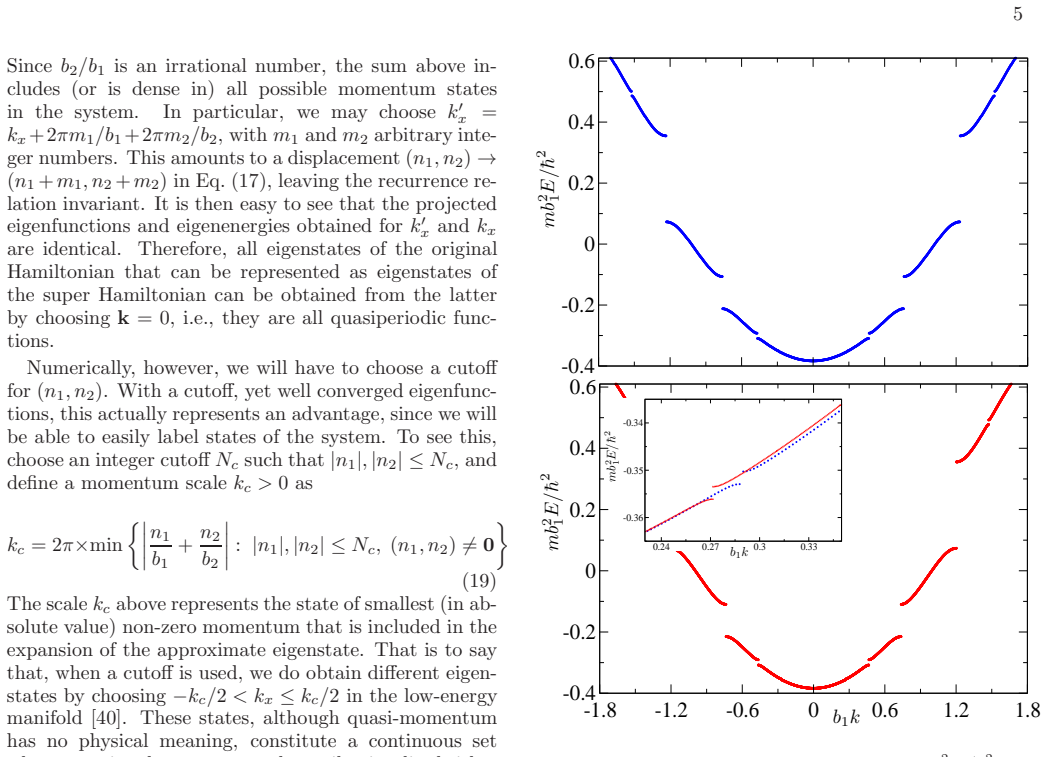
The central claim is that the one-dimensional Hamiltonian $H=-\frac{\hbar^2}{2m}\partial_x^2+v_1\cos(2\pi x/b_1)+v_2\cos(2\pi x/b_2)$ with incommensurate $b_1,b_2$ has the property that every state in its continuous spectrum is quasiperiodic and can be written as the diagonal projection of a Bloch eigenstate of the two-dimensional super Hamiltonian $H_S=\frac{1}{2m}(p_x+p_y)^2+V_1(x)+V_2(y)$. Because of a shift symmetry in the Fourier recurrence, all such states are obtained with zero quasi-momentum, so the continuous label that orders them is the rotation number of the quasiperiodic Schrödinger operator. The paper also derives the exact Green's function for any continuum state in one dimension, valid for arbitrary single-particle systems with continuous spectrum, and uses it to obtain densities of states and scattering amplitudes. For the localised phase, it shows that, if distributional solutions are admitted, Anderson-localised states are also quasiperiodic, and it introduces an open-boundary variant of the superspace method that handles both regimes numerically.
Load-bearing premise
The argument assumes that the continuous spectrum contains only the quasiperiodic states it constructs; a rigorous proof that no other type of generalized eigenfunction exists there is not given.
Editorial extensions
If this is right
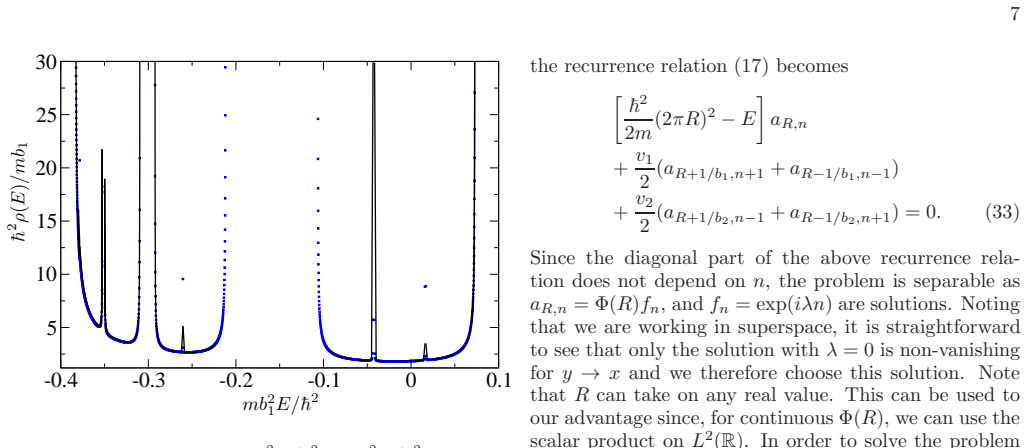
- Every continuum eigenstate of the incommensurate-superlattice Hamiltonian carries a continuous momentum-like label (the rotation number), so the density of states follows from the local super density of states without periodic approximants.
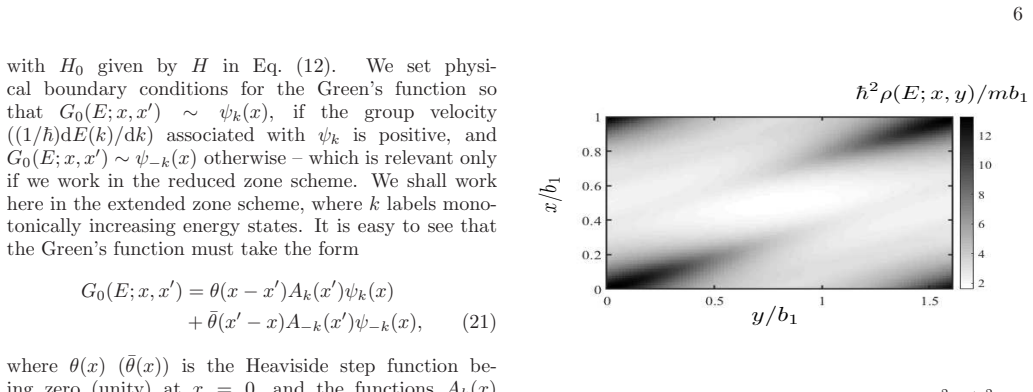
- The closed-form Green's function applies to any one-dimensional single-particle system with continuous spectrum, giving exact scattering amplitudes off zero-range impurities and defects.
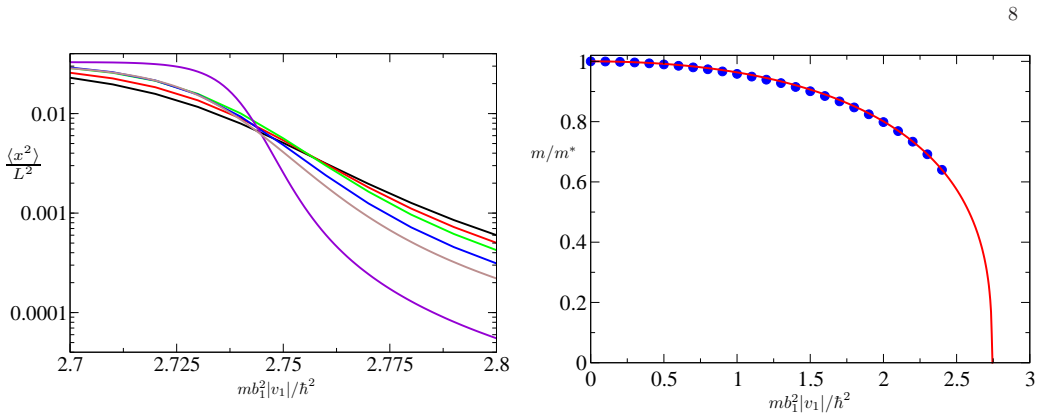
- Near the delocalisation-localisation transition the inverse effective mass vanishes as $(1-|v_1|/v_c)^\gamma$ with $\gamma\approx 1/3$, and the estimated critical point $m b_1^2 v_c/\hbar^2 = 2.7411$ matches an independent numerical value.
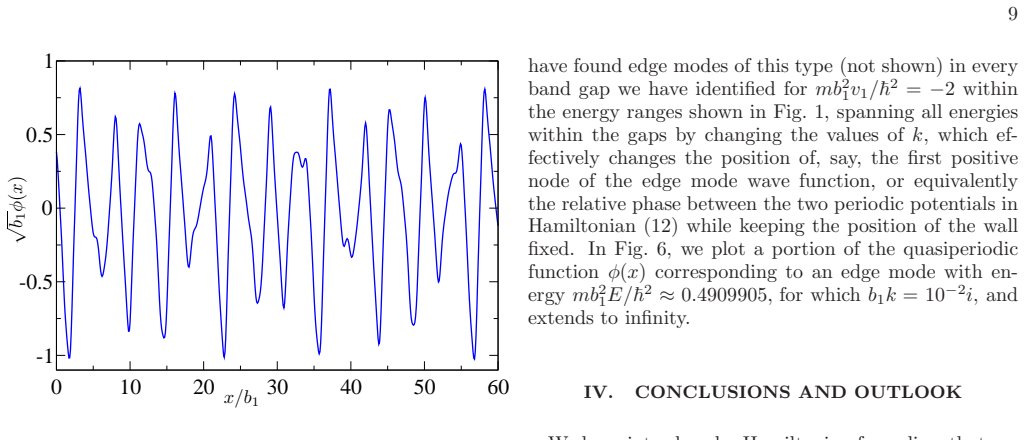
- In the delocalised phase, edge states of a semi-infinite system appear in every spectral gap the calculation resolves, and they follow directly from allowing the momentum label to become complex.
- The superspace construction extends to higher dimensions and to tight-binding quasicrystals, at increased computational cost.
Reading between the lines
- If the missing completeness proof were supplied, the super Hamiltonian would provide a full spectral decomposition of the continuum, effectively reducing the quasiperiodic operator to a periodic eigenvalue problem on the diagonal.
- The same diagonal-projection idea could be applied to other aperiodic or non-orthogonal bases, for instance trapped bosons with zero-range interactions, where the natural basis is not orthogonal.
- A concrete numerical test of the central claim is to search for generalised eigenfunctions of the one-dimensional Hamiltonian whose momentum support is not contained in the dense set $\{2\pi(n_1/b_1+n_2/b_2)\}$; finding one would contradict the claim that all continuum states are quasiperiodic.
- The distributional quasiperiodic description of localised states points toward building Wannier-type orbitals from non-converged superspace states, which could improve numerics in the localised phase and in higher-dimensional quasicrystals.
Signed reviews
Editorial analysis
A structured set of objections, weighed in public.
Referee Report
Summary. The manuscript introduces a 'super Hamiltonian' formalism intended to represent eigenstates of a quasiperiodic Hamiltonian H = -ℏ²/2m ∂²_x + V1(x) + V2(x) as diagonal projections x=y of eigenstates of a periodic Hamiltonian H_S = (p_x+p_y)^2/2m + V1(x)+V2(y) in a two-dimensional superspace. The authors apply this construction to a one-dimensional particle in two sinusoidal incommensurate potentials. They claim that every continuum eigenstate of H is quasiperiodic and can be obtained from the k=0 sector of H_S; they then use this family to derive closed-form Green's functions, density of states and local density of states, scattering states off impurities, a delocalisation-localisation transition with a critical point and critical exponent, and topological edge states in a semi-infinite geometry. The paper also discusses localized states via an open-boundary variant of the method.
Significance. If the main claims were established, the superspace construction would offer a practical route to exact continuum eigenstates and Green's functions for continuum quasiperiodic models beyond the tight-binding approximation. The projection identity for smooth functions in Section II is correct, and the one-dimensional Green's function calculation in Section III.C is a clean and potentially useful result. The explicit derivations and the numerical consistency checks between the DOS and the spectrum are also valuable. However, the central completeness claim—that all continuum states are quasiperiodic and generated by the k=0 sector—is the load-bearing step for the labelling of states, the DOS calculation, and the interpretation of the momentum label as a rotation number. That step is not proved, and the argument given is invalid in solvable limits. The manuscript therefore currently overstates its principal result.
major comments (2)
- [III.B (Eq. 18 and following paragraph)] The inference that all projected eigenstates can be obtained from k=0 is invalid. The shift invariance under k'_x = k_x + 2π(m1/b1+m2/b2) shows at most that the physical state depends on the coset [k_x] = k_x + M, where M = {2π(n1/b1+n2/b2)}. Density of M in R does not imply M=R, so [k_x] is not generally [0]; there are uncountably many distinct cosets. The failure is concrete: for v1=v2=0, the k=0 sector of H_S generates only plane waves with momenta in M, whereas H has generalized eigenfunctions e^{iKx} for every K not in M, and these are obtained only from k_x=K. The periodic limit v2=0 gives the same obstruction for Bloch states with quasimomenta outside M. Therefore the central claim that all continuum states are quasiperiodic is not proved and, as stated, is false in these solvable limits. Appendix A addresses only localized states and does not supply the missing generalized-eigenfunction completeness theorem.
- [III.D (Eq. 33)] The open-boundary method for localized states rests on an uncontrolled continuum approximation. The change of variables (n1,n2) → (R,n) maps the integer lattice onto a countable dense set of R-values, with n determined by R, but Eq. (33) is then solved as if R were a continuous variable and as if λ were an independent degree of freedom. The restriction to λ=0 is asserted to follow from the limit y→x, but for the exact lattice sum this is not demonstrated. Because this method underlies the finite-size crossing estimate of vc (Fig. 4) and the treatment of the localized phase, the authors should either provide a controlled derivation or present convergence tests showing that the continuum approximation is justified.
minor comments (6)
- [III.B] The sentence 'the sum above includes (or is dense in) all possible momentum states' is imprecise: the set M is dense in R, not equal to R, and this distinction is exactly what invalidates the subsequent k=0 reduction.
- [III.C (Eq. 30)] The momentum label q in the local super density of states is introduced without explaining its relation to the label k used in Eqs. (21)-(26); please clarify the notation.
- [III.D (Eq. 34)] The normalization of the sinc-type basis and the statement that ψ(x) vanishes for |x|=(Nc+1)/κ should be stated explicitly, since these properties are used to justify the open-boundary interpretation.
- [III.E (Eq. 37)] The reported uncertainty γ = 0.33861 ± 5×10⁻⁵ appears to reflect only the least-squares error of the one-parameter fit over the interval |v1| ∈ [2.3,2.45]; it does not account for the choice of the ansatz (37) or the fitting window. The claim of consistency with γ=1/3 is appropriate, but the displayed error bar overstates the accuracy.
- [III.F] The text says edge modes of this type are '(not shown)' immediately before presenting one in Fig. 6; please rephrase to avoid the apparent contradiction.
- [References] The note numbered [40] appears after the reference list but is a footnote; it should be formatted as a footnote or moved into the main text.
Circularity Check
No significant circularity: the super-Hamiltonian projection property is explicitly imposed by construction, and the fitted critical exponent is a numerical estimate rather than a relabeled prediction.
full rationale
The central identity HS→H is not circular: Eqs. (3), (7), and (8) deliberately construct the super Hamiltonian so that its kinetic part obeys Leibniz's rule and its potential part projects to V(x); imposing the advertised projection property by construction is a legitimate design step, not a derivation of the target from the target. The later Green's function and DOS results in Sec. III.C are derived from two independent scattering states and are internally checkable, not obtained by reinserting the desired answer. The k=0 completeness argument in Sec. III.B is mathematically questionable—density of the momentum module {2π(n1/b1+n2/b2)} does not imply equality of its cosets with [0]—but that is a correctness or completeness gap, not a circular reduction; the paper does not define 'all continuum eigenstates' in terms of the k=0 family, nor does it fit parameters to force that conclusion. The critical-exponent analysis in Sec. III.E fits the explicit ansatz (37) to m/m* data and reports γ=0.33861; because γ is a free parameter of the fit and is cross-checked against the independent result of Ref. [26], this is a numerical estimate rather than a fitted input being called an independent prediction. The self-citations ([20], [36]) appear in motivation and a side application concerning topological edge states, and do not supply the load-bearing justification for the main derivation. Overall, the paper's main derivation is self-contained; the suspicious completeness step belongs in a correctness review, not in the circularity score.
Assumptions & free parameters
free parameters (2)
- vc (critical potential strength in units of ℏ²/(m b1²)) =
2.7411 ± 10^-4
- γ (critical exponent for inverse effective mass) =
0.33861 ± 5 × 10^-5
assumptions (4)
- standard math L2(R^(d+d')) admits a countable product basis, and Bloch's theorem applies to periodic Hamiltonians in superspace.
- domain assumption The physical system is a single non-interacting particle in 1D with a potential consisting of two sinusoidal functions with incommensurate periods and equal depths v1=v2.
- ad hoc to paper In the open-boundary method, only the λ=0 Fourier mode in the index n is kept because 'only the solution with λ=0 is non-vanishing for y→x'.
- ad hoc to paper The interpolating ansatz λ(v1) = (1 - |v1|/vc)^γ (1 + γ|v1|/vc) correctly describes the inverse effective mass below the transition.
invented entities (1)
-
Auxiliary superspace coordinate y and the associated super Hamiltonian HS
Cite this review
Pith. "Pith review of Super Hamiltonian in superspace for incommensurate superlattices and quasicrystals." pith.science (2026). https://pith.science/paper/MVJ3IMTA
@misc{pith2026190803214,
  author       = {Pith},
  title        = {Pith review of: Super Hamiltonian in superspace for incommensurate superlattices and quasicrystals},
  year         = {2026},
  howpublished = {\url{https://pith.science/paper/MVJ3IMTA}},
  note         = {Machine review of arXiv:1908.03214}
}
read the original abstract
Infinite quasiperiodic arrangements in space, such as quasicrystals, are typically described as projections of higher-dimensional periodic lattices onto the physical dimension. The concept of a reference higher-dimensional space, called a superspace, has proved useful in relation to quasiperiodic systems. Although some quantum-mechanical systems in quasiperiodic media have been shown to admit quasiperiodic states, any sort of general Hamiltonian formalism in superspace is lacking to this date. Here, we show how to extend generic quantum-mechanical Hamiltonians to higher dimensions in such a way that eigenstates of the original Hamiltonian are obtained as projections of the Hamiltonian in superspace, which we call the super Hamiltonian. We apply the super Hamiltonian formalism to a simple, yet realistic one-dimensional quantum particle in a quasiperiodic potential without the tight-binding approximation, and obtain continuously labelled eigenstates of the system corresponding to a continuous spectrum. All states corresponding to the continuum are quasiperiodic. We also obtain the Green's functions for continuum states in closed form and, from them, the density of states and local density of states, and scattering states off defects and impurities. The closed form of this one-dimensional Green's function is equally valid for any continuum state in any one-dimensional single-particle quantum system admitting continuous spectrum. With the basis set we use, which is periodic in superspace, and therefore quasiperiodic in physical space, we find that Anderson-localised states are also quasiperiodic if distributional solutions are admitted, but circumvent this difficulty by generalising the superspace method to open boundary conditions (cont'd).
Figures
Figures from the paper (2 more)
Reference graph
Works this paper leans on
-
[1]
D. Shechtman, I. Blech, D. Gratias and J. W. Cahn, Phys. Rev. Lett. 53, 1951 (1984)
work page 1984
- [2]
-
[3]
N. G. de Bruijn, Indagationes Mathematicae (Proceed- ings) 84, 39 (1981)
work page 1981
- [4]
- [5]
- [6]
- [7]
- [8]
Show all 40 references
-
[9]
Levine, T
D. Levine, T. C. Lubensky, S. Ostlund, S. Ramaswamy, P. J. Steinhardt and J. Toner, Phys. Rev. Lett. 54, 1520 (1985)
1985
-
[10]
Kalugin, A
P. Kalugin, A. Y. Kitaev and L. S. Levitov, JETP Lett. 41, 145 (1985)
1985
-
[11]
Duneau and A
M. Duneau and A. Katz, Phys. Rev. Lett. 54, 2688 (1985)
1985
-
[12]
Widom, Phil
M. Widom, Phil. Mag. 88, 2339 (2008)
2008
-
[13]
Hafner and M
J. Hafner and M. Krajci, Phys. Rev. Lett. 68, 2321 (1992)
1992
-
[14]
X. Wu, S. W. Kycia, C. G. Olson, P. J. Benning, A. I. Goldman and D. W. Lynch, Phys. Rev. Lett. 75, 4540 (1995)
1995
-
[15]
M. A. Bandres, M. C. Rechtsman and M. Segev, Phys. Rev. X 6, 011016 (2016)
2016
-
[16]
L. Levi, M. Rechtsman, B. Freedman, T. Schwartz, O. Manela and M. Segev, Science 332, 1541 (2011)
2011
-
[17]
Fujiwara, S
T. Fujiwara, S. Yamamoto and G. T. de Laissardiere, Phys. Rev. Lett. 71, 4166 (1993)
1993
-
[18]
Brown, K
P. Brown, K. Semeniuk, D. Wang, B. Monserrat, C. J. Pickard and F. M. Grosche, Science Adv. 4, eaao4793 (2018)
2018
-
[19]
Viebahn, M
K. Viebahn, M. Sbroscia, E. Carter, J.- C. Yu and U. Schneider, Phys. Rev. Lett. 122, 110404 (2019)
2019
- [20]
-
[21]
R. J. Fletcher, R. Lopes, J. Man, N. Navon, R. P. Smith, M. W. Zwierlein and Z. Hadzibabic, Science 355, 377 (2017)
2017
-
[22]
Aubry and G
S. Aubry and G. Andr´ e, Ann. Israel Phys. Soc. 3, 18 (1980)
1980
-
[23]
P. W. Anderson, Phys. Rev. 109, 1492 (1958)
1958
-
[24]
H. P. L¨ uschen, S. Scherg, T. Kohlert, M. Schreiber, P. Bordia, X. Li, S. Das Sarma and I. Bloch, Phys. Rev. Lett. 120, 160404 (2018)
2018
-
[25]
Fr¨ ohlich, T
J. Fr¨ ohlich, T. Spencer, and P. Wittwer, Comm. Math. Phys. 132, 5 (1990)
1990
-
[26]
H. Yao, H. Khoudli, L. Bresque and L. Sanchez-Palencia, e-print arXiv:1904.01463
1904 arXiv
-
[27]
Moser, Comment
J. Moser, Comment. Math. Helvetici 56, 198 (1981)
1981
-
[28]
Avron and B
J. Avron and B. Simon, Comm. Math. Phys. 82, 101 (1981)
1981
-
[29]
C. W. J. Beenaker, Rev. Mod. Phys. 69, 731 (1997)
1997
-
[30]
P. M. deWolff, Acta Crystallogr. A 30, 777 (1974)
1974
-
[31]
Janner and T
A. Janner and T. Janssen, Phys. Rev. B 15, 643 (1977)
1977
-
[32]
Janssen, Phys
T. Janssen, Phys. Rep. 168, 55 (1988)
1988
- [33]
-
[34]
N. R. Cooper, J. Dalibard and I. B. Spielman, Rev. Mod. Phys. 91, 015005 (2019)
2019
-
[35]
Huang and F
H. Huang and F. Liu, Phys. Rev. Lett. 121, 126401 (2018)
2018
-
[36]
C. W. Duncan, P. ¨Ohberg and M. Valiente, Phys. Rev. B 97, 195439 (2018)
2018
-
[37]
Zak, Phys
J. Zak, Phys. Rev. Lett. 62, 2747 (1989)
1989
-
[38]
Y. E. Kraus, Y. Lahini, Z. Ringel, M. Verbin and O. Zilberberg, Phys. Rev. Lett. 109, 106402 (2012)
2012
-
[39]
E. H. Lieb and W. Liniger, Phys. Rev. 130, 1605 (1963)
1963
-
[40]
Since kc is the smallest momentum, but not the small- est momentum difference that can be achieved, at higher energies k may be restricted to a shorter interval
Reviewed August 14, 2026 · model on record in the stance chip above.
Discussion (0). Continue with ORCID to comment.