REVIEW 3 major objections 5 minor 33 references
Memristive Networks: from Graph Theory to Statistical Physics
T0 review · 3 major / 5 minor · reviewed 2026-08-14 · deepseek-v4-flash
Pith's one-line read A no-go theorem shows that the planar exponential-decay locality bound for memristive circuits cannot be extended to non-planar graphs by face-bounding cycles, because only the sphere has enough faces.
desk verdict The no-go theorem is a clean, correct new result, but the disorder-generalized equation (13) does not reduce to the homogeneous Eq. (1) as claimed, which undermines the paper's central numerical observation. read the letter →
The pith
A machine-rendered reading of the paper's core claim, the machinery that carries it, and where it could break.
The reading
What carries the argument
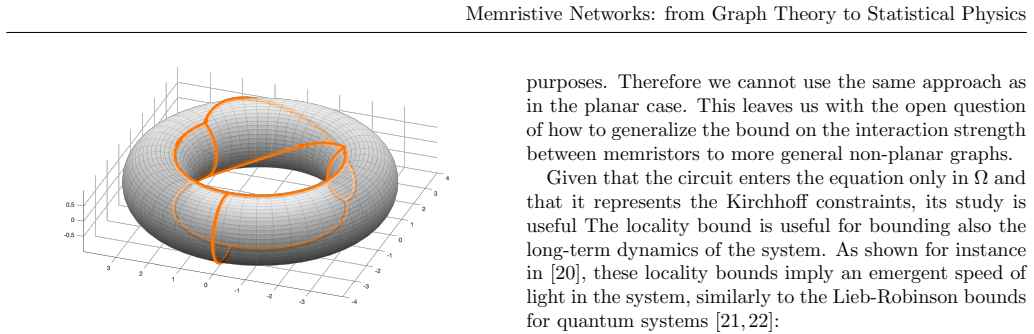
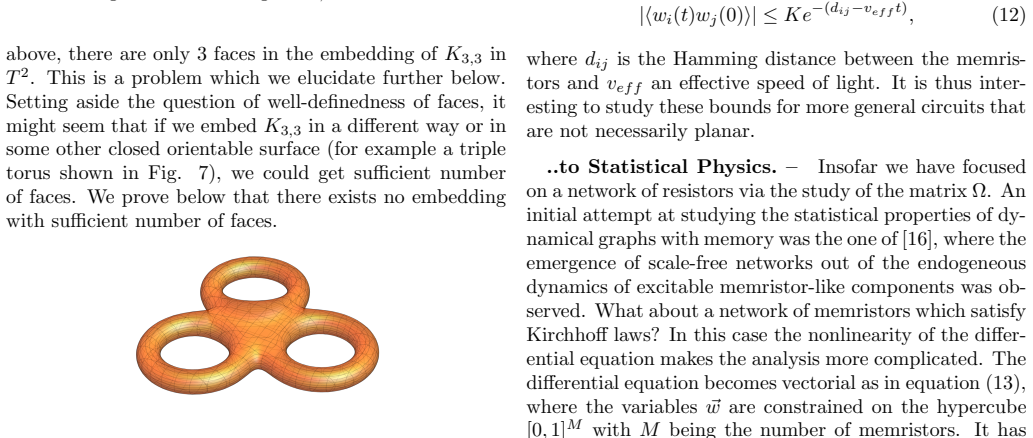
The central object is the cycle-space projector $\Omega=A(A^T A)^{-1}A^T$, defined from a basis $A$ of the graph's cycle space; it is the only place circuit topology enters the memory dynamics. The proof of the no-go theorem uses the face-counting obstruction: for planar graphs one can choose basis cycles that bound faces and express their inner products through the adjacency matrix of the dual graph, which yields the exponential decay; for non-planar graphs this requires $|F|\ge \dim C$, and the Euler characteristic $2-2g=\chi=|V|-|E|+|F|$ then forbids all genus $g\ge 1$. On the statistical-physics side, the load-bearing mapping is $\Sigma=\Omega$ and $\frac{p}{2}=\alpha\xi$, which identifies the Lyapunov function of the asymptotic dynamics with the Ising/QUBO Hamiltonian, so the circuit's fixed points are the extrema of a binary optimization problem.
What would settle it
Simulate a small circuit with two or three memristors having different $\beta_i$ and $\alpha_i$ values, integrate the component-level equations together with Kirchhoff's laws, and compare with the paper's equation (13); any disagreement refutes the disorder extension and the logarithmic-relaxation claim. For the no-go theorem, the refuting observation would be a non-planar graph embedded in a closed orientable surface with $|F|\ge |E|-|V|+1$; Euler's formula makes that impossible, so searching for such an embedding should fail.
Extended reading notes
Core claim
The central claim is that the vectorial memristor dynamics $\frac{d}{dt}\vec w = \alpha \vec w - \frac{1}{\beta}(I+\xi\Omega W)^{-1}\Omega\vec S$, with $\Omega = A(A^T A)^{-1}A^T$ the cycle-space projector, encodes Kirchhoff's laws in $\Omega$ alone, and that for planar circuits the entries of $\Omega$ decay exponentially with edge distance, $|\Omega_{ij}|\le e^{-z\,d(i,j)+\tilde\rho}$. The paper's new no-go theorem asserts that this face-bounding-cycle proof cannot be carried to non-planar graphs: any embedding whose faces could serve as a cycle basis would need $|F|\ge \dim C = |E|-|V|+1$, and combining this with $\chi=|V|-|E|+|F|=2-2g$ gives $g\le 1/2$, so only the sphere (genus zero) has enough faces. The paper further claims that with disorder the memory dynamics becomes $\frac{d}{dt}\vec w = A\vec w - B^{-1}(I+\Omega' W)^{-1}\Omega' T^{-1}\vec S$, and that numerical simulations on random graphs show the average $\langle w\rangle$ settling into a logarithmic relaxation. Finally, asymptotic states are claimed to map onto the QUBO/Ising functional $M(W)=\sum_i(r_i-\frac{p}{2}\Sigma_{ii})w_i - \frac{p}{2}\sum_{i\ne j} w_i \Sigma_{ij} w_j$ with $\Sigma=\Omega$, making the memristive network a heuristic analog optimizer for NP-complete binary problems.
Load-bearing premise
The load-bearing premise is that the disorder equation $\frac{d}{dt}\vec w = A\vec w - B^{-1}(I+\Omega' W)^{-1}\Omega' T^{-1}\vec S$, introduced with 'it can be shown' and no derivation, is the correct Kirchhoff-consistent extension of the homogeneous memristor dynamics when memristors are not identical, because the paper's logarithmic-relaxation evidence depends entirely on it.
Editorial extensions
If this is right
- For non-planar circuits, locality bounds on $|\Omega_{ij}|$ cannot be obtained by the face-bounding-cycle construction; any such bound must come from a different technique, such as spectral or probabilistic arguments.
- The emergent speed-of-light bound $|\langle w_i(t)w_j(0)\rangle|\le K e^{-(d_{ij}-v_{\rm eff}t)}$ remains established only for planar circuits, so light-cone-like behavior in non-planar memristive networks is an open question.
- If the disorder equation (13) is correct, densely connected random memristive networks should show logarithmic, glassy relaxation of the average memory, implying slow approach to computational steady states.
- Random-graph $\Omega$ entries being approximately Gaussian with variance $1/N$ connects the network to mean-field spin-glass physics, so mean-field and replica methods could predict the asymptotic value of $\langle w\rangle$.
Reading between the lines
- Editorial inference: the no-go theorem suggests that for dense non-planar graphs the meaningful locality statement is statistical rather than geometric — $\Omega_{ij}$ entries are small in a distributional sense (variance $\sim 1/N$) — and one could test whether correlation functions of the $w_i$ decay like $1/N$ on expander-like circuits.
- Editorial inference: logarithmic relaxation in the disordered equation implies that using memristive networks as QUBO heuristics on dense random circuits will be slow; a concrete testable extension is to add a small uniform diffusion term $\alpha$ and measure whether the log regime crosses over to a power law, which the paper does not report.
- Editorial inference: because the disorder matrix $T$ can take negative values in active/passive mixtures, the disorder equation may generate effective frustrated interactions even when bare couplings look ferromagnetic, offering a mechanism for intrinsic spin-glass behavior that could be tested by measuring a spin-glass order parameter in simulations.
Signed reviews
Editorial analysis
A structured set of objections, weighed in public.
Referee Report
Summary. The paper is a perspective article on a toy model of memristive networks. The authors review the exact differential equation for the internal memory variables in homogeneous circuits (Eq. 1), introduce a generalization to disordered memristors (Eq. 13), prove a new no-go theorem that the face-counting method used in [20] to derive locality bounds cannot be extended from planar to non-planar graphs, and discuss connections to slow relaxation, Ising models, and QUBO optimization. The no-go theorem is the main new theoretical result: using the Euler characteristic and the cycle-space dimension, the authors show that any closed orientable surface embedding of a non-planar graph has too few faces to supply a basis of face-bounding cycles, so the planar locality bound cannot be generalized by this method.
Significance. The no-go theorem is correct and is a genuine, if modest, contribution: it cleanly explains a structural obstruction to extending the planar locality bound, and it is derived parameter-free from the Euler characteristic. The paper is also useful as a concise introduction to the graph-theoretic origin of the projector Omega in memristive circuit equations. However, the disordered generalization (Eq. 13) that underlies the numerical log-relaxation claim is asserted without derivation and does not reduce to the homogeneous equation (1) as claimed, while the Ising-mapping equations (15) are garbled. These issues bear directly on the paper's central claims, so the manuscript needs substantial revision before it can be accepted.
major comments (3)
- [..to Statistical Physics, Eq. (13)] Equation (13) does not reduce to Eq. (1) in the homogeneous limit, contrary to the claim that 'if N_ij = 0 we recover the previous equation.' Setting N_ii = 0 gives T = I and Omega' = Omega, so Eq. (13) becomes d w/dt = A w - B^{-1}(I + Omega W)^{-1} Omega S. For homogeneous parameters A = alpha I and B = beta I, this is alpha w - (1/beta)(I + Omega W)^{-1} Omega S, whereas Eq. (1) contains (I + xi Omega W)^{-1} Omega S. The two expressions agree only for xi = 1. Since Fig. 8 is obtained by integrating Eq. (13), the log-relaxation observation is not supported unless Eq. (13) is re-derived or corrected and the numerics repeated.
- [..to Statistical Physics, Eq. (15)] The Ising-mapping equations are garbled: the line 'Sigma = Omega, p/2 = alpha xi. alpha/2 + alpha xi/3 Omega_ii - 1/beta sum_j Omega_ij S_j = r_i - p/2 Sigma_ii' does not parse as a well-formed system of equations, and the surrounding text does not specify how the vector S is obtained from r and Sigma. As written, the asserted mapping between the memristive dynamics and the QUBO functional M(W) cannot be verified or used. Please rewrite Eq. (15) as a proper set of equations and provide the derivation of the mapping.
- [..to Statistical Physics, Fig. 8] The claim that the relaxation is 'compatible with a logarithmic one' is not adequately supported: the average is over only 20 simulations, no error bars are shown, the disorder distribution is not specified (the caption gives sigma = 0.05 but does not define what sigma is, and also says 'homogeneous across the system'), the initialization of the internal variables is not described, and no quantitative goodness-of-fit criterion for the claimed log(t) regime is provided. This is a load-bearing issue because the simulation integrates Eq. (13), whose correctness is in question (see the first major comment).
minor comments (5)
- [Introduction] The manuscript references 'eqn. (13)' in the Introduction before Eq. (13) is introduced; please renumber or reorder the presentation.
- [Locality, Eqs. (10)-(11)] The no-go proof should explicitly state that the embedding is cellular; Euler's formula V - E + F = 2 - 2g holds only when all faces are disks, and the argument as written implicitly assumes this.
- [Locality, Eq. (11)] The dimension formula dim C = |E| - |V| + 1 assumes a connected graph; for a graph with c connected components the correct expression is |E| - |V| + c, which only strengthens the conclusion, but the assumption should be stated.
- [From Graph theory, Eqs. (2)-(3) and 'Cycle matrix'] The transposition conventions for the cycle matrix A are inconsistent: Eq. (2) writes A^t(ARA^t)^{-1}A while the later definition of the projector uses A(A^T A)^{-1}A^T. Please clarify the dimensions of A so that the projector acts on the edge space consistently.
- [Throughout] There are numerous typographical errors, including 'highlighlites', 'intendedended', and 'exogeneous'; a careful proofreading is needed.
Circularity Check
No circularity found; the no-go theorem is a self-contained Euler-characteristic derivation.
full rationale
The paper's original mathematical contribution, the no-go theorem in the Locality section, is derived directly from the definitions of cycle-space dimension and Euler characteristic: combining |F| >= dim C = |E|-|V|+1 with chi = |V|-|E|+|F| = 2-2g forces g <= 1/2, so only the sphere admits enough face-bounding cycles. This argument does not use any fitted parameter, empirical observation, or prior result as an input, and it is not a renamed version of the cited planar bound from [20]; the cited bound merely supplies the generalization target. The disorder-generalized equation (13) is indeed asserted with 'it can be shown' rather than derived, and the paper's claim that it reduces to Eq. (1) when N_ij=0 is a consistency statement rather than a circular reduction; any failure there is an omitted-derivation or correctness concern, not a case of a prediction being equivalent to its input by construction. The Ising/QUBO connection (Eqs. (14)-(15)) is presented as an explicit mapping with Sigma = Omega and related parameter identifications; while this relies on the authors' prior work [24,26], the present paper makes no new prediction that reduces to those citations, and the no-go theorem remains independent. Therefore there is no circular step to report.
Assumptions & free parameters
free parameters (1)
- Simulation parameters in Fig. 8 =
alpha=0.003, beta=100, sigma=0.05, dt=0.1
assumptions (3)
- domain assumption Equation (1), the homogeneous-memristor differential equation, is taken as given from reference [12].
- ad hoc to paper The generalized disorder equation (13) is assumed to be the correct description of disordered memristive circuits, stated with 'it can be shown'.
- standard math Standard graph theory: for a connected graph, the cycle-space dimension is |E|-|V|+1, and the Euler characteristic of a closed orientable surface is 2-2g.
Cite this review
Pith. "Pith review of Memristive Networks: from Graph Theory to Statistical Physics." pith.science (2026). https://pith.science/paper/MW7G6GFG
@misc{pith2026190808105,
  author       = {Pith},
  title        = {Pith review of: Memristive Networks: from Graph Theory to Statistical Physics},
  year         = {2026},
  howpublished = {\url{https://pith.science/paper/MW7G6GFG}},
  note         = {Machine review of arXiv:1908.08105}
}
read the original abstract
We provide an introduction to a very specific toy model of memristive networks, for which an exact differential equation for the internal memory which contains the Kirchhoff laws is known. In particular, we highlight how the circuit topology enters the dynamics via an analysis of directed graph. We try to highlight in particular the connection between the asymptotic states of memristors and the Ising model, and the relation to the dynamics and statics of disordered systems.
Figures


Figures from the paper (4 more)


Reference graph
Works this paper leans on
- [20]
- [1]
- [2]
-
[3]
J.J.Yang, D.B. Strukov, D.R. Stewart, Nature Nanotech- nology, 8, 13-24 (2013)
work page 2013
-
[4]
D.B. Strukov, G. Snider, D.R. Stewart, and R.S. Williams, Nature 453, pp. 80-83 (2008)
work page 2008
- [5]
-
[6]
J. J. Yang, D. B. Strukov, D. R. Stewart, Nature Nano. 8 (2013)
work page 2013
-
[7]
L. O. Chua, IEEE Transactions on Circuit Theory 18 (5), (1971)
work page 1971
Show all 33 references
-
[8]
L. O. Chua, S. M. Kang, Proc. IEEE, 64:209–223 (1976)
1976
-
[9]
Y. V. Pershin, M. Di Ventra. Advances in Physics, 60:145–227 (2011)
2011
-
[10]
Di Ventra, Y
M. Di Ventra, Y. V. Pershin, Nature Phys., 9:200 (2013)
2013
-
[11]
Indiveri,S.-C
G. Indiveri,S.-C. Liu, Proceedings of IEEE, 103:(8) 1379- 1397 (2015)
2015
-
[12]
Caravelli, F
F. Caravelli, F. L. Traversa, M. Di Ventra, Phys. Rev. E 95, 2 (2017)
2017
-
[13]
Y. V. Pershin, M. Di Ventra, Phys. Rev. E 84, 046703 (2011)
2011
-
[14]
Bollobas, Modern Graph Theory, Springer Graduate Texts in Mathematics, Springer Verlag, Berlin (2012)
B. Bollobas, Modern Graph Theory, Springer Graduate Texts in Mathematics, Springer Verlag, Berlin (2012)
2012
-
[15]
J. W. Nilsson, S. Riedel, Electric Circuits (9th ed), Pear- son Education, Saddle River NJ, (2011)
2011
-
[16]
Caravelli, A
F. Caravelli, A. Hamma, M. Di Ventra, Eur. Phys. Lett. 109, 2 (2015)
2015
-
[17]
Avizienis et al., PLoS ONE 7(8): e42772
A.V. Avizienis et al., PLoS ONE 7(8): e42772. (2012)
2012
-
[18]
A. Z. Stieg, A. V. Avizienis et al., Adv. Mater., 24: 286- 293 (2012)
2012
-
[19]
Caravelli, Int
F. Caravelli, Int. J. of Par. Emerg. and Dist. Syst. 33 (4), pp 350-366 (2017)
2017
-
[21]
Hasting, Phys
M.B. Hasting, Phys. Rev. Lett. 93, 140402 (2004)
2004
-
[22]
Schuch et al., Phys
N. Schuch et al., Phys. Rev. A 84, 032309 (2011)
2011
-
[23]
Riaza, Discrete Applied Mathematics, Vol
R. Riaza, Discrete Applied Mathematics, Vol. 160 (2012) pp. 280-290
2012
-
[24]
Caravelli, P
F. Caravelli, P. Barucca, Eur. Phys. Lett. (4) 40008 (2018)
2018
-
[25]
Campa, T
A. Campa, T. Dauxois, S. Ruffo, Physics Reports 480 (2009), pp. 57-159
2009
- [26]
-
[27]
Parisi, Lett
G. Parisi, Lett. in Math. Phy. 88:255 (2009)
2009
-
[28]
Sherrington, S
D. Sherrington, S. Kirkpatrick, Physical Review Letters, 35 (26): 1792-1796 (1975)
1975
-
[29]
F. L. Traversa, M. Di Ventra, Chaos 27, 023107 (2017)
2017
-
[30]
F. L. Traversa, C. Ramella, F. Bonani, M. Di Ventra, Science Advances 1 (6) (2015)
2015
-
[31]
A. Y. Lokhov, M. Vuffray, S. Misra, M. Chertkov Science Advances 4(3) e1700791 (2018)
2018
-
[32]
Y. V. Pershin, V. A. Slipko, M. Di Ventra, Phys. Rev. E 87, 022116 (2013)
2013
-
[33]
F. C. Sheldon, M. Di Ventra, Phys. Rev. E 95(1) 012305 (2017) p-7
2017
Reviewed August 14, 2026 · model on record in the stance chip above.
Discussion (0). Continue with ORCID to comment.