Following the Flow: Advection-Consistent Modeling for Event-based Small Object Detection
Pith reviewed 2026-06-26 10:44 UTC · model grok-4.3
The pith
Advection constraints along velocity fields preserve weak event responses for better small object detection.
A machine-rendered reading of the paper's core claim, the machinery that carries it, and where it could break.
Core claim
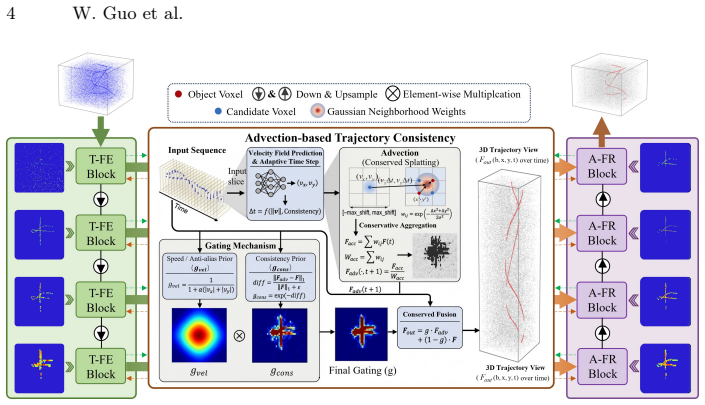
PACT integrates motion-aware feature extraction with a differentiable advection-based transport operator. This enforces coherent motion representation by propagating features along velocity fields and enforcing trajectory-level consistency through advection constraints, thereby preserving weak event responses over time.
What carries the argument
the motion-driven feature transport process using a differentiable advection-based transport operator that propagates features along estimated velocity fields
If this is right
- Small object signals maintain temporal continuity instead of becoming fragmented.
- Weak responses are protected from degradation by complex background interference.
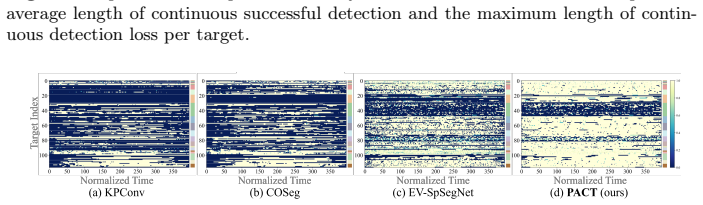
- Detection achieves 20.72% higher IoU and 15.03% higher accuracy on event-based benchmarks.
- Computational efficiency remains comparable to prior methods while improving coherence.
Where Pith is reading between the lines
- Similar advection ideas could apply to other asynchronous sensor fusion tasks where motion estimation is feasible.
- Longer event sequences might benefit more as consistency accumulates over extended trajectories.
- The reliance on velocity accuracy suggests pairing with robust optical flow methods for events could further strengthen results.
Load-bearing premise
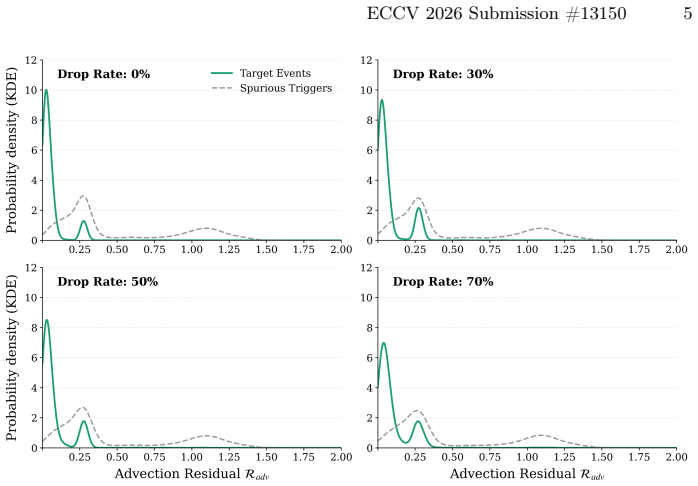
Estimated velocity fields from sparse events are accurate enough to act as reliable transport paths without adding significant errors to the features.
What would settle it
Running the model on synthetic event data where velocity fields are intentionally perturbed or estimated poorly and measuring if the IoU gains disappear.
Figures



read the original abstract
Event cameras enable high-frequency visual perception with microsecond latency, offering advantages for dynamic scenes. However, event-based small object detection remains challenging due to sparse asynchronous measurements and weak object responses that are easily disrupted by noise. Limited spatial support causes small-object signals to lose temporal continuity, resulting in fragmented and unstable predictions. To address this issue, we propose a physics-guided advection-consistent modeling framework, termed PACT, which formulates event evolution as a motion-driven feature transport process. Instead of relying solely on local spatio-temporal aggregation, PACT propagates features along estimated velocity fields and enforces trajectory-level consistency through advection constraints. This design preserves weak event responses over time and prevents their degradation under complex background interference. Technically, PACT integrates motion-aware feature extraction with a differentiable advection-based transport operator, enabling coherent motion representation and effective noise suppression during temporal evolution. Extensive experiments on benchmark event-based datasets demonstrate that PACT consistently outperforms state-of-the-art methods, achieving improvements of 20.72\% in IoU and 15.03\% in accuracy while maintaining comparable computational efficiency. The code is publicly available at https://github.com/fulongcai/PACT.
Editorial analysis
A structured set of objections, weighed in public.
Referee Report
Summary. The paper proposes PACT, a physics-guided advection-consistent modeling framework for event-based small object detection. It formulates event evolution as a motion-driven feature transport process that propagates features along estimated velocity fields and enforces trajectory-level consistency via advection constraints, integrating motion-aware feature extraction with a differentiable advection-based transport operator. This is claimed to preserve weak event responses and suppress noise. Experiments on benchmark datasets report gains of 20.72% in IoU and 15.03% in accuracy over SOTA methods, with public code release.
Significance. If the central mechanism holds, the work offers a principled way to maintain temporal coherence for sparse, weak signals in event-based small-object detection, potentially improving robustness in dynamic scenes. Public code availability supports reproducibility and is a clear strength.
major comments (2)
- [Abstract] Abstract: the central claim that estimated velocity fields provide reliable transport paths for the differentiable advection operator is load-bearing, yet the abstract supplies no error analysis, sensitivity study, or ablation isolating velocity estimation accuracy; systematic misalignment from sparse/noisy events (as flagged in the stress-test note) could propagate rather than suppress degradation.
- [Abstract] Abstract: performance claims (20.72% IoU, 15.03% accuracy) are stated without reference to specific baselines, dataset statistics, or controls that would demonstrate the advection constraints are the source of the gains rather than ancillary design choices.
minor comments (1)
- Abstract lacks explicit dataset names and comparison methods despite claiming 'extensive experiments on benchmark event-based datasets'.
Simulated Author's Rebuttal
We thank the referee for the constructive comments on the abstract. We agree that additional context on velocity estimation robustness and baseline specificity would strengthen the abstract and will revise accordingly while preserving its brevity.
read point-by-point responses
-
Referee: [Abstract] Abstract: the central claim that estimated velocity fields provide reliable transport paths for the differentiable advection operator is load-bearing, yet the abstract supplies no error analysis, sensitivity study, or ablation isolating velocity estimation accuracy; systematic misalignment from sparse/noisy events (as flagged in the stress-test note) could propagate rather than suppress degradation.
Authors: We acknowledge the abstract's brevity limits inclusion of detailed error analysis. The manuscript contains ablations on velocity estimation accuracy and sensitivity to noise in the experiments section, showing that the advection constraints mitigate misalignment effects rather than propagate them. We will revise the abstract to briefly note the robustness of the transport paths under sparse events and reference the supporting analyses. revision: yes
-
Referee: [Abstract] Abstract: performance claims (20.72% IoU, 15.03% accuracy) are stated without reference to specific baselines, dataset statistics, or controls that would demonstrate the advection constraints are the source of the gains rather than ancillary design choices.
Authors: The abstract states gains over state-of-the-art methods but does not name baselines due to length constraints. The full manuscript specifies comparisons on standard event-based datasets with ablations isolating the advection components. We will revise the abstract to reference the primary baselines and note that controls confirm the source of improvements. revision: yes
Circularity Check
No significant circularity; derivation is self-contained
full rationale
The abstract and description present PACT as a physics-guided framework that integrates motion-aware extraction with a differentiable advection operator and enforces consistency via advection constraints. No equations, fitted parameters, or self-citations are shown that would reduce any claimed prediction or consistency result to a definition or input by construction. The central mechanism is described as an independent modeling choice rather than a renaming or self-referential fit. This matches the default case of a non-circular paper.
Axiom & Free-Parameter Ledger
axioms (1)
- domain assumption Event evolution can be formulated as a motion-driven feature transport process
Reference graph
Works this paper leans on
-
[1]
In: Proceedings of the IEEE/CVF Conference on Computer Vision and Pattern Recognition
An, Z., Sun, G., Liu, Y., Liu, F., Wu, Z., Wang, D., Van Gool, L., Belongie, S.: Rethinking few-shot 3d point cloud semantic segmentation. In: Proceedings of the IEEE/CVF Conference on Computer Vision and Pattern Recognition. pp. 3996– 4006 (2024) Advection Consistency for Weak Event Responses 15
2024
-
[2]
IEEE Transactions on Neural Networks and Learning Systems25(2), 407–417 (2014)
Benosman, R., Clercq, C., Lagorce, X., Ieng, S.H., Bartolozzi, C.: Event-based visual flow. IEEE Transactions on Neural Networks and Learning Systems25(2), 407–417 (2014)
2014
-
[3]
In: Proceedings of the IEEE/CVF International Conference on Computer Vision
Bi, Y., Chadha, A., Abbas, A., Bourtsoulatze, E., Andreopoulos, Y.: Graph- based object classification for neuromorphic vision sensing. In: Proceedings of the IEEE/CVF International Conference on Computer Vision. pp. 491–501 (2019)
2019
-
[5]
In: Proceedings of the International Joint Conference on Neural Networks
Cordone, L., Miramond, B., Thierion, P.: Object detection with spiking neural networks on automotive event data. In: Proceedings of the International Joint Conference on Neural Networks. pp. 1–8. IEEE (2022)
2022
-
[6]
IEEE Transactions on Pattern Analysis and Machine In- telligence44(1), 154–180 (2022)
Gallego, G., Delbruck, T., Orchard, G., Bartolozzi, C., Taba, B., Censi, A., Leutenegger, S., Davison, A.J., Conradt, J., Daniilidis, K., Scaramuzza, D.: Event- based vision: A survey. IEEE Transactions on Pattern Analysis and Machine In- telligence44(1), 154–180 (2022)
2022
-
[7]
In: Proceedings of the IEEE Conference on Computer Vision and Pattern Recognition
Gallego, G., Rebecq, H., Scaramuzza, D.: A unifying contrast maximization frame- work for event cameras, with applications to motion, depth, and optical flow esti- mation. In: Proceedings of the IEEE Conference on Computer Vision and Pattern Recognition. pp. 3867–3876 (2018)
2018
-
[8]
In: Proceedings of the IEEE/CVF International Conference on Computer Vision
Gehrig, D., Loquercio, A., Derpanis, K.G., Scaramuzza, D.: End-to-end learn- ing of representations for asynchronous event-based data. In: Proceedings of the IEEE/CVF International Conference on Computer Vision. pp. 5632–5642 (2019)
2019
-
[9]
In: Proceedings of the IEEE/CVF Conference on Computer Vision and Pattern Recognition
Gehrig, M., Scaramuzza, D.: Recurrent vision transformers for object detection with event cameras. In: Proceedings of the IEEE/CVF Conference on Computer Vision and Pattern Recognition. pp. 13884–13893 (2023)
2023
-
[10]
In: Pro- ceedings of the IEEE/CVF Conference on Computer Vision and Pattern Recogni- tion
Hu, Q., Yang, B., Xie, L., Rosa, S., Guo, Y., Wang, Z., Trigoni, N., Markham, A.: Randla-net: Efficient semantic segmentation of large-scale point clouds. In: Pro- ceedings of the IEEE/CVF Conference on Computer Vision and Pattern Recogni- tion. pp. 11108–11117 (2020)
2020
-
[11]
In: Proceedings of the European Conference on Computer Vision
Kim, H., Leutenegger, S., Davison, A.J.: Real-time 3d reconstruction and 6-dof tracking with an event camera. In: Proceedings of the European Conference on Computer Vision. Lecture Notes in Computer Science, vol. 9910, pp. 349–364. Springer (2016)
2016
-
[12]
Kingma, D.P., Ba, J.: Adam: A method for stochastic optimization (2014), arXiv:1412.6980
work page internal anchor Pith review Pith/arXiv arXiv 2014
-
[13]
IEEE Transactions on Pattern Analysis and Machine Intelligence39(7), 1346–1359 (2017)
Lagorce, X., Orchard, G., Galluppi, F., Shi, B.E., Benosman, R.B.: Hots: A hier- archy of event-based time-surfaces for pattern recognition. IEEE Transactions on Pattern Analysis and Machine Intelligence39(7), 1346–1359 (2017)
2017
-
[14]
IEEE Journal of Solid-State Circuits 43(2), 566–576 (2008)
Lichtsteiner, P., Posch, C., Delbruck, T.: A 128×128 120 db 15µs latency asyn- chronous temporal contrast vision sensor. IEEE Journal of Solid-State Circuits 43(2), 566–576 (2008)
2008
-
[15]
In: Proceedings of the European Conference on Computer Vision
Liu, W., Anguelov, D., Erhan, D., Szegedy, C., Reed, S., Fu, C.Y., Berg, A.C.: Ssd: Single shot multibox detector. In: Proceedings of the European Conference on Computer Vision. pp. 21–37. Springer (2016)
2016
-
[16]
In: Proceedings of the European Conference on Computer Vision
Luo, X., Yao, M., Chou, Y., Xu, B., Li, G.: Integer-valued training and spike-driven inference spiking neural network for high-performance and energy-efficient object detection. In: Proceedings of the European Conference on Computer Vision. pp. 253–272. Springer (2024)
2024
-
[17]
In: 16 W
Maqueda, A.I., Loquercio, A., Gallego, G., García, N., Scaramuzza, D.: Event- based vision meets deep learning on steering prediction for self-driving cars. In: 16 W. Guo et al. ProceedingsoftheIEEE/CVFConferenceonComputerVisionandPatternRecog- nition. pp. 5419–5427 (2018)
2018
-
[18]
In: Proceedings of the IEEE/RSJ International Conference on Intelligent Robots and Systems
Mitrokhin, A., Fermüller, C., Parameshwara, C., Aloimonos, Y.: Event-based mov- ing object detection and tracking. In: Proceedings of the IEEE/RSJ International Conference on Intelligent Robots and Systems. pp. 1–9 (2018)
2018
-
[19]
In: Proceedings of the IEEE/CVF Conference on Computer Vision and Pattern Recognition
Mitrokhin, A., Hua, Z., Fermüller, C., Aloimonos, Y.: Learning visual motion seg- mentation using event surfaces. In: Proceedings of the IEEE/CVF Conference on Computer Vision and Pattern Recognition. pp. 14414–14423 (2020)
2020
-
[20]
In: Proceedings of the IEEE/CVF International Conference on Computer Vision
Mondal, A., Giraldo, J.H., Bouwmans, T., Chowdhury, A.S.: Moving object de- tection for event-based vision using graph spectral clustering. In: Proceedings of the IEEE/CVF International Conference on Computer Vision. pp. 876–884. IEEE (2021)
2021
-
[21]
IEEE Signal Processing Magazine36(6), 51–63 (2019)
Neftci, E.O., Mostafa, H., Zenke, F.: Surrogate gradient learning in spiking neural networks: Bringing the power of gradient-based optimization to spiking neural networks. IEEE Signal Processing Magazine36(6), 51–63 (2019)
2019
-
[22]
IEEE Transactions on Pattern Analysis and Machine Intelligence44(5), 2519–2533 (2022)
Pan, L., Hartley, R., Scheerlinck, C., Liu, M., Yu, X., Dai, Y.: High frame rate video reconstruction based on an event camera. IEEE Transactions on Pattern Analysis and Machine Intelligence44(5), 2519–2533 (2022)
2022
-
[23]
In: Proceedings of the IEEE/CVF Conference on Computer Vision and Pattern Recognition
Peng, Y., Li, H., Zhang, Y., Sun, X., Wu, F.: Scene-adaptive sparse transformer for event-based object detection. In: Proceedings of the IEEE/CVF Conference on Computer Vision and Pattern Recognition. pp. 16794–16804 (2024)
2024
-
[24]
In: Proceedings of the IEEE/CVF International Conference on Computer Vision
Peng, Y., Zhang, Y., Xiong, Z., Sun, X., Wu, F.: Get: Group event transformer for event-based vision. In: Proceedings of the IEEE/CVF International Conference on Computer Vision. pp. 6038–6048 (2023)
2023
-
[25]
In: Advances in Neural Information Processing Systems
Perot, E., de Tournemire, P., Nitti, D., Masci, J., Sironi, A.: Learning to detect objects with a 1 megapixel event camera. In: Advances in Neural Information Processing Systems. vol. 33, pp. 16639–16652 (2020)
2020
-
[26]
IEEE Transactions on Pattern Analysis and Machine Intelligence43(6), 1964–1980 (2021)
Rebecq, H., Ranftl, R., Koltun, V., Scaramuzza, D.: High speed and high dynamic range video with an event camera. IEEE Transactions on Pattern Analysis and Machine Intelligence43(6), 1964–1980 (2021)
1964
-
[27]
Advances in Neural Information Processing Systems28(2015)
Ren, S., He, K., Girshick, R., Sun, J.: Faster r-cnn: Towards real-time object de- tection with region proposal networks. Advances in Neural Information Processing Systems28(2015)
2015
-
[28]
In: Proceedings of the IEEE/CVF Conference on Computer Vi- sion and Pattern Recognition
Schaefer, S., Gehrig, D., Scaramuzza, D.: Aegnn: Asynchronous event-based graph neural networks. In: Proceedings of the IEEE/CVF Conference on Computer Vi- sion and Pattern Recognition. pp. 12371–12381. IEEE (2022)
2022
-
[29]
In: Proceedings of the IEEE/CVF Conference on Computer Vision and Pattern Recognition Workshops
Sekikawa, Y., Nagata, J.: Tangentially elongated gaussian belief propagation for event-based incremental optical flow estimation. In: Proceedings of the IEEE/CVF Conference on Computer Vision and Pattern Recognition Workshops. pp. 21940– 21949 (2023)
2023
-
[30]
IEEE Access12, 51275–51306 (2024)
Shariff, W., Dilmaghani, M.S., Kielty, P., Moustafa, M., Lemley, J., Corcoran, P.: Event cameras in automotive sensing: A review. IEEE Access12, 51275–51306 (2024)
2024
-
[31]
In: Proceedings of the IEEE International Conference on Computer Vision
Stoffregen, T., Gallego, G., Drummond, T., Kleeman, L., Scaramuzza, D.: Event- based motion segmentation by motion compensation. In: Proceedings of the IEEE International Conference on Computer Vision. pp. 7244–7253 (2019)
2019
-
[32]
In: Proceedings of the IEEE/CVF International Conference on Computer Vision
Su, Q., Chou, Y., Hu, Y., Li, J., Mei, S., Zhang, Z., Li, G.: Deep directly-trained spiking neural networks for object detection. In: Proceedings of the IEEE/CVF International Conference on Computer Vision. pp. 6555–6565 (2023) Advection Consistency for Weak Event Responses 17
2023
-
[33]
In: Proceedings of the IEEE/CVF International Conference on Computer Vision
Thomas, H., Qi, C.R., Deschaud, J.E., Marcotegui, B., Goulette, F., Guibas, L.J.: Kpconv: Flexible and deformable convolution for point clouds. In: Proceedings of the IEEE/CVF International Conference on Computer Vision. pp. 6411–6420 (2019)
2019
-
[34]
Advances in Neural Information Processing Systems37, 107984–108011 (2024)
Wang, A., Chen, H., Liu, L., Chen, K., Lin, Z., Han, J.: Yolov10: Real-time end- to-end object detection. Advances in Neural Information Processing Systems37, 107984–108011 (2024)
2024
-
[35]
In: Proceedings of the IEEE/CVF Conference on Computer Vision and Pattern Recognition
Wang, X., Jin, Y., Wu, W., Zhang, W., Zhu, L., Jiang, B., Tian, Y.: Object de- tection using event camera: A moe heat conduction based detector and a new benchmark dataset. In: Proceedings of the IEEE/CVF Conference on Computer Vision and Pattern Recognition. pp. 29321–29330 (2025)
2025
-
[36]
In: Proceedings of the IEEE/CVF Confer- ence on Computer Vision and Pattern Recognition
Yang, C., Huang, Z., Wang, N.: Querydet: Cascaded sparse query for accelerating high-resolution small object detection. In: Proceedings of the IEEE/CVF Confer- ence on Computer Vision and Pattern Recognition. pp. 13668–13677 (2022)
2022
-
[37]
In: Proceedings of the IEEE/CVF Conference on Computer Vision and Pattern Recognition
Zhang,J.,Dong,B.,Zhang,H.,Ding,J.,Heide,F.,Yin,B.,Yang,X.:Spikingtrans- formers for event-based single object tracking. In: Proceedings of the IEEE/CVF Conference on Computer Vision and Pattern Recognition. pp. 8801–8810. IEEE (2022)
2022
-
[38]
In: Proceedings of the IEEE/CVF Confer- ence on Computer Vision and Pattern Recognition
Zhu, A.Z., Yuan, L., Chaney, K., Daniilidis, K.: Unsupervised event-based learning of optical flow, depth, and egomotion. In: Proceedings of the IEEE/CVF Confer- ence on Computer Vision and Pattern Recognition. pp. 989–997 (2019)
2019
-
[39]
Deformable DETR: Deformable Transformers for End-to-End Object Detection
Zhu, X., Su, W., Lu, L., Li, B., Wang, X., Dai, J.: Deformable detr: Deformable transformers for end-to-end object detection (2020), arXiv:2010.04159 Following the Flow: Advection-Consistent001 001 Modeling for Event-based Small Object Detection002 002 Supplementary Material003 003 Anonymous ECCV 2026 Submission004 004 Paper ID #13150005 005 1 Additional ...
work page internal anchor Pith review Pith/arXiv arXiv 2020
-
[40]
IEEE Transactions on Neural Networks and Learning Systems25(2),126 126 407–417 (2014)127 127
Benosman, R., Clercq, C., Lagorce, X., Ieng, S.H., Bartolozzi, C.: Event-based125 125 visual flow. IEEE Transactions on Neural Networks and Learning Systems25(2),126 126 407–417 (2014)127 127
2014
- [41]
- [42]
-
[43]
In: Proceedings of the IEEE/CVF Conference on Computer133 133 Vision and Pattern Recognition
Gallego, G., Gehrig, M., Scaramuzza, D.: Focus is all you need: Loss functions for132 132 event-based vision. In: Proceedings of the IEEE/CVF Conference on Computer133 133 Vision and Pattern Recognition. IEEE (2019)134 134
2019
-
[44]
In: Proceedings of the IEEE Conference on Computer Vision and Pattern137 137 Recognition
Gallego, G., Rebecq, H., Scaramuzza, D.: A unifying contrast maximization frame-135 135 work for event cameras, with applications to motion, depth, and optical flow esti-136 136 6 ECCV 2026 Submission #13150 mation. In: Proceedings of the IEEE Conference on Computer Vision and Pattern137 137 Recognition. pp. 3867–3876 (2018)138 138
2026
-
[45]
In: Proceedings of the140 140 IEEE/CVF International Conference on Computer Vision
Gehrig, D., Loquercio, A., Derpanis, K.G., Scaramuzza, D.: End-to-end learn-139 139 ing of representations for asynchronous event-based data. In: Proceedings of the140 140 IEEE/CVF International Conference on Computer Vision. pp. 5632–5642 (2019)141 141
2019
-
[46]
In: Proceedings of the IEEE/CVF Conference on Computer143 143 Vision and Pattern Recognition
Gehrig, M., Scaramuzza, D.: Recurrent vision transformers for object detection142 142 with event cameras. In: Proceedings of the IEEE/CVF Conference on Computer143 143 Vision and Pattern Recognition. pp. 13884–13893 (2023)144 144
2023
-
[47]
In: Proceedings of the IEEE/CVF Conference on146 146 Computer Vision and Pattern Recognition
Li, D., Li, J., Liu, X., Fan, X., Tian, Y.: Asynchronous collaborative graph repre-145 145 sentation for frames and events. In: Proceedings of the IEEE/CVF Conference on146 146 Computer Vision and Pattern Recognition. pp. 1655–1666. IEEE (2025)147 147
2025
-
[48]
In: Proceedings of the European Confer-149 149 ence on Computer Vision
Messikommer, N., Gehrig, D., Loquercio, A., Scaramuzza, D.: Event-based asyn-148 148 chronous sparse convolutional networks. In: Proceedings of the European Confer-149 149 ence on Computer Vision. pp. 415–431. Springer (2020)150 150
2020
-
[49]
In: Proceedings of the IEEE/RSJ International152 152 Conference on Intelligent Robots and Systems
Mitrokhin, A., Fermüller, C., Parameshwara, C., Aloimonos, Y.: Event-based mov-151 151 ing object detection and tracking. In: Proceedings of the IEEE/RSJ International152 152 Conference on Intelligent Robots and Systems. pp. 1–9 (2018)153 153
2018
-
[50]
In: Advances in Neural Information155 155 Processing Systems
Perot, E., de Tournemire, P., Nitti, D., Masci, J., Sironi, A.: Learning to detect154 154 objects with a 1 megapixel event camera. In: Advances in Neural Information155 155 Processing Systems. vol. 33, pp. 16639–16652 (2020)156 156
2020
-
[51]
In: Proceedings of the IEEE/CVF Conference on Computer Vi-158 158 sion and Pattern Recognition
Schaefer, S., Gehrig, D., Scaramuzza, D.: Aegnn: Asynchronous event-based graph157 157 neural networks. In: Proceedings of the IEEE/CVF Conference on Computer Vi-158 158 sion and Pattern Recognition. pp. 12371–12381. IEEE (2022)159 159
2022
-
[52]
In: Proceedings of the IEEE/CVF International Conference on161 161 Computer Vision
Shiba, S., Aoki, Y., Gallego, G.: Simultaneous motion and noise estimation with160 160 event cameras. In: Proceedings of the IEEE/CVF International Conference on161 161 Computer Vision. pp. 6959–6969. IEEE (2025)162 162
2025
-
[53]
In: Proceedings of the IEEE164 164 International Conference on Computer Vision
Stoffregen, T., Gallego, G., Drummond, T., Kleeman, L., Scaramuzza, D.: Event-163 163 based motion segmentation by motion compensation. In: Proceedings of the IEEE164 164 International Conference on Computer Vision. pp. 7244–7253 (2019)165 165
2019
-
[54]
In: Proceedings of the IEEE/CVF167 167 International Conference on Computer Vision
Torbunov, D., Ren, Y., Ghose, A., Dim, O., Cui, Y.: Evrt-detr: Latent space adap-166 166 tation of image detectors for event-based vision. In: Proceedings of the IEEE/CVF167 167 International Conference on Computer Vision. pp. 9812–9821. IEEE (2025)168 168
2025
-
[55]
In: Proceedings of the IEEE/CVF170 170 Conference on Computer Vision and Pattern Recognition Workshops
Yamaki, R., Shiba, S., Gallego, G., Aoki, Y.: Iterative event-based motion segmen-169 169 tation by variational contrast maximization. In: Proceedings of the IEEE/CVF170 170 Conference on Computer Vision and Pattern Recognition Workshops. pp. 4918–171 171
-
[56]
In: Proceedings174 174 of the IEEE/CVF International Conference on Computer Vision
Zubić, N., Gehrig, D., Gehrig, M., Scaramuzza, D.: From chaos comes order: Or-173 173 dering event representations for object recognition and detection. In: Proceedings174 174 of the IEEE/CVF International Conference on Computer Vision. pp. 12846–12856.175 175 IEEE (2023)176 176
2023
-
[57]
Zubic, N., Gehrig, M., Scaramuzza, D.: State space models for event cameras.177 177 In: Proceedings of the IEEE/CVF Conference on Computer Vision and Pattern178 178 Recognition. pp. 5819–5828. IEEE (2024)179 179
2024
discussion (0)
Sign in with ORCID, Apple, or X to comment. Anyone can read and Pith papers without signing in.