REVIEW 3 major objections 4 minor 52 references
VFAD: Variational Semantic Prompting Meets Frequency-Adaptive Representation Learning for Zero-Shot Anomaly Detection
T0 review · 3 major / 4 minor · reviewed 2026-08-03 · deepseek-v4-flash
Pith's one-line read A CLIP-based framework that extracts anomaly-relevant local semantics into variational text prompts and refines visual features in the wavelet domain outperforms existing zero-shot anomaly detectors on 13 industrial and medical benchmarks.
desk verdict A competent CLIP-based ZSAD paper whose central zero-shot claim is undercut by an internal protocol violation: VisA 'capsules' and MVTec-AD 'capsule' overlap, so the two key benchmark rows are not zero-shot. read the letter →
The pith
A machine-rendered reading of the paper's core claim, the machinery that carries it, and where it could break.
The reading
What carries the argument
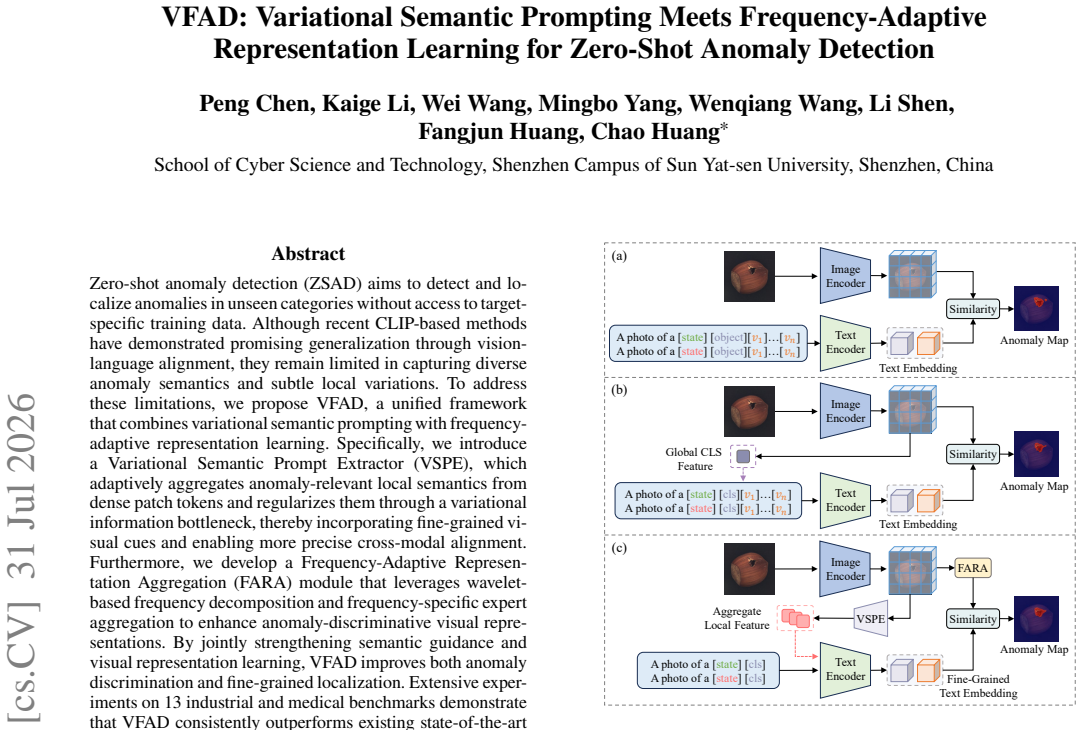
VSPE (Variational Semantic Prompt Extractor): a module that uses learnable query anchors to cross-attend over dense image patch tokens, then samples prompt tokens from a variational Gaussian latent space (via a reparameterization trick and KL regularization) and injects them into the text transformer layers. FARA (Frequency-Adaptive Representation Aggregation): a module that applies a discrete wavelet transform to split patch features into low- and high-frequency subbands, routes each subband through its own mixture-of-experts (top-k experts with a learned router), then applies an inverse wavelet transform and a residual connection to preserve the original frozen representation. Together the
What would settle it
Re-train VFAD using the paper's stated protocol (VisA as the auxiliary training set, MVTec-AD as the auxiliary set when evaluating VisA, ViT-L/14-336 backbone, 518x518 inputs, four experts per MoE branch with top-2 routing, and KL weight 0.1) and measure image-level and pixel-level AUROC/AP on the same 13 datasets. If the average gains over the previous best (94.2% vs 93.5% industrial image-level, 97.6% vs 96.8% medical image-level) or the per-dataset improvements do not hold, or if the ablation differences in Table 3 (e.g., +1.7/+1.6 I-AUROC from VSPE, +1.6/+1.1 P-AUROC from FARA on the indus
Extended reading notes
Core claim
The paper's central claim is that zero-shot anomaly detection can be improved substantially by jointly strengthening two sides of CLIP-based inference: the semantic guidance and the visual representation. On the semantic side, the proposed VSPE aggregates anomaly-relevant local cues from patch tokens via learnable query anchors, forces them through a variational information bottleneck (a Gaussian latent distribution regularized by KL divergence), and injects the sampled prompts into the text encoder, so text embeddings can reflect what anomalies look like in the input image. On the visual side, FARA splits patch features with a discrete wavelet transform into low-frequency (structure) and hi
Load-bearing premise
The paper's central claim rests on the assumption that the published evaluation protocol—training on one auxiliary industrial dataset (VisA) and on MVTec-AD when VisA is the target, then testing on the other 12 datasets with non-overlapping categories—was followed exactly and that the self-reported numbers can be reproduced, since no code, seeds, or confidence intervals are provided.
Editorial extensions
If this is right
- If the reported gains hold, factory inspection can be deployed to a new product line without collecting annotated defect images: only the frozen CLIP encoder plus the learned prompt and frequency modules need to be pointed at the new category.
- Medical screening across modalities (e.g., different MRI sequences or endoscope cameras) could be bootstrapped with zero labeled examples for the new modality, provided the auxiliary training categories do not overlap with the target.
- The separation of contributions (VSPE for image-level discrimination, FARA for pixel-level localization) suggests prompt-side and feature-side adaptation are complementary and can be tuned independently for a given deployment.
- Because the modules sit on top of frozen CLIP encoders, they could be added to any CLIP-based anomaly detector to improve fine-grained localization without retraining the backbone.
Reading between the lines
- The 'zero-shot' label depends on the choice of the auxiliary training dataset; testing with multiple auxiliary sets (or a union) would reveal whether the gains are robust to the source domain, a check the paper does not report.
- The variational information bottleneck on prompt tokens may also help other CLIP adaptation tasks that need fine-grained, diverse semantic contexts, such as open-vocabulary segmentation or referring expression grounding.
- Since the absolute gains over the previous best are small (0.7% image-level AUROC on industrial, 0.8% pixel-level on medical), the headline numbers should be treated as provisional until an independent reproduction with the same protocol is available.
- FARA's wavelet-based experts could be tested as a general fine-grained feature extractor for dense prediction tasks beyond anomaly detection, such as defect segmentation or medical lesion delineation.
Editorial analysis
A structured set of objections, weighed in public.
Referee Report
Summary. The paper proposes VFAD, a zero-shot anomaly detection method that combines a Variational Semantic Prompt Extractor (VSPE) with a Frequency-Adaptive Representation Aggregation (FARA) module. VSPE uses learnable query anchors and a variational information bottleneck to extract anomaly-relevant local semantics from patch tokens and injects them into the text encoder. FARA applies a discrete wavelet transform, then processes low- and high-frequency components with separate mixture-of-experts branches and a residual connection. The method is trained on one benchmark (VisA, or MVTec-AD when testing on VisA) and evaluated on 13 industrial and medical datasets. The paper reports state-of-the-art image- and pixel-level AUROC/AP in Tables 1-2, and ablations in Tables 3-4 support the individual contributions of VSPE and FARA.
Significance. If the reported results are reliable, VFAD is a coherent and competitive combination of established ideas in CLIP-based zero-shot anomaly detection: visual-conditioned prompt learning, variational regularization, frequency decomposition, and sparse expert aggregation. The work covers a broad set of benchmarks and includes ablations that isolate the contribution of each module, which is a strength. However, the central claim of "consistently outperforming" existing methods is supported only by self-reported tables without error bars, seeds, significance tests, or code. More importantly, the stated zero-shot protocol is internally inconsistent because VisA and MVTec-AD share the category capsules/capsule, so two of the main benchmark rows are not zero-shot. These issues are load-bearing for the paper's main claim, and the manuscript requires substantial revision before the claimed superiority can be accepted.
major comments (3)
- [Implementation details / Problem Definition] The paper states in the Implementation details: "we use VisA as the auxiliary training set since its categories do not overlap with those of the remaining datasets. For evaluation on VisA, we train the model on MVTec-AD." This directly contradicts the Problem Definition requirement that Ctrain ∩ Ctest = ∅. VisA contains a class named "capsules" and MVTec-AD contains a class named "capsule"; these are the same object category. Consequently, the MVTec-AD and VisA rows in Table 1 are not zero-shot for the capsule class, and the reported averages (93.1/87.2 I-AUROC) may be inflated by training on a class that appears in the test set. The paper provides no per-class breakdown, so the magnitude of the effect cannot be assessed. This undermines the central claim of consistent superiority. The authors should either use a truly disjoint auxiliary/target split, exclude the overlapping category, or
- [Tables 1-2 / Comparison with State-of-the-Art Methods] The claimed state-of-the-art performance is not statistically supported. No error bars, number of seeds, or significance tests are reported, and many per-dataset differences are small. For example, in Table 1 the average image-level AUROC gain over Bayes-PFL is 0.7, but VFAD is below MoECLIP on MVTec-AD (93.1 vs 93.9) and on DTD-Synthetic (95.3 vs 95.5). In Table 2, the medical image-level average gain is 0.8 AUROC over the previous best. Without multiple runs and measures of variance, these differences may be within run-to-run noise. The paper also states that code will be released only upon publication, so the results cannot currently be independently reproduced. I request error bars or confidence intervals, a statement of the number of seeds, and ideally a public code release or a detailed reproducibility appendix.
- [Experimental Setups / Ablation Study] Several hyperparameters appear to be tuned on the evaluation datasets without a separate validation protocol. The implementation details fix the KL weight λ=0.1, number of query anchors A=8, prompt depth J=9, and expert settings (4 experts, top-2); Figure 5 sweeps the number of experts on MVTec-AD and selects the best. If these choices were made by observing test-set performance, the reported zero-shot generalization is optimistic. Please clarify the validation procedure, or report performance as a function of the swept hyperparameters on a held-out split.
minor comments (4)
- [Eqs. (6)-(7)] The conditions for prompt updating appear reversed. The text says J is the maximum depth for prompt updating, but Eq. (6) discards the updated prompt for i≤J, while Eq. (7) keeps it for i>J. Please clarify the intended behavior and correct the equations.
- [Table 2] In the BrainMRI row, MoECLIP is reported as (88.5, 97.1) for I-AUROC and I-AP, which is unusual relative to its other rows. Please verify the numbers.
- [Supplementary references] The text refers to "Supplementary Material A" and "Supplementary Material B", but no supplementary PDF is provided with the arXiv submission. Please include the supplementary material or remove the references.
- [Notation] In Eq. (13), softmax is applied over the two text embeddings but no temperature is mentioned. For reproducibility, specify whether a temperature is used and, if so, its value.
Circularity Check
No significant circularity; the method's derivation is self-contained and the benchmark evaluation, apart from a possible category-overlap protocol issue, is an empirical comparison rather than a definitional reduction.
full rationale
VFAD's derivation does not reduce to its inputs by construction. VSPE and FARA are defined by explicit equations (Eqs. 1-12) and the training loss (Eqs. 16-17) supervises the model's own predictions against ground truth; the benchmark numbers in Tables 1-2 are measured empirical results, not quantities derived from the method's definitions. The only in-manuscript passage that could be read as a validity flaw is in Implementation details: 'we use VisA as the auxiliary training set since its categories do not overlap with those of the remaining datasets. For evaluation on VisA, we train the model on MVTec-AD.' The skeptical concern that VisA contains 'capsules' and MVTec-AD contains 'capsule', creating a possible same-category overlap, is a data-protocol/contamination issue (potential violation of the stated Ctrain∩Ctest=∅ condition), not a circularity: it does not make any predicted quantity equal to a fitted parameter by construction, and it does not collapse the claimed derivation into its inputs. Hyperparameter choices (number of experts, query anchors, λ) tuned on evaluation sets are a mild selection-bias risk, not definitional circularity. The sole self-citation, Chen, Huang, and Huang 2026 (DyC-CLIP), appears in a standard definition sentence in Related Work and is not load-bearing. No uniqueness theorem, smuggled ansatz, or renamed-known-result pattern is present. Thus the appropriate circularity score is 0; the protocol-overlap and reproducibility concerns belong to correctness/validity assessment, not to this circularity pass.
Assumptions & free parameters
free parameters (5)
- KL weight λ =
0.1
- Number of learnable query anchors A =
8
- Number of MoE experts per frequency branch K and top-k =
4 experts, top-2 routing
- Prompt injection depth J =
9
- Layer selection for patch features =
layers 6, 12, 18, 24
assumptions (4)
- domain assumption CUAD: The reported baseline numbers faithfully reflect a unified protocol under which the auxiliary training set is either VisA or MVTec-AD (per the stated protocol), and the category splits truly are disjoint.
- domain assumption The discrete wavelet transform and its inverse on patch features approximately preserve the information needed for zero-shot detection, and the low-/high-frequency split is a meaningful decomposition for CLIP features.
- domain assumption The Gaussian variational bottleneck assumption for semantic prompts (reparameterization trick) is an appropriate and sufficient regularizer.
- domain assumption No information leakage between the datasets used for training and evaluation beyond category disjointness.
Cite this review
Pith. "Pith review of VFAD: Variational Semantic Prompting Meets Frequency-Adaptive Representation Learning for Zero-Shot Anomaly Detection." pith.science (2026). https://pith.science/paper/MWM2ELU5
@misc{pith2026260729370,
  author       = {Pith},
  title        = {Pith review of: VFAD: Variational Semantic Prompting Meets Frequency-Adaptive Representation Learning for Zero-Shot Anomaly Detection},
  year         = {2026},
  howpublished = {\url{https://pith.science/paper/MWM2ELU5}},
  note         = {Machine review of arXiv:2607.29370}
}
read the original abstract
Zero-shot anomaly detection (ZSAD) aims to detect and localize anomalies in unseen categories without access to target-specific training data. Although recent CLIP-based methods have demonstrated promising generalization through vision-language alignment, they remain limited in capturing diverse anomaly semantics and subtle local variations. To address these limitations, we propose VFAD, a unified framework that combines variational semantic prompting with frequency-adaptive representation learning. Specifically, we introduce a Variational Semantic Prompt Extractor (VSPE), which adaptively aggregates anomaly-relevant local semantics from dense patch tokens and regularizes them through a variational information bottleneck, thereby incorporating fine-grained visual cues and enabling more precise cross-modal alignment. Furthermore, we develop a Frequency-Adaptive Representation Aggregation (FARA) module that leverages wavelet-based frequency decomposition and frequency-specific expert aggregation to enhance anomaly-discriminative visual representations. By jointly strengthening semantic guidance and visual representation learning, VFAD improves both anomaly discrimination and fine-grained localization. Extensive experiments on 13 industrial and medical benchmarks demonstrate that VFAD consistently outperforms existing state-of-the-art ZSAD methods across diverse anomaly scenarios. The code will be publicly available upon publication.
Figures


Figures from the paper (2 more)


Reference graph
Works this paper leans on
-
[1]
Communication, Simulation, and Intelligent Agents: Implications of Personal Intelligent Machines for Medical Education
Clancey, William J. Communication, Simulation, and Intelligent Agents: Implications of Personal Intelligent Machines for Medical Education. Proceedings of the Eighth International Joint Conference on Artificial Intelligence (IJCAI-83)
-
[2]
Classification Problem Solving
Clancey, William J. Classification Problem Solving. Proceedings of the Fourth National Conference on Artificial Intelligence
-
[3]
, title =
Robinson, Arthur L. , title =. 1980 , doi =. https://science.sciencemag.org/content/208/4447/1019.full.pdf , journal =
1980
-
[4]
New Ways to Make Microcircuits Smaller---Duplicate Entry
Robinson, Arthur L. New Ways to Make Microcircuits Smaller---Duplicate Entry. Science
-
[5]
Clancey and Glenn Rennels , abstract =
Diane Warner Hasling and William J. Clancey and Glenn Rennels , abstract =. Strategic explanations for a diagnostic consultation system , journal =. 1984 , issn =. doi:https://doi.org/10.1016/S0020-7373(84)80003-6 , url =
-
[6]
and Rennels, Glenn R
Hasling, Diane Warner and Clancey, William J. and Rennels, Glenn R. and Test, Thomas. Strategic Explanations in Consultation---Duplicate. The International Journal of Man-Machine Studies
-
[7]
Poligon: A System for Parallel Problem Solving
Rice, James. Poligon: A System for Parallel Problem Solving
-
[8]
Transfer of Rule-Based Expertise through a Tutorial Dialogue
Clancey, William J. Transfer of Rule-Based Expertise through a Tutorial Dialogue
Show all 52 references
-
[9]
The Engineering of Qualitative Models
Clancey, William J. The Engineering of Qualitative Models
-
[10]
2023 , eprint=
Attention Is All You Need , author=. 2023 , eprint=
2023
-
[11]
Pluto: The 'Other' Red Planet
NASA. Pluto: The 'Other' Red Planet
-
[12]
Pattern Recognition , pages=
DyC-CLIP: Dynamic Context-Aware Multi-Modal Prompt Learning for Zero-Shot Anomaly Detection , author=. Pattern Recognition , pages=. 2026 , publisher=
2026
-
[13]
Proceedings of the IEEE/CVF Conference on Computer Vision and Pattern Recognition , pages=
Bayesian prompt flow learning for zero-shot anomaly detection , author=. Proceedings of the IEEE/CVF Conference on Computer Vision and Pattern Recognition , pages=
-
[14]
European Conference on Computer Vision , pages=
Vcp-clip: A visual context prompting model for zero-shot anomaly segmentation , author=. European Conference on Computer Vision , pages=. 2024 , organization=
2024
-
[15]
Proceedings of the IEEE/CVF Conference on Computer Vision and Pattern Recognition , pages=
MoECLIP: Patch-Specialized Experts for Zero-shot Anomaly Detection , author=. Proceedings of the IEEE/CVF Conference on Computer Vision and Pattern Recognition , pages=
-
[16]
Proceedings of the IEEE/CVF conference on computer vision and pattern recognition , pages=
MVTec AD--A comprehensive real-world dataset for unsupervised anomaly detection , author=. Proceedings of the IEEE/CVF conference on computer vision and pattern recognition , pages=
-
[17]
European Conference on Computer Vision , pages=
Spot-the-difference self-supervised pre-training for anomaly detection and segmentation , author=. European Conference on Computer Vision , pages=. 2022 , organization=
2022
-
[18]
2021 IEEE 30th International Symposium on Industrial Electronics (ISIE) , pages=
VT-ADL: A vision transformer network for image anomaly detection and localization , author=. 2021 IEEE 30th International Symposium on Industrial Electronics (ISIE) , pages=. 2021 , organization=
2021
-
[19]
DAGM symposium in , volume=
Weakly supervised learning for industrial optical inspection , author=. DAGM symposium in , volume=
-
[20]
Proceedings of the IEEE/CVF Winter Conference on Applications of Computer Vision , pages=
Zero-shot versus many-shot: Unsupervised texture anomaly detection , author=. Proceedings of the IEEE/CVF Winter Conference on Applications of Computer Vision , pages=
-
[21]
Proceedings of the IEEE/CVF conference on computer vision and pattern recognition , pages=
Multiresolution knowledge distillation for anomaly detection , author=. Proceedings of the IEEE/CVF conference on computer vision and pattern recognition , pages=
-
[22]
Brain , volume=
Brain tumor detection using MRI images , author=. Brain , volume=
-
[23]
2020 , howpublished =
Ahmed Hamada , title =. 2020 , howpublished =
2020
-
[24]
IEEE transactions on medical imaging , volume=
Automated polyp detection in colonoscopy videos using shape and context information , author=. IEEE transactions on medical imaging , volume=. 2015 , publisher=
2015
-
[25]
saliency maps from physicians , author=
WM-DOVA maps for accurate polyp highlighting in colonoscopy: Validation vs. saliency maps from physicians , author=. Computerized medical imaging and graphics , volume=. 2015 , publisher=
2015
-
[26]
Pattern Recognition
The EndoTect 2020 challenge: evaluation and comparison of classification, segmentation and inference time for endoscopy , author=. Pattern Recognition. ICPR International Workshops and Challenges: Virtual Event, January 10-15, 2021, Proceedings, Part VIII , pages=. 2021 , orga...
2020
-
[27]
International conference on multimedia modeling , pages=
Kvasir-seg: A segmented polyp dataset , author=. International conference on multimedia modeling , pages=. 2019 , organization=
2019
-
[28]
2018 IEEE 15th international symposium on biomedical imaging (ISBI 2018) , pages=
Skin lesion analysis toward melanoma detection: A challenge at the 2017 international symposium on biomedical imaging (isbi), hosted by the international skin imaging collaboration (isic) , author=. 2018 IEEE 15th international symposium on biomedical imaging (ISBI 2018) , pag...
2017
-
[29]
Computers in Industry , volume=
Mixed supervision for surface-defect detection: From weakly to fully supervised learning , author=. Computers in Industry , volume=. 2021 , publisher=
2021
-
[30]
Proceedings of the IEEE/CVF conference on computer vision and pattern recognition , pages=
Winclip: Zero-/few-shot anomaly classification and segmentation , author=. Proceedings of the IEEE/CVF conference on computer vision and pattern recognition , pages=
-
[31]
European conference on computer vision , pages=
Adaclip: Adapting clip with hybrid learnable prompts for zero-shot anomaly detection , author=. European conference on computer vision , pages=. 2024 , organization=
2024
-
[32]
International Conference on Learning Representations , volume=
Anomalyclip: Object-agnostic prompt learning for zero-shot anomaly detection , author=. International Conference on Learning Representations , volume=
-
[33]
Proceedings of the Computer Vision and Pattern Recognition Conference , pages=
Aa-clip: Enhancing zero-shot anomaly detection via anomaly-aware clip , author=. Proceedings of the Computer Vision and Pattern Recognition Conference , pages=
-
[34]
ICASSP 2026-2026 IEEE International Conference on Acoustics, Speech and Signal Processing (ICASSP) , pages=
Wmoe-clip: Wavelet-enhanced mixture-of-experts prompt learning for zero-shot anomaly detection , author=. ICASSP 2026-2026 IEEE International Conference on Acoustics, Speech and Signal Processing (ICASSP) , pages=. 2026 , organization=
2026
-
[35]
Proceedings of the IEEE/CVF Conference on Computer Vision and Pattern Recognition , pages=
DLVP-CLIP: Enhancing fine-grained zero-shot anomaly detection via dynamic local visual prompting , author=. Proceedings of the IEEE/CVF Conference on Computer Vision and Pattern Recognition , pages=
-
[36]
International journal of computer vision , volume=
Learning to prompt for vision-language models , author=. International journal of computer vision , volume=. 2022 , publisher=
2022
-
[37]
Proceedings of the IEEE/CVF conference on computer vision and pattern recognition , pages=
Conditional prompt learning for vision-language models , author=. Proceedings of the IEEE/CVF conference on computer vision and pattern recognition , pages=
-
[38]
Proceedings of the IEEE/CVF international conference on computer vision , pages=
Prompt-aligned gradient for prompt tuning , author=. Proceedings of the IEEE/CVF international conference on computer vision , pages=
-
[39]
Proceedings of the IEEE/CVF International Conference on Computer Vision , pages=
FE-CLIP: Frequency Enhanced CLIP Model for Zero-Shot Anomaly Detection and Segmentation , author=. Proceedings of the IEEE/CVF International Conference on Computer Vision , pages=
-
[40]
European Conference on Computer Vision , pages=
Gallop: Learning global and local prompts for vision-language models , author=. European Conference on Computer Vision , pages=. 2024 , organization=
2024
-
[41]
Proceedings of the AAAI Conference on Artificial Intelligence , volume=
Adaptclip: Adapting clip for universal visual anomaly detection , author=. Proceedings of the AAAI Conference on Artificial Intelligence , volume=
-
[42]
Proceedings of the IEEE/CVF Conference on Computer Vision and Pattern Recognition , pages=
Reasoning-Driven Anomaly Detection and Localization with Image-Level Supervision , author=. Proceedings of the IEEE/CVF Conference on Computer Vision and Pattern Recognition , pages=
-
[43]
Proceedings of the IEEE/CVF Conference on Computer Vision and Pattern Recognition , pages=
MMR-AD: A Large-Scale Multimodal Dataset for Benchmarking General Anomaly Detection with Multimodal Large Language Models , author=. Proceedings of the IEEE/CVF Conference on Computer Vision and Pattern Recognition , pages=
-
[44]
Proceedings of the IEEE/CVF Conference on Computer Vision and Pattern Recognition , pages=
VisualAD: Language-free zero-shot anomaly detection via Vision Transformer , author=. Proceedings of the IEEE/CVF Conference on Computer Vision and Pattern Recognition , pages=
-
[45]
International conference on machine learning , pages=
Learning transferable visual models from natural language supervision , author=. International conference on machine learning , pages=. 2021 , organization=
2021
-
[46]
Proceedings of the Computer Vision and Pattern Recognition Conference , pages=
Towards zero-shot anomaly detection and reasoning with multimodal large language models , author=. Proceedings of the Computer Vision and Pattern Recognition Conference , pages=
-
[47]
The Thirteenth International Conference on Learning Representations , year=
One-for-all few-shot anomaly detection via instance-induced prompt learning , author=. The Thirteenth International Conference on Learning Representations , year=
-
[48]
Proceedings of the IEEE/CVF International Conference on Computer Vision , pages=
Dictas: A framework for class-generalizable few-shot anomaly segmentation via dictionary lookup , author=. Proceedings of the IEEE/CVF International Conference on Computer Vision , pages=
-
[49]
Proceedings of the AAAI Conference on Artificial Intelligence , volume=
Mau-gpt: Enhancing multi-type industrial anomaly understanding via anomaly-aware and generalist experts adaptation , author=. Proceedings of the AAAI Conference on Artificial Intelligence , volume=
-
[50]
Proceedings of the AAAI Conference on Artificial Intelligence , volume=
PromptMoE: Generalizable zero-shot anomaly detection via visually-guided prompt mixtures , author=. Proceedings of the AAAI Conference on Artificial Intelligence , volume=
-
[51]
Proceedings of the IEEE international conference on computer vision , pages=
Focal loss for dense object detection , author=. Proceedings of the IEEE international conference on computer vision , pages=
-
[52]
arXiv preprint arXiv:1911.02855 , year=
Dice loss for data-imbalanced NLP tasks , author=. arXiv preprint arXiv:1911.02855 , year=
1911 arXiv
Reviewed August 3, 2026 · model on record in the stance chip above.
Discussion (0). Sign in to comment.