REVIEW 3 major objections 4 minor 1 cited by
Ordinary confidence intervals can be made valid after model selection by splitting a score variable with noise.
Reviewed by Pith at T0; open to challenge. T0 means a machine referee read the full paper against a public rubric. the ladder, T0–T4 →
T0 review · deepseek-v4-flash
2026-08-03 09:30 UTC pith:MWZBYCNR
load-bearing objection Score-thinning is a real advance, but the theory and simulations operate in different asymptotic regimes—still worth a serious referee. the 3 major comments →
Post-selection inference for penalized M-estimators via score thinning
The pith
A machine-rendered reading of the paper's core claim, the machinery that carries it, and where it could break.
Core claim
The central claim is Theorem 6: under regularity conditions, a standard (non-selective) confidence interval centered at the noisy model-E M-estimator covers the population parameter conditional on the event that the noisy penalized M-estimator selected model E, with asymptotic probability at least 1-alpha. The proof decomposes the score variable into two approximately independent normal variables, shows the selection event depends only on one piece (up to a vanishing remainder) via the KKT conditions, and the coverage event only on the other, then applies a conditional Berry-Esseen bound. Corollary 7 extends the result to adding noise directly to the outcomes whenever the loss is affine in t
What carries the argument
The score variable Zhat_n = sqrt(n) P_n \dot ell_{theta-bar_n^{E,*}}, the normalized gradient of the loss at the population parameter of the selected model. Gaussian thinning: with W ~ N(0, Sigma-hat), set Z^(1) = Zhat + gamma W and Z^(2) = Zhat - (1/gamma) W; these are approximately independent normals. The selection event equals {Z^(1) + o_p(1) in a union of convex sets} (Lemma 4), and the coverage event equals {Z^(2) + o_p(1) in a convex set} (Lemma 5). Lemma 2's conditional Berry-Esseen bound converts this approximate independence into a conditional-coverage guarantee in Theorem 6.
Load-bearing premise
The loss function's gradient must admit a uniform second-order Taylor expansion around the selected-model parameter whose remainder is o_p(n^{-1/2}); if that quick decay fails, both the event characterizations and the coverage guarantee collapse.
What would settle it
Simulate a setting where the Taylor remainder is not o_p(n^{-1/2}) (for example, median regression with fixed p and n) and measure the conditional coverage of the proposed interval; a persistent gap below 1-alpha would refute the theorem's reach. Alternatively, check whether Condition 4 holds for a given loss by verifying the remainder rate directly.
If this is right
- For practitioners, valid post-selection inference after lasso-style selection reduces to fitting two M-estimators, one with noise added and one with noise subtracted; no special selective-inference software is required.
- The result covers generalized linear models with canonical links, including logistic regression, a setting where exact data-thinning methods are unavailable.
- Coverage is conditional on the selected model, not merely unconditional, so the guarantee is the one selective-inference users actually want.
- Intervals from this approach are wider than those from exact randomized selective inference in simulations, but narrower than sample splitting, offering a trade-off between convenience and power.
- Corollary 7 implies that for appropriate losses, the analyst may add noise to the response instead of to the optimization objective, which is computationally simpler.
Where Pith is reading between the lines
- Editorial inference: the same score-splitting mechanism could plausibly be adapted to provide valid post-selection p-values and false-discovery-rate control, not just confidence intervals, for penalized M-estimators.
- Editorial inference: Condition 5 restricts the approach to penalties whose selection regions are finitely piecewise-convex (true for the lasso but open for the group lasso); extending it would cover more structured penalties.
- Editorial inference: a promising stress test is the p > n regime, which the paper leaves open; score thinning may behave differently when the score covariance is singular.
- Editorial inference: the asymptotic independence between selection and inference suggests that the variance estimator and the noise split gamma could be tuned separately, hinting at a possible power-improving modification.
Editorial analysis
A structured set of objections, weighed in public.
Referee Report
Summary. This paper proposes a method for post-selection inference after penalized M-estimation. The main idea is to add Gaussian noise to the score of an M-estimator and use the two resulting noisy score variables for selection and inference, respectively. Under regularity conditions, the authors show that the selection event and the event that a standard fixed-model confidence interval covers its target can both be approximately characterized by these thinned score variables, yielding asymptotic conditional coverage (Theorem 6). A corollary applies the result to generalized linear models by adding noise directly to the outcomes (Corollary 7). The paper includes a Berry--Esseen-type analysis, simulation studies in linear, logistic, and cluster-correlated settings, and an application to a social network.
Significance. If the main theorem is correct, this is a substantial contribution: it would provide a simple, distribution-free, asymptotically valid alternative to bespoke selective inference procedures for a broad class of penalized M-estimators. The paper builds on and extends data-thinning ideas, and the proof machinery—especially the conditional Berry--Esseen bound—is nontrivial and largely carefully developed. The authors also provide code, which is valuable for reproducibility. However, as detailed below, the theorem is proved only under a local-alternative assumption that the paper's own simulations and application do not satisfy, and the proof has a gap concerning convergence of the variance estimator. The conceptual promise is real, but the current manuscript needs additional work before the central claim can be regarded as fully established.
major comments (3)
- [Assumption 1(i) and Section 5.1] Please note the above comment is the same as the intended comment; the section field is used for citation.
- [Appendix B.5 (proof of Theorem 6)] This is a separate technical issue from the local-alternative mismatch.
- [Algorithm 1, Step 2] This issue is local but affects the empirical implementation.
minor comments (4)
- [Abstract and general presentation] There are several typographical issues, e.g., "independen" in the abstract and formatting glitches like "glmnetinR". A careful proofread is recommended.
- [Section 3.2, Corollary 7] The condition \ell_\theta(Y_i) = \theta^T A_i Y_i + a_{\theta,i} is stated with A_i of dimension p x d. In the GLM application, Y_i is scalar and A_i = -X_i, so A_i \bar W_{n,i} is p-dimensional. This is clear enough, but it would help to explicitly state the dimensions in Section 3.2 to avoid confusion.
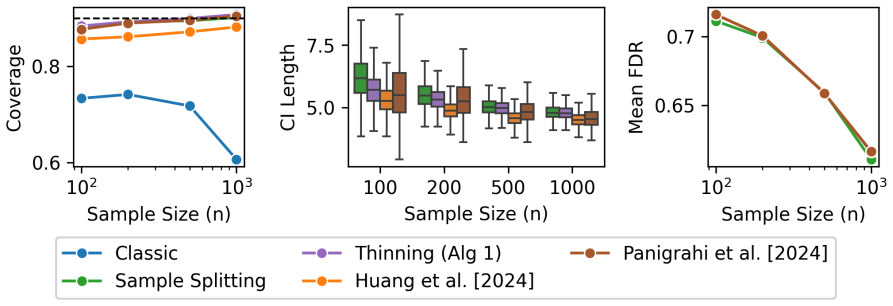
- [Section 5.1] The sentence "We note the following." and the list formatting could be improved. Also, the claim that "All other approaches attain 90% coverage" is contradicted by the displayed undercoverage of Huang et al. in Figure 1; the text should be clarified.
- [Section 6] The discussion lists limitations n > p and L1-only penalty, but as noted above it does not mention the local-alternative restriction or the lack of validation in that regime. The discussion would be more transparent if this were included.
Circularity Check
No circularity: the conditional coverage result is derived, not assumed, and self-citations are background building blocks.
full rationale
The central claim, Theorem 6, is that a standard non-selective confidence interval attains nominal coverage conditional on the model selected by a noisy penalized M-estimator. The proof does not assume this conditional coverage. Its inputs are: (i) approximate Gaussianity of the score variable (Condition 1, Lemma 1); (ii) a conditional Berry-Esseen bound that measures how close conditional probabilities are to unconditional ones (Lemma 2); (iii) a characterization of the selection and coverage events as convex-set events in thinned score variables (Lemmas 4 and 5); and (iv) Condition 3, which is only the fixed-model, non-selective coverage of the same interval. The target conditional coverage is then obtained by showing the difference between conditional and unconditional coverage vanishes. The construction of the thinned scores (2.10) borrows the adding/subtracting-noise idea from the data-thinning literature (Rasines and Young 2023; Neufeld et al. 2024; Dharamshi et al. 2025), but the paper proves its own Berry-Esseen-type bounds and does not import a post-selection theorem from those citations. The self-citations (Neufeld, Dharamshi, Witten; Panigrahi) are background references and are not load-bearing in the proof of Theorem 6. The local-alternative Assumption 1(i) is a genuine technical condition, and the reviewer's observation that the simulations use fixed sparse parameters is a real concern about the scope of the experiments, but it is a mismatch between assumptions and simulations, not a circular derivation. Similarly, the Discussion's stated limitations (n > p, L1-only verification) are honest scope restrictions, not hidden circular inputs. Therefore the derivation chain is self-contained relative to its stated assumptions, and no step reduces by definition to its own output.
Axiom & Free-Parameter Ledger
free parameters (2)
- γ (information split) =
γ=1 in experiments
- λ (penalty strength) =
λ∝√(log p)·sd(Y) in simulations and application
axioms (10)
- domain assumption Observations are independent (triangular array), not necessarily i.i.d.
- domain assumption Condition 1: score covariance Σ_n is invertible and centered third moments are uniformly bounded
- domain assumption Condition 2: uniqueness of the penalized estimator and submodel estimator
- domain assumption Condition 3: existence of a standard fixed-model CI around the noisy M-estimator with asymptotic coverage
- domain assumption Condition 4: uniform second-order Taylor expansion of the score with o_p(n^{-1/2}) remainder for both estimators
- domain assumption Assumption 1: local alternatives and convergence of Σ_n and H_n
- domain assumption Condition 5: penalty subgradient sets form finite unions of convex sets with nonempty interiors
- domain assumption Condition 6: L1 consistency of the score covariance estimator
- domain assumption Condition 7: loss is affine in the response with fixed matrices A_i
- domain assumption p is fixed and n→∞
read the original abstract
We consider inference for M-estimators after model selection using a sparsity-inducing penalty. While existing methods for this task require bespoke inference procedures, we propose a simpler approach, which relies on two insights: (i) adding and subtracting carefully-constructed noise to a Gaussian random variable with unknown mean and known variance leads to two \emph{independent} Gaussian random variables; and (ii) both the selection event resulting from penalized M-estimation, and the event that a standard (non-selective) confidence interval for an M-estimator covers its target, can be characterized in terms of an approximately normal ``score variable". We combine these insights to show that -- when the noise is chosen carefully -- there is asymptotic independence between the model selected using a noisy penalized M-estimator, and the event that a standard (non-selective) confidence interval on noisy data covers the selected parameter. Therefore, selecting a model via penalized M-estimation (e.g. \verb=glmnet= in \verb=R=) on noisy data, and then conducting \emph{standard} inference on the selected model (e.g. \verb=glm= in \verb=R=) using noisy data, yields valid inference: \emph{no bespoke methods are required}. Our results require independence of the observations, but only weak distributional requirements. We apply the proposed approach to conduct inference on the association between sex and smoking in a social network.
Figures


Forward citations
Cited by 1 Pith paper
-
Flexible Inference for Winners with Conditional Validity
A data-adaptive exponential randomization scheme yields conditionally valid confidence intervals for top-k winners, with selection quality close to standard top-k and shorter intervals than polyhedral methods.
Reference graph
Works this paper leans on
-
[1]
˜θn ←arg min θ∈Rp Pnℓθ
-
[2]
Sample noise ˆWn ←N 0, 1 n Pn i=1 Xi ¨b X ⊤ i ˜θn X ⊤ i /α ˜θn
-
[3]
Estimate ˆθ(λ) n as in (3.1) and defineE:= supp ˆθ(λ) n
-
[4]
Estimate ˆθE n as in (3.5)
-
[5]
the form 1 n nX i=1 Yi − 1 γ ˜Wn,i − ˙b(X ⊤ i,E ˆθE n ) 2 Xi,EX ⊤ i,E
Compute the modified sandwich variance estimator: ˆSE n ← Hn,E,E ˆθE n −1 ˜Σn,E,E Hn,E,E ˆθE n −1 where ˜Σn,E,E ← 1 γ2 Var ˆWn,E,E + 1 n nX i=1 Yi − ˙b(X ⊤ i,E ˆθE n ) 2 Xi,EX ⊤ i,E.(C.1) Output:A confidence interval centered at ˆθE n , CIξ,α n ˆθE n , ˆSE n = ξ⊤ ˆθE n ±n −1/2z1−α/2 ξ⊤ ˆSE n ξ 1/2 . the form 1 n nX i=1 Yi − 1 γ ˜Wn,i − ˙b(X ⊤ i,E ˆθE n ) ...
-
[2023]
To apply this result to ˆWn andW n, we must condition on ˆΣn so that ˆWn is Gaussian
allows us to bound the total variation between two Gaussian random variables with the same mean but different covariances. To apply this result to ˆWn andW n, we must condition on ˆΣn so that ˆWn is Gaussian. Since ˆΣn is a function of the data Dn :={(X i, Yi)}n i=1, it is sufficient to condition onD n. By Theorem 1.1 and Equation 2 of Devroye et al. [202...
2023
discussion (0)
Sign in with ORCID, Apple, or X to comment. Anyone can read and Pith papers without signing in.