REVIEW 4 major objections 6 minor 1 cited by
Reference-Guided Identity Preserving Face Restoration
T0 review · 4 major / 6 minor · reviewed 2026-08-07 · deepseek-v4-flash
Pith's one-line read The paper claims that a reference face is best exploited both as a fused multi-level context and as an extra hard-example identity target, and that several references can be combined at inference without retraining.
desk verdict A clean, well-ablated incremental improvement over RefLDM whose 'state-of-the-art' claim is undercut by circular ArcFace metrics and test-set hyperparameter tuning; the independent FaceNet evidence shows only a small effect. read the letter →
The pith
A machine-rendered reading of the paper's core claim, the machinery that carries it, and where it could break.
The reading
What carries the argument
The load-bearing object is Composite Context, \(c = \text{Concat}(W_H \varphi_H(x_{\text{REF}}), W_G \varphi_G(x_{\text{REF}})) + e_{\text{position}}\), a fixed-length sequence of 198 tokens built from a high-level identity embedding and a general face representation, injected through cross-attention in a latent diffusion UNet. The Hard Example Identity Loss \(L_{\text{HID}}\) is the second mechanism: it adds the reference face as a second cosine-similarity target, with the same identity embedding used for both context and loss, and balances the two targets by \(\$\lambda$\). This targets the documented plateau of ordinary identity loss early in training. The multi-reference extension is carried by classifier-free guidance: the noise prediction is a weighted combination of unconditioned, low-quality-only, and per-reference conditioned predictions, averaged over references.
What would settle it
A blind human side-by-side identity test on the FFHQ-Ref Severe set, or evaluation with a face-recognition model whose architecture and training data differ from the one used in the loss, would show whether the reported IDS gains correspond to genuine identity preservation. If human raters see no consistent identity advantage, the central claim is not supported.
Extended reading notes
Core claim
The central claim is that identity preservation in diffusion-based face restoration is limited not by what the reference face contains but by how it is encoded and how the identity signal is supervised. The paper conditions a latent diffusion UNet on a Composite Context that concatenates a high-level identity embedding from a pretrained face-recognition network with the full token sequence from a general face-representation network, projecting both into the cross-attention space. It also replaces the standard timestep-scaled identity loss with \(L_{\text{HID}}(x_{\text{HQ}}, x_{\text{REF}}, \hat{x}) = (1-\$\lambda$)L_{\text{ID}}(x_{\text{HQ}}, \hat{x}) + \$\lambda$ L_{\text{ID}}(x_{\text{REF}}, \hat{x})\), where \(\hat{x}\) is the direct denoising estimate and the reference face plays the role of a hard example. On the FFHQ-Ref benchmarks the reported identity similarity to the ground truth rises from 0.826 to 0.843 under moderate degradation and from 0.571 to 0.609 under severe degradation, while similarity to the reference face rises from 0.624 to 0.732. The same single-reference model can use several reference faces at inference through an averaged classifier-free-guidance rule, with reported identity gains that saturate near five references.
Load-bearing premise
The paper's main identity metric is the same cosine similarity that its loss maximizes, so the strongest reading of the reported gains assumes that this similarity tracks real perceived identity rather than fitting the metric.
Editorial extensions
If this is right
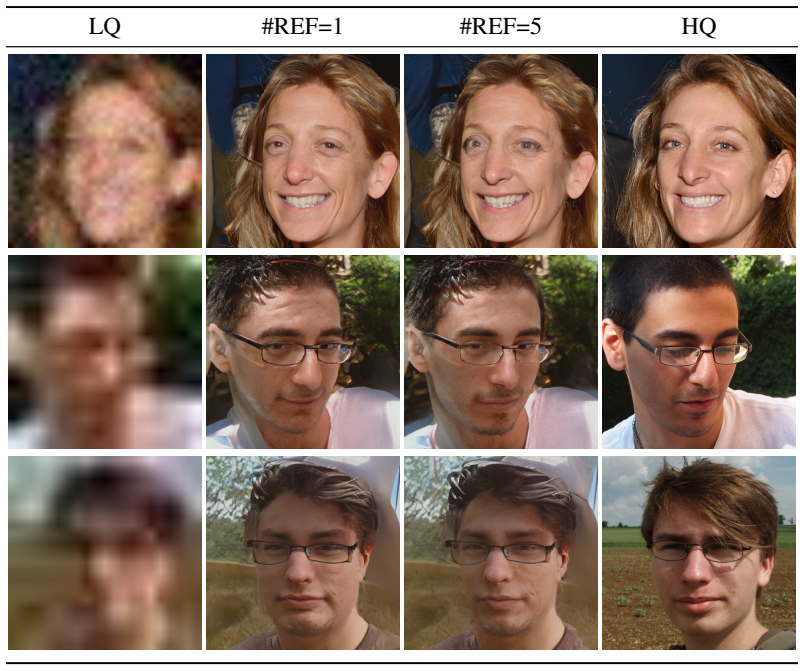
- A single-reference training setup is enough; additional reference faces can be combined at inference and the reported identity similarity rises until about five references, with no extra training.
- Conditioning on both identity-level and appearance-level reference information recovers details like skin texture and facial marks, not just global identity.
- Adding the reference as a hard example keeps the identity loss from collapsing to a tiny value, so identity supervision remains active throughout training and helps most on severely degraded inputs.
- The identity gains are not accompanied by a quality collapse: perceptual and no-reference quality indices remain competitive with prior methods.
Reading between the lines
- My inference: the reported drop in IDS(REF) when more reference faces are added may be partly a metric artifact, since that score is measured against the first reference only and the averaged prediction is allowed to move toward common identity traits of the other references.
- My inference: if the single-reference training plus reference-averaged inference works because the conditioning is additive, the same training-free multi-reference trick could transfer to other diffusion restorers whose reference conditioning is also separable; the paper does not test this.
- My inference: the FaceNet numbers in the paper are consistent but smaller than the ArcFace gains, so a cautious reading is that the direction of improvement is real but the headline magnitude may shrink under an identity metric the model never saw.
Editorial analysis
A structured set of objections, weighed in public.
Referee Report
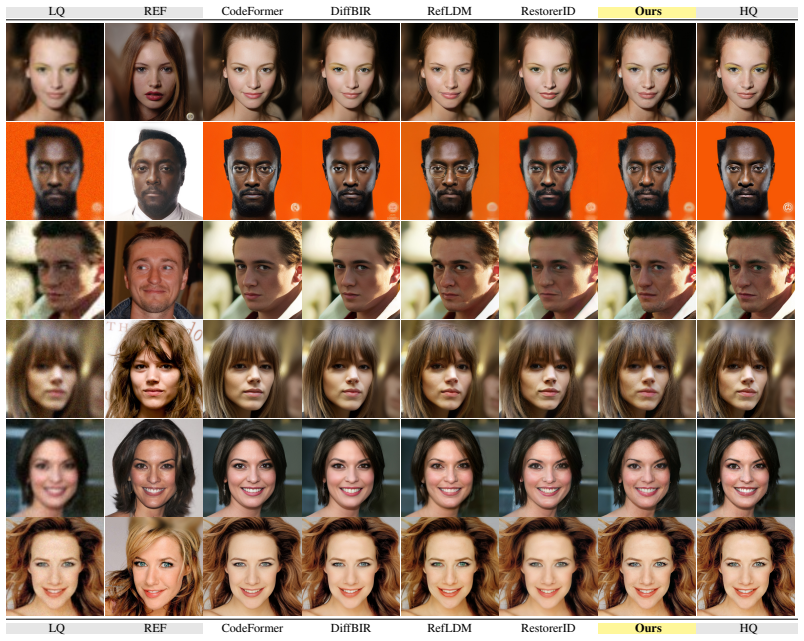
Summary. This paper proposes a reference-based face restoration method built on a latent diffusion model. The method has three components: Composite Context, which concatenates an ArcFace identity embedding with a full FaRL token sequence to condition the UNet; Hard Example Identity Loss, which adds an ArcFace identity loss against the reference face to the existing identity loss against the ground-truth face; and a training-free multi-reference inference scheme that averages classifier-free guidance outputs over several reference contexts. The method is evaluated on FFHQ-Ref Moderate, FFHQ-Ref Severe, and CelebA-Ref-Test against CodeFormer, DiffBIR, RefLDM, and RestorerID, reporting identity metrics IDS and IDS(REF) alongside FaceNet, LPIPS, MUSIQ, NIQE, and FID. The paper claims state-of-the-art identity-preserving restoration.
Significance. Identity preservation is a recognized weakness of diffusion-based face restoration, so a method that makes better use of reference faces would be practically valuable. The paper's strengths include a clear and simple formulation, careful use of the same training and test data as RefLDM for comparability, detailed ablations with per-image standard deviations, an independent FaceNet identity metric, a wrong-reference analysis, and a training-free multi-reference extension that is easy to adopt. The central claim, however, is weakened by the fact that the headline identity metrics are exactly the ArcFace objectives optimized during training; the independent FaceNet metric shows much smaller gains. The significance of the work therefore depends on whether the identity-preservation claim can be supported by metrics and comparisons that are not entangled with the training loss.
major comments (4)
- [§4 Evaluation; Eq. (3); Tables 1-3] The headline metrics IDS and IDS(REF) are cosine similarities in the ArcFace embedding space, and Eq. (3) explicitly minimizes ArcFace distance to both x_HQ and x_REF. Consequently, the large reported gains on IDS(REF) — for example 0.732 vs 0.624 on FFHQ-Ref Moderate and 0.712 vs 0.554 on FFHQ-Ref Severe — are expected from direct optimization of the evaluation metric and do not by themselves establish better identity preservation. The paper acknowledges this risk in the Evaluation paragraph and adds FaceNet, but the abstract and conclusion still base the state-of-the-art claim primarily on IDS and IDS(REF). Please re-center the identity-preservation claim on the independent FaceNet results or add additional independent validation such as a different face recognition model, verification TAR@FAR, or a human study, and state the FaceNet gains explicitly in the abstract and conclusion.
- [§4.2 Table 6; §4 Implementation Details; Table 13] The hyperparameters lambda and the classifier-free guidance scales s_i and s_c are selected using the same test benchmarks on which the final numbers are reported. Specifically, lambda=0.6 is justified by Table 6 evaluated on FFHQ-Ref Moderate and Severe test sets, and s_i=1.2, s_c=1.2 are selected using Table 13 on FFHQ-Ref Severe. This makes the reported comparisons partially in-sample, inflating the apparent advantage over baselines whose hyperparameters may not be tuned in the same way. Please add a held-out validation split or otherwise quantify the selection-induced optimism.
- [Tables 1, 7, 8] The abstract states that the method 'consistently outperforms previous work,' but on image-quality metrics the method is not consistently better. For example, on FFHQ-Ref Severe the method has LPIPS 0.3647 versus 0.3366 for RefLDM and 0.3113 for CodeFormer, and FID 38.3 versus 36.0 for RefLDM. The claim should be scoped to identity preservation, or the quality trade-offs should be discussed and the abstract tempered accordingly.
- [§3.3 Eq. (6); Table 2] The multi-reference extension is a plausible heuristic, but the evidence for its benefit is limited to identity metrics: with more references, IDS and FaceNet improve while IDS(REF) declines and LPIPS, MUSIQ, NIQE, and FID remain essentially flat. Since IDS(REF) is one of the terms optimized by the Hard Example Identity Loss, its decline with more references deserves a more careful treatment than the current explanation, and the claim that 'the identity preservation improves' should be scoped to the metrics that actually improve.
minor comments (6)
- [§3.1] The word 'dimention' should be 'dimension' in the description of the projection matrix W_G.
- [§4 Implementation Details] The phrase 'The classifier-guidance scales' should read 'The classifier-free guidance scales' for consistency with Eq. (5).
- [Tables 4-6 and text] The naming is inconsistent: 'Hard Example Identity Loss' in the text and Figure 2, but 'Hard Identity Loss' in the Table 6 caption and occasionally in Section 4.2. Please unify the terminology.
- [§3.2] Equation (2) uses the notation sqrt(alpha_bar_t) without defining it in this paper; adding a one-line definition or a reference to the DDPM convention would make the equation self-contained.
- [Figure 2] The loss curves in Figure 2 lack axis labels and a numerical scale, which makes the claimed plateau and the recovery effect hard to verify. Please add labeled axes and, ideally, the training hyperparameters used to produce the curves.
- [§4.1, Tables 7-9] The per-image standard deviations are useful, but the paper does not report significance tests for the differences against RefLDM. A paired test or confidence interval on the FaceNet differences would strengthen the claim that the independent metric improvement is meaningful.
Circularity Check
ArcFace IDS and IDS(REF) are the exact objectives of the Hard Example Identity Loss, so the largest identity-preservation gains are partially circular; independent FaceNet gains are small, and the central SOTA claim is not firmly established.
-
self definitional
[Eq. (3) with Eq. (2); Section 4 'Evaluation']
"LID(xHQ, ˆx) = √¯αt · (1−cos⟨ϕH(xHQ), ϕH( ˆx)⟩) ... LHID(xHQ,xREF, ˆx) = (1−λ)LID(xHQ, ˆx) + λLID(xREF, ˆx). ... IDS (i.e., the cosine similarity of ArcFace [16] embedding) for person identity preservation. ... Since we optimize the identity loss using the ArcFace [16] model during training, using IDS alone may not properly reflect generalization performance due to potential overfitting."
Minimizing Eq. (3) maximizes the ArcFace cosine similarity between the restored output and both xHQ and xREF. The paper's headline metrics are exactly those quantities: IDS is the ArcFace cosine similarity between output and HQ, and IDS(REF) is the same similarity with the first reference face. Thus the largest reported gains (especially IDS(REF), +0.108 Moderate and +0.158 Severe over RefLDM) are the training objective re-measured on the test set, not independent evidence. The paper itself concedes the overfitting risk. The only independent identity metric, FaceNet, shows much smaller gains (0.850 vs 0.837 Moderate, 0.743 vs 0.733 Severe, 0.827 vs 0.821 CelebA), so the SOTA identity claim leans on a partially circular metric.
-
fitted input called prediction
[Section 4.2 'Hard Example Identity Loss Ablation' (Table 6); Section 4 'Implementation Details' (Table 13)]
"Hence, we empirically set the λ parameter as 0.6 by default, by considering all the three identity preservation metrics. ... The classifier-guidance scales are selected as si = 1.2 and sc = 1.2 for inference."
Table 6 sweeps λ on the FFHQ-Ref Moderate and Severe test sets and selects 0.6 by looking at IDS, FaceNet and IDS(REF) on those same test sets; Table 13 selects si=1.2 and sc=1.2 using FFHQ-Ref Severe test metrics. The same test benchmarks are then reported as the method's state-of-the-art comparison. This is a benchmark-selection loop: the reported numbers are partly fit to the evaluation set rather than a clean out-of-sample prediction, making the headline identity gains additionally forced.
full rationale
The method is not a tautology: Composite Context and the Hard Example Identity Loss are concrete architectural and loss contributions, and the model is not simply re-emitting its inputs. However, the signature identity metrics IDS and IDS(REF) are the exact ArcFace cosine terms minimized in Eq. (3), so gains on those metrics are expected by construction; the paper's own Evaluation section flags this overfitting risk. The only independent identity metric, FaceNet, shows small improvements relative to per-image standard deviations, so the central 'state-of-the-art identity preserving restoration' claim rests substantially on the circular metric. In addition, λ and the classifier-free guidance scales were selected on the same test benchmarks, further weakening the out-of-sample interpretation. Independent quality metrics (LPIPS, MUSIQ, NIQE, FID) and qualitative results still show consistent, if modest, improvements, so the circularity is partial rather than total. No load-bearing self-citation was found; the authors' own metric-learning references [40, 41] are peripheral related work.
Assumptions & free parameters
free parameters (4)
- lambda (λ) =
0.6
- w_HID =
0.1
- CFG scale s_i =
1.2
- CFG scale s_c =
1.2
assumptions (5)
- domain assumption Pre-trained ArcFace and FaRL embeddings encode complementary identity and appearance information useful for cross-attention conditioning.
- standard math The DDPM/LDM formulation with concatenated LQ latent and cross-attention conditioning is a valid image restoration backbone.
- domain assumption The second-order degradation pipeline of Real-ESRGAN simulates real-world face degradations.
- ad hoc to paper Averaging classifier-free guidance outputs over multiple reference contexts in Eq. (6) is a valid multi-reference conditioning mechanism.
- domain assumption ArcFace cosine similarity is a reliable proxy for identity preservation even when optimized as a training loss.
Cite this review
Pith. "Pith review of Reference-Guided Identity Preserving Face Restoration." pith.science (2026). https://pith.science/paper/MXAVHT2B
@misc{pith2026250521905,
  author       = {Pith},
  title        = {Pith review of: Reference-Guided Identity Preserving Face Restoration},
  year         = {2026},
  howpublished = {\url{https://pith.science/paper/MXAVHT2B}},
  note         = {Machine review of arXiv:2505.21905}
}
read the original abstract
Preserving face identity is a critical yet persistent challenge in diffusion-based image restoration. While reference faces offer a path forward, existing reference-based methods often fail to fully exploit their potential. This paper introduces a novel approach that maximizes reference face utility for improved face restoration and identity preservation. Our method makes three key contributions: 1) Composite Context, a comprehensive representation that fuses multi-level (high- and low-level) information from the reference face, offering richer guidance than prior singular representations. 2) Hard Example Identity Loss, a novel loss function that leverages the reference face to address the identity learning inefficiencies found in the existing identity loss. 3) A training-free method to adapt the model to multi-reference inputs during inference. The proposed method demonstrably restores high-quality faces and achieves state-of-the-art identity preserving restoration on benchmarks such as FFHQ-Ref and CelebA-Ref-Test, consistently outperforming previous work.
Figures


Figures from the paper (9 more)




Forward citations
Cited by 1 Pith paper
-
Generative Manifold Distillation: Aligning Restoration Trajectories with Natural Image Prior
Pre-trained restoration models can be adapted to unlabeled out-of-distribution images by distilling quality-gated pseudo-targets from a frozen text-to-image diffusion oracle via mixed-supervision fine-tuning.
Reference graph
Works this paper leans on
-
[1]
Esrgan: Enhanced super-resolution generative adversarial networks, 2018
Xintao Wang, Ke Yu, Shixiang Wu, Jinjin Gu, Yihao Liu, Chao Dong, Chen Change Loy, Yu Qiao, and Xiaoou Tang. Esrgan: Enhanced super-resolution generative adversarial networks, 2018
work page 2018
-
[2]
Chan, and Chen Change Loy
Jianyi Wang, Zongsheng Yue, Shangchen Zhou, Kelvin C.K. Chan, and Chen Change Loy. Exploiting diffusion prior for real-world image super-resolution. 2024
2024
-
[3]
Scaling up to excellence: Practicing model scaling for photo-realistic image restoration in the wild, 2024
Fanghua Yu, Jinjin Gu, Zheyuan Li, Jinfan Hu, Xiangtao Kong, Xintao Wang, Jingwen He, Yu Qiao, and Chao Dong. Scaling up to excellence: Practicing model scaling for photo-realistic image restoration in the wild, 2024
2024
-
[4]
Diffbir: Towards blind image restoration with generative diffusion prior, 2024
Xinqi Lin, Jingwen He, Ziyan Chen, Zhaoyang Lyu, Bo Dai, Fanghua Yu, Wanli Ouyang, Yu Qiao, and Chao Dong. Diffbir: Towards blind image restoration with generative diffusion prior, 2024
work page 2024
-
[5]
Seesr: Towards semantics-aware real-world image super-resolution
Rongyuan Wu, Tao Yang, Lingchen Sun, Zhengqiang Zhang, Shuai Li, and Lei Zhang. Seesr: Towards semantics-aware real-world image super-resolution. InProceedings of the IEEE/CVF conference on computer vision and pattern recognition, pages 25456–25467, 2024
2024
-
[6]
Pixel-aware stable diffusion for realistic image super-resolution and personalized stylization
Tao Yang, Rongyuan Wu, Peiran Ren, Xuansong Xie, , and Lei Zhang. Pixel-aware stable diffusion for realistic image super-resolution and personalized stylization. InThe European Conference on Computer Vision (ECCV) 2024, 2023
work page 2024
-
[7]
Denoising diffusion probabilistic models, 2020
Jonathan Ho, Ajay Jain, and Pieter Abbeel. Denoising diffusion probabilistic models, 2020
2020
-
[8]
Denoising diffusion implicit models, 2022
Jiaming Song, Chenlin Meng, and Stefano Ermon. Denoising diffusion implicit models, 2022
2022
Show all 52 references
-
[9]
High-resolution image synthesis with latent diffusion models, 2022
Robin Rombach, Andreas Blattmann, Dominik Lorenz, Patrick Esser, and Björn Ommer. High-resolution image synthesis with latent diffusion models, 2022
2022
-
[10]
Sdxl: Improving latent diffusion models for high-resolution image synthesis, 2023
Dustin Podell, Zion English, Kyle Lacey, Andreas Blattmann, Tim Dockhorn, Jonas Müller, Joe Penna, and Robin Rombach. Sdxl: Improving latent diffusion models for high-resolution image synthesis, 2023
2023
-
[11]
Chan, Chongyi Li, and Chen Change Loy
Shangchen Zhou, Kelvin C.K. Chan, Chongyi Li, and Chen Change Loy. Towards robust blind face restoration with codebook lookup transformer. InNeurIPS, 2022
2022
-
[12]
Ref-ldm: A latent diffusion model for reference-based face image restoration
Chi-Wei Hsiao, Yu-Lun Liu, Cheng-Kun Yang, Sheng-Po Kuo, Yucheun Kevin Jou, and Chia-Ping Chen. Ref-ldm: A latent diffusion model for reference-based face image restoration. InAdvances in Neural Information Processing Systems, 2024
2024
-
[13]
Restorerid: Towards tuning-free face restoration with id preservation, 2024
Jiacheng Ying, Mushui Liu, Zhe Wu, Runming Zhang, Zhu Yu, Siming Fu, Si-Yuan Cao, Chao Wu, Yunlong Yu, and Hui-Liang Shen. Restorerid: Towards tuning-free face restoration with id preservation, 2024
2024
-
[14]
Instantrestore: Single-step personalized face restoration with shared-image attention, 2024
Howard Zhang, Yuval Alaluf, Sizhuo Ma, Achuta Kadambi, Jian Wang, and Kfir Aberman. Instantrestore: Single-step personalized face restoration with shared-image attention, 2024
2024
-
[15]
Learning dual memory dictionaries for blind face restoration, 2022
Xiaoming Li, Shiguang Zhang, Shangchen Zhou, Lei Zhang, and Wangmeng Zuo. Learning dual memory dictionaries for blind face restoration, 2022
2022
-
[16]
Arcface: Additive angular margin loss for deep face recognition.IEEE Transactions on Pattern Analysis and Machine Intelligence, 44(10):5962–5979, October 2022
Jiankang Deng, Jia Guo, Jing Yang, Niannan Xue, Irene Kotsia, and Stefanos Zafeiriou. Arcface: Additive angular margin loss for deep face recognition.IEEE Transactions on Pattern Analysis and Machine Intelligence, 44(10):5962–5979, October 2022
2022
-
[17]
General facial representation learning in a visual-linguistic manner
Yinglin Zheng, Hao Yang, Ting Zhang, Jianmin Bao, Dongdong Chen, Yangyu Huang, Lu Yuan, Dong Chen, Ming Zeng, and Fang Wen. General facial representation learning in a visual-linguistic manner. arXiv preprint arXiv:2112.03109, 2021
2021 arXiv
-
[18]
Osdface: One-step diffusion model for face restoration, 2025
Jingkai Wang, Jue Gong, Lin Zhang, Zheng Chen, Xing Liu, Hong Gu, Yutong Liu, Yulun Zhang, and Xiaokang Yang. Osdface: One-step diffusion model for face restoration, 2025. 10
2025
-
[19]
Facenet: A unified embedding for face recognition and clustering
Florian Schroff, Dmitry Kalenichenko, and James Philbin. Facenet: A unified embedding for face recognition and clustering. In2015 IEEE Conference on Computer Vision and Pattern Recognition (CVPR), page 815–823. IEEE, June 2015
2015
-
[20]
A metric learning reality check, 2020
Kevin Musgrave, Serge Belongie, and Ser-Nam Lim. A metric learning reality check, 2020
2020
-
[21]
Revisiting training strategies and generalization performance in deep metric learning, 2020
Karsten Roth, Timo Milbich, Samarth Sinha, Prateek Gupta, Björn Ommer, and Joseph Paul Cohen. Revisiting training strategies and generalization performance in deep metric learning, 2020
2020
-
[22]
Classifier-free diffusion guidance, 2022
Jonathan Ho and Tim Salimans. Classifier-free diffusion guidance, 2022
2022
-
[23]
Consistency models, 2023
Yang Song, Prafulla Dhariwal, Mark Chen, and Ilya Sutskever. Consistency models, 2023
2023
-
[24]
Diffusion models beat gans on image synthesis, 2021
Prafulla Dhariwal and Alex Nichol. Diffusion models beat gans on image synthesis, 2021
2021
-
[25]
Kingma, Abhishek Kumar, Stefano Ermon, and Ben Poole
Yang Song, Jascha Sohl-Dickstein, Diederik P. Kingma, Abhishek Kumar, Stefano Ermon, and Ben Poole. Score-based generative modeling through stochastic differential equations, 2021
2021
-
[26]
The power of context: How multimodality improves image super-resolution
Kangfu Mei, Hossein Talebi, Mojtaba Ardakani, Vishal M Patel, Peyman Milanfar, and Mauricio Delbracio. The power of context: How multimodality improves image super-resolution. InProceedings of the IEEE/CVF Conference on Computer Vision and Pattern Recognition, 2025
2025
-
[27]
Fsrnet: End-to-end learning face super-resolution with facial priors, 2017
Yu Chen, Ying Tai, Xiaoming Liu, Chunhua Shen, and Jian Yang. Fsrnet: End-to-end learning face super-resolution with facial priors, 2017
2017
-
[28]
Enhanced blind face restoration with multi-exemplar images and adaptive spatial feature fusion
Xiaoming Li, Wenyu Li, Dongwei Ren, Hongzhi Zhang, Meng Wang, and Wangmeng Zuo. Enhanced blind face restoration with multi-exemplar images and adaptive spatial feature fusion. InCVPR, 2020
2020
-
[29]
Towards real-world blind face restoration with generative facial prior, 2021
Xintao Wang, Yu Li, Honglun Zhang, and Ying Shan. Towards real-world blind face restoration with generative facial prior, 2021
2021
-
[30]
PGDiff: Guiding diffusion models for versatile face restoration via partial guidance
Peiqing Yang, Shangchen Zhou, Qingyi Tao, and Chen Change Loy. PGDiff: Guiding diffusion models for versatile face restoration via partial guidance. InNeurIPS, 2023
2023
-
[31]
Blind face restoration via deep multi-scale component dictionaries
Xiaoming Li, Chaofeng Chen, Shangchen Zhou, Xianhui Lin, Wangmeng Zuo, and Lei Zhang. Blind face restoration via deep multi-scale component dictionaries. InECCV, 2020
2020
-
[32]
Gomez, Lukasz Kaiser, and Illia Polosukhin
Ashish Vaswani, Noam Shazeer, Niki Parmar, Jakob Uszkoreit, Llion Jones, Aidan N. Gomez, Lukasz Kaiser, and Illia Polosukhin. Attention is all you need, 2023
2023
-
[33]
Pdgrad: Guiding diffusion model for reference-based blind face restoration with pivot direction gradient guidance.Sensors, 24(22), 2024
Geon Min, Tae Bok Lee, and Yong Seok Heo. Pdgrad: Guiding diffusion model for reference-based blind face restoration with pivot direction gradient guidance.Sensors, 24(22), 2024
2024
-
[34]
Pfstorer: Personal- ized face restoration and super-resolution, 2024
Tuomas Varanka, Tapani Toivonen, Soumya Tripathy, Guoying Zhao, and Erman Acar. Pfstorer: Personal- ized face restoration and super-resolution, 2024
2024
-
[35]
Faceme: Robust blind face restoration with personal identification, 2025
Siyu Liu, Zheng-Peng Duan, Jia OuYang, Jiayi Fu, Hyunhee Park, Zikun Liu, Chun-Le Guo, and Chongyi Li. Faceme: Robust blind face restoration with personal identification, 2025
2025
-
[36]
Llv-fsr: Exploiting large language-vision prior for face super-resolution, 2024
Chenyang Wang, Wenjie An, Kui Jiang, Xianming Liu, and Junjun Jiang. Llv-fsr: Exploiting large language-vision prior for face super-resolution, 2024
2024
-
[37]
U-net: Convolutional networks for biomedical image segmentation, 2015
Olaf Ronneberger, Philipp Fischer, and Thomas Brox. U-net: Convolutional networks for biomedical image segmentation, 2015
2015
-
[38]
Deep residual learning for image recognition, 2015
Kaiming He, Xiangyu Zhang, Shaoqing Ren, and Jian Sun. Deep residual learning for image recognition, 2015
2015
-
[39]
An image is worth 16x16 words: Transformers for image recognition at scale, 2021
Alexey Dosovitskiy, Lucas Beyer, Alexander Kolesnikov, Dirk Weissenborn, Xiaohua Zhai, Thomas Unterthiner, Mostafa Dehghani, Matthias Minderer, Georg Heigold, Sylvain Gelly, Jakob Uszkoreit, and Neil Houlsby. An image is worth 16x16 words: Transformers for image recognition at...
2021
-
[40]
Mo Zhou and Vishal M. Patel. Enhancing adversarial robustness for deep metric learning, 2022
2022
-
[41]
Adversarial attack and defense in deep ranking.IEEE Transactions on Pattern Analysis and Machine Intelligence, 46(8):5306– 5324, 2024
Mo Zhou, Le Wang, Zhenxing Niu, Qilin Zhang, Nanning Zheng, and Gang Hua. Adversarial attack and defense in deep ranking.IEEE Transactions on Pattern Analysis and Machine Intelligence, 46(8):5306– 5324, 2024
2024
-
[42]
Tim Brooks, Aleksander Holynski, and Alexei A. Efros. Instructpix2pix: Learning to follow image editing instructions, 2023. 11
2023
-
[43]
A style-based generator architecture for generative adversarial networks, 2019
Tero Karras, Samuli Laine, and Timo Aila. A style-based generator architecture for generative adversarial networks, 2019
2019
-
[44]
Real-esrgan: Training real-world blind super- resolution with pure synthetic data, 2021
Xintao Wang, Liangbin Xie, Chao Dong, and Ying Shan. Real-esrgan: Training real-world blind super- resolution with pure synthetic data, 2021
2021
-
[45]
Pali: A jointly-scaled multilingual language-image model, 2023
Xi Chen, Xiao Wang, Soravit Changpinyo, AJ Piergiovanni, Piotr Padlewski, Daniel Salz, Sebastian Goodman, Adam Grycner, Basil Mustafa, Lucas Beyer, Alexander Kolesnikov, Joan Puigcerver, Nan Ding, Keran Rong, Hassan Akbari, Gaurav Mishra, Linting Xue, Ashish Thapliyal, James B...
2023
-
[46]
Efros, Eli Shechtman, and Oliver Wang
Richard Zhang, Phillip Isola, Alexei A. Efros, Eli Shechtman, and Oliver Wang. The unreasonable effectiveness of deep features as a perceptual metric, 2018
2018
-
[47]
Musiq: Multi-scale image quality transformer, 2021
Junjie Ke, Qifei Wang, Yilin Wang, Peyman Milanfar, and Feng Yang. Musiq: Multi-scale image quality transformer, 2021
2021
-
[48]
completely blind
Anish Mittal, Rajiv Soundararajan, and Alan C Bovik. Making a “completely blind” image quality analyzer. IEEE Signal processing letters, 20(3):209–212, 2012
2012
-
[49]
Gans trained by a two time-scale update rule converge to a local nash equilibrium, 2018
Martin Heusel, Hubert Ramsauer, Thomas Unterthiner, Bernhard Nessler, and Sepp Hochreiter. Gans trained by a two time-scale update rule converge to a local nash equilibrium, 2018
2018
-
[50]
Webface260m: A benchmark unveiling the power of million-scale deep face recognition, 2021
Zheng Zhu, Guan Huang, Jiankang Deng, Yun Ye, Junjie Huang, Xinze Chen, Jiagang Zhu, Tian Yang, Jiwen Lu, Dalong Du, and Jie Zhou. Webface260m: A benchmark unveiling the power of million-scale deep face recognition, 2021
2021
-
[51]
Deepfake generation and detection: A benchmark and survey, 2024
Gan Pei, Jiangning Zhang, Menghan Hu, Zhenyu Zhang, Chengjie Wang, Yunsheng Wu, Guangtao Zhai, Jian Yang, Chunhua Shen, and Dacheng Tao. Deepfake generation and detection: A benchmark and survey, 2024
2024
-
[52]
identity blending
Pierre Fernandez, Hady Elsahar, I. Zeki Yalniz, and Alexandre Mourachko. Video seal: Open and efficient video watermarking.arXiv preprint arXiv:2412.09492, 2024. A Detailed Quantitative Results and More Visualizations The detailed results and comparison with state-of-the-art m...
2024 arXiv
Reviewed August 7, 2026 · model on record in the stance chip above.
Discussion (0). Sign in to comment.