REVIEW 4 major objections 4 minor 56 references
Improving realistic semi-supervised learning with doubly robust estimation
T0 review · 4 major / 4 minor · reviewed 2026-08-09 · deepseek-v4-flash
Pith's one-line read Explicitly estimating the unlabeled class distribution with a doubly robust estimator and plugging it into existing pseudo-labeling methods improves accuracy in realistic long-tailed semi-supervised learning.
desk verdict The two-stage plug-in idea is sensible and the empirical gains look real, but the doubly robust theory does not survive contact with label shift. read the letter →
The pith
A machine-rendered reading of the paper's core claim, the machinery that carries it, and where it could break.
The reading
What carries the argument
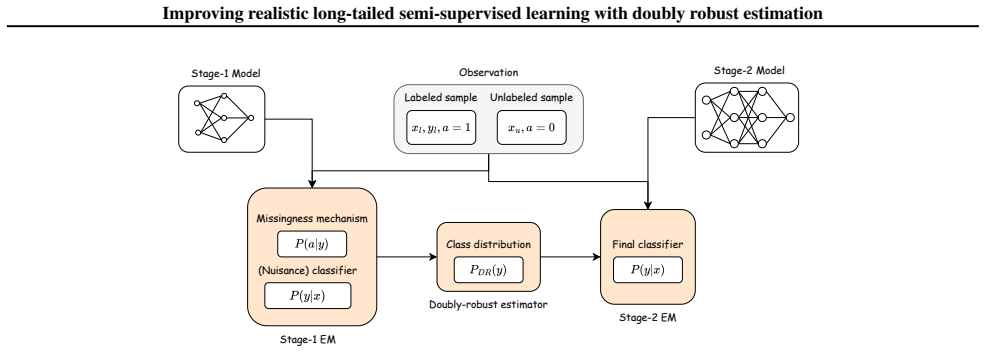
The load-bearing object is the doubly robust estimator of the finite-dimensional parameter $P(Y)$, written as a dataset average of the outcome-regression term plus an inverse-probability-weighted residual, $\frac{1}{N}\sum_i [\hat{P}(Y=c|X_i) + \frac{\mathbf{1}(A_i=1)}{\hat{P}(A_i=1|Y_i)}(\mathbf{1}(Y_i=c) - \hat{P}(Y=c|X_i))]$. Its double robustness makes the first-stage estimate resilient to misspecification of either the classifier or the missingness mechanism, and the efficiency theorem turns the two nuisance errors into a second-order product so that the bias vanishes at an $n^{-1/2}$ rate. The second-stage plug-in is the parameter substitution into logit adjustment and pseudo-labeling within SimPro and BOAT.
What would settle it
Run the two-stage procedure on a controlled dataset where the classifier is deliberately misspecified or the labeled set is so small that the $n^{-1/4}$ rate fails; if the doubly robust estimate's total variation distance to the true unlabeled distribution stops beating the on-the-fly estimates, the practical bite of the efficiency claim is falsified. Alternatively, use cross-fitting and check whether the TV distance and downstream accuracy improve as Theorem 3.2's sample-splitting requirement would predict.
Extended reading notes
Core claim
The central claim is that explicitly estimating the unlabeled class distribution $P(Y|A=0)$ with the doubly robust estimator $\Psi_{\mathrm{dr}}$ yields a better estimate than on-the-fly pseudo-label-based estimates, and that freezing this estimate and plugging it into existing methods improves final classification accuracy. The estimator combines an outcome-regression term (the average model prediction) with an inverse-probability-weighting correction term that up-weights labeled data by the missingness mechanism; it is unbiased if either nuisance function is correct, and Theorem 3.2 asserts it is asymptotically normal with the efficient influence function variance when both converge at an $n^{-1/4}$ rate. Empirically, the plug-in versions SimPro+ and BOAT+ beat their bases in most settings, and the benefit is most pronounced in the consistent and uniform shift settings where SimPro alone overshoots head classes.
Load-bearing premise
The strong guarantee rests on the assumption that both the classifier and the label-selection mechanism converge at an $n^{-1/4}$ rate and are estimated on separate data, but the experiments train them on the same data without splitting.
Editorial extensions
If this is right
- SimPro+ improves accuracy over SimPro in 9 of 10 CIFAR-10 settings, and BOAT+ improves over BOAT in 8 of 10 settings.
- The plug-in gains extend to STL-10 and ImageNet-127, and a small Wide ResNet-28-2 suffices for stage-1 distribution estimation.
- Even when stage-1 estimation is mediocre on CIFAR-100, the plug-in does not degrade accuracy and reaches parity with the baselines in most settings.
- Under the stated assumptions, the unlabeled class distribution estimate is asymptotically efficient, meaning no regular estimator can beat its limiting variance.
- Because only a finite-dimensional parameter is estimated in stage 1, the preliminary step is computationally cheap and decouples from the final classifier size.
Reading between the lines
- A testable extension is to apply the same two-stage plug-in to any pseudo-labeling SSL method that accepts a class-prior argument, such as DASO or CReST+, predicting that their head-class overshoot will drop whenever the DR estimate is better than the online estimate.
- The theory assumes sample splitting, but the experiments train the nuisance functions on the same data without cross-fitting; whether the practical gains persist and whether efficiency holds without the split is an open question the paper leaves implicit.
- Because the estimator targets $P(Y)$ while the test distribution is assumed uniform, the approach could be extended to jointly estimate $P(Y|A=0)$ and adapt to test-time label shift, connecting to calibration-style post-hoc corrections.
- An implication of the efficiency result is that stage-1 could be swapped for any nuisance estimator meeting the $n^{-1/4}$ rate, making the method a general wrapper around label-shift SSL rather than a change specific to SimPro or BOAT.
Editorial analysis
A structured set of objections, weighed in public.
Referee Report
Summary. The paper tackles realistic long-tailed semi-supervised learning (RTSSL), where the unlabeled class distribution P(Y|A=0) is unknown and differs from the labeled distribution. The authors propose a two-stage procedure: stage 1 estimates P(Y|A=0) via an EM algorithm and a 'doubly robust' estimator Ψdr that combines a classifier P(Y|X,θ) and a missingness mechanism P(A|Y,θ); stage 2 plugs this frozen estimate into existing pseudo-labeling methods (SimPro, BOAT). The central theoretical claim, Theorem 3.2 in Section 3.3.1, asserts that Ψdr is asymptotically normal and efficient under n^{-1/4} nuisance convergence. Experiments on CIFAR-10, CIFAR-100, STL-10, and ImageNet-127 report improved class-distribution estimates and improved classification accuracy in most settings.
Significance. The empirical framework is appealing: the connection between RTSSL and non-ignorable missing data is natural, the two-stage plug-in idea is simple and reproducible, and the experimental comparison is broad, including multiple baselines, ablations, and several label-shift configurations. If the theoretical guarantee were valid, the paper would make a useful contribution to semiparametric SSL. However, the central theoretical result is not established, and the estimator does not actually possess the advertised double-robustness property. Since the abstract and Section 3.3 present this theory as a primary contribution, the flaw substantially reduces the significance of the work; the empirical gains alone are modest and would require reframing.
major comments (4)
- [Appendix A, Eq. (20)] The proof of Theorem 3.2 relies on an invalid algebraic step. Under the paper's label-shift assumption A ⟂ X | Y (Eq. 2), the term E[1(A=1)/Pθ(A=1|Y) 1(Y=c)] equals E[P(A=1|Y)/Pθ(A=1|Y) 1(Y=c)] = E[r(Y)/rθ(Y) 1(Y=c)] = r(c)/rθ(c) P(Y=c). The paper instead replaces this with E[P(A=1|Y)/Pθ(A=1|Y) P(Y=c|X)], treating the propensity ratio as if it were a function of X alone. That replacement would require missing-at-random structure (A ⟂ Y | X), not the label-shift assumption. Consequently the product-of-errors bound in Eq. (21) and the claimed o_P(N^{-1/2}) remainder do not follow, and the asymptotic normality and efficiency conclusion of Theorem 3.2 is unsupported.
- [Section 3.3, after Eq. (13)] The estimator Ψdr is not doubly robust under label shift. The text claims that if either P(Y|X) or P(A=1|Y) is correct, Ψdr is unbiased. The second direction fails: if Pθ(Y|X,θ)=P(Y|X) is correct but Pθ(A|Y,θ) is misspecified, then E[Ψdr(c)] = P(Y=c) + E[(P(A=1|Y)/Pθ(A=1|Y))(1(Y=c) - P(Y=c|X))], which is not zero in general. For example, with uninformative X, P(Y=1)=0.5, P(A=1|Y=1)=0.8, and Pθ(A=1|Y=1)=0.2, one obtains E[Ψdr(1)] ≈ 1.59 ≠ 0.5. Only the 'propensity correct' direction is unbiased. This directly contradicts the abstract's claim of a 'strong theoretical guarantee' and the double-robustness statement in Section 3.3.
- [Section 4.1 / Appendix C / Assumption A.1.3] The experiments do not implement the sample splitting required by Assumption A.1.3. The stage-1 Wide ResNet-28-2 nuisances are trained by EM on the same combined dataset used for the sample average in Eq. (13), without cross-fitting or auxiliary samples, and no evidence is provided that the EM-trained estimates achieve the n^{-1/4} L2 rates of Assumption 3.1. Thus, even if Theorem 3.2 were correctly proven, the experiments would not instantiate its conditions, and the claim that a small network suffices for stage 1 is not supported by the stated theory.
- [Appendix A, Eq. (27)] The efficiency argument also contains an error in the tangent-space decomposition. The paper defines T_{A|Y} = {h(A,Y) : E[h|Y]=0} and states that the second term in Eq. (27), namely (1(A=1)/P(A=1|Y)-1)(1(Y=c)-P(Y=c|X)), lies in T_{A|Y}. This term depends on X through P(Y=c|X), so it is not a function of (A,Y) alone and cannot belong to T_{A|Y} as defined. The projection of the X-dependent factor onto functions of Y would be needed, but this is not done. Hence the conclusion that φ is the efficient influence function is not established.
minor comments (4)
- [Section 3.2, Eq. (9)] The logit-adjustment loss in Eq. (9) is written with a '+' between P(Y=c|X,xi,uniform,θ) and P(Y=c), which is not the standard logit adjustment of Menon et al.; the formula appears to be a typesetting error and should be corrected to the usual multiplicative or logit-space form.
- [Section 4.2, text after Table 4] The text says the approach 'does not degrade the accuracy for most settings' on CIFAR-100, but Table 4 shows that SimPro+ is worse than SimPro in 5 of 10 settings and BOAT+ is worse than BOAT in 4 of 10 settings (with 2 ties). The wording should be adjusted to match the table counts.
- [Section 3.3, Eq. (10)] The outcome-regression estimator Ψor averages P(Y=c|X,θ) over both labeled and unlabeled samples, which estimates the combined class distribution P(Y), not directly P(Y|A=0). The text should clarify this intermediate step and how P(Y|A=0) is recovered from the known P(A) and P(Y|A=1).
- [Throughout] There are several typographical and grammatical issues, such as 'as an initial step ,' in the abstract, 'we propose ... to estimate ... as an initial step, using ...' with an awkward comma, and 'shows that we can plug in this estimation' in Section 2. A careful proofreading pass is needed.
Circularity Check
No significant circularity: the DR estimator is a standard semiparametric plug-in evaluated against independent baselines; self-citations are not load-bearing.
full rationale
The paper's derivation chain is self-contained. The target P(Y|A=0) is estimated by a doubly robust combination (Eq. 13) of two nuisance functions P(Y|X,theta) and P(A|Y,theta) that are themselves learned by EM; using the same model's outputs as nuisances is standard semiparametric practice, and the estimator is not defined in terms of the target quantity. The claimed empirical improvement is tested by plugging the frozen estimate into SimPro and BOAT and comparing against the original algorithms on held-out test accuracy (Tables 3-6), so the prediction is not fitted to the outcome it is said to predict. The only self-citations (Pham et al., 2023) appear as contextual references for DR estimation and training instability, not as evidence for the paper's main claims, so they do not form a load-bearing self-citation chain. The identifiability of the label shift model is cited to external work (Miller & Futoma, 2023; Sportisse et al., 2023), and the n^{-1/4} rate assumption is cited to external results (Chernozhukov et al., 2022). A possible issue in the proof of Theorem 3.2 (the conditional expectation step in Eq. 20 assumes a missing-at-random structure rather than the paper's label shift assumption) is a mathematical correctness concern, not a circularity concern, because it does not make any output equal to an input by construction.
Assumptions & free parameters
assumptions (4)
- domain assumption Label shift assumption: P(X|Y,A) = P(X|Y) (Equation 2).
- domain assumption Test class distribution is uniform, P(Y|uniform) = 1/C.
- ad hoc to paper Assumption 3.1: both nuisance estimators converge at op(N^{-1/4}).
- ad hoc to paper Assumption A.1.3: nuisances estimated on auxiliary samples independent of the averaging sample.
Cite this review
Pith. "Pith review of Improving realistic semi-supervised learning with doubly robust estimation." pith.science (2026). https://pith.science/paper/MXMRBQ2Y
@misc{pith2026250200279,
  author       = {Pith},
  title        = {Pith review of: Improving realistic semi-supervised learning with doubly robust estimation},
  year         = {2026},
  howpublished = {\url{https://pith.science/paper/MXMRBQ2Y}},
  note         = {Machine review of arXiv:2502.00279}
}
read the original abstract
A major challenge in Semi-Supervised Learning (SSL) is the limited information available about the class distribution in the unlabeled data. In many real-world applications this arises from the prevalence of long-tailed distributions, where the standard pseudo-label approach to SSL is biased towards the labeled class distribution and thus performs poorly on unlabeled data. Existing methods typically assume that the unlabeled class distribution is either known a priori, which is unrealistic in most situations, or estimate it on-the-fly using the pseudo-labels themselves. We propose to explicitly estimate the unlabeled class distribution, which is a finite-dimensional parameter, \emph{as an initial step}, using a doubly robust estimator with a strong theoretical guarantee; this estimate can then be integrated into existing methods to pseudo-label the unlabeled data during training more accurately. Experimental results demonstrate that incorporating our techniques into common pseudo-labeling approaches improves their performance.
Figures

Reference graph
Works this paper leans on
-
[1]
write newline
" write newline "" before.all 'output.state := FUNCTION n.dashify 't := "" t empty not t #1 #1 substring "-" = t #1 #2 substring "--" = not "--" * t #2 global.max substring 't := t #1 #1 substring "-" = "-" * t #2 global.max substring 't := while if t #1 #1 substring * t #2 global.max substring 't := if while FUNCTION format.date year duplicate empty "emp...
-
[2]
Maximum likelihood with bias-corrected calibration is hard-to-beat at label shift adaptation
Alexandari, A., Kundaje, A., and Shrikumar, A. Maximum likelihood with bias-corrected calibration is hard-to-beat at label shift adaptation. In International Conference on Machine Learning, pp.\ 222--232. PMLR, 2020
work page 2020
-
[3]
Arazo, E., Ortego, D., Albert, P., O’Connor, N. E., and McGuinness, K. Pseudo-labeling and confirmation bias in deep semi-supervised learning. In 2020 International joint conference on neural networks (IJCNN), pp.\ 1--8. IEEE, 2020
work page 2020
-
[4]
Regularized learning for domain adaptation under label shifts
Azizzadenesheli, K., Liu, A., Yang, F., and Anandkumar, A. Regularized learning for domain adaptation under label shifts. arXiv preprint arXiv:1903.09734, 2019
arXiv 1903
-
[5]
D., Kurakin, A., Sohn, K., Zhang, H., and Raffel, C
Berthelot, D., Carlini, N., Cubuk, E. D., Kurakin, A., Sohn, K., Zhang, H., and Raffel, C. Remixmatch: Semi-supervised learning with distribution alignment and augmentation anchoring. arXiv preprint arXiv:1911.09785, 2019 a
arXiv 1911
-
[6]
Berthelot, D., Carlini, N., Goodfellow, I., Papernot, N., Oliver, A., and Raffel, C. A. Mixmatch: A holistic approach to semi-supervised learning. Advances in neural information processing systems, 32, 2019 b
work page 2019
-
[7]
Buda, M., Maki, A., and Mazurowski, M. A. A systematic study of the class imbalance problem in convolutional neural networks. Neural networks, 106: 0 249--259, 2018
work page 2018
-
[8]
Semi-supervised learning (chapelle, o
Chapelle, O., Scholkopf, B., and Zien, A. Semi-supervised learning (chapelle, o. et al., eds.; 2006)[book reviews]. IEEE Transactions on Neural Networks, 20 0 (3): 0 542--542, 2009
work page 2006
Show all 56 references
-
[9]
Double/debiased machine learning for treatment and structural parameters, 2018
Chernozhukov, V., Chetverikov, D., Demirer, M., Duflo, E., Hansen, C., Newey, W., and Robins, J. Double/debiased machine learning for treatment and structural parameters, 2018
2018
-
[10]
M., and Syrgkanis, V
Chernozhukov, V., Newey, W., Quintas-Mart nez, V. M., and Syrgkanis, V. Riesznet and forestriesz: Automatic debiased machine learning with neural nets and random forests. In International Conference on Machine Learning, pp.\ 3901--3914. PMLR, 2022
2022
-
[11]
An analysis of single-layer networks in unsupervised feature learning
Coates, A., Ng, A., and Lee, H. An analysis of single-layer networks in unsupervised feature learning. In Proceedings of the fourteenth international conference on artificial intelligence and statistics, pp.\ 215--223. JMLR Workshop and Conference Proceedings, 2011
2011
-
[12]
Class-balanced loss based on effective number of samples
Cui, Y., Jia, M., Lin, T.-Y., Song, Y., and Belongie, S. Class-balanced loss based on effective number of samples. In Proceedings of the IEEE/CVF conference on computer vision and pattern recognition, pp.\ 9268--9277, 2019
2019
-
[13]
Simpro: A simple probabilistic framework towards realistic long-tailed semi-supervised learning
Du, C., Han, Y., and Huang, G. Simpro: A simple probabilistic framework towards realistic long-tailed semi-supervised learning. arXiv preprint arXiv:2402.13505, 2024
2024 arXiv
-
[14]
Rda: Reciprocal distribution alignment for robust semi-supervised learning
Duan, Y., Qi, L., Wang, L., Zhou, L., and Shi, Y. Rda: Reciprocal distribution alignment for robust semi-supervised learning. In European Conference on Computer Vision, pp.\ 533--549. Springer, 2022
2022
-
[15]
Towards semi-supervised learning with non-random missing labels
Duan, Y., Zhao, Z., Qi, L., Zhou, L., Wang, L., and Shi, Y. Towards semi-supervised learning with non-random missing labels. In Proceedings of the IEEE/CVF International Conference on Computer Vision, pp.\ 16121--16131, 2023
2023
-
[16]
Cossl: Co-learning of representation and classifier for imbalanced semi-supervised learning
Fan, Y., Dai, D., Kukleva, A., and Schiele, B. Cossl: Co-learning of representation and classifier for imbalanced semi-supervised learning. In Proceedings of the IEEE/CVF conference on computer vision and pattern recognition, pp.\ 14574--14584, 2022
2022
-
[17]
Foster, D. J. and Syrgkanis, V. Orthogonal statistical learning. The Annals of Statistics, 51 0 (3): 0 879--908, 2023
2023
-
[18]
Boosting consistency in dual training for long-tailed semi-supervised learning
Gan, K., Wei, T., and Zhang, M.-L. Boosting consistency in dual training for long-tailed semi-supervised learning. arXiv preprint arXiv:2406.13187, 2024
2024 arXiv
-
[19]
A unified view of label shift estimation
Garg, S., Wu, Y., Balakrishnan, S., and Lipton, Z. A unified view of label shift estimation. Advances in Neural Information Processing Systems, 33: 0 3290--3300, 2020
2020
-
[20]
and Bengio, Y
Grandvalet, Y. and Bengio, Y. Semi-supervised learning by entropy minimization. Advances in neural information processing systems, 17, 2004
2004
-
[21]
On non-random missing labels in semi-supervised learning
Hu, X., Niu, Y., Miao, C., Hua, X.-S., and Zhang, H. On non-random missing labels in semi-supervised learning. arXiv preprint arXiv:2206.14923, 2022
2022 arXiv
-
[22]
Ibrahim, J. G. and Lipsitz, S. R. Parameter estimation from incomplete data in binomial regression when the missing data mechanism is nonignorable. Biometrics, pp.\ 1071--1078, 1996
1996
-
[23]
Deepmatch: Balancing deep covariate representations for causal inference using adversarial training
Kallus, N. Deepmatch: Balancing deep covariate representations for causal inference using adversarial training. In International Conference on Machine Learning, pp.\ 5067--5077. PMLR, 2020
2020
-
[24]
Kennedy, E. H. Towards optimal doubly robust estimation of heterogeneous causal effects. Electronic Journal of Statistics, 17 0 (2): 0 3008--3049, 2023
2023
-
[25]
Kennedy, E. H. Semiparametric doubly robust targeted double machine learning: a review. Handbook of Statistical Methods for Precision Medicine, pp.\ 207--236, 2024
2024
-
[26]
J., and Shin, J
Kim, J., Hur, Y., Park, S., Yang, E., Hwang, S. J., and Shin, J. Distribution aligning refinery of pseudo-label for imbalanced semi-supervised learning. Advances in neural information processing systems, 33: 0 14567--14579, 2020
2020
-
[27]
and Hinton, G
Krizhevsky, A. and Hinton, G. Learning multiple layers of features from tiny images. Technical Report 0, University of Toronto, Toronto, Ontario, 2009. URL https://www.cs.toronto.edu/ kriz/learning-features-2009-TR.pdf
2009
-
[28]
and Aila, T
Laine, S. and Aila, T. Temporal ensembling for semi-supervised learning. arXiv preprint arXiv:1610.02242, 2016
2016 arXiv
-
[29]
Lee, D.-H. et al. Pseudo-label: The simple and efficient semi-supervised learning method for deep neural networks. In Workshop on challenges in representation learning, ICML, volume 3, pp.\ 896. Atlanta, 2013
2013
-
[30]
Abc: Auxiliary balanced classifier for class-imbalanced semi-supervised learning
Lee, H., Shin, S., and Kim, H. Abc: Auxiliary balanced classifier for class-imbalanced semi-supervised learning. Advances in Neural Information Processing Systems, 34: 0 7082--7094, 2021
2021
-
[31]
Detecting and correcting for label shift with black box predictors
Lipton, Z., Wang, Y.-X., and Smola, A. Detecting and correcting for label shift with black box predictors. In International conference on machine learning, pp.\ 3122--3130. PMLR, 2018
2018
-
[32]
Three heads are better than one: Complementary experts for long-tailed semi-supervised learning
Ma, C., Elezi, I., Deng, J., Dong, W., and Xu, C. Three heads are better than one: Complementary experts for long-tailed semi-supervised learning. In Proceedings of the AAAI Conference on Artificial Intelligence, volume 38, pp.\ 14229--14237, 2024
2024
-
[33]
K., Jayasumana, S., Rawat, A
Menon, A. K., Jayasumana, S., Rawat, A. S., Jain, H., Veit, A., and Kumar, S. Long-tail learning via logit adjustment. arXiv preprint arXiv:2007.07314, 2020
2007 arXiv
-
[34]
Miller, A. C. and Futoma, J. Label shift estimators for non-ignorable missing data. arXiv preprint arXiv:2310.18261, 2023
2023 arXiv
-
[35]
Neal, R. M. and Hinton, G. E. A view of the em algorithm that justifies incremental, sparse, and other variants. In Learning in graphical models, pp.\ 355--368. Springer, 1998
1998
-
[36]
Q., Kim, H., and Sabuncu, M
Nguyen, M., Wang, A. Q., Kim, H., and Sabuncu, M. R. Adapting to shifting correlations with unlabeled data calibration. arXiv preprint arXiv:2409.05996, 2024
2024 arXiv
-
[37]
Oh, Y., Kim, D.-J., and Kweon, I. S. DASO : Distribution-aware semantics-oriented pseudo-label for imbalanced semi-supervised learning. In Proceedings of the IEEE/CVF conference on computer vision and pattern recognition, pp.\ 9786--9796, 2022
2022
-
[38]
A., Huynh-Pham, P.-M., Santacatterina, M., Lim, S.-N., and Zabih, R
Pham, K., Hirshberg, D. A., Huynh-Pham, P.-M., Santacatterina, M., Lim, S.-N., and Zabih, R. Stable estimation of survival causal effects. arXiv preprint arXiv:2310.02278, 2023
2023 arXiv
-
[39]
Balanced meta-softmax for long-tailed visual recognition
Ren, J., Yu, C., Ma, X., Zhao, H., Yi, S., et al. Balanced meta-softmax for long-tailed visual recognition. Advances in neural information processing systems, 33: 0 4175--4186, 2020
2020
-
[40]
Rubin, D. B. Inference and missing data. Biometrika, 63 0 (3): 0 581--592, 1976
1976
-
[41]
Adjusting the outputs of a classifier to new a priori probabilities: a simple procedure
Saerens, M., Latinne, P., and Decaestecker, C. Adjusting the outputs of a classifier to new a priori probabilities: a simple procedure. Neural computation, 14 0 (1): 0 21--41, 2002
2002
-
[42]
Don't fear the unlabelled: safe semi-supervised learning via simple debiasing
Schmutz, H., Humbert, O., and Mattei, P.-A. Don't fear the unlabelled: safe semi-supervised learning via simple debiasing. arXiv preprint arXiv:2203.07512, 2022
2022 arXiv
-
[43]
Adapting neural networks for the estimation of treatment effects
Shi, C., Blei, D., and Veitch, V. Adapting neural networks for the estimation of treatment effects. Advances in neural information processing systems, 32, 2019
2019
-
[44]
A., Cubuk, E
Sohn, K., Berthelot, D., Carlini, N., Zhang, Z., Zhang, H., Raffel, C. A., Cubuk, E. D., Kurakin, A., and Li, C.-L. Fixmatch: Simplifying semi-supervised learning with consistency and confidence. Advances in neural information processing systems, 33: 0 596--608, 2020
2020
-
[45]
Are labels informative in semi-supervised learning? estimating and leveraging the missing-data mechanism
Sportisse, A., Schmutz, H., Humbert, O., Bouveyron, C., and Mattei, P.-A. Are labels informative in semi-supervised learning? estimating and leveraging the missing-data mechanism. In International Conference on Machine Learning, pp.\ 32521--32539. PMLR, 2023
2023
-
[46]
P., Ebrahimi, S., and D'Amour, A
Sun, Q., Murphy, K. P., Ebrahimi, S., and D'Amour, A. Beyond invariance: test-time label-shift adaptation for addressing ``spurious''' correlations. Advances in Neural Information Processing Systems, 36: 0 23789--23812, 2023
2023
-
[47]
Tsiatis, A. A. Semiparametric theory and missing data, volume 4. Springer, 2006
2006
-
[48]
Van der Vaart, A. W. Asymptotic statistics, volume 3. Cambridge university press, 2000
2000
-
[49]
and Athey, S
Wager, S. and Athey, S. Estimation and inference of heterogeneous treatment effects using random forests. Journal of the American Statistical Association, 113 0 (523): 0 1228--1242, 2018
2018
-
[50]
Crest: A class-rebalancing self-training framework for imbalanced semi-supervised learning
Wei, C., Sohn, K., Mellina, C., Yuille, A., and Yang, F. Crest: A class-rebalancing self-training framework for imbalanced semi-supervised learning. In Proceedings of the IEEE/CVF conference on computer vision and pattern recognition, pp.\ 10857--10866, 2021
2021
-
[51]
and Gan, K
Wei, T. and Gan, K. Towards realistic long-tailed semi-supervised learning: Consistency is all you need. In Proceedings of the IEEE/CVF Conference on Computer Vision and Pattern Recognition, pp.\ 3469--3478, 2023
2023
-
[52]
Learning label shift correction for test-agnostic long-tailed recognition
Wei, T., Mao, Z., Zhou, Z.-H., Wan, Y., and Zhang, M.-L. Learning label shift correction for test-agnostic long-tailed recognition. In Forty-first International Conference on Machine Learning, 2024
2024
-
[53]
Xie, Q., Luong, M.-T., Hovy, E., and Le, Q. V. Self-training with noisy student improves imagenet classification. In Proceedings of the IEEE/CVF conference on computer vision and pattern recognition, pp.\ 10687--10698, 2020
2020
-
[54]
Towards causal foundation model: on duality between causal inference and attention
Zhang, J., Jennings, J., Hilmkil, A., Pawlowski, N., Zhang, C., and Ma, C. Towards causal foundation model: on duality between causal inference and attention. arXiv preprint arXiv:2310.00809, 2023
2023 arXiv
-
[55]
Dc-ssl: Addressing mismatched class distribution in semi-supervised learning
Zhao, Z., Zhou, L., Duan, Y., Wang, L., Qi, L., and Shi, Y. Dc-ssl: Addressing mismatched class distribution in semi-supervised learning. In Proceedings of the IEEE/CVF conference on computer vision and pattern recognition, pp.\ 9757--9765, 2022
2022
-
[56]
Doubly-robust self-training
Zhu, B., Ding, M., Jacobson, P., Wu, M., Zhan, W., Jordan, M., and Jiao, J. Doubly-robust self-training. Advances in Neural Information Processing Systems, 36, 2024
2024
Reviewed August 9, 2026 · model on record in the stance chip above.
Discussion (0). Continue with ORCID to comment.