REVIEW 4 major objections 5 minor 33 references
Freezing the speckles: focal plane wavefront sensing with the spatially-clipped self-coherent camera
T0 review · 4 major / 5 minor · reviewed 2026-08-14 · deepseek-v4-flash
Pith's one-line read A single-exposure wavefront sensor digs the first lab dark hole, cutting speckle intensity twofold.
desk verdict A genuinely honest lab demo of an incremental SCC variant, with a real but partial dark hole; the bandwidth and speed claims outrun the measurements. read the letter →
The pith
A machine-rendered reading of the paper's core claim, the machinery that carries it, and where it could break.
The reading
What carries the argument
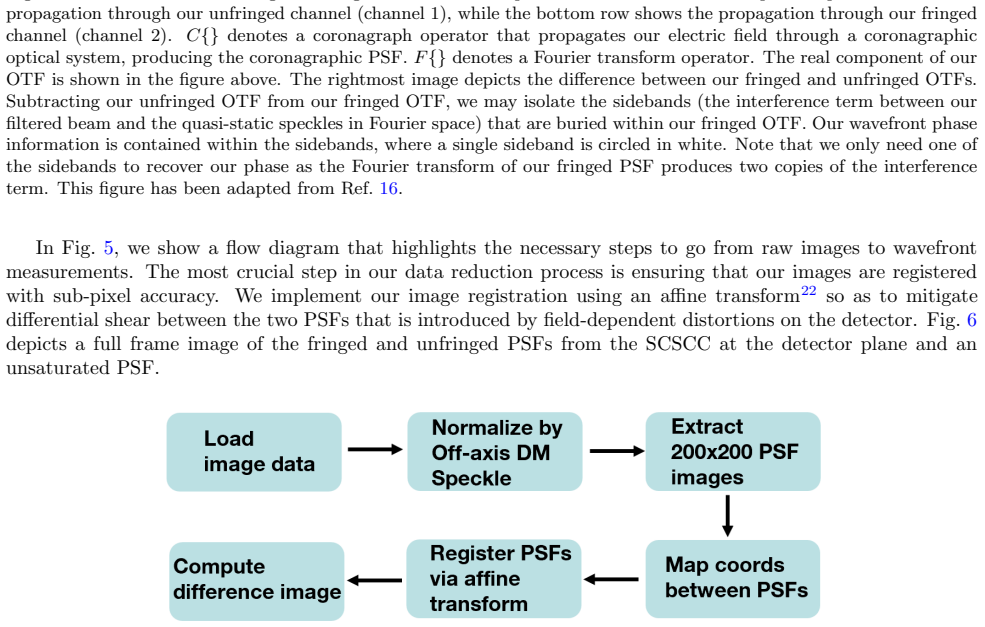
The carrying mechanism is the SCSCC optic: a pupil stop with a 71\,$\mu$m pinhole placed 2\,mm (0.53 pupil diameters) from the stop edge, followed by a Wollaston prism (a polarizing beam splitter) that creates two channels. In one channel a knife edge blocks the pinhole's reference beam, giving an unfringed point spread function; in the other the reference interferes with the speckles, giving a fringed point spread function. A single exposure records both, and subtracting the registered PSFs yields a difference image $\Delta I$ whose linear response to deformable-mirror modes is calibrated into an interaction matrix $H$; the DM command solves $\mathbf{a} = \arg\min_{\mathbf{a}} |\Delta I + H\mathbf{a}|^2 + \lambda \|\mathbf{a}\|^2$. The phase information can equivalently be recovered from one sideband of the difference optical transfer function.
What would settle it
Run the SCSCC loop and a pairwise-probing loop back to back on the same static speckle field: if the SCSCC-recovered electric field does not predict the change produced by a known deformable-mirror poke, or if pairwise probing digs a deeper dark hole under identical conditions, the single-exposure sensing claim is undermined.
Extended reading notes
Core claim
The paper claims that the SCSCC, which forms a reference beam with a pinhole placed close to the Lyot stop and then splits the light into fringed and unfringed channels, measures the complex electric field in the science focal plane from a single exposure. Combined with implicit electric field conjugation (iEFC), this measurement closes a wavefront control loop that digs a dark hole: in a $5\text{--}10\,\lambda/D$ measurement region the mean normalized intensity dropped from $1\times10^{-3}$ to $5\times10^{-4}$, about a factor of two, after ten iterations. The paper also claims that the SCSCC inherits the classical self-coherent camera's single-shot advantage while increasing spectral bandwidth by a factor of three and reducing the beam footprint, at the cost of a registration-sensitive data reduction.
Load-bearing premise
The load-bearing premise is that the fringed and unfringed images can be aligned with one fixed sub-pixel coordinate map, even though the speckle field changes with every deformable-mirror mode; the paper states this registration inconsistency is why part of the control region is poorly sensed.
Editorial extensions
If this is right
- Focal-plane wavefront control can run on single-exposure measurements, so speckle suppression loops can operate about four times faster than pairwise-probing schemes that require at least four images.
- The SCSCC's wider spectral bandwidth and reduced beam footprint remove two practical barriers that have kept the classical self-coherent camera mostly in the lab, making the sensor viable for real telescopes and space missions.
- The factor-of-two contrast improvement is a floor set by registration errors: the paper attributes the partially sensed dark hole to the fixed-image-structure assumption, so better registration should make the full control region respond uniformly.
- Because the interaction matrix is calibrated empirically, the control loop does not depend on a precise end-to-end optical model of the coronagraph, an advantage for on-sky operation where models diverge from reality.
Reading between the lines
- If the central claim holds, the same single-exposure difference image could feed other controllers, such as electric field conjugation, without any additional exposures; the paper only demonstrates iEFC.
- The paper's stated registration failure points to a concrete fix it does not test: fitting a mode-dependent or iteratively refined coordinate transform should recover the poorly sensed left half of the control region and deepen the dark hole.
- A factor-of-three spectral bandwidth gain and a smaller pupil footprint suggest the SCSCC geometry could transfer to segmented-aperture observatories, where oversized reference optics are impractical; this is an extrapolation rather than a tested result.
- Since the sensor records time-varying speckles in one frame, pairing it with predictive control could suppress speckles evolving faster than the current loop cadence; the paper demonstrates static suppression only.
Signed reviews
Editorial analysis
A structured set of objections, weighed in public.
Referee Report
Summary. The paper describes the Spatially-Clipped Self-Coherent Camera (SCSCC), a variant of the self-coherent camera that uses a pinhole near the Lyot stop, a Wollaston prism and knife edge to create fringed and unfringed channels on a single detector, and an empirically calibrated interaction matrix for focal-plane wavefront sensing and control. On the CACTI testbed with a 633 nm laser, the authors calibrate 360 Fourier modes and run 10 iterations of implicit electric field conjugation (iEFC), reporting a factor-of-two reduction in mean normalized intensity in a 5-10 lambda/D measurement region. They claim the first lab dark hole with SCSCC+iEFC and state that time-varying speckles can be removed with single-exposure sensing. The central evidence is an experimental demonstration, but the reported reduction is measured in a post hoc subset of the specified control region and is not supported by uncertainty estimates or by a validation of the registration assumptions used to build the interaction matrix.
Significance. If the demonstration is robust, the result is significant: it would be the first laboratory dark hole with SCSCC+iEFC, supporting a single-exposure focal-plane wavefront sensing approach that could in principle speed up speckle control relative to pairwise probing. The paper has real strengths: the common-path Wollaston prism design is a sensible way to split fringed and unfringed channels while limiting differential aberrations; the data-reduction pipeline is described in enough detail to be reproducible; and the empirical interaction-matrix calibration is a direct measurement rather than a derivation from the target result, so the circularity concern is low. However, the headline claims of dark-hole control, spectral bandwidth gain, and time-varying speckle mitigation are not all supported by the presented measurements, and the main contrast result is evaluated in a region chosen after seeing the outcome.
major comments (4)
- [Section 3, Fig. 10] The central claim rests on a post hoc reduction of the measurement region. The paper defines a control region of 2-10 lambda/D with width 20 lambda/D, but the contrast curve in Fig. 10 and the abstract/conclusion claim a factor-of-two reduction only in a 5-10 lambda/D region of width 8 lambda/D, explicitly because the left half of the specified control region is poorly sensed. Because the metric is evaluated after inspecting the results, the reported reduction is vulnerable to selection bias and does not demonstrate control over the specified dark hole. Please report the mean intensity over the full specified control region, show before/after spatial maps of that region, and provide run-to-run uncertainties or error bars for the contrast curve.
- [Section 2.2 and Eq. (1)] The interaction matrix H is calibrated from difference images, each acquired with a different Fourier mode applied to the DM, yet the affine registration between the channel 1 and channel 2 PSFs assumes a fixed image structure. The paper itself states that the speckle field varies with every applied Fourier mode, causing registration inconsistencies between calibration frames. Any mode-dependent registration error therefore enters H as a systematic term that is not the focal-plane electric field, and the paper attributes the poorly sensed left half of the control region to exactly this effect. The dark-hole claim requires either a quantification of registration residuals across the calibration frames or a cross-validation showing that the measured intensity reduction is insensitive to the registration procedure (for example, by repeating the calibration with different reference speckle sets). Without this, the factor-of-two reduction cannot be unambiguously attributed to SCSCC sensing of the focal-plane field.
- [Abstract and Section 2.1] The abstract claims that the SCSCC boosts the sensor's spectral bandwidth by a factor of 3, but no spectral bandwidth measurement or simulation is presented anywhere in the paper. The experimental data are monochromatic (He-Ne, 633 nm), so this claimed advantage is unverified. The claim should either be removed from the abstract or supported by a dedicated measurement or by the simulation reference (Ref. 18) presented in a quantitative way.
- [Abstract and Section 4] The paper motivates the SCSCC by its ability to freeze time-varying speckles with a single exposure, but no time-varying speckle test is reported. The experiment consists of 10 iterations of wavefront control on static laboratory speckles; there is no measurement of how the sensor and control loop respond when the speckle field changes in time. Please either add a time-varying demonstration or temper the claims about temporal speckle removal so that they are presented as anticipated rather than demonstrated behavior.
minor comments (5)
- [Abstract] The abstract gives the dark-hole region as 5-11 lambda/D while Section 3 and Fig. 10 give 5-10 lambda/D; the inconsistency should be corrected.
- [Abstract] The phrase 'boosting the sensor's spectral bandwidth by factors of 3, respectively' is ambiguous because two quantities are mentioned (beam footprint and bandwidth) with one 'respectively'; please clarify which quantity changes by which factor.
- [Section 2.2] The text calls the procedure a 'point-to-point coordinate mapping,' but the actual method is a seven-point affine transform; using that terminology consistently would be clearer.
- [Section 3, Fig. 10] The contrast curve would be more informative with error bars or at least a statement of the number of independent measurements per iteration; currently the reader cannot judge the significance of the 2x reduction.
- [Section 3, Fig. 9] The normalized-intensity scale and the exact definition of 'off-axis DM speckle' used for normalization are described in the caption, but the spatial extent of the 2-10 lambda/D control region versus the 5-10 lambda/D measurement region is not marked in the figure; adding both outlines would make the post hoc selection clear to the reader.
Circularity Check
No significant circularity: the SCSCC+iEFC dark hole is an experimental measurement, not a derivation from the cited formalism.
full rationale
The paper's central claims are laboratory results: the first SCSCC+iEFC dark hole on the CACTI testbed and a roughly 2x reduction in speckle intensity over a 5-10 lambda/D region. The SCSCC sensing concept and initial simulations are attributed to the authors' prior work (Ref. 18), which is a self-citation, but the present demonstration does not derive the dark-hole claim from that formalism as a 'prediction'. The interaction matrix H in Eq. (1) is empirically calibrated from measured difference images for each Fourier mode, and the contrast curve in Fig. 10 is an independent post-control measurement of the channel 1 PSF after physically applying DM commands. No parameter is fitted to the target 2x contrast; the measurement region was reduced after seeing which speckles were poorly sensed, which weakens the demonstration but does not create a definitional equivalence. The registration instability is explicitly acknowledged and affects half the control region, but this is a stated limitation rather than a circular reduction. No equation reduces to its own input by construction, and no fitted parameter is renamed as a prediction. The self-citation to Ref. 18 provides provenance for the wavefront-sensing concept, not a load-bearing uniqueness theorem or a forbidden alternative. Therefore no significant circularity is present; the score of 1 reflects only the minor self-citation for the sensing formalism.
Assumptions & free parameters
free parameters (4)
- Tikhonov regularization coefficient lambda =
Not specified
- Calibration mode amplitude =
0.01 waves
- Number of Fourier modes in control basis =
360
- Pinhole diameter and pupil-to-pinhole separation =
71 micrometers diameter, 0.53 D_EP separation
assumptions (4)
- standard math Fourier optics propagation: the OTF is the Fourier transform of the PSF, and the coronagraph can be represented by a linear operator acting on the electric field.
- domain assumption The SCSCC formalism from Ref. 18: the pinhole-filtered reference beam interferes with speckles, and the imaginary part of the inverse Fourier transform of an isolated sideband contains the wavefront phase.
- domain assumption Affine registration with seven common speckle features sufficiently corrects field-dependent distortion between channels 1 and 2.
- domain assumption The Wollaston prism introduces negligible differential aberrations between the two channels beyond the polarization residuals noted.
Cite this review
Pith. "Pith review of Freezing the speckles: focal plane wavefront sensing with the spatially-clipped self-coherent camera." pith.science (2026). https://pith.science/paper/MXRVZ5XZ
@misc{pith2026260810151,
  author       = {Pith},
  title        = {Pith review of: Freezing the speckles: focal plane wavefront sensing with the spatially-clipped self-coherent camera},
  year         = {2026},
  howpublished = {\url{https://pith.science/paper/MXRVZ5XZ}},
  note         = {Machine review of arXiv:2608.10151}
}
read the original abstract
The next generation of Extremely Large Telescopes (ELTs) and the Habitable Worlds Observatory (HWO) require active speckle suppression to directly image exo-Earths. Focal plane wavefront sensing and control allows us to detect and remove time-varying speckles through measurements of the electric field. Wavefront sensing approaches include pairwise probing (PWP) and the self-coherent camera (SCC). However, the PWP technique is time-consuming, requiring at least 4 images and reducing the speed at which aberrations can be eliminated. The classical SCC modifies a standard coronagraph design, creating a reference electric field that interferes with speckles in the final focal plane, forming Fizeau fringes. However, this design only works over small spectral bandwidths and requires significantly oversized optics, limiting its effectiveness. We demonstrate a new SCC variant, the Spatially-Clipped SCC (SCSCC). The SCSCC utilizes a pinhole placed close to the Lyot stop, reducing the overall beam footprint and boosting the sensor's spectral bandwidth by factors of 3, respectively. A beamsplitter and knife edge downstream of the Lyot stop splits the light into 2 channels: fringed and unfringed, enabling wavefront sensing with a single exposure. Time-varying speckles are frozen in place, making them easy to remove. We present the SCSCC optical design combined with the photon resolving Hamamatsu Orca-Quest 2 camera. Furthermore, we demonstrate high speed wavefront control with the SCSCC, minimizing speckle intensity by 2x within a 5-11 lambda/D dark hole region on the Comprehensive Adaptive Optics and Coronagraph Test Instrument (CACTI) at the University of Arizona. These lab tests are in preparation for an on-sky demonstration of the SCSCC with the MagAO-X instrument. Our results make the SCSCC a valuable wavefront sensor for upcoming missions, including the Giant Magellan Telescope and HWO.
Figures


Figures from the paper (7 more)



Reference graph
Works this paper leans on
-
[1]
The luvoir extreme coronagraph for living planetary systems (eclips) i: searching and characterizing exoplanetary gems,
Pueyo, L., Stark, C., Juanola-Parramon, R., Zimmerman, N., Bolcar, M., Roberge, A., Arney, G., Ruane, G., Riggs, A. J. E., Belikov, R., Sirbu, D., Redding, D., Soummer, R., Laginja, I., and Will, S., “The luvoir extreme coronagraph for living planetary systems (eclips) i: searching and characterizing exoplanetary gems,” 3 (09 2019)
2019
-
[2]
High-Contrast Coronagraphy,
Kenworthy, M. A. and Haffert, S. Y., “High-Contrast Coronagraphy,” (May 2025). Publisher: Annual Reviews
2025
-
[3]
Direct Imaging and Spectroscopy of Extrasolar Planets,
Currie, T., Biller, B., Lagrange, A., Marois, C., Guyon, O., Nielsen, E. L., Bonnefoy, M., and De Rosa, R. J., “Direct Imaging and Spectroscopy of Extrasolar Planets,” in [Protostars and Planets VII], Inutsuka, S., Aikawa, Y., Muto, T., Tomida, K., and Tamura, M., eds.,Astronomical Society of the Pacific Conference Series534, 799 (July 2023)
2023
-
[4]
Coyle, L. E., “Enabling the Habitable Worlds Observatory: using systems engineering, integrated modeling and technology development to achieve ultra-stable optical systems,” in [Astronomical Optics: Design, Manufacture, and Test of Space and Ground Systems IV], Hull, T. B., Kim, D., and Hallibert, P., eds., PC12677, PC1267702, SPIE (2023). Backup Publishe...
work page 2023
-
[5]
Steiger, S., Chen, P., and Pueyo, L. A., “Incorporating wavefront error, wavefront sensing and control, and sensitivities into exposure time calculations for future space missions with the error budget software,” 12(4), 041005
-
[6]
Give’on, A., Kern, B. D., and Shaklan, S., “Pair-wise, deformable mirror, image plane-based diversity electric field estimation for high contrast coronagraphy,” in [Techniques and Instrumentation for Detection of Exoplanets V],8151, 376–385, SPIE (Sept. 2011)
work page 2011
-
[7]
Methods and limitations of focal plane sensing, estimation, and control in high-contrast imaging,
Groff, T. D., Riggs, A. J. E., Kern, B., and Kasdin, N. J., “Methods and limitations of focal plane sensing, estimation, and control in high-contrast imaging,”Journal of Astronomical Telescopes, Instruments, and Systems2, 011009 (Dec. 2015). Publisher: SPIE
work page 2015
-
[8]
Cady, E., Bowman, N., Greenbaum, A., Ingalls, J., Kern, B., Krist, J., Marx, D., Poberezhskiy, I., Riggs, A., Ruane, G., Seo, B.-J., Shi, F., and Zhou, H., “High-order wavefront sensing and control for the Ro- man Coronagraph Instrument (CGI): architecture and measured performance,”Journal of Astronomical Telescopes, Instruments, and Systems11(Apr. 2025)
work page 2025
Show all 33 references
-
[9]
Implicit electric field Conjugation: Data-driven focal plane control,
Haffert, S. Y., Males, J. R., Ahn, K., Van Gorkom, K., Guyon, O., Close, L. M., Long, J. D., Hedglen, A. D., Schatz, L., Kautz, M., Lumbres, J., Rodack, A., Knight, J. M., and Miller, K., “Implicit electric field Conjugation: Data-driven focal plane control,” (Mar. 2023). arXi...
2023 arXiv
-
[10]
On-sky speckle nulling through a single-mode fiber with the keck planet imager and characterizer,
Xin, Y., Xuan, J. W., Mawet, D., Wang, J., Ruane, G., Echeverri, D., Jovanovic, N.,´O, C. D., Fitzgerald, M., Horstman, K., Hsu, C.-C., Liberman, J., L´ opez, R. A., Phillips, C. L., Ren, B. B., Ruffio, J.-B., and Sappey, B., “On-sky speckle nulling through a single-mode fiber...
-
[11]
Comparative laboratory study of electric field conjugation algorithms,
Desai, N., Potier, A., Redmond, S. F., Ruane, G., Poon, P. K., Riggs, A. J. E., Noyes, M., and Prada, C. M., “Comparative laboratory study of electric field conjugation algorithms,”Journal of Astronomical Telescopes, Instruments, and Systems10(July 2024). arXiv:2309.04920 [astro-ph]
2024 arXiv
-
[12]
The Self-Coherent Camera: a new tool for planet detection,
Baudoz, P., Boccaletti, A., Baudrand, J., and Rouan, D., “The Self-Coherent Camera: a new tool for planet detection,” in [IAU Colloq. 200: Direct Imaging of Exoplanets: Science & Techniques], Aime, C. and Vakili, F., eds., 553–558 (Jan. 2006)
2006
-
[13]
Hardware demonstra- tions of component-level technologies for ultra-stable optical systems,
Coyle, L., Knight, J. S., Hicks, B., Frater, E., Ho, J., Shugrue, J., and Jurczyk, S., “Hardware demonstra- tions of component-level technologies for ultra-stable optical systems,” in [2021 IEEE Aerospace Conference (50100)], 1–11 (Mar. 2021). ISSN: 1095-323X
2021
-
[14]
Minimization of non-common path aberrations at the palomar telescope using a self-coherent camera,
Galicher, R., Baudoz, P., Delorme, J.-R., Mawet, D., Bottom, M., Wallace, J. K., Serabyn, E., and Shelton, C., “Minimization of non-common path aberrations at the palomar telescope using a self-coherent camera,” 631, A143. Publisher: EDP Sciences
-
[15]
The polarization-encoded self-coherent camera,
Bos, S. P., “The polarization-encoded self-coherent camera,”Astronomy & Astrophysics646, A177 (Feb. 2021). Publisher: EDP Sciences
2021
-
[16]
Fast-modulation imaging with the self-coherent camera,
Martinez, P., “Fast-modulation imaging with the self-coherent camera,”Astronomy & Astrophysics629, L10 (Sept. 2019). Publisher: EDP Sciences
2019
-
[17]
The spectrally modulated self-coherent camera (SM-SCC): Increasing throughput for focal- plane wavefront sensing,
Haffert, S. Y., “The spectrally modulated self-coherent camera (SM-SCC): Increasing throughput for focal- plane wavefront sensing,”Astronomy & Astrophysics659, A51 (Mar. 2022). Publisher: EDP Sciences
2022
-
[18]
Single-shot focal plane wavefront sensing with the spatially-clipped self-coherent camera,
Liberman, J., Haffert, S. Y., Males, J. R., Derby, K., and Douglas, E. S., “Single-shot focal plane wavefront sensing with the spatially-clipped self-coherent camera,” in [Techniques and Instrumentation for Detection of Exoplanets XII], Ruane, G. J. and Millar-Blanchaer, M. A....
-
[19]
Vector vortex coronagraphy for exoplanet detection with spatially variant diffractive waveplates,
Serabyn, E., Prada, C. M., Chen, P., and Mawet, D., “Vector vortex coronagraphy for exoplanet detection with spatially variant diffractive waveplates,”36(5), D13–D19
-
[20]
Experimental demonstration of a three-sided pyramid wavefront sensor on the CACTI testbed,
Schatz, L. H., Codona, J., Long, J. D., Males, J. R., Pullen, W., Gorkom, K. V., Chambouleyron, V., Close, L. M., Correia, C., Fauvarque, O., Fusco, T., Guyon, O., Hart, M., Janin-Potiron, P., Johnson, R., Jovanovic, N., Lumbres, J. R., Mateen, M., Sauvage, J.-F., and Neichel,...
2022
-
[21]
Performance of the Fast Atmospheric Self Coherent camera at the NEW-EARTH lab and a simplified measurement algorithm,
Thompson, W., Marois, C., Singh, G., Lardi` ere, O., Gerard, B., Fu, Q., and Heidrich, W., “Performance of the Fast Atmospheric Self Coherent camera at the NEW-EARTH lab and a simplified measurement algorithm,” in [Adaptive Optics Systems VIII],12185, 724–735, SPIE (Aug. 2022)
2022
-
[22]
Hartley, R. I. and Zisserman, A., [Multiple View Geometry in Computer Vision], Cambridge University Press, ISBN: 0521540518, second ed. (2004)
2004
-
[23]
On-sky, real-time optical gain calibration on MagAO-x using incoherent speckles,
McEwen, E. A., Males, J. R., Guyon, O., Haffert, S. Y., Long, J. D., Close, L. M., Gorkom, K. V., Lumbres, J., Hedglen, A. D., Schatz, L., Kautz, M. Y., Pearce, L. A., Kueny, J., McLeod, A. L., Foster, W. B., Li, J., Roberts, R., and Weinberger, A. J., “On-sky, real-time optic...
-
[24]
L., Dillon, D., Cetre, S., Jensen-Clem, R., Yuzvinsky, T
Gerard, B. L., Dillon, D., Cetre, S., Jensen-Clem, R., Yuzvinsky, T. D., and Schmidt, H., “First experimental results of the fast atmospheric self-coherent camera technique on the santa cruz extreme adaptive optics laboratory testbed: demonstration of high speed focal plane wa...
-
[25]
Closed-loop atmospheric dispersion correction for high-contrast imaging with MagAO-X,
Twitchell, K. M. et al., “Closed-loop atmospheric dispersion correction for high-contrast imaging with MagAO-X,” in [Adaptive Optics Systems X],Proc. SPIE, to appear (2026)
2026
-
[26]
The OpenCV Library,
Bradski, G., “The OpenCV Library,”Dr. Dobb’s Journal of Software Tools(2000)
2000
-
[27]
Characterizing deformable mirrors for the MagAO-x instrument,
Van Gorkom, K., Males, J. R., Close, L. M., Lumbres, J., Hedglen, A., Long, J. D., Haffert, S. Y., Guyon, O., Kautz, M., Schatz, L., Miller, K., Rodack, A. T., Knight, J. M., and Morzinski, K. M., “Characterizing deformable mirrors for the MagAO-x instrument,”7, 039001. ADS Bi...
-
[28]
MagAO-x phase II upgrades: implementation and first on-sky results of a new post-AO 1000 actuator deformable mirror,
Kueny, J. K., Gorkom, K. V., Kautz, M., Haffert, S., Males, J. R., Hedglen, A., Close, L., McEwen, E., Li, J., Long, J. D., Foster, W., Pearce, L., McLeod, A., Lumbres, J., Schatz, L., Guyon, O., and Liberman, J., “MagAO-x phase II upgrades: implementation and first on-sky res...
-
[29]
MagAO-x: commissioning results and status of ongoing upgrades,
Males, J. R., Close, L. M., Haffert, S. Y., Kautz, M. Y., Kueny, J., Long, J. D., McEwen, E., Swimmer, N., Iii, J. I. B., Foster, W., Mazin, B. A., Pearce, L., Liberman, J., Twitchell, K., Weinberger, A. J., Guyon, O., Hedglen, A. D., McLeod, A., Roberts, R., Gorkom, K. V., Li...
-
[30]
High Contrast Imaging for Python (HCIPy): an open-source adaptive optics and coronagraph simulator,
Por, E. H., Haffert, S. Y., Radhakrishnan, V. M., Doelman, D. S., van Kooten, M., and Bos, S. P., “High Contrast Imaging for Python (HCIPy): an open-source adaptive optics and coronagraph simulator,” in [Adaptive Optics Systems VI], Close, L. M., Schreiber, L., and Schmidt, D....
2018
-
[31]
Astropy: A community Python package for astronomy,
Astropy Collaboration, Robitaille, T. P., Tollerud, E. J., Greenfield, P., Droettboom, M., Bray, E., Aldcroft, T., Davis, M., Ginsburg, A., Price-Whelan, A. M., Kerzendorf, W. E., Conley, A., Crighton, N., Barbary, K., Muna, D., Ferguson, H., Grollier, F., Parikh, M. M., Nair,...
2013
-
[32]
Matplotlib: A 2d graphics environment,
Hunter, J. D., “Matplotlib: A 2d graphics environment,”Computing in Science & Engineering9(3), 90–95 (2007)
2007
-
[33]
Ipython: A system for interactive scientific computing,
Perez, F. and Granger, B. E., “Ipython: A system for interactive scientific computing,”Computing in Science and Engineering9(3), 21–29 (2007)
2007
Reviewed August 14, 2026 · model on record in the stance chip above.
Discussion (0). Continue with ORCID to comment.