Introduction to matrix-product states and tensor networks
Pith reviewed 2026-06-25 22:06 UTC · model grok-4.3
The pith
Matrix-product states represent low-entanglement quantum many-body systems efficiently using tensors with virtual indices.
A machine-rendered reading of the paper's core claim, the machinery that carries it, and where it could break.
Core claim
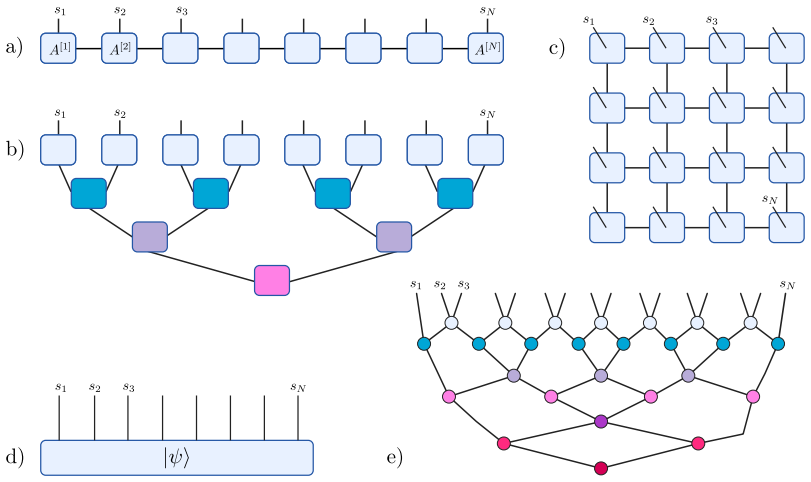
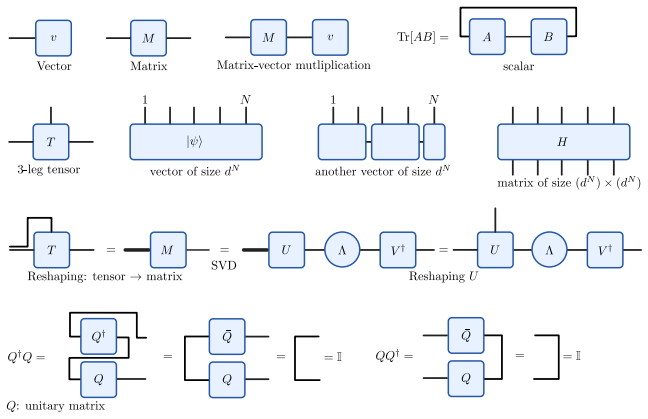
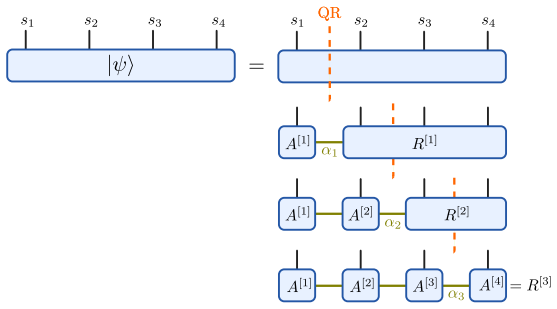
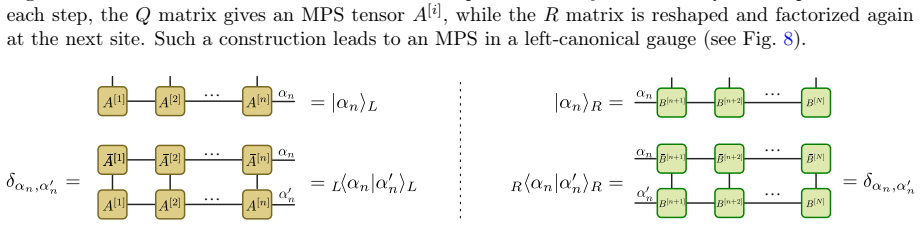
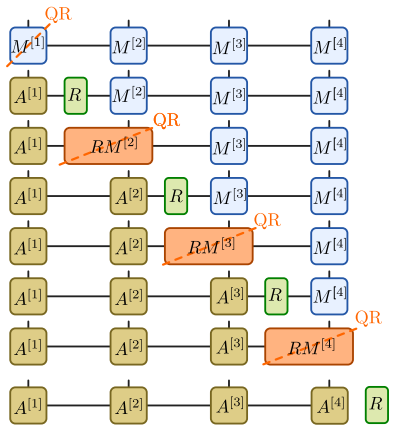
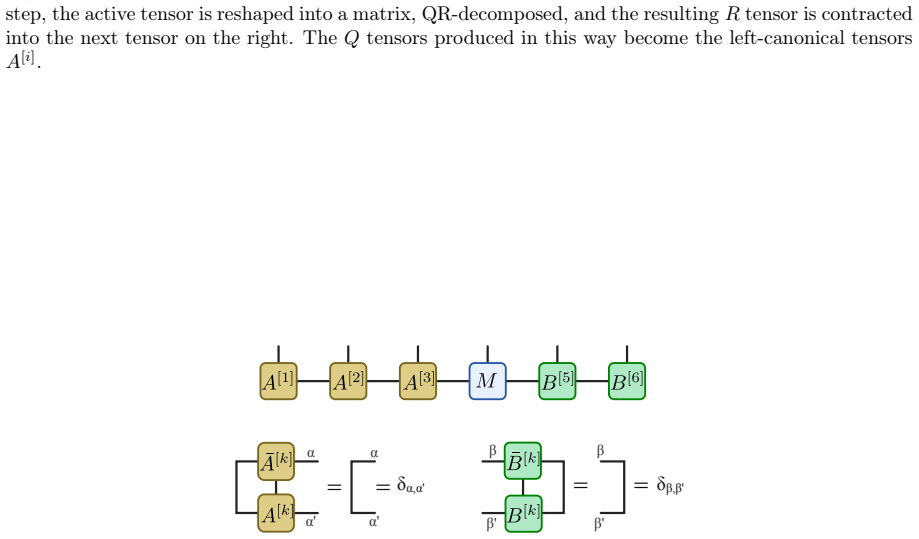
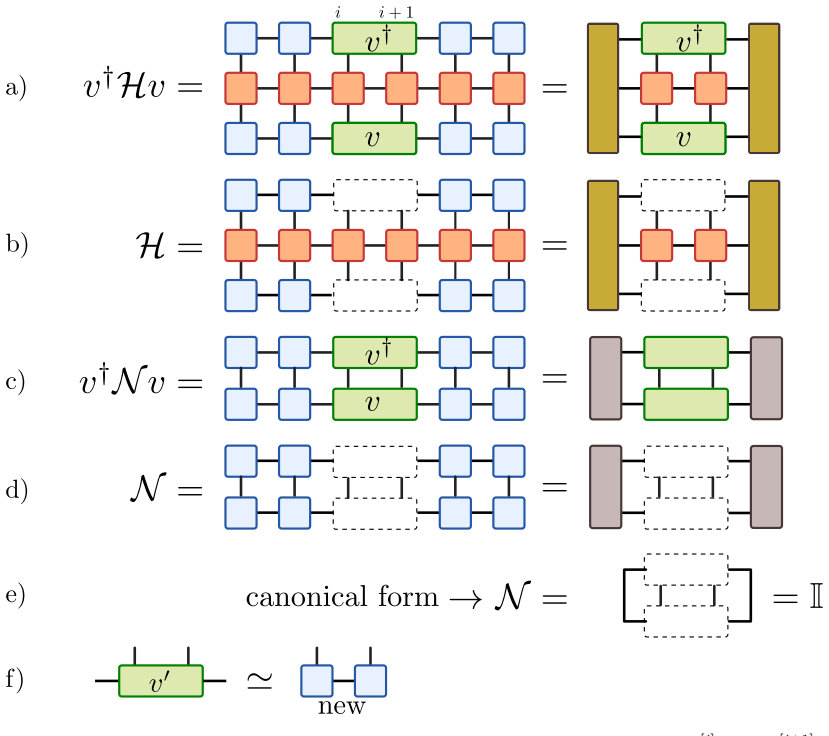
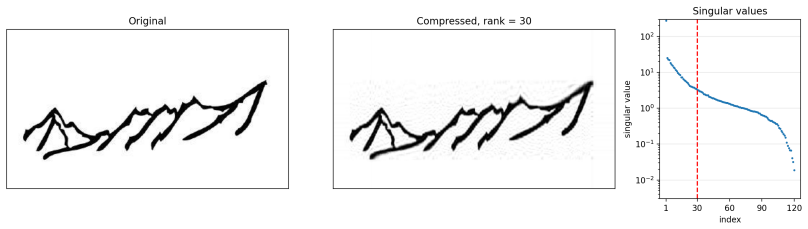
Matrix-product states factor a many-body wavefunction into a product of local tensors connected by auxiliary indices; the dimension of these indices bounds the entanglement that can be captured exactly, and standard linear-algebra operations such as QR and singular-value decompositions convert between equivalent representations while preserving the physical state.
What carries the argument
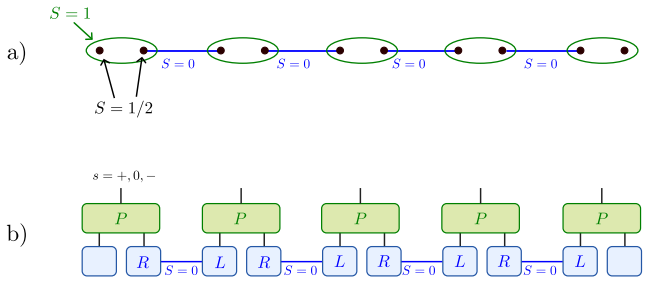
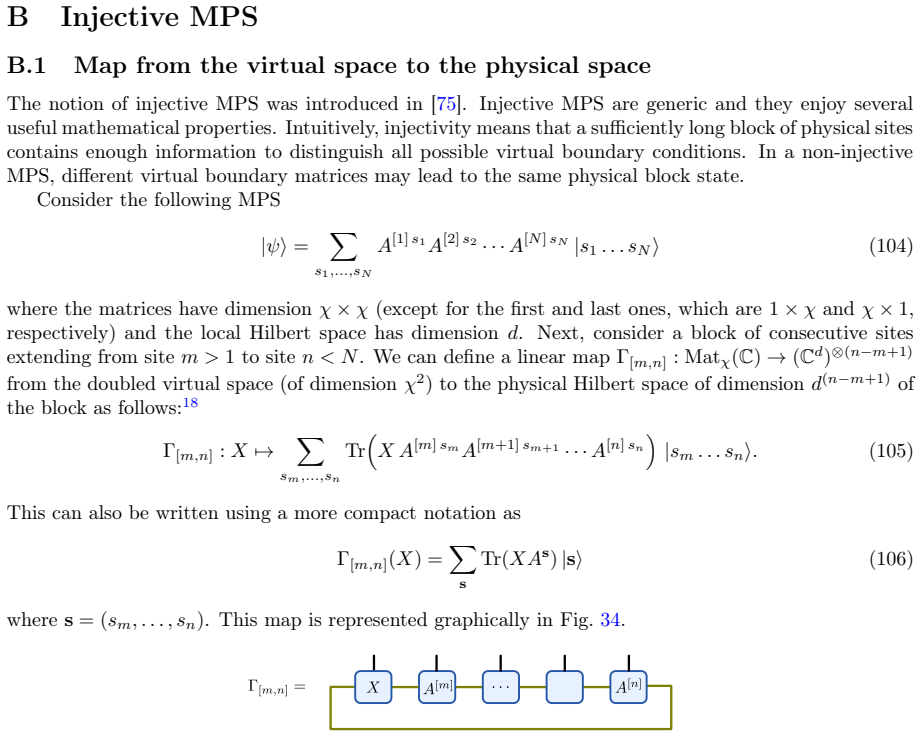
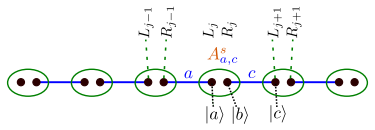
Matrix-product states (MPS), a chain of tensors each carrying one physical index for the local degree of freedom and two virtual indices that encode entanglement between neighboring sites.
If this is right
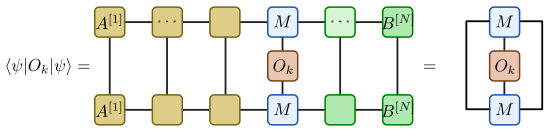
- Expectation values of local operators are obtained by contracting a short segment of the MPS network with the corresponding matrix-product operator.
- Ground-state search reduces to iterative local optimization of the MPS tensors under the DMRG sweep procedure.
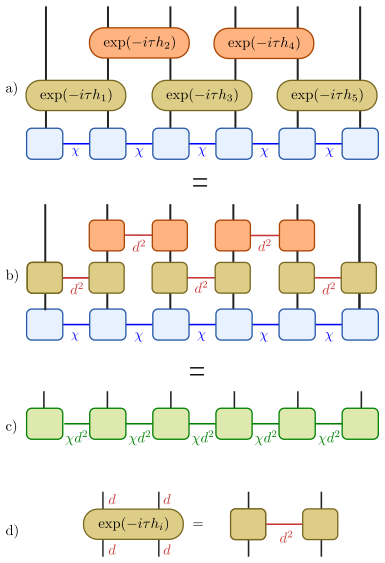
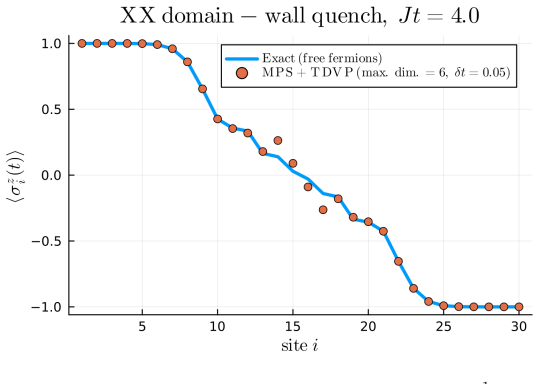
- Real-time evolution is performed by applying short-time operators while repeatedly truncating back to a chosen bond dimension.
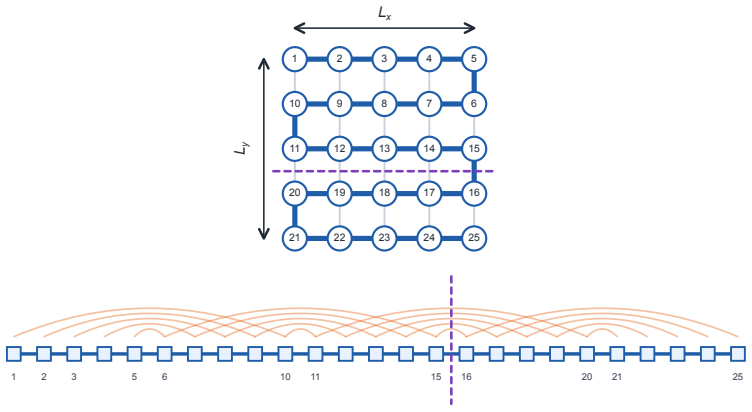
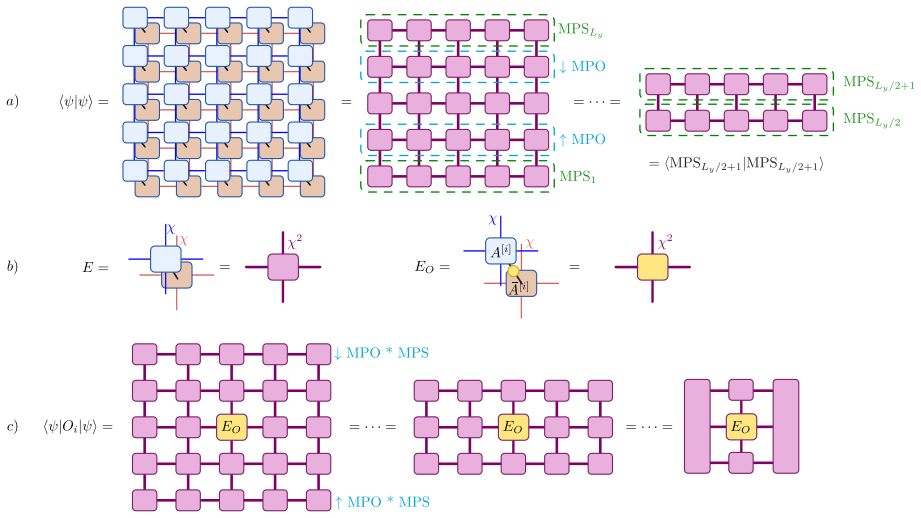
- Projected entangled-pair states generalize the same construction to two dimensions, with contraction performed approximately by boundary MPS methods.
Where Pith is reading between the lines
- The provision of Julia code examples indicates that the same tensor operations can be executed immediately in existing numerical libraries without new implementation.
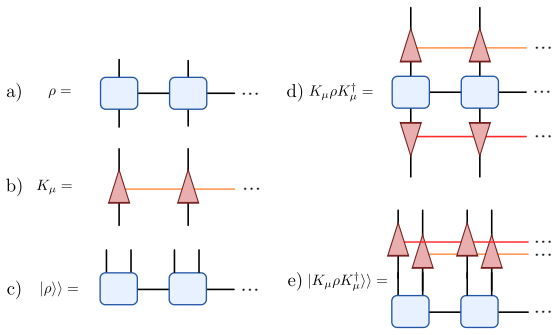
- The treatment of Lindblad dynamics shows the formalism extends from closed unitary evolution to open-system master equations with the same tensor objects.
- Canonical-form choices imply that numerical stability can be improved by selecting a gauge that avoids ill-conditioned tensors during contractions.
Load-bearing premise
The reader already knows quantum mechanics and linear algebra well enough to follow tensor manipulations without extra explanation.
What would settle it
A concrete counter-example would be a quantum state whose entanglement entropy grows linearly with subsystem size yet is exactly reproduced by an MPS whose bond dimension stays bounded as system size increases.
Figures



read the original abstract
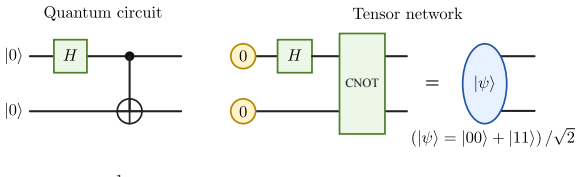
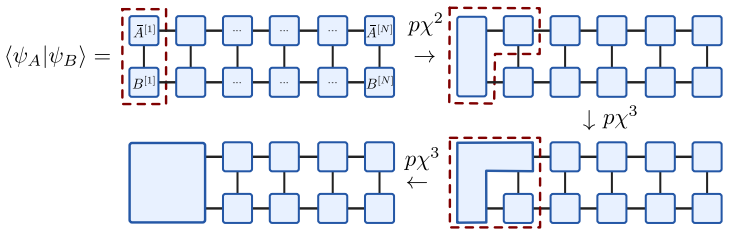
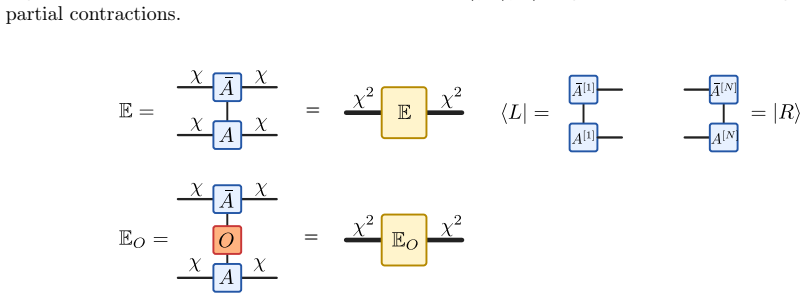
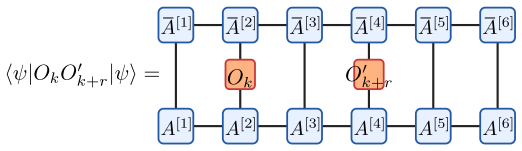
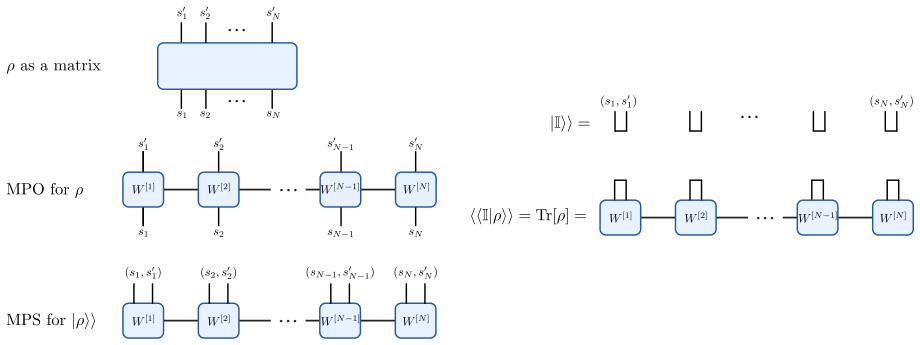
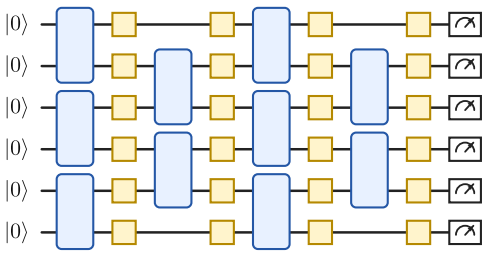
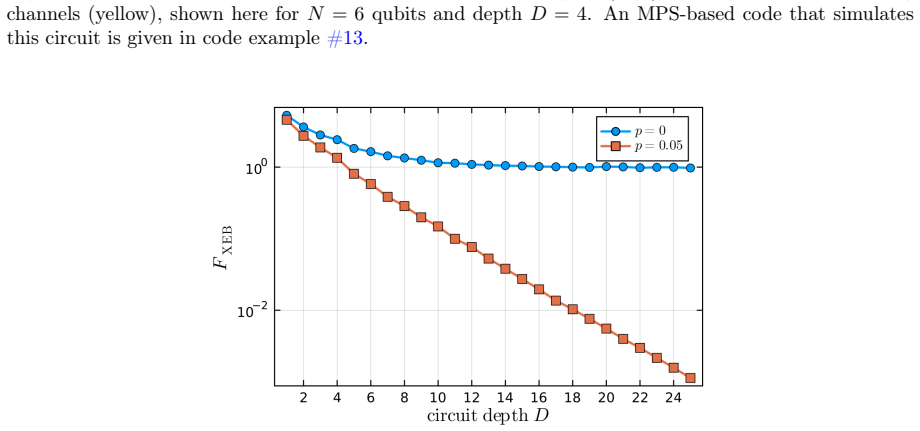
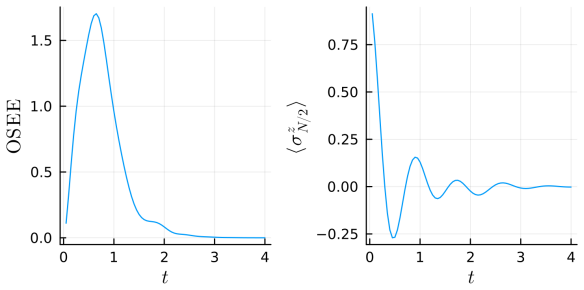
These notes provide an introduction to tensor-network methods in quantum many-body physics, with an emphasis on matrix-product states (MPS). They develop the basic tensor-network language, including graphical notation, virtual indices, bond dimensions, gauge freedom, canonical forms, QR and singular-value decompositions, and the role of entanglement in controlling the efficiency of the representation. The main MPS algorithms are then introduced, including contractions, correlation functions, matrix-product operators, DMRG, and time-evolution methods. The notes also briefly discuss projected entangled-pair states (PEPS) as a higher-dimensional generalization of MPS, together with the basic ideas behind approximate PEPS contraction. Finally, tensor-network representations of mixed states, quantum channels, and Lindblad dynamics are presented, with applications to thermal states and open quantum systems. The presentation is accompanied by short Julia code examples based on ITensor, ITensorMPS, and TensorMixedStates. These notes were written for the 9th Les Houches Summer School on Computational Physics: Open Quantum Systems, held in June 2026.
Editorial analysis
A structured set of objections, weighed in public.
Referee Report
Summary. These lecture notes introduce tensor-network methods in quantum many-body physics with emphasis on matrix-product states (MPS). They develop graphical notation, virtual indices, bond dimensions, gauge freedom, canonical forms, QR/SVD decompositions, and the role of entanglement; then present MPS algorithms including contractions, correlation functions, matrix-product operators, DMRG, and time evolution; briefly cover PEPS and approximate contraction; and discuss tensor-network representations of mixed states, quantum channels, and Lindblad dynamics with applications to thermal states and open systems. The presentation includes short Julia/ITensor code examples and was prepared for the 9th Les Houches Summer School on Computational Physics: Open Quantum Systems.
Significance. If the explanations are accurate and the code examples function as described, the notes supply a practical, self-contained introduction to established tensor-network techniques together with reproducible code. This combination can serve as a useful teaching resource for researchers entering the field of computational condensed-matter physics, particularly those attending summer schools focused on open quantum systems.
minor comments (2)
- The notes assume background in quantum mechanics and linear algebra; adding a short prerequisites paragraph near the beginning would help readers assess readiness.
- Code snippets are described as short and based on ITensor/ITensorMPS/TensorMixedStates; confirming that all examples run without modification on current package versions would strengthen the reproducibility claim.
Simulated Author's Rebuttal
We thank the referee for their positive summary of the lecture notes and for recommending acceptance. We appreciate the recognition of the notes as a practical, self-contained introduction with reproducible code examples.
Circularity Check
Expository notes with no novel derivations or claims
full rationale
This is a set of lecture notes introducing established tensor-network methods (MPS, PEPS, MPO, DMRG, time evolution, mixed-state representations) with standard graphical notation, decompositions, and ITensor code examples. No new predictions, uniqueness theorems, fitted parameters, or derivations are advanced. All material is standard background material presented for pedagogical purposes at a summer school, with no load-bearing steps that could reduce to self-definition, self-citation chains, or renaming of results. The document is therefore self-contained against external benchmarks and exhibits no circularity.
Axiom & Free-Parameter Ledger
Reference graph
Works this paper leans on
-
[1]
Misguich
G. Misguich. Introduction to matrix-product states and tensor networks – Julia code examples. url: https://github.com/gregoire-misguich/Introduction-to-matrix-product-states- and-tensor-networks
-
[2]
M. Fishman, S. White, and E. Stoudenmire. The ITensor Software Library for Tensor Network Calculations. SciPost Phys. Codebases(2022), 004. doi: 10.21468/SciPostPhysCodeb.4
-
[3]
Houdayer and G
J. Houdayer and G. Misguich.TensorMixedStates: A Julia Library for Simulating Pure and Mixed Quantum States Using Matrix Product States. SciPost Phys. Codebases (2026), 072. doi: 10 . 21468/SciPostPhysCodeb.72. url: https://github.com/jerhoud/TensorMixedStates.jl
2026
-
[4]
J. Eisert, M. Cramer, and M. B. Plenio.Colloquium: Area Laws for the Entanglement Entropy. Rev. Mod. Phys.82.1 (2010), 277–306.doi: 10.1103/RevModPhys.82.277
-
[5]
P. Corboz, R. Orús, B. Bauer, and G. Vidal. Simulation of Strongly Correlated Fermions in Two Spatial Dimensions with Fermionic Projected Entangled-Pair States. Phys. Rev. B 81.16 (2010), 165104. doi: 10.1103/PhysRevB.81.165104
-
[6]
Q. Mortier, L. Devos, L. Burgelman, B. Vanhecke, N. Bultinck, F. Verstraete, J. Haegeman, and L. Vanderstraeten.Fermionic Tensor Network Methods. SciPost Phys.18.1 (2025), 012.doi: 10.21468/SciPostPhys.18.1.012
-
[7]
The Density Matrix Renormalization Group in Quantum Chemistry
G.K.-L.ChanandS.Sharma. The Density Matrix Renormalization Group in Quantum Chemistry. Annu. Rev. Phys. Chem.62 (2011), 465–481.doi: 10.1146/annurev-physchem-032210-103338
-
[8]
S. Szalay, M. Pfeffer, V. Murg, G. Barcza, F. Verstraete, R. Schneider, and Ö. Legeza.Tensor Prod- uct Methods and Entanglement Optimization for Ab Initio Quantum Chemistry. Int. J. Quantum Chem. 115.19 (2015), 1342–1391.doi: 10.1002/qua.24898
-
[9]
G. Vidal. Classical Simulation of Infinite-Size Quantum Lattice Systems in One Spatial Dimension. Phys. Rev. Lett.98.7 (2007), 070201.doi: 10.1103/PhysRevLett.98.070201
-
[10]
I. P. McCulloch. Infinite Size Density Matrix Renormalization Group, Revisited. 2008. arXiv: 0804.2509 [cond-mat]
Pith/arXiv arXiv 2008
-
[11]
J. Jordan, R. Orús, G. Vidal, F. Verstraete, and J. I. Cirac.Classical Simulation of Infinite-Size Quantum Lattice Systems in Two Spatial Dimensions. Phys. Rev. Lett.101.25 (2008), 250602.doi: 10.1103/PhysRevLett.101.250602
-
[12]
F. Verstraete and J. I. Cirac.Continuous Matrix Product States for Quantum Fields. Phys. Rev. Lett. 104.19 (2010), 190405.doi: 10.1103/PhysRevLett.104.190405
-
[13]
A. E. Feiguin, E. Rezayi, C. Nayak, and S. Das Sarma.Density Matrix Renormalization Group Study of Incompressible Fractional Quantum Hall States. Phys. Rev. Lett.100.16 (2008), 166803. doi: 10.1103/PhysRevLett.100.166803. 58
-
[14]
M. P. Zaletel and R. S. K. Mong.Exact Matrix Product States for Quantum Hall Wave Functions. Phys. Rev. B86.24 (2012), 245305.doi: 10.1103/PhysRevB.86.245305
-
[15]
Topological Characterization of Fractional Quantum Hall Ground States from Microscopic Hamiltonians
M.P.Zaletel,R.S.K.Mong,andF.Pollmann. Topological Characterization of Fractional Quantum Hall Ground States from Microscopic Hamiltonians. Phys. Rev. Lett.110.23 (2013), 236801.doi: 10.1103/PhysRevLett.110.236801
-
[16]
S. Östlund and S. Rommer.Thermodynamic Limit of Density Matrix Renormalization. Phys. Rev. Lett. 75.19 (1995), 3537–3540.doi: 10.1103/PhysRevLett.75.3537
-
[17]
I. V. Oseledets. Tensor-Train Decomposition. SIAM J. Sci. Comput.33 (2011), 2295. doi: 10. 1137/090752286
2011
-
[18]
Stoudenmire and S
E. Stoudenmire and S. R. White. Studying Two-Dimensional Systems with the Density Matrix Renormalization Group. Annu. Rev. Condens. Matter Phys.3.1 (2012), 111–128.doi: 10.1146/ annurev-conmatphys-020911-125018
2012
-
[19]
Nishino, Y
T. Nishino, Y. Hieida, K. Okunishi, N. Maeshima, Y. Akutsu, and A. Gendiar.Two-Dimensional Tensor Product Variational Formulation.Prog. Theor. Phys.105.3 (2001), 409–417.doi: 10.1143/ PTP.105.409
2001
-
[20]
F. Verstraete and J. I. Cirac. Renormalization Algorithms for Quantum-Many Body Systems in Two and Higher Dimensions. 2004. arXiv:cond-mat/0407066
Pith/arXiv arXiv 2004
-
[21]
G. Vidal. Entanglement Renormalization. Phys. Rev. Lett.99.22 (2007), 220405. doi: 10.1103/ PhysRevLett.99.220405
2007
-
[22]
G. Vidal. Class of Quantum Many-Body States That Can Be Efficiently Simulated. Phys. Rev. Lett. 101.11 (2008), 110501.doi: 10.1103/PhysRevLett.101.110501
-
[23]
G. Evenbly and G. Vidal. Algorithms for Entanglement Renormalization. Phys. Rev. B 79.14 (2009), 144108. doi: 10.1103/PhysRevB.79.144108
-
[24]
C. Holzhey, F. Larsen, and F. Wilczek.Geometric and Renormalized Entropy in Conformal Field Theory. Nuclear Physics B424.3 (1994), 443–467.doi: 10.1016/0550-3213(94)90402-2
-
[25]
G. Vidal, J. I. Latorre, E. Rico, and A. Kitaev.Entanglement in Quantum Critical Phenomena. Phys. Rev. Lett.90.22 (2003), 227902.doi: 10.1103/PhysRevLett.90.227902
-
[26]
P. Calabrese and J. Cardy. Entanglement Entropy and Quantum Field Theory. J. Stat. Mech. Theory Exp.2004.06 (2004), P06002.doi: 10.1088/1742-5468/2004/06/P06002
-
[27]
Entanglement Renormalization and Holography.Physical Review D86.6(2012),065007
B.Swingle. Entanglement Renormalization and Holography.Physical Review D86.6(2012),065007. doi: 10.1103/PhysRevD.86.065007
-
[28]
Holographic derivation of entanglement entropy from the anti-de
S. Ryu and T. Takayanagi. Holographic Derivation of Entanglement Entropy from AdS/CFT. Phys. Rev. Lett.96.18 (2006), 181602.doi: 10.1103/PhysRevLett.96.181602
-
[29]
S. R. White. Density Matrix Formulation for Quantum Renormalization Groups. Phys. Rev. Lett. 69.19 (1992), 2863–2866.doi: 10.1103/PhysRevLett.69.2863
-
[30]
S. R. White.Density-Matrix Algorithms for Quantum Renormalization Groups.Phys. Rev. B48.14 (1993), 10345–10356.doi: 10.1103/PhysRevB.48.10345
-
[31]
U. Schollwöck. The Density-Matrix Renormalization Group in the Age of Matrix Product States. Ann. Phys.January 2011 Special Issue 326.1 (2011), 96–192.doi: 10.1016/j.aop.2010.09.012
-
[32]
S. R. White and A. E. Feiguin.Real-Time Evolution Using the Density Matrix Renormalization Group. Phys. Rev. Lett.93.7 (2004), 076401.doi: 10.1103/PhysRevLett.93.076401
-
[33]
Time-Dependent Density-Matrix Renormalization- Group Using Adaptive Effective Hilbert Spaces.J
A.J.Daley,C.Kollath,U.Schollwöck,andG.Vidal. Time-Dependent Density-Matrix Renormalization- Group Using Adaptive Effective Hilbert Spaces.J. Stat. Mech. Theory Exp.2004.04 (2004), P04005. doi: 10.1088/1742-5468/2004/04/P04005
-
[34]
D.Gobert,C.Kollath,U.Schollwöck,andG.Schütz. Real-Time Dynamics in Spin-1/2 Chains with Adaptive Time-Dependent Density Matrix Renormalization Group.Phys. Rev. E71.3(2005),036102. doi: 10.1103/PhysRevE.71.036102
-
[35]
G. Vidal. Efficient Classical Simulation of Slightly Entangled Quantum Computations. Phys. Rev. Lett. 91.14 (2003), 147902.doi: 10.1103/PhysRevLett.91.147902
-
[36]
G. Vidal. Efficient Simulation of One-Dimensional Quantum Many-Body Systems.Phys. Rev. Lett. 93.4 (2004), 040502.doi: 10.1103/PhysRevLett.93.040502. 59
-
[37]
J. Haegeman, J. I. Cirac, T. J. Osborne, I. Pižorn, H. Verschelde, and F. Verstraete. Time- Dependent Variational Principle for Quantum Lattices. Phys. Rev. Lett. 107.7 (2011), 070601. doi: 10.1103/PhysRevLett.107.070601
-
[38]
J. Haegeman, C. Lubich, I. Oseledets, B. Vandereycken, and F. Verstraete.Unifying Time Evo- lution and Optimization with Matrix Product States. Phys. Rev. B 94.16 (2016), 165116. doi: 10.1103/PhysRevB.94.165116
-
[39]
M. P. Zaletel, R. S. K. Mong, C. Karrasch, J. E. Moore, and F. Pollmann. Time-Evolving a Matrix Product State with Long-Ranged Interactions. Phys. Rev. B 91.16 (2015), 165112. doi: 10.1103/PhysRevB.91.165112
-
[40]
Y. Zhou, E. M. Stoudenmire, and X. Waintal.What Limits the Simulation of Quantum Comput- ers?: Phys. Rev. X10.4 (2020), 041038.doi: 10.1103/PhysRevX.10.041038
-
[41]
T. Ayral, T. Louvet, Y. Zhou, C. Lambert, E. M. Stoudenmire, and X. Waintal.Density-Matrix Renormalization Group Algorithm for Simulating Quantum Circuits with a Finite Fidelity. PRX Quantum 4.2 (2023), 020304.doi: 10.1103/PRXQuantum.4.020304
-
[42]
S. Cerezo-Roquebrún, A. Bou-Comas, J. T. Schneider, E. López, L. Tagliacozzo, and S. Carignano. Spatio-Temporal Tensor-Network Approaches to out-of-Equilibrium Dynamics Bridging Open and Closed Systems. 2025. arXiv:2502.20214 [quant-ph]
arXiv 2025
-
[43]
S. Carignano, G. Lami, J. D. Nardis, and L. Tagliacozzo.Overcoming the Entanglement Barrier with Sampled Tensor Networks. 2025. arXiv:2505.09714 [quant-ph]
arXiv 2025
-
[44]
Verstraete, J
F. Verstraete, J. J. García-Ripoll, and J. I. Cirac.Matrix Product Density Operators: Simulation of Finite-Temperature and Dissipative Systems. Phys. Rev. Lett.93.20 (2004), 207204. doi: 10. 1103/PhysRevLett.93.207204
2004
-
[45]
M. Zwolak and G. Vidal.Mixed-State Dynamics in One-Dimensional Quantum Lattice Systems: A Time-Dependent Superoperator Renormalization Algorithm. Phys. Rev. Lett.93.20 (2004), 207205. doi: 10.1103/PhysRevLett.93.207205
-
[46]
J. Keeling, E. M. Stoudenmire, M.-C. Bañuls, and D. R. Reichman.Process Tensor Approaches to Non-Markovian Quantum Dynamics. 2025. arXiv:2509.07661 [quant-ph]
Pith/arXiv arXiv 2025
-
[47]
F. Pan and P. Zhang. Simulation of Quantum Circuits Using the Big-Batch Tensor Network Method. Phys. Rev. Lett.128.3 (2022), 030501.doi: 10.1103/PhysRevLett.128.030501
-
[48]
Tindall, M
J. Tindall, M. Fishman, E. M. Stoudenmire, and D. Sels.Efficient Tensor Network Simulation of IBM’s Eagle Kicked Ising Experiment. PRX Quantum 5.1 (2024), 010308. doi: 10 . 1103 / PRXQuantum.5.010308
2024
-
[49]
Classification of Gapped Symmetric Phases in One-Dimensional Spin Systems
X.Chen,Z.-C.Gu,andX.-G.Wen. Classification of Gapped Symmetric Phases in One-Dimensional Spin Systems. Phys. Rev. B83.3 (2011), 035107.doi: 10.1103/PhysRevB.83.035107
-
[50]
X. Chen, Z.-C. Gu, and X.-G. Wen.Complete Classification of One-Dimensional Gapped Quantum Phases in Interacting Spin Systems. Phys. Rev. B84.23 (2011), 235128.doi: 10.1103/PhysRevB. 84.235128
-
[51]
Schuch, D
N. Schuch, D. Pérez-García, and I. Cirac. Classifying Quantum Phases Using Matrix Product States and Projected Entangled Pair States. Phys. Rev. B 84.16 (2011), 165139. doi: 10.1103/ PhysRevB.84.165139
2011
-
[52]
B.Derrida,M.R.Evans,V.Hakim,andV.Pasquier. Exact Solution of a 1D Asymmetric Exclusion Model Using a Matrix Formulation. J. Phys. A Math. Gen.26.7 (1993), 1493.doi: 10.1088/0305- 4470/26/7/011
-
[53]
K. Mallick. Some Exact Results for the Exclusion Process. J. Stat. Mech. Theory Exp.2011.01 (2011), P01024. doi: 10.1088/1742-5468/2011/01/P01024
-
[54]
T. Nishino. Density Matrix Renormalization Group Method for 2D Classical Models. J. Phys. Soc. Jpn. 64.10 (1995), 3598–3601.doi: 10.1143/JPSJ.64.3598
-
[55]
R. Orús and G. Vidal. Infinite Time-Evolving Block Decimation Algorithm beyond Unitary Evo- lution. Phys. Rev. B78.15 (2008), 155117.doi: 10.1103/PhysRevB.78.155117
-
[56]
I. Oseledets and E. Tyrtyshnikov. TT-cross Approximation for Multidimensional Arrays. Linear Algebra Appl.432.1 (2010), 70–88.doi: 10.1016/j.laa.2009.07.024. 60
-
[57]
Y. Núñez Fernández, M. K. Ritter, M. Jeannin, J.-W. Li, T. Kloss, T. Louvet, S. Terasaki, O. Par- collet, J. von Delft, H. Shinaoka, et al.Learning Tensor Networks with Tensor Cross Interpolation: New Algorithms and Libraries. SciPost Phys.18.3 (2025), 104.doi: 10.21468/SciPostPhys.18. 3.104
-
[58]
M. K. Ritter, Y. Núñez Fernández, M. Wallerberger, J. von Delft, H. Shinaoka, and X. Waintal. Quantics Tensor Cross Interpolation for High-Resolution Parsimonious Representations of Multi- variate Functions.Phys. Rev. Lett.132.5(2024),056501. doi: 10.1103/PhysRevLett.132.056501
-
[59]
X. Waintal, C.-H. Huang, and C. W. Groth.Who Can Compete with Quantum Computers? Lecture Notes on Quantum Inspired Tensor Networks Computational Techniques. 2026. arXiv:2601.03035 [quant-ph]
arXiv 2026
-
[60]
R. Orús. A Practical Introduction to Tensor Networks: Matrix Product States and Projected En- tangled Pair States. Ann. Phys.349 (2014), 117–158.doi: 10.1016/j.aop.2014.06.013
-
[61]
J. C. Bridgeman and C. T. Chubb.Hand-Waving and Interpretive Dance: An Introductory Course on Tensor Networks. J. Phys. A Math. Theor.50.22 (2017), 223001. doi: 10.1088/1751-8121/ aa6dc3
-
[62]
P. Silvi, F. Tschirsich, M. Gerster, J. Jünemann, D. Jaschke, M. Rizzi, and S. Montangero.The Tensor Networks Anthology: Simulation Techniques for Many-Body Quantum Lattice Systems. SciPost Phys. Lect.(2019), 008. doi: 10.21468/SciPostPhysLectNotes.8
-
[63]
R. Orús. Tensor Networks for Complex Quantum Systems. Nat. Rev. Phys.1.9 (2019), 538–550. doi: 10.1038/s42254-019-0086-7
-
[64]
J. I. Cirac, D. Pérez-García, N. Schuch, and F. Verstraete.Matrix Product States and Projected Entangled Pair States: Concepts, Symmetries, Theorems. Rev. Mod. Phys.93.4 (2021), 045003. doi: 10.1103/RevModPhys.93.045003
-
[65]
M. C. Bañuls. Tensor Network Algorithms: A Route Map. Annu. Rev. Condens. Matter Phys.14 (2023), 173–191.doi: 10.1146/annurev-conmatphys-040721-022705
-
[66]
B. V.-D. Cuiper, W. Wiesiolek, and F. Verstraete.Les Houches Lecture Notes on Tensor Networks
-
[67]
arXiv: 2512.24390 [cond-mat.str-el]
-
[68]
S. Paeckel, T. Köhler, A. Swoboda, S. R. Manmana, U. Schollwöck, and C. Hubig.Time-Evolution Methods for Matrix-Product States. Ann. Phys.411 (2019), 167998.doi: 10.1016/j.aop.2019. 167998
-
[69]
von Delft
J. von Delft. Lecture Course on Tensor Networks, Ludwig Maximilian University Munich (2025). url: https://www.theorie.physik.uni-muenchen.de/lsvondelft/teams-groups/teaching/ tensornetworks1
2025
-
[70]
J. Gray. quimb: a python library for quantum information and many-body calculations. J. Open Source Softw.3.29 (2018), 819.doi: 10.21105/joss.00819
-
[71]
J. Hauschild and F. Pollmann.Efficient Numerical Simulations with Tensor Networks: Tensor Net- work Python (TeNPy).SciPost Phys. Lect.(2018), 005.doi: 10.21468/SciPostPhysLectNotes.5
-
[72]
url: https://tenpy.readthedocs.io
TenPy: Tensor Network Python Library. url: https://tenpy.readthedocs.io
-
[73]
url: https://tensornetwork.org/
tensornetwork.org. url: https://tensornetwork.org/
-
[74]
G. Evenbly. tensor.net. url: https://tensor.net/
-
[75]
P. Pippan, S. R. White, and H. G. Evertz.Efficient Matrix-Product State Method for Periodic Boundary Conditions. Phys. Rev. B81.8 (2010), 081103.doi: 10.1103/PhysRevB.81.081103
-
[76]
D. Perez-Garcia, F. Verstraete, M. M. Wolf, and J. I. Cirac.Matrix Product State Representations. Quantum Info. Comput.7.5 (2007), 401–430.doi: 10.5555/2011832.2011833
-
[77]
I. Affleck, T.Kennedy, E.H.Lieb, andH. Tasaki.Rigorous Results on Valence-Bond Ground States in Antiferromagnets. Phys. Rev. Lett.59.7 (1987), 799–802.doi: 10.1103/PhysRevLett.59.799
-
[78]
L.Tagliacozzo,G.Evenbly,andG.Vidal. Simulation of Two-Dimensional Quantum Systems Using a Tree Tensor Network That Exploits the Entropic Area Law. Phys. Rev. B80.23 (2009), 235127. doi: 10.1103/PhysRevB.80.235127
-
[79]
Investigating neutron polarizabilities through compton scattering on3He
N. Schuch, M. M. Wolf, F. Verstraete, and J. I. Cirac.Computational Complexity of Projected Entangled Pair States. Phys. Rev. Lett.98.14 (2007), 140506. doi: 10.1103/PhysRevLett.98. 140506. 61
-
[80]
G. M. Crosswhite and D. Bacon. Finite Automata for Caching in Matrix Product Algorithms. Phys. Rev. A78.1 (2008), 012356.doi: 10.1103/PhysRevA.78.012356
discussion (0)
Sign in with ORCID, Apple, or X to comment. Anyone can read and Pith papers without signing in.