REVIEW 2 major objections 5 minor 41 references
Level anti-crossings of an NV center in diamond: Decoherence-free subspaces and 3D sensors of microwave magnetic fields
T0 review · 2 major / 5 minor · reviewed 2026-08-14 · deepseek-v4-flash
Pith's one-line read At two level anti-crossings, a single NV center becomes a decoherence-free 3D microwave-field sensor.
desk verdict Worth a serious referee: the vector-detection scheme is real, but the title oversells '3D' and the 14N spin preparation is unexplained. read the letter →
The pith
A machine-rendered reading of the paper's core claim, the machinery that carries it, and where it could break.
The reading
What carries the argument
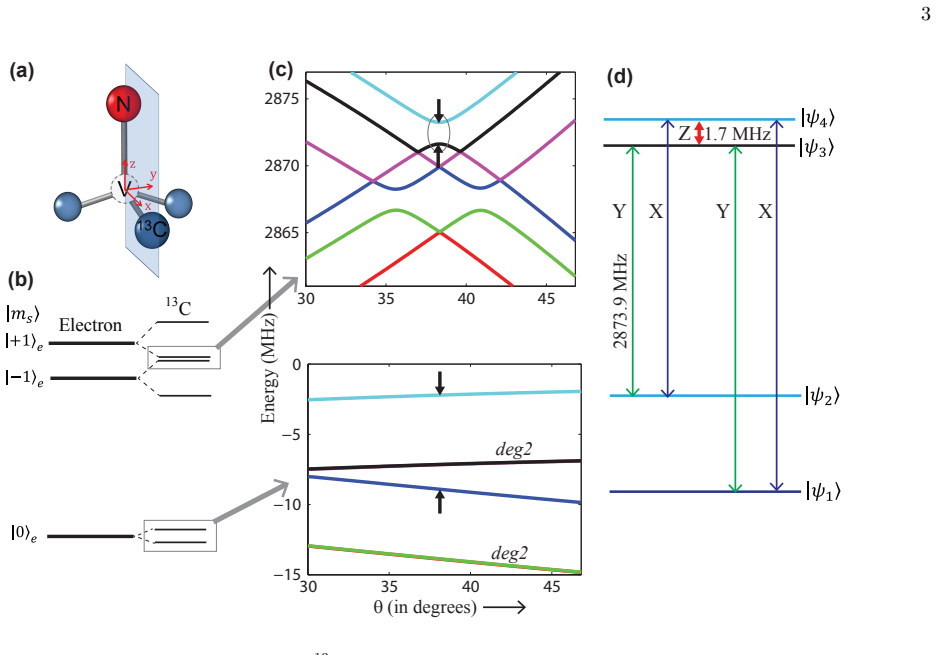
The central machinery is the level anti-crossing (LAC) and the zero first-order Zeeman (ZEFOZ) shift it generates. A non-secular (off-axis) hyperfine term mixes electron-spin and first-shell $^{13}$C nuclear-spin states, flattening the energy levels so that the first derivatives of transition frequencies with respect to field amplitude and orientation vanish; magnetic-field noise then shifts the transitions only to second order, which is the decoherence-free subspace effect. The same mixing produces nearly equal superpositions of the $m_s = 0$ and $m_s = \pm 1$ electron-spin projections with the carbon spin, and these superpositions project the dipole operator $S_x$, $S_y$, or $S_z$ onto a single axis for each transition. Numerically diagonalizing the full Hamiltonian, including the $^{14}$N nuclear spin, turns the approximate eigenstates and the measured transition amplitudes into the vector-field sensor.
What would settle it
Repeat the Ramsey and Rabi measurements at $\theta = 38.4^\circ$ with the $^{14}$N nuclear spin prepared in $m_I = +1$ rather than $m_I = 0$: if the four transitions still show the 5–7-fold $T_2^*$ increase and the $x$/$y$-only selection, the assumption is not load-bearing; otherwise the claim is confined to the $m_I = 0$ manifold.
Extended reading notes
Core claim
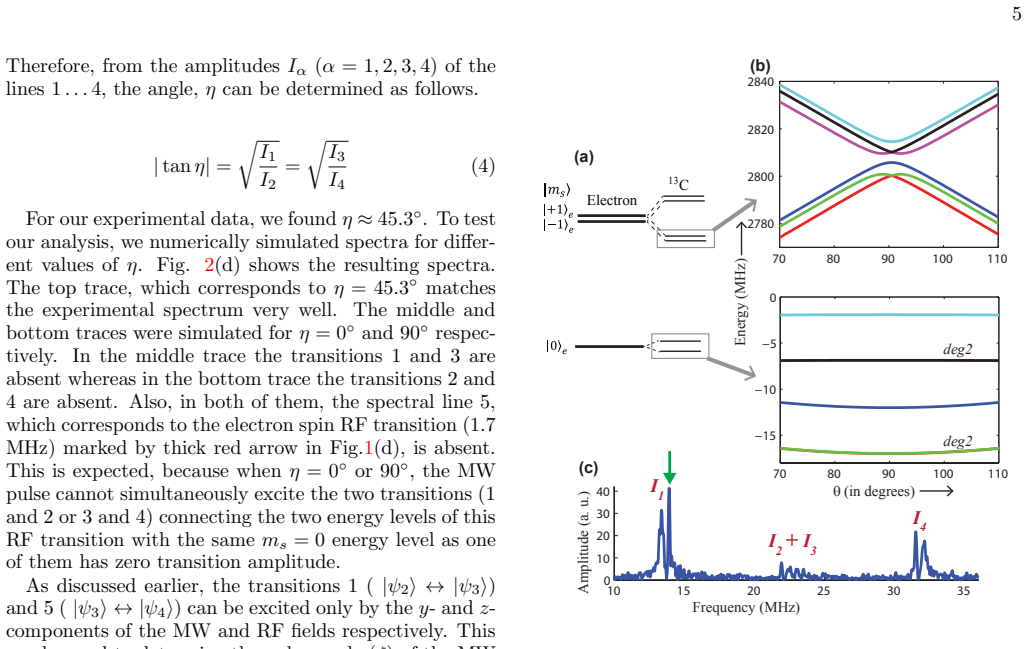
The paper's central claim is that two low-field level anti-crossings of an NV center coupled to a first-shell $^{13}$C nuclear spin—one at $\theta \approx 38.4^\circ$ where the electron Zeeman splitting matches the $\approx 127$ MHz hyperfine splitting, and one at $\theta = 90^\circ$ where the static field lies in the plane perpendicular to the NV axis—each create a decoherence-free subspace. At these points the first derivatives of the transition frequencies with respect to field strength and orientation vanish (the ZEFOZ effect), so the measured $T_2^*$ values are 5–7 times longer than at other orientations, and the eigenstates are nearly equal superpositions that select a single Cartesian component ($S_x$, $S_y$, or $S_z$) for each transition. Using the amplitude ratios of the selected lines and selective Rabi frequencies, the authors determine the azimuthal angle $\eta \approx 45.3^\circ$ and polar angle $\zeta \approx 39^\circ$ of the microwave field, demonstrating full vector detection of the microwave magnetic field with a single NV center.
Load-bearing premise
The central analysis assumes the $^{14}$N nuclear spin is in the $m_I = 0$ state; the paper does not explain how that state is prepared or selected, and the claimed decoherence-free subspace and single-component transitions hold only for that manifold.
Editorial extensions
If this is right
- At the first LAC, four microwave transitions acquire $T_2^*$ values of 7.6–10.5 $\mu$s, compared with 1.6 $\mu$s at an arbitrary orientation, so coherence-limited operations at that angle become substantially longer.
- The azimuthal angle of the microwave field follows from line-amplitude ratios: $|\tan \eta| = \sqrt{I_1/I_2} = \sqrt{I_3/I_4}$, giving $45.3^\circ$ and confirmed by simulation and by the second LAC measurement.
- Selective Rabi frequencies of the $y$-driven and $z$-driven transitions determine the polar angle $\zeta$, here $39^\circ$ with the stated uncertainty, so both angles of the field are available from one center.
- At the transverse LAC, the line width narrows from 0.60–0.80 MHz to 0.12 MHz at $\theta = 90^\circ$, showing the same protection mechanism in a second, independent geometry.
- If these results hold, vector microwave magnetometry with a single NV center replaces arrangements that required at least three differently oriented centers, and the measured field orientation can guide optimal-control pulse design for the symmetry-broken center.
Reading between the lines
- A testable extension, not developed in the paper, is to use the single-component selection to calibrate microwave field vectors at other defect centers whose hyperfine coupling breaks rotational symmetry, without needing a multi-center array.
- Because the analysis assumes the $^{14}$N nuclear spin remains in $m_I = 0$, an experiment that initializes or post-selects $m_I = \pm 1$ should show the decoherence-free subspace and single-axis selection degrade; the paper does not address this.
- The vector information obtained at the LACs could be fed directly into optimal-control pulse design, since a center with a nearby $^{13}$C is not symmetric around the NV axis and its control fields need a known orientation.
Signed reviews
Editorial analysis
A structured set of objections, weighed in public.
Referee Report
Summary. The paper studies level anti-crossings (LACs) of a single NV center coupled to a first-shell 13C nuclear spin in a small static magnetic field (~28.9 G). Two LAC configurations are examined: one in the ms=±1 manifold when the electron Zeeman splitting matches the 13C hyperfine splitting (θ≈38.4°), and another when the static field lies in the transverse plane (θ=90°). At these orientations, the authors observe that certain electron-spin transition frequencies have zero first-order derivatives with respect to the magnetic field (ZEFOZ), leading to measured T2* enhancements by factors of 5–7. They further report that specific transitions are dominated by single Cartesian components of the magnetic dipole moment, which they use to determine the azimuthal angle η of an applied microwave field from amplitude ratios of four spectral lines, and to estimate the polar angle ζ from the ratio of Rabi frequencies of two transitions. Numerical simulations are used to cross-check the extracted η. The paper claims this constitutes vector detection of microwave/RF fields with a single NV center, with potential applications in optimal control and quantum sensing.
Significance. If the central claims hold, this is a valuable contribution to NV-center quantum sensing and control: it demonstrates that a single NV center, rather than an ensemble with multiple crystallographic orientations, can determine the direction of an oscillating magnetic field, which is relevant for precise microwave control and vector magnetometry. The experimental data are presented with confidence intervals on the T2* values and with a systematic linewidth-versus-angle measurement for the transverse-field LAC. The ZEFOZ explanation is a standard and appropriate perturbation-theory argument, and the measured T2* enhancement is an experimental result rather than a derived prediction. The consistency check in Sec. IV, which uses the η value extracted in Sec. III to simulate the φ-dependent amplitude ratios, is a reasonable cross-check and not circular. The main weaknesses are the unaddressed role of the 14N nitrogen spin manifold in the theoretical analysis and the fact that the demonstrated polar-angle determination is explicitly limited, which makes the '3D sensor' claim stronger than what is experimentally established.
major comments (2)
- [Sec. III, Eq. (3)] The entire LAC, ZEFOZ, and single-component transition-amplitude analysis is carried out for eigenstates with the 14N nuclear spin fixed to m_I2=0, but the paper never states how this manifold is initialized or selected in the experiment. The full Hamiltonian in Eq. (1) includes the 14N hyperfine and quadrupole terms, and for m_I2=±1 the transition frequencies shift by A2zz≈−2.3 MHz, moving the exact LAC orientation and the ZEFOZ condition relative to θ=38.4°. If the 14N spin is not polarized or selected, the measured T2* values and the line intensities I1–I4 used in Eq. (4) would be weighted averages over three differently shifted manifolds, and the claimed factor-5–7 enhancement and the single-component vector calibration would not be established for the eigenstates written in Eq. (3). The authors should specify the 14N preparation or selection procedure, or provide a quantitative argument (for example, frequency selectivity of the microwave pulses) that only the m_I2=0 manifold contributes, and if necessary, repeat the analysis for the m_I2=±1 manifolds.
- [Title, Abstract, and Sec. V] The title and abstract claim '3D sensors' and 'vector detection' of microwave magnetic fields, but Sec. V states that the polar angle ζ was determined only with limited accuracy because of impedance mismatches in the microwave circuit, while the azimuthal angle η was determined accurately. As demonstrated, the scheme accurately determines η and estimates ζ with a large uncertainty; the claim of a completed three-dimensional vector sensor is therefore stronger than the experimental demonstration. The authors should temper the title/abstract claims or provide an improved measurement of ζ with a well-matched microwave circuit.
minor comments (5)
- [Sec. II, first paragraph] The text reads 'it’s structure' and should be 'its structure'.
- [Sec. III, Fig. 2(d)] The simulated spectra in Fig. 2(d) are described as corresponding to η=45.3°, 0°, and 90°, but the figure itself does not label the traces with their η values; please add clear labels to improve readability.
- [Sec. III, T2* values] The reported T2* values include confidence intervals, but the fitting procedure and the method of error estimation are not described; please specify how the intervals were obtained (for example, nonlinear least-squares covariance or bootstrap).
- [Sec. IV, Fig. 4] The linewidths in Fig. 4 are described as full widths at half height of absolute-value spectra; please state whether any apodization or zero-filling was applied before the Fourier transform, since this affects the measured linewidths.
- [Sec. III, 'Decoherence-free subspaces'] The term 'decoherence-free subspace' is used for transitions whose first-order Zeeman shift vanishes; this is a ZEFOZ point rather than a strict decoherence-free subspace in the sense of a noise-immune subsystem. Please clarify the terminology or justify its use in this context.
Circularity Check
No significant circularity: the T2* enhancement is measured and the transition amplitudes follow from the Hamiltonian, not from the fitted parameters.
full rationale
The paper's derivation chain is self-contained with respect to its central claims. The ZEFOZ/DFS explanation is a standard perturbation-theory result supported by external references [27-30], and the observed T2* increases by factors of 5-7 are experimental measurements, not outputs of a fit. The transition amplitudes singled out in Sec. III follow from the eigenstates of Eq. (3), which are obtained by diagonalizing the Hamiltonian (1); they are not fitted to the coherence data. The vector-detection angle eta is extracted from amplitude ratios in Eq. (4) and then used in simulations: the Fig. 2(d) comparison is an in-sample consistency check rather than an independent prediction, but the same eta is subsequently compared against different experimental data in Sec. IV (amplitude ratios versus phi at theta = 90 degrees), which provides an independent cross-check. The only self-citations are Ref. [33] for the 13C hyperfine tensor parameters and Ref. [38] for the strong-driving study; these are experimentally measured inputs, and the LAC positions and ZEFOZ behavior are recomputed from the Hamiltonian rather than imported as the conclusion. The unstated m_I2 = 0 manifold assumption in Eq. (3) is a potential correctness or assumption gap, not a circularity, because it does not make any claimed result equivalent to its own input by construction. No circular step meeting the required standards can be exhibited, so the score is 0.
Assumptions & free parameters
assumptions (3)
- domain assumption The 14N nuclear spin is in the m_I = 0 state throughout the measurements.
- domain assumption The spin bath is dominated by 13C nuclear spins and the dominant dephasing mechanism is magnetic-field noise that couples linearly to the transition frequency.
- domain assumption The hyperfine parameters for the first-shell 13C and the 14N nuclear spins, taken from Refs. [33,32,36,37], are accurate for the measured NV center.
Cite this review
Pith. "Pith review of Level anti-crossings of an NV center in diamond: Decoherence-free subspaces and 3D sensors of microwave magnetic fields." pith.science (2026). https://pith.science/paper/MYR5WHDA
@misc{pith2026190807796,
  author       = {Pith},
  title        = {Pith review of: Level anti-crossings of an NV center in diamond: Decoherence-free subspaces and 3D sensors of microwave magnetic fields},
  year         = {2026},
  howpublished = {\url{https://pith.science/paper/MYR5WHDA}},
  note         = {Machine review of arXiv:1908.07796}
}
read the original abstract
Nitrogen-vacancy (NV) centers in diamond have become an important tool for quantum technologies. All of these applications rely on long coherence times of electron and nuclear spins associated with these centers. Here, we study the energy level anti-crossings of an NV center in diamond coupled to a first-shell 13C nuclear spin in a small static magnetic field. These level anti-crossings occur for specific orientations of the static magnetic field due to the strong non-secular components of the Hamiltonian. At these orientations we observe decoherence-free subspaces, where the electron spin coherence times (T_2* ) are 5-7 times longer than those at other orientations. Another interesting property at these level anti-crossings is that individual transition amplitudes are dominated by a single component of the magnetic dipole moment. Accordingly, this can be used for vector detection of microwave magnetic fields with a single NV center. This is particularly important to precisely control the center using numerical optimal control techniques.
Figures

Figures from the paper (1 more)

Reference graph
Works this paper leans on
-
[1]
M. W. Doherty, N. B. Manson, P. Delaney, F. Jelezko, J. Wrachtrup, and L. C. Hollenberg, Physics Reports 528, 1 (2013)
2013
-
[2]
The actual difference between these quantities is due to the deviations from the approximations in Eq. 3. Similarly, for the transitions marked by the letter ‘X’ (blue arrows) in Fig. 1(d), |⟨ψ2|Sx|ψ4⟩|≈ 0.80 and|⟨ψ1|Sx|ψ4⟩|≈ 0.60 and the corresponding matrix elements of the operators Sy and Sz are approximately zero. This implies that these transitions ca...
-
[3]
Childress and R
L. Childress and R. Hanson, MRS Bulletin 38, 134 (2013)
2013
-
[4]
S. Hong, M. S. Grinolds, L. M. Pham, D. L. Sage, L. Luan, R. L. Walsworth, and A. Yacoby, MRS Bul- letin 38, 155 (2013)
work page 2013
-
[5]
Schirhagl, K
R. Schirhagl, K. Chang, M. Loretz, and C. L. Degen, Annual Review of Physical Chemistry 65, 83 (2014)
2014
-
[6]
L. Rondin, J.-P. Tetienne, T. Hingant, J.-F. Roch, P. Maletinsky, and V. Jacques, Reports on Progress in Physics 77, 056503 (2014)
work page 2014
-
[7]
C. A. Ryan, J. S. Hodges, and D. G. Cory, Phys. Rev. Lett. 105, 200402 (2010)
work page 2010
-
[8]
G. de Lange, Z. H. Wang, D. Rist` e, V. V. Dobrovitski, and R. Hanson, Science 330, 60 (2010)
work page 2010
Show all 41 references
-
[9]
van der Sar, Z
T. van der Sar, Z. H. Wang, M. S. Blok, H. Bernien, T. H. Taminiau, D. M. Toyli, D. A. Lidar, D. D. Awschalom, R. Hanson, and V. V. Dobrovitski, Nature 484, 82 (2012)
2012
-
[10]
J. H. Shim, I. Niemeyer, J. Zhang, and D. Suter, EPL (Europhysics Letters) 99, 40004 (2012)
2012
-
[11]
Zhang, A
J. Zhang, A. M. Souza, F. D. Brandao, and D. Suter, Phys. Rev. Lett. 112, 050502 (2014)
2014
-
[12]
Zhang and D
J. Zhang and D. Suter, Phys. Rev. Lett. 115, 110502 (2015)
2015
-
[13]
Bar-Gill, L
N. Bar-Gill, L. Pham, A. Jarmola, D. Budker, and R. Walsworth, Nature Communications 4, 1743 (2013)
2013
-
[14]
J. R. Maze, J. M. Taylor, and M. D. Lukin, Phys. Rev. B 78, 094303 (2008)
2008
-
[15]
Mizuochi, P
N. Mizuochi, P. Neumann, F. Rempp, J. Beck, V. Jacques, P. Siyushev, K. Nakamura, D. J. Twitchen, H. Watanabe, S. Yamasaki, F. Jelezko, and J. Wrachtrup, Phys. Rev. B 80, 041201 (2009)
2009
-
[16]
P. L. Stanwix, L. M. Pham, J. R. Maze, D. Le Sage, T. K. Yeung, P. Cappellaro, P. R. Hemmer, A. Yacoby, M. D. Lukin, and R. L. Walsworth, Phys. Rev. B 82, 201201 (2010)
2010
-
[17]
Balasubramanian, P
G. Balasubramanian, P. Neumann, D. Twitchen, M. Markham, R. Kolesov, N. Mizuochi, J. Isoya, J. Achard, J. Beck, J. Tissler, V. Jacques, P. R. Hem- mer, F. Jelezko, and J. Wrachtrup, Nature Materials 8, 383 (2009)
2009
-
[18]
Childress, M
L. Childress, M. V. Gurudev Dutt, J. M. Taylor, A. S. Zibrov, F. Jelezko, J. Wrachtrup, P. R. Hemmer, and M. D. Lukin, Science 314, 281 (2006)
2006
-
[19]
M. V. G. Dutt, L. Childress, L. Jiang, E. Togan, J. Maze, F. Jelezko, A. S. Zibrov, P. R. Hemmer, and M. D. Lukin, Science 316, 1312 (2007)
2007
-
[20]
T. H. Taminiau, J. Cramer, T. van der Sar, V. V. Do- brovitski, and R. Hanson, Nature nanotechnology 9, 171 (2014)
2014
-
[21]
Neumann, N
P. Neumann, N. Mizuochi, F. Rempp, P. Hemmer, H. Watanabe, S. Yamasaki, V. Jacques, T. Gaebel, F. Jelezko, and J. Wrachtrup, Science 320, 1326 (2008)
2008
-
[22]
J. H. Shim, I. Niemeyer, J. Zhang, and D. Suter, Phys. Rev. A 87, 012301 (2013)
2013
-
[23]
Jelezko, T
F. Jelezko, T. Gaebel, I. Popa, M. Domhan, A. Gruber, and J. Wrachtrup, Phys. Rev. Lett. 93, 130501 (2004)
2004
-
[24]
X.-F. He, N. B. Manson, and P. T. H. Fisk, Phys. Rev. B 47, 8809 (1993)
1993
-
[25]
R. J. Epstein, F. M. Mendoza, Y. K. Kato, and D. D. Awschalom, Nature Physics 1, 94 (2005)
2005
-
[26]
Jacques, P
V. Jacques, P. Neumann, J. Beck, M. Markham, D. Twitchen, J. Meijer, F. Kaiser, G. Balasubramanian, F. Jelezko, and J. Wrachtrup, Phys. Rev. Lett. 102, 057403 (2009)
2009
-
[27]
Smeltzer, J
B. Smeltzer, J. McIntyre, and L. Childress, Phys. Rev. A 80, 050302 (2009)
2009
-
[28]
Fraval, M
E. Fraval, M. J. Sellars, and J. J. Longdell, Phys. Rev. Lett. 92, 077601 (2004)
2004
-
[29]
Fraval, M
E. Fraval, M. J. Sellars, and J. J. Longdell, Phys. Rev. Lett. 95, 030506 (2005)
2005
-
[30]
J. J. Longdell, A. L. Alexander, and M. J. Sellars, Phys. Rev. B 74, 195101 (2006)
2006
-
[31]
Lovri´ c, P
M. Lovri´ c, P. Glasenapp, D. Suter, B. Tumino, A. Ferrier, P. Goldner, M. Sabooni, L. Rippe, and S. Kr¨ oll, Phys. Rev. B 84, 104417 (2011)
2011
-
[32]
J. H. N. Loubser and J. A. van Wyk, Reports on Progress in Physics 41, 1201 (1978)
1978
-
[33]
Felton, A
S. Felton, A. M. Edmonds, M. E. Newton, P. M. Mar- tineau, D. Fisher, D. J. Twitchen, and J. M. Baker, Phys. Rev. B 79, 075203 (2009)
2009
-
[34]
K. R. K. Rao and D. Suter, Phys. Rev. B 94, 060101 (2016)
2016
-
[35]
P. Wang, Z. Yuan, P. Huang, X. Rong, M. Wang, X. Xu, C. Duan, C. Ju, F. Shi, and J. Du, Nature Communica- tions 6, 6631 (2015)
2015
-
[36]
C. S. Shin, M. C. Butler, H.-J. Wang, C. E. Avalos, S. J. Seltzer, R.-B. Liu, A. Pines, and V. S. Bajaj, Phys. Rev. B 89, 205202 (2014)
2014
-
[37]
X.-F. He, N. B. Manson, and P. T. H. Fisk, Phys. Rev. B 47, 8816 (1993)
1993
-
[38]
M. Chen, M. Hirose, and P. Cappellaro, Phys. Rev. B 92, 020101 (2015)
2015
-
[39]
K. R. K. Rao and D. Suter, arXiv:1610.04512 [quant-ph] (2016)
2016 arXiv
-
[40]
Dolde, H
F. Dolde, H. Fedder, M. W. Doherty, T. Nobauer, F. Rempp, G. Balasubramanian, T. Wolf, F. Reinhard, L. C. L. Hollenberg, F. Jelezko, and J. Wrachtrup, Na- ture Physics 7, 459 (2011)
2011
-
[41]
C. S. Shin, C. E. Avalos, M. C. Butler, H.-J. Wang, S. J. Seltzer, R.-B. Liu, A. Pines, and V. S. Bajaj, Phys. Rev. B 88, 161412 (2013)
2013
Reviewed August 14, 2026 · model on record in the stance chip above.
Discussion (0). Continue with ORCID to comment.