Surviving by Serving: Functional Relevance Drives Self-Organization in Complex Adaptive Systems
Pith reviewed 2026-06-26 02:23 UTC · model grok-4.3
The pith
Functional utilization feedback drives spontaneous self-organization into stable networks in multi-agent systems.
A machine-rendered reading of the paper's core claim, the machinery that carries it, and where it could break.
Core claim
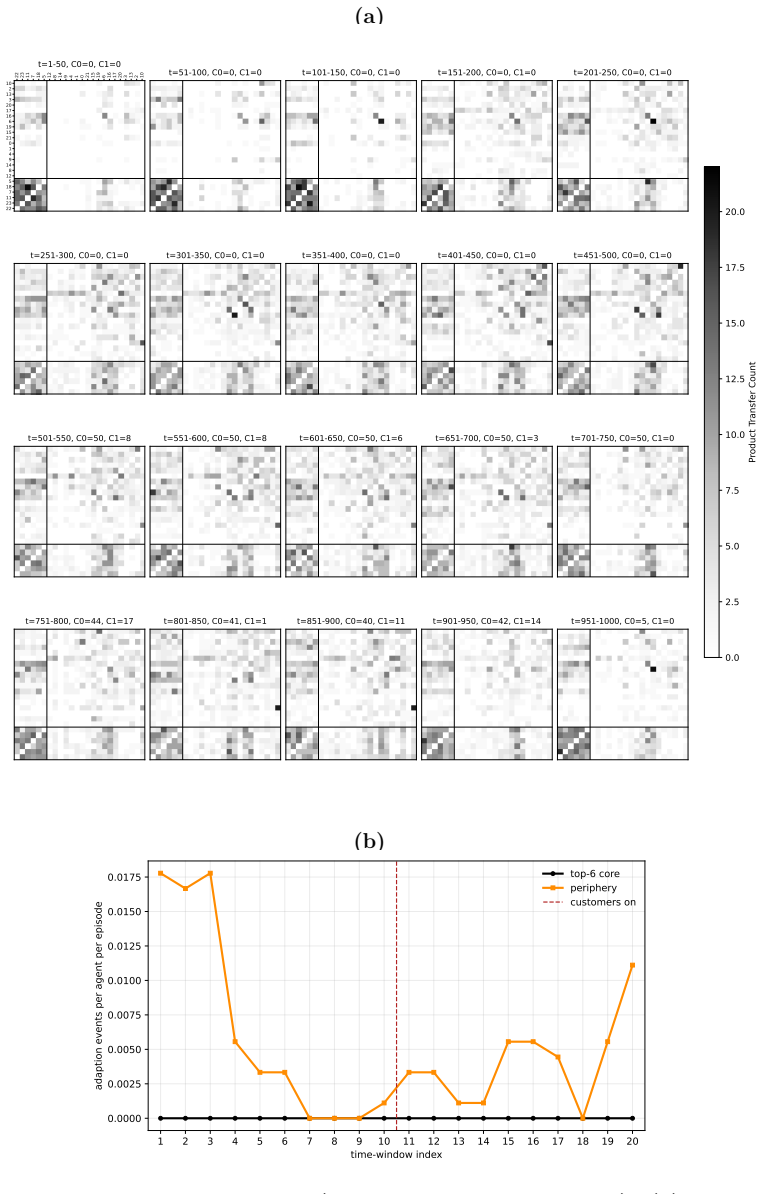
The authors argue that local functional utilization feedback is sufficient for components to self-organize into persistent interaction networks, including stable transformation chains and core-periphery architecture, while also generating novel states that enable previously unreachable conditions; these networks arise even in the absence of external selection pressures, thereby creating a pre-adaptive search phase from which functional solutions can later emerge.
What carries the argument
The minimal multi-agent model in which agents transform shared resources and receive local feedback exclusively when their outputs are subsequently utilized by other agents.
If this is right
- Stable transformation chains form through repeated local utilization events.
- Core-periphery organization appears spontaneously in the interaction network.
- Novel states are produced that allow the system to reach target conditions inaccessible before.
- Self-sustaining networks develop without any external selection pressure.
- A pre-adaptive exploration phase precedes the emergence of functional solutions.
Where Pith is reading between the lines
- The same local rule could be tested in chemical reaction networks or economic models to check whether unused components are preferentially modified.
- Adding spatial embedding or stochastic noise to the model might reveal whether chain formation remains robust under more realistic conditions.
- In neural or genetic systems this mechanism could predict that rarely used connections or pathways are more likely to be rewired or lost over time.
- Extensions that vary the number of agents or resource types could show the range of system sizes in which the organization persists.
Load-bearing premise
That the specific adaptation rules and resource-sharing mechanics chosen for this minimal model suffice to demonstrate the general Surviving by Serving principle rather than producing organization through model-specific artifacts.
What would settle it
Running the simulation after removing the local utilization feedback signal and checking whether transformation chains and core-periphery organization still appear or whether the agents remain in an unstructured, non-functional state.
Figures
read the original abstract
Complex adaptive systems often develop organized structures without centralized control. Yet the local mechanisms by which functional organization emerges and persists remain incompletely understood. Here we propose Surviving by Serving (SBS) as a general principle of self-organization: components persist as long as their outputs are utilized by other components, whereas prolonged non-utilization promotes adaptation and exploration. To investigate this idea, we introduce a minimal multi-agent model in which agents transform shared resources and receive only local feedback when their outputs are subsequently utilized elsewhere in the system. Despite the absence of global objectives, the system spontaneously self-organizes into functional interaction networks. We observe the emergence of stable transformation chains, core-periphery organization, and the generation of novel states that enable previously inaccessible target conditions to be reached. Remarkably, self-sustaining interaction networks can arise even without external selection pressures, creating a pre-adaptive search phase from which later functional solutions emerge. These findings suggest that functional utilization may provide a simple, substrate-independent mechanism for the emergence and stabilization of organized structure in complex adaptive systems.
Editorial analysis
A structured set of objections, weighed in public.
Referee Report
Summary. The paper proposes 'Surviving by Serving' (SBS) as a general principle of self-organization in complex adaptive systems: components persist when their outputs are utilized by others, while non-utilization drives adaptation. It introduces a minimal multi-agent model in which agents transform shared resources and receive only local feedback on utilization. The abstract claims that, without global objectives or external selection, the system spontaneously forms stable transformation chains, core-periphery structures, and novel states enabling new target conditions, suggesting functional utilization as a substrate-independent mechanism.
Significance. If the minimal model rigorously demonstrates that local utilization feedback alone suffices for the reported structures in a manner independent of specific implementation details, the result would offer a simple, falsifiable mechanism for functional organization with potential relevance to biological, ecological, and artificial systems. The absence of external selection and the pre-adaptive search phase are conceptually attractive strengths. However, without equations, parameters, or quantitative results, the significance cannot yet be assessed.
major comments (1)
- [Abstract / Model description] Abstract / Model section: The central claim that 'local utilization feedback alone produces self-organization (stable chains, core-periphery, novel states) in a substrate-independent manner' cannot be evaluated because the manuscript provides no equations defining agent transformation rules, resource sharing mechanics, the precise definition of 'utilized', adaptation/exploration rules, or any simulation parameters and quantitative outcomes. This is load-bearing for the general SBS principle, as the skeptic correctly notes that unstated details could generate the structures via model-specific dynamics rather than the proposed mechanism.
Simulated Author's Rebuttal
We thank the referee for their thoughtful review and for highlighting the need for greater transparency in the model specification. We agree that the absence of explicit equations, parameters, and quantitative results in the submitted manuscript prevents full evaluation of the central claims. We will revise the manuscript accordingly.
read point-by-point responses
-
Referee: [Abstract / Model description] Abstract / Model section: The central claim that 'local utilization feedback alone produces self-organization (stable chains, core-periphery, novel states) in a substrate-independent manner' cannot be evaluated because the manuscript provides no equations defining agent transformation rules, resource sharing mechanics, the precise definition of 'utilized', adaptation/exploration rules, or any simulation parameters and quantitative outcomes. This is load-bearing for the general SBS principle, as the skeptic correctly notes that unstated details could generate the structures via model-specific dynamics rather than the proposed mechanism.
Authors: We fully agree that the model must be specified in sufficient detail for the claims to be evaluated. The submitted version omitted the formal description of the agent update rules, the precise definition of utilization feedback, the resource transformation function, the adaptation mechanism, and the simulation parameters. In the revision we will add a dedicated Model section containing: (i) the mathematical definition of each agent's transformation rule and the shared resource vector; (ii) the local utilization signal and its update rule; (iii) the exploration/adaptation rule (including any stochastic component); (iv) all numerical parameters and initial conditions; and (v) quantitative metrics (e.g., chain stability, core-periphery indices, novelty counts) with statistical summaries across runs. These additions will allow readers to verify that the reported structures emerge from the local feedback rule rather than from hidden implementation choices. revision: yes
Circularity Check
No circularity: model implements stated principle without reduction to fitted inputs or self-citations
full rationale
The provided text (abstract and description) introduces SBS as a conceptual principle defined by local utilization feedback and adaptation on non-utilization, then describes a minimal multi-agent model explicitly built to embody that rule. No equations, parameter-fitting procedures, self-citations, or uniqueness theorems are present that would allow any result to reduce to its inputs by construction. The observed self-organization is a direct consequence of the implemented rules rather than a tautological renaming or fitted prediction, making the derivation self-contained as a simulation demonstration.
Axiom & Free-Parameter Ledger
Reference graph
Works this paper leans on
-
[1]
More is different: broken symmetry and the nature of the hierarchical structure of science.Science, 177(4047):393–396, 1972
Philip W Anderson. More is different: broken symmetry and the nature of the hierarchical structure of science.Science, 177(4047):393–396, 1972
1972
-
[2]
Complex adaptive systems.Daedalus, 121(1):17–30, 1992
John H Holland. Complex adaptive systems.Daedalus, 121(1):17–30, 1992
1992
-
[3]
Oxford university press, 2009
Melanie Mitchell.Complexity: A guided tour. Oxford university press, 2009
2009
-
[4]
Network science.Philosophical Transactions of the Royal Society A: Mathematical, Physical and Engineering Sciences, 371(1987):20120375, 2013
Albert-L´ aszl´ o Barab´ asi. Network science.Philosophical Transactions of the Royal Society A: Mathematical, Physical and Engineering Sciences, 371(1987):20120375, 2013
1987
-
[5]
Self-organization in biological systems
Scott Camazine, Jean-Louis Deneubourg, Guy Theraula, James Sneyd, and Nigel R Franks. Self-organization in biological systems. Princeton university press, 2020
2020
-
[6]
Springer Science & Business Media, 2012
Manfred Eigen and Peter Schuster.The hypercycle: a principle of natural self-organization. Springer Science & Business Media, 2012
2012
-
[7]
The origins of order: Self-organization and selection in evolution
Stuart A Kauffman. The origins of order: Self-organization and selection in evolution. InSpin glasses and biology, pages 61–100. World Scientific, 1992
1992
-
[8]
Autocatalytic networks at the basis of life’s origin and organiza- tion.Life, 8(4):62, 2018
Wim Hordijk and Mike Steel. Autocatalytic networks at the basis of life’s origin and organiza- tion.Life, 8(4):62, 2018
2018
-
[9]
Springer Science & Business Media, 2012
Humberto R Maturana and Francisco J Varela.Autopoiesis and cognition: The realization of the living. Springer Science & Business Media, 2012
2012
-
[10]
Biological autonomy.A philo, 14, 2015
Alvaro Moreno and Matteo Mossio. Biological autonomy.A philo, 14, 2015
2015
-
[11]
Biological organisation as closure of constraints.Journal of theoretical biology, 372:179–191, 2015
Ma¨ el Mont´ evil and Matteo Mossio. Biological organisation as closure of constraints.Journal of theoretical biology, 372:179–191, 2015
2015
-
[12]
Springer, Berlin, 1979
Manfred Eigen and Peter Schuster.The Hypercycle: A Principle of Natural Self-Organization. Springer, Berlin, 1979
1979
-
[13]
Kauffman.The Origins of Order: Self-Organization and Selection in Evolution
Stuart A. Kauffman.The Origins of Order: Self-Organization and Selection in Evolution. Oxford University Press, New York, 1993
1993
-
[14]
Detecting autocatalytic, self-sustaining sets in chemical reaction systems.Journal of Theoretical Biology, 227(4):451–461, 2004
Wim Hordijk and Mike Steel. Detecting autocatalytic, self-sustaining sets in chemical reaction systems.Journal of Theoretical Biology, 227(4):451–461, 2004
2004
-
[15]
The structure of autocatalytic sets: Evolvabil- ity, enablement, and emergence.Acta Biotheoretica, 60(4):379–392, 2012
Wim Hordijk, Mike Steel, and Stuart Kauffman. The structure of autocatalytic sets: Evolvabil- ity, enablement, and emergence.Acta Biotheoretica, 60(4):379–392, 2012
2012
-
[16]
Maturana and Francisco J
Humberto R. Maturana and Francisco J. Varela.Autopoiesis and Cognition: The Realization of the Living. D. Reidel Publishing Company, Dordrecht, 1980
1980
-
[17]
Varela.Principles of Biological Autonomy
Francisco J. Varela.Principles of Biological Autonomy. North-Holland, New York, 1979
1979
-
[18]
The computational boundary of a “self”: developmental bioelectricity drives multicellularity and scale-free cognition.Frontiers in psychology, 10:493866, 2019
Michael Levin. The computational boundary of a “self”: developmental bioelectricity drives multicellularity and scale-free cognition.Frontiers in psychology, 10:493866, 2019. 20
2019
-
[19]
Michael Levin. Life, death, and self: Fundamental questions of primitive cognition viewed through the lens of body plasticity and synthetic organisms.Biochemical and Biophysical Re- search Communications, 564:114–133, 2021
2021
-
[20]
Artificial life: organization, adaptation and complexity from the bottom up
Mark A Bedau. Artificial life: organization, adaptation and complexity from the bottom up. Trends in cognitive sciences, 7(11):505–512, 2003
2003
-
[21]
Adam Smith.An Inquiry into the Nature and Causes of the Wealth of Nations. W. Strahan and T. Cadell, London, 1776
-
[22]
Friedrich A. Hayek. The use of knowledge in society.The American Economic Review, 35(4):519– 530, 1945
1945
-
[23]
Borgatti and Martin G
Stephen P. Borgatti and Martin G. Everett. Models of core/periphery structures.Social Net- works, 21(4):375–395, 1999
1999
-
[24]
Structure and dynamics of core/periphery networks.Journal of Complex Networks, 1(2):93–123, 2013
Peter Csermely, Andras London, Ling-Yun Wu, and Brian Uzzi. Structure and dynamics of core/periphery networks.Journal of Complex Networks, 1(2):93–123, 2013
2013
-
[25]
Brian Arthur
W. Brian Arthur. Foundations of complexity economics.Nature Reviews Physics, 3:136–145, 2021
2021
-
[26]
Agent-based computational economics: Growing economies from the bottom up.Artificial Life, 8(1):55–82, 2002
Leigh Tesfatsion. Agent-based computational economics: Growing economies from the bottom up.Artificial Life, 8(1):55–82, 2002
2002
-
[27]
Epstein and Robert Axtell.Growing Artificial Societies: Social Science from the Bottom Up
Joshua M. Epstein and Robert Axtell.Growing Artificial Societies: Social Science from the Bottom Up. MIT Press, Cambridge, MA, 1996
1996
-
[28]
Stephen Jay Gould and Elisabeth S. Vrba. Exaptation–a missing term in the science of form. Paleobiology, 8(1):4–15, 1982
1982
-
[29]
Kauffman.Investigations
Stuart A. Kauffman.Investigations. Oxford University Press, New York, 2000
2000
-
[30]
Brian Arthur.The Nature of Technology: What It Is and How It Evolves
W. Brian Arthur.The Nature of Technology: What It Is and How It Evolves. Free Press, New York, 2009
2009
-
[31]
echo state
Herbert Jaeger. The “echo state” approach to analysing and training recurrent neural networks- with an erratum note.Bonn, Germany: German National Research Center for Information Technology GMD Technical Report, 148(34):13, 2001
2001
-
[32]
Real-time computing without stable states: A new framework for neural computation based on perturbations.Neural compu- tation, 14(11):2531–2560, 2002
Wolfgang Maass, Thomas Natschl¨ ager, and Henry Markram. Real-time computing without stable states: A new framework for neural computation based on perturbations.Neural compu- tation, 14(11):2531–2560, 2002
2002
-
[33]
Reservoir computing approaches to recurrent neural network training.Computer Science Review, 3(3):127–149, 2009
Mantas Lukoˇ seviˇ cius and Herbert Jaeger. Reservoir computing approaches to recurrent neural network training.Computer Science Review, 3(3):127–149, 2009
2009
-
[34]
Analysis of structure and dynamics in three-neuron motifs.Frontiers in Computational Neuroscience, 13:5, 2019
Patrick Krauss, Alexandra Zankl, Achim Schilling, Holger Schulze, and Claus Metzner. Analysis of structure and dynamics in three-neuron motifs.Frontiers in Computational Neuroscience, 13:5, 2019
2019
-
[35]
Recurrence resonance” in three-neuron motifs.Frontiers in computational neuroscience, 13, 2019
Patrick Krauss, Karin Prebeck, Achim Schilling, and Claus Metzner. Recurrence resonance” in three-neuron motifs.Frontiers in computational neuroscience, 13, 2019
2019
-
[36]
Weight statistics controls dynamics in recurrent neural networks.PloS one, 14(4):e0214541, 2019
Patrick Krauss, Marc Schuster, Verena Dietrich, Achim Schilling, Holger Schulze, and Claus Met- zner. Weight statistics controls dynamics in recurrent neural networks.PloS one, 14(4):e0214541, 2019. 21
2019
-
[37]
Claus Metzner and Patrick Krauss. Dynamical phases and resonance phenomena in information- processing recurrent neural networks.arXiv preprint arXiv:2108.02545, 2021
arXiv 2021
-
[38]
Dynamics and information import in recurrent neural net- works.Frontiers in Computational Neuroscience, 16, 2022
Claus Metzner and Patrick Krauss. Dynamics and information import in recurrent neural net- works.Frontiers in Computational Neuroscience, 16, 2022
2022
-
[39]
Quan- tifying and maximizing the information flux in recurrent neural networks.Neural Computation, 36(3):351–384, 2024
Claus Metzner, Marius E Yamakou, Dennis Voelkl, Achim Schilling, and Patrick Krauss. Quan- tifying and maximizing the information flux in recurrent neural networks.Neural Computation, 36(3):351–384, 2024
2024
-
[40]
Recurrence resonance- noise-enhanced dynamics in recurrent neural networks.Frontiers in Complex Systems, 2:1479417, 2024
Claus Metzner, Achim Schilling, Andreas Maier, and Patrick Krauss. Recurrence resonance- noise-enhanced dynamics in recurrent neural networks.Frontiers in Complex Systems, 2:1479417, 2024
2024
-
[41]
Nonlinear neural dynamics and classification accuracy in reservoir computing.Neural Computation, 37(8):1469–1504, 2025
Claus Metzner, Achim Schilling, Andreas Maier, and Patrick Krauss. Nonlinear neural dynamics and classification accuracy in reservoir computing.Neural Computation, 37(8):1469–1504, 2025
2025
-
[42]
Organizational regularities in recurrent neural networks.Frontiers in Complex Systems, 3:1636222, 2025
Claus Metzner, Achim Schilling, Andreas Maier, and Patrick Krauss. Organizational regularities in recurrent neural networks.Frontiers in Complex Systems, 3:1636222, 2025
2025
-
[43]
Sorn: a self-organizing recurrent neural network.Frontiers in Computational Neuroscience, 3:23, 2009
Andreea Lazar, Gordon Pipa, and Jochen Triesch. Sorn: a self-organizing recurrent neural network.Frontiers in Computational Neuroscience, 3:23, 2009
2009
-
[44]
Rumelhart, Geoffrey E
David E. Rumelhart, Geoffrey E. Hinton, and Ronald J. Williams. Learning representations by back-propagating errors.Nature, 323(6088):533–536, 1986
1986
-
[45]
Surviving by Serv- ing
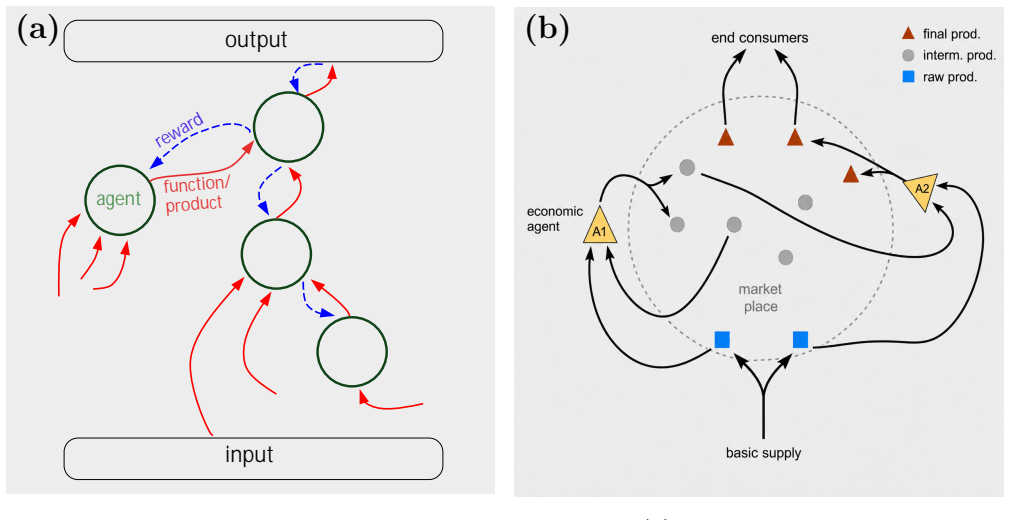
Yann LeCun, Yoshua Bengio, and Geoffrey Hinton. Deep learning.nature, 521(7553):436–444, 2015. 22 output input agent function/ product reward (a) (b) Figure 1:Main idea and adaptive interaction network. (a)Principle of “Surviving by Serv- ing”: Components or agents (green) receive local reinforcement signals (blue) when their outputs, functions, or states...
2015
discussion (0)
Sign in with ORCID, Apple, or X to comment. Anyone can read and Pith papers without signing in.