Optimal Design of Tubular Perfectly Conducting Objects in Electromagnetic Chirality
Pith reviewed 2026-07-01 01:16 UTC · model grok-4.3
The pith
Newton-type shape optimization of tubular perfectly conducting objects maximizes their electromagnetic chirality.
A machine-rendered reading of the paper's core claim, the machinery that carries it, and where it could break.
Core claim
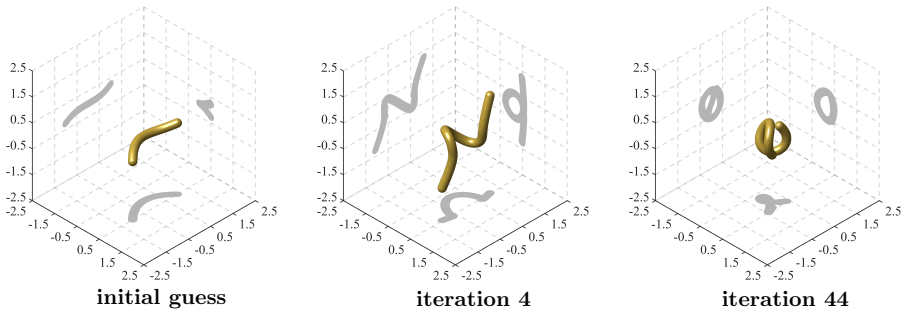
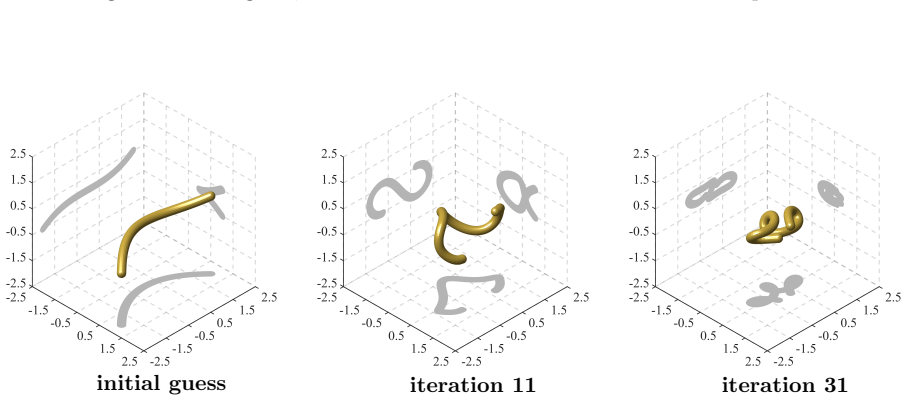
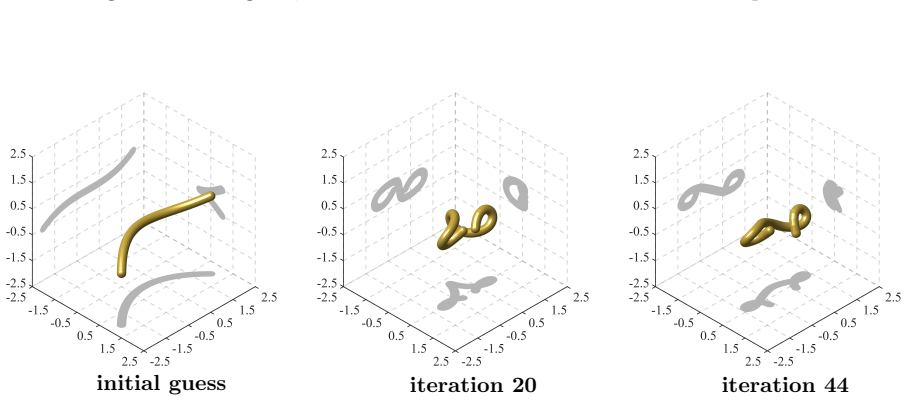
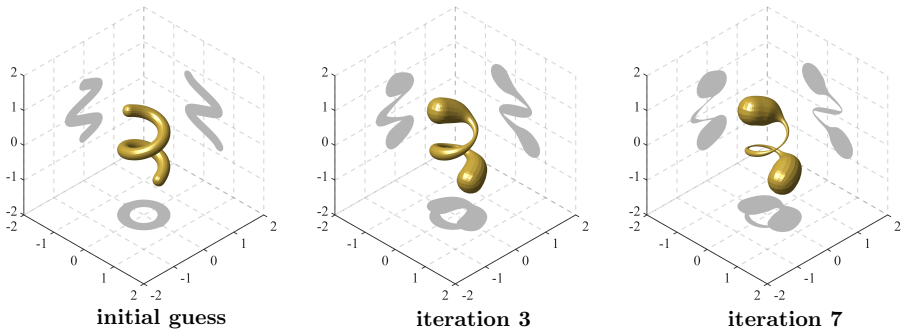
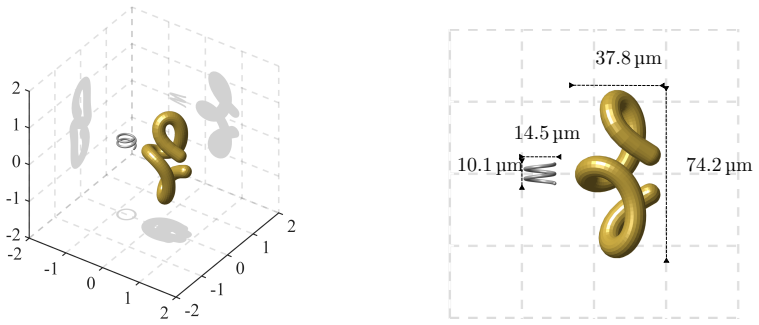
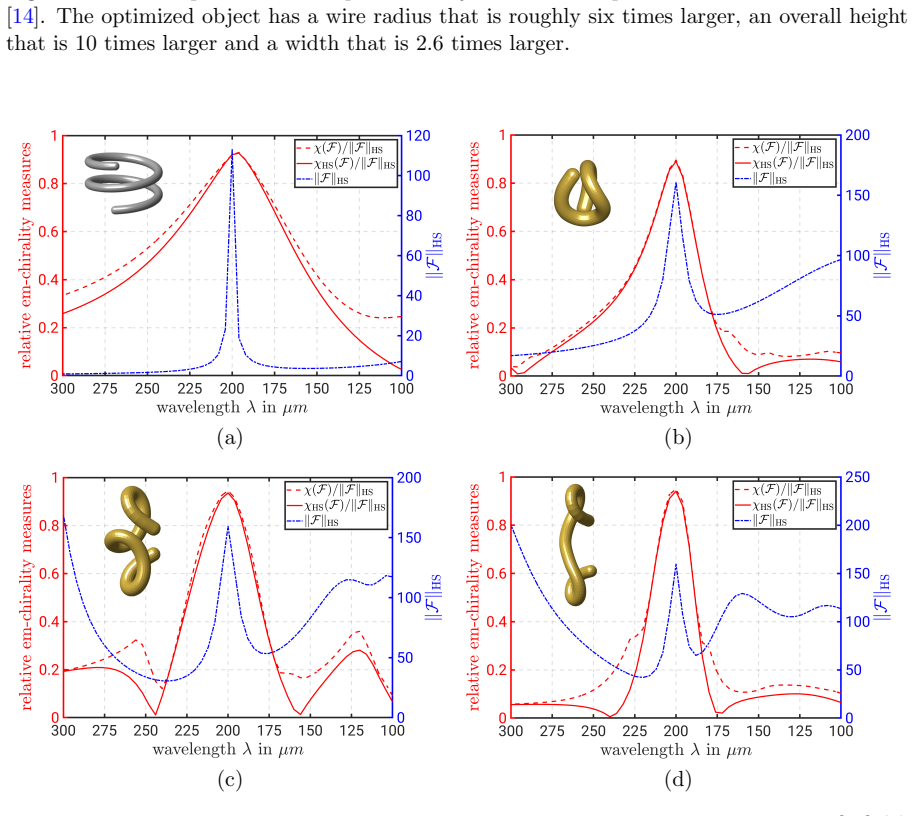
By applying a Newton-type iterative maximization of a regularized em-chirality measure with respect to the scatterer's shape, using the domain derivative of the far-field operator obtained from the electric field integral equation, the approach yields strongly em-chiral tubular scattering objects capable of exciting higher-order modes beyond the dipole regime with nonintuitive shapes that expand the known set of highly em-chiral objects.
What carries the argument
The domain derivative of the object-to-far-field operator for the electric field integral equation on tubular perfectly conducting domains, which supplies the gradient information for the Newton iteration maximizing the em-chirality functional.
If this is right
- The optimized tubular shapes achieve strong em-chirality while exciting modes beyond the dipole approximation.
- The differentiability analysis extends previously known domain derivative results specifically to the far-field operator.
- The boundary element method implementation evaluates both the scattered fields and their shape derivatives in the same framework.
- The resulting objects expand the catalog of known highly em-chiral scatterers with nonintuitive geometries.
Where Pith is reading between the lines
- The same derivative-based iteration could be adapted to optimize chirality in non-tubular or finite-length scatterers.
- The nonintuitive optimal shapes suggest that manual or intuition-driven design will miss many high-chirality configurations.
- Applications in polarization-selective antennas or sensors would follow directly if the tubular constraint is relaxed.
Load-bearing premise
The object-to-far-field operator map is differentiable with respect to shape changes for tubular perfectly conducting scatterers.
What would settle it
A concrete tubular shape for which a small boundary perturbation produces a discontinuous change in the far-field pattern, or for which the Newton iteration diverges because the derivative does not exist.
Figures
read the original abstract
This work is about the shape optimization of long tubular objects in electromagnetic chirality (em-chirality). Em-chirality is a property of individual scattering objects or metamaterials describing their qualitatively different response to electromagnetic waves of opposite polarization handedness. The optimization is performed by a Newton-type iterative maximization of a regularized em-chirality measure with respect to the scatterer's shape. In this context, the differentiability of the object-to-far field operator map is analyzed rigorously, thereby extending previously known results on the domain derivative to the far field operator setting. Our optimal design algorithm is based on the electric field integral equation, which is employed both for the evaluation of scattered fields and for the computation of the domain derivative. Our implementation is done via the boundary element method. The numerical examples presented in this work yield strongly em-chiral scattering objects capable of exciting higher-order modes beyond the dipole regime with nonintuitive shapes that expand the known set of highly em-chiral scattering objects.
Editorial analysis
A structured set of objections, weighed in public.
Referee Report
Summary. The manuscript develops a shape optimization framework for long tubular perfectly conducting (PEC) scatterers aimed at maximizing electromagnetic chirality. It employs a Newton-type iterative algorithm driven by a regularized em-chirality functional, with the electric field integral equation (EFIE) used both to evaluate scattered fields and to compute shape derivatives; the implementation relies on the boundary element method (BEM). The central theoretical contribution is a claimed rigorous extension of prior domain-derivative results to establish differentiability of the object-to-far-field operator map under the tubular PEC setting. Numerical examples are presented that purportedly produce nonintuitive shapes capable of exciting higher-order modes beyond the dipole regime.
Significance. If the differentiability result is valid for the specific tubular geometries and the numerical designs are reproducible with quantitative validation, the work would supply a systematic computational tool for generating em-chiral scatterers that go beyond dipole approximations, thereby enlarging the catalog of known highly chiral objects in scattering theory.
major comments (2)
- [Differentiability analysis] The differentiability analysis (abstract and the section extending domain derivatives): the extension to the far-field operator for long thin tubular PEC objects must explicitly address the high aspect-ratio geometry, end effects, and the trace operator under BEM discretization with the chosen regularization of the chirality measure. Without such coverage, the shape gradients supplied to the Newton iteration are not guaranteed to be well-defined, undermining the reported optimal designs.
- [Numerical examples] Numerical examples section: the central claim that the computed shapes are strongly em-chiral and excite higher-order modes rests on unshown examples. No convergence data with respect to mesh refinement, no error bars on the chirality values, and no direct comparison against known chiral reference objects are provided, so the reliability and novelty of the designs cannot be assessed.
minor comments (1)
- [Abstract] The abstract states that the differentiability result is 'analyzed rigorously' yet does not indicate the precise theorem or section containing the proof.
Simulated Author's Rebuttal
We thank the referee for the constructive comments, which help improve the clarity and rigor of our work on shape optimization for em-chiral tubular PEC scatterers. We address each major point below and will revise the manuscript accordingly.
read point-by-point responses
-
Referee: The differentiability analysis (abstract and the section extending domain derivatives): the extension to the far-field operator for long thin tubular PEC objects must explicitly address the high aspect-ratio geometry, end effects, and the trace operator under BEM discretization with the chosen regularization of the chirality measure. Without such coverage, the shape gradients supplied to the Newton iteration are not guaranteed to be well-defined, undermining the reported optimal designs.
Authors: Our differentiability result extends prior domain-derivative theory for the EFIE to the far-field operator map under the tubular PEC constraint. The analysis relies on the well-posedness of the EFIE for high-aspect-ratio scatterers and the continuity properties of the trace operator in the chosen Sobolev spaces. Nevertheless, to address the referee's concern directly, we will add an explicit subsection in the revised manuscript that discusses the high-aspect-ratio limit, end-effect estimates, and the compatibility of the regularization with BEM discretization, thereby confirming that the shape gradients remain well-defined for the Newton scheme. revision: yes
-
Referee: Numerical examples section: the central claim that the computed shapes are strongly em-chiral and excite higher-order modes rests on unshown examples. No convergence data with respect to mesh refinement, no error bars on the chirality values, and no direct comparison against known chiral reference objects are provided, so the reliability and novelty of the designs cannot be assessed.
Authors: We agree that quantitative validation is essential. In the revised version we will augment the numerical section with mesh-refinement convergence tables for the chirality functional, include error estimates or standard deviations on the reported values, and add direct comparisons against reference chiral objects (e.g., helical and twisted-tube benchmarks) to substantiate both the reliability of the optimizer and the novelty of the obtained nonintuitive shapes. revision: yes
Circularity Check
No circularity: optimization driven by external functional with independent differentiability analysis
full rationale
The derivation chain consists of defining an em-chirality measure, formulating its maximization via Newton iteration on the EFIE, proving differentiability of the shape-to-far-field map by extending domain-derivative results within the present work, and obtaining numerical shapes via BEM discretization. None of these steps reduce to self-definition, fitted inputs renamed as predictions, or load-bearing self-citations that render the outputs tautological; the reported shapes and mode excitations are genuine outputs of the optimization procedure applied to an externally defined functional. The paper is therefore self-contained against external benchmarks with no circular reduction.
Axiom & Free-Parameter Ledger
free parameters (1)
- regularization parameter
axioms (1)
- domain assumption The object-to-far field operator map is differentiable with respect to shape perturbations for perfectly conducting tubular scatterers.
Reference graph
Works this paper leans on
-
[1]
T. Arens, R. Griesmaier, and M. Kn¨ oller. Maximizing the electromagnetic chirality of thin dielectric tubes.SIAM J. Appl. Math., 81(5):1979–2006, 2021.doi:10.1137/21M1393509
-
[2]
T. Arens, F. Hagemann, F. Hettlich, and A. Kirsch. The definition and measurement of electro- magnetic chirality.Math. Methods Appl. Sci., 41(2):559–572, 2018.doi:10.1002/mma.4628
-
[3]
T. Arens, M. Kn¨ oller, and R. Schurr. Inverse electromagnetic scattering problems for long tubular objects.SIAM J. Sci. Comp., 48(1):A185–A208, 2026.doi:10.1137/24M1687108
-
[4]
A. Ben-Moshe, B. M. Maoz, A. O. Govorov, and G. Markovich. Chirality and chiroptical effects in inorganic nanocrystal systems with plasmon and exciton resonances.Chem. Soc. Rev., 42:7028–7041, 2013.doi:10.1039/C3CS60139K
-
[5]
T. Betcke and M. W. Scroggs. Bempp-cl: A fast Python based just-in-time compiling boundary element library.Journal of Open Source Software, 6(59):2879, 2021.doi:10.21105/joss.02879
-
[6]
A. Buffa, M. Costabel, and D. Sheen. On traces forH(curl,Ω) in Lipschitz domains.J. Math. Anal. Appl., 276(2):845–867, 2002.doi:10.1016/S0022-247X(02)00455-9
-
[7]
A. Buffa and R. Hiptmair. Galerkin boundary element methods for electromagnetic scattering. Topics in Computational Wave Propagation, Lect. Notes Comput. Sci. Eng, 31:85–126, 01 2003. doi:10.1007/978-3-642-55483-4_3
-
[8]
A. Buffa and R. Hiptmair. A coercive combined field integral equation for electromagnetic scattering. SIAM J. Num. Anal., 42(2):621–640, 2004.doi:10.1137/S0036142903423393
-
[9]
Buffa, R
A. Buffa, R. Hiptmair, T. von Petersdorff, and C. Schwab. Boundary element methods for Maxwell equations in Lipschitz domains.SAM Research Report 2001-05, 2001.doi:10.3929/ ethz-a-004288266
2001
-
[10]
Y. Capdeboscq, R. Griesmaier, and M. Kn¨ oller. An asymptotic representation formula for scatter- ing by thin tubular structures and an application in inverse scattering.Multiscale Model. Simul., 19(2):846–885, 2021.doi:10.1137/20M1369907
-
[11]
D. Colton and R. Kress.Inverse acoustic and electromagnetic scattering theory. Applied mathe- matical sciences 93. Springer, Cham, 4th edition, 2019.doi:10.1007/978-3-030-30351-8. [12]NIST Digital Library of Mathematical Functions.https://dlmf.nist.gov/, Release 1.2.7 of 2026- 06-15. F. W. J. Olver, A. B. Olde Daalhuis, D. W. Lozier, B. I. Schneider, R. F...
-
[12]
Dunford and J
N. Dunford and J. Schwartz.Linear operators. Part II. Wiley Classics Library. John Wiley & Sons, Inc., New York, 1988
1988
-
[13]
I. Fernandez-Corbaton, M. Fruhnert, and C. Rockstuhl. Objects of maximum electromagnetic chirality.Phys. Rev. X, 6(3):031013, 2016.doi:10.1103/physrevx.6.031013
-
[14]
I. Fernandez-Corbaton, R. Griesmaier, M. Kn¨ oller, and C. Rockstuhl. Maximizing the electromag- netic chirality of thin metallic nanowires at optical frequencies.J. Comput. Phys., 475:111854, 23, 2023.doi:10.1016/j.jcp.2022.111854
-
[15]
I. Fernandez-Corbaton, C. Rockstuhl, P. Ziemke, P. Gumbsch, A. Albiez, R. Schwaiger, T. Fren- zel, M. Kadic, and M. Wegener. New twists of 3d chiral metamaterials.Advanced Materials, 31(26):1807742, 2019.doi:10.1002/adma.201807742
-
[16]
The optical helicity in a more algebraic approach to electromagnetism
Fernandez-Corbaton, Ivan. The optical helicity in a more algebraic approach to electromagnetism. Photoniques, (113):54–58, 2022.doi:10.1051/photon/202111354. 25
-
[17]
J. K. Gansel, M. Latzel, A. Fr¨ olich, J. Kaschke, M. Thiel, and M. Wegener. Tapered gold-helix metamaterials as improved circular polarizers.Applied Physics Letters, 100(10):101109, 03 2012. doi:10.1063/1.3693181
-
[18]
J. K. Gansel, M. Thiel, M. S. Rill, M. Decker, K. Bade, V. Saile, G. von Freymann, S. Linden, and M. Wegener. Gold helix photonic metamaterial as broadband circular polarizer.Science, 325(5947):1513–1515, 2009.doi:10.1126/science.1177031
-
[19]
X. Garcia-Santiago, M. Hammerschmidt, J. Sachs, S. Burger, H. Kwon, M. Kn¨ oller, T. Arens, P. Fis- cher, I. Fernandez-Corbaton, and C. Rockstuhl. Toward maximally electromagnetically chiral scat- terers at optical frequencies.ACS Photonics, 9(6):1954–1964, 2022.doi:10.1021/acsphotonics. 1c01887
-
[20]
R. Griesmaier and J. Sylvester. Uncertainty principles for inverse source problems for electromag- netic and elastic waves.Inverse Problems, 34(6):065003, 2018.doi:10.1088/1361-6420/aab45c
-
[22]
M. Hentschel, M. Sch¨ aferling, X. Duan, H. Giessen, and N. Liu. Chiral plasmonics.Science Advances, 3(5):e1602735, 2017.doi:10.1126/sciadv.1602735
-
[23]
F. Hettlich. The domain derivative of time-harmonic electromagnetic waves at interfaces.Math. Methods Appl. Sci., 35(14):1681–1689, 2012.doi:10.1002/mma.2548
-
[24]
P. B. Johnson and R. W. Christy. Optical constants of the noble metals.Phys. Rev. B, 6:4370–4379, Dec 1972.doi:10.1103/PhysRevB.6.4370
-
[25]
M. Kadic, G. W. Milton, M. van Hecke, and M. Wegener. 3d metamaterials.Nature Reviews Physics, 1(3):198–210, Mar 2019.doi:10.1038/s42254-018-0018-y
-
[26]
J. Kaschke and M. Wegener. Optical and infrared helical metamaterials.Nanophotonics, 5(4):510– 523, 2016.doi:doi:10.1515/nanoph-2016-0005
-
[27]
A. Kirsch and F. Hettlich.The Mathematical Theory of Time-Harmonic Maxwells Equations: Expansion-, Integral-, and Varionational Methods. Cham, 2015.doi:10.1007/978-3-319-11086-8
-
[28]
A. Kirsch and R. Kress. Uniqueness in inverse obstacle scattering.Inverse Problems, 9(2):285–299, 1993.doi:10.1088/0266-5611/9/2/009
-
[29]
M. Kn¨ oller.Electromagnetic scattering from thin tubular objects and an application in electromag- netic chirality. PhD thesis, Karlsruher Institut f¨ ur Technologie (KIT), 2023.doi:10.5445/IR/ 1000161368
work page doi:10.5445/ir/ 2023
-
[30]
J. Kraus. The helical antenna.Proceedings of the IRE, 37(3):263–272, 1949.doi:10.1109/JRPROC. 1949.231279
-
[31]
R. Kress. Uniqueness in inverse obstacle scattering for electromagnetic waves. InProceedings of the URSI General Assembly, 2002
2002
-
[32]
Li and M
D.-H. Li and M. Fukushima. On the global convergence of the BFGS method for nonconvex unconstrained optimization problems.SIAM J. Optim., 11(4):1054–1064, 2001.doi:10.1137/ S1052623499354242
2001
-
[33]
I. Lindell, A. Sihvola, and J. Kurkijarvi. Karl F. Lindman: the last Hertzian, and a harbinger of electromagnetic chirality.IEEE Antennas and Propagation Magazine, 34(3):24–30, June 1992. doi:10.1109/74.153530
-
[34]
R. A. Litherland, J. Simon, O. Durumeric, and E. Rawdon. Thickness of knots.Topology Appl., 91(3):233–244, 1999.doi:10.1016/S0166-8641(97)00210-1. 26
-
[35]
P. Monk.Finite element methods for Maxwells equations. Numerical mathematics and scientific computation, Oxford science publications. Clarendon Press, Oxford, 1st edition, 2003.doi:10. 1093/acprof:oso/9780198508885.001.0001
-
[36]
J. B. Pendry. A chiral route to negative refraction.Science, 306(5700):1353–1355, 2004.doi: 10.1126/science.1104467
-
[37]
Reed and B
M. Reed and B. Simon.Methods of modern mathematical physics. Academic Press, San Diego, Calif., rev. and enlarged ed. edition, 2010
2010
-
[38]
M. Sch¨ aferling, D. Dregely, M. Hentschel, and H. Giessen. Tailoring enhanced optical chirality: Design principles for chiral plasmonic nanostructures.Phys. Rev. X, 2:031010, Aug 2012.doi: 10.1103/PhysRevX.2.031010
-
[39]
R. Schurr.Inverse scattering problems and shape optimization with respect to electromagnetic chi- rality for long tubular objects. PhD thesis, Karlsruhe Institute of Technology (KIT), mar 2026. doi:10.5445/IR/1000191846
-
[40]
H. Urey, K. V. Chellappan, E. Erden, and P. Surman. State of the art in stereoscopic and autostereo- scopic displays.Proceedings of the IEEE, 99(4):540–555, 2011.doi:10.1109/JPROC.2010.2098351
-
[41]
W. Wang, B. J¨ uttler, D. Zheng, and Y. Liu. Computation of rotation minimizing frames.ACM Trans. Graph., 27(1):1–18, 2008.doi:10.1145/1330511.1330513
-
[42]
Z. Wang, F. Cheng, T. Winsor, and Y. Liu. Optical chiral metamaterials: a review of the fundamentals, fabrication methods and applications.Nanotechnology, 27(41):412001, sep 2016. doi:10.1088/0957-4484/27/41/412001
-
[43]
H. Wheeler. A helical antenna for circular polarization.Proceedings of the IRE, 35(12):1484–1488, 1947.doi:10.1109/JRPROC.1947.234573
-
[44]
C. Wu, H. Li, X. Yu, F. Li, H. Chen, and C. T. Chan. Metallic helix array as a broadband wave plate.Phys. Rev. Lett., 107:177401, Oct 2011.doi:10.1103/PhysRevLett.107.177401. 27
discussion (0)
Sign in with ORCID, Apple, or X to comment. Anyone can read and Pith papers without signing in.