REVIEW 4 major objections 4 minor 47 references
Modeling and Performance Analysis for Fluid Antenna System Enabled UAV Near-Field Communications
T0 review · 4 major / 4 minor · reviewed 2026-08-11 · deepseek-v4-flash
Pith's one-line read A greedy subarray partition makes near-field FAS-UAV channel modeling lightweight without losing non-uniform spatial accuracy.
desk verdict Equation (3) collapses the planar FAS onto a single ray, making the central model internally inconsistent; the subarray-partition idea is worth pursuing but the paper needs major revision. read the letter →
The pith
A machine-rendered reading of the paper's core claim, the machinery that carries it, and where it could break.
The reading
What carries the argument
The load-bearing object is the greedy subarray partition with aperture threshold $D_{\mathrm{sub}}$. Active ports are grouped so that any two ports in a subarray are separated by no more than $D_{\mathrm{sub}}$, with $D_{\mathrm{sub}}$ chosen below the maximum satisfying $D^{\mathrm{sub}}_{\max} < \sqrt{\lambda \xi_{\mathrm{sub},R}/2}$, the Rayleigh-distance condition that keeps the receiver in the far field of every subarray. This turns per-port spherical-wave phase computations into one shared distance and angle parameter set per subarray, so the CIR is evaluated once per group, the partition costs $O(P_h P_v + P_{\mathrm{act}}^2)$, and a port switch only triggers $O(\varepsilon)$ distance checks against existing subarray centers.
What would settle it
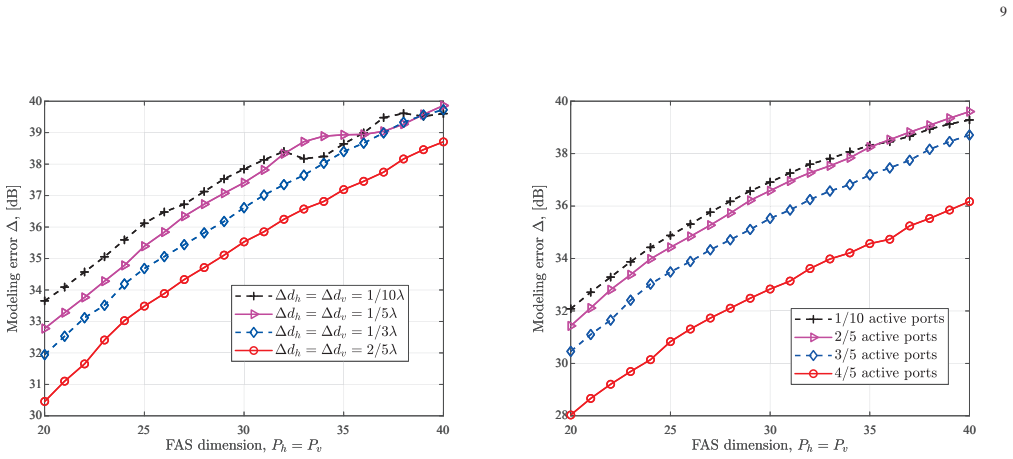
At the paper's simulation settings ($f_c = 5$ GHz, $H_0 = 20$ m, $D_0 = 60$ m, 50$\times$50 FAS with $\Delta d = 2/5\lambda$ and 3/5 active ports), compute the normalized modeling error $\Delta$ of (33) against an exact per-port spherical-wave channel for a sweep of $D_{\mathrm{sub}}$ values. If the error does not shrink toward zero as $D_{\mathrm{sub}}$ approaches one-port size and does not stay within a few decibels at the working $D_{\mathrm{sub}}$, the shared-parameter assumption collapses.
Extended reading notes
Core claim
The paper's central claim is that a planar FAS on a moving UAV can be modeled with near-field accuracy without computing a spherical-wave response for every active port. The channel is built as a sum of LoS and NLoS components, with a binary port-state matrix tracking which ports are active and UAV motion kinematics updating all geometry with time. The key move is to partition active ports into subarrays whose aperture satisfies the Rayleigh-distance bound $D_{\mathrm{sub}} < \sqrt{\lambda \xi_{\mathrm{sub},R}/2}$, so that within each subarray the planar-wave approximation holds and all ports share one representative distance and one set of departure/arrival angles. A greedy algorithm forms these subarrays, and a dynamic update rule lets a newly activated port join or create a subarray in $O(\varepsilon)$ time. Ports are chosen by maximum channel gain to skip deep fades, and the paper derives the normalized modeling error against a UPA baseline and the MIMO channel capacity. The reported simulations show the partitioned model tracks the spatially non-uniform near-field channel and that the partition induces only limited capacity loss.
Load-bearing premise
The load-bearing premise is that the planar-wave approximation inside each subarray is accurate enough for one distance and one angle to represent all ports in the group; the paper gives no bound on the phase error this introduces across the subarray aperture.
Editorial extensions
If this is right
- Port reconfiguration on a UAV FAS becomes fast enough for real-time tracking: each port switch costs $O(\varepsilon)$ rather than a full per-port spherical-wave recomputation.
- The threshold $D_{\mathrm{sub}}$ gives designers an explicit accuracy–complexity dial, with smaller subarrays approaching the spherical-wave model.
- The model makes the non-uniform near-field gain landscape of FAS visible, so capacity and diversity can be optimized over FAS physical parameters such as port spacing and activation ratio.
- The channel-gain selective activation predicts that a moderate active-port ratio (e.g., 3/5) beats all-port activation, because all-port activation includes deep-fading positions.
- Because the subarrays simply carry planar-wave phase while the overall geometry stays time-varying, the framework extends naturally to other mobile air-to-ground platforms beyond UAVs.
Reading between the lines
- Testable extension: comparing the proposed model against an exact per-port spherical-wave simulation, rather than the UPA baseline used in the paper, would quantify the true error of the shared-parameter assumption and validate where the accuracy boundary at the chosen $D_{\mathrm{sub}}$ holds.
- The greedy partition is scanning-order dependent; choosing the center port more cleverly could reduce the number of subarrays $\varepsilon$ further, cutting the dynamic update cost without changing $D_{\mathrm{sub}}$.
- Connecting neighbouring problems: the same subarray philosophy could be applied to FAS receiver arrays or to reconfigurable intelligent surfaces, where sparse activation makes fixed mechanical partitions inapplicable.
- A natural extension is to let $D_{\mathrm{sub}}$ adapt to the instantaneous UAV-to-user distance, giving a seamless handover between near-field and far-field regimes as the UAV flies.
Signed reviews
Editorial analysis
A structured set of objections, weighed in public.
Referee Report
Summary. The paper proposes a dynamic port-reconfigurable near-field channel model for FAS-assisted UAV-to-mobile-user links, combining LoS/NLoS decomposition with UAV motion and a binary port activation matrix. It also introduces a greedy subarray partition scheme with a dynamic update algorithm to reduce computational complexity, a maximum-gain port selection strategy, a modeling-accuracy metric against a UPA baseline, and a MIMO-style capacity analysis. Numerical results are presented for modeling error and channel capacity under varying FAS dimensions, port spacing, active port ratios, and UAV dynamics.
Significance. If the model were geometrically sound, the paper would offer a useful simulation and design tool for FAS-enabled UAV near-field links, and the greedy subarray scheme with explicit complexity analysis (O(PhPv + Pact^2) partition, O(epsilon) updates) is a practical contribution. The derivation of capacity formulas and the port selection strategy are standard but clearly presented. However, the central geometric definition in Eq. (3) collapses the intended planar port grid onto a single ray, which invalidates the claimed 2D non-uniform spatial distribution and calls into question all numerical results built on it. The modeling-accuracy metric in Eq. (33) is also internal to the modeling assumptions rather than a comparison to an exact spherical-wave model or measurements, so the central 'accurate characterization' claim is not established by the evidence provided.
major comments (4)
- [Sec. II, Eq. (3)] Equation (3) defines the port position as d_(ph,pv),T = k_ph,pv times a unit vector, where k_ph,pv = sqrt(k_ph^2 Delta d_h^2 + k_pv^2 Delta d_v^2) is a nonnegative scalar. Since every port offset is therefore a nonnegative multiple of the same unit vector, all Ph by Pv ports collapse onto a single ray from the FAS center; ports with equal k_ph,pv coincide, and no port lies on the opposite side of the center or in a perpendicular direction. For example, with P_h = P_v = 3 and zero orientation angles, the four corner ports all map to the same point on the positive x-axis, and the nine ports reduce to at most three distinct points. This is an internal inconsistency in the model, not a subarray approximation issue. The subsequent channel expressions, including the LoS CIR in Eq. (20), the NLoS CIR in Eq. (23), and the vectorized response in Eqs. (37)-(39), use separate horizontal and vertical offsets and therefore assume a genuine 2D planar array. As written, the claimed non-uniform 2D spatial distribution in the abstract and in Figures 4-13 cannot be produced by the model. This needs to be fixed by replacing Eq. (3) with a proper planar position vector, e.g., d_(ph,pv),T = [k_ph Delta d_h, k_pv Delta d_v, 0]^T in the FAS local frame before applying orientation rotations, and all subsequent results must be regenerated.
- [Sec. III-B, Eq. (33)] The modeling accuracy metric Delta in Eq. (33) compares the proposed FAS channel to a UPA channel model generated under the same assumptions and with the same subarray partition procedure. This does not measure accuracy against an exact spherical-wave model or against measured channels; it measures the difference between two model variants that share the same approximations. Consequently, the claim in the abstract that 'the proposed model accurately characterizes the non-uniform spatial distribution of near-field channels' is not supported by the reported modeling-error results. The authors should either compare against an exact per-port spherical-wave model (as a ground truth) or against measured data, and should provide an error bound, perhaps in terms of the maximum phase error across the subarray aperture, to justify the accuracy-complexity tradeoff.
- [Sec. II-A, Eq. (10) and Sec. II-B, Eq. (20)] The load-bearing premise of the subarray partition is that all ports within a subarray can share one distance and one angle parameter set because the subarray aperture satisfies the Rayleigh-distance bound D_sub < sqrt(lambda * xi / 2). However, this is asserted without an error bound on the intra-subarray phase variation. The Rayleigh distance is a heuristic far-field boundary, not a guarantee that the planar-wave approximation is accurate for the CIR phase terms in Eq. (20). For the claimed 'limited accuracy loss' relative to per-port spherical-wave processing, a quantitative bound is needed, e.g., bounding the maximum phase error across the subarray aperture as a function of D_sub, wavelength, and distance, and showing that this bound is small for the scenarios simulated. Without such a bound, the complexity-accuracy tradeoff is not demonstrated.
- [Sec. IV, Figs. 4-13] Because all numerical results are generated from the collapsed geometry in Eq. (3), the channel-gain distributions in Figures 4, the active-port patterns in Figure 5, and the modeling-error and capacity curves in Figures 6-13 do not correspond to any physical planar FAS. Even if the geometry is corrected, the simulations must be rerun, and the qualitative conclusions (e.g., dependence on port spacing and active-port ratio) may change. The current set of results therefore cannot be used to validate the model's claims.
minor comments (4)
- [Sec. II-B, Eq. (22)] The denominator of Eq. (22) uses (d^G_psub_sub,x(t) - d_p,x(t))^2, but d_p,x(t) is not defined in the context of a subarray; it should presumably be the subarray center coordinate. Please clarify the notation.
- [Sec. II-A, Algorithm 2] Algorithm 2 updates the subarray center when a new port is added, but the description does not specify how the center is recomputed (e.g., average of member ports or first port). This should be stated for reproducibility.
- [References] Reference [23] lists 'IEEE Wireless Commun. Lett.' twice in the same entry, and the venue information for [11] and [46] should be checked for duplicated journal names.
- [Throughout] Please correct typographical issues such as 'the the' in the text after Eq. (15), 'UA V' spacing artifacts, and 'the the components' in the lines following Eq. (22).
Circularity Check
No significant circularity; the modeling, subarray partition, and complexity claims are self-contained rather than fitted or citation-derived.
full rationale
The paper does not fit parameters to data and then rename the fit as a prediction. The channel model is constructed from explicit geometry, propagation phases, and stochastic scatterer distributions; the subarray partition is an algorithmic construction with an independently stated complexity accounting (Eqs. (13)-(15)); and the modeling-accuracy metric (Eq. (33)) compares the proposed FAS model against a UPA benchmark under the same subarray processing, which is a model-to-model consistency check rather than a circular reduction. Channel capacity uses the standard MIMO formula (Eq. (34)). Self-citations, such as the note that subarray-based complexity reduction was verified in prior MIMO/RIS studies, are motivational and not load-bearing because the complexity reduction is re-derived here. The most serious issue in the paper, Eq. (3), collapses the planar port grid onto a single ray and would undermine the claimed 2D non-uniform spatial distribution; however, that is an internal model-consistency or correctness defect, not a circular reduction of a prediction to its input, so it does not raise the circularity score.
Assumptions & free parameters
free parameters (6)
- Subarray aperture threshold D_sub =
not specified
- Active port ratio =
3/5
- FAS dimensions and port spacing =
Ph=Pv=50, Delta d = 2/5 lambda
- Rician factor K =
not specified
- Von Mises parameters (kappa, mu_alpha, mu_beta) =
not specified
- Cluster and scatterer counts (L, N) =
not specified
assumptions (7)
- domain assumption The Rayleigh distance L=2D^2/lambda is the correct near/far-field boundary, and enforcing D_sub < sqrt(lambda xi / 2) makes the far-field assumption valid within a subarray.
- ad hoc to paper All active ports within a subarray share identical distance and angle parameters relative to the receiver.
- domain assumption LoS and NLoS propagation paths are independent and combine through the Rician factor K.
- domain assumption Scatterer angular distributions follow von Mises distributions.
- standard math The standard MIMO capacity expression with equal power allocation applies to the FAS channel.
- domain assumption Mutual coupling can be neglected by setting C_FAS(t,tau)=I in numerical analysis.
- domain assumption The MU is low-mobility or quasi-static over a channel update interval.
Cite this review
Pith. "Pith review of Modeling and Performance Analysis for Fluid Antenna System Enabled UAV Near-Field Communications." pith.science (2026). https://pith.science/paper/MZJ7MV3N
@misc{pith2026260809179,
  author       = {Pith},
  title        = {Pith review of: Modeling and Performance Analysis for Fluid Antenna System Enabled UAV Near-Field Communications},
  year         = {2026},
  howpublished = {\url{https://pith.science/paper/MZJ7MV3N}},
  note         = {Machine review of arXiv:2608.09179}
}
read the original abstract
Fluid antenna systems (FASs) offer a promising solution for unmanned aerial vehicle (UAV) air-to-ground (A2G) communications by enabling reconfigurable radiation characteristics. Addressing the limitations of traditional models in capturing the dynamic port configuration of FAS and the near-field nature of UAV communications, this paper proposes a dynamic port-reconfigurable near-field channel model for FAS-assisted UAV-to-mobile user (MU) links. Furthermore, we develop a FAS-adaptive subarray partition scheme utilizing a greedy strategy. By decomposing line-of-sight (LoS) and non-line-of-sight (NLoS) components and integrating UAV motion dynamics with FAS port activation states, the proposed model accurately characterizes the non-uniform spatial distribution of near-field channels. The subarray partition scheme dynamically groups active ports to satisfy near-field conditions while significantly reducing computational complexity, supported by a dynamic update algorithm that efficiently handles subarray adjustments during port switching. To avoid low effective gain and deep-fading ports in dense FAS configurations, a channel gain-based selection strategy is employed to prioritize high-gain ports. We derive and analyze the modeling accuracy and channel capacity, investigating the impact of FAS dimensions, port spacing, active port count, and UAV dynamics on system performance. Finally, the computational complexity of the subarray partition scheme is evaluated, verifying its advantages for real-time applications and providing a theoretical foundation for the design and analysis of FAS in dynamic scenarios.
Figures


Figures from the paper (7 more)




Reference graph
Works this paper leans on
-
[1]
A vision of 6G wireless systems: Applications, trends, technologies, and open research problems,
W. Saad, et al. , “A vision of 6G wireless systems: Applications, trends, technologies, and open research problems,” IEEE Netw., vol. 34, no. 3, pp. 134-142, May 2020
work page 2020
-
[2]
On the road to 6G: Visions, requirements, key technologies, and testbeds,
C.-X. Wang, et al. , “On the road to 6G: Visions, requirements, key technologies, and testbeds,” IEEE Commun. Surv. Tutorials , vol. 25, no. 2, pp. 905-974, Secondquarter 2023
work page 2023
-
[3]
Cell-free satellite-UA V networks for 6G wide-area internet of things,
C. Liu, et al. , “Cell-free satellite-UA V networks for 6G wide-area internet of things,” IEEE J. Sel. Areas Commun. , vol. 39, no. 4, pp. 1116-1131, Apr. 2021
work page 2021
-
[4]
S. Aggarwal, et al. , “Blockchain-envisioned UA V communication using 6G networks: Open issues, use cases, and future directions, ” IEEE Internet Things J. , vol. 8, no. 7, pp. 5416-5441, Apr. 2021
work page 2021
-
[5]
Deep reinforcement learning enabled UA V trajectory optimization for A2G communication systems,
H. Jiang, et al. , “Deep reinforcement learning enabled UA V trajectory optimization for A2G communication systems,” IEEE Trans. Cogn. Commun. Netw., vol. 12, pp. 3164-3178, Nov. 2026
work page 2026
-
[6]
MIMO channel spatial correlation and capacity in tunnel entrance scenarios,
H. Wang, et al. , “MIMO channel spatial correlation and capacity in tunnel entrance scenarios,” IEEE Antennas Wireless Propag. Lett. , vol. 23, no. 1, pp. 319-323, Jan. 2024
work page 2024
-
[7]
Extremely large-scale MIMO: Fundamentals, chal- lenges, solutions, and future directions,
Z. Wang, et al. , “Extremely large-scale MIMO: Fundamentals, chal- lenges, solutions, and future directions,” IEEE Wireless Commun. , vol. 31, no. 3, pp. 117-124, Jun. 2024
work page 2024
-
[8]
Efficient ODMA for unsourced random access in MIMO and hybrid massive MIMO,
Z. Zhang et al. , “Efficient ODMA for unsourced random access in MIMO and hybrid massive MIMO,” IEEE Internet Things J. , vol. 11, no. 23, pp. 38846-38860, 1 Dec.1, 2024
work page 2024
Show all 47 references
-
[9]
Joint pattern, data and channel estimation for un- sourced random access in GMAC and MIMO systems,
Z. Zhang, et al. , “Joint pattern, data and channel estimation for un- sourced random access in GMAC and MIMO systems,” IEEE Trans. Wireless Commun., Early Access, DOI: 10.1109/TWC.2026.3705749
2026
-
[10]
Fluid antenna systems,
K. K. Wong, et al. , “Fluid antenna systems,” IEEE Trans. Wireless Commun., vol. 20, no. 3, pp. 1950-1962, Mar. 2021
1950
-
[11]
Dynamic channel modeling of fluid antenna systems in UA V communications,
H. Jiang, et al. , “Dynamic channel modeling of fluid antenna systems in UA V communications,” IEEE Wireless Commun. Lett. , vol. 14, no. 10, pp. 3169-3173, Oct. 2025
2025
-
[12]
On fundamental limits for fluid antenna-assisted integrated sensing and communications for unsourced rando m access,
Z. Zhang, et al. , “On fundamental limits for fluid antenna-assisted integrated sensing and communications for unsourced rando m access,” IEEE J. Sel. Areas Commun. , vol. 44, pp. 136-149, Sep. 2026
2026
-
[13]
UA V -relay assisted RSMA fluid antenna system: Outage probability analysis,
F. R. Ghadi, et al. , “UA V -relay assisted RSMA fluid antenna system: Outage probability analysis,” IEEE Wireless Commun. Lett. , vol. 14, no. 9, pp. 2907-2911, Sept. 2025
2025
-
[14]
Fluid antenna system for 6G: When Bruce Lee inspires wireless communications,
K. K. Wong, et al. , “Fluid antenna system for 6G: When Bruce Lee inspires wireless communications,” IET Electron. Lett. , vol. 56, no. 24, pp. 1288-1290, Nov. 2020
2020
-
[15]
Performance limits of fluid antenna systems,
K. K. Wong, et al., “Performance limits of fluid antenna systems,” IEEE Commun. Lett. , vol. 24, no. 11, pp. 2469-2472, Nov. 2020
2020
-
[16]
Finite-aperture fluid antenna array design: Analysis and algorithm,
Z. Zhang, et al. , “Finite-aperture fluid antenna array design: Analysis and algorithm,” IEEE IEEE Wireless Commun. Lett. , vol. 15, pp. 3199- 3203, 2026
2026
-
[17]
Finite-aperture planar fluid antenna array,
Z. Zhang, et al. , “Finite-aperture planar fluid antenna array,” preprint, arXiv:2605.22040, 2026
2026 arXiv
-
[18]
Electromagnetic-aware fluid antenna array,
Z. Zhang, et al. , “Electromagnetic-aware fluid antenna array,” preprint, arXiv:2607.21375, 2026
2026 arXiv
-
[19]
DBRAA: Sub-6 GHz and millimeter wave dual-band reconfigurable antenna array for ISAC,
K. Chen, et al. , “DBRAA: Sub-6 GHz and millimeter wave dual-band reconfigurable antenna array for ISAC,” IEEE Trans. Commun. , vol. 73, no. 10, pp. 9830-9845, Oct. 2025. 13
2025
-
[20]
Beam training and tracking for extremely large-scale MIMO communications,
K. Chen, et al. , “Beam training and tracking for extremely large-scale MIMO communications,” IEEE Trans. Wireless Commun. , vol. 23, no. 5, pp. 5048-5062, May 2024
2024
-
[21]
Simultaneous be am training and target sensing in ISAC systems with RIS,
K. Chen, C. Qi, O. A. Dobre, and G. Y . Li, “Simultaneous be am training and target sensing in ISAC systems with RIS,” IEEE Trans. Wireless Commun., vol. 23, no. 4, pp. 2696-2710, Apr. 2024
2024
-
[22]
On fundamental limits of slow-fluid antenna multiple access for unsourced random access,
Z. Zhang, et al. , “On fundamental limits of slow-fluid antenna multiple access for unsourced random access,” IEEE Wireless Commun. Lett. , vol. 14, no. 11, pp. 3455-3459, Nov. 2025
2025
-
[23]
Cramer-Rao Bounds for Activity Detection in Con- ventional and Fluid Antenna Systems
Z. Zhang, et al. , “Cramer-Rao Bounds for Activity Detection in Con- ventional and Fluid Antenna Systems”, IEEE Wireless Commun. Lett. , IEEE Wireless Commun. Lett. , vol. 15, pp. 3059-3063, 2026
2026
-
[24]
Fluid antenna multiple access ,
K. K. Wong and K. F. Tong, “Fluid antenna multiple access ,” IEEE Trans. Wireless Commun. , vol. 21, no. 7, pp. 4801-4815, July 2022
2022
-
[25]
On the performance of fluid antennas systems under α-µ fading channels,
P . D. Alvim, et al., “On the performance of fluid antennas systems under α-µ fading channels,” IEEE Wireless Commun. Lett. , vol. 13, no. 1, pp. 108-112, Jan. 2024
2024
-
[26]
Fluid antenna system: New insights on outage probability and diversity gain,
W. K. New, et al. , “Fluid antenna system: New insights on outage probability and diversity gain,” IEEE Trans. Wireless Commun. , vol. 23, no. 1, pp. 128-140, Jan. 2024
2024
-
[27]
Joint activity detection and channel estimation for fluid antenna system exploiting geographical and angular in formation,
Z. Zhang, et al. , “Joint activity detection and channel estimation for fluid antenna system exploiting geographical and angular in formation,” IEEE J. Sel. Topics Signal Process. , vol. 20, no. 3, pp. 354–370, 2026
2026
-
[28]
Geometry-structured channel reconstruction for con- ventional and fluid antenna systems: Bayesian inference and fundamental limits,
Z. Zhang, et al. , “Geometry-structured channel reconstruction for con- ventional and fluid antenna systems: Bayesian inference and fundamental limits,” arXiv preprint arXiv:2606.04001 , 2026
2026 arXiv
-
[29]
RIS-aided fluid antenna arra y-mounted AA V networks,
L.-H. Shen and Y .-H. Chiu, “RIS-aided fluid antenna arra y-mounted AA V networks,”IEEE Wireless Commun. Lett. , vol. 14, no. 4, pp. 1049- 1053, Apr. 2025
2025
-
[30]
Sum-rate maximization for UA V relay-aided fluid antenna system with NOMA,
S. B. S. Abdou, et al., “Sum-rate maximization for UA V relay-aided fluid antenna system with NOMA,” in Proc. IEEE Int. Symp. Telecommun. Technol. (ISTT), Langkawi Island, Malaysia, 2024, pp. 53-58
2024
-
[31]
Cross far- and near-field wireless communications in terahertz ultra-large antenna array systems,
C. Han, et al. , “Cross far- and near-field wireless communications in terahertz ultra-large antenna array systems,” IEEE Wireless Commun. , vol. 31, no. 3, pp. 148-154, Jun. 2024
2024
-
[32]
Near-field wideband beamforming for e xtremely large antenna arrays,
M. Cui and L. Dai, “Near-field wideband beamforming for e xtremely large antenna arrays,” IEEE Trans. Wireless Commun. , vol. 23, no. 10, pp. 13110-13124, Oct. 2024
2024
-
[33]
Near-field communications: A tutorial review,
Y . Liu, et al. , “Near-field communications: A tutorial review,” IEEE Open J. Commun. Soc. , vol. 4, pp. 1999-2049, Aug. 2023
1999
-
[34]
Near-field channel modeling for electromagnetic infor- mation theory,
Z. Wan, et al. , “Near-field channel modeling for electromagnetic infor- mation theory,” IEEE Trans. Wireless Commun. , vol. 23, no. 12, pp. 18004-18018, Dec. 2024
2024
-
[35]
Wideband near-field channel covariance estimation for XL-MIMO systems in the face of beam split,
C. Ruan, et al. , “Wideband near-field channel covariance estimation for XL-MIMO systems in the face of beam split,” IEEE Trans. V eh. Technol., vol. 74, no. 2, pp. 2912-2926, Feb. 2025
2025
-
[36]
Characteristics and channel capacity studies of a novel 6G non-stationary massive MIMO channel model considering m utual coupling,
Y . Y ang, et al. , “Characteristics and channel capacity studies of a novel 6G non-stationary massive MIMO channel model considering m utual coupling,” IEEE J. Sel. Areas Commun. , vol. 42, no. 6, pp. 1519-1533, Jun. 2024
2024
-
[37]
Large-scale RIS enabled air-ground channels: Near- field modeling and analysis,
H. Jiang, et al. , “Large-scale RIS enabled air-ground channels: Near- field modeling and analysis,” IEEE Trans. Wireless Commun. , vol. 24, no. 2, pp. 1074-1088, Feb. 2025
2025
-
[38]
High-efficient near-field channel characteristics analy sis for large-scale MIMO communication systems,
H. Jiang, et al., “High-efficient near-field channel characteristics analy sis for large-scale MIMO communication systems,” IEEE Internet Things J., vol. 12, no. 6, pp. 7446-7458, Mar. 2025
2025
-
[39]
Reliability-aware computation offloading for delay- sensitive applications in MEC-enabled aerial computing,
K. Peng, et al. , “Reliability-aware computation offloading for delay- sensitive applications in MEC-enabled aerial computing,” IEEE Trans. Green Commun. Networking , vol. 6, no. 3, pp. 1511-1519, Sept. 2022
2022
-
[40]
Generative AI-aided QoE-aware resource allocations for RlS-assisted digital twin interaction with uncertain e volution,
J. Chen et al. , “Generative AI-aided QoE-aware resource allocations for RlS-assisted digital twin interaction with uncertain e volution,” IEEE Trans. Mob. Comput. , vol. 25, no. 6, pp. 7888-7905, June 2026
2026
-
[41]
Digital twins for low-altitude UA V networks–cooperation and learning,
L. Zhou, et al. , “Digital twins for low-altitude UA V networks–cooperation and learning,” IEEE Trans. Mob. Comput. , vol. 25, no. 4, pp. 4839-4856, Apr. 2026
2026
-
[42]
A new spatial block-correlation model for fluid antenna systems,
P . Ram´ ırez-Espinosa,et al. , “A new spatial block-correlation model for fluid antenna systems,” IEEE Trans. Wireless Commun. , vol. 23, no. 11, pp. 15829-15843, Nov. 2024
2024
-
[43]
An information-theoretic characterization of MIMO- FAS: Optimization, diversity-multiplexing tradeoff and q-outage capac- ity,
W. K. New, et al., “An information-theoretic characterization of MIMO- FAS: Optimization, diversity-multiplexing tradeoff and q-outage capac- ity,” IEEE Trans. Wireless Commun., vol. 23, no. 6, pp. 5541-5556, Jun. 2024
2024
-
[44]
Meta fluid antenna: Architecture design, performance analysis, experimental examination
B. Liu, et al. , “Meta fluid antenna: Architecture design, performance analysis, experimental examination”, available: arXiv:2509.12032, 2025
2025
-
[45]
Finite-blocklength fluid antenna systems with spatial block-correlation channel model,
Z. Zhang, et al. , “Finite-blocklength fluid antenna systems with spatial block-correlation channel model,” IEEE Commun. Lett. , vol. 15, pp. 1911-1915, Feb. 2026
1911
-
[46]
Channel estimation and reconstruction in fluid antenna system: Oversampling is essential,
W. K. New, et al. , “Channel estimation and reconstruction in fluid antenna system: Oversampling is essential,” IEEE Trans. Wireless Com- mun., vol. 24, no. 1, pp. 309-322, Jan. 2025
2025
-
[47]
Channel estimation for FAS-assisted multi-user mmWave systems,
H. Xu, et al., “Channel estimation for FAS-assisted multi-user mmWave systems,” IEEE Commun. Lett. , vol. 28, no. 3, pp. 632-636, Mar. 2024
2024
Reviewed August 11, 2026 · model on record in the stance chip above.
Discussion (0). Continue with ORCID to comment.