Theory and internal structure of ADER-DG method for partial differential equations
Pith reviewed 2026-06-27 04:24 UTC · model grok-4.3
The pith
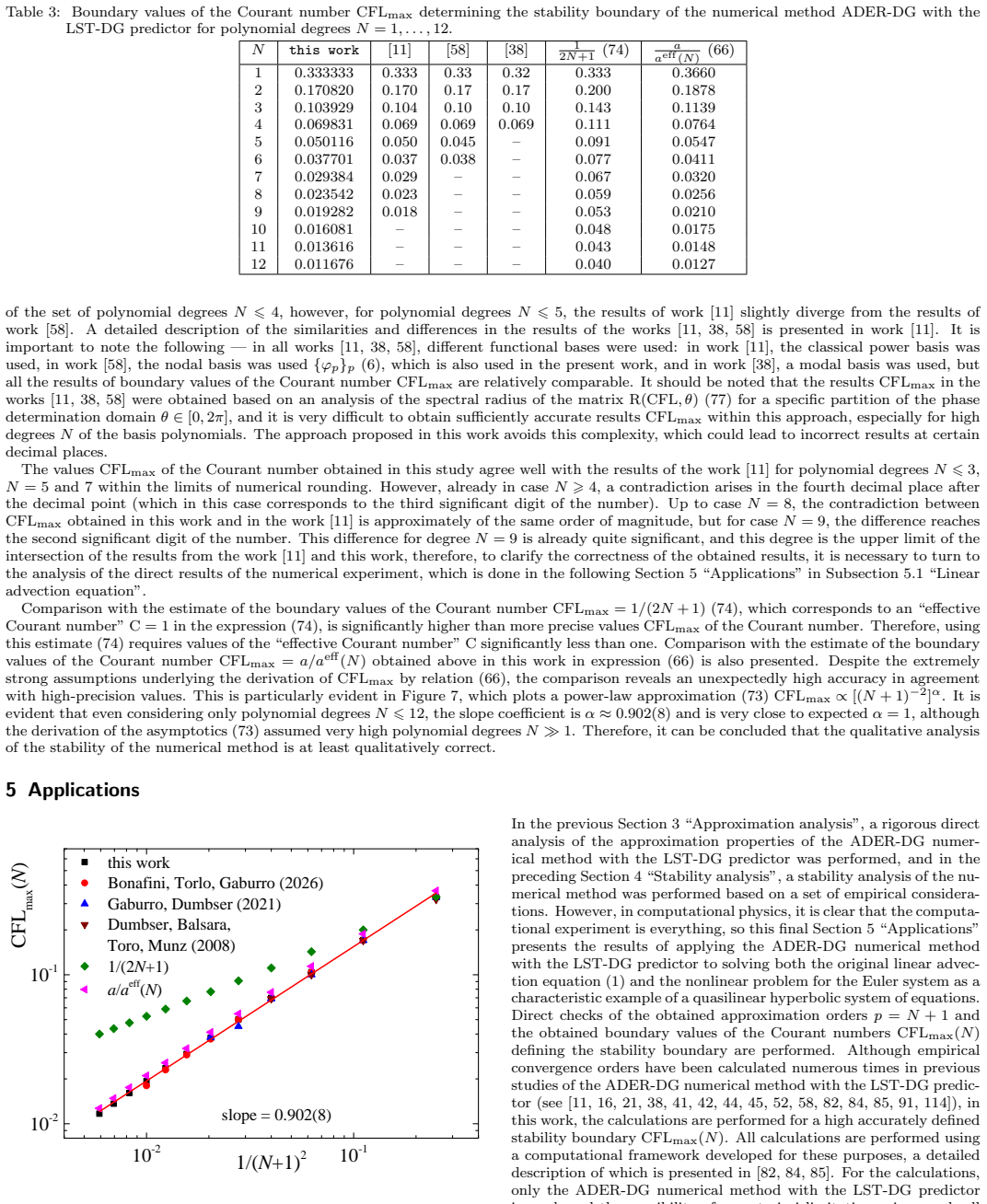
ADER-DG stability is violated exactly when a matrix eigenvalue reaches -1, reducing the CFL limit to polynomial roots with CFL_max(N) scaling as 1/(N+1)^2
A machine-rendered reading of the paper's core claim, the machinery that carries it, and where it could break.
Core claim
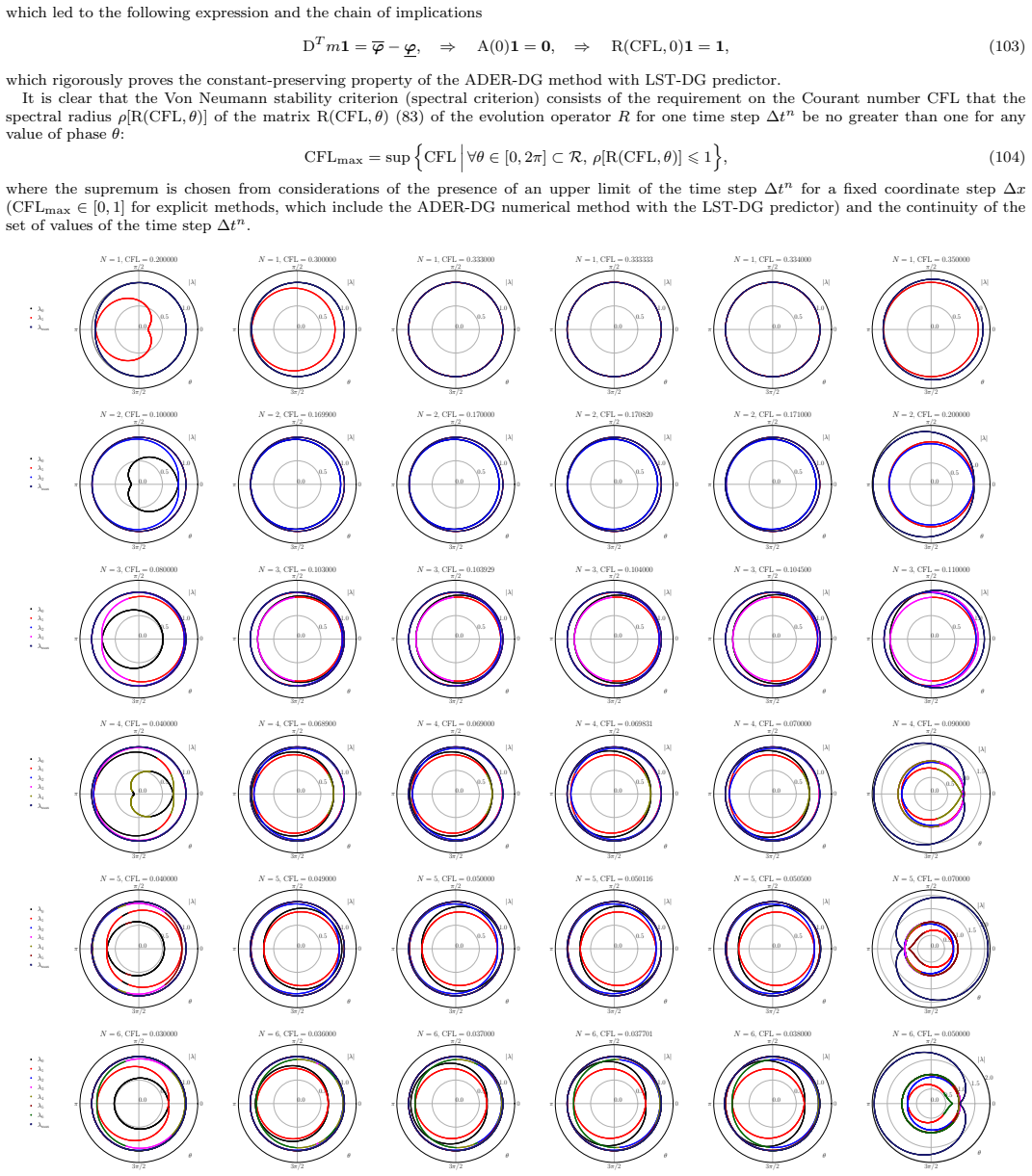
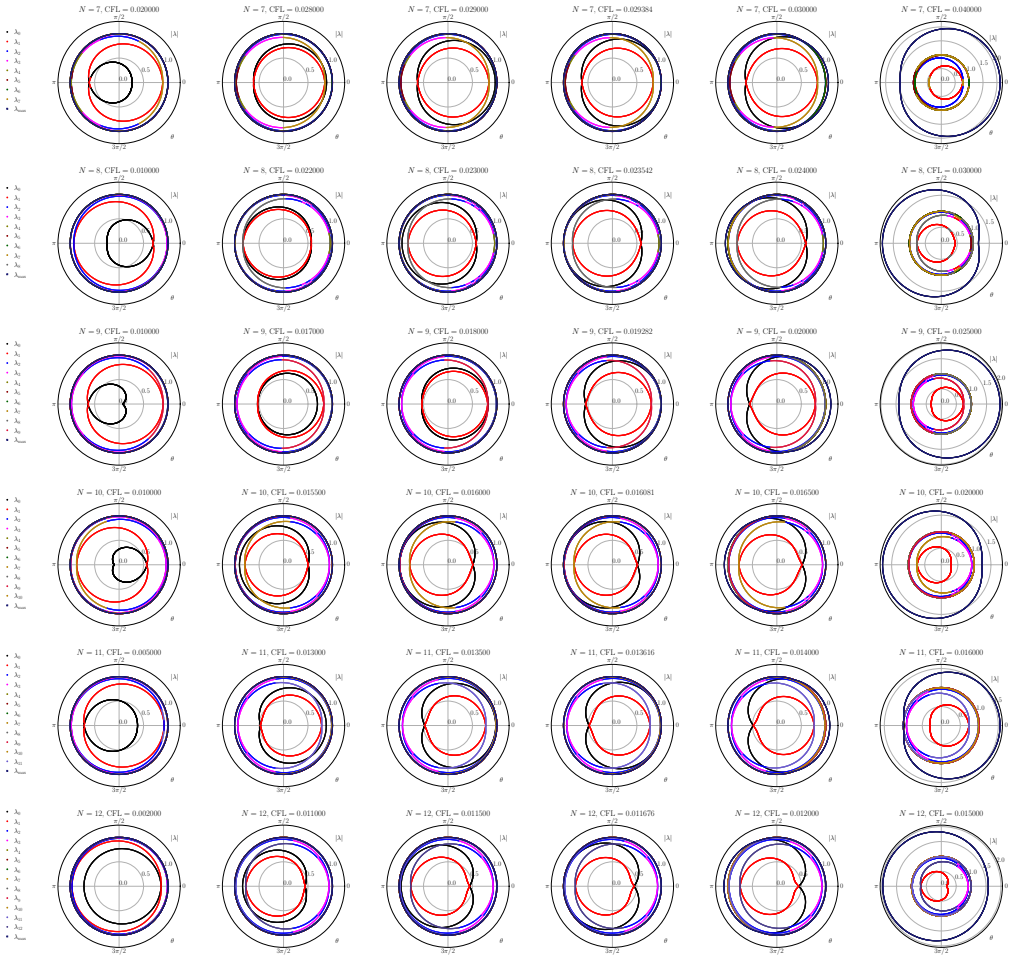
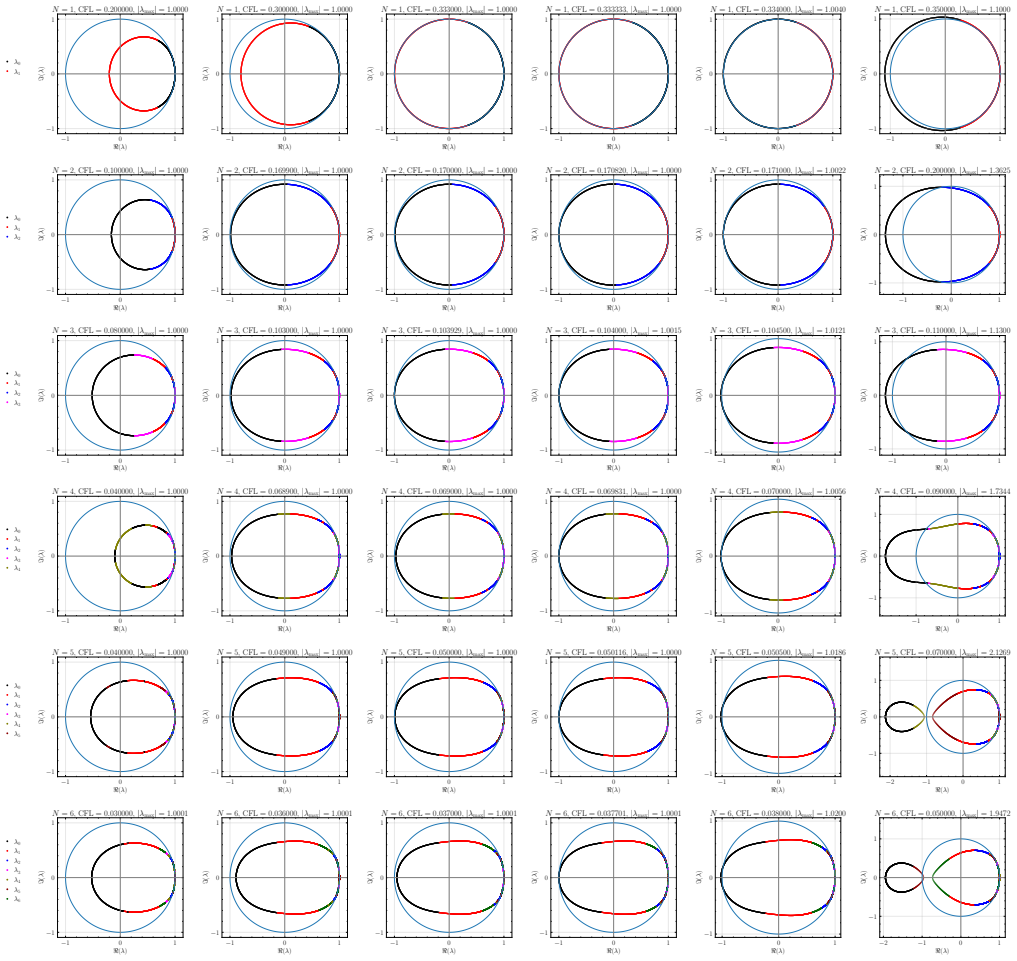
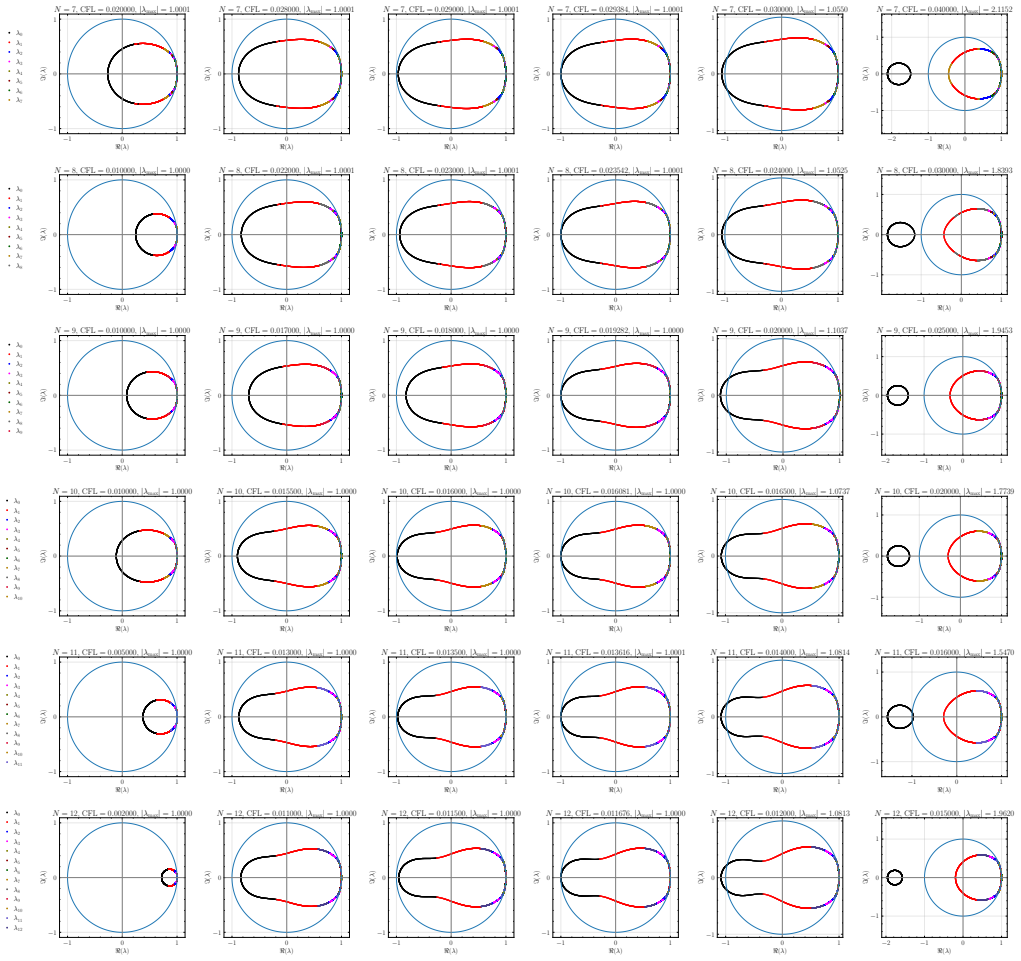
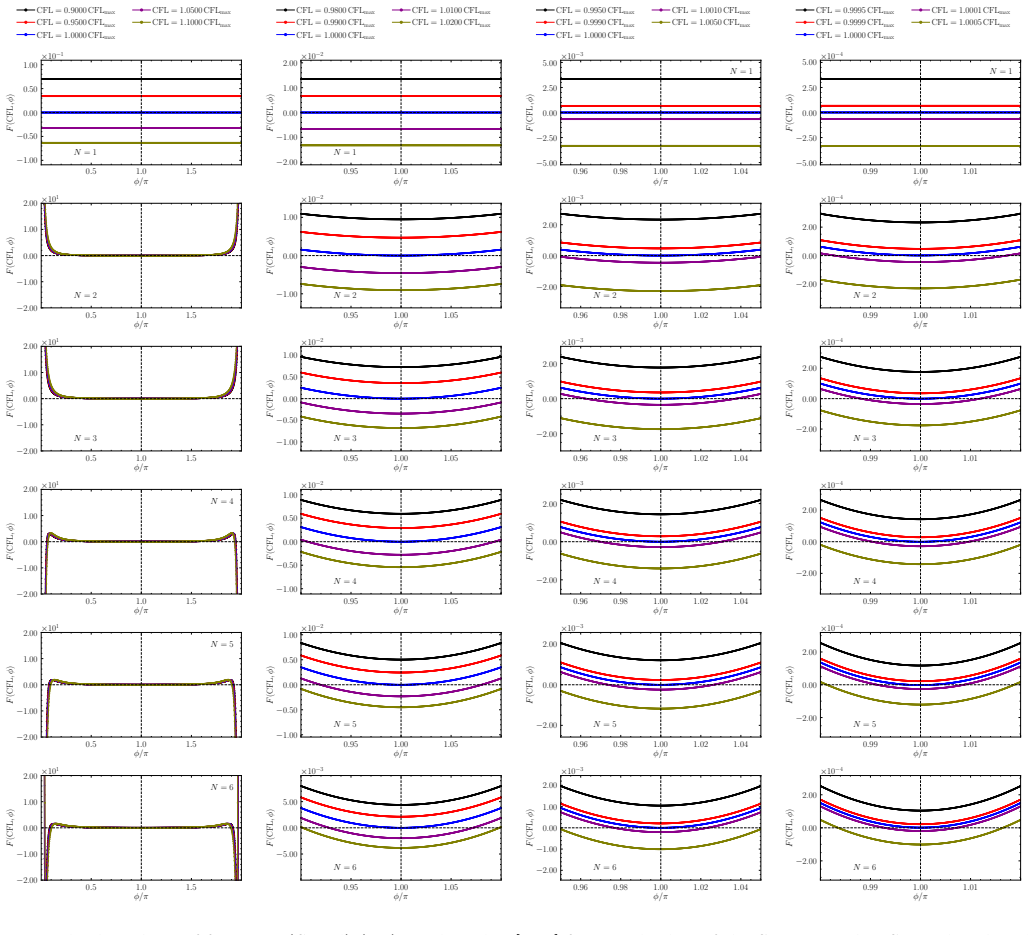
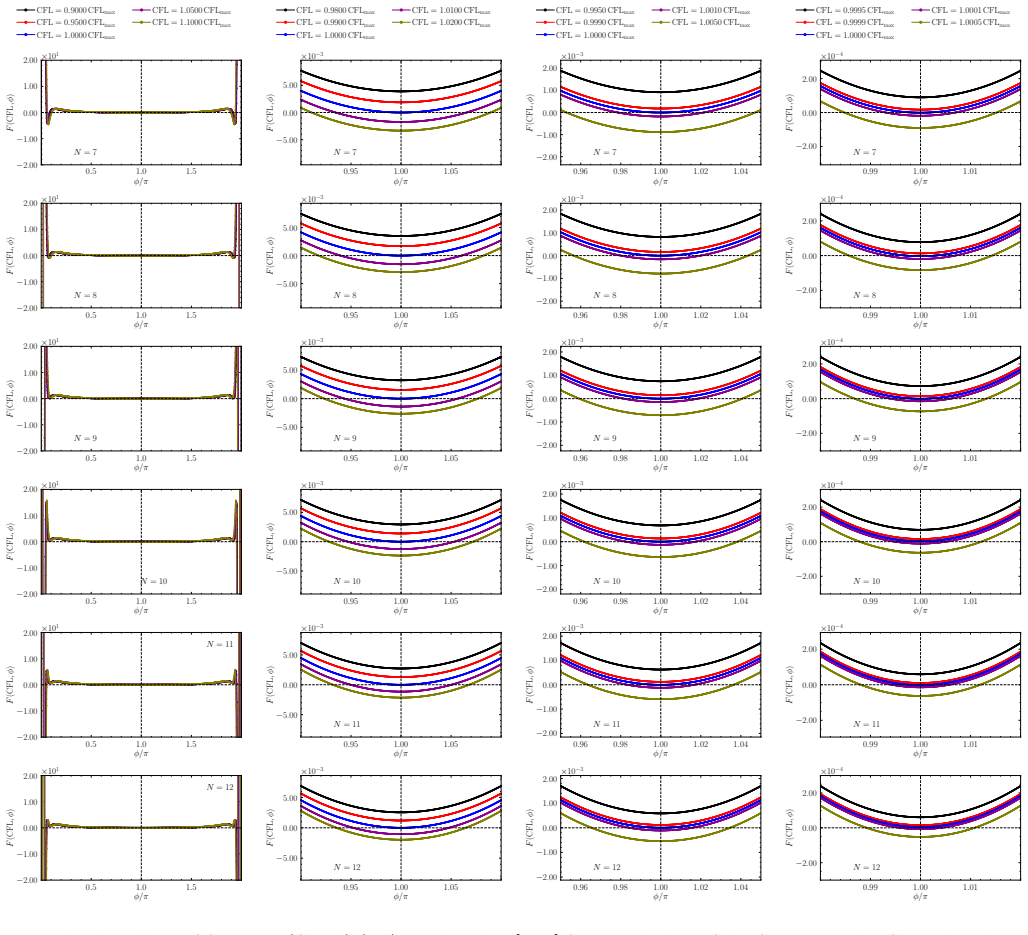
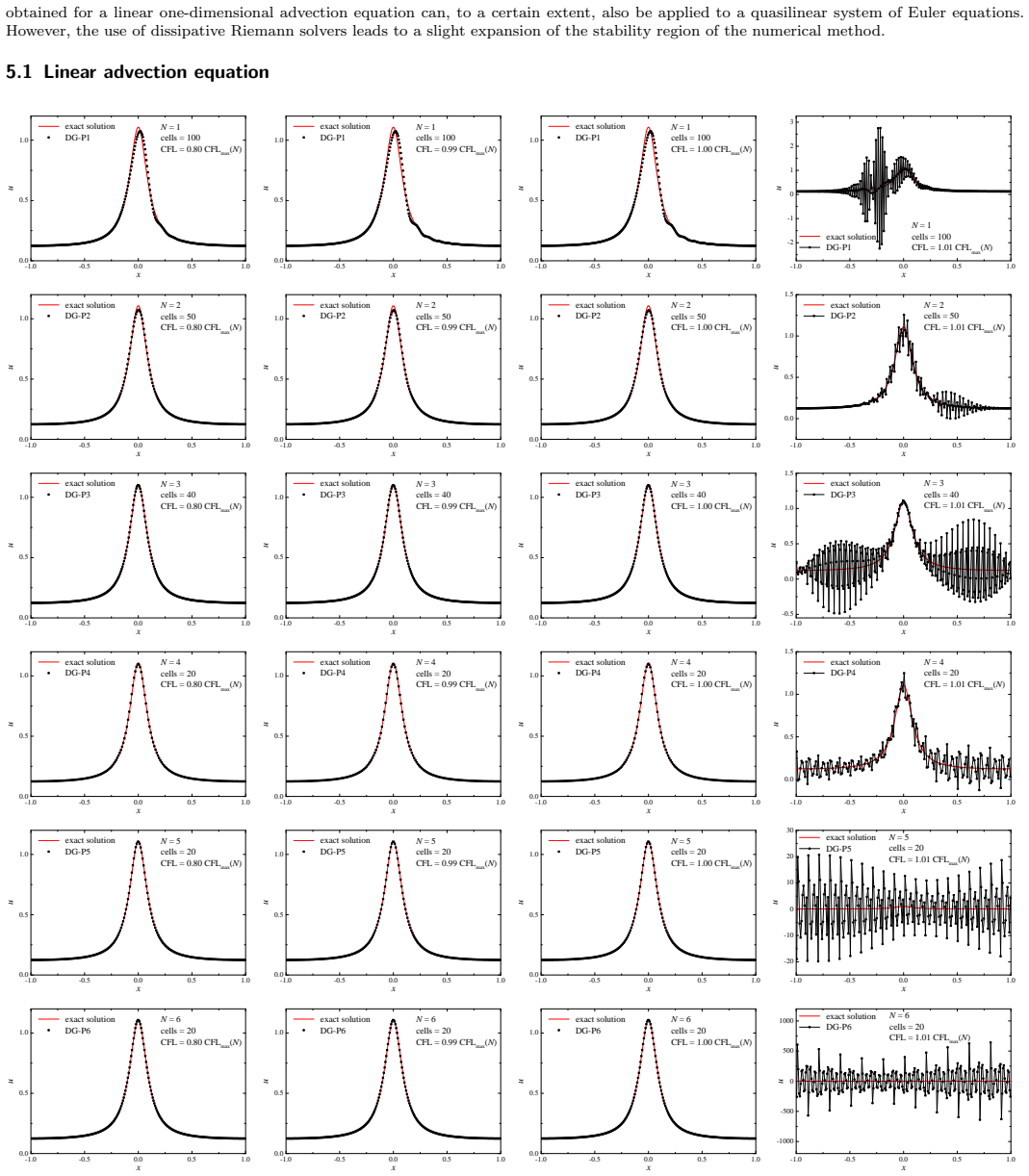
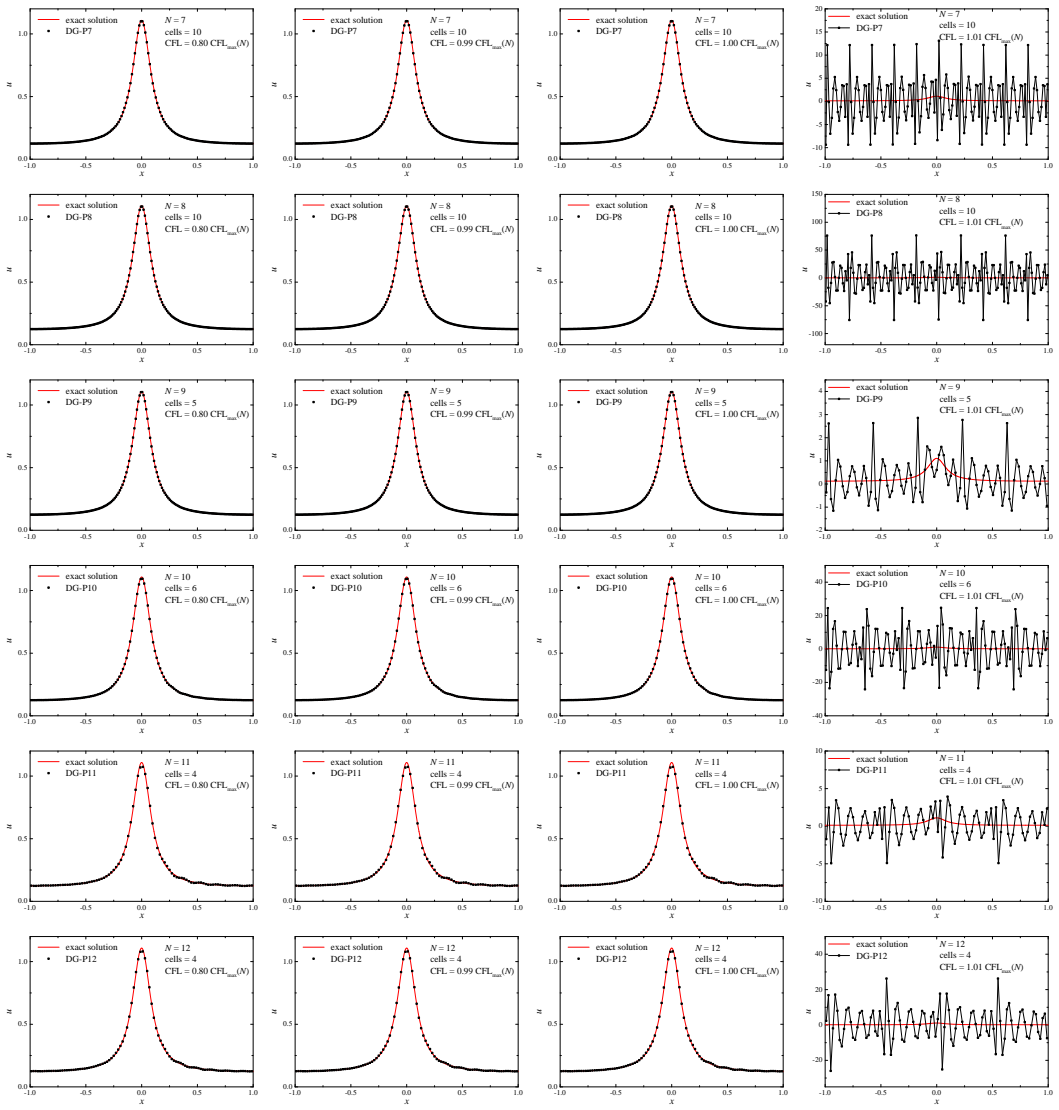
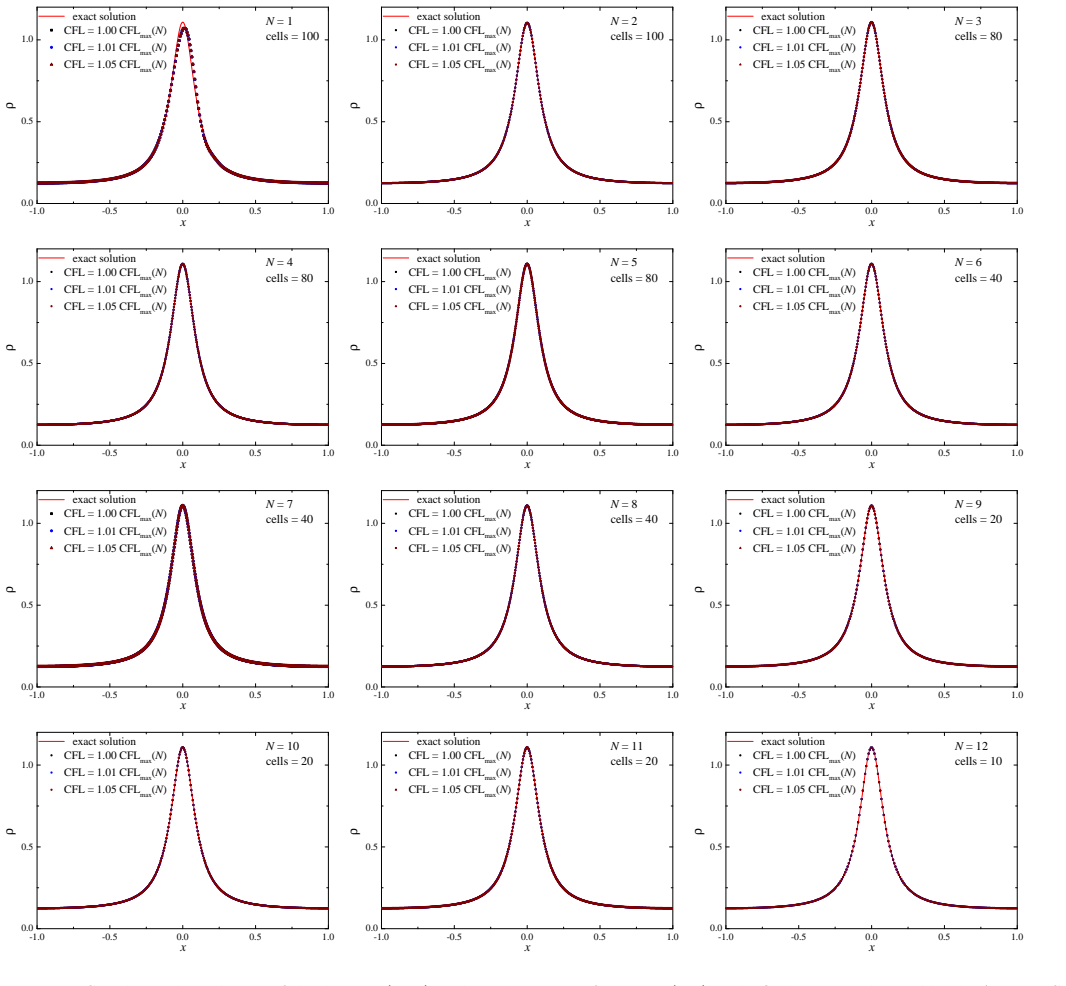
In the linear case, stability is violated precisely when one of the matrix eigenvalues reaches λ = -1, regardless of the phase θ. The stability condition is thereby reduced to the problem of calculating the roots of polynomials in the Courant number CFL. The maximum values CFL_max(N) are obtained for arbitrary degrees N, an asymptotic CFL_max(N) ∝ 1/(N+1)^2 is derived with a rigorous direct proof, and approximation orders p = N+1 are established. Numerical experiments on the linear advection equation and the Euler system confirm the theoretical CFL limits, with the nonlinear results underestimating the true boundary by at most 5 percent owing to the approximate Riemann solver.
What carries the argument
The eigenvalue threshold condition that stability violation occurs exactly when a matrix eigenvalue reaches λ = -1 independent of phase θ, which converts the stability problem into root-finding for polynomials in CFL
If this is right
- Stability analysis reduces to locating roots of polynomials in the Courant number
- Existing estimates proportional to 1/(2N+1) overestimate the allowable CFL, especially at large N
- CFL_max(N) follows the asymptotic scaling 1/(N+1)^2
- The scheme attains approximation order p = N+1 for arbitrary polynomial degree N
- Exceeding the computed CFL_max by one percent produces immediate instability in linear problems
Where Pith is reading between the lines
- The tighter CFL limits allow more aggressive yet safe time-step choices in high-order fluid simulations than previously assumed
- The quadratic decay in CFL_max with N implies that very high-order runs may need substantially smaller steps than linear scaling would suggest
- The framework could be applied to other time integrators or DG variants to obtain comparable explicit stability bounds
Load-bearing premise
The linear eigenvalue condition at -1 extends to the nonlinear Euler system with only a small underestimation of the true CFL limit.
What would settle it
A linear advection simulation run at CFL = computed CFL_max(N) + 0.01 should exhibit immediate instability while the same run at CFL = CFL_max(N) remains stable.
Figures
read the original abstract
Highly accurate stability boundary values for the ADER-DG method are obtained for arbitrary degrees $N$ of basis polynomials. In the linear case, stability is violated precisely when one of the matrix eigenvalues reaches $\lambda = -1$, regardless of the phase $\theta$. A rigorous mathematical framework for the stability is developed. The stability condition is significantly simplified, reducing it to the problem of calculating the roots of polynomials in the Courant number $\mathrm{CFL}$. The maximum of the Courant numbers $\mathrm{CFL}_{\rm max}(N)$ are calculated. These results are new and very convenient for practical use. A comparison of the obtained results with existing results reveals differences that may be significant for the selection of calculation parameters, especially for high degrees $N$. It is shown that widely used existing estimates $\mathrm{CFL}_{\rm max}(N) \propto 1/(2N+1)$ are overestimated. An interesting qualitative asymptotic $\mathrm{CFL}_{\rm max}(N) \propto 1/(N+1)^{2}$ is obtained. A rigorous direct proof of the approximation is presented. Approximation orders $p = N+1$ for arbitrary degrees $N$ are rigorously derived. A set of numerical experiments is carried out to apply the ADER-DG method to solving both a linear advection equation and an Euler system of equations. The results obtained in these calculations confirm the theoretical results well. In particular, an excess of the Courant number over the $\mathrm{CFL}_{\rm max}(N)$ by even 1% in the linear case immediately leads to significant instability of the numerical solution. The obtained estimates of the boundary Courant number in the nonlinear case are somewhat underestimated -- by no more than 5%, which is due to the diffusivity and stability of the approximate Riemann solver. Empirical convergence orders are obtained, which are in good agreement with the theoretical results.
Editorial analysis
A structured set of objections, weighed in public.
Referee Report
Summary. The paper develops a stability analysis for the ADER-DG discretization of PDEs. It asserts that, in the linear case, an amplification matrix eigenvalue reaches exactly λ = −1 (independent of Fourier phase θ) at the stability boundary; this reduces the CFL limit computation to root-finding on polynomials whose coefficients derive from the discretization matrices. Explicit values of CFL_max(N) are obtained for arbitrary polynomial degree N, an asymptotic CFL_max(N) ∝ 1/(N+1)^2 is derived with a direct proof, and approximation orders p = N+1 are shown rigorously. Numerical tests on linear advection and the nonlinear Euler system are reported to confirm the linear threshold to within 1 % and to show that the linear CFL_max underestimates the nonlinear limit by at most 5 %.
Significance. If the claimed reduction to polynomial roots and the direct proof of the 1/(N+1)^2 asymptotic hold, the work supplies a practical, parameter-free tool for selecting stable time steps in high-order ADER-DG schemes, especially at large N where existing 1/(2N+1) estimates are shown to be optimistic. The rigorous derivation of both the asymptotic and the approximation orders constitutes a clear methodological advance for the field.
major comments (2)
- [linear stability analysis] Linear stability analysis (abstract and the section deriving the amplification matrix): the central simplification to roots of polynomials in CFL rests on the assertion that the first eigenvalue to exit the unit disk is always exactly λ = −1 and that this occurs uniformly for every phase θ. The manuscript must exhibit an explicit argument or lemma showing that no other eigenvalue leaves the disk earlier for any θ; without this step the reduction is not guaranteed for arbitrary N.
- [numerical experiments] Nonlinear Euler experiments (numerical results section): the statement that the linear CFL_max(N) underestimates the true nonlinear limit by ≤5 % is presented as an empirical observation. Because this bound is used to extend the linear theory to the target application, the manuscript should report the precise range of N, the specific initial data, and the grid resolutions over which the 5 % figure was obtained; a single set of runs does not yet establish that the discrepancy remains bounded as N grows.
minor comments (2)
- [abstract / results comparison] The abstract states that existing CFL estimates are “overestimated”; the comparison table or figure should list the numerical values of both the new CFL_max(N) and the classical 1/(2N+1) formula side-by-side for at least N = 1…8 so that the magnitude of the difference is immediately visible.
- [stability reduction] Notation for the polynomial whose roots determine CFL_max(N) should be introduced once with an explicit formula (e.g., P_N(λ,CFL) = 0) rather than described only in prose.
Simulated Author's Rebuttal
We thank the referee for the thorough review and constructive feedback. The comments highlight important points for rigor and clarity. We address each major comment below and will incorporate revisions accordingly.
read point-by-point responses
-
Referee: [linear stability analysis] Linear stability analysis (abstract and the section deriving the amplification matrix): the central simplification to roots of polynomials in CFL rests on the assertion that the first eigenvalue to exit the unit disk is always exactly λ = −1 and that this occurs uniformly for every phase θ. The manuscript must exhibit an explicit argument or lemma showing that no other eigenvalue leaves the disk earlier for any θ; without this step the reduction is not guaranteed for arbitrary N.
Authors: We agree that an explicit lemma is required to rigorously justify the reduction for arbitrary N. The manuscript asserts the property based on the structure of the amplification matrix derived from the ADER-DG discretization, but does not include a standalone proof that no other eigenvalue exits the unit disk first. In the revision we will insert a new lemma (in the linear stability section) that proves, for the specific block structure of the matrix and the monotonic dependence of its eigenvalues on the CFL number, that the eigenvalue reaching −1 is always the first to leave the unit disk, uniformly in θ. The lemma will rely on continuity arguments and the fact that all other eigenvalues remain strictly inside the disk until that point. revision: yes
-
Referee: [numerical experiments] Nonlinear Euler experiments (numerical results section): the statement that the linear CFL_max(N) underestimates the true nonlinear limit by ≤5 % is presented as an empirical observation. Because this bound is used to extend the linear theory to the target application, the manuscript should report the precise range of N, the specific initial data, and the grid resolutions over which the 5 % figure was obtained; a single set of runs does not yet establish that the discrepancy remains bounded as N grows.
Authors: The 5 % figure is indeed an empirical observation drawn from the reported Euler tests. The current manuscript does not tabulate the exact range of N, initial data, or resolutions used to obtain it. In the revision we will add a dedicated subsection (or table) that lists: (i) the polynomial degrees tested (N = 1 to N = 8), (ii) the specific initial conditions (smooth isentropic vortex and a Riemann problem), and (iii) the grid resolutions employed. We will also perform and report additional runs at higher N (up to N = 12) on refined meshes to verify that the relative discrepancy remains ≤ 5 %; if the bound holds only for moderate N we will qualify the statement accordingly. revision: yes
Circularity Check
No circularity: stability analysis reduces to explicit polynomial root-finding from discretization matrices
full rationale
The paper develops a rigorous mathematical framework showing linear stability violation occurs precisely when a matrix eigenvalue reaches λ=-1 independent of phase θ, which directly simplifies the CFL condition to root-finding on polynomials whose coefficients derive from the ADER-DG discretization. CFL_max(N) values, the 1/(N+1)^2 asymptotic (with direct proof), and approximation orders p=N+1 are obtained as explicit outputs of this framework rather than by fitting, renaming, or self-referential construction. No load-bearing self-citations, ansatzes smuggled via prior work, or predictions that collapse to inputs are present; numerical experiments serve only as separate confirmation.
Axiom & Free-Parameter Ledger
axioms (1)
- domain assumption Stability is violated precisely when one of the matrix eigenvalues reaches λ = -1, regardless of the phase θ.
Reference graph
Works this paper leans on
-
[1]
R. Abgrall. High order schemes for hyperbolic problems using globally continuous approximation and avoiding mass matrices.J. Sci. Comput., 73:461–494, 2017
2017
-
[2]
Abgrall, P
R. Abgrall, P. Bacigaluppi, and S. Tokareva. High-order residual distribution scheme for the time-dependent Euler equations of fluid dynamics.Comput. Math. Appl., 78:274–290, 2019
2019
-
[3]
Abgrall, M
R. Abgrall, M. Dumbser, and P.H. Maire. A simple and general framework for the construction of exactly div-curl-grad compatible discontinuous Galerkin finite element schemes on unstructured simplex meshes.J. Comput. Phys., 541:114340, 2025. https://doi.org
2025
-
[4]
Abramowitz and I
M. Abramowitz and I. Stegun.Handbook of Mathematical Functions with Formulas, Graphs, and Mathematical Tables. United States Department of Commerce, National Bureau of Standards (NBS), United States, 1972
1972
-
[5]
Alcubierre.Introduction to 3+1 Numerical Relativity
M. Alcubierre.Introduction to 3+1 Numerical Relativity. OUP, 2008
2008
-
[6]
Avesania, M
D. Avesania, M. Dumbser, R. Vacondio, and R. Maurizio. An alternative SPH formulation: ADER-WENO-SPH.Comput. Methods Appl. Mech. Engrg., 382:113871, 2021
2021
-
[7]
Bassi, S
C. Bassi, S. Busto, and M. Dumbser. High order ADER-DG schemes for the simulation of linear seismic waves induced by nonlinear dispersive free-surface water waves.Appl. Numer. Math., 158:236, 2020
2020
-
[8]
Baumgarte and S.L
T.W. Baumgarte and S.L. Shapiro.Numerical relativity. CUP, 2010
2010
-
[9]
Baumgarte and S.L
T.W. Baumgarte and S.L. Shapiro.Numerical relativity. CUP, 2021
2021
-
[10]
C. Bona, C. Palenzuela-Luque, and C. Bona-Casas.Elements of Numerical Relativity and Relativistic Hydrodynamics: From Einstein’s Equations to Astrophysical Simulations, volume 783 ofLecture Notes in Physics. Springer Berlin, Heidelberg, 2009. https://doi.org
2009
-
[11]
Bonafini, D
M. Bonafini, D. Torlo, and E. Gaburro. Stability analysis of Arbitrary-Lagrangian-Eulerian ADER-DG methods on classical and degenerate spacetime geometries, 2026
2026
-
[12]
Boscheri, D.S
W. Boscheri, D.S. Balsara, and M. Dumbser. Lagrangian ADER-WENO finite volume schemes on unstructured triangular meshes based on genuinely multidimensional HLL Riemann solvers.J. Comput. Phys., 267:112–140, 2014
2014
-
[13]
Boscheri and M
W. Boscheri and M. Dumbser. Arbitrary-Lagrangian-Eulerian one-step WENO finite volume schemes on unstructured triangular meshes. Commun. Comput. Phys., 14:1174–1210, 2013
2013
-
[14]
Boscheri and M
W. Boscheri and M. Dumbser. A direct Arbitrary-Lagrangian-Eulerian ADER-WENO finite volume scheme on unstructured tetrahedral meshes for conservative and non-conservative hyperbolic systems in 3D.J. Comput. Phys., 275:484–508, 2014
2014
-
[15]
Boscheri and M
W. Boscheri and M. Dumbser. An efficient quadrature-free formulation for high order Arbitrary-Lagrangian-Eulerian ADER-WENO finite volume schemes on unstructured meshes.J. Sci. Comput., 66:240–273, 2016
2016
-
[16]
Boscheri and M
W. Boscheri and M. Dumbser. Arbitrary-Lagrangian-Eulerian discontinuous Galerkin schemes with a posteriori subcell finite volume limiting on moving unstructured meshes.J. Comput. Phys., 346:449, 2017
2017
-
[17]
Boscheri, M
W. Boscheri, M. Dumbser, and D.S. Balsara. High order Lagrangian ADER-WENO schemes on unstructured meshes — Application of several node solvers to hydrodynamics and magnetohydrodynamics.Int. J. Numer. Meth. Fluids, 76:737–773, 2014
2014
-
[18]
Boscheri and R
W. Boscheri and R. Loub` ere. High order accurate direct Arbitrary-Lagrangian-Eulerian ADER-MOOD finite volume schemes for non- conservative hyperbolic systems with stiff source terms.Commun. Comput. Phys., 21:271–306, 2017
2017
-
[19]
Boscheri, R
W. Boscheri, R. Loub` ere, and M. Dumbser. Direct Arbitrary-Lagrangian-Eulerian ADER-MOOD finite volume schemes for multidimen- sional hyperbolic conservation laws.J. Comput. Phys., 292:56–81, 2015
2015
-
[20]
Busto, L
A. Busto, L. Rio-Martin, M.E. Vazquez-Cendon, and M. Dumbser. A semi-implicit hybrid finite volume/finite element scheme for all Mach number flows on staggered unstructured meshes.Applied Mathematics and Computation, 402:126117, 2021
2021
-
[21]
Busto, S
S. Busto, S. Chiocchetti, M. Dumbser, E. Gaburro, and I. Peshkov. High order ADER schemes for continuum mechanics.Front. Phys., 32:8, 2020
2020
-
[22]
Busto, M
S. Busto, M. Dumbser, C. Escalante, N. Favrie, and S. Gavrilyuk. On high order ADER discontinuous Galerkin schemes for first order hyperbolic reformulations of nonlinear dispersive systems.J. Sci. Comput., 87:48, 2021
2021
-
[23]
Butcher.Numerical Methods for Ordinary Differential Equations
J.C. Butcher.Numerical Methods for Ordinary Differential Equations. Wiley, UK, 2016. 34
2016
-
[24]
Castro, J
C.E. Castro, J. Behrens, and C. Pelties. Optimization of the ADER-DG method in GPU applied to linear hyperbolic PDEs.Int. J. Numer. Meth. Fluids, 81:195–217, 2016
2016
-
[25]
Charrier, B
D.E. Charrier, B. Hazelwood, E. Tutlyaeva, M. Bader, M. Dumbser, A. Kudryavtsev, A. Moskovsky, and T. Weinzierl. Studies on the energy and deep memory behaviour of a cache-oblivious, task-based hyperbolic PDE solver.Int. J. High Perform. Comput. Appl., 33:973–991, 2019
2019
-
[26]
Charrier, B
D.E. Charrier, B. Hazelwood, and T. Weinzierl. Enclave tasking for DG methods on dynamically adaptive meshes.SIAM J. Sci. Comput., 42:A69–A92, 2020
2020
-
[27]
Clain, S
S. Clain, S. Diot, and R. Loub` ere. A high-order finite volume method for systems of conservation laws — Multidimensional Optimal Order Detection (MOOD).J. Comput. Phys., 230:4028–4050, 2011
2011
-
[28]
Cockburn, S
B. Cockburn, S. Hou, , and C.-W. Shu. TVB Runge-Kutta local projection discontinuous Galerkin finite element method for conservation laws. IV. The multidimensional case.Math. Comp., 54:545–581, 1990
1990
-
[29]
Cockburn, S-.Y
B. Cockburn, S-.Y. Lin, and C.-W. Shu. TVB Runge-Kutta local projection discontinuous Galerkin finite element method for conservation laws III: One-dimensional systems.J. Comput. Phys., 84:90–113, 1989
1989
-
[30]
Cockburn and C.-W
B. Cockburn and C.-W. Shu. TVB Runge-Kutta local projection discontinuous Galerkin finite element method for conservation laws. II. General framework.Math. Comp., 52:411–435, 1989
1989
-
[31]
Cockburn and C.-W
B. Cockburn and C.-W. Shu. The Runge-Kutta local projectionP 1-discontinuous-Galerkin finite element method for scalar conservation laws.ESAIM: M2AN, 25:337–361, 1991
1991
-
[32]
Cockburn and C.-W
B. Cockburn and C.-W. Shu. TVB Runge-Kutta local projection discontinuous Galerkin Method for Conservation Laws V: Multidimen- sional Systems.J. Comput. Phys., 141:199–224, 1998
1998
-
[33]
Daniel, V
J.W. Daniel, V. Pereyra, and L.L. Schumaker. Iterated deferred corrections for initial value problems.Acta Ci. Venezolana, 19:128–140, 1968
1968
-
[34]
Dekker and J.G
K. Dekker and J.G. Verwer.Stability of Runge-Kutta Methods for Stiff Nonlinear Differential Equations. North-Holland, Amsterdam, 1984
1984
-
[35]
S. Diot, S. Clain, and R. Loub` ere. Improved detection criteria for the Multi-dimensional Optimal Order Detection (MOOD) on unstructured meshes with very high-order polynomials.Computers & Fluids, 64:43–63, 2012
2012
-
[36]
S. Diot, R. Loub` ere, and S. Clain. The MOOD method in the three-dimensional case: very high-order finite volume method for hyperbolic systems.Int. J. Numer. Meth. Fluids, 73:362–386, 2013
2013
-
[37]
M. Dumbser. Arbitrary high orderP N PM schemes on unstructured meshes for the compressible Navier-Stokes equations.Computers & Fluids, 39:60–76, 2010
2010
-
[38]
Dumbser, D.S
M. Dumbser, D.S. Balsara, E.F. Toro, and C.-D. Munz. A unified framework for the construction of one-step finite volume and discontinuous Galerkin schemes on unstructured meshes.J. Comput. Phys., 227:8209–8253, 2008
2008
-
[39]
Dumbser and V
M. Dumbser and V. Casulli. A staggered semi-implicit spectral discontinuous Galerkin scheme for the shallow water equations.Appl. Math. Comput., 219:8057–8077, 2013
2013
-
[40]
Dumbser, C
M. Dumbser, C. Enaux, and E.F. Toro. Finite volume schemes of very high order of accuracy for stiff hyperbolic balance laws.J. Comput. Phys., 227:3971, 2008
2008
-
[41]
Dumbser, F
M. Dumbser, F. Fambri, M. Tavelli, M. Bader, and T. Weinzierl. Efficient implementation of ADER discontinuous Galerkin schemes for a scalable hyperbolic PDE engine.Axioms, 7(3):63, 2018
2018
-
[42]
Dumbser, F
M. Dumbser, F. Guercilena, S. Koppel, L. Rezzolla, and O. Zanotti. Conformal and covariant Z4 formulation of the Einstein equations: Strongly hyperbolic first-order reduction and solution with discontinuous Galerkin schemes.Phys. Rev. D, 97:084053, 2018
2018
-
[43]
Dumbser, A
M. Dumbser, A. Hidalgo, and O. Zanotti. High order space-time adaptive ADER-WENO finite-volume schemes for non-conservative hyperbolic systems.Comput. Methods Appl. Mech. Engrg., 268:359–387, 2014
2014
-
[44]
Dumbser and R
M. Dumbser and R. Loub` ere. A simple robust and accurate a posteriori sub-cell finite volume limiter for the discontinuous Galerkin method on unstructured meshes.J. Comput. Phys., 319:163, 2016
2016
-
[45]
Dumbser and O
M. Dumbser and O. Zanotti. Very high orderP N PM schemes on unstructured meshes for the resistive relativistic mhd equations.J. Comput. Phys., 228:6991, 2009
2009
-
[46]
Dumbser, O
M. Dumbser, O. Zanotti, E. Gaburro, and I. Peshkov. A well-balanced discontinuous Galerkin method for the first-order Z4 formulation of the Einstein-Euler system.J. Comp. Phys., 504:112875, 2024
2024
-
[47]
Dumbser, O
M. Dumbser, O. Zanotti, A. Hidalgo, and D.S. Balsara. ADER-WENO finite-volume schemes with space-time adaptive mesh refinement. J. Comput. Phys., 248:257–286, 2013
2013
-
[48]
Dumbser, O
M. Dumbser, O. Zanotti, R. Loub` ere, and S. Diot. A posteriori subcell limiting of the discontinuous Galerkin finite-element method for hyperbolic conservation laws.J. Comput. Phys., 278:47–75, 2014
2014
-
[49]
A. Dutt, L. Greengard, and V. Rokhlin. Spectral deferred correction methods for ordinary differential equations.BIT, 40:241–266, 2000
2000
-
[50]
Einfeldt
B. Einfeldt. On Godunov-type methods for gas dynamics.SIAM J. Numer. Anal., 25:294, 1988
1988
-
[51]
Einfeldt
B. Einfeldt. On Godunov-type methods near low densities.J. Comput. Phys., 92:273, 1991
1991
-
[52]
Fambri, M
F. Fambri, M. Dumbser, S. Koppel, L. Rezzolla, and O. Zanotti. ADER discontinuous Galerkin schemes for general-relativistic ideal magnetohydrodynamics.MNRAS, 477:4543, 2018
2018
-
[53]
Fambri, M
F. Fambri, M. Dumbser, and O. Zanotti. Space-time adaptive ADER-DG schemes for dissipative flows: Compressible Navier-Stokes and resistive MHD equations.Computer Physics Communications, 220:297, 2017
2017
-
[54]
Fernandez, M.J.C
E.G. Fernandez, M.J.C. Diaz, M. Dumbser, and T.M. de Luna. An arbitrary high order well-balanced ADER-DG numerical scheme for the multilayer shallow-water model with variable density.J. Sci. Comput., 90:52, 2022
2022
-
[55]
Funaro.Polynomial Approximation of Differential Equations
D. Funaro.Polynomial Approximation of Differential Equations. Lecture Notes in Physics Monographs. Springer-Verlag, Berlin, Heidel- berg, 1992
1992
-
[56]
E. Gaburro. A unified framework for the solution of hyperbolic PDE systems using high order direct arbitrary-lagrangian-eulerian schemes on moving unstructured meshes with topology change.Archives of Computational Methods in Engineering, 28:1249, 2021
2021
-
[57]
Gaburro, W
E. Gaburro, W. Boscheri, S. Chiocchetti, C. Klingenberg, V. Springel, and M. Dumbser. High order direct Arbitrary-Lagrangian-Eulerian schemes on moving Voronoi meshes with topology changes.J. Comput. Phys., 407:109167, 2020
2020
-
[58]
Gaburro and M
E. Gaburro and M. Dumbser. A posteriori subcell finite volume limiter for generalP N PM schemes: Applications from gasdynamics to relativistic magnetohydrodynamics.J. Sci. Comput., 86:37, 2021
2021
-
[59]
Gaburro, P
E. Gaburro, P. Offner, M. Ricchiuto, and D. Torlo. High order entropy preserving ADER-DG schemes.Applied Mathematics and Computation, 440:127644, 2023
2023
-
[60]
Gourgoulhon.3+1 Formalism in General Relativity
E. Gourgoulhon.3+1 Formalism in General Relativity. Springer, 2012
2012
-
[61]
Hairer, S.P
E. Hairer, S.P. Nørsett, and G. Wanner.Solving Ordinary Differential Equations I: Nonstiff Problems. Springer-Verlag, Berlin, Heidelberg, 1987
1987
-
[62]
Hairer and G
E. Hairer and G. Wanner.Solving Ordinary Differential Equations II: Stiff and Differential-Algebraic Problems. Springer-Verlag, Berlin, Heidelberg, 1996
1996
-
[63]
Han Veiga, L
M. Han Veiga, L. Micalizzi, and D. Torlo. On improving the efficiency of ADER methods.Appl. Math. Comput., 466:128426, 2024
2024
-
[64]
Han Veiga, P
M. Han Veiga, P. ¨Offner, and D. Torlo. DeC and ADER: Similarities, differences and a unified framework.Journal of Scientific Computing, 87:2, 2021
2021
-
[65]
Hidalgo and M
A. Hidalgo and M. Dumbser. ADER schemes for nonlinear systems of stiff advection-diffusion-reaction equations.J. Sci. Comput., 48:173, 2011. 35
2011
-
[66]
H.T. Huynh. A Flux Reconstruction Approach to High-Order Schemes Including Discontinuous Galerkin Methods. In45th AIAA Aerospace Sciences Meeting and Exhibit, number 2007-4079 in AIAA Paper, 2007. https://doi.org/10.2514/6.2007-4079
-
[68]
H.T. Huynh, Z.J. Wang, and P.E. Vincent. High-order methods for computational fluid dynamics: A brief review of compact differential formulations on unstructured grids.Comput. & Fluids, 98:209–220, 2014. https://doi.org/10.2514/6.2009-403
-
[69]
IEEE.IEEE Standard for Floating-Point Arithmetic, Jul 2019
2019
-
[70]
H. Jackson. On the eigenvalues of the ADER-WENO Galerkin predictor.J. Comput. Phys., 333:409, 2017
2017
-
[71]
S.-C. Klein. Stabilizing discontinuous Galerkin methods using Dafermos’ entropy rate criterion: I — one-dimensional conservation laws. J. Sci. Comput., 95:55, 2023
2023
-
[72]
S. Liu and L. Yuan. A modified a posteriori subcell limiter for high order FR-scheme for 1D detonation simulation.J. Sci. Comput., 97:31, 2023. https://doi.org/10.1007/s10915-023-02347-7
-
[73]
Liu, C.-W
Y. Liu, C.-W. Shu, and M. Zhang. Strong stability preserving property of the deferred correction time discretization.J. Comput. Math., 26:633–646, 2008
2008
-
[74]
Loub` ere, M
R. Loub` ere, M. Dumbser, and S. Diot. A new family of high order unstructured MOOD and ADER finite volume schemes for multidi- mensional systems of hyperbolic conservation laws.Commun. Comput. Phys., 16:718–763, 2014
2014
-
[75]
Micalizzi, D
L. Micalizzi, D. Torlo, and W. Boscheri. Efficient iterative arbitrary high-order methods: an adaptive bridge between low and high order. Commun. Appl. Math. Comput., 7:40, 2023
2023
-
[76]
Millington, V.A
R.C. Millington, V.A. Titarev, and E.F. Toro. ADER: Arbitrary-order non-oscillatory advection schemes. InHyperbolic Problems: Theory, Numerics, Applications, volume 141 ofISNM International Series of Numerical Mathematics. Birkh¨ auser, Basel, 2001
2001
-
[77]
M.L. Minion. Semi-implicit spectral deferred correction methods for ordinary differential equations.Commun. Math. Sci., 1:471–489, 2003
2003
-
[78]
Montecinos, A
G.I. Montecinos, A. Santaca, M. Celant, L.O. Muller, and E.F. Toro. ADER scheme with a simplified solver for the generalized Riemann problem and an average ENO reconstruction procedure. application to blood flow.Computers & Fluids, 248:105685, 2022
2022
-
[79]
Muzzolon, M
S. Muzzolon, M. Dumbser, O. Zanotti, and E. Gaburro. High order numerical discretizations of the Einstein-Euler equations in the Generalized Harmonic formulation.J. Comput. Phys., page 115206, 2026. https://doi.org
2026
-
[80]
¨Offner, L
P. ¨Offner, L. Petri, and D. Torlo. Analysis for implicit and implicit-explicit ADER and DeC methods for ordinary differential equations, advection-diffusion and advection-dispersion equations.Appl. Numer. Math., 212:110–134, 2025
2025
-
[81]
C.A. Pereira and B.C. Vermeire. Hybridized formulations of flux reconstruction schemes for advection-diffusion problems.J. Comput. Phys., 516:113364, 2024. https://doi.org/10.1016/j.jcp.2024.113364
discussion (0)
Sign in with ORCID, Apple, or X to comment. Anyone can read and Pith papers without signing in.