REVIEW 4 major objections 4 minor 8 references
Matrix Nets: A New Deep Architecture for Object Detection
T0 review · 4 major / 4 minor · reviewed 2026-08-14 · deepseek-v4-flash
Pith's one-line read Matrix Nets assign each object to a feature layer matched to its size and shape, and the resulting keypoint detector KP-xNet reaches 47.8 mAP on MS COCO, above other single-shot detectors with fewer parameters and less training.
desk verdict A genuinely new aspect-ratio-aware feature pyramid idea that deserves a serious look, but the headline COCO number is not backed by controlled comparisons and could well come from the training recipe rather than the matrix layers. read the letter →
The pith
A machine-rendered reading of the paper's core claim, the machinery that carries it, and where it could break.
The reading
What carries the argument
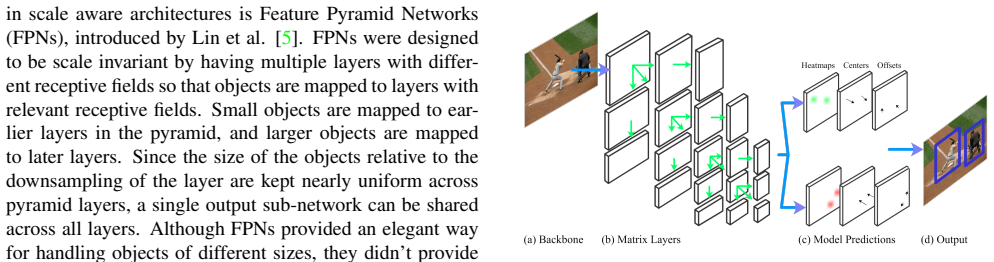
The load-bearing object is the layer matrix $\{l_{i,j}\}$: entry $l_{i,j}$ has width downsampling $2^{i-1}$ and height downsampling $2^{j-1}$ relative to $l_{1,1}$, so the diagonal is a feature pyramid and the off-diagonal entries are rectangular feature maps specialized to wide or tall objects. The mechanism that keeps the construction cheap is generating all off-diagonal layers with shared $3\times3$ convolutions of stride $1\times2$ (moving right) and $2\times1$ (moving down), while the object-to-layer assignment rule doubles the range of widths and heights with each step and relaxes the boundaries by 0.8 and 1.3. That assignment rule is what allows a square convolution kernel with a fixed receptive field to serve every layer: the context an object needs is bounded by its layer's receptive field, and the target widths, heights, and centers within a layer have a small dynamic range. In KP-xNet, this replaces corner pooling with ordinary convolutions for heatmaps and replaces learned embeddings with direct center regression followed by within-layer corner matching.
What would settle it
Trace the effective receptive field of each matrix layer, for example by back-propagating a single active unit through the shared $1\times2$ and $2\times1$ strided convolutions, and check whether it doubles with every horizontal and vertical step; if it does not, the layer-range rule assigns objects to the wrong layer. A behavioral check is to run the detector on images consisting only of extreme-aspect-ratio objects, such as 1:10 or 10:1, and see whether they are detected by the intended off-diagonal layers or whether errors cluster at the 0.8 and 1.3 boundaries.
Extended reading notes
Core claim
Matrix Nets are constructed by taking the standard feature pyramid as the diagonal of a matrix of layers $l_{i,j}$, with width downsampling $2^{i-1}$ and height downsampling $2^{j-1}$ relative to the top-left layer. The off-diagonal rectangles are generated with shared $3\times3$ convolutions using stride $1\times2$ for horizontal steps and $2\times1$ for vertical steps, so few new parameters are introduced. Object widths and heights are assigned to layers by doubling each dimension with every step away from $l_{1,1}$, starting from $[24,48]\times[24,48]$ pixels, with boundaries relaxed by factors of 0.8 and 1.3. The paper argues that this makes the range of object sizes within each layer narrow enough that a square output kernel can capture the needed context for any aspect ratio, eliminating corner pooling and embedding-based corner matching. The empirical discovery is that this architecture, as KP-xNet, reports 47.8 mAP on MS COCO test-dev with a ResNeXt-101-X backbone under multi-scale testing, surpassing the 47.0 mAP the paper cites for the highest reported prior single-shot detector while training in 180k iterations rather than 480k on a backbone about twice as large.
Load-bearing premise
The construction works only if each step across the layer matrix really doubles how much image context a feature vector sees; if the shared strided convolutions do not produce that doubling, or if the hand-set 0.8 and 1.3 boundaries put very wide or very tall objects in the wrong layer, the claimed advantage over a plain feature pyramid disappears.
Editorial extensions
If this is right
- Keypoint detectors can drop corner pooling and embedding matching entirely, replacing them with per-layer center regression, which the paper argues also removes the quadratic pairwise cost of embedding training.
- Because object sizes are nearly uniform in each layer, the same shared square output head can detect very wide, very tall, and square objects without anchor templates or special pooling layers.
- Matrix Nets can be attached to any backbone, like a feature pyramid, so the same layer matrix could be used with anchor-based or two-stage detectors, not only keypoint-based ones.
- Off-diagonal layers representing extreme aspect ratios cover rare objects and can be pruned, giving a direct parameter-versus-coverage tradeoff.
- The reported result implies that a smaller backbone trained for fewer iterations can outperform much larger keypoint detectors on MS COCO, which is the paper's concrete evidence that scale-and-shape-aware layer assignment is what matters.
Reading between the lines
- An untested extension is to apply the same matrix construction to tasks where extreme aspect ratios are the norm, such as text detection or document layout analysis; the paper only demonstrates object detection on MS COCO.
- If the receptive-field-doubling rule is accurate, localization errors should concentrate near the relaxed 0.8 and 1.3 layer boundaries, because objects near a boundary have the most ambiguous assignment; inspecting failure images at those sizes would test the rule directly.
- The paper's headline comparison changes both the backbone and the training budget, so the cleanest test of the architecture's benefit would hold the backbone fixed and vary only whether the feature maps are arranged in a pyramid or a matrix.
- The per-layer center matching suggests a testable scalability prediction: on crowded images, KP-xNet's matching cost grows linearly with object count, whereas embedding-based matching grows quadratically, so the accuracy gap should widen as scenes get denser.
Signed reviews
Editorial analysis
A structured set of objections, weighed in public.
Referee Report
Summary. The paper proposes Matrix Nets (xNets), a feature-pyramid variant that adds off-diagonal rectangular layers to handle objects of different aspect ratios. The authors describe generating these layers by applying shared strided convolutions to diagonal (FPN-like) layers, and they derive hand-set width/height ranges for object-to-layer assignment. They instantiate this idea in KP-xNet, a keypoint detector that predicts corner heatmaps and regresses object centers per matrix layer, removing corner pooling and embedding-based corner matching. Experiments on MS COCO test-dev report 47.8 mAP with a ResNeXt-101-X backbone under multi-scale testing, which the paper claims is state-of-the-art among single-shot detectors while using half the parameters and training 3x faster than the next best architecture.
Significance. If the result holds, xNets would be a conceptually simple and parameter-efficient extension of FPNs that makes the receptive-field context match object aspect ratios, and KP-xNet's center-regression matching would be an interesting simplification of keypoint detectors. The paper's central contribution, however, is currently not isolated: the 47.8 mAP is obtained from a system that differs from its baselines in many components beyond the matrix layers, and the efficiency claims are not directly measured. The paper does not provide code, error bars, or a controlled ablation that removes only the off-diagonal layers. These gaps are load-bearing because the abstract attributes the improvement to the architecture. The conceptual formulation and the low-parameter layer-generation scheme are strengths, but the empirical support is conditional pending controlled experiments.
major comments (4)
- [Section 4, Table 1] The abstract claims that xNets are the cause of the reported 47.8 mAP, but the paper never isolates the matrix layers. KP-xNet differs from CenterNet (the closest baseline) in backbone, number of training iterations (180k vs 480k), batch size, data augmentation (custom cutout), multi-scale test procedure, and the detection head (center regression instead of embeddings, no corner pooling). Because Table 1 compares only published numbers from other training setups, there is no evidence linking the 0.8 mAP gain to the off-diagonal layers rather than to those other changes. Please add an ablation that holds the backbone, loss, data, and optimization fixed and toggles only the matrix layers (e.g., diagonal-only FPN-style layers vs full matrix). This experiment is load-bearing for the central claim.
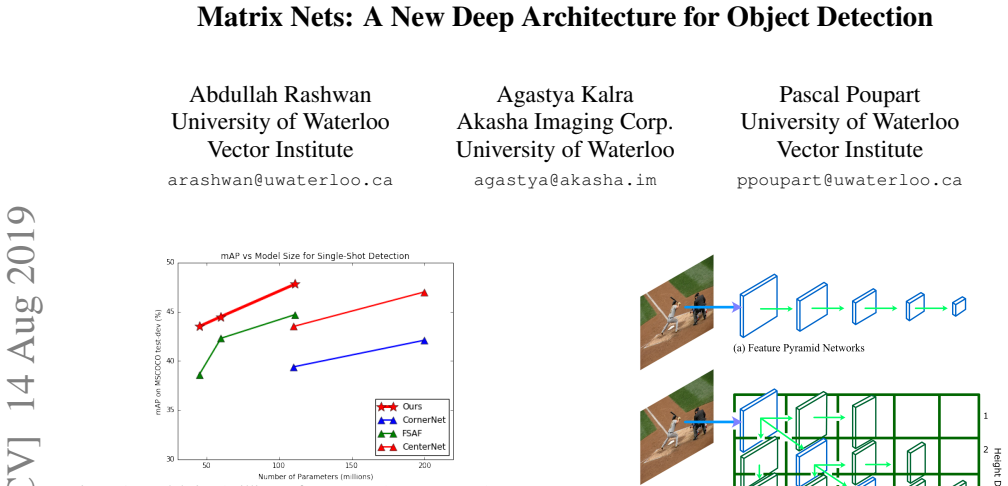
- [Section 4.1] The claim that the model uses half the parameters and trains 3x faster than the next best architecture is not backed by measured quantities in the paper. Table 1 has no parameter counts or training times, and Figure 1's parameter values are taken from other papers. The 3x speed figure appears to be inferred from 180k versus 480k iterations on different hardware and batch sizes, which is not a valid timing comparison. Please report parameter counts and training time measured under controlled conditions.
- [Section 2.2] The layer-range assignment assumes that each step to the right or down in the matrix doubles the receptive field in one dimension, but no derivation or empirical support is given. The actual receptive field of an off-diagonal layer depends on the number and stride placement of the shared 3x3 convolutions and on the receptive field of the source diagonal layer. Since the 0.8 and 1.3 relaxation factors and the hand-set base range determine which objects are assigned to each layer, the correctness of this assumption is central to the architecture's claimed advantage; please include an explicit receptive-field calculation or a validation (e.g., per-size and per-aspect-ratio accuracy).
- [Section 4] No error bars or repeated runs are reported, and no code is provided. Given that the margin over CenterNet (Multi-Scale) is 0.8 mAP, which is within typical run-to-run variability, the robustness of the headline result is unclear. At minimum, report the variance across multiple runs or provide reproducibility artifacts (code and pretrained models).
minor comments (4)
- [Section 2] The formal definition of l_{i,j} swaps the roles of i and j relative to the following sentence and the l_{1,2} example: the text says width downsampling is 2^{i-1}, but moving right (increasing j) is later said to cut width. Please correct the definition or the index convention.
- [Section 4] Please clarify the relationship between the 512x512 training crops, the 900-pixel max-side test resize, and the multi-scale test protocol (which scales are used). This matters for reproducing the reported numbers.
- [Figure 1 and Table 1] For a fair parameter comparison, state whether the plotted parameter counts include the detection head, and report the parameter count of KP-xNet explicitly in Table 1.
- [Throughout] There are nomenclature inconsistencies (ResNext vs ResNeXt, KP- xNet spacing vs KP-xNet, MatrixNets vs Matrix Nets). Please standardize.
Circularity Check
No circularity: the architecture and its COCO benchmark are self-contained empirical claims; layer ranges are hand-set design choices, not fitted outputs.
full rationale
The paper's derivation chain is self-contained and empirically anchored. The core contribution is a new layer-generation scheme in which diagonal layers come from a feature pyramid and off-diagonal layers are produced by shared strided convolutions; this is a constructive definition, not a derivation from the target result. The layer ranges are generated recursively from a hand-set base range for l1,1 using the stated doubling rule (Section 2.2), with relaxation factors 0.8 and 1.3 chosen in advance. These are design hyperparameters, not parameters fitted to the final mAP, and the paper does not rename any fitted quantity as a prediction. The reported 47.8 mAP is an empirical benchmark against external published detectors (CornerNet, CenterNet, RetinaNet, FSAF), so the central claim is falsifiable and does not reduce to its inputs by construction. The paper contains no author self-citations that carry a load-bearing premise, and no uniqueness theorem or prior-work conclusion is imported to force the architecture choice. The absence of an ablation isolating the matrix layers is a genuine experimental-design limitation that belongs under correctness risk, not circularity: a missing control does not make the claim definitionally equivalent to its inputs. Overall, no circular step is exhibited that would satisfy the standard of Eq. X = Eq. Y by construction or a fitted parameter renamed as a prediction.
Assumptions & free parameters
free parameters (3)
- l1,1 base layer range =
24-48 px by 24-48 px
- Range relaxation factors =
0.8 and 1.3
- Pruning scheme for off-diagonal layers =
not specified
assumptions (3)
- domain assumption The receptive field roughly doubles in a dimension when the feature map resolution is halved in that dimension, so layer ranges should double with each matrix step.
- domain assumption Off-diagonal matrix layers can be created by shared strided convolutions on FPN diagonal layers without losing needed information.
- domain assumption Center regression within a matrix layer is easier than matching by embeddings because the range of possible centers is small.
Cite this review
Pith. "Pith review of Matrix Nets: A New Deep Architecture for Object Detection." pith.science (2026). https://pith.science/paper/N32HQYHE
@misc{pith2026190804646,
  author       = {Pith},
  title        = {Pith review of: Matrix Nets: A New Deep Architecture for Object Detection},
  year         = {2026},
  howpublished = {\url{https://pith.science/paper/N32HQYHE}},
  note         = {Machine review of arXiv:1908.04646}
}
read the original abstract
We present Matrix Nets (xNets), a new deep architecture for object detection. xNets map objects with different sizes and aspect ratios into layers where the sizes and the aspect ratios of the objects within their layers are nearly uniform. Hence, xNets provide a scale and aspect ratio aware architecture. We leverage xNets to enhance key-points based object detection. Our architecture achieves mAP of 47.8 on MS COCO, which is higher than any other single-shot detector while using half the number of parameters and training 3x faster than the next best architecture.
Figures
Reference graph
Works this paper leans on
-
[1]
write newline
" write newline "" before.all 'output.state := FUNCTION fin.entry add.period write newline FUNCTION new.block output.state before.all = 'skip after.block 'output.state := if FUNCTION new.sentence output.state after.block = 'skip output.state before.all = 'skip after.sentence 'output.state := if if FUNCTION not #0 #1 if FUNCTION and 'skip pop #0 if FUNCTIO...
-
[2]
T. DeVries and G. W. Taylor. Improved regularization of convolutional neural networks with cutout. arXiv preprint arXiv:1708.04552 , 2017
arXiv 2017
-
[3]
K. Duan, S. Bai, L. Xie, H. Qi, Q. Huang, and Q. Tian. Centernet: Object detection with keypoint triplets. arXiv preprint arXiv:1904.08189 , 2019
arXiv 1904
- [4]
-
[5]
Y. Li, Y. Chen, N. Wang, and Z. Zhang. Scale-aware trident networks for object detection. arXiv preprint arXiv:1901.01892 , 2019
arXiv 1901
-
[6]
T.-Y. Lin, P. Doll \'a r, R. Girshick, K. He, B. Hariharan, and S. Belongie. Feature pyramid networks for object detection. In Proceedings of the IEEE conference on computer vision and pattern recognition , pages 2117--2125, 2017
work page 2017
-
[7]
T.-Y. Lin, P. Goyal, R. Girshick, K. He, and P. Doll \'a r. Focal loss for dense object detection. In Proceedings of the IEEE international conference on computer vision , pages 2980--2988, 2017
2017
-
[8]
C. Zhu, Y. He, and M. Savvides. Feature selective anchor-free module for single-shot object detection. arXiv preprint arXiv:1903.00621 , 2019
arXiv 1903
Reviewed August 14, 2026 · model on record in the stance chip above.
Discussion (0). Continue with ORCID to comment.