Conditional Normalizing Flow for Gas-Surface Scattering from Thermal to Hypersonic Velocities
Pith reviewed 2026-07-01 02:13 UTC · model grok-4.3
The pith
Conditional normalizing flows model gas-surface scattering from thermal to hypersonic velocities while enforcing detailed balance.
A machine-rendered reading of the paper's core claim, the machinery that carries it, and where it could break.
Core claim
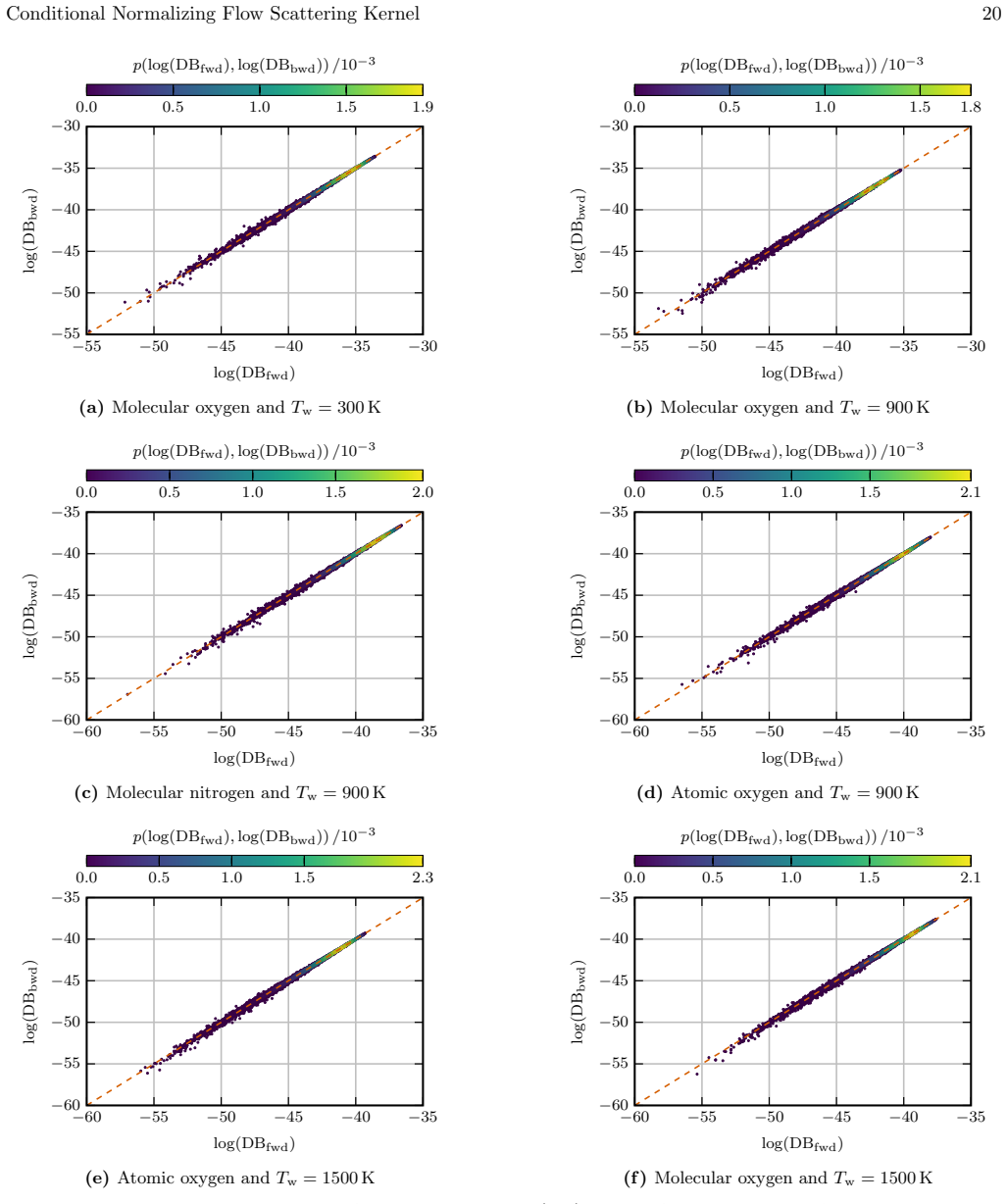
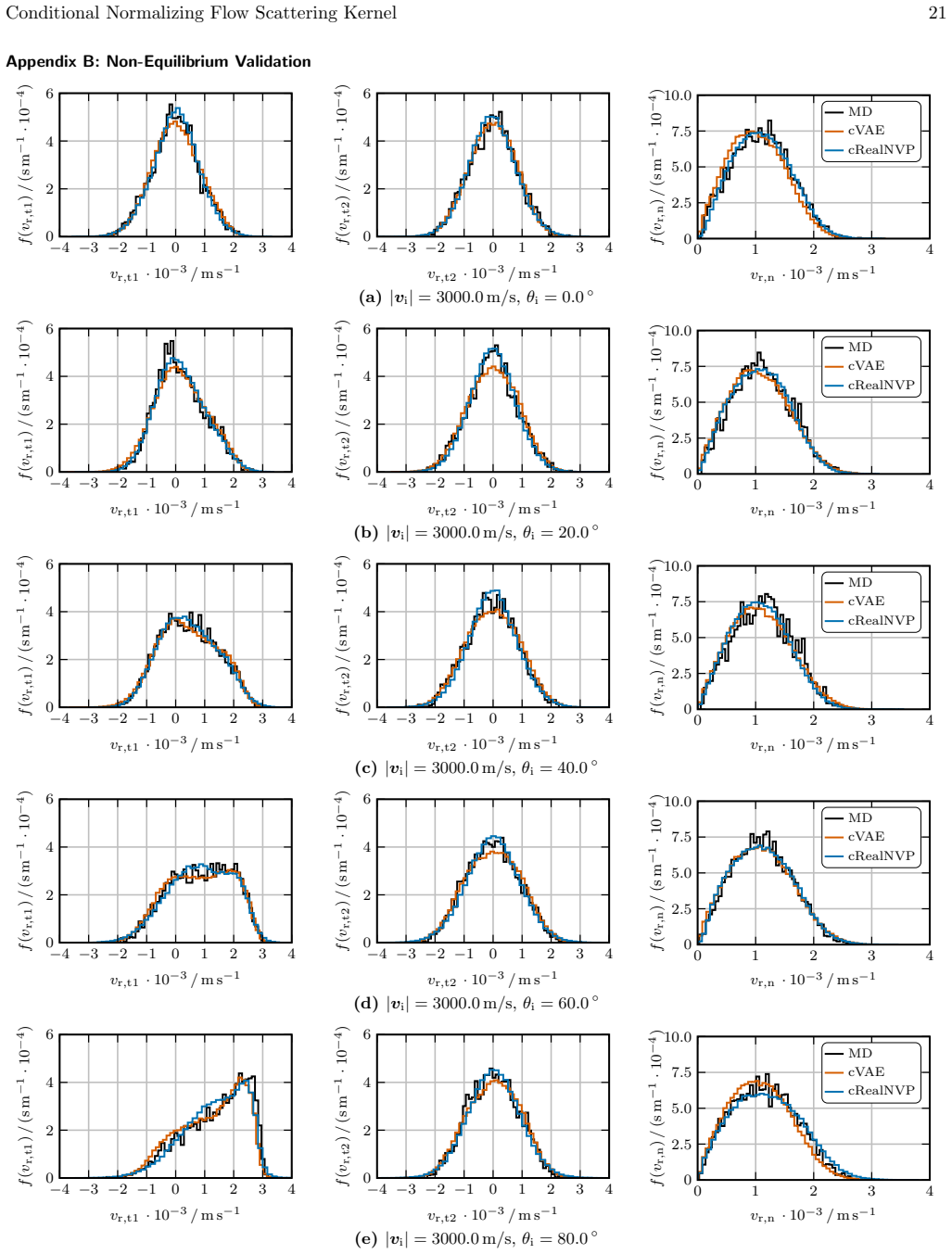
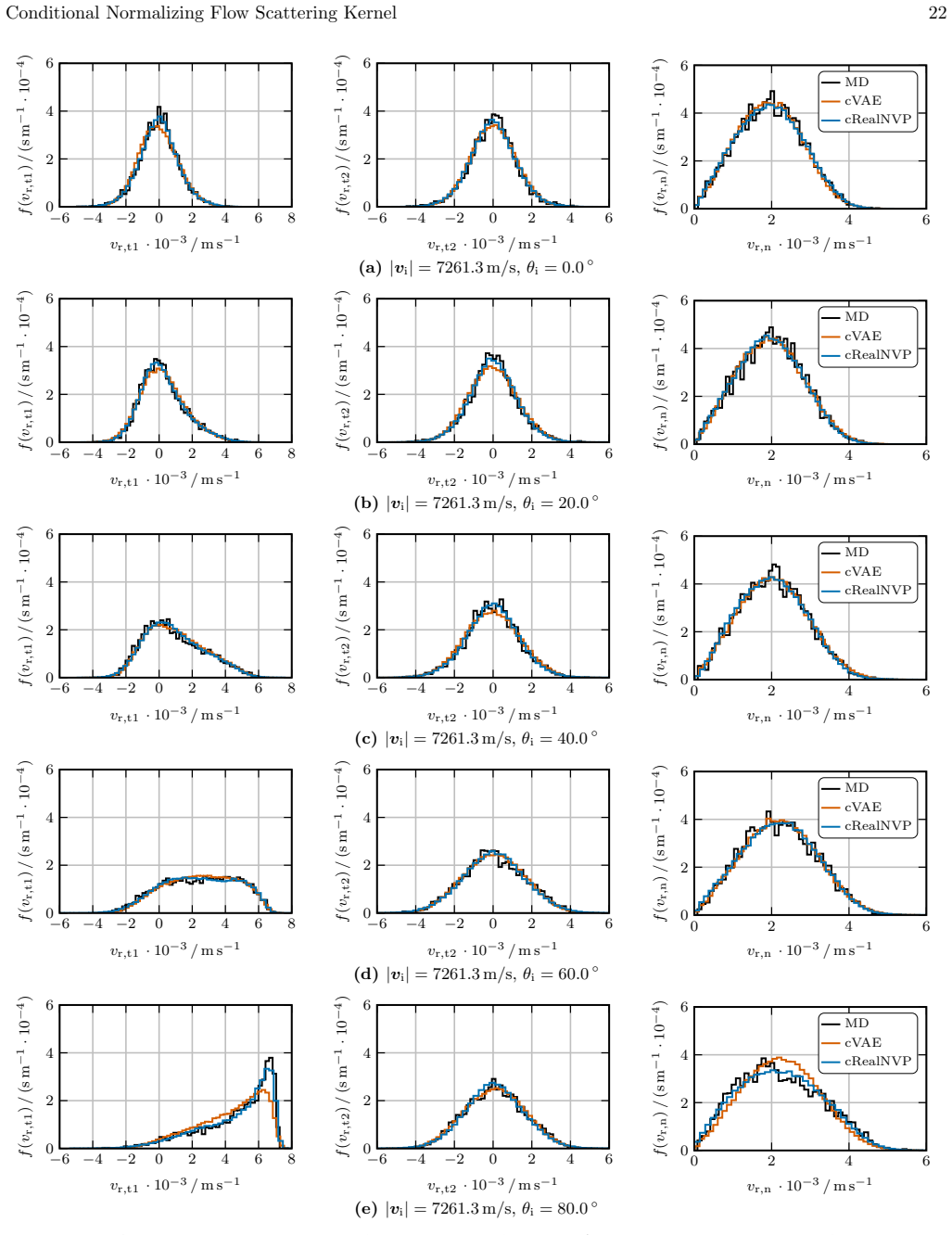
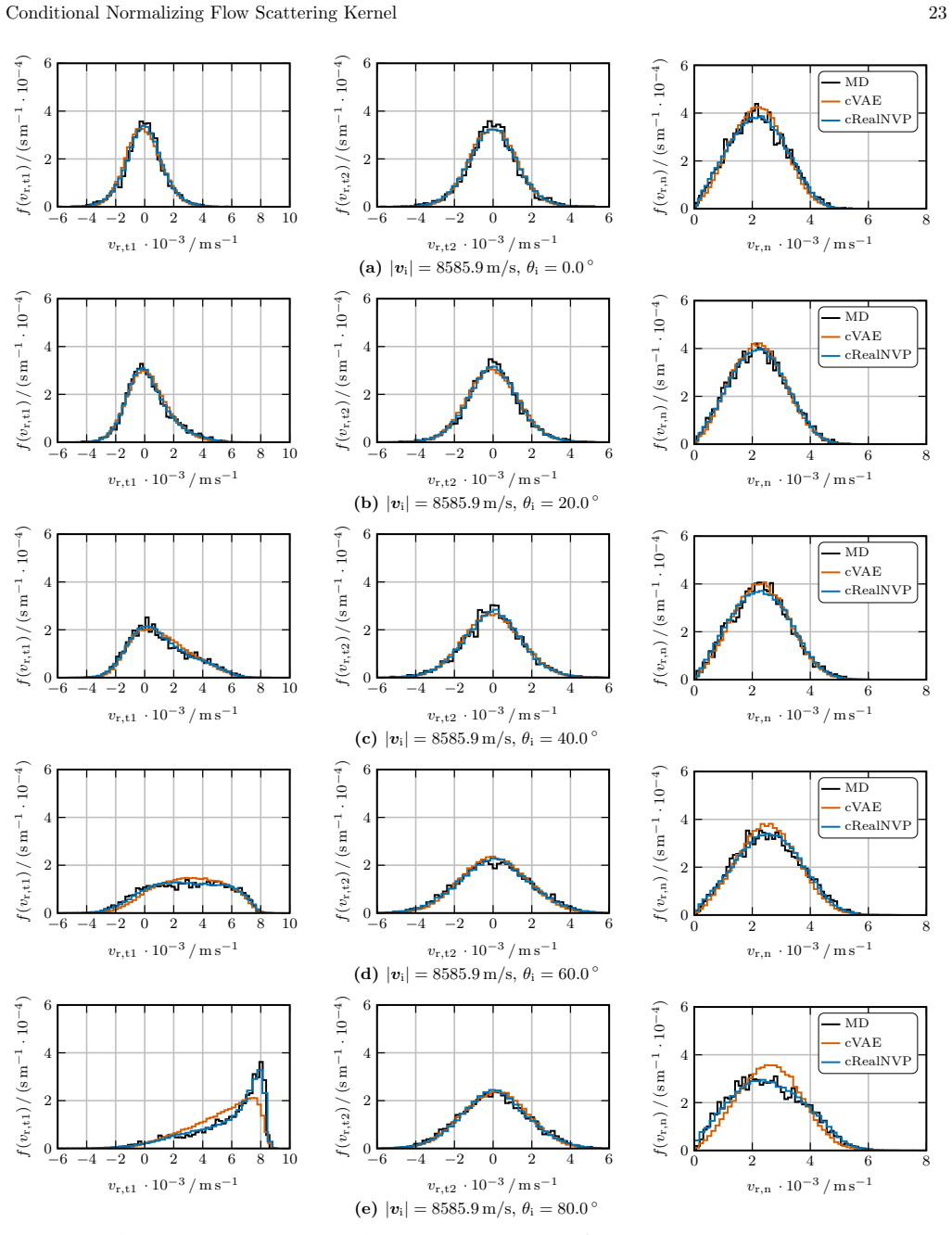
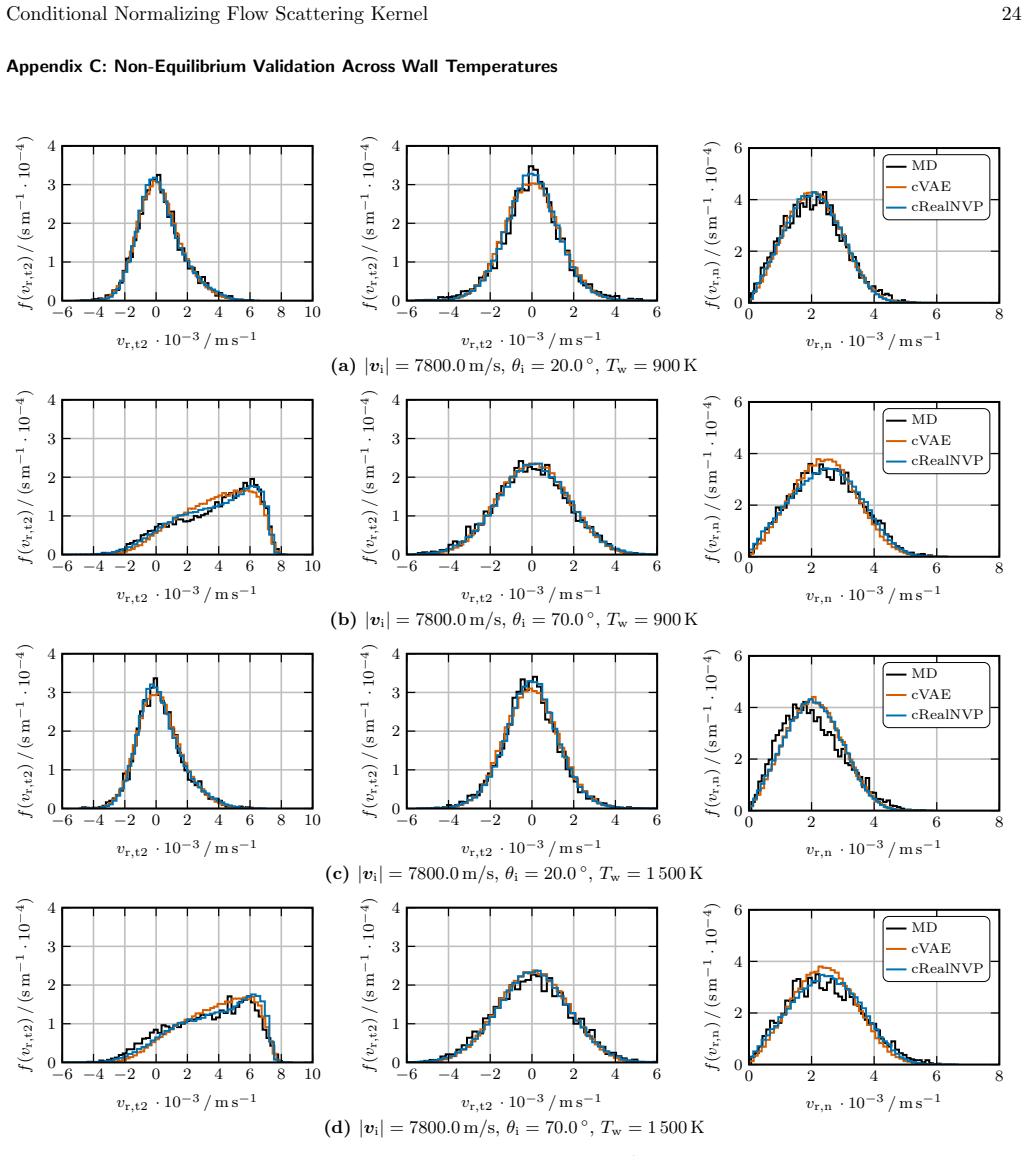
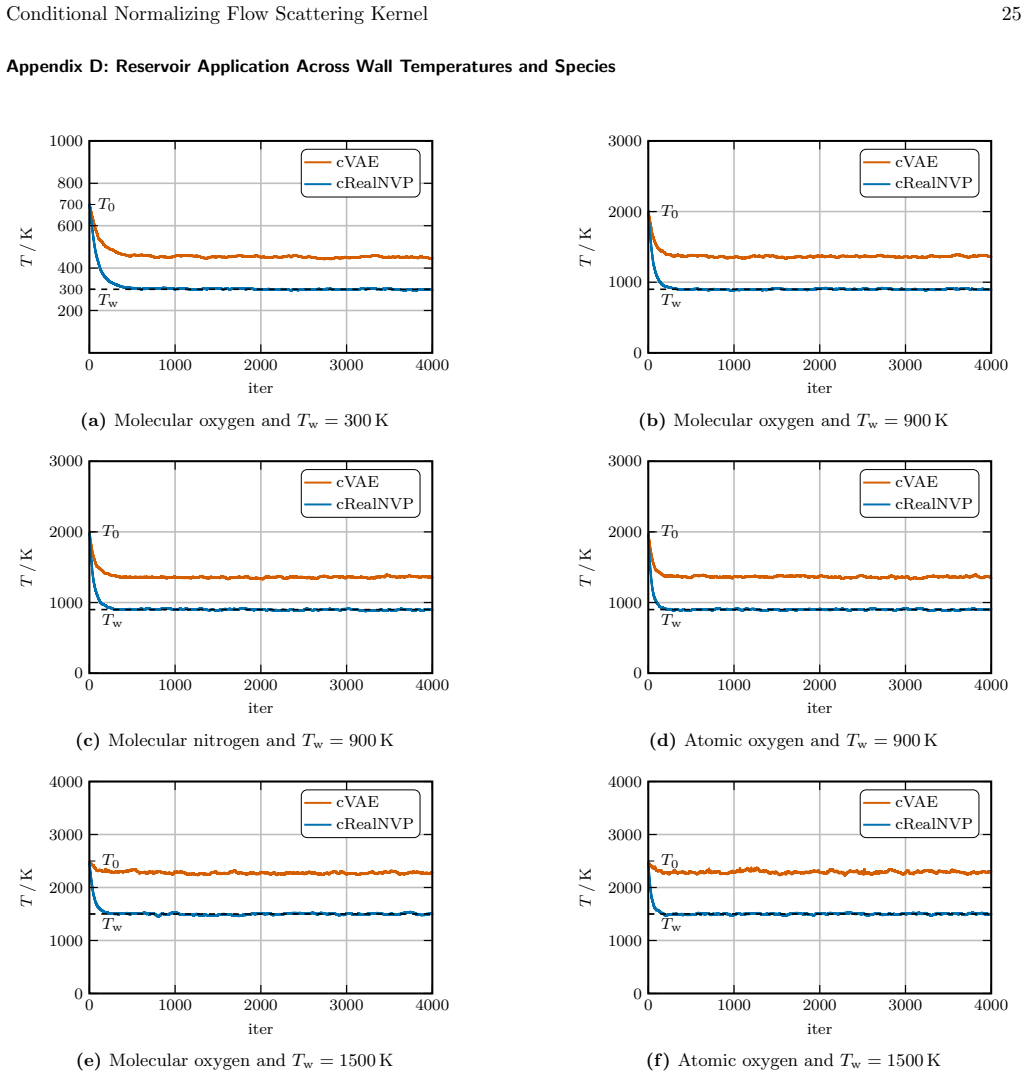
A conditional RealNVP model trained on expanded molecular dynamics data from thermal to hypersonic velocities, with an added detailed balance loss term, produces scattering kernels that achieve improved accuracy in the original high-velocity regime while successfully capturing thermal-velocity scattering and approximating thermalization within acceptable tolerances.
What carries the argument
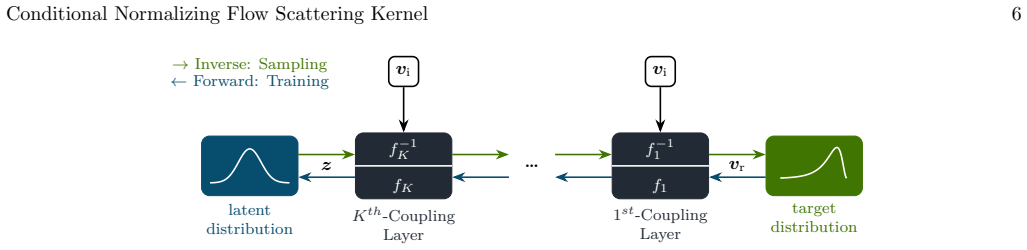
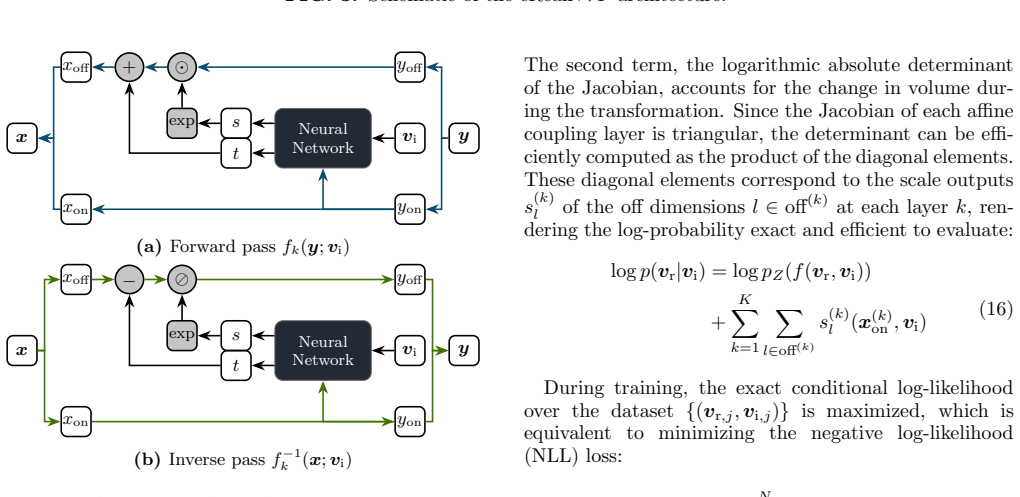
The conditional Real-valued Non-Volume Preserving (cRealNVP) flow conditioned on incident velocity and augmented with a detailed balance loss term during training.
If this is right
- The model supports simulation of multi-bounce scenarios inside complex geometries such as air-breathing electric propulsion intakes.
- It supplies a general method for constructing thermodynamically consistent scattering kernels in other rarefied gas dynamics problems.
- Accuracy gains appear in the original high-velocity single-impact regime as well as the newly added thermal regime.
- The framework enables more reliable aerodynamic modeling for VLEO mission planning and spacecraft design.
Where Pith is reading between the lines
- Integration into direct simulation Monte Carlo codes could improve overall drag and heat-flux predictions for satellites experiencing velocity-dependent surface interactions.
- The same conditioning approach might be tested on different surface materials or gas species to check transferability without retraining from scratch.
- If thermalization tolerances hold under repeated bounces, the model could reduce the need for separate equilibrium and non-equilibrium kernels in long-duration orbital simulations.
Load-bearing premise
The molecular dynamics simulations used for training accurately represent real gas-surface interactions across the full velocity range, and the detailed balance loss enforces thermodynamic consistency without introducing artifacts or degrading single-impact performance.
What would settle it
A direct comparison of predicted post-collision velocity and angular distributions against experimental gas-surface scattering data at thermal velocities, or a numerical check confirming that the trained model satisfies detailed balance when sampling from equilibrium distributions.
Figures
read the original abstract
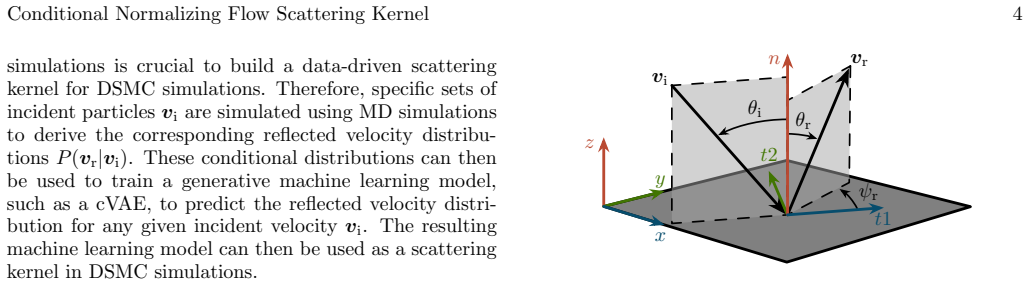
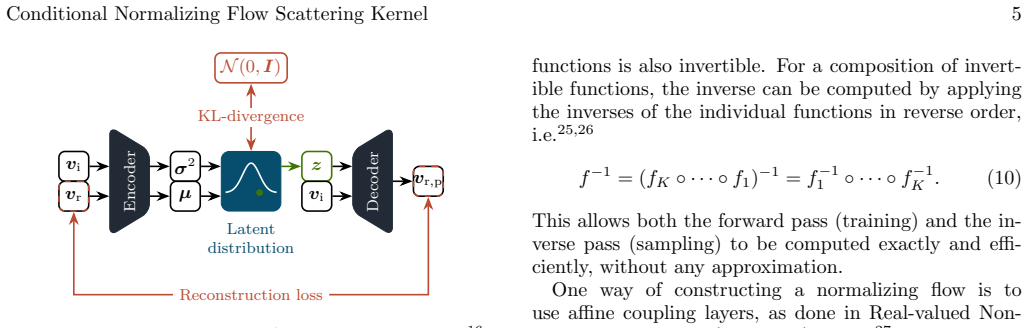
Accurate aerodynamic modeling of satellites in very low Earth orbit (VLEO) requires gas-surface interaction (GSI) models that capture the full velocity spectrum from thermal to orbital speeds. Atmospheric particles initially strike spacecraft surfaces at hypersonic velocities of 6 000 - 10 000 m/s. Due to surface roughness and complex geometries, especially within air-breathing electric propulsion (ABEP) intake systems, multiple collisions occur, progressively reducing the particle velocities. A recent machine learning framework for deriving scattering kernels from molecular dynamics (MD) simulations has shown promise, but remains limited to high-velocity single impacts and possibly violates fundamental equilibrium principles such as detailed balance. This work extends this machine learning based scattering kernel to cover the complete velocity range using conditional normalizing flows trained with physics-informed constraints, enabling accurate modeling of multi-bounce scenarios in realistic VLEO applications. We train a conditional Real-valued Non-Volume Preserving (cRealNVP) model on expanded molecular dynamics simulations covering velocities from thermal to hypersonic speeds, incorporating a detailed balance loss term. The resulting model demonstrates improved accuracy compared to previous approaches even in the original high-velocity regime, while successfully capturing thermal-velocity scattering. Quantitative assessment shows that thermalization is approximated within acceptable tolerances. This framework provides essential capabilities for accurate ABEP intake optimization and VLEO mission planning while offering a general methodology applicable to broader rarefied gas dynamics problems requiring thermodynamic consistency.
Editorial analysis
A structured set of objections, weighed in public.
Referee Report
Summary. The paper extends a prior machine-learning framework for gas-surface scattering kernels by training a conditional RealNVP (cRealNVP) normalizing flow on molecular-dynamics data spanning thermal to hypersonic velocities. A detailed-balance loss term is added to enforce thermodynamic consistency, enabling modeling of multi-bounce thermalization relevant to VLEO and ABEP applications. The abstract states that the resulting model improves accuracy even in the original high-velocity regime and approximates thermalization within acceptable tolerances.
Significance. If the quantitative claims hold and the detailed-balance constraint does not degrade single-impact fidelity or introduce artifacts, the work would supply a practical, thermodynamically consistent scattering model for rarefied-gas aerodynamics over the full velocity range needed for VLEO mission planning. The combination of conditional flows with an explicit physics loss is a methodological strength that could generalize to other rarefied-gas problems.
major comments (2)
- [Methods] Methods section: the explicit functional form of the detailed-balance loss, its weighting relative to the data likelihood, and the precise training protocol (including how negative samples or equilibrium targets are generated) are not supplied. Without these, it is impossible to determine whether the loss reduces to a fitted quantity or enforces consistency independently of the training targets, directly affecting the central claim of thermodynamic consistency without new artifacts.
- [Results] Results section: the statements of 'improved accuracy' and 'thermalization approximated within acceptable tolerances' are presented without accompanying tables of error metrics (e.g., mean absolute deviation in velocity or energy accommodation coefficients), ablation studies removing the detailed-balance term, or direct comparisons against the prior high-velocity model on identical test sets. These omissions make the quantitative claims unverifiable from the manuscript.
minor comments (2)
- [Abstract] The abstract refers to 'expanded molecular dynamics simulations' but does not specify the surface model, interatomic potentials, or number of trajectories per velocity bin; these details belong in the Methods section for reproducibility.
- Notation for the conditional input (velocity magnitude or vector) and the output distribution (scattered velocity or kernel) should be defined once at first use and used consistently.
Simulated Author's Rebuttal
We thank the referee for the constructive comments, which help strengthen the manuscript. We address each major comment below and will revise accordingly to improve clarity and verifiability.
read point-by-point responses
-
Referee: [Methods] Methods section: the explicit functional form of the detailed-balance loss, its weighting relative to the data likelihood, and the precise training protocol (including how negative samples or equilibrium targets are generated) are not supplied. Without these, it is impossible to determine whether the loss reduces to a fitted quantity or enforces consistency independently of the training targets, directly affecting the central claim of thermodynamic consistency without new artifacts.
Authors: We agree that these implementation details were omitted from the Methods section. In the revised manuscript we will provide the explicit functional form of the detailed-balance loss, the relative weighting hyperparameter, and the full training protocol including generation of equilibrium targets and negative samples. This addition will make the enforcement of thermodynamic consistency transparent and reproducible. revision: yes
-
Referee: [Results] Results section: the statements of 'improved accuracy' and 'thermalization approximated within acceptable tolerances' are presented without accompanying tables of error metrics (e.g., mean absolute deviation in velocity or energy accommodation coefficients), ablation studies removing the detailed-balance term, or direct comparisons against the prior high-velocity model on identical test sets. These omissions make the quantitative claims unverifiable from the manuscript.
Authors: We acknowledge that the Results section lacks the requested quantitative tables, ablation studies, and side-by-side comparisons. The revised version will include tables reporting mean absolute deviations for velocity and energy accommodation coefficients, ablation experiments with and without the detailed-balance term, and direct performance comparisons against the prior model on identical test sets. These additions will allow readers to verify the stated improvements. revision: yes
Circularity Check
No significant circularity detected
full rationale
The provided abstract and context describe training a cRealNVP model on MD simulations with an added detailed balance loss term as a physics-informed constraint. No equations, self-citations, or derivation steps are quoted that reduce any prediction or result to its inputs by construction (e.g., no fitted parameter renamed as prediction, no uniqueness theorem imported from prior self-work, no ansatz smuggled via citation). The central claims rest on external MD data fidelity and the loss term's ability to enforce consistency without degrading single-impact accuracy; these are empirical preconditions, not internal reductions. The reader's noted uncertainty about the loss term cannot be resolved into a specific circular reduction without quoted methods or equations showing equivalence by construction. This is the common case of a self-contained empirical ML model against external benchmarks.
Axiom & Free-Parameter Ledger
Reference graph
Works this paper leans on
-
[1]
and Roberts, P
Virgili-Llop, J. and Roberts, P. and Hao, D. Z. and Ramio-Tomas, L. Very Low Earth Orbit mission concepts for Earth Observation. Benefits and challenges. Reinventing Space Conference. 2014
2014
-
[2]
Laux , school =
M. Laux , school =. Direkte Simulation verdünnter, reagierender Strömungen , year =
-
[3]
Crisp, N.H. and others. The benefits of very low earth orbit for earth observation missions. Progress in Aerospace Sciences. 2020. doi:10.1016/j.paerosci.2020.100619
-
[4]
Fasoulas, S. and others. Motivation, Structure and Goals of the Collaborative Research Center 1667: Advancing Technologies of Very Low-Altitude Satellites - ATLAS. 2 ^ nd International Conference on Very Low Earth Orbit Missions and Technologies. 2025. doi:10.1007/s12567-025-00687-8
-
[5]
Bird, G. A. Molecular Gas Dynamics and the Direct Simulation of Gas Flows. 1994
1994
-
[6]
Nejad, S. M. Scattering Dynamics of rarefied gases. 2023
2023
-
[7]
Maxwell, J. C. On stresses in rarefied gases arising from inequalities of temperature. Phil. Trans. R. Soc. 1879. doi:10.1098/rstl.1879.0067
-
[8]
Livadiotti, S. and others. A review of gas-surface interaction models for orbital aerodynamics applications. Progress in Aerospace Sciences. 2020. doi:10.1016/j.paerosci.2020.100675
-
[9]
Liang, T. and Zhang, J. and Li, Q. A parameter-free physical model for gas–surface interaction. Physics of Fluids. 2021. doi:10.1063/5.0059029
-
[10]
Mehta, P. M. and Walker, A. and McLaughlin, C. A. and Koller, J. Comparing Physical Drag Coefficients Computed Using Different Gas–Surface Interaction Models. Journal of Spacecraft and Rockets. 2014. doi:10.2514/1.A32566
-
[11]
Cercignani, C. and Lampis, M. Kinetic models for gas-surface interactions. Transport Theory and Statistical Physics. 1971. doi:10.1080/00411457108231440
-
[12]
The Boltzmann Equation and Its Applications , volume =
Cercignani, Carlo , editorb =. The Boltzmann Equation and Its Applications , volume =. 1988 , langid =
1988
-
[13]
Washboard model of gas–surface scattering
Tully, John C. Washboard model of gas–surface scattering. The Journal of Chemical Physics. 1990. doi:10.1063/1.458421
-
[14]
Molecular Dynamics Modeling of Gas-Surface Interactions
Chen, Y. Molecular Dynamics Modeling of Gas-Surface Interactions. 2024
2024
-
[15]
Liao, M. and To, Q.-D. and Léonard, C. and Yang, W. Prediction of thermal conductance and friction coefficients at a solid-gas interface from statistical learning of collisions. Phys. Rev. E. 2018. doi:10.1103/PhysRevE.98.042104
-
[16]
Roth, J. and Eisfeld, E. and Klein, D. and Hocker, S. and Lipp, H. and Trebin, H.-R. IMD - the ITAP molecular dynamics simulation package. The European Physical Journal Special Topics. 2019. doi:10.1140/epjst/e2019-800147-7
-
[17]
Tangney, P. and Scandolo, S. An ab initio parametrized interatomic force field for silica. Journal of Chemical Physics. 2019. doi:10.1063/1.1513312
-
[18]
Hocker, S. and Beck, P. and Schmauder, S. and Roth, J. and Trebin, H.-R. Simulation of crack propagation in alumina with ab initio based polarizable force field. The Journal of Chemical Physics. 2012. doi:10.1063/1.3685900
-
[19]
Kingma, D. P. and Welling, M. Auto-Encoding Variational Bayes. 2022. arXiv:1312.6114
work page internal anchor Pith review Pith/arXiv arXiv 2022
-
[20]
and Lee, H
Sohn, K. and Lee, H. and Yan, X. Learning Structured Output Representation using Deep Conditional Generative Models. Advances in Neural Information Processing Systems. 2015
2015
-
[21]
Xu, C. and Caracciolo, A. and Jorge, P. D. C. and Gouzman, I. and Pilinski, M. D. and Minton, T. K. Inelastic scattering dynamics of hyperthermal O atoms on engineering surfaces relevant to satellites in low Earth orbit. 2 ^ nd International Conference on Very Low Earth Orbit Missions and Technologies. 2025. doi:10.1007/s12567-025-00628-5
-
[22]
Andric, N. and Meyer, D. W. and Jenny, P. Data-based modeling of gas-surface interaction in rarefied gas flow simulations. Physics of Fluids. 2019. doi:10.1063/1.5094768
-
[23]
Murray, V. J. and Pilinski, M. D. and Smoll, E. J. and Qian, M. and Minton, T. K. and Madzunkov, S. M. and Darrach, M. R. Gas-Surface Scattering Dynamics Applied to Concentration of Gases for Mass Spectrometry in Tenuous Atmospheres. The Journal of Physical Chemistry C. 2017. doi:10.1021/acs.jpcc.7b00456
-
[24]
Allen, M. P. and Tildesley, D. J. Computer Simulation of Liquids. 2017
2017
-
[25]
Fasoulas, S. and Munz, C.-D. and Pfeiffer, M. and Beyer, J. and Binder, T. and Copplestone, S. and Mirza, A. and Nizenkov, P. and Ortwein, P. and Reschke, W. Combining particle-in-cell and direct simulation Monte Carlo for the simulation of reactive plasma flows. Physics of Fluids. 2019. doi:10.1063/1.5097638
-
[26]
François Chollet and others. Keras. 2015
2015
-
[27]
TensorFlow: Large-Scale Machine Learning on Heterogeneous Distributed Systems
Abadi, M. and others. TensorFlow : Large-Scale Machine Learning on Heterogeneous Systems. 2016. arXiv:1603.04467v2
work page internal anchor Pith review Pith/arXiv arXiv 2016
-
[28]
Davis, P. J. and Rabinowitz, P. Methods of Numerical Integration. 1975
1975
-
[29]
and Schwartzentruber, Thomas E
Minton, Timothy K. and Schwartzentruber, Thomas E. and Xu, Chenbiao. On the Utility of Coated POSS-Polyimides for Vehicles in Very Low Earth Orbit. ACS Applied Materials & Interfaces. 2021. doi:10.1021/acsami.1c14196
-
[30]
Luciana A. Sinpetru and Nicholas H. Crisp and David Mostaza-Prieto and Sabrina Livadiotti and Peter C.E. Roberts. ADBSat : Methodology of a novel panel method tool for aerodynamic analysis of satellites. Computer Physics Communications. 2022. doi:10.1016/j.cpc.2022.108326
-
[31]
Incorporating Second-Order Functional Knowledge for Better Option Pricing
Dugas, Charles and Bengio, Yoshua and B\' e lisle, Fran c ois and Nadeau, Claude and Garcia, Ren\' e. Incorporating Second-Order Functional Knowledge for Better Option Pricing. Advances in Neural Information Processing Systems. 2000
2000
-
[32]
Rectified linear units improve restricted boltzmann machines
Nair, Vinod and Hinton, Geoffrey E. Rectified linear units improve restricted boltzmann machines. Proceedings of the 27th International Conference on Machine Learning. 2010
2010
-
[33]
Rectifier nonlinearities improve neural network acoustic models
Maas, Andrew L and Hannun, Awni Y and Ng, Andrew Y and others. Rectifier nonlinearities improve neural network acoustic models. Proceedings of the 30th International Conference on Machine Learning. 2013
2013
-
[34]
Fast and Accurate Deep Network Learning by Exponential Linear Units (ELUs)
Djork-Arné Clevert and Thomas Unterthiner and Sepp Hochreiter. Fast and Accurate Deep Network Learning by Exponential Linear Units ( ELUs ). 2016. arXiv:1511.07289
work page internal anchor Pith review Pith/arXiv arXiv 2016
-
[35]
Thermospheric Density and Wind Determination from Satellite Dynamics
Eelco Niening Doornbos. Thermospheric Density and Wind Determination from Satellite Dynamics. 2011
2011
-
[36]
Poovathingal, Savio and Schwartzentruber, Thomas E. and Murray, Vanessa J. and Minton, Timothy K. Molecular Simulation of Carbon Ablation Using Beam Experiments and Resolved Microstructure. AIAA Journal. 2016. doi:10.2514/1.J054562
-
[37]
and Hocker, S
Schütte, M. and Hocker, S. and Lipp, H. and Roth, J. and Fasoulas, S. and Pfeiffer, M. , title =. Physics of Fluids , volume =. 2025 , month =
2025
-
[38]
Li, L. and Wang, L. and Minton, T. K. and Yang, J. C. Structural Characterization of Oxide layers on Aluminum Formed by Exposure to Hyperthermal Atomic Oxygen. MRS Proceedings. 2004. doi:10.1557/PROC-851-NN9.4
-
[39]
Mohammad Nejad, Shahin and Iype, Eldhose and Nedea, Silvia and Frijns, Arjan and Smeulders, David. Modeling rarefied gas-solid surface interactions for Couette flow with different wall temperatures using an unsupervised machine learning technique. Phys. Rev. E. 2021. doi:10.1103/PhysRevE.104.015309
-
[40]
2017 , eprint=
Density estimation using Real NVP , author=. 2017 , eprint=
2017
-
[41]
2016 , eprint=
Variational Inference with Normalizing Flows , author=. 2016 , eprint=
2016
-
[42]
2015 , eprint=
NICE: Non-linear Independent Components Estimation , author=. 2015 , eprint=
2015
-
[43]
2023 , eprint=
Learning Likelihoods with Conditional Normalizing Flows , author=. 2023 , eprint=
2023
-
[44]
Physics of Fluids , volume =
Park, Woonghwi and Jun, Eunji , title =. Physics of Fluids , volume =. 2025 , month =
2025
-
[45]
Jorge, Pedro D. C. and Schwartzentruber, Thomas E. and Hubin, Annick and Magin, Thierry E. and Minton, Timothy K. , title =. The Journal of Physical Chemistry C , volume =. 2025 , doi =
2025
-
[46]
A wave scattering approach to modelling surface roughness in orbital aerodynamics , journal =
Anton, Sabin-Viorel and Sousa Alves, Bernardo and Siemes, Christian and Van Den. A wave scattering approach to modelling surface roughness in orbital aerodynamics , journal =. doi:10.1016/j.asr.2025.05.069 , pages =
-
[47]
2026 , howpublished =
2026
-
[48]
Garcia and Wolfgang Wagner , title =
Alejandro L. Garcia and Wolfgang Wagner , title =. Journal of Computational Physics , volume =. 2006 , issn =
2006
-
[49]
CRC Handbook of Chemistry and Physics , editor =
discussion (0)
Sign in with ORCID, Apple, or X to comment. Anyone can read and Pith papers without signing in.