REVIEW 4 major objections 4 minor 60 references
The superconductivity mechanism in Nd-1111 iron-based superconductor doped by calcium
T0 review · 4 major / 4 minor · reviewed 2026-08-14 · deepseek-v4-flash
Pith's one-line read This paper reports that low-level calcium doping of the iron-based superconductor NdFeAsO0.8F0.2 suppresses superconductivity exactly as nonmagnetic impurity pair breaking predicts, and takes this as evidence that spin fluctuations are…
desk verdict A real data set on Ca-doped Nd-1111, but the paper's conclusion that it confirms S± pairing is an overreach. read the letter →
The pith
A machine-rendered reading of the paper's core claim, the machinery that carries it, and where it could break.
The reading
What carries the argument
The load-bearing instrument is the Abrikosov-Gorkov theory of $T_c$ suppression by nonmagnetic impurity pair breaking, in which $T_c$ decreases linearly with impurity concentration and the initial slope $dT_c/dn_I$ is set by the exchange constant $J$ and the density of states $N(0)$. The paper uses its experimental $dT_c/dx$ and a literature value $N(0) = 10$ states/eV atom spin to extract $J_{exc} = |8|$ meV. The second pillar is the $S_\pm$ versus $S_{++}$ distinction: in the published five-orbital impurity model cited by the authors, nonmagnetic impurities strongly suppress the sign-reversing $S_\pm$ state but leave the sign-preserving $S_{++}$ state nearly unchanged, so the reported phase diagram, where $T_c$ and $T_{SDW}$ fall together, selects spin-fluctuation pairing.
What would settle it
A decisive check would be to measure the Hall coefficient or another carrier probe across the same calcium series and to repeat the experiment with an isovalent, nonmagnetic substitution that does not change the electron count, while controlling for lattice effects. If $T_c$ drops just as steeply without a comparable rise in residual resistivity $\rho_0$, or if the carrier density changes substantially with $x$, then the Abrikosov-Gorkov attribution to nonmagnetic pair breaking, and with it the $S_\pm$ inference, would not hold. Alternatively, a phase-sensitive probe or ARPES measurement showing no sign change between electron and hole pockets would directly contradict the $S_\pm$ claim.
Extended reading notes
Core claim
The central claim is that a low concentration of calcium ions, substituting at the neodymium site of the 1111 iron-based superconductor, acts purely as nonmagnetic scattering centers, and that the resulting $T_c$ suppression is evidence for the sign-reversing $S_\pm$ pairing state. The authors show a linear decrease of $T_c$ with calcium content and with residual resistivity $\rho_0$, quantitatively described by the Abrikosov-Gorkov theory. They estimate $J_{exc} = |8|$ meV for the exchange coupling between calcium spins and conduction electrons. In the same samples, the temperature of the spin-density-wave transition also decreases with calcium content, so the Fe moments order stripe-antiferromagnetically only at lower temperatures. Because the measured phase diagram matches the theoretical one in which the $S_\pm$ state is fragile to nonmagnetic impurities while the $S_{++}$ state is robust, the authors conclude that spin fluctuations dominate the pairing mechanism in their synthesized samples.
Load-bearing premise
The whole mechanism conclusion rests on the assumption that calcium replacing neodymium acts only as a nonmagnetic scattering center. Since Ca$^{2+}$ replaces Nd$^{3+}$, it also removes electrons and shrinks the lattice, and if those carrier-doping or chemical-pressure effects, rather than scattering, drive the $T_c$ suppression, the observed data no longer single out the $S_\pm$ pairing state.
Editorial extensions
If this is right
- Calcium doping at $x \leq 0.05$ is a working impurity probe for pairing symmetry in Nd-1111, because it suppresses superconductivity in a controlled, Abrikosov-Gorkov-like way.
- The extracted $J_{exc} \approx 8$ meV provides a quantitative measure of the exchange coupling between a nonmagnetic impurity and conduction-electron spins in this family.
- The simultaneous fall of $T_{SDW}$ and $T_c$ under the same impurity implies that the spin-density-wave order and superconductivity share a common magnetic origin.
- If the $S_\pm$ assignment is correct, other probes of this material, such as penetration depth or ARPES, are expected to find a fully gapped sign-reversing order parameter.
Reading between the lines
- If the nonmagnetic-scattering assumption is right, the same calcium-doping protocol could rank the pairing symmetry of other 1111 compounds from resistivity data alone, without needing phase-sensitive measurements.
- Because Ca$^{2+}$ also dopes holes, a cleaner test would use an isovalent rare-earth substitution, such as La$^{3+}$ for Nd$^{3+}$, with a similar ionic-radius change; that comparison is absent from the paper but would separate scattering from band-filling.
- The authors' own data show lattice parameters shrinking with calcium content, so an independent pressure experiment could determine how much of the $T_c$ drop is chemical pressure rather than pair breaking.
- If confirmed, the result strengthens the general claim that spin fluctuations, not orbital fluctuations, dominate pairing in the iron-pnictide family, though it does not rule out a subdominant orbital-fluctuation contribution.
Signed reviews
Editorial analysis
A structured set of objections, weighed in public.
Referee Report
Summary. The paper reports resistivity and X-ray diffraction measurements on polycrystalline Nd1-xCaxFeAsO0.8F0.2 with x = 0, 0.01, 0.025, 0.05, and 0.1. The authors find that calcium substitution suppresses the superconducting transition temperature, increases the residual resistivity, and lowers the spin-density-wave transition temperature. They fit the initial Tc suppression to the Abrikosov-Gorkov theory, obtain an exchange constant J_exc of about 8 meV between calcium ions and conduction-electron spins, and compare their experimental phase diagram with the theoretical impurity phase diagram of Onari and Kontani. On this basis they conclude that the S± spin-fluctuation pairing state is the dominant pairing mechanism in their samples.
Significance. If the central inference were valid, the paper would provide a useful experimental constraint on the pairing state in the Nd-1111 iron-based superconductor and a quantitative estimate of the impurity exchange coupling. The manuscript's strengths are that it presents raw resistivity and XRD data for five compositions, includes Rietveld-refined lattice parameters, and directly engages the impurity-sensitivity predictions of spin-fluctuation theory. However, the significance is currently limited because the data do not isolate nonmagnetic pair breaking from carrier-doping and chemical-pressure effects: the same observations are compatible with band-filling, structural, or orbital-fluctuation scenarios. The final claim that the S± mechanism is confirmed is therefore not justified by the evidence presented.
major comments (4)
- [Section 3, Eq. (3) and Fig. 7(a)] The central inference that Ca acts as a pure Abrikosov-Gorkov nonmagnetic scatterer is assumed rather than tested. The authors' own Fig. 2 and the accompanying discussion show that calcium substitution substantially changes the lattice parameters, especially c, and the text mentions changes in Fe-As bond lengths, pnictogen height, and structural distortion. In addition, Ca2+ replacing Nd3+ changes the formal electron count by one hole per substitution, partially compensating the electron doping from fluorine. Both chemical pressure and band filling can suppress Tc in a way that resembles the observed linear decrease. Since Eq. (3) contains no terms for these contributions and no independent measurement, such as Hall coefficient, thermopower, or comparison with an isovalent impurity, is provided, the observed dTc/dx cannot by itself establish nonmagnetic pair breaking. Consequently, the conclusion in Section 4 that the S± state is confirmed as the dominant pairing mechanism is not supported by the presented data.
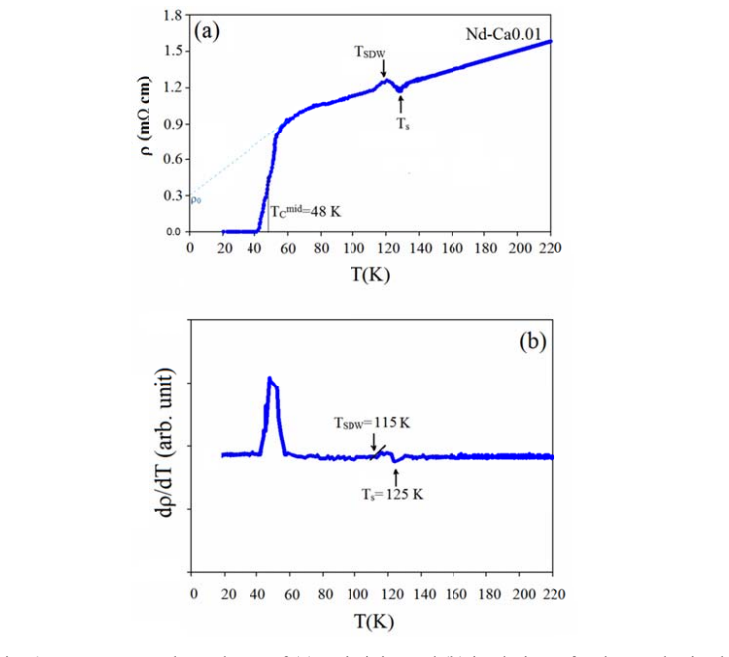
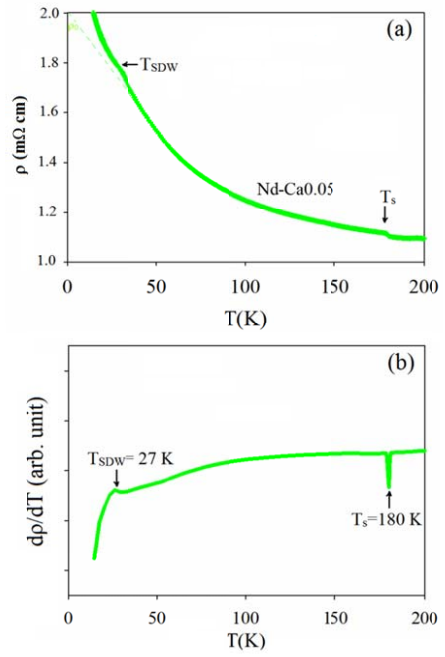
- [Figs. 3-6 and Fig. 9(a)] The phase diagram is built on TS and TSDW values identified from shoulders in the resistivity derivatives, but no objective criterion, error bar, or independent confirmation from magnetization, specific heat, or neutron scattering is given. With only five polycrystalline samples and broad transitions, the plotted phase diagram has limited quantitative content. The claimed matching with the theoretical phase diagram in Fig. 9(b) is therefore qualitative at best and cannot carry the weight of the pairing-mechanism conclusion.
- [Section 3, AG fit and J_exc] The linear AG fit in Fig. 7(a) uses at most four superconducting compositions (x = 0, 0.01, 0.025, and 0.05; the x = 0.1 sample is fully suppressed). No uncertainties are reported for Tc, for the residual resistivity ρ0, or for the fitted slope dTc/dx = -81.15 K/atom, and J_exc = |8| meV is quoted without an error bar. The density of states N(0) = 10 states/eV is taken from an unpublished PhD thesis, Ref. [52], so the quantitative exchange-constant claim is not robust.
- [Section 'Phase diagram of synthesized samples', final paragraph] The logical argument that suppression by nonmagnetic impurities identifies the S± state is a dichotomy that the paper's own citations do not support. Ref. [58] is cited for the statement that Tc can be weakly suppressed in the S++ state through localization and orbital-degeneracy effects near impurities. The manuscript nevertheless asserts that 'the S++ state has not an effect on the impurity doped samples.' That assertion is not established by the data. Since the measurements cannot distinguish a fragile S± state from a weakly suppressed S++ state or from carrier-doping and structural effects, the binary inference to spin fluctuations fails.
minor comments (4)
- [Throughout] The manuscript contains numerous typographical errors and garbled passages; examples include 'stripe antiferroma gnetic', 'play and important role', 'have be en', 'S. onari', and the broken equation fragment for 1/τ_s in Section 3. A thorough editorial pass is needed.
- [Fig. 9(b)] The theoretical phase diagram is reproduced from Ref. [33] without axis labels or a statement of the model parameters used, so the claimed matching with Fig. 9(a) is not independently assessable.
- [Section 2] The calcium content is only nominal; no EDX, WDS, or other compositional analysis is reported, so the actual impurity concentration used in the AG fit may differ from x.
- [Notation] Transition-temperature notation is inconsistent (TC, Tc, TC0), and J_exc is reported only as an absolute value; a brief statement of the sign convention and its physical meaning would improve clarity.
Circularity Check
No significant circularity: the measured Tc suppression and AG analysis are independent inputs, and the S± conclusion rests on an external theoretical comparison rather than on a construction from the same data.
full rationale
The paper's measured Tc suppression and residual resistivity increase are independent inputs. The Abrikosov-Gorkov analysis (Eqs. (1)-(4)) fits the initial slope dTc/dnI and uses an external N(0) from Ref. [52] to estimate Jexc; this is an estimate, not a prediction constructed from the pairing assumption. The central S± conclusion is obtained by comparing the observed impurity sensitivity with the externally cited theoretical result of Onari and Kontani (Ref. [33]) that S± is impurity-fragile while S++ is robust. That comparison is a consistency check, not a definitional equivalence: nothing in the measured resistivity or lattice data is asserted to define or entail S±; rather, an external theory is invoked. The only self-citation (Ref. [46]) is used for synthesis details, lattice-parameter comparisons, and as a closing agreement statement; it is not load-bearing for the derivation. No fitted parameter is renamed as a prediction, and no result is imported from the authors' own prior work as a uniqueness theorem. Therefore no circular step can be exhibited, and the score is 0.
Assumptions & free parameters
free parameters (2)
- dTc/dx at low x =
-81.15 K/atom
- dTc/dρ0 slope =
not stated
assumptions (5)
- domain assumption Abrikosov-Gorkov theory applies to this multi-band superconductor with nonmagnetic impurities and a single pair-breaking rate.
- domain assumption Calcium replacing neodymium acts as a nonmagnetic scattering center without significantly changing the band filling.
- domain assumption The S± state is fragile and S++ is robust against nonmagnetic impurities, as calculated by Onari and Kontani (Ref. [33]).
- domain assumption N(0) = 10 states/eV for NdFeAsO0.8F0.2, taken from Ref. [52] (an unpublished PhD thesis).
- domain assumption Resistivity shoulders in the doped samples mark the structural transition TS and the SDW transition TSDW.
Cite this review
Pith. "Pith review of The superconductivity mechanism in Nd-1111 iron-based superconductor doped by calcium." pith.science (2026). https://pith.science/paper/N3OAOKDF
@misc{pith2026190800675,
  author       = {Pith},
  title        = {Pith review of: The superconductivity mechanism in Nd-1111 iron-based superconductor doped by calcium},
  year         = {2026},
  howpublished = {\url{https://pith.science/paper/N3OAOKDF}},
  note         = {Machine review of arXiv:1908.00675}
}
read the original abstract
We described the effect of nonmagnetic impurity on the superconductivity behavior of the NdFeAsO0.8F0.2 iron-based superconductor. The resistivity measurement showed that the superconductivity suppressed upon increasing the low amounts of calcium impurity (x<0.05). Also, the Tc decreased with the increase in the residual resistivity. Such behavior was qualitatively described by the Abrikosov-Gorkov theory and confirmed that these impurities act as scattering centers. For our samples, the exchange constant between the calcium and the conduction electron spins was estimated Jexc=|8| meV. Moreover, we presented the phase diagram of our synthesized samples for the various calcium dopings and found that according to increase of the calcium impurities and temperature decreasing of the spin-density wave (TSDW), Fe ions arranged stripe antiferromagnetically at lower temperatures and also the superconducting transition temperature (TC) declined. Based on our results and in agreement with the available theories as explained in the text, since the S++ state has not an effect on the impurity doped samples, and the S+- state that is attributed to the spin fluctuations mechanism causes the superconducting suppression for low amounts of calcium. So, it confirms the role of the spinfluctuations as a dominant pairing mechanism in our synthesized samples.
Figures

Figures from the paper (1 more)

Reference graph
Works this paper leans on
- [52]
-
[58]
J. Li, Y.F. Guo, S. B. Zhang, J. Yuan, Y. Ts ujimo, X. Wang, C. I. Sathish, Y. Sun, S. Yu, W. Yi K. Yamaura, E. Takayama, Y. Shirako, M. Akaogi, H. Kontani, Phys. Rev. B 85, 214509 (2012)
work page 2012
-
[1]
Y. Kamihara, M. Hirano, R. Kawamura, H. Yanagi, T. Kamiya, H. Hosono, J. Am. Chem. Soc. 128, 10012 (2006)
work page 2006
-
[2]
N. L. Wang, H. Hosono, P. Dai, Iron based superconductor: Materials, Properties and Mechanisms, first Edition, (CRC Press, 2012), pp1-20
work page 2012
-
[3]
N. Fujiwara, S. Tsutsumi, S. Iimura, S. Mats uishi, H. Hossono, Y. Yamakawa, H. Kontani, Phys. Rev. Lett. 111, 097002 (2013)
work page 2013
- [4]
- [5]
-
[6]
M. Calamiotou, D. Lampakis, N. D. Zhigadlo, S. Katrych, J. Karpinski, A. Fitch, P. Tsiaklagkanos, E. Liarokapis, Physica C 527, 55 (2016)
work page 2016
Show all 60 references
-
[7]
Stanev, J
V. Stanev, J. Kang, Z. Tesanovic, Phys. Rev. B 78, 184509 (2008)
2008
-
[8]
A. V. Chubukov, M. Khodas, R. M. Fernandes, , Phys. Rev. X 6, 041045 (2016)
2016
-
[9]
P. C. Canifield, S. L. Bud’ ko, Annu. Rev. Condens. Matter Phys. 1, 27 (2010). [ 1 0 ] S . M a t s u i s h i , T . H a n n a , Y . M u r a b a , S . W . K i m , J . E . K i m , M . T a k a t a , S . S h a m o t o , R . I . Smith, H. Hosono, Phys. Rev. B 85, 014514 (2012)
2010
-
[11]
Hayashi, P
K. Hayashi, P. V. Sushko, Y. Hashimoto, A. L. Shluger, H. Hosono, Nat. Commun. 5, (2014) 3515
2014
-
[12]
Hosono, S
H. Hosono, S. Matsuishi, Current Opinion Sol. State Mat. Sci. 17 (2013) 49
2013
-
[13]
C. Fang, H. Yao, W. F. Tsai, J. P. Hu, S. A. Kivelson, Phys. Rev. B 77, 224509 (2008)
2008
-
[14]
Yildirim, Phys
T. Yildirim, Phys. Rev. Lett. 102, 037003 (2009)
2009
-
[15]
Chubukov, D
V. Chubukov, D. V. Efremov, I. Eremin, Phys. Rev. B 78, 134512 (2008)
2008
-
[16]
Kruger, S
F. Kruger, S. Kumar, J. Zaanen, J. van den Brink, Phys. Rev. B 79, 054504 (2009)
2009
-
[17]
C. Chen, B. Moritz, J. van den Bri nk, T. P. Devereaux, R. R. P. Singh, Phys. Rev. B 80, 180418 (2009)
2009
-
[18]
W. Lv. J. Wu, P. Phillips, Phys. Rev. B 80, 224506 (2009)
2009
-
[19]
Eremin, J
I. Eremin, J. Knolle, R. M. Fernandes, J. Schmalian, A. V. Chobokov, J. Phys. Soc. Jpn. 83, 061015 (2014)
2014
-
[20]
R. M. Fernandes, A. V. Chobokov, J. Schmalian, Nat. Phys. 10, 97 (2014)
2014
-
[21]
Kuroki, H
K. Kuroki, H. Usui, S. Onari, R. Arita, H. Aoki, Phys. Rev. B 79, 224511 (2009)
2009
-
[22]
Kuroki, Physica C 470, S267 (2010)
K. Kuroki, Physica C 470, S267 (2010)
2010
-
[23]
W. Ly, F. Kruger, P. Phillips, Phys. Rev. B 82, 045125 (2010)
2010
-
[24]
Yamada, J
T. Yamada, J. Ishizuka, Y. Ono, J. Phys. Soc. Jpn. 83, 043704 (2014)
2014
-
[25]
Onari, H
S. Onari, H. Kontani, Phys. Rev. Lett 109, 137001 (2012)
2012
-
[26]
I. I. Mazin, D. J. Singh, M. D. Johannes, M. H. Du, Phys. Rev. Lett 101, 057003 (2008)
2008
-
[27]
Kuroki, S
K. Kuroki, S. Onari, R. Arita, H. Usui, Y. Tanaka, H. Kontani, H. Aoki, Phys. Rev. Lett 101, 087004 (2008)
2008
-
[28]
R. M. Fernandes, A. V. Chobukov, J. Knolle, I, Eremin, J. Schmalain, Phys. Rev. B 85, 024534 (2012)
2012
-
[29]
Kontani, T
H. Kontani, T. Saito, S. Onari, Phys. Rev. B 84, 024528 (2011)
2011
-
[30]
Kontani, S
H. Kontani, S. Onari, Phys. Rev. Lett. 104, 157001 (2010)
2010
-
[31]
Yanagi, Y
Y. Yanagi, Y. Yamakawa, Y. Ono, Phys. Rev. B 81, 054518 (2010)
2010
-
[32]
Yanagi, Y
Y. Yanagi, Y. Yamakawa, N. Adachi, Y. Ono, Phys. Rev. B 82, 064518 (2011)
2011
-
[33]
Onari, H
S. Onari, H. Kontani, Phys. Rev. Lett. 103, 177001 (2009)
2009
-
[34]
Kontani, Y
H. Kontani, Y. Inoue, T. Saito, Y. Yamakawa, S. Onari, Solid state Commun. 152, 718 (2012)
2012
-
[35]
Saito, S
T. Saito, S. Onari, Y. Yakamawa, H. Kontani, S. V. Borisenko, V. B. Zabolotnyy, Phys. Rev. B 90, 035104 (2014)
2014
-
[36]
Parker et al., Phys
D. Parker et al., Phys. Rev. B 78, 134524 (2008)
2008
-
[37]
Y. Bang, H. Choi, H. Won, Phys. Rev. B 79, 054529 (2009)
2009
-
[38]
Kariyado, M
T. Kariyado, M. Ogata, J. Phys. Soc. Jpn. 79, 083704 (2010)
2010
-
[39]
Matsuishi, T
S. Matsuishi, T. Hanna, Y. Muraba, S. W. Kim, J. E. Kim, M. Takata, S. Shamoto, I. Smith. H. Hosono, Phys. Rev. B 85, 014514 (2012)
2012
-
[40]
A. F. Wang, J. J. Pin, P. Cheng, G. J. Ye, F. Chen, J. Q. Ma, X. F. Lu, B. Lei, X. G. Luo, X. H Chen, Phys. Rev. B 88, 094516 (2013)
2013
-
[41]
Cheng, B
P. Cheng, B. Shen, F. Han,H. Wen, Eur. Phys. J. B 104, 37007 (2013)
2013
-
[42]
M. Sato, Y. Kobayashi, S. C. Lee, H. Takahashi, E. Satomi, Y. Miura, J. Phys. Soc. Jpn. 79, 014710 (2010)
2010
-
[43]
J. Li, Y. Guo, S. Zhang, S. Yu, Y. Tsujimoto, H. Kontani, K. Yamaura, E. Takayama, Phys. Rev. B 84, 020513(R) (2011). 17
2011
-
[44]
P. F. S. Rosa, C. Adriano, T. M. Garietezi, M. M. Piva, K. Mydeen, T. Grant, Z. Fisk, M. Nicklas, Sci. Rep. 4, 6252 (2014)
2014
-
[45]
Ishida, S
J. Ishida, S. Limura, S. Matsuishi, H. Hosono, Phys. Condens. Matter. 26, 435702 (2014)
2014
-
[46]
Shahbaz Tehrani, V
F. Shahbaz Tehrani, V. Daadmehr, J. Supercond. Nov. Magn 32(6), 1497 (2019) , doi: 10.1007/s10948-019-05197-3
2019 doi
-
[47]
Alborzi, V
Z. Alborzi, V. Daadmehr, accepted in the J. Supercond. Nov. Magn., doi:10.1007/s10948-019- 05209-2
-
[48]
Abrikosov, L.P
A.A. Abrikosov, L.P. Gorkov, Sov. Phys. JEPT 12, 1243 (1961)
1961
-
[49]
A. A. Abrikosov, Sov. Phys. Uspekhi 12, 168 (1969)
1969
-
[50]
Fulde, Mod
P. Fulde, Mod. Phys. Lett. B 24, 2601(2010)
2010
-
[51]
Malik, C.V
S.K. Malik, C.V. Tomy, P. Bhargava, Phys. Rev. B 44, 7042 (1991)
1991
-
[53]
P. G. Pagliuso, C. Rettori, S. B. Oseroff, P. C. C. Canfield, E. M. Baggio, D. Sanchez, Phys. Rev. B 57, 3668 (1998)
1998
-
[54]
E. M. Bittel, C. Adriano, C. Giles, C. Rettori, Z. Fisk, P. G. Pagliuso, J. Of Phys.: Cond. Matt. 23, 455701 (2011)
2011
-
[55]
J. Zhao, Q. Huang, C. Cruz, S. Li, J. W. Lynn, Y. Chen, M. A. Green, G. F. Chen, G. Li, Z. Li, J. L. Luo, N. L. wang, P. Dai, Nat. Mate. 7, 2315 (2008)
2008
-
[56]
R. H. Liu et al., Phys. Rev. Lett. 101, 087001(2008)
2008
-
[57]
A. F. Kordyuk, Low Temp. Phys. 38, 888 (2012)
2012
-
[59]
R. M. Fernandes, M. G. Vavilov, A. V. Chubukov, (2012). Phys. Rev. B 85, 140512 (2012)
2012
-
[60]
M. G. Vavilov, A. V. Chubukov, Phys. Rev. B 84, 214521 (2011)
2011
-
[61]
Senga, H
Y. Senga, H. Kontani, J. Phys. Soc. Jpn. 77, 113710 (2008). 18
2008
Reviewed August 14, 2026 · model on record in the stance chip above.
Discussion (0). Continue with ORCID to comment.