REVIEW 3 major objections 5 minor 23 references
Regime-Gated Residual Mixture-of-Experts for Cross-Sectional Volatility Forecasting
T0 review · 3 major / 5 minor · reviewed 2026-08-16 · deepseek-v4-flash
Pith's one-line read In compact neural volatility forecasters, regime information should enter through the routing gate, not the forecasting input.
desk verdict A carefully controlled empirical study whose robust negative result on input-appended regime variables is solid, but the 'decisive pathway' claim rests on a tiny untested gain. read the letter →
The pith
A machine-rendered reading of the paper's core claim, the machinery that carries it, and where it could break.
The reading
What carries the argument
The load-bearing object is the regime-gated residual mixture-of-experts layer. A base network $\text{Block}(x;\theta_b)$, trained first and frozen, produces the level forecast $\hat{y}_{\text{base}}$; $K$ zero-initialized experts each output residual corrections $r_k(x)$; and a soft gate $\pi = \operatorname{softmax}(g(x,z))$ combines them as $\hat{y} = \hat{y}_{\text{base}} + \sum_k \pi_k r_k(x)$. Regime variables $z$ appear only inside the gate, never in the forecasting blocks. Two regularizers carry the argument: a shrinkage penalty $\alpha\left(\sum_k \pi_k r_k(x)\right)^2$ that keeps corrections close to the base forecast, and a load-balancing penalty $\lambda_{\text{LB}} \sum_k (\bar{\pi}_k - 1/K)^2$ that prevents routing collapse. This separation of the base from the corrections is what allows the controlled comparison: the same block, capacity, and data are used everywhere, with only the integration pathway of $z$ varied.
What would settle it
Count the trainable parameters of the large MLP and the proposed model under the reported widths; if the MLP has materially fewer parameters, retrain with parameter-matched widths and check whether the IC gap and collapse rates persist. The central claim would be falsified if a parameter-matched MLP with regime variables appended to the input matches or beats the proposed model on IC, RMSE, and collapsed seeds.
Extended reading notes
Core claim
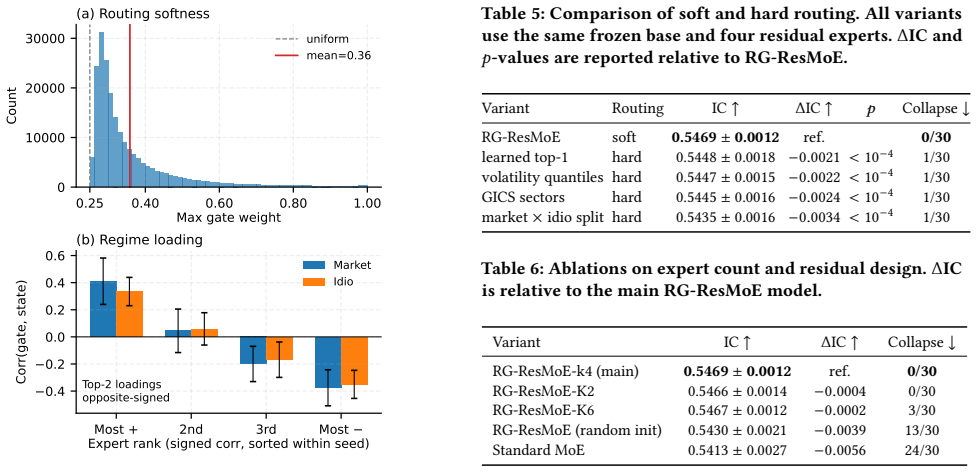
RG-ResMoE consistently outperforms a capacity-matched MLP on every reported forecast metric, and the paper argues the advantage is architectural rather than merely additive capacity. It reports a daily cross-sectional rank correlation (IC) of 0.5469, RMSE of 0.2304, out-of-sample $R^2$ of 0.292, and a quasi-likelihood loss of 0.735, with zero collapsed training runs out of 30; the large MLP scores 0.5421, 0.2320, 0.282, and 2.23 with 3 collapsed runs. Appending the same two regime variables directly to the MLP input lowers its IC to 0.5378 and collapses all 30 seeds, while gate-only use raises the proposed model's IC slightly and leaves zero collapses. All hard-routing variants, including learned top-1 gates and hand-crafted volatility partitions, underperform the soft gate by 0.0021 to 0.0034 in IC, and a standard mixture-of-experts without the frozen base collapses in 24 of 30 runs. The paper concludes that in compact forecasters the value of mixture-of-experts lies less in increasing capacity than in controlling how nonstationary regime information influences prediction.
Load-bearing premise
The load-bearing premise is that the large comparison network truly has the same number of parameters as the proposed model; the paper matches hidden-layer widths but reports no parameter counts, so if the comparison network is actually smaller, the conclusion that the architecture rather than extra capacity drives the gains would not follow.
Editorial extensions
If this is right
- Regime variables should be routed through a gating network rather than concatenated to the predictor inputs in compact neural volatility models.
- Soft, continuous expert weighting dominates discrete regime assignment; hand-crafted partitions based on volatility quantiles, sectors, or market-by-idiosyncratic splits do not recover soft-gate performance.
- The frozen base forecast and zero-initialized residual corrections are the main source of training stability; increasing expert count from two to six provides no additional accuracy and hurts stability.
- The accuracy advantage over the large MLP is concentrated in elevated-volatility periods, with about 4.3 times and 6.7 times the full-sample gain in the top volatility decile and the COVID crisis, translating into better Value-at-Risk coverage.
- The same ordering of results holds on an independent Japanese equity panel, suggesting the pathway principle is not an artifact of the U.S. sample.
Reading between the lines
- I infer the gate is learning a smooth, state-conditional interpolation among correction functions rather than selecting discrete regimes; a natural test is to constrain the gate to a small number of interpretable regime probabilities and check whether accuracy is retained.
- The mechanism may generalize beyond volatility: any auxiliary nonstationary signal that destabilizes direct input integration could be moved into the routing gate, though this is not tested in the paper.
- Because the paper reports no parameter counts for the large comparison MLP versus the proposed model, the architecture-versus-capacity attribution would be sharpest if replicated with exact parameter-count-matched baselines.
- An untested extension is whether the same pathway principle holds for longer-context sequence models or for forecasts other than five-day realized volatility, which the paper explicitly leaves for future work.
Signed reviews
Editorial analysis
A structured set of objections, weighed in public.
Referee Report
Summary. The paper asks where regime information should enter a compact neural volatility forecaster. It proposes RG-ResMoE, in which a frozen base MLP predicts volatility from stock features and a soft gate uses market and idiosyncratic volatility state variables to route zero-initialized residual correction experts. The evaluation is a rolling walk-forward study on 1,027 U.S. equities with 30 seeds, plus a Japanese replication panel, comparing against persistence, GARCH, HAR, ridge, small and large MLPs, input-integration variants, hard-routing variants, and standard MoE. The headline claims are that appending regime variables to the forecasting input degrades accuracy and stability, that routing them only through the gate improves both, that soft routing beats hard routing, and that the gains concentrate in high-volatility periods.
Significance. If the central claim is established, the paper offers a concrete and transferable design principle for regime-aware forecasting in compact models, and it cleanly separates capacity effects from integration-pathway effects. The experimental protocol is a genuine strength: rolling non-overlapping test windows, 30 random seeds, validation-based hyperparameter selection, Diebold-Mariano tests with Newey-West standard errors for the main comparisons, and an independent cross-market replication. The residual, zero-initialized MoE formulation is well motivated and the stability results are unusually clean. However, the headline 'integration pathway is decisive' claim currently rests on a statistically untested difference of +0.0004 in IC between RG-ResMoE and RG-ResMoE(-z), and the capacity-matching assertion is unverified because no parameter counts are reported. These gaps are load-bearing for the paper's central message, so the manuscript requires major revision rather than acceptance in its present form.
major comments (3)
- [§6.1, Table 4] The gate-pathway comparison RG-ResMoE versus RG-ResMoE(-z) is the single most load-bearing comparison in the paper, yet no Diebold-Mariano p-value is reported for it. The IC difference is +0.0004, which is smaller than the reported across-seed standard deviations (±0.0011 and ±0.0012) and an order of magnitude smaller than the input-pathway degradation (-0.0043 for MLP-L vs MLP-L(+z)). The paper's own testing framework in Section 4.4, Eq. (9), should be applied to this comparison in exactly the same way it is applied to Tables 3, 5, 7, and 8. Without that test, the claim that 'restricting them to the routing gate improves accuracy' is not supported; at best the evidence shows absence of harm plus elimination of one collapsed seed (0/30 vs 1/30). The same absence of pairwise significance testing applies to the input-pathway deltas in Table 4: they are large and suggestive, but no p-values are reported.
- [§4.2, 'capacity-matched' claim] The manuscript asserts that MLP-L with hidden width H=44 'matches the overall forecasting capacity of the full RG-ResMoE model,' but it reports no parameter counts for any model. This is load-bearing because the paper's conclusion that RG-ResMoE's gains come from the residual expert architecture 'rather than from additional parameters' depends on equality of parameter budgets. If MLP-L actually has fewer parameters, or if the optimization landscape differs due to width, the architecture-vs-capacity attribution is undermined. Please report parameter counts for every neural model in Table 2 (or at least MLP-S, MLP-L, RG-ResMoE, and the MoE variants), and confirm that the counts are equal or state the actual discrepancy.
- [§7, Tables 7 and 8] The VaR calibration improvements (Table 7) and the stress-window IC gains (Table 8) are computed relative to MLP-L or MLP-S, not relative to RG-ResMoE(-z). These comparisons therefore reflect the combined effect of the residual architecture, the gate, and any capacity differences; they cannot be used to attribute the gains to the regime-gating pathway. The abstract's statement that 'restricting them to the routing gate improves accuracy and Value-at-Risk calibration' overreaches the evidence. Please either rerun the VaR and stress analyses for RG-ResMoE(-z), or explicitly rephrase the claim so that these results are attributed to the RG-ResMoE architecture as a whole, not to the gate pathway alone.
minor comments (5)
- [§6.1, Figure 2] Figure 2 plots per-window ΔIC and ΔRMSE for the input and gate pathways, but it provides no confidence bands, error bars, or significance information. Given that the aggregate gate-pathway effect is tiny, the visual impression of 'stability' should be backed by a per-window statistical summary or at least by reporting the across-window mean and standard error of the gate-pathway deltas.
- [§4.2, MLP-S sizing] The description of MLP-S as 'matching an individual block in RG-ResMoE' is ambiguous, since RG-ResMoE contains a base block plus four expert blocks. Please clarify whether MLP-S matches the width of a single block but uses only one block, and how its parameter count compares to one expert block.
- [Table 4, layout] Table 4 mixes models with and without the `ref.` marker, which is slightly confusing because some rows are reference rows and others are comparison rows. Consider adding a separate column for p-values (which is currently missing) and clearly labeling all rows that are not tested against a reference.
- [§8, replication paragraph] The Japanese replication paragraph reports p-values for IC, RMSE, and QLIKE for RG-ResMoE vs MLP-L, but not for the RG-ResMoE vs RG-ResMoE(-z) comparison, which would parallel the main-market weakness. Please add the gate-pathway comparison for Japan as well.
- [§4.3, collapse threshold] The collapse threshold is described as 'a prespecified diagnostic threshold' but the actual value (mean test QLIKE > 2.0) appears only in the caption of Figure 4. Please state it explicitly in the protocol in Section 4.3.
Circularity Check
Empirical benchmarking paper with no circular derivation; the untested gate-pathway delta is a statistical weakness, not circularity.
full rationale
RG-ResMoE is an empirical benchmarking paper, not a derivation. The target y_i,t (Eq. 1) is the annualized five-day forward realized volatility computed from future returns, and no model prediction enters that definition. The regime variables z_i,t are 20-day rolling volatilities of market and idiosyncratic residuals computed from past data, so the inputs are not defined in terms of the forecast target. The architecture equations (2)-(7) define the base forecast, expert residual corrections, gate weights, and loss; the final prediction y_hat = y_hat_base + y_hat_correction is a sum of learned components, not a restatement of any fitted quantity. The ablation comparisons—RG-ResMoE(-z), MLP-L(+z), hard-routing variants, expert count variants, and random initialization—are genuine architectural perturbations that isolate design choices rather than renaming known results. No load-bearing step is justified by a self-citation: the reference list contains no works by the present authors, so none of the cited regime-switching, MoE, or residual-learning results are used to import a conclusion from the authors' own prior work. The closest concern is statistical rather than circular: the gate-pathway comparison in Table 4 (RG-ResMoE vs RG-ResMoE(-z), +0.0004 IC) is reported without a Diebold-Mariano p-value and is comparable to the across-seed standard deviations, so the claim that the integration pathway is decisive is not fully established by the positive half of the comparison. Similarly, the asserted capacity match between MLP-L (H=44) and RG-ResMoE is not verified by parameter counts, which weakens the attribution of gains to architecture rather than capacity. Both of these are evidentiary or experimental-design issues; neither involves an equation reducing to its own inputs, a fitted parameter being renamed as a prediction, or a load-bearing self-citation. The rolling walk-forward evaluation produces out-of-sample predictions, and the regularizers alpha and lambda_LB are tuned on validation data rather than test windows. No circular step is present.
Assumptions & free parameters
free parameters (4)
- alpha (residual shrinkage coefficient)
- lambda_LB (load-balancing coefficient)
- QLIKE collapse threshold =
2.0
- Hidden width H of the shared MLP block =
16 for RG-ResMoE blocks, 44 for MLP-L
assumptions (4)
- domain assumption Returns are sufficiently well-behaved that realized volatility over the next five days is a meaningful target.
- domain assumption The two regime state variables (20-day market volatility and 20-day idiosyncratic volatility) capture the relevant nonstationarity.
- domain assumption Yahoo Finance data are accurate and survivorship bias does not materially affect model rankings.
- standard math Standard properties of softmax, MSE, GELU, and Adam are used without proof.
Cite this review
Pith. "Pith review of Regime-Gated Residual Mixture-of-Experts for Cross-Sectional Volatility Forecasting." pith.science (2026). https://pith.science/paper/N3TSHUBA
@misc{pith2026260812251,
  author       = {Pith},
  title        = {Pith review of: Regime-Gated Residual Mixture-of-Experts for Cross-Sectional Volatility Forecasting},
  year         = {2026},
  howpublished = {\url{https://pith.science/paper/N3TSHUBA}},
  note         = {Machine review of arXiv:2608.12251}
}
read the original abstract
Financial volatility is regime dependent, yet incorporating regime information into neural networks can also destabilize training. This paper asks where such information should enter a neural cross-sectional volatility forecasting model. We study five-day realized-volatility forecasts for 1,027 U.S. equities using a rolling walk-forward evaluation framework in which information, model capacity, hyperparameter tuning, and random seeds are matched across architectures. We propose RG-ResMoE, a regime-gated residual mixture-of-experts architecture in which regime information is used only for expert routing rather than for direct forecasting. The base predictor models volatility from stock features, while a gating network uses regime state variables to route residual corrections. RG-ResMoE consistently outperforms a capacity-matched MLP in both forecasting accuracy and training stability in the main U.S. study. Similar gains are observed on an independent Japanese panel. The integration pathway is decisive: appending the same regime variables directly to the forecasting input degrades both predictive performance and training stability, whereas restricting them to the routing gate improves accuracy and Value-at-Risk calibration. Hard routing consistently underperforms soft routing. The results suggest that, in compact neural volatility forecasting models, the primary value of mixture-of-experts models lies less in increasing model capacity than in controlling how nonstationary regime information influences prediction.
Figures


Figures from the paper (1 more)

Reference graph
Works this paper leans on
-
[1]
Jordan T Ash and Ryan P Adams. 2020. On warm-starting neural network training. NeurIPS33 (2020), 3884–3894
work page 2020
-
[2]
Melike Bildirici and Özgür Ersin. 2014. Modeling Markov switching ARMA- GARCH neural networks models and an application to forecasting stock returns. The Scientific World Journal2014, 1 (2014), 497941
work page 2014
-
[3]
Tim Bollerslev. 1986. Generalized autoregressive conditional heteroskedasticity. Journal of Econometrics31, 3 (1986), 307–327
work page 1986
-
[4]
Fulvio Corsi. 2009. A simple approximate long-memory model of realized volatil- ity.Journal of Financial Econometrics7, 2 (2009), 174–196
work page 2009
-
[5]
Francis X Diebold and Roberto S Mariano. 1995. Comparing predictive accuracy. Journal of Business and Economic Statistics13, 3 (1995), 253–263
work page 1995
-
[6]
William Fedus, Barret Zoph, and Noam Shazeer. 2022. Switch Transformers: Scaling to Trillion Parameter Models with Simple and Efficient Sparsity.Journal of Machine Learning Research23, 120 (2022), 1–39
work page 2022
-
[7]
Stephen F Gray. 1996. Modeling the conditional distribution of interest rates as a regime-switching process.Journal of financial economics42, 1 (1996), 27–62
work page 1996
-
[8]
James D Hamilton. 1989. A new approach to the economic analysis of nonstation- ary time series and the business cycle.Econometrica: Journal of the econometric society(1989), 357–384
work page 1989
Show all 23 references
-
[9]
James D Hamilton and Raul Susmel. 1994. Autoregressive conditional het- eroskedasticity and changes in regime.Journal of Econometrics64, 1-2 (1994), 307–333
1994
-
[10]
Cheng He, Zhenyu Guan, Xijie Liang, Defu Lian, Jiajia Li, Enhong Chen, Patrick PC Lee, Geng Hu, and Zehao Chen. 2026. RAVEN: A Regime-Aware Variable-context Expert Network for Financial Time Series Forecasting.arXiv preprint arXiv:2606.24062(2026)
2026 arXiv
-
[11]
Kaiming He, Xiangyu Zhang, Shaoqing Ren, and Jian Sun. 2016. Deep residual learning for image recognition. InProceedings of the IEEE conference on computer vision and pattern recognition. 770–778
2016
-
[12]
Robert A Jacobs, Michael I Jordan, Steven J Nowlan, and Geoffrey E Hinton. 1991. Adaptive mixtures of local experts.Neural computation3, 1 (1991), 79–87
1991
-
[13]
Paul H. Kupiec. 1995. Techniques for Verifying the Accuracy of Risk Measurement Models.The Journal of Derivatives3, 2 (1995), 73–84. doi:10.3905/jod.1995.407942
1995
-
[14]
Sangheon Lee and Poongjin Cho. 2025. Graph-based stock volatility forecasting with effective transfer entropy and Hurst-based regime adaptation.Fractal and Fractional9, 6 (2025), 339
2025
-
[15]
Xu Liu, Juncheng Liu, Gerald Woo, Taha Aksu, Yuxuan Liang, Roger Zimmer- mann, Chenghao Liu, Junnan Li, Silvio Savarese, Caiming Xiong, et al . 2025. Moirai-MoE: Empowering Time Series Foundation Models with Sparse Mixture of Experts. InInternational Conference on Machine Lear...
2025
-
[16]
Whitney K Newey and Kenneth D West. 1987. A Simple, Positive Semi-Definite, Heteroskedasticity and Autocorrelation Consistent Covariance Matrix.Econo- metrica: Journal of the Econometric Society(1987), 703–708
1987
-
[17]
Andrew J Patton. 2011. Volatility forecast comparison using imperfect volatility proxies.Journal of Econometrics160, 1 (2011), 246–256
2011
-
[18]
Joan Puigcerver, Carlos Riquelme Ruiz, Basil Mustafa, and Neil Houlsby. 2024. From sparse to soft mixtures of experts. InInternational Conference on Learning Representations, Vol. 2024. 28435–28445
2024
-
[19]
Noam Shazeer, Azalia Mirhoseini, Krzysztof Maziarz, Andy Davis, Quoc Le, Geoffrey Hinton, and Jeff Dean. 2017. Outrageously large neural networks: The sparsely-gated mixture-of-experts layer.arXiv preprint arXiv:1701.06538(2017)
2017 arXiv
-
[20]
Xiaoming Shi, Shiyu Wang, Yuqi Nie, Dianqi Li, Zhou Ye, Qingsong Wen, and Ming Jin. 2025. Time-MoE: Billion-Scale Time Series Foundation Models with Mixture of Experts. InInternational Conference on Learning Representations. https: //openreview.net/forum?id=e1wDDFmlVu
2025
-
[21]
Chunxia Tian, Roengchai Tansuchat, and Songsak Sriboonchitta. 2026. Regime- Aware Stock Index Forecasting Under Latent Market States: A Hybrid Statistical Learning Framework with Cross-Market Validation.Forecasting8, 3 (2026), 50
2026
-
[22]
Zhaojian Yu, Yinghao Wu, Genesis Wang, and Heming Weng. 2024. MIGA: Mixture-of-Experts with Group Aggregation for Stock Market Prediction.arXiv preprint arXiv:2410.02241(2024)
2024 arXiv
-
[23]
Hongyi Zhang, Yann N Dauphin, and Tengyu Ma. 2019. Fixup initialization: Residual learning without normalization.arXiv preprint arXiv:1901.09321(2019). 8
2019 arXiv
Reviewed August 16, 2026 · model on record in the stance chip above.
Discussion (0). Continue with ORCID to comment.