Dynamics of Binary System around a Supermassive Black Hole :Binary Scattering and Eccentric vZLK Oscillations
Pith reviewed 2026-05-22 04:51 UTC · model grok-4.3
The pith
Eccentric bound orbits of binaries around supermassive black holes exhibit scattering-type vZLK oscillations with step-like changes driven by periapsis passages.
A machine-rendered reading of the paper's core claim, the machinery that carries it, and where it could break.
Core claim
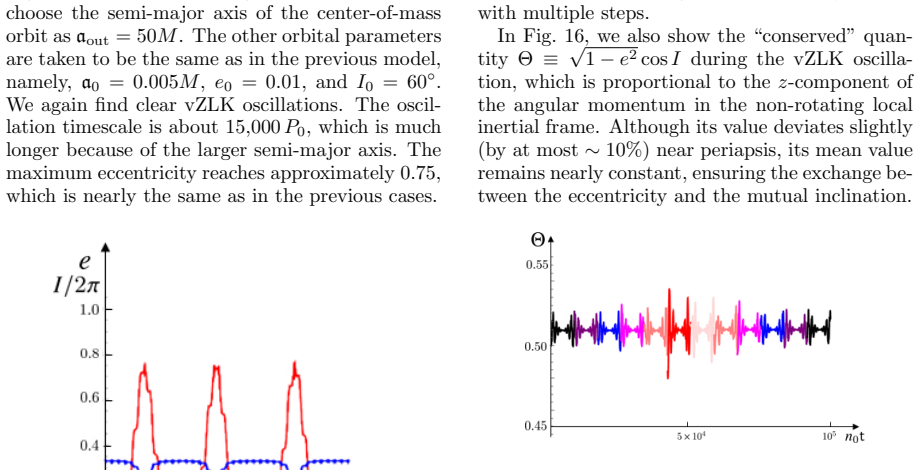
In the local inertial frame within Kerr spacetime, unbound parabolic and hyperbolic orbits display adiabatic, tidally affected, chaotic, or disruptive scattering regimes depending on the binary semi-major axis, with strong eccentricity excitation and chaotic behavior for softer binaries sensitive to the argument of periapsis. For eccentric bound elliptic orbits, the vZLK oscillations are qualitatively distinct, proceeding via step-like changes from successive periapsis passages interpreted as scattering events, with the z-component of angular momentum approximately conserved, and black hole rotation providing minor modifications to the profiles.
What carries the argument
Scattering-type vZLK oscillations, where repeated periapsis passages act as a sequence of scattering events driving the orbital evolution on dynamical timescales.
If this is right
- The SMBH spin modifies the oscillation profiles but its effect is smaller than that of initial orbital parameters.
- Binary scattering in unbound orbits can lead to tidal disruption or chaotic changes in orbital parameters for sufficiently soft binaries.
- The dynamics provide a unified picture of periapsis-driven tidal interactions in galactic nuclei.
- Strong dependence on the argument of periapsis affects the outcome of close encounters.
Where Pith is reading between the lines
- This mechanism may influence the formation rates of close binaries or gravitational wave events in dense stellar environments near supermassive black holes.
- Similar scattering interpretations could apply to other hierarchical systems with strong tidal perturbations at close approaches.
- The conservation of the angular momentum component might allow simplified models for long-term evolution predictions.
Load-bearing premise
The binary motion can be described in a local inertial frame in Kerr spacetime with tidal effects captured only by the Riemann curvature and approximate conservation of the z-component of angular momentum.
What would settle it
A high-precision simulation or observation of an eccentric bound binary orbit around a supermassive black hole that shows smooth continuous evolution rather than discrete step-like changes at periapsis passages would challenge the scattering-type interpretation.
Figures




read the original abstract
We study the dynamics of a binary orbiting a supermassive black hole (SMBH), focusing on both binary scattering in unbound orbits and eccentric von Zeipel-Lidov-Kozai (vZLK) oscillations in bound orbits. The motion is described in a local inertial frame in Kerr spacetime, where tidal effects are encoded in the Riemann curvature. For unbound (parabolic and hyperbolic) orbits, we identify four scattering regimes-adiabatic, tidally affected, chaotic, and disruptive-depending on the binary semi-major axis. As the binary becomes softer, tidal interactions near periapsis lead to strong eccentricity excitation, large changes in the orbital parameters, and eventually chaotic behavior or tidal disruption, with a sensitive dependence on the argument of periapsis. For eccentric bound (elliptic) orbits, the vZLK mechanism differs qualitatively from the standard one, although the $z$-component of the angular momentum in the local inertial frame remains approximately conserved. The evolution proceeds on a dynamical timescale and exhibits step-like changes driven by repeated periapsis passages, which can be interpreted as a sequence of scattering events. We refer to this behavior as scattering-type vZLK oscillations. The rotation of the SMBH also modifies the oscillation profiles, although its effect is less significant than the dependence on the initial orbital parameters. These results suggest a unified picture of periapsis-driven tidal dynamics in galactic nuclei.
Editorial analysis
A structured set of objections, weighed in public.
Referee Report
Summary. The manuscript examines the dynamics of a binary system orbiting a supermassive black hole using a local inertial frame in Kerr spacetime, with tidal effects encoded solely via the Riemann curvature tensor. For unbound (parabolic and hyperbolic) orbits it identifies four scattering regimes—adiabatic, tidally affected, chaotic, and disruptive—whose boundaries depend on binary semi-major axis and argument of periapsis. For eccentric bound orbits it reports a qualitatively distinct “scattering-type” vZLK mechanism that evolves on dynamical timescales through step-like changes driven by repeated periapsis passages, while the z-component of angular momentum in the local frame remains approximately conserved; SMBH spin modifies the profiles but is sub-dominant to initial orbital parameters.
Significance. If the local-frame Riemann-tide truncation remains accurate for the eccentricities and periapsis distances explored, the work supplies a unified, periapsis-driven picture of binary scattering and eccentricity excitation that could inform models of stellar binaries in galactic nuclei, including pathways to tidal disruption or gravitational-wave mergers. The reported approximate conservation of local-frame Lz and the distinction between standard and scattering-type vZLK constitute potentially useful conceptual results, though both rest on the validity of the adopted approximation.
major comments (2)
- [Abstract] Abstract and the description of the local inertial frame: the central claim that eccentric bound orbits exhibit scattering-type vZLK oscillations with approximate Lz conservation relies on the assertion that tidal effects are adequately captured by the Riemann tensor alone. No quantitative error estimate or comparison against the exact two-body Kerr geodesic problem is supplied to bound the regime where curvature gradients at periapsis remain negligible.
- [Results on bound orbits] Results section on bound orbits: the reported step-like evolution and interpretation as a sequence of scattering events are load-bearing for the qualitative difference from standard vZLK, yet the manuscript contains no convergence tests, time-step criteria, or sensitivity analysis that would confirm these features are not artifacts of the local-frame truncation.
minor comments (2)
- [Title] Title contains a spacing inconsistency around the colon (“Black Hole :Binary”).
- [Abstract] The abstract states that SMBH spin effects are “less significant” than initial orbital parameters; a brief quantitative comparison (e.g., fractional change in oscillation amplitude) would strengthen this statement.
Simulated Author's Rebuttal
We thank the referee for their careful review and valuable comments on our manuscript. We have carefully considered each point and provide detailed responses below. Revisions have been made to enhance the discussion on the validity of our approximations and to include numerical validation tests.
read point-by-point responses
-
Referee: [Abstract] Abstract and the description of the local inertial frame: the central claim that eccentric bound orbits exhibit scattering-type vZLK oscillations with approximate Lz conservation relies on the assertion that tidal effects are adequately captured by the Riemann tensor alone. No quantitative error estimate or comparison against the exact two-body Kerr geodesic problem is supplied to bound the regime where curvature gradients at periapsis remain negligible.
Authors: We agree that providing a quantitative bound on the approximation error would improve the manuscript. Our approach follows the standard treatment of tidal perturbations in curved spacetime by using the Riemann tensor in the local inertial frame, which is valid when the binary's size is much smaller than the distance to the SMBH. For the parameters studied, the ratio of binary semi-major axis to periapsis radius is typically 10^{-3} or smaller, making gradient corrections small. In the revised version, we have added an order-of-magnitude estimate of the neglected terms in the Methods section to explicitly bound the regime of validity. A direct comparison to the full two-body Kerr problem is computationally intensive and left for future work, but the current approximation captures the leading tidal effects accurately. revision: yes
-
Referee: [Results on bound orbits] Results section on bound orbits: the reported step-like evolution and interpretation as a sequence of scattering events are load-bearing for the qualitative difference from standard vZLK, yet the manuscript contains no convergence tests, time-step criteria, or sensitivity analysis that would confirm these features are not artifacts of the local-frame truncation.
Authors: The step-like evolution is a physical consequence of the repeated close encounters at periapsis in the eccentric orbit, analogous to scattering events, and is not expected to be an artifact. We employ a symplectic integrator with adaptive stepping to handle the strong perturbations near periapsis. To address the concern, the revised manuscript now includes a dedicated paragraph on numerical methods, specifying the time-step criteria (minimum of 50 steps per periapsis passage) and results from convergence tests at different resolutions. These tests confirm that the qualitative features, including the step-like changes and approximate Lz conservation, remain robust. Sensitivity analysis is provided through the exploration of different initial conditions and orbital parameters. revision: yes
Circularity Check
No significant circularity; derivation is self-contained from local-frame orbital analysis
full rationale
The paper defines the setup via the local inertial frame in Kerr spacetime with tidal effects from the Riemann tensor, then derives scattering regimes for unbound orbits and step-like evolution for bound eccentric orbits directly from the dynamics. Approximate conservation of the z-component of angular momentum is reported as an observed outcome rather than an imposed definition or fitted input. No equations reduce by construction to prior results, no parameters are fitted to a subset and relabeled as predictions, and no load-bearing claims rest on self-citations or uniqueness theorems imported from the authors' prior work. The central results follow from integrating the approximated equations of motion without tautological closure.
Axiom & Free-Parameter Ledger
axioms (1)
- domain assumption The motion of the binary can be described in a local inertial frame in Kerr spacetime with tidal effects encoded in the Riemann curvature.
Lean theorems connected to this paper
-
IndisputableMonolith/Foundation/AlexanderDuality.leanalexander_duality_circle_linking unclear?
unclearRelation between the paper passage and the cited Recognition theorem.
The motion is described in a local inertial frame in Kerr spacetime, where tidal effects are encoded in the Riemann curvature.
-
IndisputableMonolith/Cost/FunctionalEquation.leanwashburn_uniqueness_aczel unclear?
unclearRelation between the paper passage and the cited Recognition theorem.
For eccentric bound (elliptic) orbits, the vZLK mechanism differs qualitatively... step-like changes driven by repeated periapsis passages
What do these tags mean?
- matches
- The paper's claim is directly supported by a theorem in the formal canon.
- supports
- The theorem supports part of the paper's argument, but the paper may add assumptions or extra steps.
- extends
- The paper goes beyond the formal theorem; the theorem is a base layer rather than the whole result.
- uses
- The paper appears to rely on the theorem as machinery.
- contradicts
- The paper's claim conflicts with a theorem or certificate in the canon.
- unclear
- Pith found a possible connection, but the passage is too broad, indirect, or ambiguous to say the theorem truly supports the claim.
Reference graph
Works this paper leans on
-
[1]
The results depend strongly on the argument of periapsisω 0 for some range ofa 0
nearly circular binary(e 0 = 0.01) We first present the results for the nearly circular binary case. The results depend strongly on the argument of periapsisω 0 for some range ofa 0. In Fig. 2, we show the final eccentricity, semi-major axis, and angular momentum for the initial semi-major axesa 0 = 0.01M, 0.015M, 0.02M, and 0.025M. The calculations were ...
-
[2]
Theω 0-dependence of the orbital parameters are shown in Fig
eccentric binary(e 0 = 0.5) We also analyze the eccentric binary withe 0 = 0.5. Theω 0-dependence of the orbital parameters are shown in Fig. 4. The initial semi-major axis are chosen asa 0 = 0.01M,0.015Mand 0.02M.a 0 = 0.01M gives the adiabatic scattering, whilea 0 = 0.015Mand 0.02Mare classified into the T phase and the C phase, respectively. (a) final ...
-
[3]
Rotating SMBH(a=M) Next, we analyze the rotational effect of the SMBH. We consider the extreme Kerr black hole (a=M). For the center-of-mass orbital motion, there are two cases: prograde (L >0) and retrograde (L <0) orbits. To compare the results with the Schwarzschild case (a= 0), we analyze orbits with the same periapsisr p. Forr p = 10M, the angular mo...
work page 2026
-
[4]
B. P. Abbott et al (The Ligo Scientific Collabora- tion & the Virgo Collaboration), Phys. Rev. Lett. 116, 061102 (2016)
work page 2016
-
[5]
B. P. Abbott et al., Living Reviews in Relativity 23(2020)
work page 2020
-
[6]
Abbott et al., SoftwareX13, 100658 (2021)
R. Abbott et al., SoftwareX13, 100658 (2021)
work page 2021
-
[7]
B. P. Abbott et al. (The Ligo Scientific Collabora- tion & the Virgo Collaboration), Phys. Rev. Lett. 119, 161101 (2017)
work page 2017
-
[8]
B. P. Abbott et al. (The Ligo Scientific Collabo- ration & the Virgo Collaboration), Phys. Rev. D 100, 104036 (2019)
work page 2019
-
[9]
R. Abbott et al. (The Ligo Scientific Collabora- tion & the Virgo Collaboration), The Astrophysi- cal Journal900, L13 (2020)
work page 2020
-
[10]
R. Abbott et al. (The Ligo Scientific Collaboration & the Virgo Collaboration), Physical Review D 103(2021)
work page 2021
-
[11]
R. Abbott et al. (The Ligo Scientific Collabora- tion & the Virgo Collaboration), The Astrophysi- cal Journal Letters913, L7 (2021)
work page 2021
-
[12]
R. Abbott et al. (The Ligo Scientific Collabora- tion, the Virgo Collaboration & the KAGRA col- laboration), The Astrophysical Journal949, 76 (2023)
work page 2023
-
[13]
M. A. S. Martinez, G. Fragione, K. Kremer, S. Chatterjee, C. L. Rodriguez, J. Samsing, C. S. Ye, N. C. Weatherford, M. Zevin, S. Naoz, et al., The Astrophysical Journal903, 67 (2020)
work page 2020
- [14]
-
[15]
von Zeipel, Astronomische Nachrichten183, 345–418 (1910)
H. von Zeipel, Astronomische Nachrichten183, 345–418 (1910)
work page 1910
- [16]
- [17]
- [18]
- [19]
- [20]
-
[21]
S. Naoz, B. Kocsis, A. Loeb, and N. Yunes, As- trophys. J.773, 187 (2013b)
-
[22]
S. Naoz, W. Farr, and F. Rasio, Astrophys. J.754, L36 (2012)
work page 2012
-
[23]
S. Naoz, C. M. Will, E. Ramirez-Ruiz, A. Hees, A. M. Ghez, and T. Do, The Astrophysical Jour- nal888, L8 (2019)
work page 2019
-
[24]
J. Teyssandier, S. Naoz, I. Lizarraga, and F. A. Rasio, Astrophys. J.779, 169 (2013)
work page 2013
-
[25]
G. Li, S. Naoz, B. Kocsis, and A. Loeb, Mon. Not. R. Astron. Soc.451, 1341 (2015)
work page 2015
- [26]
- [27]
- [28]
- [29]
- [30]
-
[31]
X. Fang, T. A. Thompson, and C. M. Hirata, The Astrophysical Journal875, 75 (2019)
work page 2019
-
[32]
Y. Fang, X. Chen, and Q.-G. Huang, The Astro- physical Journal887, 210 (2019)
work page 2019
-
[33]
Naoz, Annual Review of Astronomy and Astro- physics54, 441 (2016)
S. Naoz, Annual Review of Astronomy and Astro- physics54, 441 (2016)
work page 2016
- [34]
-
[35]
B. Liu, D. J. Mu˜ noz, and D. Lai, Monthly No- tices of the Royal Astronomical Society447, 747 (2015)
work page 2015
-
[36]
B. Katz, S. Dong, and R. Sari, Physical Review Letters107, 181101 (2011)
work page 2011
-
[37]
P. Amaro-Seoane, A. Sesana, L. Hoffman, M. Benacquista, C. Eichhorn, J. Makino, and R. Spurzem, Mon. Not. R. Astron. Soc.402, 2308 (2010)
work page 2010
- [38]
- [39]
-
[40]
F. Antonini, S. Chatterjee, C. Rodriguez, M. Morscher, and B. Pattabiraman, Astrophys. J.816, 2 (2016)
work page 2016
- [41]
- [42]
- [43]
-
[44]
Observing Eccentricity Oscillations of Binary Black Holes in LISA
L. Randall and Z.-Z. Xianyu, arXiv:1902.08604 [astro-ph.HE] (2019)
work page internal anchor Pith review Pith/arXiv arXiv 1902
- [45]
- [46]
- [47]
- [48]
-
[49]
R. S. Chandramouli and N. Yunes, Phys. Rev. D 105(2022)
work page 2022
- [50]
- [51]
-
[52]
D. C. Heggie, Mon. Not. R. Astron. Soc.173, 729 (1975)
work page 1975
- [53]
- [54]
-
[55]
R. L. Riddle et al., Astrophys. J.799, 4 (2015)
work page 2015
-
[56]
F. Antonini, S. Chattejee, C. Rodriguez, M. Morscher, B. Pattabiraman, V. Kalogera, and F. Rasio, Astrophys. J.816, 2 (2016)
work page 2016
-
[57]
A. P. Stephan, S. Naoz, A. M. Ghez, M. R. Morris, A. Ciurlo, T. Do, K. Breivik, S. Coughlin, and C. L. Rodriguez, Astrophys. J.878, 58 (2019)
work page 2019
-
[58]
M. Mapelli, F. Santoliquido, Y. Bouffanais, M. Arca Sedda, M. C. Artale, and A. Ballone, Symmetry13(2021)
work page 2021
-
[59]
V. Gayathri, I. Bartos, Z. Haiman, S. Klimenko, B. Kocsis, S. M´ arka, and Y. Yang, The Astrophys- ical Journal890, L20 (2020)
work page 2020
-
[60]
F. K. Manasse and C. W. Misner, Journal of Mathematical Physics4, 735 (1963)
work page 1963
-
[61]
A. I. Nesterov, Classical and Quantum Gravity 16, 465 (1999)
work page 1999
-
[62]
P. Delva and M. C. Angonin, Gen. Rel. Grav.44, 1 (2012), 0901.4465
work page internal anchor Pith review Pith/arXiv arXiv 2012
-
[63]
P. Banerjee, S. Paul, R. Shaikh, and T. Sarkar, Physics Letters B795, 29 (2019)
work page 2019
- [64]
-
[65]
R. M. Cheng and C. R. Evans, Physical Review D 87(2013)
work page 2013
- [66]
-
[67]
A. Gorbatsievich and A. Bobrik, AIP Conference Proceedings1205, 87 (2010)
work page 2010
- [68]
-
[69]
F. Camilloni, G. Grignani, T. Harmark, R. Oliveri, M. Orselli, and D. Pica, Phys. Rev. D107, 084011 (2023)
work page 2023
- [70]
-
[71]
F. Camilloni, T. Harmark, G. Grignani, M. Orselli, and D. Pica, Mon. Not. R. As- tron. Soc.531, 1884–1904 (2024)
work page 1904
-
[72]
J. G. Hills, Nature331, 687 (1988)
work page 1988
- [73]
-
[74]
Perturbative Approach to an orbital evolution around a Supermassive black hole
Y. Mino, Physical Review D67, 084027 (2003), gr-qc/0302075
work page internal anchor Pith review Pith/arXiv arXiv 2003
-
[75]
Marck, Proceedings of the Royal Society of London A385, 431 (1983)
J.-A. Marck, Proceedings of the Royal Society of London A385, 431 (1983)
work page 1983
-
[76]
van de Meent, Classical and Quantum Gravity 37, 145007 (2020), 1906.05090
M. van de Meent, Classical and Quantum Gravity 37, 145007 (2020), 1906.05090
-
[77]
R. A. Mardling and S. J. Aarseth, Monthly No- tices of the Royal Astronomical Society321, 398 (2001)
work page 2001
-
[78]
A. Myll¨ ari, M. Valtonen, A. Pasechnik, and S. Mikkola, Monthly Notices of the Royal Astro- nomical Society476, 830 (2018)
work page 2018
-
[79]
B. C. Bromley, S. J. Kenyon, M. J. Geller, and W. R. Brown, The Astrophysical Journal749, L42 (2012), 1203.6644
work page internal anchor Pith review Pith/arXiv arXiv 2012
-
[80]
T. Hayashi, A. A. Trani, and Y. Suto, The Astro- physical Journal939, 81 (2022), 2207.07011
discussion (0)
Sign in with ORCID, Apple, or X to comment. Anyone can read and Pith papers without signing in.