REVIEW 3 major objections 5 minor 24 references
Spin beats in the photoluminescence polarization dynamics of charged excitons in InP/(In,Ga)P quantum dots in presence of nuclear quadrupole interaction
T0 review · 3 major / 5 minor · reviewed 2026-08-14 · deepseek-v4-flash
Pith's one-line read Nuclear quadrupole interaction pins the Overhauser field along the growth axis, explaining the measured spin-beat dynamics of charged excitons in InP/(In,Ga)P quantum dots.
desk verdict A credible experimental paper whose central X+/X- decomposition is a post hoc assumption; it deserves review, with the referee pushing for charging-state or single-dot verification. read the letter →
The pith
A machine-rendered reading of the paper's core claim, the machinery that carries it, and where it could break.
The reading
What carries the argument
The load-bearing object is the nuclear quadrupole interaction of indium nuclei (spin 9/2) in the strained InP/(In,Ga)P interface, which pins the Overhauser field along the [001] growth axis; the second mechanism is the decomposition of the measured PL polarization into an X+ oscillating term and an X- monotonically decaying term. The quadrupole interaction prevents nuclear dipole-dipole fluctuations from destroying the nuclear orientation even at zero field, and the two-term decomposition reconciles the pinned-field picture with the observed Larmor precession.
What would settle it
Measure time-resolved circular polarization on a single gate-tunable InP/(In,Ga)P quantum dot, selecting either the X+ or X- charge state: if the X+ trion shows a monotonic decay component or a Larmor frequency that deviates from linearity at fields near 100 mT, the claim that DNP is absent for X+ trions is refuted.
Extended reading notes
Core claim
The central discovery is that in this QD system the nuclear quadrupole interaction of indium nuclei (spin 9/2) creates an energy pattern that preserves the projection of nuclear spin on the growth axis, so the dynamically polarized Overhauser field stays pinned along that axis rather than following the external magnetic field. In Voigt geometry the measured PL polarization is therefore a sum of a Larmor-precessing contribution, assigned to the X+ trion where no dynamic nuclear polarization develops, and a monotonically decaying contribution, assigned to the X- trion whose electron spin is stabilized by the pinned Overhauser field. This decomposition is what allows a linear Larmor frequency versus field, with |g_e| = 1.43, to coexist with a nuclear field strength of about 100 mT inferred from the crossover of the two contributions.
Load-bearing premise
The explanation assumes that dynamic nuclear polarization builds up only in dots with resident electrons (giving X- trions) and not in photo-doped X+ trions; if X+ trions also polarize nuclei, or if the monotonic PL component has another origin, the two-population resolution fails.
Editorial extensions
If this is right
- In InP/(In,Ga)P quantum dots, electron and nuclear spin orientation can survive at zero external magnetic field when resident electrons are present.
- The electron g-factor magnitude, |g_e| = 1.43, can be extracted from the linear Larmor frequency because the X+ trion contribution carries no nuclear-field shift.
- The X- trion depolarization curve broadens in the presence of dynamic nuclear polarization, giving a direct measure of the pinned Overhauser field strength (about 70 mT from the Hanle HWHM).
- In external fields above 60 mT, the electron spin relaxation in 'frozen' nuclear field fluctuations is well described by the existing theory, while below 60 mT the X- contribution must be included.
- The quadrupole stabilization mechanism should manifest in other self-organized quantum dots whose nuclei have spin greater than 1/2.
Reading between the lines
- If the two-population picture is correct, single-dot experiments with controllable charging should show that the X+ trion PL has no nuclear-field signature whereas the X- trion retains a pinned-field offset, which would turn the ensemble inference into a direct test.
- The model implies that the resident-electron lifetime, not just the trion lifetime, controls when dynamic nuclear polarization can build up; engineering longer resident-electron dwell times could strengthen the zero-field spin stabilization.
- One could extend the measurement to tilted magnetic fields: a pinned Overhauser field should produce an angular-dependent crossover between oscillating and monotonic components that is not captured by a free Overhauser field model.
- The two-contribution decomposition suggests that in mixed-charge ensembles, extracting spin coherence from ensemble PL requires subtracting the decay component; methods that ignore it would underestimate the X+ spin lifetime.
Signed reviews
Editorial analysis
A structured set of objections, weighed in public.
Referee Report
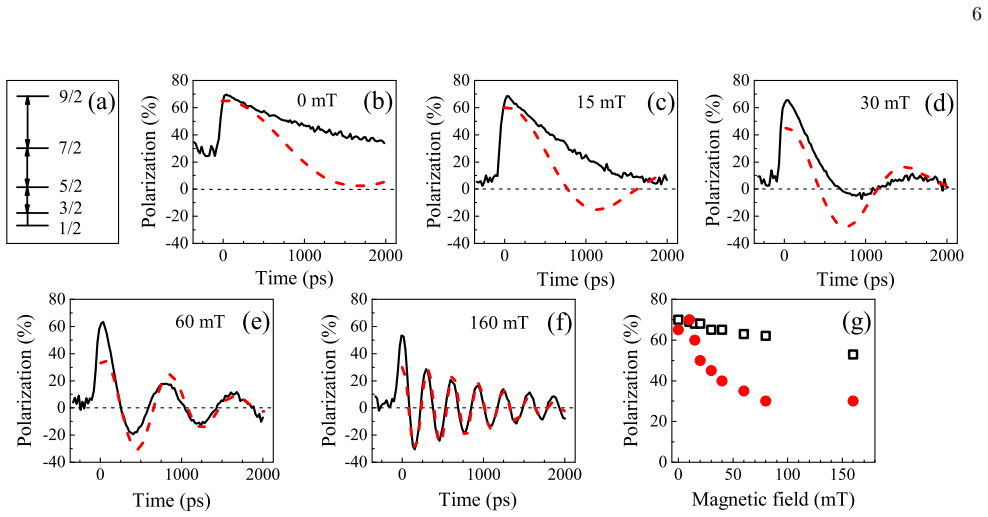
Summary. The paper reports experimental studies of the photoluminescence (PL) polarization dynamics of InP/(In,Ga)P quantum dots (QDs) in magnetic fields up to 400 mT, in both Voigt and Faraday geometries, with and without suppression of dynamic nuclear polarization (DNP). The key observations are that DNP broadens the Hanle curve, increases the zero-field polarization, and causes the time-resolved PL polarization in Voigt field to consist of an oscillating component superimposed on a monotonically decaying background. The authors propose that nuclear quadrupole interaction pins the dynamically polarized Overhauser field along the QD growth axis, stabilizing nuclear and electron spins even at zero external field. To reconcile the observed linear dependence of the Larmor frequency on the external field with the pinned-field model (which would give sqrt(B^2+B_N^2)), they introduce a two-population decomposition: an oscillating X+ trion contribution without DNP, and a monotonic X- trion contribution with a pinned Overhauser field. The X+ dynamics are modeled using the frozen nuclear-field-fluctuation theory of Merkulov et al. [17], with good agreement claimed only for fields exceeding 60 mT.
Significance. If the two-population interpretation is correct, the work demonstrates a mechanism for zero-field spin stabilization via nuclear quadrupole interaction and explains a distinctive monotonic background in trion polarization dynamics. The paper provides careful data over a wide field range and makes contact with an established theory; the extracted nuclear-field fluctuation amplitude (Δb = 12 mT) is consistent with the Hanle width and with an independent estimate of about 20 mT. However, the central novelty rests on an unverified decomposition of the PL into two charging states, so the significance is conditional. The proposed scenario is plausible and testable, but the current evidence does not yet conclusively separate it from alternative explanations.
major comments (3)
- [Section III, paragraph beginning 'In order to resolve this contradiction'] The central decomposition of the PL into independent X+ (oscillating, no DNP) and X- (monotonic, pinned Overhauser field) contributions is introduced post hoc to remove the contradiction between the linear Larmor frequency and the sqrt(B^2+B_N^2) dependence. The text explicitly states that 'to describe the experimental results it is necessary to assume' that DNP occurs only with resident electrons. No charging-state measurement, excitation-power dependence, or single-dot data are presented to support the existence of the photo-doped X+ subensemble or the absence of DNP on X+ trions. If the monotonic component originates from the non-precessing projection of the same electron-spin ensemble precessing in an oblique total field (as suggested earlier in Section III), or if DNP also affects X+ dots, the observed linear frequency directly contradicts the pinned-field model. This assumption is load-bearing for the paper's central claim and must be independently tested, or the paper should be reframed as presenting a conjecture with specific falsifiable predictions.
- [Section IV B, 'Quantitative description of the PL polarization dynamics in absence of DNP'] The quantitative agreement with the frozen-field theory of Ref. [17] is confined to fields above 60 mT; the paper acknowledges 'significant mismatch' below 60 mT and attributes it to the X- contribution, which is not included in the model. However, the most novel phenomena—zero-field stabilization, the enhanced zero-field polarization, and the monotonic background—occur in exactly this low-field regime. Thus the paper does not provide a quantitative model of the phenomenon it claims to explain. The statements that good agreement is achieved in the range 60-320 mT are accurate, but they demonstrate only that the X+ contribution behaves as expected in large fields. Please provide a quantitative description of the X- contribution or restrict the claim of quantitative support accordingly.
- [Section III and Section IV A, estimates of BN] The Overhauser field strength BN is estimated from the HWHM of the broadened Hanle component (70 mT) and from the field at which the monotonic and oscillating amplitudes become equal (about 100 mT), and these same estimates are then used to support the pinning picture. Because these values are extracted from the very phenomena the model is meant to explain, the agreement is partly circular. An independent determination of BN, for instance from the Faraday-field asymmetry or from additional measurements such as NMR or single-dot experiments, would substantially strengthen the case. If no independent determination is available, the authors should clearly state that BN is a fitted parameter and quantify the sensitivity of the conclusions to its value.
minor comments (5)
- [Title and abstract] The word 'quadrupol e' contains a typographical error and should read 'quadrupole'.
- [Section II, 'Experimental details'] The text refers to 'Ti:Sph lasers'; this should likely be 'Ti:Sapphire lasers'.
- [Figure 1 caption and Section III] The name 'Lorenz' appears instead of 'Lorentz' in the description of the fitting curves; please correct this.
- [Section IV B, paragraph on X- contribution vanishing] The text states that the X- 'monotonically decaying' contribution vanishes in fields exceeding 40 mT, but later states that good agreement with the theory is achieved only above 60 mT; these two thresholds should be reconciled or explained.
- [Inset of Figure 2(b)] The calculated dashed line presumably uses BN = 100 mT, but the paper does not explicitly state the value used for BN in this calculation; please specify it in the caption or text.
Circularity Check
No significant circularity: the two-population decomposition is an openly proposed post hoc hypothesis, and the fitted parameters are not relabeled as predictions.
full rationale
The paper does not exhibit a load-bearing circular reduction. The central contradiction is stated explicitly: a pinned Overhauser field of BN = 100 mT would give a Larmor frequency proportional to sqrt(B^2 + BN^2), but the measured frequency is linear in B. The authors then "propose that the PL consists of two independent contributions," assigning the oscillating part to X+ trions without DNP and the monotonic part to X- trions with a pinned Overhauser field. This is an acknowledged hypothesis, introduced to resolve the contradiction, not a derived prediction. The X+/X- assignment is supported by an external analogy to GaAs quantum-well recharging (Ref. [22]) and by different lifetimes of resident versus photoexcited carriers, so it does not reduce to a self-citation chain. The fitted parameters (Delta b, A, and the BN estimates from the equal-amplitude crossing and Hanle HWHM) are openly presented as fits; the paper does not claim them as first-principles predictions. The frozen-field theory from Ref. [17] is external, and its rough independent estimate of Delta b ~ 20 mT is compared with the fitted 12 mT and the 16 mT Hanle width rather than being forced to agree. The quadrupole-pinning mechanism is grounded in Ref. [5], an independent prior result, and in the measured Hanle and time-resolved data. Self-citations such as Refs. [11,12] supply empirical facts that are also reported by external groups; they are not used as an unverified uniqueness theorem or as an ansatz smuggled in by the authors' own prior work. The most vulnerable element is the untested two-population decomposition, but that is an evidentiary and modeling weakness, not a circularity in the strict sense of a conclusion equivalent to its input by construction. No equation is defined in terms of the claimed result, and no fitted parameter is renamed as a prediction in a way that would force the conclusion.
Assumptions & free parameters
free parameters (5)
- Nuclear field fluctuation amplitude Delta b =
12 mT
- Amplitude normalization factor A =
Varies with field, from about 1 down to 0.3 relative units
- Overhauser field strength BN =
70 mT from Hanle HWHM; approximately 100 mT from amplitude equality
- Electron g-factor magnitude |g_e| =
1.43
- Hanle curve HWHMs =
16 mT and 70 mT
assumptions (5)
- domain assumption Electron spin relaxation in frozen nuclear field fluctuations is described by the Merkulov-Efros-Rosen model (Ref. [17]).
- domain assumption The nuclear quadrupole interaction of indium nuclei (spin 9/2) with uniaxial strain along [001] dominates the nuclear Zeeman splitting up to about 100 mT.
- domain assumption The Overhauser field of dynamically polarized nuclei is pinned along the growth axis, close to the quadrupole axis.
- ad hoc to paper Photo-doping generates a subensemble of positively charged dots (X+ trions) in the nominally negatively charged quantum dot ensemble.
- ad hoc to paper Dynamic nuclear polarization is negligible for X+ trions but significant for X- trions with resident electrons.
Cite this review
Pith. "Pith review of Spin beats in the photoluminescence polarization dynamics of charged excitons in InP/(In,Ga)P quantum dots in presence of nuclear quadrupole interaction." pith.science (2026). https://pith.science/paper/N3XSMYW6
@misc{pith2026190804167,
  author       = {Pith},
  title        = {Pith review of: Spin beats in the photoluminescence polarization dynamics of charged excitons in InP/(In,Ga)P quantum dots in presence of nuclear quadrupole interaction},
  year         = {2026},
  howpublished = {\url{https://pith.science/paper/N3XSMYW6}},
  note         = {Machine review of arXiv:1908.04167}
}
abstract
The spin dynamics of positively (X$^{+}$) and negatively (X$^{-}$) charged excitons in InP/In$_{0.48}$Ga$_{0.52}$P quantum dots subject to a magnetic field is studied. We find that a characteristic feature of the system under study is the presence of nuclear quadrupole interaction, which leads to stabilization of the nuclear and electron spins in a quantum dot in zero external magnetic field. In detail, the nuclear quadrupole interaction leads to pinning of the Overhauser field along the quadrupole axis, which is close to the growth axis of the heterostructure. The nuclear effects are observed only when resident electrons are confined in the quantum dots, i.e. for X$^{-}$ trion photoexcitation. The presence of X$^{-}$ and X$^{+}$ trion contributions to the photoluminescence together with the quadrupole interaction significantly affects the dynamics of optical orientation in Voigt magnetic field. In absence of dynamic nuclear spin polarization the time evolution of the photoluminescence polarization was fitted by a form which describes the electron spin relaxation in "frozen" nuclear field fluctuations. In relatively large external magnetic fields exceeding 60 mT good agreement between theory and experiment is achieved.
Figures


Reference graph
Works this paper leans on
-
[5]
R. I. Dzhioev and V. L. Korenev, Stabilization of the Electron-Nuclear Spin Orientation in Quantum Dots by the Nuclear Quadrupole Interaction, Phys. Rev. Lett. 99, 037401 (2007)
work page 2007
-
[9]
E. A. Chekhovich, M. N. Makhonin, J. Skiba-Szymanska, A. B. Krysa, V. D. Kulakovskii, M. S. Skolnick, and A. I. Tartakovskii, Dynamics of optically induced nuclear spin polarization in individual InP / GaxIn1− xP quantum dots, Phys. Rev. B 81, 245308 (2010)
work page 2010
-
[17]
I. A. Merkulov, Al. L. Efros, and M. Rosen, Electron spin relaxation by nuclei in semiconductor quantum dots, Phys. Rev. B 65, 205309 (2002)
work page 2002
- [1]
-
[2]
A. S. Bracker, D. Gammon, and V. L. Korenev, Fine structure and optical pumping of spins in individual semi- conductor quantum dots, Semicond. Sci. Technol. 23, 114004 (2008)
work page 2008
-
[3]
G. E. Pikus and A. N. Titkov, in Optical Orientation , edited by F. Meier and B. Zakharchenya (North-Holland, Amsterdam, 1984), Chap. 3
work page 1984
-
[4]
A. Khaetskii and Yu. V. Nazarov, Spin relaxation in semiconductor quantum dots, Phys. Rev. B 61, 12639 (2000)
work page 2000
-
[6]
C. P. Slichter, Principles of Magnetic Resonance (Springer-Verlag, Berlin, 1990)
work page 1990
Show all 24 references
-
[7]
V. G. Fleisher and I. A. Merculov, in Optical Orientation, edited by F. Meier and B. Zakharchenya (North-Holland, Amsterdam, 1984), Chap. 5
1984
-
[8]
Kurtenbach, K
A. Kurtenbach, K. Eberl, and T. Shitara, Nanoscale InP islands embedded in InGaP, Appl. Phys. Lett. 66, 361 (1995)
1995
-
[10]
Lombez, P.-F
L. Lombez, P.-F. Braun, X. Marie, P. Renucci, B. Ur- baszek, T. Amand, O. Krebs, and P. Voisin, Electron spin quantum beats in positively charged quantum dots: Nuclear field effects, Phys. Rev. B 75, 195314 (2007)
2007
-
[11]
I. A. Yugova, I. Ya. Gerlovin, V. G. Davydov, I. V. Ig- natiev, I. E. Kozin, H. W. Ren, M. Sugisaki, S. Sugou, and Y. Masumoto, Fine structure and spin quantum beats in InP quantum dots in a magnetic field, Phys. Rev. B 66, 235312 (2002)
2002
-
[12]
S. V. Nekrasov, Yu. G. Kusrayev, I. A. Akimov, V. L. Ko- renev, L. Langer, and M. Salewski, Negative circular polarization dynamics in InP/InGaP quantum dots, J. Phys.: Conf. Ser. 741, 012189 (2016)
2016
-
[13]
E. L. Ivchenko and G. E. Pikus, Superlattices and Other Heterostructures (Springer-Verlag, Berlin, 1997)
1997
-
[14]
Paillard, X
M. Paillard, X. Marie, P. Renussi, T. Amand, A. Jbeli, and J. M. Gerard, Spin Relaxation Quenching in Semi- conductor Quantum Dots, Phys. Rev. Lett. 86, 1634 (2001)
2001
-
[15]
A. P. Heberle, J. J. Baumberg, and K. Kohler, Ultrafast Coherent Control and Destruction of Excitons in Quan- tum Wells, Phys. Rev. Lett. 75, 2598 (1995)
1995
-
[16]
Amand, X
T. Amand, X. Marie, P. Le Jeune, M. Brousseau, D. Ro- bart, J. Barrau, and R. Planel, Spin Quantum Beats of 2D Excitons, Phys. Rev. Lett. 78, 1355 (1997)
1997
-
[18]
Kapaldo, S
J. Kapaldo, S. Rouvimov, J. L. Merz, S. Oktyabrsky, S. A. Blundell, N. Bert, P. Brunkov, N. A. Kalyuzh- nyy, S. A. Mintairov, S. Nekrasov, R. Saly, A. S. Vlasov, and A. M. Mintairov, Ga-In intermixing, intrinsic doping, and Wigner localization in the emission spectra of self- ...
2016
-
[19]
A. S. Bracker, E. A. Stinaff, D. Gammon, M. E. Ware, J. G. Tischler, A. Shabaev, Al. L. Efros, D. Park, D. Ger- shoni, V. L. Korenev, and I. A. Merkulov, Optical Pump- ing of the Electronic and Nuclear Spin of Single Charge- Tunable Quantum Dots, Phys. Rev. Lett. 94, 047402 (2005)
2005
-
[20]
A. A. Sirenko, T. Ruf, A. K. Kurtenback, and K. Eberl, in 23rd International Conference on the Physics of Semi- conductors (World Scientific, Berlin, 1996), Vol. 2, p. 1385
1996
-
[21]
Syperek, D
M. Syperek, D. R. Yakovlev, I. A. Yugova, J. Misiewicz, M. Jetter, M. Schulz, P. Michler, and M. Bayer, Electron and hole spins in InP/(Ga,In)P self-assembled quantum dots, Phys. Rev. B 86, 125320 (2012)
2012
-
[22]
O. V. Volkov, I. V. Kukushkin, D. V. Kulakovskii, K. von Klitzing, and K. Eberl, Bistable Charge States in a Photoexcited Quasi-Two-Dimensional Electron-Hole System, JETP Lett. 71, 322 (2000)
2000
-
[23]
Löshe, Kerninduktion (veb Deutscher Verlag der Wis- senschaften, Berlin, 1957)
A. Löshe, Kerninduktion (veb Deutscher Verlag der Wis- senschaften, Berlin, 1957)
1957
-
[24]
J. G. Tischler, A. S. Bracker, D. Gammon, and D. Park, Fine structure of trions and excitons in single GaAs quan- tum dots, Phys. Rev. B 66, 081310(R) (2002)
2002
Reviewed August 14, 2026 · model on record in the stance chip above.
Discussion (0). Continue with ORCID to comment.