REVIEW 3 major objections 6 minor 37 references
Detail Matters: Mamba-Inspired Joint Unfolding Network for Snapshot Spectral Compressive Imaging
T0 review · 3 major / 6 minor · reviewed 2026-08-10 · deepseek-v4-flash
Pith's one-line read MiJUN reconstructs hyperspectral detail from single 2D snapshots with a Mamba-Transformer hybrid.
desk verdict MiJUN is a credible empirical extension with released code; the A-HQS equations are circular as printed and the O(1/k^2) claim is unproven, but the experimental contribution justifies peer review. read the letter →
The pith
A machine-rendered reading of the paper's core claim, the machinery that carries it, and where it could break.
The reading
What carries the argument
The load-bearing object is the iterative unfolding scheme A-HQS: Eqs. (4a)-(4c) define an accelerated half-quadratic splitting that alternates a closed-form $x$-update (simplified via the Sherman-Morrison-Woodbury identity to element-wise division using $\Phi\Phi^T$) with a learned proximal operator. The proximal operator is the MMB network: (1) Mamba-iT, which fuses a selective state space model branch with a global-local attention branch and is described as a variant of the Transformer, and (2) M-k Mamba, which applies tensor mode-$k$ unfolding along each mode of the 3D HSI to produce 12 scanning directions and emphasize low-rankness before feeding into the SSM. The paper also asserts that A-HQS corresponds to a second-order differential equation with $O(1/k^2)$ convergence.
What would settle it
Run the literal iteration from Eqs. (4a)-(4c) with a random initialization and standard CASSI matrices; if no step can be evaluated because $x_{k+1}$ requires $\hat{z}_{k+1}$ which requires $z_{k+1}$ which requires $x_{k+1}$, or if the reported PSNR gains vanish when the indexing is corrected, the methodological claim of an accelerated convergent scheme collapses.
Extended reading notes
Core claim
MiJUN establishes that a deep unfolding network can beat Transformer-based competitors in CASSI reconstruction while using roughly one-third the parameters and computation. The key is a Mamba-inspired prior extractor (MMB) that acts as the proximal operator in an accelerated half-quadratic splitting loop: the Mamba-iT module reformulates selective state space models as linear attention and adds a global-local attention mechanism, while the M-k Mamba module unfolds the 3D tensor along each mode so that low-rank structure is exposed and twelve scanning sequences are generated. The paper reports that this yields sharper details (hair, bird wings) and higher PSNR/SSIM than prior methods on both synthetic and real measurements, and that the acceleration scheme converges with rate $O(1/k^2)$.
Load-bearing premise
The A-HQS iteration in Eqs. (4a)-(4c) is assumed to be well-posed and to converge with the stated $O(1/k^2)$ rate, but as written the updates reference each other cyclically, so the acceleration mechanism is not actually demonstrated.
Editorial extensions
If this is right
- CASSI hardware could reconstruct higher-quality hyperspectral images in real time, since MiJUN-5stg needs only 0.56M parameters and 40.98 GFLOPs.
- The Mamba-as-Transformer reformulation suggests that selective state space models can replace costly $O(N^2)$ attention in image reconstruction without losing long-range context.
- Tensor mode-$k$ unfolding gives a principled way to feed 3D image tensors into sequence-based state space models, exposing low-rank structure along each mode.
- The accelerated unfolding scheme, if valid, would reduce the number of unfolding stages needed to reach a given accuracy, cutting memory and training time.
- Similar joint unfolding designs could be applied to other snapshot compressive imaging problems, such as video or medical spectral imaging.
Reading between the lines
- The claimed acceleration rests on an iteration whose equations are circular as printed: $x_{k+1}$ depends on $\hat{z}_{k+1}$, which is built from $z_{k+1}$, which depends on $x_{k+1}$. If the indexing is taken literally, the scheme is not executable; the empirical gains likely come from the learned proximal modules rather than from the acceleration step itself.
- The tensor mode-$k$ unfolding idea could transfer to other 3D inverse problems (e.g., video snapshot compressive imaging or multi-spectral medical imaging) where low-rank structure along specific tensor modes is known to exist.
- The global-local attention branch that compensates Mamba's local-texture loss suggests that any sequential state space model for images might benefit from an explicit local attention companion, not just a convolutional patch.
Editorial analysis
A structured set of objections, weighed in public.
Referee Report
Summary. The paper proposes MiJUN, a deep unfolding network for snapshot spectral compressive imaging (CASSI). The method combines an accelerated half-quadratic splitting (A-HQS) framework with a Mamba-inspired architecture that integrates global-local attention and mode-k tensor unfolding for multi-directional scanning. The authors report state-of-the-art PSNR/SSIM on ten synthetic scenes from the CAVE/KAIST protocols, improved generalization on the ICVL dataset, qualitative gains on real CASSI data, and lower parameter/FLOP counts than prior deep unfolding models. A reference implementation is provided.
Significance. If the empirical results hold, MiJUN is a meaningful step forward for CASSI reconstruction, offering strong accuracy with notably lower complexity than competing DUNs (e.g., Table 1: MiJUN-5stg at 0.56M params achieves 40.60 dB vs. RDLUF-MixS2-9stg at 1.89M params achieving 39.57 dB). The evaluation protocol is standard, the comparisons are comprehensive, and the ablations cover the main components. The code release is a further strength. However, the methodological contribution as written contains serious technical inconsistencies in the derivation of the A-HQS iteration, and the paper's central novelty claims are obscured by these issues.
major comments (3)
- [Methodology, Eqs. (4a)–(4c) and Eq. (9)] The A-HQS iteration as written is circular: Eq. (4a) defines x_{k+1} using \hat{z}_{k+1}; Eq. (4c) defines \hat{z}_{k+1} from z_{k+1}; and Eq. (4b) defines z_{k+1} from x_{k+1}. In addition, Eq. (4b) has the optimization variable z appearing only in the subscript of z_k, making the objective constant in z and the argmin ill-posed. Consequently, the scheme cannot be executed as stated, and the subsequent identification z_{k+1} = proxNet_{τ,μ}(x_{k+1}) in Eq. (9) is not derived. The formula in Eq. (5) suggests the intended update uses \hat{z}_k in place of \hat{z}_{k+1}, and the z-subproblem should be z_{k+1} = argmin_z μ/2 ||x_{k+1} - z||^2 + τ R(z). The authors should correct these equations so that the algorithm is computable and consistent with the implementation in Fig. 3.
- [Abstract and Introduction] The paper claims that A-HQS attains O(1/k^2) convergence and can be interpreted as a second-order differential equation, but no proof, statement of assumptions, or reference to a supporting theorem is provided. Given the indexing errors in Eqs. (4a)–(4c), it is unclear what the actual iteration is whose convergence is being claimed. The authors should either prove the rate for the corrected update or cite the specific result they are invoking, and they should justify the second-order ODE interpretation with a derivation.
- [Ablation study, Table 3] The ablation in Table 3 shows that adding the acceleration strategy alone (w/Acc) improves PSNR by only 0.01 dB over the baseline (38.59 to 38.60), while SSIM improves from 0.969 to 0.971. This marginal gain does not support the paper's strong claim that A-HQS 'effectively eliminates redundant information' and 'accelerates the convergence of iterations.' The authors should provide additional evidence, such as convergence curves, results at different stage counts, or an ablation where the acceleration is combined with each other component separately, to substantiate the role of A-HQS. If the acceleration's effect is negligible, the novelty claim should be revised accordingly.
minor comments (6)
- [Eq. (1)] The summation in Eq. (1) is garbled; it should be written as \sum_{n=1}^{N_\lambda}.
- [Eq. (7) and surrounding text] The statement that ΦΦ^T is an identity matrix interspersed with zeros is not self-evident for the CASSI model; a concise derivation or an explicit expression would help readers verify the simplification leading to Eq. (8).
- [Table 3] There is a typo: 'Mamaba' should be 'Mamba' in the table rows, and 'Mamaba→ M-k Mamaba' should be 'Mamba → M-k Mamba'.
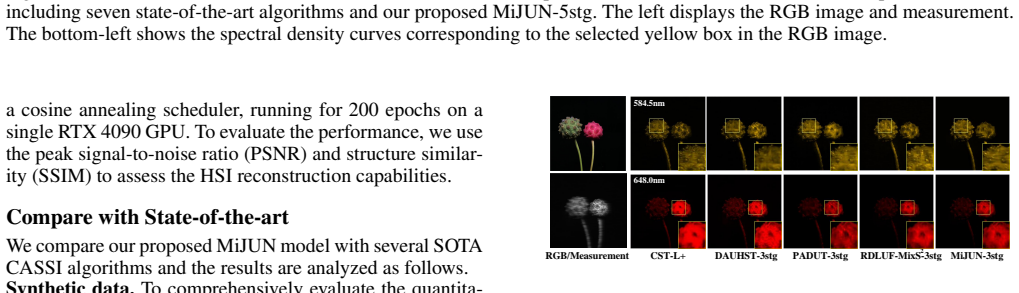
- [Figure 4] The two subfigures of Fig. 4 are not fully described in the text; the notations (a) and (b) are not explicitly referenced in the paragraph on Mamba-inspired Transformer.
- [Related Work / Method] The claim that tensor mode-k unfolding is integrated into Mamba 'for the first time' should be supported by a citation search; recent works on Mamba for hyperspectral imaging may already use similar unfolding strategies.
- [Experiments, Real data] The real-data comparison in Fig. 7 refers to 'Scene 4' without explaining how the scene was selected or what its characteristics are; adding context would improve the reproducibility of the qualitative evaluation.
Circularity Check
A-HQS update in Eqs. (4a)-(4c) is circular as written, but the benchmark results are externally tested; no load-bearing self-citation circularity.
-
self definitional
[Methodology, Accelerated deep unfolding framework, Eqs. (4a)-(4c) and Eq. (9)]
"xk+1 = argminx 1/2 ∥y − Φx∥2 + µ/2 ∥x − ˆzk+1∥2, (4a) zk+1 = argminz µ/2 ∥xk+1 − zk∥2 + τ R(zk), (4b) ˆzk+1 = zk+1 + βk+1(zk+1 − zk), (4c)"
Equations (4a)-(4c) form a closed loop: x_{k+1} uses \hat z_{k+1}, \hat z_{k+1} uses z_{k+1}, and z_{k+1} is supposed to be the argmin of (4b) in z, but the objective contains only z_k and R(z_k), not the free variable z. Hence (4b) does not define a function of z, and the later replacement z_{k+1}=proxNet(x_{k+1}) in Eq. (9) is an additional ansatz, not a consequence. As printed, the update is circular and not computable; no independent derivation of the claimed A-HQS recursion is given.
full rationale
The main quantitative claim (Table 1: MiJUN-5stg reaches 40.60 dB average PSNR vs 39.57 dB for RDLUF-MixS2-9stg) is measured on ten KAIST simulation scenes plus unseen ICVL and real data, so the empirical result is not defined in terms of the paper's own fitted parameters; it is an external benchmark comparison. The Mamba and tensor mode-k components are architectural proposals, not renamed versions of the evaluation metric, and the paper does not fit a parameter and then call its fitted value a prediction. Several citations are to prior work of co-author Xin Yuan (e.g., GAP-Net, DAUHST, plug-and-play SCI), but these are used as baselines or building blocks rather than as the sole justification for MiJUN's central claim; no uniqueness theorem from the authors is imported to force the design. The one genuine circularity is formal: the A-HQS equations (4a)-(4c) define x_{k+1} through \hat z_{k+1} through z_{k+1} through x_{k+1}, and (4b)'s argmin is not well-posed because the variable z does not appear in the objective. This undermines the reproducibility of the methodological derivation and the asserted O(1/k^2) convergence (which is stated without proof), but it does not make the empirical benchmark results circular. Hence score 2.
Assumptions & free parameters
free parameters (4)
- beta_k (momentum coefficient) =
not specified; scheduled or learned
- mu (penalty parameter) =
learned per stage
- lambda (channel expansion factor) =
not specified (predefined)
- number of unfolding stages =
5, 7, or 9
assumptions (4)
- domain assumption CASSI forward model (Eq. 1-2) is an accurate representation of the physical system
- domain assumption Phi Phi^T is diagonal (Eq. 7)
- domain assumption The proximal operator can be replaced by a learned denoiser proxNet (Eq. 9)
- ad hoc to paper A-HQS has O(1/k^2) convergence and corresponds to a second-order differential equation
Cite this review
Pith. "Pith review of Detail Matters: Mamba-Inspired Joint Unfolding Network for Snapshot Spectral Compressive Imaging." pith.science (2026). https://pith.science/paper/N4A7T45H
@misc{pith2026250101262,
  author       = {Pith},
  title        = {Pith review of: Detail Matters: Mamba-Inspired Joint Unfolding Network for Snapshot Spectral Compressive Imaging},
  year         = {2026},
  howpublished = {\url{https://pith.science/paper/N4A7T45H}},
  note         = {Machine review of arXiv:2501.01262}
}
abstract
In the coded aperture snapshot spectral imaging system, Deep Unfolding Networks (DUNs) have made impressive progress in recovering 3D hyperspectral images (HSIs) from a single 2D measurement. However, the inherent nonlinear and ill-posed characteristics of HSI reconstruction still pose challenges to existing methods in terms of accuracy and stability. To address this issue, we propose a Mamba-inspired Joint Unfolding Network (MiJUN), which integrates physics-embedded DUNs with learning-based HSI imaging. Firstly, leveraging the concept of trapezoid discretization to expand the representation space of unfolding networks, we introduce an accelerated unfolding network scheme. This approach can be interpreted as a generalized accelerated half-quadratic splitting with a second-order differential equation, which reduces the reliance on initial optimization stages and addresses challenges related to long-range interactions. Crucially, within the Mamba framework, we restructure the Mamba-inspired global-to-local attention mechanism by incorporating a selective state space model and an attention mechanism. This effectively reinterprets Mamba as a variant of the Transformer} architecture, improving its adaptability and efficiency. Furthermore, we refine the scanning strategy with Mamba by integrating the tensor mode-$k$ unfolding into the Mamba network. This approach emphasizes the low-rank properties of tensors along various modes, while conveniently facilitating 12 scanning directions. Numerical and visual comparisons on both simulation and real datasets demonstrate the superiority of our proposed MiJUN, and achieving overwhelming detail representation.
Figures


Figures from the paper (4 more)


Reference graph
Works this paper leans on
-
[1]
Bioucas-Dias, J. M.; and Figueiredo, M. A. 2007. A new TwIST: Two-step iterative shrinkage/thresholding algorithms for image restoration. IEEE Transactions on Image processing, 16(12): 2992--3004
work page 2007
-
[2]
Cai, Y.; Lin, J.; Hu, X.; Wang, H.; Yuan, X.; Zhang, Y.; Timofte, R.; and Van Gool, L. 2022 a . Coarse-to-fine sparse transformer for hyperspectral image reconstruction. In European Conference on Computer Vision, 686--704. Springer
work page 2022
-
[3]
Cai, Y.; Lin, J.; Hu, X.; Wang, H.; Yuan, X.; Zhang, Y.; Timofte, R.; and Van Gool, L. 2022 b . Mask-guided spectral-wise transformer for efficient hyperspectral image reconstruction. In Proceedings of the IEEE/CVF Conference on Computer Vision and Pattern Recognition, 17502--17511
work page 2022
-
[4]
Cai, Y.; Lin, J.; Wang, H.; Yuan, X.; Ding, H.; Zhang, Y.; Timofte, R.; and Gool, L. V. 2022 c . Degradation-aware unfolding half-shuffle transformer for spectral compressive imaging. Advances in Neural Information Processing Systems, 35: 37749--37761
work page 2022
-
[5]
Cao, M.; Wang, L.; Zhu, M.; and Yuan, X. 2024. Hybrid CNN-Transformer Architecture for Efficient Large-Scale Video Snapshot Compressive Imaging. International Journal of Computer Vision, 1--20
work page 2024
-
[6]
Chan, S. H.; Wang, X.; and Elgendy, O. A. 2016. Plug-and-play ADMM for image restoration: Fixed-point convergence and applications. IEEE Transactions on Computational Imaging, 3(1): 84--98
work page 2016
-
[7]
Chen, Y.; Gui, X.; Zeng, J.; Zhao, X.; and He, W. 2023. Combining low-rank and deep plug-and-play priors for snapshot compressive imaging. IEEE Transactions on Neural Networks and Learning Systems, 1--13
work page 2023
-
[8]
Cheng, Z.; Chen, B.; Lu, R.; Wang, Z.; Zhang, H.; Meng, Z.; and Yuan, X. 2022. Recurrent neural networks for snapshot compressive imaging. IEEE Transactions on Pattern Analysis and Machine Intelligence, 45(2): 2264--2281
work page 2022
Show all 37 references
-
[9]
Dong, Y.; Gao, D.; Qiu, T.; Li, Y.; Yang, M.; and Shi, G. 2023. Residual degradation learning unfolding framework with mixing priors across spectral and spatial for compressive spectral imaging. In Proceedings of the IEEE/CVF Conference on Computer Vision and Pattern Recogniti...
2023
-
[10]
Ebner, A.; and Haltmeier, M. 2024. Plug-and-play image reconstruction is a convergent regularization method. IEEE Transactions on Image Processing
2024
-
[11]
Gu, A.; and Dao, T. 2023. Mamba: Linear-time sequence modeling with selective state spaces. arXiv preprint arXiv:2312.00752
2023 arXiv
-
[12]
Gu, A.; Goel, K.; and R \'e , C. 2021. Efficiently modeling long sequences with structured state spaces. arXiv preprint arXiv:2111.00396
2021 arXiv
-
[13]
Gu, A.; Johnson, I.; Goel, K.; Saab, K.; Dao, T.; Rudra, A.; and R \'e , C. 2021. Combining recurrent, convolutional, and continuous-time models with linear state space layers. Advances in neural information processing systems, 34: 572--585
2021
-
[14]
Han, D.; Wang, Z.; Xia, Z.; Han, Y.; Pu, Y.; Ge, C.; Song, J.; Song, S.; Zheng, B.; and Huang, G. 2024. Demystify Mamba in Vision: A Linear Attention Perspective. arXiv preprint arXiv:2405.16605
2024 arXiv
-
[15]
Hu, X.; Cai, Y.; Lin, J.; Wang, H.; Yuan, X.; Zhang, Y.; Timofte, R.; and Van Gool, L. 2022. Hdnet: High-resolution dual-domain learning for spectral compressive imaging. In Proceedings of the IEEE/CVF Conference on Computer Vision and Pattern Recognition, 17542--17551
2022
-
[16]
Huang, T.; Dong, W.; Yuan, X.; Wu, J.; and Shi, G. 2021. Deep gaussian scale mixture prior for spectral compressive imaging. In Proceedings of the IEEE/CVF Conference on Computer Vision and Pattern Recognition, 16216--16225
2021
-
[17]
Li, M.; Fu, Y.; Liu, J.; and Zhang, Y. 2023. Pixel adaptive deep unfolding transformer for hyperspectral image reconstruction. In Proceedings of the IEEE/CVF International Conference on Computer Vision, 12959--12968
2023
-
[18]
Liu, Y.; Tian, Y.; Zhao, Y.; Yu, H.; Wang, Y.; Ye, Q.; and Liu, Y. 2024. VMamba: Visual State Space Model. arXiv preprint arXiv:2401.10166
2024 arXiv
-
[19]
J.; and Dai, Q
Liu, Y.; Yuan, X.; Suo, J.; Brady, D. J.; and Dai, Q. 2018. Rank minimization for snapshot compressive imaging. IEEE transactions on pattern analysis and machine intelligence, 41(12): 2990--3006
2018
-
[20]
Luo, F.; Chen, X.; Gong, X.; Wu, W.; and Guo, T. 2024. Dual-Window Multiscale Transformer for Hyperspectral Snapshot Compressive Imaging. In Proceedings of the AAAI Conference on Artificial Intelligence, volume 38, 3972--3980
2024
-
[21]
Luo, Y.; Zhao, X.; Meng, D.; and Jiang, T. 2022. Hlrtf: Hierarchical low-rank tensor factorization for inverse problems in multi-dimensional imaging. In Proceedings of the IEEE/CVF Conference on Computer Vision and Pattern Recognition, 19303--19312
2022
-
[22]
Ma, J.; Liu, X.; Shou, Z.; and Yuan, X. 2019. Deep tensor ADMM-net for snapshot compressive imaging. In Proceedings of the IEEE/CVF International Conference on Computer Vision, 10223--10232
2019
-
[23]
Meng, Z.; Ma, J.; and Yuan, X. 2020. End-to-end low cost compressive spectral imaging with spatial-spectral self-attention. In European conference on computer vision, 187--204
2020
-
[24]
Meng, Z.; Yuan, X.; and Jalali, S. 2023. Deep unfolding for snapshot compressive imaging. International Journal of Computer Vision, 131(11): 2933--2958
2023
-
[25]
Pei, X.; Huang, T.; and Xu, C. 2024. EfficientVMamba: Atrous Selective Scan for Light Weight Visual Mamba. arXiv preprint arXiv:2403.09977
2024 arXiv
-
[26]
Wang, L.; Cao, M.; Zhong, Y.; and Yuan, X. 2023. Spatial-temporal transformer for video snapshot compressive imaging. IEEE Transactions on Pattern Analysis and Machine Intelligence, 45(7): 9072--9089
2023
-
[27]
Wang, L.; Sun, C.; Zhang, M.; Fu, Y.; and Huang, H. 2020. Dnu: Deep non-local unrolling for computational spectral imaging. In Proceedings of the IEEE/CVF Conference on Computer Vision and Pattern Recognition, 1661--1671
2020
-
[28]
Wu, Z.; Lu, R.; Fu, Y.; and Yuan, X. 2025. Latent Diffusion Prior Enhanced Deep Unfolding for Snapshot Spectral Compressive Imaging. In European Conference on Computer Vision, 164--181. Springer
2025
-
[29]
Xie, X.; Cui, Y.; Ieong, C.-I.; Tan, T.; Zhang, X.; Zheng, X.; and Yu, Z. 2024. Fusionmamba: Dynamic feature enhancement for multimodal image fusion with mamba. arXiv preprint arXiv:2404.09498
2024 arXiv
-
[30]
Xu, P.; Liu, L.; Zheng, H.; Yuan, X.; Xu, C.; and Xue, L. 2023. Degradation-aware dynamic fourier-based network for spectral compressive imaging. IEEE Transactions on Multimedia
2023
-
[31]
Yuan, X. 2016. Generalized alternating projection based total variation minimization for compressive sensing. In 2016 IEEE International conference on image processing, 2539--2543
2016
-
[32]
Yuan, X.; Liu, Y.; Suo, J.; and Dai, Q. 2020. Plug-and-play algorithms for large-scale snapshot compressive imaging. In Proceedings of the IEEE/CVF Conference on Computer Vision and Pattern Recognition, 1447--1457
2020
-
[33]
Yuan, X.; Liu, Y.; Suo, J.; Durand, F.; and Dai, Q. 2021. Plug-and-play algorithms for video snapshot compressive imaging. IEEE Transactions on Pattern Analysis and Machine Intelligence, 44(10): 7093--7111
2021
-
[34]
Zhang, X.; and Wu, X. 2021. Attention-guided image compression by deep reconstruction of compressive sensed saliency skeleton. In Proceedings of the IEEE/CVF Conference on Computer Vision and Pattern Recognition, 13354--13364
2021
-
[35]
Zhang, X.; Zhang, Y.; Xiong, R.; Sun, Q.; and Zhang, J. 2022. Herosnet: Hyperspectral explicable reconstruction and optimal sampling deep network for snapshot compressive imaging. In Proceedings of the IEEE/CVF Conference on Computer Vision and Pattern Recognition, 17532--17541
2022
-
[36]
, " * write output.state after.block = add.period write newline
ENTRY address archivePrefix author booktitle chapter edition editor eid eprint howpublished institution isbn journal key month note number organization pages publisher school series title type volume year label extra.label sort.label short.list INTEGERS output.state before.all...
-
[37]
write newline
" write newline "" before.all 'output.state := FUNCTION n.dashify 't := "" t empty not t #1 #1 substring "-" = t #1 #2 substring "--" = not "--" * t #2 global.max substring 't := t #1 #1 substring "-" = "-" * t #2 global.max substring 't := while if t #1 #1 substring * t #2 gl...
Reviewed August 10, 2026 · model on record in the stance chip above.
Discussion (0). Continue with ORCID to comment.