REVIEW 4 major objections 5 minor 43 references
Towards a Training Free Approach for 3D Scene Editing
T0 review · 4 major / 5 minor · reviewed 2026-08-11 · deepseek-v4-flash
Pith's one-line read The paper claims that FreeEdit, a modular mesh-based pipeline, can insert, replace, or delete objects in large 3D scenes from a text prompt alone, without any per-edit training, by locating a collision-free placement automatically.
desk verdict A promising training-free 3D editing system, but the main quantitative claim is undercut by an inconsistent penetration metric; warrants review with major revision. read the letter →
The pith
A machine-rendered reading of the paper's core claim, the machinery that carries it, and where it could break.
The reading
What carries the argument
The key mechanism is the hierarchical voxel-erosion location finder. On the grounding object, vertices whose normals point upward (roughly parallel to the global Z axis) are selected; these are clustered, and a voxel grid is built with cell size equal to a fraction of the scaled object's width. A small all-ones filter is convolved over the grid, and cells whose average exceeds a threshold are kept, producing a coarser grid; this erosion repeats until no cell survives or the grid is smaller than the filter. The surviving cell in the last grid is interpreted as the optimal placement, and its coordinates are reconstructed by Eq. 2. The procedure encodes the paper's claim that flat, spacious, unoccupied regions are the right place to put an object, and it is the part of the pipeline that replaces user-provided bounding boxes or masks.
What would settle it
Take a planar slab with two identical flat regions symmetric under 90-degree rotation. If the algorithm has no tie-breaking rule, rotating the entire scene mesh by 90 degrees should change the chosen placement cell, which would show the claimed 'optimal location' is not well-defined and would invalidate the collision-minimization claim as stated.
Extended reading notes
Core claim
The central discovery is that 3D scene editing can be decomposed into a sequence of frozen, pretrained components plus one lightweight geometric search, eliminating per-edit optimization. The pipeline classifies the prompt into insertion, replacement, or deletion, extracts the primary object and the grounding object, synthesizes a 3D mesh for the object, grounds the target object in the scene, and scales the object using relative bounding-box widths from generated 2D images. The distinctive step is the location finder: it filters the grounding object's upward-facing vertices, clusters them, voxelizes the surface at a resolution tied to the object width, and repeatedly applies an averaging convolution over the grid to shrink to a stable candidate cell. That cell is used to compute the placement coordinates, aiming to minimize intersection with the rest of the scene. For replacement, the grounded object is removed, the cavity is filled, and the replacement mesh is scaled to fit. The paper reports the location finder cuts penetration-percentage roughly in half relative to a center-placement baseline, both before and after a rotation-refinement step.
Load-bearing premise
The whole method depends on the assumption that the multi-level voxel-erosion search always settles on a single best cell and that Eq. 2 turns that cell into correct coordinates, but the paper does not state how ties among candidate cells are broken, and the formula's mixing of hierarchy level with voxel width is left unexplained.
Editorial extensions
If this is right
- If FreeEdit works as claimed, 3D scene editing no longer requires training a NeRF for each edit, enabling near real-time, iterative customization of room-sized scenes.
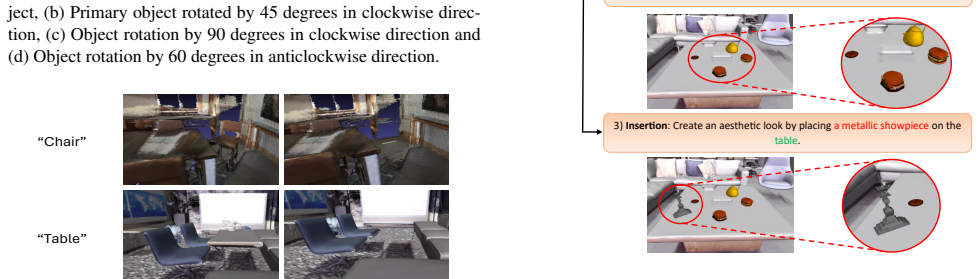
- Insertion, replacement, deletion, translation, rotation, and iterative multi-object insertion all run through the same frozen-component pipeline, so a stacked prompt can add several objects one after another without retraining.
- Because the pipeline operates on meshes, it can be applied to both reconstructed real-world scans and synthetic room-scale scenes, as demonstrated in the paper.
- The location finder's automatic placement removes the need for positional priors such as bounding boxes or masks, reducing user interaction to the text prompt itself.
- The penetration-percent metric drops by roughly half compared with a center-placement baseline, and a rotation-refinement step further reduces intersections.
Reading between the lines
- A natural extension would be to replace the upward-normal filter with a local-supportness criterion so the placement search handles non-flat surfaces, which the paper explicitly lists as a current limitation.
- The minimum-width-ratio scaling rule could be swapped for a learned object-size predictor, since the paper notes that large scaling values produce unrealistic placements.
- The same voxel-erosion search could be reused as a generic surface-placement cost map for robotic manipulators or virtual staging tools, because it only needs a mesh and a footprint size.
- The paper measures quality primarily by geometric intersection; an alternative evaluation could compare semantic plausibility of the chosen locations against human judgments, since placement appropriateness is not fully captured by vertex penetration.
Editorial analysis
A structured set of objections, weighed in public.
Referee Report
Summary. The paper proposes FreeEdit, a training-free pipeline for text-guided 3D scene editing on mesh representations, supporting object insertion, replacement, deletion, translation, rotation, and iterative insertion. The pipeline combines an LLM for task classification and entity extraction, Shap-E for text-to-3D object synthesis, OpenMask3D for open-vocabulary object grounding, Grounding DINO for scale estimation, a hierarchical voxel-erosion location finder, and a rotation-based refinement step that minimizes a penetration percentage metric. The authors evaluate against Instruct-NeRF2NeRF and a traditional center-placement baseline on ScanNet and Replica scenes, reporting quantitative penetration percentages and a user study. The central claimed contribution is an automatic placement algorithm that minimizes mesh intersection with prior scene objects.
Significance. If the claims are substantiated, FreeEdit would be a timely and practically relevant contribution: a modular, training-free alternative to NeRF-based 3D editing that can operate on room-sized multi-object scenes without positional priors. The qualitative results and user study suggest the pipeline can produce reasonable insertions and replacements. The paper also explicitly acknowledges several limitations (flat-surface restriction, inpainting artifacts, lack of relational placement, scale-threshold issues), which is constructive. However, the quantitative evidence currently does not support the central minimal-intersection claim as cleanly as presented: the defining equation for the headline metric is inconsistent with the stated SDF convention, and the refinement step optimizes exactly the metric used for evaluation. These issues are load-bearing and must be resolved before the contribution can be assessed fairly.
major comments (4)
- [§4.1, Eq. (3)] The definition of penetration percent is internally inconsistent. Section 3.1 defines the SDF with negative sign for inside points and positive for outside points, but Eq. (3) counts vertices with dist(v_n, M) > 0 as penetrated, which is the opposite of the text immediately above it ('count of primary object vertices having negative signed distance'). The explanatory sentence 'intersection results in vertices penetration out of the scene leading to positive sign' contradicts the convention established in Section 3.1. Because Table 1 is the only quantitative support for the central claim that the location finder reduces intersections, this inconsistency makes the reported 3.84% vs 7.45% reduction uninterpretable. Please reconcile the sign convention, specify whether M is the union of all scene mesh objects or just the grounding object, and clarify how SDF is computed for non-watertight ScanNet/Replica meshes.
- [§3.7 and §4.1] The evaluation metric is the same objective used by the refinement step. The refinement step in Section 3.7 rotates the primary object to minimize penetration percent defined by Eq. (3), and Table 1 then reports penetration percent as the headline quantitative result. The improvement from 4.40% to 3.84% is therefore partly by construction and does not independently validate the placement quality. The claim that FreeEdit finds placements with minimal intersection needs support from a metric not used in the optimization, for example an independent mesh-intersection volume computed after the fact, or a comparison against random rotations/placements on the same scenes.
- [§3.6, Eq. (2)] The coordinate reconstruction formula appears dimensionally inconsistent and underspecified. The term (x_id + levels - 0.5) * width adds an integer number of hierarchy levels to a voxel index and multiplies by a voxel width, which mixes an ordinal count with spatial units; if 'levels' denotes the number of erosion levels, this changes the coordinate mapping in a way that is not derived. In addition, the algorithm description does not specify how ties are broken when more than one cell in the final grid has value 1, and it asserts that the selected location 'minimizes the intersection with prior objects' without describing the optimization over candidate cells. Please provide a precise pseudocode, the tie-breaking rule, and a derivation of Eq. (2).
- [§3.5 and §4.1] The scale of the primary object is chosen as the minimum of the scales measured over a small set of generated images, but no ablation or principled justification is given for this selection rule. Since object scale directly determines both penetration and the realism of the placement, and Table 1 aggregates results across all 1250 cases, the arbitrary minimum rule is a load-bearing free parameter. Please provide an ablation or justification for the scale selection, and report sensitivity to the number of generated images and to the choice of bounding-box dimension.
minor comments (5)
- [§3.6] Throughout Section 3.6, 'slither' should be 'slide' (e.g., 'slithered over the grid').
- [Fig. 2] Figure 2 mentions 'Top-k views' and 'Clip' but the number k and the CLIP aggregation procedure are not defined in the text; please clarify how the top-k views are selected and used.
- [§3.6] The DBSCAN parameters (eps, min_samples) and the convolution threshold are not specified; please report the chosen values or state that they are fixed across all scenes.
- [§4.1] The user study reports mean scores but no number of responses per question, no variance, and no significance test; given the small sample size (35 participants), please add these details.
- [§2] The related work section would benefit from explicitly discussing recent mesh-based or training-free editing methods, if any exist, to sharpen the 'first training-free approach' claim.
Circularity Check
Refinement report is self-fulfilling: penetration metric doubles as optimization objective; central location-finder claim remains independent.
-
fitted input called prediction
[Section 3.7 (Refinement) and Section 4.1 (Quantitative Results, Table 1)]
"Now the object is rotated by certain angles at equal intervals and angle with least penetration percent (Eq.3) is considered to rotate the object. ... After refinement (Section 3.7), the percentage is further reduced for both the methods."
The quantitative metric reported in Table 1, penetration percent (Eq. 3), is exactly the objective that Section 3.7 minimizes when selecting the object's rotation. The Yes row of Table 1 is therefore the optimized value of the reported metric, not an independent measurement: the reduction after refinement is forced by construction because the rotation is chosen to minimize precisely that quantity. This makes the claim that 'the percentage is further reduced' a restatement of the optimization objective rather than a derived prediction. The No-refinement comparison is not circular because the location finder uses a voxel-erosion heuristic rather than Eq. 3, so the circularity is partial and does not affect the central placement claim.
full rationale
FreeEdit's central derivation—the location finder that selects a placement via voxel erosion, the grounding pipeline, and the scaling mechanism—does not reduce to its inputs; it is an independent heuristic evaluated against a center-placement baseline. No load-bearing self-citation was found. However, one quantitative evaluation is self-fulfilling: Section 3.7 rotates the inserted object to minimize penetration percent (Eq. 3), and Section 4.1 then reports that penetration percent drops after refinement. Because the Yes row of Table 1 is the minimum of the evaluation metric over rotations, that specific reduction is by construction rather than evidence. The sign contradiction in the metric (negative SDF counts as inside per Section 3.1, but Eq. 3 counts positive SDF as penetration) is a correctness issue, not a circularity, and does not affect this score. On balance, the central qualitative claims are supported by examples and a user study, so the circularity is partial and limited to the refinement rows.
Assumptions & free parameters
free parameters (6)
- Voxel size for location finder =
not reported in main text
- Erosion threshold =
not reported in main text
- Number of generated images for scale estimation =
not reported
- Scale selection rule (minimum) =
minimum of computed scales
- DBSCAN eps and min_samples =
not reported
- Rotation angle interval =
not reported
assumptions (4)
- domain assumption Upward-facing vertex normals, clustered and eroded, identify all feasible placement regions on a grounding object.
- domain assumption The minimum bounding-box width ratio from a few generated 2D images reliably estimates the 3D scale between primary and grounding objects.
- domain assumption GPT-4 correctly classifies edit tasks and extracts primary/grounding entities from arbitrary text prompts.
- domain assumption Pre-trained models (Shap-E, OpenMask3D, Grounding DINO, latent diffusion) produce meshes and detections of sufficient quality for direct composition.
Cite this review
Pith. "Pith review of Towards a Training Free Approach for 3D Scene Editing." pith.science (2026). https://pith.science/paper/N4G7RM7M
@misc{pith2026241212766,
  author       = {Pith},
  title        = {Pith review of: Towards a Training Free Approach for 3D Scene Editing},
  year         = {2026},
  howpublished = {\url{https://pith.science/paper/N4G7RM7M}},
  note         = {Machine review of arXiv:2412.12766}
}
read the original abstract
Text driven diffusion models have shown remarkable capabilities in editing images. However, when editing 3D scenes, existing works mostly rely on training a NeRF for 3D editing. Recent NeRF editing methods leverages edit operations by deploying 2D diffusion models and project these edits into 3D space. They require strong positional priors alongside text prompt to identify the edit location. These methods are operational on small 3D scenes and are more generalized to particular scene. They require training for each specific edit and cannot be exploited in real-time edits. To address these limitations, we propose a novel method, FreeEdit, to make edits in training free manner using mesh representations as a substitute for NeRF. Training-free methods are now a possibility because of the advances in foundation model's space. We leverage these models to bring a training-free alternative and introduce solutions for insertion, replacement and deletion. We consider insertion, replacement and deletion as basic blocks for performing intricate edits with certain combinations of these operations. Given a text prompt and a 3D scene, our model is capable of identifying what object should be inserted/replaced or deleted and location where edit should be performed. We also introduce a novel algorithm as part of FreeEdit to find the optimal location on grounding object for placement. We evaluate our model by comparing it with baseline models on a wide range of scenes using quantitative and qualitative metrics and showcase the merits of our method with respect to others.
Figures


Figures from the paper (6 more)


Reference graph
Works this paper leans on
-
[1]
Josh Achiam, Steven Adler, Sandhini Agarwal, Lama Ah- mad, Ilge Akkaya, Florencia Leoni Aleman, Diogo Almeida, Janko Altenschmidt, Sam Altman, Shyamal Anadkat, et al. Gpt-4 technical report. arXiv preprint arXiv:2303.08774 , 2023
arXiv 2023
-
[2]
Sine: Semantic-driven image-based nerf editing with prior-guided editing field
Chong Bao, Yinda Zhang, Bangbang Yang, Tianxing Fan, Zesong Yang, Hujun Bao, Guofeng Zhang, and Zhaopeng Cui. Sine: Semantic-driven image-based nerf editing with prior-guided editing field. In The IEEE/CVF Computer Vi- sion and Pattern Recognition Conference (CVPR), 2023
work page 2023
-
[3]
In- structpix2pix: Learning to follow image editing instructions
Tim Brooks, Aleksander Holynski, and Alexei A Efros. In- structpix2pix: Learning to follow image editing instructions. In Proceedings of the IEEE/CVF Conference on Computer Vision and Pattern Recognition, pages 18392–18402, 2023
2023
-
[4]
Masactrl: Tuning-free mu- tual self-attention control for consistent image synthesis and editing
Mingdeng Cao, Xintao Wang, Zhongang Qi, Ying Shan, Xi- aohu Qie, and Yinqiang Zheng. Masactrl: Tuning-free mu- tual self-attention control for consistent image synthesis and editing. In Proceedings of the IEEE/CVF International Con- ference on Computer Vision (ICCV) , pages 22560–22570, October 2023
work page 2023
-
[5]
Yukang Cao, Yan-Pei Cao, Kai Han, Ying Shan, and Kwan- Yee K. Wong. Dreamavatar: Text-and-shape guided 3d hu- man avatar generation via diffusion models. InIEEE Confer- ence on Computer Vision and Pattern Recognition (CVPR) , 2024
work page 2024
-
[6]
Set-the-scene: Global-local training for generating controllable nerf scenes
Dana Cohen-Bar, Elad Richardson, Gal Metzer, Raja Giryes, and Daniel Cohen-Or. Set-the-scene: Global-local training for generating controllable nerf scenes. 2023 IEEE/CVF In- ternational Conference on Computer Vision Workshops (IC- CVW), pages 2912–2921, 2023
work page 2023
-
[7]
Diffedit: Diffusion-based seman- tic image editing with mask guidance
Guillaume Couairon, Jakob Verbeek, Holger Schwenk, and Matthieu Cord. Diffedit: Diffusion-based seman- tic image editing with mask guidance. arXiv preprint arXiv:2210.11427, 2022
arXiv 2022
-
[8]
Chang, Manolis Savva, Maciej Hal- ber, Thomas Funkhouser, and Matthias Nießner
Angela Dai, Angel X. Chang, Manolis Savva, Maciej Hal- ber, Thomas Funkhouser, and Matthias Nießner. Scannet: Richly-annotated 3d reconstructions of indoor scenes. In Proc. Computer Vision and Pattern Recognition (CVPR), IEEE, 2017
2017
Show all 43 references
-
[9]
Study on interior decoration system design based on 3d scene modeling technology
Zhang Dan. Study on interior decoration system design based on 3d scene modeling technology. In 2017 Interna- tional Conference on Smart Grid and Electrical Automation (ICSGEA), pages 380–383, 2017
2017
-
[10]
Vica-nerf: View- consistency-aware 3d editing of neural radiance fields
Jiahua Dong and Yu-Xiong Wang. Vica-nerf: View- consistency-aware 3d editing of neural radiance fields. In Thirty-seventh Conference on Neural Information Process- ing Systems, 2023
2023
-
[11]
3d mod- eling and augmented reality
Shen Fangyang, Jia Jun, Lu Xuejun, and Qi Yue. 3d mod- eling and augmented reality. In 2010 4th International Uni- versal Communication Symposium, pages 185–192, 2010
2010
-
[12]
3d sketching for interactive model retrieval in virtual reality
Daniele Giunchi, Stuart James, and Anthony Steed. 3d sketching for interactive model retrieval in virtual reality. In Proceedings of the Joint Symposium on Computational Aes- thetics and Sketch-Based Interfaces and Modeling and Non- Photorealistic Animation and Rendering , Exp...
2018
-
[13]
Fusedrf: Fusing multiple radiance fields
Rahul Goel, Dhawal Sirikonda, Rajvi Shah, and PJ Narayanan. Fusedrf: Fusing multiple radiance fields. arXiv preprint arXiv:2306.04180, 2023
2023 arXiv
-
[14]
Tenenbaum, Antonio Torralba, Florian Shkurti, and Liam Paull
Qiao Gu, Alihusein Kuwajerwala, Sacha Morin, Krishna Murthy Jatavallabhula, Bipasha Sen, Aditya Agarwal, Cor- ban Rivera, William Paul, Kirsty Ellis, Rama Chellappa, Chuang Gan, Celso Miguel de Melo, Joshua B. Tenenbaum, Antonio Torralba, Florian Shkurti, and Liam Paull. Conce...
2024
-
[15]
Instruct-nerf2nerf: Edit- ing 3d scenes with instructions
Ayaan Haque, Matthew Tancik, Alexei Efros, Aleksander Holynski, and Angjoo Kanazawa. Instruct-nerf2nerf: Edit- ing 3d scenes with instructions. In Proceedings of the IEEE/CVF International Conference on Computer Vision , 2023
2023
-
[16]
Prompt-to-prompt im- age editing with cross attention control
Amir Hertz, Ron Mokady, Jay Tenenbaum, Kfir Aberman, Yael Pritch, and Daniel Cohen-Or. Prompt-to-prompt im- age editing with cross attention control. arXiv preprint arXiv:2208.01626, 2022
2022 arXiv
-
[17]
Denoising dif- fusion probabilistic models
Jonathan Ho, Ajay Jain, and Pieter Abbeel. Denoising dif- fusion probabilistic models. In H. Larochelle, M. Ranzato, R. Hadsell, M.F. Balcan, and H. Lin, editors, Advances in Neural Information Processing Systems , volume 33, pages 6840–6851. Curran Associates, Inc., 2020
2020
-
[18]
Shap-e: Generat- ing conditional 3d implicit functions
Heewoo Jun and Alex Nichol. Shap-e: Generat- ing conditional 3d implicit functions. arXiv preprint arXiv:2305.02463, 2023
2023 arXiv
-
[19]
Instruct 3d-to-3d: Text in- struction guided 3d-to-3d conversion
Hiromichi Kamata, Yuiko Sakuma, Akio Hayakawa, Masato Ishii, and Takuya Narihira. Instruct 3d-to-3d: Text in- struction guided 3d-to-3d conversion. arXiv preprint arXiv:2303.15780, 2023
2023 arXiv
-
[20]
Imagic: Text-based real image editing with diffusion models
Bahjat Kawar, Shiran Zada, Oran Lang, Omer Tov, Huiwen Chang, Tali Dekel, Inbar Mosseri, and Michal Irani. Imagic: Text-based real image editing with diffusion models. InCon- ference on Computer Vision and Pattern Recognition 2023 , 2023
2023
-
[21]
Lo ´aiciga Rodr´ıguez
Peter K ´an, Andrija Kurtic, Mohamed Radwan, and Jorge M. Lo ´aiciga Rodr´ıguez. Automatic interior design in aug- mented reality based on hierarchical tree of procedural rules. Electronics, 10(3), 2021
2021
-
[22]
Control-nerf: Editable feature volumes for scene rendering and manipulation
Verica Lazova, Vladimir Guzov, Kyle Olszewski, Sergey Tulyakov, and Gerard Pons-Moll. Control-nerf: Editable feature volumes for scene rendering and manipulation. In Proceedings of the IEEE/CVF Winter Conference on Appli- cations of Computer Vision (WACV), pages 4340–4350, Jan...
2023
-
[23]
Advances in 3d generation: A survey
Xiaoyu Li, Qi Zhang, Di Kang, Weihao Cheng, Yiming Gao, Jingbo Zhang, Zhihao Liang, Jing Liao, Yan-Pei Cao, and Ying Shan. Advances in 3d generation: A survey. arXiv preprint arXiv: 2401.17807, 2024
2024 arXiv
-
[24]
Grounding dino: Marrying dino with grounded pre-training for open-set object detection
Shilong Liu, Zhaoyang Zeng, Tianhe Ren, Feng Li, Hao Zhang, Jie Yang, Chunyuan Li, Jianwei Yang, Hang Su, Jun Zhu, et al. Grounding dino: Marrying dino with grounded pre-training for open-set object detection. arXiv preprint arXiv:2303.05499, 2023
2023 arXiv
-
[25]
Lorensen and Harvey E
William E. Lorensen and Harvey E. Cline. Marching cubes: A high resolution 3d surface construction algorithm. In Mau- reen C. Stone, editor, Proceedings of the 14th Annual Con- ference on Computer Graphics and Interactive Techniques, SIGGRAPH 1987, Anaheim, California, USA, Ju...
1987
-
[26]
Industrial augmented reality: 3d-content editor for augmented reality maintenance worker support system
Mario Lorenz, Sebastian Knopp, Jisu Kim, and Philipp Kli- mant. Industrial augmented reality: 3d-content editor for augmented reality maintenance worker support system. In 2020 IEEE International Symposium on Mixed and Aug- mented Reality Adjunct (ISMAR-Adjunct) , pages 203–205, 2020
2020
-
[27]
The intersection of fashion, immersive technology, and sus- tainability: A literature review
Lyndsay Mesjar, Karen Cross, Yang Jiang, and Josie Steed. The intersection of fashion, immersive technology, and sus- tainability: A literature review. Sustainability, 15(4), 2023
2023
-
[28]
Sked: Sketch-guided text-based 3d editing
Aryan Mikaeili, Or Perel, Mehdi Safaee, Daniel Cohen-Or, and Ali Mahdavi-Amiri. Sked: Sketch-guided text-based 3d editing. In Proceedings of the IEEE/CVF International Con- ference on Computer Vision, pages 14607–14619, 2023
2023
-
[29]
Glide: Towards photorealistic image generation and editing with text-guided diffusion models
Alex Nichol, Prafulla Dhariwal, Aditya Ramesh, Pranav Shyam, Pamela Mishkin, Bob McGrew, Ilya Sutskever, and Mark Chen. Glide: Towards photorealistic image generation and editing with text-guided diffusion models. In Interna- tional Conference on Machine Learning, 2021
2021
-
[30]
Point-e: A system for generat- ing 3d point clouds from complex prompts
Alex Nichol, Heewoo Jun, Prafulla Dhariwal, Pamela Mishkin, and Mark Chen. Point-e: A system for generat- ing 3d point clouds from complex prompts. arXiv preprint arXiv:2212.08751, 2022
2022 arXiv
-
[31]
Learning transferable visual models from natural language supervision
Alec Radford, Jong Wook Kim, Chris Hallacy, Aditya Ramesh, Gabriel Goh, Sandhini Agarwal, Girish Sastry, Amanda Askell, Pamela Mishkin, Jack Clark, Gretchen Krueger, and Ilya Sutskever. Learning transferable visual models from natural language supervision. In International Con...
2021
-
[32]
High-resolution image synthesis with latent diffusion models
Robin Rombach, Andreas Blattmann, Dominik Lorenz, Patrick Esser, and Bj ¨orn Ommer. High-resolution image synthesis with latent diffusion models. In Proceedings of the IEEE/CVF Conference on Computer Vision and Pattern Recognition (CVPR), pages 10684–10695, June 2022
2022
-
[33]
V ox-e: Text-guided voxel editing of 3d ob- jects
Etai Sella, Gal Fiebelman, Peter Hedman, and Hadar Averbuch-Elor. V ox-e: Text-guided voxel editing of 3d ob- jects. In Proceedings of the IEEE/CVF International Con- ference on Computer Vision, pages 430–440, 2023
2023
-
[34]
Inserf: Text-driven generative object insertion in neural 3d scenes
Mohamad Shahbazi, Liesbeth Claessens, Michael Niemeyer, Edo Collins, Alessio Tonioni, Luc Van Gool, and Federico Tombari. Inserf: Text-driven generative object insertion in neural 3d scenes. Arxiv, 2024
2024
-
[35]
Object- stitch: Object compositing with diffusion model
Yizhi Song, Zhifei Zhang, Zhe Lin, Scott Cohen, Brian Price, Jianming Zhang, Soo Ye Kim, and Daniel Aliaga. Object- stitch: Object compositing with diffusion model. In Pro- ceedings of the IEEE/CVF Conference on Computer Vision and Pattern Recognition (CVPR), pages 18310–18319...
2023
-
[36]
Stevens and Thomas Butkiewicz
Andrew H. Stevens and Thomas Butkiewicz. Faster multi- beam sonar data cleaning: Evaluation of editing 3d point clouds using immersive vr. In OCEANS 2019 MTS/IEEE SEATTLE, pages 1–10, 2019
2019
-
[37]
Julian Straub, Thomas Whelan, Lingni Ma, Yufan Chen, Erik Wijmans, Simon Green, Jakob J. Engel, Raul Mur-Artal, Carl Ren, Shobhit Verma, Anton Clarkson, Mingfei Yan, Brian Budge, Yajie Yan, Xiaqing Pan, June Yon, Yuyang Zou, Kimberly Leon, Nigel Carter, Jesus Briales, Tyler Gi...
1906 arXiv
-
[38]
Sumner, Marc Pollefeys, Federico Tombari, and Francis Engelmann
Ayc ¸a Takmaz, Elisabetta Fedele, Robert W. Sumner, Marc Pollefeys, Federico Tombari, and Francis Engelmann. OpenMask3D: Open-V ocabulary 3D Instance Segmentation. In Advances in Neural Information Processing Systems (NeurIPS), 2023
2023
-
[39]
Flex: Full- body grasping without full-body grasps
Purva Tendulkar, D´ıdac Sur´ıs, and Carl V ondrick. Flex: Full- body grasping without full-body grasps. In Conference on Computer Vision and Pattern Recognition (CVPR), 2023
2023
-
[40]
Training-free con- sistent text-to-image generation, 2024
Yoad Tewel, Omri Kaduri, Rinon Gal, Yoni Kasten, Lior Wolf, Gal Chechik, and Yuval Atzmon. Training-free con- sistent text-to-image generation, 2024
2024
-
[41]
Grasp’d: Differentiable contact-rich grasp syn- thesis for multi-fingered hands
Dylan Turpin, Liquan Wang, Eric Heiden, Yun-Chun Chen, Miles Macklin, Stavros Tsogkas, Sven Dickinson, and Ani- mesh Garg. Grasp’d: Differentiable contact-rich grasp syn- thesis for multi-fingered hands. In European Conference on Computer Vision, pages 201–221. Springer, 2022
2022
-
[42]
RePaint-NeRF: Nerf editting via semantic masks and diffusion models
Xingchen Zhou, Ying He, F Richard Yu, Jianqiang Li, and You Li. RePaint-NeRF: Nerf editting via semantic masks and diffusion models. In IJCAI, 2023
2023
-
[43]
Dreameditor: Text-driven 3d scene editing with neural fields
Jingyu Zhuang, Chen Wang, Liang Lin, Lingjie Liu, and Guanbin Li. Dreameditor: Text-driven 3d scene editing with neural fields. In SIGGRAPH Asia 2023 Conference Papers, pages 1–10, 2023
2023
Reviewed August 11, 2026 · model on record in the stance chip above.
Discussion (0). Continue with ORCID to comment.