REVIEW 4 major objections 5 minor 1 cited by
Probing the pseudogap and beyond: Examining single-particle properties of the hole- and electron-doped Hubbard model
T0 review · 4 major / 5 minor · reviewed 2026-08-06 · deepseek-v4-flash
Pith's one-line read This paper argues, from unbiased numerically exact simulations of the doped Hubbard model, that the cuprate pseudogap is a smooth crossover driven by strong correlations — not a symmetry-breaking phase transition.
desk verdict Solid DQMC study with honest caveats; crossover claim is plausible but the no-pocket and T*_A evidence are resolution-limited. read the letter →
The pith
A machine-rendered reading of the paper's core claim, the machinery that carries it, and where it could break.
The reading
What carries the argument
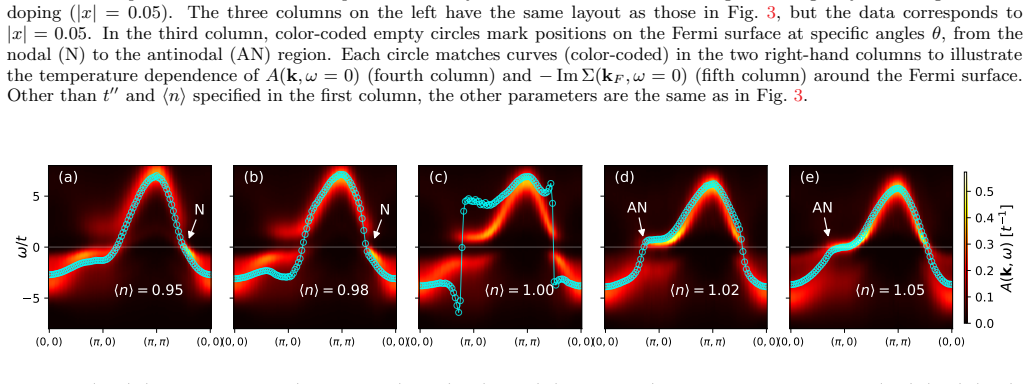
The load-bearing object is the single-particle self-energy $\Sigma_k(\omega)$, extracted from the simulated spectral function $A(\mathbf{k},\omega)$ through Dyson's equation $G^R(\mathbf{k},\omega) = 1/(\omega - (\epsilon_{\mathbf{k}}-\mu) + i\delta - \Sigma_{\mathbf{k}}(\omega))$. An explicit two-pole calculation in the paper's appendix shows that a pole-like real part $\mathrm{Re}\,\Sigma \sim (\omega-\omega_0)^{-1}$ opens a gap of size roughly $2a^{-1/2}$ at the Fermi level, while a linear negative slope $\mathrm{Re}\,\Sigma \sim -b\omega$ merely renormalizes the band and leaves it gapless; the pseudogap appears where the pole-like remnant of the Mott gap sits closest to the Fermi level — near the antinode for hole doping, near the node for electron doping. Methodologically, the argument rides on three tools: determinant quantum Monte Carlo (a numerically exact simulation of the interacting Hubbard model), maximum-entropy analytic continuation (which converts imaginary-time Green's functions and spin susceptibilities into real-frequency spectra), and twisted boundary conditions on an $8\times 8$ cluster (which raise the momentum resolution to that of a $64 \times 64$ lattice).
What would settle it
Run the same model at temperatures below $T/t = 1/4$ on larger clusters with a real-frequency method that avoids maximum-entropy reconstruction: if the antinodal spectral weight develops a kink that sharpens as the lattice grows, if a Fermi pocket with a resolvable back side appears in the self-energy, or if the three $T^*$ values converge to a single lattice-size-independent number, the crossover conclusion would fail, whereas a smooth, size-independent evolution of the antinodal weight is what the paper's picture predicts.
Extended reading notes
Core claim
On the paper's own terms, the central discovery is that the hole-doped pseudogap of the Hubbard model is a smooth crossover driven by strong correlations, and that its momentum-space signatures — Fermi arcs and a nodal–antinodal dichotomy — follow directly from the momentum dependence of the Mott gap rather than from antiferromagnetic order, Fermi pockets, or a Lifshitz transition. The decisive evidence sits in the self-energy: at low hole doping the real part $\mathrm{Re}\,\Sigma_k(\omega)$ develops a pole-like $1/(\omega-\omega_0)$ remnant of the Mott gap whose position relative to the Fermi level shifts with momentum, suppressing coherent weight at the antinode while the node stays coherent; electron doping reverses the dichotomy, and the same simulations show no enclosed pockets anywhere in the Brillouin zone. The temperature dependence of the antinodal spectral weight defines a spectroscopic pseudogap onset $T^*_A \sim t/3$, while simulated NMR probes — the Knight shift and $(T_1T)^{-1}$ evaluated with oxygen-site form factors — give their own onset temperatures $T^*_{K_s}$ and $T^*_{T_1}$ that do not coincide with $T^*_A$. Because no disorder enters the calculation, the paper concludes that the pseudogap is a true smooth crossover even in the clean limit, describing a high-temperature pseudogap that is visible only for dopings near half-filling.
Load-bearing premise
The load-bearing premise is that the computer reconstruction of real-frequency spectra from the imaginary-time simulation data is quantitatively reliable — including the pole-shaped feature in the self-energy that carries the argument — and that an $8\times 8$ lattice with twisted boundary conditions stands in for the infinite system, a premise the paper itself flags by noting that no error bars are shown for spectral functions and that finite-size effects are more pronounced for electron doping and likely extend to the spectra.
Editorial extensions
If this is right
- Different probes will legitimately define different pseudogap temperatures $T^*$: the spectroscopic onset, the NMR Knight-shift onset, and the spin-lattice-relaxation onset are distinct scales, so apparent disagreements among ARPES, NMR, and transport experiments are what a correlation-driven crossover predicts rather than evidence of a hidden transition.
- Fermi arcs are not the visible halves of damped Fermi pockets: the self-energy analysis finds no enclosed pockets, ruling out the arc-from-pocket-back-side mechanism at the studied dopings and temperatures.
- Weak-coupling fermiology — band structure plus antiferromagnetic nesting — correctly describes the electron-doped side (coherent quasiparticles, hot spots) but fails for hole doping, where the antinodal self-energy is governed by the remnant Mott gap; hole-doped pseudogap physics is a strong-coupling effect.
- Hole doping reproduces the linear-in-$T$ resistivity associated with strange metallicity, while electron doping curves toward Fermi-liquid behavior, connecting the coherence asymmetry between the two dopings to transport anomalies.
- The pseudogap seen here is the high-temperature pseudogap, appearing only near half-filling; the paper leaves open a distinct lower-temperature pseudogap away from half-filling with a much smaller energy scale.
Reading between the lines
- Testable extension: map the three onset temperatures $T^*_A$, $T^*_{K_s}$, and $T^*_{T_1}$ across a grid of $U$, $t'$, and $t''$ values — the crossover picture predicts the probe-dependence survives over a wide parameter range, since the mechanism is the momentum-dependent Mott gap rather than a special hopping geometry.
- The pole-like self-energy implies a zero of the Green's function near the same frequency, so re-analyzing the same simulation data through the zeros of $G(\mathbf{k},\omega)$ could provide a sharper, MaxEnt-robust diagnostic for the crossover than the peak-based definition of $T^*_A$.
- The simulations stop at $T/t \ge 1/4$; the crossover conclusion implicitly invites a direct check that the antinodal spectral weight stays smooth as the lattice grows and the temperature drops, with no emerging kink or pocket back side.
- If the crossover view is right, the two temperature scales seen in NMR experiments on real cuprates are likely two smooth onsets of the same Mott-controlled physics rather than signatures of two distinct orders — a reinterpretation that simultaneous ARPES and Knight-shift measurements on the same sample could test.
Signed reviews
Editorial analysis
A structured set of objections, weighed in public.
Referee Report
Summary. This paper uses determinant quantum Monte Carlo (DQMC) with twisted boundary conditions and maximum-entropy analytic continuation to compute single-particle spectral functions, self-energies, NMR-like spin susceptibilities, transport, and thermodynamics of the two-dimensional Hubbard model with U/t = 6, t'/t = -0.25, and t''/t = 0 or 0.15, on 8x8 lattices for both hole and electron doping. It reports a systematic electron-hole asymmetry: the electron-doped side exhibits stronger antiferromagnetic correlations, more coherent quasiparticles, and hot spots on the Fermi surface, while the hole-doped side develops a nodal-antinodal dichotomy and a pseudogap without signatures of Fermi pockets. The authors attribute this dichotomy to the momentum dependence of the Mott gap, as seen in both the spectral function and a Re Sigma ~ 1/omega self-energy, and they compare pseudogap temperatures extracted from the antinodal spectral weight, Knight shift, and (T1T)^-1, finding that these temperatures do not coincide. They conclude that the pseudogap is a smooth crossover driven by strong correlations, not a symmetry-breaking phase transition, even without disorder.
Significance. If the central claims hold, this is a valuable contribution to the pseudogap debate. The paper's strengths include systematic DQMC simulations with twisted-boundary-condition momentum resolution, a cross-check of the MaxEnt Fermi surfaces against the continuation-free proxy -beta G(k, tau = beta/2), direct comparison of spectroscopy-like and NMR-like probes within the same model, and public release of data and analysis routines. The electron-hole asymmetry and the explicit statement that the pseudogap temperature is probe-dependent are interesting and testable, and the comparison across independent probes is not circular. However, the load-bearing negative claim of no Fermi pockets and the quantitative crossover temperatures rest on MaxEnt spectral functions and self-energies without error bars, and on finite-size assumptions that are acknowledged but not checked for the spectral quantities. The significance is therefore conditional on resolving these points.
major comments (4)
- [Section III, Figs. 8-10; Appendix B] The central negative claim that no Fermi pockets appear is a resolution-limited statement. The quantity Re Sigma_k(omega = 0) + (epsilon_k - mu) is obtained through MaxEnt continuation, Kramers-Kronig inversion, Dyson inversion, and two-dimensional spline interpolation over momenta from 15 twisted 8x8 boundary conditions; Appendix B states that error bars are not shown for single-particle spectral functions and self-energies. A small pocket back side would appear as a second zero crossing in a narrow momentum window near the antinode, precisely where A(k,0) is smallest and where MaxEnt bias and spline smoothing are most likely to erase it. Please provide a quantitative test of this resolution limit, for example by applying the same continuation and interpolation pipeline to synthetic G(k,tau) generated from spectra with and without a small pocket, or by showing convergence with respect to the number of twists and lattice size.
- [Section IV, Figs. 7(d) and 14] The value T*_A = t/3 for n = 0.95 is identified from a cubic-spline peak of the antinodal spectral weight versus temperature using essentially three temperature points (T/t = 1/2, 1/3, 1/4) and no error bars. Because the probe-dependence conclusion in Fig. 14 hinges on this peak, please provide bootstrap confidence intervals or additional temperature points to confirm that the antinodal nonmonotonicity is real and that the peak position is robust.
- [Appendix C4 and Figs. C8, 9-10] The paper acknowledges that finite-size effects are more pronounced for electron doping and states that they 'are likely to extend to other properties not explicitly analyzed here, such as the single-particle spectral function, self-energy, and (T1T)^-1,' yet no finite-size check is presented for the no-pocket result or for T*_A. Given that the no-pocket and crossover conclusions are the central claims, please add a 10x10 or 12x12 comparison for the hole-doped n = 0.95 case, or an equivalent twist-convergence study, to demonstrate that the real-frequency self-energy structure is converged.
- [Section IV and Fig. 14] The text states that for t''/t = 0 the Knight-shift peak 'occurs at much lower temperatures, even outside the range of our study,' but Fig. 14 reports T*_Ks values for t''/t = 0. Please clarify how T*_Ks was extracted and reconcile these statements, since the summary comparison of T* values depends on the consistency of these definitions.
minor comments (5)
- [Abstract and Section V] The abstract says 'transition towards the pseudogap' while the conclusion says the pseudogap is a smooth crossover; please use consistent terminology to avoid implying a phase transition.
- [Fig. 9 caption] The caption says dashed lines highlight the change in sign of Re Sigma_k(omega = 0) + (epsilon_k - mu); please state explicitly whether these dashed lines are zero contours or merely guides to the eye.
- [Appendix A3 and Figs. 12-13] The Knight shift and (T1T)^-1 are plotted in arbitrary units; please state in the captions that constant prefactors are omitted and whether the quantities are normalized per site.
- [Appendix A2 and Eq. (A21)] The notation for twisted-boundary-condition Green's functions is compact and could be confusing; a one-sentence reminder that the twist angle enters through the redefined operators in Eq. (A18) would improve readability.
- [Appendix A1, footnote [132]] The footnote-like reference [132] embedded in a sentence about interpolation would be clearer as a regular parenthetical or a numbered footnote in the standard style.
Circularity Check
No significant circularity: the crossover conclusion rests on comparing independent DQMC observables, and the self-energy analysis is a consistency check, not a fitted prediction.
full rationale
The central claim that the pseudogap is a smooth crossover is supported by comparing three independently defined quantities: the antinodal spectral weight peak (T*_A), the Knight shift peak (T*_Ks), and the (T1T)^{-1} peak (T*_T1), all computed from the same DQMC data but with distinct operational definitions. No parameter is fitted to force these temperatures to agree, and their disagreement is an empirical finding. The self-energy is obtained from the spectral function via Dyson inversion, so statements such as 'A(k,omega) should follow omega - (Re Sigma_k(omega) + (epsilon_k - mu)) = 0' are mathematical reformulations rather than independent predictions; the paper uses this as an internal consistency check and characterization tool, not as the load-bearing evidence for the crossover conclusion. Technical self-citations (e.g., Refs. [84,108,130,139,140]) are used for methodology and prior numerical context and are not load-bearing for the central claim. The paper's own caveats — that error bars are omitted for single-particle spectral functions and self-energies, and that finite-size effects 'are likely to extend to other properties not explicitly analyzed here, such as the single-particle spectral function, self-energy, and (T1T)^{-1}' — are correctness and robustness risks rather than circularity. No equation in the paper reduces the crossover conclusion to its own inputs by construction.
Assumptions & free parameters
free parameters (4)
- U/t on-site interaction =
6 (and 8 in supplementary)
- t'/t next-nearest-neighbor hopping =
-0.25
- t''/t third-nearest-neighbor hopping =
0 or 0.15
- Pole-fit parameters a, c, omega0, omega1 in Eq. C7 =
See Fig. C7
assumptions (5)
- domain assumption Maximum entropy analytic continuation of imaginary-time DQMC data yields reliable real-frequency spectral functions and self-energies.
- domain assumption An 8x8 lattice with 15 twisted boundary conditions and spline interpolation of the self-energy approximates the thermodynamic-limit momentum-resolved spectral function.
- domain assumption The single-band Hubbard model with t' = -0.25t captures the relevant physics of the cuprate pseudogap.
- domain assumption The fermion sign problem is mild enough at the chosen parameters that DQMC estimates are effectively unbiased.
- standard math Dyson's equation and Kramers-Kronig inversion give a valid self-energy from the MaxEnt spectral function.
Cite this review
Pith. "Pith review of Probing the pseudogap and beyond: Examining single-particle properties of the hole- and electron-doped Hubbard model." pith.science (2026). https://pith.science/paper/N4HYF7HO
@misc{pith2026250615770,
  author       = {Pith},
  title        = {Pith review of: Probing the pseudogap and beyond: Examining single-particle properties of the hole- and electron-doped Hubbard model},
  year         = {2026},
  howpublished = {\url{https://pith.science/paper/N4HYF7HO}},
  note         = {Machine review of arXiv:2506.15770}
}
read the original abstract
We compute high-resolution angle-resolved photoemission spectroscopy of the Hubbard model using the unbiased determinant quantum Monte Carlo algorithm, revealing an asymmetry between electron and hole doping. Electron doping exhibits more coherent quasiparticles and stronger antiferromagnetic correlations compared to hole doping. At low doping, a nodal-antinodal dichotomy on the Fermi surface is observed, similar to cuprate experiments. The dichotomy reflects the momentum dependence of the Mott gap, as manifested in both the spectral function and the self-energy. For hole doping, we observe a transition towards the pseudogap, without signature of pocket formation. The simulated nuclear magnetic resonance pseudogap temperatures do not necessarily agree with the temperature determined by spectroscopy. These findings collectively suggest the pseudogap is a smooth crossover driven by strong correlations.
Figures


Figures from the paper (11 more)




Forward citations
Cited by 1 Pith paper
-
Momentum-Selective Two-Component Excitations in Electron-Doped Mott Insulators
In the t-t'-J model, electron doping (t'>0) selectively enhances coherent quasiparticle weight at antinodes while nodal weight stays resonance-driven and incoherent, yielding a momentum-split two-fluid spectrum.
Reviewed August 6, 2026 · model on record in the stance chip above.
Discussion (0). Continue with ORCID to comment.