TOI-6884b: A low-mass brown dwarf transiting a slightly evolved star
Pith reviewed 2026-06-30 04:39 UTC · model grok-4.3
The pith
TOI-6884b is a brown dwarf of 26 Jupiter masses transiting a slightly evolved star on a 4.8-day orbit.
A machine-rendered reading of the paper's core claim, the machinery that carries it, and where it could break.
Core claim
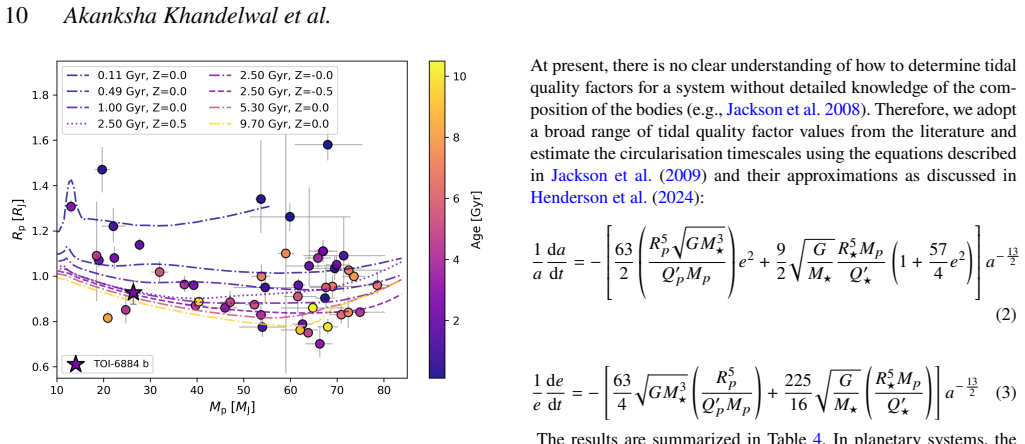
The central discovery is the confirmation that the transiting object TOI-6884b has a mass of 26.32 Jupiter masses and radius of 0.927 Jupiter radii, placing it firmly in the brown dwarf regime, with an orbital period of 4.808 days around its F-type host star that has a radius of 1.84 solar radii indicating slight evolution off the main sequence.
What carries the argument
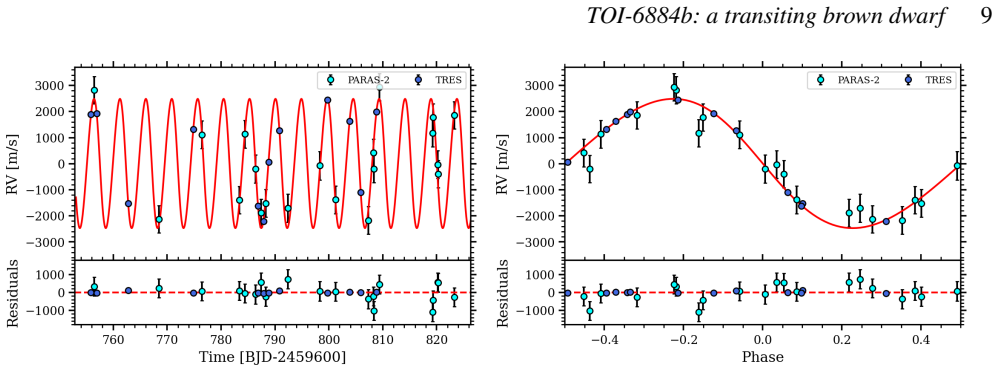
The combination of TESS light curves with ground-based radial velocity measurements and additional photometry to resolve the orbital period and measure the companion mass.
If this is right
- The system helps map the population of short-period brown dwarfs around evolved stars.
- It shows that ground-based radial velocities are essential to confirm periods from space-based photometry when aliases are possible.
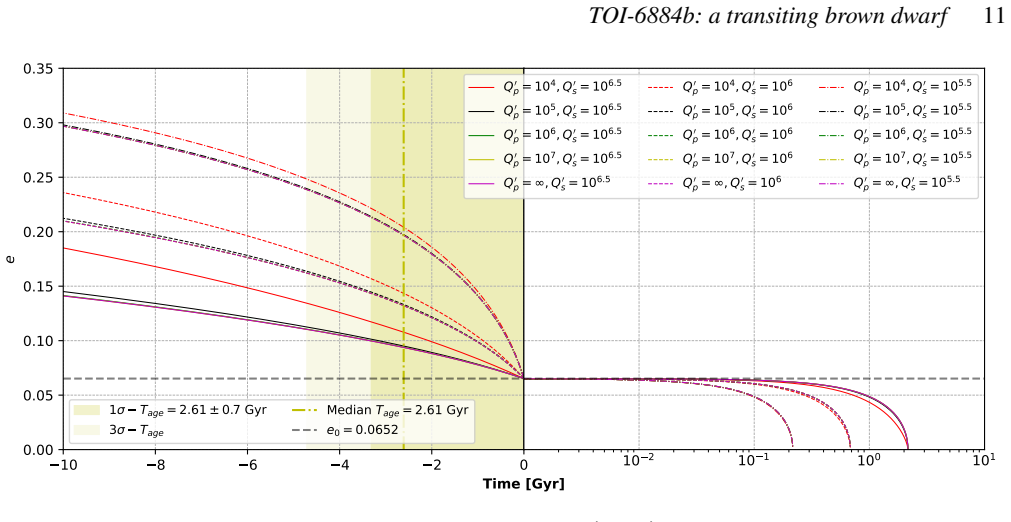
- The nearly circular orbit suggests tidal forces have acted on the system.
- Such detections aid models of structural evolution for brown dwarfs in close orbits.
Where Pith is reading between the lines
- Future monitoring could detect changes in the orbit due to the star's evolution.
- This case may indicate that brown dwarfs can form or migrate to short periods without being engulfed during stellar expansion.
- Comparison with other systems could reveal if low-mass brown dwarfs have different radius properties than higher-mass ones.
Load-bearing premise
The radial velocity data accurately reflect the gravitational pull of the transiting companion at the reported period without significant contamination from stellar spots or other signals.
What would settle it
Spectroscopic observations that measure a companion mass exceeding 80 Jupiter masses or photometry showing no transit at the 4.808-day period.
Figures
read the original abstract
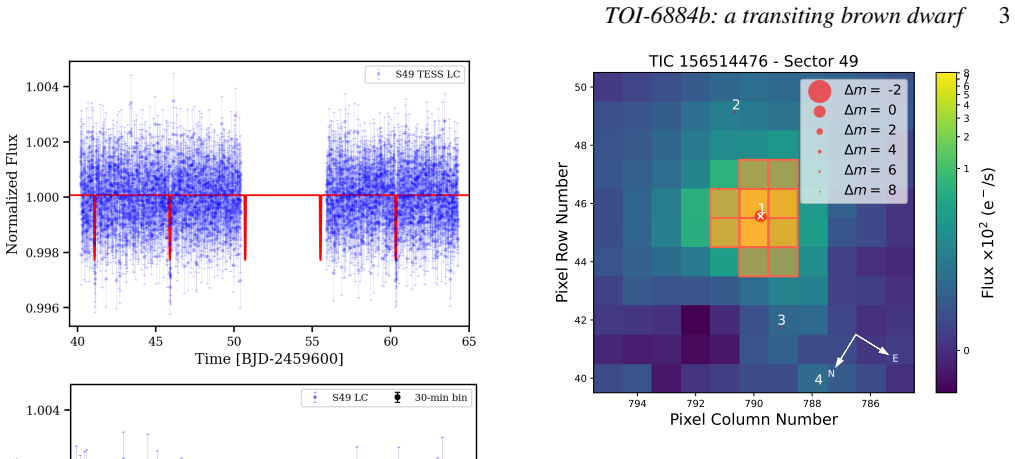
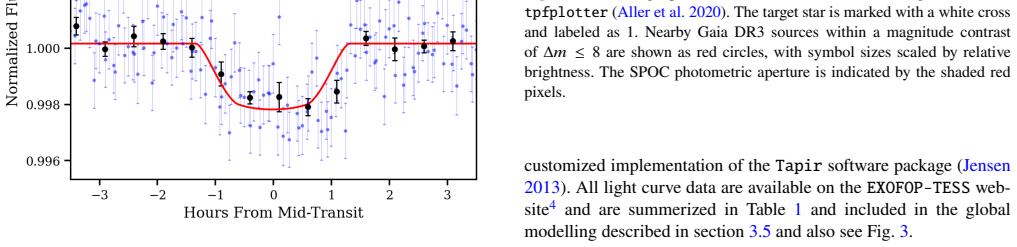
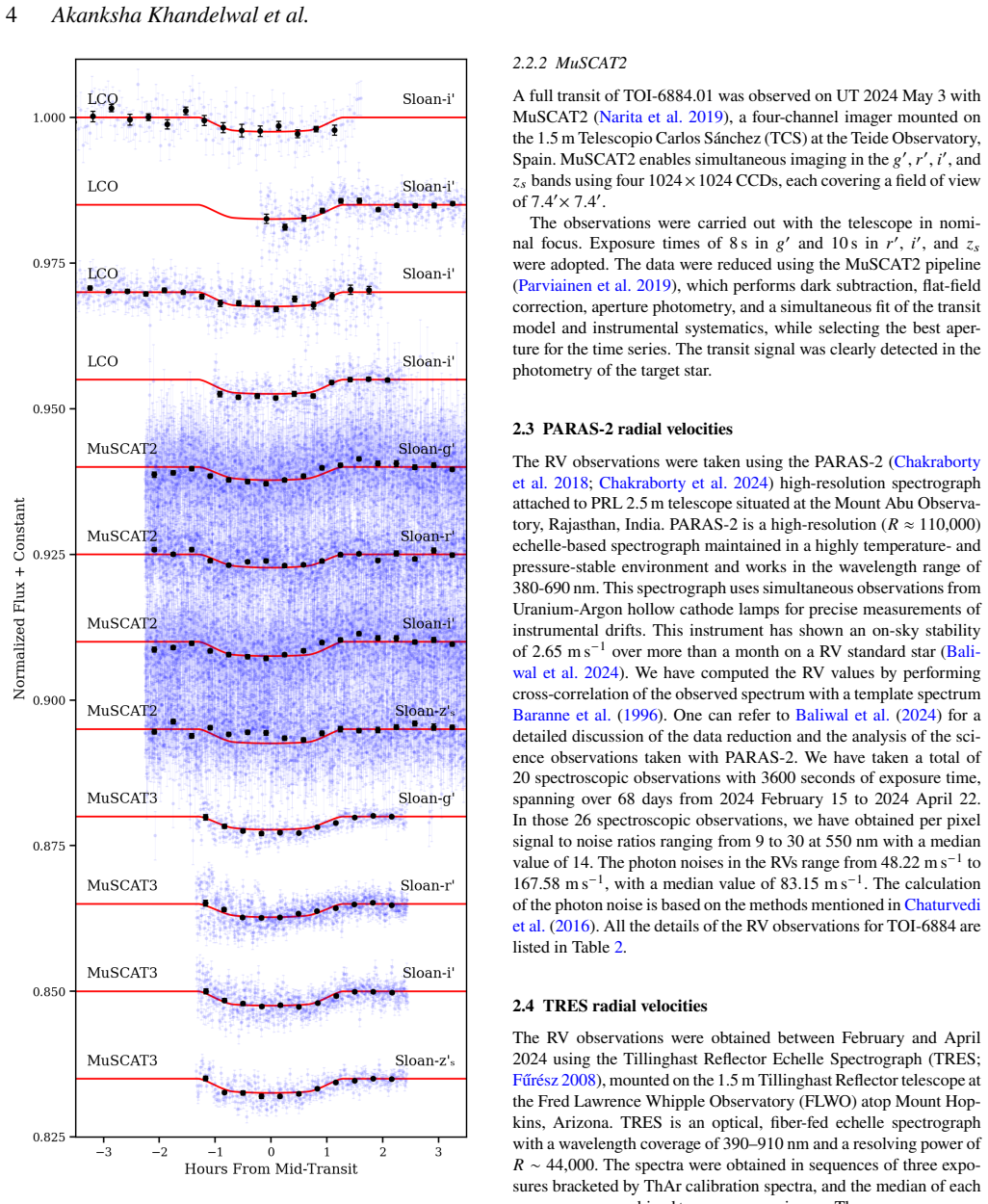
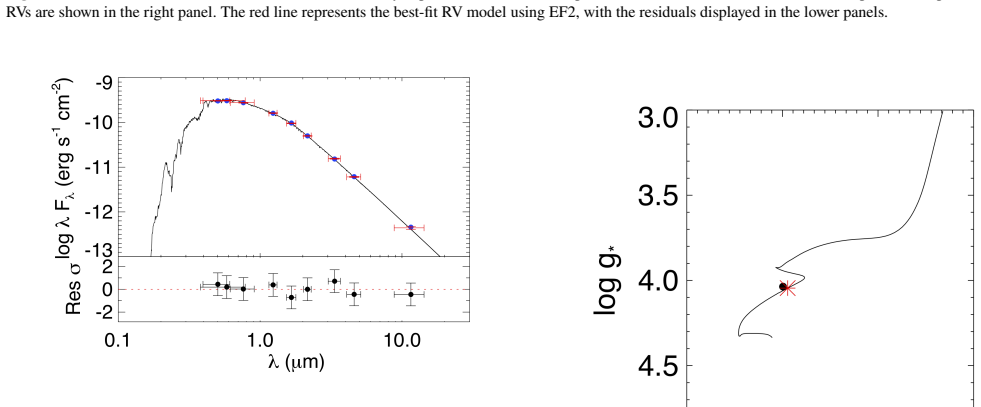
We report the discovery of a low-mass transiting brown dwarf orbiting TOI-6884 (TIC~156514476, $T_{\rm mag}=11.4$) from NASA's \textit{Transiting Exoplanet Survey Satellite} (\textit{TESS}) mission. The \textit{TESS} light curves initially suggested an orbital period of $\sim$14.42~days; however, our high-precision ground-based radial velocity measurements and multi-epoch time-series photometry reveal this to be a harmonic alias. We determine the true orbital period to be $4.808264^{+0.000015}_{-0.000014}$~days and confirm the substellar nature of the companion. TOI-6884b has a mass of $26.32^{+0.98}_{-0.93}\,M_{\mathrm{J}}$, a radius of $0.927^{+0.51}_{-0.52}\,R_{\mathrm{J}}$, and resides on a nearly circular orbit ($e=0.067^{+0.010}_{-0.012}$). Its host star is a late F-type slightly evolved star with $M_\star = 1.410^{+0.075}_{-0.069}\,M_\odot$,\msun, $R_\star = 1.840^{+0.072}_{-0.073}\,R_\odot$, $\log{g} = 4.057^{+0.045}_{-0.039}$, $[{\rm Fe/H}] = 0.094^{+0.073}_{-0.068}$~dex, and $T_{\rm eff}=6330^{+180}_{-160}$,\mathrm{K}$. TOI-6884b is a key addition to the small population of well-characterized transiting brown dwarfs orbiting host stars that have evolved off the main sequence. The detection of such systems will contribute to our understanding of the dynamical histories and structural evolution of short-period substellar companions around evolved stars.
Editorial analysis
A structured set of objections, weighed in public.
Referee Report
Summary. The manuscript reports the discovery of the transiting low-mass brown dwarf TOI-6884b around the slightly evolved F-type star TOI-6884 (TIC 156514476). TESS photometry initially indicated a ~14.42-day period, but ground-based radial velocity measurements and multi-epoch photometry are used to establish the true period as 4.808264 days, yielding a companion mass of 26.32 M_J, radius of 0.927 R_J, and eccentricity of 0.067; the host star parameters are also derived.
Significance. If the period alias is correctly resolved, the system adds a precisely characterized transiting brown dwarf to the limited sample orbiting evolved stars, supporting studies of substellar companion evolution and dynamics in post-main-sequence environments.
major comments (2)
- [Orbital period determination and RV analysis sections] The resolution of the 14.42 d TESS alias in favor of the 4.808 d period is load-bearing for all derived parameters (mass, radius, eccentricity). The abstract states that ground-based RV and photometry 'reveal this to be a harmonic alias,' but without explicit quantitative comparison (e.g., RV periodogram power, false-alarm probabilities, or Bayesian evidence for both periods in the joint photometric-RV fit), it is not possible to assess whether the shorter period is unambiguously preferred.
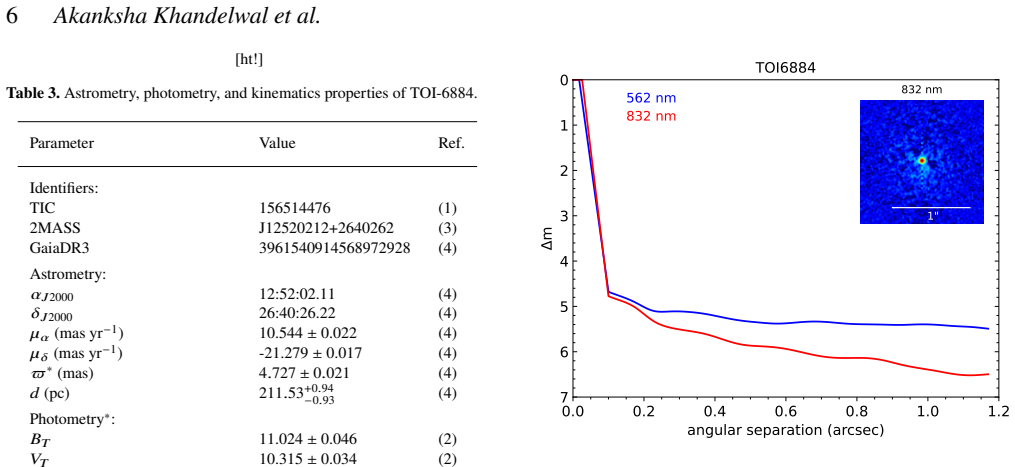
- [Derived parameters table and transit modeling] Table reporting the final parameters (likely Table 3 or equivalent): the radius uncertainty of +0.51/-0.52 R_J on a value of 0.927 R_J implies a fractional uncertainty exceeding 50%, which appears inconsistent with the precision expected from a detected transit and requires explicit justification in the light-curve modeling section.
minor comments (2)
- [Abstract] Abstract contains a formatting artifact: 'M_\star = 1.410^{+0.075}_{-0.069}\,M_\odot,\msun' includes an extraneous ',\msun'.
- [Abstract and parameter tables] Notation for stellar mass in the abstract mixes LaTeX and plain text; ensure consistent use of solar mass symbol throughout.
Simulated Author's Rebuttal
We thank the referee for their careful review and constructive comments. We address each major comment below and indicate where revisions will be incorporated.
read point-by-point responses
-
Referee: [Orbital period determination and RV analysis sections] The resolution of the 14.42 d TESS alias in favor of the 4.808 d period is load-bearing for all derived parameters (mass, radius, eccentricity). The abstract states that ground-based RV and photometry 'reveal this to be a harmonic alias,' but without explicit quantitative comparison (e.g., RV periodogram power, false-alarm probabilities, or Bayesian evidence for both periods in the joint photometric-RV fit), it is not possible to assess whether the shorter period is unambiguously preferred.
Authors: We agree that explicit quantitative support for the period choice strengthens the analysis. In the revised manuscript we will include the RV periodogram with powers and false-alarm probabilities at both the 4.808 d signal and the 14.42 d alias, together with the Bayesian evidence ratio from the joint photometric-RV model comparison demonstrating the clear preference for the shorter period. revision: yes
-
Referee: [Derived parameters table and transit modeling] Table reporting the final parameters (likely Table 3 or equivalent): the radius uncertainty of +0.51/-0.52 R_J on a value of 0.927 R_J implies a fractional uncertainty exceeding 50%, which appears inconsistent with the precision expected from a detected transit and requires explicit justification in the light-curve modeling section.
Authors: The large fractional uncertainty on the radius is a direct consequence of the shallow transit depth relative to the evolved host star and the available photometric precision. We will add a dedicated paragraph in the transit modeling section that quantifies the contributions to the radius uncertainty (including limb-darkening priors, dilution, and photometric noise) and explains why the radius remains only loosely constrained despite the secure transit detection. revision: yes
Circularity Check
No significant circularity; results from independent observational datasets
full rationale
The paper reports a standard exoplanet/brown-dwarf discovery and parameter fit using TESS photometry, ground-based RV time series, and multi-epoch transit photometry. Orbital period, mass (from RV semi-amplitude), radius (from transit depth), and eccentricity are obtained by direct model fitting to these external datasets. No equations reduce a claimed prediction to a fitted input by construction, no load-bearing self-citations underpin the central claims, and no ansatz or uniqueness theorem is imported from prior author work. The derivation chain is self-contained against the supplied observations and standard Keplerian/transit models.
Axiom & Free-Parameter Ledger
free parameters (2)
- Orbital period
- Companion mass
axioms (1)
- domain assumption The observed signal is produced by a transiting companion on a Keplerian orbit and is not a false positive or residual alias.
Reference graph
Works this paper leans on
-
[22]
, keywords =
ELODIE: A spectrograph for accurate radial velocity measurements. , keywords =
-
[26]
Evolutionary models for cool brown dwarfs and extrasolar giant planets. The case of HD 20945
Evolutionary models for cool brown dwarfs and extrasolar giant planets. The case of HD 209458. , keywords =. doi:10.1051/0004-6361:20030252 , archivePrefix =. astro-ph/0302293 , primaryClass =
work page internal anchor Pith review Pith/arXiv arXiv doi:10.1051/0004-6361:20030252
-
[29]
, year = 1966, month = jan, volume =
Q in the Solar System. , year = 1966, month = jan, volume =. doi:10.1016/0019-1035(66)90051-0 , adsurl =
-
[31]
, keywords =
Tidal evolution in close binary systems. , keywords =
-
[39]
arXiv e-prints , keywords =
EXOFASTv2: A public, generalized, publication-quality exoplanet modeling code. arXiv e-prints , keywords =
-
[47]
Beating Stellar Systematic Error Floors Using Transit-based Densities. , keywords =. doi:10.3847/1538-3881/aceda2 , archivePrefix =. 2209.14301 , primaryClass =
-
[48]
Monthly Notices of the Royal Astronomical Society , volume =
Vines, Jose I and Jenkins, James S , title = ". Monthly Notices of the Royal Astronomical Society , volume =. 2022 , month =. doi:10.1093/mnras/stac956 , url =
-
[49]
Hartman and Sébastien Lépine , title =
Zachary D. Hartman and Sébastien Lépine , title =. The Astrophysical Journal Supplement Series , abstract =. 2020 , month =. doi:10.3847/1538-4365/ab79a6 , url =
-
[53]
Model atmospheres for G, F, A, B, and O stars. , keywords =. doi:10.1086/190589 , adsurl =
-
[62]
Software and Cyber infrastructure for Astronomy IV , year=
The TESS science processing operations center , author=. Software and Cyber infrastructure for Astronomy IV , year=
-
[70]
arXiv e-prints , keywords =
Gaia Data Release 3: Summary of the content and survey properties. arXiv e-prints , keywords =
-
[72]
, keywords =
The Tycho-2 catalogue of the 2.5 million brightest stars. , keywords =
-
[73]
VizieR Online Data Catalog , keywords =
VizieR Online Data Catalog: AAVSO Photometric All Sky Survey (APASS) DR9 (Henden+, 2016). VizieR Online Data Catalog , keywords =
2016
-
[74]
VizieR Online Data Catalog , keywords =
VizieR Online Data Catalog: AllWISE Data Release (Cutri+ 2013). VizieR Online Data Catalog , keywords =
2013
-
[75]
VizieR Online Data Catalog , keywords =
VizieR Online Data Catalog: 2MASS All-Sky Catalog of Point Sources (Cutri+ 2003). VizieR Online Data Catalog , keywords =
2003
-
[76]
VizieR Online Data Catalog , keywords =
VizieR Online Data Catalog: Henry Draper Catalogue and Extension (Cannon+ 1918-1924; ADC 1989). VizieR Online Data Catalog , keywords =
1918
-
[77]
Astrometric and photometric star catalogues derived from the ESA HIPPARCOS Space Astrometry Mission
The HIPPARCOS and TYCHO catalogues. Astrometric and photometric star catalogues derived from the ESA HIPPARCOS Space Astrometry Mission. ESA Special Publication , year = 1997, series =
1997
-
[87]
Determining Which Binary Component Hosts the TESS Transiting Planet. , keywords =. doi:10.3847/1538-3881/ac75ee , archivePrefix =. 2206.02825 , primaryClass =
-
[89]
American Astronomical Society Meeting Abstracts \#231 , year = 2018, series =
Stellar Companions of Exoplanet Host Stars in K2. American Astronomical Society Meeting Abstracts \#231 , year = 2018, series =
2018
-
[93]
ascl:1306.007 , adsurl =
Tapir: A web interface for transit/eclipse observability. ascl:1306.007 , adsurl =
-
[117]
Nature , year=
An abundance of small exoplanets around stars with a wide range of metallicities , author=. Nature , year=
-
[118]
The Stellar Populations of Galaxies , year = 1992, editor =
Model Atmospheres for Population Synthesis. The Stellar Populations of Galaxies , year = 1992, editor =
1992
-
[120]
2008 , Title =
G\'abor F. 2008 , Title =
2008
-
[129]
Adams F. C., Laughlin G., 2006, @doi [ ] 10.1086/506145 , https://ui.adsabs.harvard.edu/abs/2006ApJ...649.1004A 649, 1004
-
[130]
Agol E., Luger R., Foreman-Mackey D., 2020, @doi [The Astronomical Journal] 10.3847/1538-3881/ab4fee , 159, 123
-
[131]
Albrecht S., et al., 2012, @doi [ ] 10.1088/0004-637X/757/1/18 , https://ui.adsabs.harvard.edu/abs/2012ApJ...757...18A 757, 18
-
[132]
Alibert Y., Mordasini C., Benz W., Winisdoerffer C., 2005, @doi [ ] 10.1051/0004-6361:20042032 , https://ui.adsabs.harvard.edu/abs/2005A&A...434..343A 434, 343
-
[133]
Aller A., Lillo-Box J., Jones D., Miranda L. F., Barcel \'o Forteza S., 2020, @doi [ ] 10.1051/0004-6361/201937118 , https://ui.adsabs.harvard.edu/abs/2020A&A...635A.128A 635, A128
-
[134]
Baliwal S., et al., 2024, @doi [A&A] 10.1051/0004-6361/202450934 , 691, A12
-
[135]
Baliwal S., et al., 2025, @doi [ ] 10.3847/1538-3881/ada959 , https://ui.adsabs.harvard.edu/abs/2025AJ....169..147B 169, 147
-
[136]
Baraffe I., Chabrier G., Allard F., Hauschildt P. H., 2002, @doi [ ] 10.1051/0004-6361:20011638 , https://ui.adsabs.harvard.edu/abs/2002A&A...382..563B 382, 563
-
[137]
Baraffe I., Homeier D., Allard F., Chabrier G., 2015, @doi [ ] 10.1051/0004-6361/201425481 , https://ui.adsabs.harvard.edu/abs/2015A&A...577A..42B 577, A42
work page internal anchor Pith review doi:10.1051/0004-6361/201425481 2015
-
[138]
Baranne A., et al., 1996, , https://ui.adsabs.harvard.edu/abs/1996A&AS..119..373B 119, 373
1996
-
[139]
Barragán O., Aigrain S., Rajpaul V. M., Zicher N., 2021, @doi [Monthly Notices of the Royal Astronomical Society] 10.1093/mnras/stab2889 , 509, 866
-
[140]
Beatty T. G., Morley C. V., Curtis J. L., Burrows A., Davenport J. R. A., Montet B. T., 2018, @doi [ ] 10.3847/1538-3881/aad697 , https://ui.adsabs.harvard.edu/abs/2018AJ....156..168B 156, 168
-
[141]
Bensby T., Feltzing S., Oey M. S., 2014, @doi [ ] 10.1051/0004-6361/201322631 , https://ui.adsabs.harvard.edu/abs/2014A&A...562A..71B 562, A71
-
[142]
Bouchy F., et al., 2011, @doi [ ] 10.1051/0004-6361/201015276 , https://ui.adsabs.harvard.edu/abs/2011A&A...525A..68B 525, A68
-
[143]
Brown T. M., et al., 2013, @doi [ ] 10.1086/673168 , https://ui.adsabs.harvard.edu/abs/2013PASP..125.1031B 125, 1031
work page internal anchor Pith review doi:10.1086/673168 2013
-
[144]
Buchhave L. A., et al., 2010, @doi [ ] 10.1088/0004-637X/720/2/1118 , https://ui.adsabs.harvard.edu/abs/2010ApJ...720.1118B 720, 1118
-
[145]
A., et al., 2012, Nature, 486, 375
Buchhave L. A., et al., 2012, Nature, 486, 375
2012
-
[146]
B., 2007, @doi [ ] 10.1086/514326 , https://ui.adsabs.harvard.edu/abs/2007ApJ...661..502B 661, 502
Burrows A., Hubeny I., Budaj J., Hubbard W. B., 2007, @doi [ ] 10.1086/514326 , https://ui.adsabs.harvard.edu/abs/2007ApJ...661..502B 661, 502
-
[147]
Burrows A., Heng K., Nampaisarn T., 2011, @doi [ ] 10.1088/0004-637X/736/1/47 , https://ui.adsabs.harvard.edu/abs/2011ApJ...736...47B 736, 47
-
[148]
Butters O. W., et al., 2010, @doi [ ] 10.1051/0004-6361/201015655 , https://ui.adsabs.harvard.edu/abs/2010A&A...520L..10B 520, L10
-
[149]
Castro-Gonz \'a lez A., et al., 2024, @doi [ ] 10.1051/0004-6361/202451656 , https://ui.adsabs.harvard.edu/abs/2024A&A...691A.233C 691, A233
-
[150]
Chabrier G., Baraffe I., Allard F., Hauschildt P., 2000, @doi [ ] 10.1086/309513 , https://ui.adsabs.harvard.edu/abs/2000ApJ...542..464C 542, 464
-
[151]
Chabrier G., Baraffe I., Phillips M., Debras F., 2023, @doi [ ] 10.1051/0004-6361/202243832 , https://ui.adsabs.harvard.edu/abs/2023A&A...671A.119C 671, A119
-
[152]
Chakraborty A., Thapa N., Kumar K., Neelam P. J. S. S. V., Sharma R., Roy A., 2018, in Evans C. J., Simard L., Takami H., eds, Society of Photo-Optical Instrumentation Engineers (SPIE) Conference Series Vol. 10702, Ground-based and Airborne Instrumentation for Astronomy VII. p. 107026G, @doi 10.1117/12.2313055
-
[153]
Chakraborty A., et al., 2024, @doi [Bulletin de la Société Royale des Sciences de Liège] 10.25518/0037-9565.11602 , p. 68–88
-
[154]
Chaturvedi P., Chakraborty A., Anandarao B. G., Roy A., Mahadevan S., 2016, @doi [Monthly Notices of the Royal Astronomical Society] 10.1093/mnras/stw1560 , 462, 554
-
[155]
Choi J., Dotter A., Conroy C., Cantiello M., Paxton B., Johnson B. D., 2016, @doi [ ] 10.3847/0004-637X/823/2/102 , https://ui.adsabs.harvard.edu/abs/2016ApJ...823..102C 823, 102
work page internal anchor Pith review doi:10.3847/0004-637x/823/2/102 2016
-
[156]
Ciardi D. R., Beichman C. A., Horch E. P., Howell S. B., 2015, @doi [ ] 10.1088/0004-637X/805/1/16 , https://ui.adsabs.harvard.edu/abs/2015ApJ...805...16C 805, 16
-
[157]
Claret A., 2017, @doi [ ] 10.1051/0004-6361/201629705 , https://ui.adsabs.harvard.edu/abs/2017A&A...600A..30C 600, A30
-
[158]
Claret A., Bloemen S., 2011, @doi [ ] 10.1051/0004-6361/201116451 , https://ui.adsabs.harvard.edu/abs/2011A&A...529A..75C 529, A75
-
[159]
Collins K. A., Kielkopf J. F., Stassun K. G., Hessman F. V., 2017, @doi [ ] 10.3847/1538-3881/153/2/77 , http://adsabs.harvard.edu/abs/2017AJ....153...77C 153, 77
-
[160]
M., et al., 2003, VizieR Online Data Catalog, https://ui.adsabs.harvard.edu/abs/2003yCat.2246....0C p
Cutri R. M., et al., 2003, VizieR Online Data Catalog, https://ui.adsabs.harvard.edu/abs/2003yCat.2246....0C p. II/246
2003
-
[161]
M., et al., 2021, VizieR Online Data Catalog, https://ui.adsabs.harvard.edu/abs/2014yCat.2328....0C p
Cutri R. M., et al., 2021, VizieR Online Data Catalog, https://ui.adsabs.harvard.edu/abs/2014yCat.2328....0C p. II/328
2021
-
[162]
Dekany R., et al., 2013, @doi [ ] 10.1088/0004-637X/776/2/130 , https://ui.adsabs.harvard.edu/abs/2013ApJ...776..130D 776, 130
-
[163]
Dotter A., 2016, @doi [ ] 10.3847/0067-0049/222/1/8 , https://ui.adsabs.harvard.edu/abs/2016ApJS..222....8D 222, 8
work page internal anchor Pith review doi:10.3847/0067-0049/222/1/8 2016
-
[164]
D., et al., 2019, arXiv e-prints, https://ui.adsabs.harvard.edu/abs/2019arXiv190709480E p
Eastman J. D., et al., 2019, arXiv e-prints, https://ui.adsabs.harvard.edu/abs/2019arXiv190709480E p. arXiv:1907.09480
Pith/arXiv arXiv 2019
-
[165]
F u r\'esz G., 2008, PhD thesis, University of Szeged, Hungary
2008
-
[166]
B., 2006, @doi [ ] 10.1086/500802 , https://ui.adsabs.harvard.edu/abs/2006ApJ...642..505F 642, 505
Ford E. B., 2006, @doi [ ] 10.1086/500802 , https://ui.adsabs.harvard.edu/abs/2006ApJ...642..505F 642, 505
-
[167]
Furlan E., Howell S. B., 2017, @doi [ ] 10.3847/1538-3881/aa7b70 , https://ui.adsabs.harvard.edu/abs/2017AJ....154...66F 154, 66
-
[168]
Furlan E., Howell S. B., 2020, @doi [ ] 10.3847/1538-4357/ab9c9c , https://ui.adsabs.harvard.edu/abs/2020ApJ...898...47F 898, 47
-
[169]
Furlan E., et al., 2017, @doi [ ] 10.3847/1538-3881/153/2/71 , https://ui.adsabs.harvard.edu/abs/2017AJ....153...71F 153, 71
-
[170]
Gagn \'e J., et al., 2018, @doi [ ] 10.3847/1538-4357/aaae09 , https://ui.adsabs.harvard.edu/abs/2018ApJ...856...23G 856, 23
-
[171]
Gaia Collaboration et al., 2023, @doi [ ] 10.1051/0004-6361/202243940 , https://ui.adsabs.harvard.edu/abs/2023A&A...674A...1G 674, A1
-
[172]
Gardner J. P., et al., 2006, @doi [ ] 10.1007/s11214-006-8315-7 , https://ui.adsabs.harvard.edu/abs/2006SSRv..123..485G 123, 485
-
[173]
Inference from Iterative Simulation Using Multiple Sequences
Gelman A., Rubin D. B., 1992, @doi [Statistical Science] 10.1214/ss/1177011136 , https://ui.adsabs.harvard.edu/abs/1992StaSc...7..457G 7, 457
-
[174]
Grieves N., et al., 2017, @doi [ ] 10.1093/mnras/stx334 , https://ui.adsabs.harvard.edu/abs/2017MNRAS.467.4264G 467, 4264
-
[175]
Grieves N., et al., 2021, @doi [ ] 10.1051/0004-6361/202141145 , https://ui.adsabs.harvard.edu/abs/2021A&A...652A.127G 652, A127
-
[176]
Grunblatt S. K., et al., 2016, @doi [ ] 10.3847/0004-6256/152/6/185 , https://ui.adsabs.harvard.edu/abs/2016AJ....152..185G 152, 185
-
[177]
Grunblatt S. K., et al., 2018, @doi [ ] 10.3847/2041-8213/aacc67 , https://ui.adsabs.harvard.edu/abs/2018ApJ...861L...5G 861, L5
-
[178]
Guerrero N. M., et al., 2021, @doi [ ] 10.3847/1538-4365/abefe1 , https://ui.adsabs.harvard.edu/abs/2021ApJS..254...39G 254, 39
-
[179]
Halbwachs J. L., Mayor M., Udry S., Arenou F., 2003, @doi [ ] 10.1051/0004-6361:20021507 , https://ui.adsabs.harvard.edu/abs/2003A&A...397..159H 397, 159
-
[180]
L., Brandl B., Pirger B., Blacken C., Gull G
Hayward T. L., Brandl B., Pirger B., Blacken C., Gull G. E., Schoenwald J., Houck J. R., 2001, @doi [ ] 10.1086/317969 , https://ui.adsabs.harvard.edu/abs/2001PASP..113..105H 113, 105
-
[181]
Henderson B. A., et al., 2024, @doi [ ] 10.1093/mnras/stae1940 , https://ui.adsabs.harvard.edu/abs/2024MNRAS.533.2823H 533, 2823
-
[182]
Hennebelle P., Chabrier G., 2008, @doi [ ] 10.1086/589916 , https://ui.adsabs.harvard.edu/abs/2008ApJ...684..395H 684, 395
-
[183]
H g E., et al., 2000, , https://ui.adsabs.harvard.edu/abs/2000A&A...355L..27H 355, L27
2000
-
[184]
Howell S. B., Everett M. E., Sherry W., Horch E., Ciardi D. R., 2011, @doi [ ] 10.1088/0004-6256/142/1/19 , https://ui.adsabs.harvard.edu/abs/2011AJ....142...19H 142, 19
-
[185]
Howell S. B., Scott N. J., Matson R. A., Everett M. E., Furlan E., Gnilka C. L., Ciardi D. R., Lester K. V., 2021, @doi [Frontiers in Astronomy and Space Sciences] 10.3389/fspas.2021.635864 , https://ui.adsabs.harvard.edu/abs/2021FrASS...8...10H 8, 10
discussion (0)
Sign in with ORCID, Apple, or X to comment. Anyone can read and Pith papers without signing in.