REVIEW 3 major objections 5 minor 21 references
Dark matter in the Randall-Sundrum model
T0 review · 3 major / 5 minor · reviewed 2026-08-14 · deepseek-v4-flash
Pith's one-line read In a Randall-Sundrum warped extra dimension, a graviton that prefers top quarks or leptons can make scalar, vector, fermion, and spin-3/2 dark matter match the observed relic density while passing all current bounds.
desk verdict A plausible incremental extension of their earlier RS dark matter study, with a genuinely new spin-3/2 slice but under-specified benchmark inputs and no scan over the parameters that would actually justify the 'large parameter space' claim. read the letter →
The pith
A machine-rendered reading of the paper's core claim, the machinery that carries it, and where it could break.
The reading
What carries the argument
The central object is the massive spin-2 Kaluza-Klein graviton $Y_{\mu\nu}$ of the Randall-Sundrum model, coupled to Standard-Model and dark-matter fields through their energy-momentum tensors with a common interaction scale $\Lambda$ and non-universal coefficients $c_i$. Dark matter, living on the infrared brane, annihilates through s-channel graviton exchange; the thermally averaged cross section, evaluated with standard freeze-out formulas, sets the relic density. Loop-induced effective couplings $c^{\rm eff}_{gg}$ and $c^{\rm eff}_{\gamma\gamma}$ from top or lepton triangles control the direct-detection cross section and the collider production rate, and the ratio of these quantities to the graviton mass $m_Y$ determines consistency with experiment.
What would settle it
Recompute the relic-density contours using the hierarchy $c_{tt} \gg c_{gg}\alpha_s/4\pi \sim c_1\alpha/4\pi$ instead of setting all couplings to 1. If no contour at $\Lambda = 1$ TeV reaches $\Omega_{\rm DM}h^2 \simeq 0.119$ while staying below current direct-detection and collider bounds, the central claim would be refuted.
Extended reading notes
Core claim
The central claim is that the top-philic and lepto-philic benchmark models of the Randall-Sundrum Kaluza-Klein graviton can explain the observed thermal relic density for scalar, vector, Dirac fermion, and spin-3/2 fermion dark matter without violating current direct or indirect detection constraints or collider resonance limits. In the top-philic model the graviton couples strongly to the right-handed top quark and, through loops, to gluons and photons; in the lepto-philic model it couples strongly to right-handed charged leptons. For each dark-matter spin the paper exhibits contours of constant relic density $\Omega_{\rm DM}h^2 = 0.119$ in the $m_{\rm DM}$--$m_Y$ plane, and tests those contours against experimental bounds. The conclusion, on the authors' own terms, is that both benchmark models remain viable for a reasonable set of parameters.
Load-bearing premise
The central claim rests on fixing the graviton interaction scale to 1 TeV and every particle-specific coupling to 1, values the paper does not scan over and which are not the hierarchy it states between top and loop-suppressed couplings.
Editorial extensions
If this is right
- For each of the four dark-matter spins, there is a contour in the $m_{\rm DM}$--$m_Y$ plane at $\Lambda = 1$ TeV along which the predicted relic density equals the measured value.
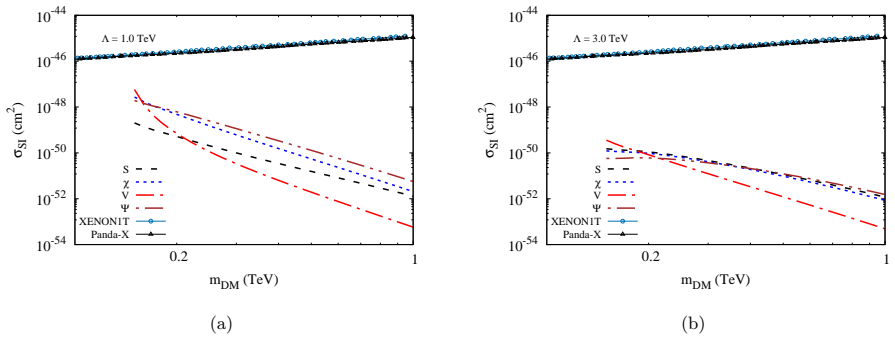
- In the top-philic benchmark, the spin-independent scattering cross sections on the relic-density contours fall below current direct-detection upper limits for both $\Lambda=1$ and $\Lambda=3$ TeV.
- In the lepto-philic benchmark, direct detection is not a meaningful constraint, because the DM-nucleon coupling enters only through a loop-suppressed graviton-photon effective coupling.
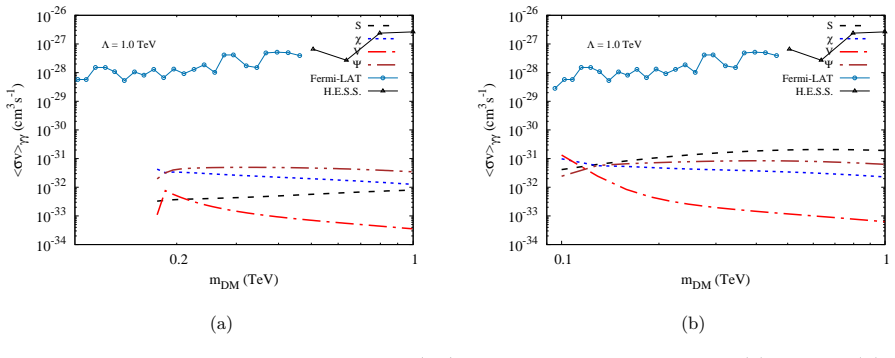
- The velocity-averaged annihilation cross sections into two photons are three to four orders of magnitude below current gamma-ray upper limits, so indirect searches do not constrain these models.
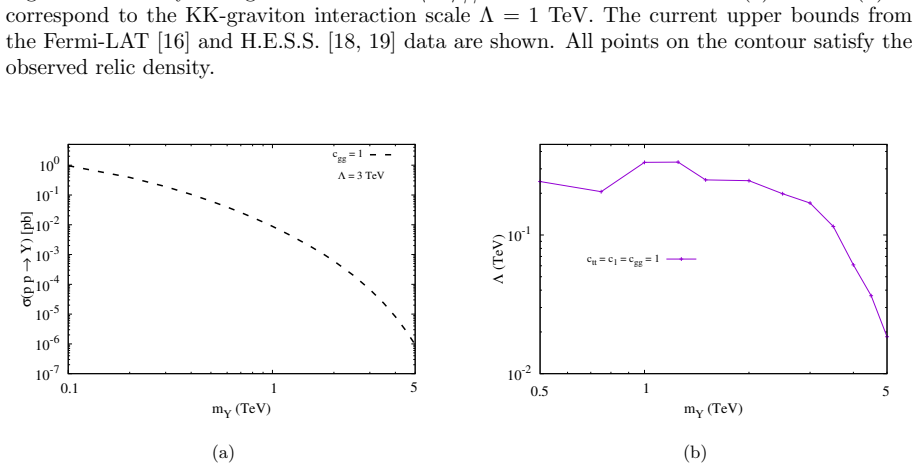
- Collider resonance searches in the top-antitop channel put lower limits on the graviton interaction scale of only a few hundred GeV for graviton masses between 500 GeV and 5 TeV, leaving the relic-density regions compatible.
Reading between the lines
- The paper does not scan over the graviton scale or the particle-specific couplings; whether the viable region is large or narrow is therefore still open, and a scan over $c_{tt}, c_{gg}, c_{\ell\ell}, c_1$ with their stated hierarchy would settle it.
- Because the lepto-philic model's direct signal is so suppressed, the most promising test of that benchmark would be a gamma-ray line search rather than another ton-scale direct-detection experiment.
- The same effective-coupling machinery could be applied to dark matter living in the bulk of the extra dimension, which would change the graviton--DM couplings and shift the relic-density contours.
Signed reviews
Editorial analysis
A structured set of objections, weighed in public.
Referee Report
Summary. This manuscript studies a simplified Randall-Sundrum (RS) KK-graviton portal for dark matter. It considers two benchmark constructions, a top-philic model and a lepto-philic model, and four dark-matter spin assignments: real scalar, real vector, Dirac fermion, and spin-3/2 fermion. For each candidate, the authors compute thermal relic-density contours in the (m_DM, m_Y) plane, the spin-independent DM-nucleon cross section, the gamma-gamma annihilation rate, and LHC KK-graviton production and constraints. The central claim is that both benchmark models have a large parameter space compatible with the observed relic density and with direct, indirect, and LHC searches.
Significance. If fully supported, the paper would be a useful survey of spin dependence in a graviton-portal dark-matter setup, and the inclusion of spin-3/2 dark matter is a genuine extension of the earlier work in Ref. [1]. The authors make appropriate use of standard public tools (LanHEP and CalcHEP) and provide scaling relations that allow some results to be rescaled to other values of the parameters. However, the quantitative support for the 'large parameter space' claim is limited by the fixed benchmark choices, and the spin-3/2 results are not independently checkable from the text. The conclusions are plausible but, as presented, are stronger than what the displayed scans demonstrate.
major comments (3)
- [Section 2, Eqs. (2)-(4), Figs. 1-4] All relic-density, direct-detection, and indirect-detection plots fix Lambda = 1 TeV (or 3 TeV in one direct-detection panel) and set ctt = cgg = cll = c1 = 1, yet the paper concludes that there is a 'large parameter space.' Because the annihilation and scattering rates scale as powers of c/Lambda, the plotted contours are one-dimensional slices of the parameter space and do not establish the size of the viable region. Moreover, this choice is not representative of Model A: Section 2 states the hierarchy ctt > cgg alpha_s/4pi ~ c1 alpha/4pi, so setting the loop-suppressed couplings equal to the tree-level coupling inverts the model's stated hierarchy. The authors should either scan over Lambda and the couplings c_i or rephrase the claim to refer to these specific benchmark slices, and they should demonstrate that the hierarchy imposed in Eqs. (2)-(3) still admits a viable region.
- [Section 2, Eq. (4) and Fig. 1] The spin-3/2 dark-matter interaction is not specified. The text says only 'For the expression of energy-momentum tensor T^{mu nu}_{DM} we refer [1].' A spin-3/2 Rarita-Schwinger field requires a definite Lagrangian, including the treatment of spurious spin-1/2 components and any associated consistency constraints; referring to a companion paper without specifying the T^{mu nu} used in the CalcHEP implementation is insufficient. The spin-3/2 contours in Fig. 1 therefore cannot be checked or reproduced. Please provide the explicit T^{mu nu}, the resulting Feynman rules, and the model-file structure, or remove the spin-3/2 claim from the conclusions.
- [Section 3.4 and Fig. 4] The statement that the models are 'consistent with the LHC data' is not directly demonstrated for the benchmark points used in Fig. 1. Fig. 4a shows the production cross section for Lambda = 3 TeV, whereas the relic-density contours use Lambda = 1 TeV, and Fig. 4b shows only the lower limit on Lambda without overlaying the (m_DM, m_Y) contours from Fig. 1. Since the central recommendation is a combined viability claim, the authors should show explicitly that the points on the relic-density contours satisfy the CMS 95% CL exclusion for the same Lambda, or state the range of Lambda for which the Fig. 1 contours and the LHC constraint overlap.
minor comments (5)
- [Fig. 1 caption] The caption describes '2 sigma contour of constant relic density 0.119,' but Eq. (8) gives a central value and no uncertainty is propagated; please clarify what '2 sigma' means here or remove it.
- [Fig. 2 caption] The experiment name is written 'PANDA 2X-II' in the caption, while Ref. [13] is PandaX-II; please correct the spelling for consistency.
- [Section 2 after Eq. (4)] The effective loop-induced couplings c^eff_gg and c^eff_gamma-gamma are said to be evaluated in Refs. [1,4,5], but their explicit definitions are not given in this paper even though they enter Eq. (10) and Fig. 4a; please state the definitions or include an appendix with the relevant expressions.
- [Conclusion] The last paragraph contains a typo, 'Randall-Sundram', which should be 'Randall-Sundrum'.
- [Section 3.1, Eqs. (8)-(9)] In the text after Eq. (9), the symbol g appearing in the freeze-out condition is not defined separately from g_*(x_F); please specify its meaning.
Circularity Check
Spin-3/2 DM predictions are imported from the authors' own prior paper; scalar/vector/fermion predictions are independently computed.
-
self citation load bearing
[Section 2, after Eq. (4); spin-3/2 contours in Figs. 1–3]
"Lint =− 1 Λ cDMYμνTμν DM. (4) For the expression of energy-momentum tensor T μν DM we refer [1]."
The spin-3/2 dark-matter phenomenology is the paper's advertised new extension, but the spin-3/2 energy-momentum tensor T^μν_DM that defines the DM-graviton interaction is not given in this paper; the reader is referred to [1], which is the same authors' arXiv:1905.10583. Every spin-3/2 relic-density contour and cross-section curve in Figs. 1–3 therefore inherits its dynamical content from that self-citation rather than from an independently shown Lagrangian, Feynman rule, or CalcHEP model file. If [1] supplied a different T^μν, the spin-3/2 plots would change. Thus the spin-3/2 part of the central claim reduces to an unverified, load-bearing self-citation, even though the scalar, vector, and Dirac-fermion results are computed from explicit Lagrangians in this paper.
full rationale
The main derivation is not circular: the relic density and direct/indirect/LHC rates are computed from explicit RS benchmark Lagrangians using the standard Boltzmann/CalcHEP pipeline, with Planck's Ωh² = 0.119 used as a target rather than fitted. The benchmark couplings are chosen, not extracted from the data, so no fitted input is renamed as a prediction. The parameter-space limitation noted in the reader's take (fixed c_tt = c_gg = c_ll = c_1 = 1) is a coverage issue, not a circularity. The one genuine circularity concern is localized: the spin-3/2 dark-matter extension relies on the same authors' prior paper for the energy-momentum tensor, with no independent derivation or model file provided here. Since that self-citation is load-bearing for the spin-3/2 curves but not for the scalar, vector, or Dirac-fermion predictions, the overall circularity score is moderate: 4 rather than 6.
Assumptions & free parameters
free parameters (6)
- ctt =
1 (benchmark)
- cgg =
1 (benchmark)
- cll =
1 (benchmark)
- c1 =
1 (benchmark)
- Lambda =
1 TeV (also 3 TeV in Fig. 2b)
- cDM =
order one (not specified)
assumptions (4)
- standard math Thermal freeze-out relic density follows the standard approximate Boltzmann solution
- domain assumption The Universe expands according to the effective 4D Friedmann equation in the Randall-Sundrum model with radius stabilization
- domain assumption Dark matter particles are SM singlets, odd under a Z2 symmetry, live on the IR brane, and have mass below the KK graviton mass
- domain assumption Dark matter interacts with the Standard Model only through the KK graviton via the energy-momentum tensor
invented entities (1)
-
Spin-3/2 fermionic dark matter (Psi)
Cite this review
Pith. "Pith review of Dark matter in the Randall-Sundrum model." pith.science (2026). https://pith.science/paper/N4ZLKHVN
@misc{pith2026190810334,
  author       = {Pith},
  title        = {Pith review of: Dark matter in the Randall-Sundrum model},
  year         = {2026},
  howpublished = {\url{https://pith.science/paper/N4ZLKHVN}},
  note         = {Machine review of arXiv:1908.10334}
}
read the original abstract
In Ref. \cite{Goyal:2019vsw}, we had considered simplified dark matter models interacting gravitationally with the Standard Model particles in a Randall-Sundrum frame work where models are considered with non-universal couplings. In the top-philic graviton model the right-handed top quarks are taken to interact strongly with the gravitons and in the lepton-philic model, we assume that only the right-handed charged leptons interact strongly with the gravitons. We extend the study to include not only the scalar, vector and spin-1/2 fermions but also spin-3/2 fermionic dark matter. We find that there is a large parameter space in these benchmark models where it is possible to achieve the observed relic density consistent with the direct and indirect searches, which are also consistent with the data from Large Hadron Collider.
Figures

Figures from the paper (1 more)
Reference graph
Works this paper leans on
-
[1]
Dark matter in the Randall-Sundrum model with non-universal coupling
A. Goyal, R. Islam and M. Kumar, arXiv:1905.10583 [hep-ph]
work page Pith review arXiv 1905
- [2]
-
[3]
H. M. Lee, M. Park and V. Sanz, JHEP 1405, 063 (2014) [arXiv:1401.5301 [hep-ph]]
arXiv 2014
-
[4]
C. Q. Geng and D. Huang, Phys. Rev. D 93, no. 11, 115032 (2016) [arXiv:1601.07385 [hep-ph]]
work page Pith review arXiv 2016
-
[5]
C. Q. Geng, D. Huang and K. Yamashita, JHEP 1810, 046 (2018) [arXiv:1807.09643 [hep-ph]]
work page Pith review arXiv 2018
-
[6]
P. Creminelli, A. Nicolis and R. Rattazzi, JHEP 0203, 051 (2002) [hep-th/0107141]
arXiv 2002
- [7]
-
[8]
A. Semenov, Comput. Phys. Commun. 201, 167 (2016) [arXiv:1412.5016 [physics.comp-ph]]
arXiv 2016
Show all 21 references
-
[9]
Belyaev, N
A. Belyaev, N. D. Christensen and A. Pukhov, Comput. Phys. Commun. 184, 1729 (2013) [arXiv:1207.6082 [hep-ph]]
2013 arXiv
-
[10]
J. Kopp, L. Michaels and J. Smirnov, JCAP 1404, 022 (2014) [arXiv:1401.6457 [hep-ph]]
2014 arXiv
-
[11]
J. Kopp, V. Niro, T. Schwetz and J. Zupan, Phys. Rev. D 80, 083502 (2009) [arXiv:0907.3159 [hep-ph]]
2009 arXiv
-
[12]
D’Eramo, B
F. D’Eramo, B. J. Kavanagh and P. Panci, Phys. Lett. B 771, 339 (2017) [arXiv:1702.00016 [hep-ph]]
2017 arXiv
-
[13]
Cui et al
X. Cui et al. [PandaX-II Collaboration], Phys. Rev. Lett. 119, no. 18, 181302 (2017) [arXiv:1708.06917 [astro-ph.CO]]
2017 arXiv
-
[14]
Aprile et al
E. Aprile et al. [XENON Collaboration], JCAP 1604, no. 04, 027 (2016) [arXiv:1512.07501 [physics.ins-det]]
2016 arXiv
-
[15]
Aprile et al
E. Aprile et al. [XENON Collaboration], Eur. Phys. J. C 77, no. 12, 881 (2017) [arXiv:1708.07051 [astro- ph.IM]]
2017 arXiv
-
[16]
Ackermann et al
M. Ackermann et al. [Fermi-LAT Collaboration], Phys. Rev. D 91, no. 12, 122002 (2015) [arXiv:1506.00013 [astro-ph.HE]]
2015 arXiv
-
[17]
Ackermann et al
M. Ackermann et al. [Fermi-LAT Collaboration], Phys. Rev. Lett. 115, no. 23, 231301 (2015) [arXiv:1503.02641 [astro-ph.HE]]
2015 arXiv
-
[18]
Abramowski et al
A. Abramowski et al. [H.E.S.S. Collaboration], Phys. Rev. Lett. 110, 041301 (2013) [arXiv:1301.1173 [astro- ph.HE]]
2013 arXiv
-
[19]
Abdalla et al
H. Abdalla et al. [H.E.S.S. Collaboration], Phys. Rev. Lett. 117, no. 15, 151302 (2016) [arXiv:1609.08091 [astro-ph.HE]]
2016 arXiv
-
[20]
Bonciani, T
R. Bonciani, T. Jezo, M. Klasen, F. Lyonnet and I. Schienbein, JHEP 1602, 141 (2016) [arXiv:1511.08185 [hep-ph]]
2016 arXiv
-
[21]
A. M. Sirunyan et al. [CMS Collaboration], JHEP 1904, 031 (2019) [arXiv:1810.05905 [hep-ex]]
2019 arXiv
Reviewed August 14, 2026 · model on record in the stance chip above.
Discussion (0). Continue with ORCID to comment.