REVIEW 5 minor 67 references
WAFT-Stereo: Warping-Alone Field Transforms for Stereo Matching
T0 review · 0 major / 5 minor · reviewed 2026-07-13 · grok-4.5
Pith's one-line read Cost volumes are unnecessary for state-of-the-art stereo matching; high-resolution warping plus one classification step and iterative regression is enough, and faster.
desk verdict Clean empirical win: pure warping plus one soft classification step beats cost-volume stereo on public boards while running faster; the stereo-specific head is the real addition over their own WAFT flow work. read the letter →
The pith
A machine-rendered reading of the paper's core claim, the machinery that carries it, and where it could break.
The reading
What carries the argument
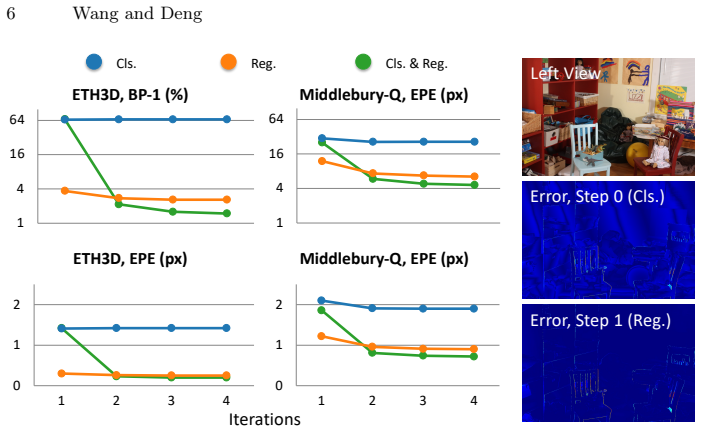
Feature-space warping: at each iteration the right-view feature map is backward-warped by the current disparity estimate and concatenated with the left-view features; a shared Vision-Transformer updater then either classifies soft bin probabilities (first step) or regresses a Mixture-of-Laplace residual (subsequent steps).
What would settle it
Replace the first classification step with an ordinary regression step (or with a cost-volume classifier) while keeping every other hyper-parameter fixed; if the hybrid model no longer converges in four iterations or loses its leaderboard rank, the claim that classification-without-cost-volumes is the key fails.
Extended reading notes
Core claim
Cost volumes are not required for strong stereo matching. A pure warping architecture that first classifies disparity into a modest number of bins and then iteratively regresses residual updates reaches first place on ETH3D (BP-0.5), Middlebury (RMSE) and all KITTI metrics, while cutting latency by 1.8–6.7 imes relative to leading cost-volume methods and reducing zero-shot error on ETH3D by up to 81 percent.
Load-bearing premise
A soft classification over only forty fixed disparity bins supplies an initial estimate accurate enough for later regression to finish the job in four or five iterations on real high-resolution pairs.
Editorial analysis
A structured set of objections, weighed in public.
Referee Report
Summary. WAFT-Stereo proposes a fully warping-based stereo matcher that dispenses with cost volumes. It extracts features with a LoRA-adapted DepthAnythingV2 backbone, obtains an initial disparity via soft classification over a fixed set of bins (soft-CE loss), then iteratively refines the field by backward-warping the right-view features and regressing residual updates with a Mixture-of-Laplace loss. The architecture is a simplified adaptation of the optical-flow method WAFT, with the classification head, LoRA fine-tuning, and high-resolution ResNet blocks as the main stereo-specific changes. On public leaderboards the method ranks first on ETH3D BP-0.5, Middlebury RMSE and all KITTI metrics, reports large zero-shot gains (especially on ETH3D), and claims 1.8–6.7 imes lower latency than competitive cost-volume systems while releasing code and weights.
Significance. If the empirical claims hold, the paper supplies a clean existence proof that cost volumes—long treated as indispensable—are not required for state-of-the-art stereo accuracy or efficiency. The design is deliberately simple (standard ViT/DPT blocks + warping), scales with backbone size, and generalizes strongly from synthetic data alone. Public leaderboard rankings, matched-data ablations (Table 4), controlled architecture ablations (Table 5), and open code make the result immediately usable and falsifiable. The work therefore has clear practical value for real-time and high-resolution stereo and conceptual value for the broader correspondence literature.
minor comments (5)
- Middlebury BP-2 is not first and is dominated by the single hard scene Classroom2E (illumination change). A short quantitative note of the gap after excluding that scene would make the Pareto claim more transparent.
- Latency and MAC numbers (Fig. 2, Table 6) are single-GPU (L40, BF16). A brief statement of measurement protocol (batch size, warm-up, whether amortized over multiple runs) would improve reproducibility.
- Table 5 shows that B=5 bins hurts while B=20/40/80 are comparable; a one-sentence discussion of how B should scale with Dmax or image resolution would help practitioners.
- The soft-target definition in §3.2 uses an absolute-distance kernel before Softmax; a short justification or reference for this particular soft labeling would be useful.
- Minor presentation: “diparity” typo in §3.1; inconsistent hyphenation of “zero-shot” / “zero shot”; Fig. 5 caption could more clearly label the three curves.
Circularity Check
No significant circularity: empirical architecture claims are validated on independent public benchmarks with standard training data.
full rationale
WAFT-Stereo is an empirical computer-vision paper whose central claims (cost volumes unnecessary; pure high-resolution warping plus one soft-classification step over fixed bins followed by MoL regression iterations yields SOTA accuracy and 1.8–6.7× speed-ups) are supported by training on public synthetic/real corpora and evaluation on external leaderboards (ETH3D, KITTI-2012/2015, Middlebury) whose ground truth is independent of the authors. The architecture is an adaptation of the authors’ prior optical-flow work WAFT, but that citation supplies only the starting design; the stereo-specific modifications (classification head, LoRA fine-tuning, ResNet high-resolution blocks) and all reported metrics are new experiments, not algebraic identities or fitted parameters re-labeled as predictions. No quantity is defined in terms of a later-reported result, no uniqueness theorem is imported to forbid alternatives, and no ansatz is smuggled that forces the leaderboard numbers by construction. The paper is therefore self-contained against external benchmarks; the ordinary self-citation of prior work does not constitute circularity under the stated criteria.
Assumptions & free parameters
free parameters (5)
- number of disparity bins B =
40
- maximum disparity Dmax =
800 (main) / 320 (ablation)
- LoRA rank =
8
- number of high-resolution ResNet blocks =
4
- iteration count T and discount γ =
T=4 or 5
assumptions (4)
- domain assumption Feature-space bilinear warping of the right-view features using the current disparity estimate is a sufficient substitute for explicit cost-volume construction.
- ad hoc to paper A soft-cross-entropy classification over a fixed set of disparity bins yields a coarse but stable initial disparity that subsequent regression can refine.
- domain assumption DepthAnythingV2 features (frozen + LoRA) already contain the geometric cues needed for accurate stereo matching.
- domain assumption Mixture-of-Laplace loss is superior to L1 for iterative disparity regression.
Cite this review
Pith. "Pith review of WAFT-Stereo: Warping-Alone Field Transforms for Stereo Matching." pith.science (2026). https://pith.science/paper/N5C4T2BK
@misc{pith2026260324836,
  author       = {Pith},
  title        = {Pith review of: WAFT-Stereo: Warping-Alone Field Transforms for Stereo Matching},
  year         = {2026},
  howpublished = {\url{https://pith.science/paper/N5C4T2BK}},
  note         = {Machine review of arXiv:2603.24836}
}
read the original abstract
We introduce WAFT-Stereo, a simple and effective warping-based method for stereo matching. WAFT-Stereo demonstrates that cost volumes, a common design used in many leading methods, are not necessary for strong performance and can be replaced by warping with improved efficiency. WAFT-Stereo ranks first on ETH3D (BP-0.5), Middlebury (RMSE), and KITTI (all metrics), reducing the zero-shot error by 81% on ETH3D, while being 1.8-6.7x faster than competitive methods. Code and model weights are available at https://github.com/princeton-vl/WAFT-Stereo.
Figures


Figures from the paper (3 more)


Reference graph
Works this paper leans on
-
[1]
Science China Information Sciences 63, 1–11 (2020) 2, 4, 9, 11, 12
Bao, W., Wang, W., Xu, Y., Guo, Y., Hong, S., Zhang, X.: InStereo2k: a large real dataset for stereo matching in indoor scenes. Science China Information Sciences 63, 1–11 (2020) 2, 4, 9, 11, 12
2020
-
[2]
Computer vision and image understanding63(1), 75–104 (1996) 4
Black, M.J., Anandan, P.: The robust estimation of multiple motions: Parametric and piecewise-smooth flow fields. Computer vision and image understanding63(1), 75–104 (1996) 4
1996
-
[3]
In: European conference on computer vision
Brox, T., Bruhn, A., Papenberg, N., Weickert, J.: High accuracy optical flow esti- mation based on a theory for warping. In: European conference on computer vision. pp. 25–36. Springer (2004) 4
2004
-
[4]
Butler, D.J., Wulff, J., Stanley, G.B., Black, M.J.: A naturalistic open source movie for optical flow evaluation. pp. 611–625 (2012) 4, 9, 12
2012
-
[5]
arXiv preprint arXiv:2001.10773 (2020) 4, 9, 12
Cabon, Y., Murray, N., Humenberger, M.: Virtual KITTI 2. arXiv preprint arXiv:2001.10773 (2020) 4, 9, 12
arXiv 2001
-
[6]
Chen, Z., Long, W., Yao, H., Zhang, Y., Wang, B., Qin, Y., Wu, J.: Mocha-stereo: Motif channel attention network for stereo matching. pp. 27768–27777 (2024) 3, 11, 12
2024
-
[7]
arXiv preprint arXiv:2501.08643 (2025) 1, 2, 3, 4, 5, 6, 7, 9, 10, 11, 12, 13, 14
Cheng, J., Liao, W., Cai, Z., Liu, L., Xu, G., Wang, X., Wang, Y., Yuan, Z., Deng, Y., Zang, J., et al.: Monster++: Unified stereo matching, multi-view stereo, and real-time stereo with monodepth priors. arXiv preprint arXiv:2501.08643 (2025) 1, 2, 3, 4, 5, 6, 7, 9, 10, 11, 12, 13, 14
arXiv 2025
-
[8]
In: International Con- ference on Learning Representations (ICLR) (2021) 7, 8
Dosovitskiy, A., Beyer, L., Kolesnikov, A., Weissenborn, D., Zhai, X., Unterthiner, T., Dehghani, M., Minderer, M., Heigold, G., Gelly, S., et al.: An image is worth 16x16 words: Transformers for image recognition at scale. In: International Con- ference on Learning Representations (ICLR) (2021) 7, 8
2021
Show all 67 references
-
[9]
arXiv preprint arXiv:2308.13561 (2023) 1
Engel, J., Somasundaram, K., Goesele, M., Sun, A., Gamino, A., Turner, A., Ta- lattof, A., Yuan, A., Souti, B., Meredith, B., et al.: Project aria: A new tool for egocentric multi-modal ai research. arXiv preprint arXiv:2308.13561 (2023) 1
2023 arXiv
-
[10]
Geiger, A., Lenz, P., Urtasun, R.: Are we ready for autonomous driving? the KITTI vision benchmark suite. pp. 3354–3361 (2012) 1, 3, 4, 9, 12
2012
-
[11]
In: Proceedings of the IEEE/CVF Inter- national Conference on Computer Vision
Guan, T., Guo, J., Wang, C., Liu, Y.H.: Bridgedepth: Bridging monocular and stereo reasoning with latent alignment. In: Proceedings of the IEEE/CVF Inter- national Conference on Computer Vision. pp. 27681–27691 (2025) 1, 3, 4, 7, 9, 11, 12, 13, 14, 15 16 Wang and Deng
2025
-
[12]
In: Proceedings of the IEEE/CVF Conference on Computer Vision and Pattern Recognition
Guan, T., Wang, C., Liu, Y.H.: Neural markov random field for stereo matching. In: Proceedings of the IEEE/CVF Conference on Computer Vision and Pattern Recognition. pp. 5459–5469 (2024) 3
2024
-
[13]
arXiv preprint arXiv:2411.14053 (2024) 3
Guo, X., Zhang, C., Zhang, Y., Wang, R., Nie, D., Zheng, W., Poggi, M., Zhao, H., Ye, M., Zou, Q., et al.: Stereo anything: Unifying zero-shot stereo matching with large-scale mixed data. arXiv preprint arXiv:2411.14053 (2024) 3
2024
-
[14]
Guo, X., Yang, K., Yang, W., Wang, X., Li, H.: Group-wise correlation stereo network. pp. 3273–3282 (2019) 11
2019
-
[15]
In: Proceedings of the IEEE/CVF Conference on Computer Vision and Pattern Recognition (CVPR)
He, K., Zhang, X., Ren, S., Sun, J.: Deep residual learning for image recognition. In: Proceedings of the IEEE/CVF Conference on Computer Vision and Pattern Recognition (CVPR). pp. 770–778 (2016) 14
2016
-
[16]
IEEE transactions on pattern anal- ysis and machine intelligence35(2), 504–511 (2012) 4
Hosni, A., Rhemann, C., Bleyer, M., Rother, C., Gelautz, M.: Fast cost-volume filtering for visual correspondence and beyond. IEEE transactions on pattern anal- ysis and machine intelligence35(2), 504–511 (2012) 4
2012
-
[17]
Iclr1(2), 3 (2022) 2, 7, 9
Hu, E.J., Shen, Y., Wallis, P., Allen-Zhu, Z., Li, Y., Wang, S., Wang, L., Chen, W., et al.: Lora: Low-rank adaptation of large language models. Iclr1(2), 3 (2022) 2, 7, 9
2022
-
[18]
In: European conference on computer vision
Huang, Z., Shi, X., Zhang, C., Wang, Q., Cheung, K.C., Qin, H., Dai, J., Li, H.: Flowformer: A transformer architecture for optical flow. In: European conference on computer vision. pp. 668–685. Springer (2022) 6
2022
-
[19]
In: Proceedings of the IEEE/CVF Winter Conference on Applications of Computer Vision
Jahedi, A., Luz, M., Rivinius, M., Bruhn, A.: Ccmr: High resolution optical flow estimation via coarse-to-fine context-guided motion reasoning. In: Proceedings of the IEEE/CVF Winter Conference on Applications of Computer Vision. pp. 6899– 6908 (2024) 6
2024
-
[20]
In: Proceedings of the Computer Vision and Pattern Recognition Conference
Jiang, H., Lou, Z., Ding, L., Xu, R., Tan, M., Jiang, W., Huang, R.: Defom-stereo: Depth foundation model based stereo matching. In: Proceedings of the Computer Vision and Pattern Recognition Conference. pp. 21857–21867 (2025) 1, 2, 3, 4, 7, 9, 11, 12, 14
2025
-
[21]
Karaev, N., Rocco, I., Graham, B., Neverova, N., Vedaldi, A., Rupprecht, C.: DynamicStereo: Consistent dynamic depth from stereo videos. pp. 13229–13239 (2023) 3, 12
2023
-
[22]
Li, J., Wang, P., Xiong, P., Cai, T., Yan, Z., Yang, L., Liu, J., Fan, H., Liu, S.: Practicalstereomatchingviacascadedrecurrentnetworkwithadaptivecorrelation. pp. 16263–16272 (2022) 4, 9, 11, 12, 13
2022
-
[23]
In: International Conference on 3D Vision (3DV)
Lipson, L., Teed, Z., Deng, J.: RAFT-Stereo: Multilevel recurrent field transforms for stereo matching. In: International Conference on 3D Vision (3DV). pp. 218–227 (2021) 1, 2, 3, 4, 11, 12, 14, 15
2021
-
[24]
ICLR (2019) 10
Loshchilov, I.: Decoupled weight decay regularization. ICLR (2019) 10
2019
-
[25]
In: Proceedings of the IEEE conference on computer vision and pattern recognition
Mayer, N., Ilg, E., Hausser, P., Fischer, P., Cremers, D., Dosovitskiy, A., Brox, T.: A large dataset to train convolutional networks for disparity, optical flow, and scene flow estimation. In: Proceedings of the IEEE conference on computer vision and pattern recognition. pp. ...
2016
-
[26]
Mayer, N., Ilg, E., Hausser, P., Fischer, P., Cremers, D., Dosovitskiy, A., Brox, T.: A large dataset to train convolutional networks for disparity, optical flow, and scene flow estimation. pp. 4040–4048 (2016) 4, 9, 12, 13
2016
-
[27]
In: Proc
Mehl, L., Schmalfuss, J., Jahedi, A., Nalivayko, Y., Bruhn, A.: Spring: A high- resolutionhigh-detaildatasetandbenchmarkforsceneflow,opticalflowandstereo. In: Proc. IEEE/CVF Conference on Computer Vision and Pattern Recognition (CVPR) (2023) 4, 9, 11, 12
2023
-
[28]
In: ICCV
Memin, E., Perez, P.: A multigrid approach for hierarchical motion estimation. In: ICCV. vol. 98, pp. 933–938 (1998) 4 WAFT-Stereo: Warping-Alone Field Transforms for Stereo Matching 17
1998
-
[29]
Menze, M., Geiger, A.: Object scene flow for autonomous vehicles. pp. 3061–3070 (2015) 1, 2, 3, 4, 9, 12, 13
2015
-
[30]
In: Proceedings of the IEEE/CVF International Confer- ence on Computer Vision
Min, J., Jeon, Y., Kim, J., Choi, M.: S2m2: Scalable stereo matching model for reliable depth estimation. In: Proceedings of the IEEE/CVF International Confer- ence on Computer Vision. pp. 26729–26739 (2025) 1, 3, 4, 5, 6, 7, 9, 10, 11, 12, 14
2025
-
[31]
arXiv preprint arXiv:2511.16993 (2025) 3
Min, J., Kim, J., Min, C.H., Kim, M., Jeon, Y., Choi, M.: Depthfocus: Controllable depth estimation for see-through scenes. arXiv preprint arXiv:2511.16993 (2025) 3
2025
-
[32]
In: Proceedings of the Computer Vision and Pattern Recognition Conference
Morimitsu, H., Zhu, X., Cesar, R.M., Ji, X., Yin, X.C.: Dpflow: Adaptive optical flow estimation with a dual-pyramid framework. In: Proceedings of the Computer Vision and Pattern Recognition Conference. pp. 17810–17820 (2025) 6
2025
-
[33]
ACM Transactions on Graphics (ToG)38(6), 1–15 (2019) 12
Niklaus, S., Mai, L., Yang, J., Liu, F.: 3d ken burns effect from a single image. ACM Transactions on Graphics (ToG)38(6), 1–15 (2019) 12
2019
-
[34]
In: 2025 IEEE/RSJ International Conference on Intelligent Robots and Systems (IROS)
Patel, M., Yang, F., Qiu, Y., Cadena, C., Scherer, S., Hutter, M., Wang, W.: Tartanground: A large-scale dataset for ground robot perception and navigation. In: 2025 IEEE/RSJ International Conference on Intelligent Robots and Systems (IROS). pp. 20524–20531. IEEE (2025) 4, 9
2025
-
[35]
In: Proceedings of the IEEE/CVF conference on computer vision and pattern recognition
Raistrick, A., Lipson, L., Ma, Z., Mei, L., Wang, M., Zuo, Y., Kayan, K., Wen, H., Han, B., Wang, Y., et al.: Infinite photorealistic worlds using procedural genera- tion. In: Proceedings of the IEEE/CVF conference on computer vision and pattern recognition. pp. 12630–12641 (2023) 4
2023
-
[36]
In: Proceedings of the IEEE/CVF Conference on Computer Vision and Pattern Recognition
Raistrick, A., Mei, L., Kayan, K., Yan, D., Zuo, Y., Han, B., Wen, H., Parakh, M., Alexandropoulos, S., Lipson, L., et al.: Infinigen indoors: Photorealistic indoor scenes using procedural generation. In: Proceedings of the IEEE/CVF Conference on Computer Vision and Pattern Re...
2024
-
[37]
IEEE Transactions on Pattern Analysis and Machine Intelligence (PAMI) (2023) 4, 9, 11, 12
Ramirez, P.Z., Costanzino, A., Tosi, F., Poggi, M., Salti, S., Mattoccia, S., Di Ste- fano, L.: Booster: A benchmark for depth from images of specular and transparent surfaces. IEEE Transactions on Pattern Analysis and Machine Intelligence (PAMI) (2023) 4, 9, 11, 12
2023
-
[38]
In: Proceedings of the IEEE/CVF international conference on computer vision
Ranftl, R., Bochkovskiy, A., Koltun, V.: Vision transformers for dense prediction. In: Proceedings of the IEEE/CVF international conference on computer vision. pp. 12179–12188 (2021) 7, 8
2021
-
[39]
In: Pattern Recognition: 36th German Conference, GCPR 2014, Münster, Germany, September 2-5, 2014, Proceedings 36
Scharstein, D., Hirschmüller, H., Kitajima, Y., Krathwohl, G., Nešić, N., Wang, X., Westling, P.: High-resolution stereo datasets with subpixel-accurate ground truth. In: Pattern Recognition: 36th German Conference, GCPR 2014, Münster, Germany, September 2-5, 2014, Proceedings...
2014
-
[40]
International journal of computer vision47(1), 7–42 (2002) 4
Scharstein, D., Szeliski, R.: A taxonomy and evaluation of dense two-frame stereo correspondence algorithms. International journal of computer vision47(1), 7–42 (2002) 4
2002
-
[41]
Schops, T., Schonberger, J.L., Galliani, S., Sattler, T., Schindler, K., Pollefeys, M., Geiger, A.: A multi-view stereo benchmark with high-resolution images and multi-camera videos. pp. 3260–3269 (2017) 2, 3, 9, 12, 13
2017
-
[42]
arXiv preprint arXiv:2508.10104 (2025) 7, 14
Siméoni, O., Vo, H.V., Seitzer, M., Baldassarre, F., Oquab, M., Jose, C., Khali- dov, V., Szafraniec, M., Yi, S., Ramamonjisoa, M., et al.: Dinov3. arXiv preprint arXiv:2508.10104 (2025) 7, 14
2025 arXiv
-
[43]
In: Artificial intelligence and machine learning for multi- domain operations applications
Smith, L.N., Topin, N.: Super-convergence: Very fast training of neural networks using large learning rates. In: Artificial intelligence and machine learning for multi- domain operations applications. vol. 11006, pp. 369–386. SPIE (2019) 10 18 Wang and Deng
2019
-
[44]
In: Proceedings of the IEEE conference on computer vision and pattern recognition
Sun, D., Yang, X., Liu, M.Y., Kautz, J.: Pwc-net: Cnns for optical flow using pyramid, warping, and cost volume. In: Proceedings of the IEEE conference on computer vision and pattern recognition. pp. 8934–8943 (2018) 1, 4
2018
-
[45]
Teed, Z., Deng, J.: RAFT: Recurrent all-pairs field transforms for optical flow. pp. 402–419 (2020) 2, 3, 4, 8, 9
2020
-
[46]
In: Proceedings of the IEEE/CVF conference on computer vision and pat- tern recognition
Tosi, F., Liao, Y., Schmitt, C., Geiger, A.: Smd-nets: Stereo mixture density net- works. In: Proceedings of the IEEE/CVF conference on computer vision and pat- tern recognition. pp. 8942–8952 (2021) 4, 9, 11, 12
2021
-
[47]
In: Proceedings of the IEEE Conference on Computer Vision and Pattern Recognition Workshops
Tremblay, J., To, T., Birchfield, S.: Falling things: A synthetic dataset for 3d ob- ject detection and pose estimation. In: Proceedings of the IEEE Conference on Computer Vision and Pattern Recognition Workshops. pp. 2038–2041 (2018) 4, 9, 11, 12
-
[48]
In: IEEE International Conference on Multimedia and Expo (ICME) (2021) 12
Wang,Q.,Zheng,S.,Yan,Q.,Deng,F.,Zhao,K.,Chu,X.:IRS:Alargenaturalistic indoor robotics stereo dataset to train deep models for disparity and surface normal estimation. In: IEEE International Conference on Multimedia and Expo (ICME) (2021) 12
2021
-
[49]
In: IEEE/RSJ International Conference on Intelligent Robots and Systems (IROS)
Wang, W., Zhu, D., Wang, X., Hu, Y., Qiu, Y., Wang, C., Hu, Y., Kapoor, A., Scherer, S.: TartanAir: A dataset to push the limits of visual slam. In: IEEE/RSJ International Conference on Intelligent Robots and Systems (IROS). pp. 4909–4916 (2020) 4, 9, 12, 13
2020
-
[50]
Wang, X., Xu, G., Jia, H., Yang, X.: Selective-Stereo: Adaptive frequency infor- mation selection for stereo matching. pp. 19701–19710 (2024) 3, 9, 10, 11, 12
2024
-
[51]
arXiv preprint arXiv:2507.13347 (2025) 7
Wang, Y., Zhou, J., Zhu, H., Chang, W., Zhou, Y., Li, Z., Chen, J., Pang, J., Shen, C., He, T.: Pi3: Permutation-equivariant visual geometry learning. arXiv preprint arXiv:2507.13347 (2025) 7
2025 arXiv
-
[52]
arXiv preprint arXiv:2506.21526 (2025) 1, 2, 4, 5, 6, 7, 9
Wang, Y., Deng, J.: Waft: Warping-alone field transforms for optical flow. arXiv preprint arXiv:2506.21526 (2025) 1, 2, 4, 5, 6, 7, 9
2025
-
[53]
In: European Conference on Computer Vision
Wang, Y., Lipson, L., Deng, J.: Sea-raft: Simple, efficient, accurate raft for optical flow. In: European Conference on Computer Vision. pp. 36–54. Springer (2024) 4, 6, 8, 14
2024
-
[54]
Weinzaepfel, P., Lucas, T., Leroy, V., Cabon, Y., Arora, V., Brégier, R., Csurka, G., Antsfeld, L., Chidlovskii, B., Revaud, J.: CroCo v2: Improved cross-view com- pletion pre-training for stereo matching and optical flow. pp. 17969–17980 (2023) 3, 9, 11, 12
2023
-
[55]
In: Proceedings of the IEEE/CVF conference on computer vision and pattern recognition
Wen, B., Trepte, M., Aribido, J., Kautz, J., Gallo, O., Birchfield, S.: Foundation- stereo: Zero-shot stereo matching. In: Proceedings of the IEEE/CVF conference on computer vision and pattern recognition. pp. 5249–5260 (2025) 1, 2, 3, 4, 5, 6, 7, 8, 9, 10, 11, 12, 13, 14, 15
2025
-
[56]
Wu, C.Y., Wang, J., Hall, M., Neumann, U., Su, S.: Toward practical monocular indoordepthestimation.In:ProceedingsoftheIEEE/CVFconferenceoncomputer vision and pattern recognition. pp. 3814–3824 (2022) 12
2022
-
[57]
In: Proceedings of the IEEE/CVF Conference on Computer Vi- sion and Pattern Recognition
Xu, G., Wang, X., Ding, X., Yang, X.: Iterative geometry encoding volume for stereo matching. In: Proceedings of the IEEE/CVF Conference on Computer Vi- sion and Pattern Recognition. pp. 21919–21928 (2023) 1, 3, 6, 8, 12, 15
2023
-
[58]
arXiv preprint arXiv:2409.00638 (2024) 3, 6
Xu, G., Wang, X., Zhang, Z., Cheng, J., Liao, C., Yang, X.: IGEV++: Itera- tive multi-range geometry encoding volumes for stereo matching. arXiv preprint arXiv:2409.00638 (2024) 3, 6
2024 arXiv
-
[59]
IEEE Transactions on Pattern Analysis and Machine Intelligence (PAMI) (2023) 3, 12 WAFT-Stereo: Warping-Alone Field Transforms for Stereo Matching 19
Xu, H., Zhang, J., Cai, J., Rezatofighi, H., Yu, F., Tao, D., Geiger, A.: Unifying flow, stereo and depth estimation. IEEE Transactions on Pattern Analysis and Machine Intelligence (PAMI) (2023) 3, 12 WAFT-Stereo: Warping-Alone Field Transforms for Stereo Matching 19
2023
-
[60]
Yan, D., Raistrick, A., Deng, J.: What makes good synthetic training data for zero-shot stereo matching? arXiv preprint arXiv:2504.16930 (2025) 4, 9
2025
-
[61]
arXiv preprint arXiv:2510.14260 (2025) 9, 11, 12, 14
Yan, T., Liu, T., Yang, X., Zhao, Q., Xia, Z.: Matchattention: Matching the relative positions for high-resolution cross-view matching. arXiv preprint arXiv:2510.14260 (2025) 9, 11, 12, 14
2025 arXiv
-
[62]
Yang, G., Manela, J., Happold, M., Ramanan, D.: Hierarchical deep stereo match- ing on high-resolution images. pp. 5515–5524 (2019) 9, 11, 12
2019
-
[63]
Yang, G., Song, X., Huang, C., Deng, Z., Shi, J., Zhou, B.: DrivingStereo: A large- scale dataset for stereo matching in autonomous driving scenarios. pp. 899–908 (2019) 4
2019
-
[64]
Yang, L., Kang, B., Huang, Z., Xu, X., Feng, J., Zhao, H.: Depth anything: Un- leashing the power of large-scale unlabeled data. pp. 10371–10381 (2024) 2, 3, 7, 10, 11, 12, 14
2024
-
[65]
In: Proceedings of the IEEE conference on computer vision and pattern recognition
Zbontar, J., LeCun, Y.: Computing the stereo matching cost with a convolutional neural network. In: Proceedings of the IEEE conference on computer vision and pattern recognition. pp. 1592–1599 (2015) 1, 3, 4
2015
-
[66]
Zhao, H., Zhou, H., Zhang, Y., Chen, J., Yang, Y., Zhao, Y.: High-frequency stereo matching network. pp. 1327–1336 (2023) 4, 7, 11, 13
2023
-
[67]
In: Proceedings of the IEEE/CVF Conference on Computer Vision and Pattern Recognition
Zhou, S., Zhang, J., Zuo, W., Xie, H., Pan, J., Ren, J.S.: Davanet: Stereo deblurring with view aggregation. In: Proceedings of the IEEE/CVF Conference on Computer Vision and Pattern Recognition. pp. 10996–11005 (2019) 12
2019
Reviewed July 13, 2026 · model on record in the stance chip above.
Discussion (0). Sign in to comment.