REVIEW 3 major objections 6 minor 23 references
On Accurate and Reliable Anomaly Detection for Gas Turbine Combustors: A Deep Learning Approach
T0 review · 3 major / 6 minor · reviewed 2026-08-14 · deepseek-v4-flash
Pith's one-line read Deep-learned features from exhaust-gas temperature profiles detect combustor anomalies more accurately and more consistently than handcrafted features.
desk verdict A plausible but under-validated industrial case study: SDAE features beat handcrafted features for combustor anomaly detection on one GE turbine, but the reported 0.99 vs 0.96 TPR gap rests on a random 5-fold CV protocol that leaks event windows into training folds. read the letter →
The pith
A machine-rendered reading of the paper's core claim, the machinery that carries it, and where it could break.
The reading
What carries the argument
The load-bearing mechanism is the stacked denoising autoencoder (SDAE), an unsupervised deep network that corrupts each input thermocouple profile with noise and is trained to reconstruct the clean profile. To reconstruct, the network must capture dependencies among all 27 temperature channels, so the resulting hidden-layer activations act as learned features that summarize the full profile. The paper stacks two denoising autoencoders (30 then 12 hidden neurons), uses the 12-unit hidden layer as the feature vector, and feeds it into an extreme learning machine (ELM) classifier, a feedforward neural network with random fixed input weights and fast least-squares output training. The 12 learned features are patterns rather than scalar statistics, and this representational difference is what the paper argues drives the accuracy and robustness gain.
What would settle it
Re-run the comparison with a temporal validation scheme in which the classifier is trained only on samples before each event window and tested on samples inside it, or group all samples from each event into a single fold; if the true-positive-rate gap between learned and handcrafted features shrinks to within one standard deviation at the 1% false-positive point, the paper's central claim of a decisive accuracy-and-robustness gain would be undermined.
Extended reading notes
Core claim
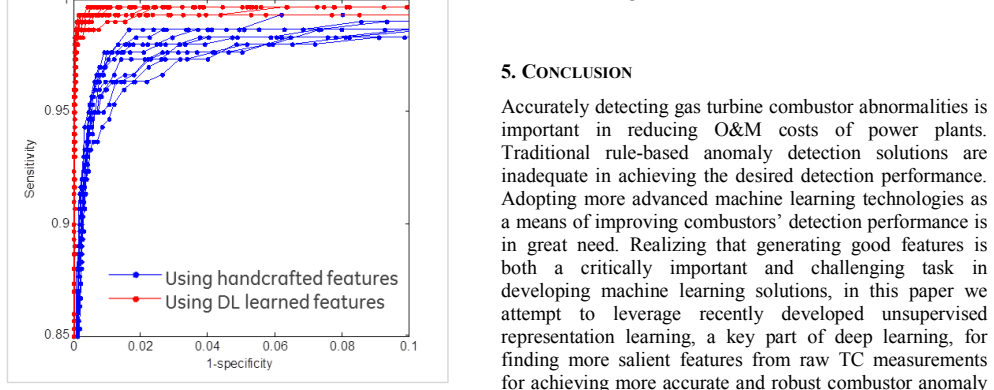
The paper's central claim is that replacing handcrafted features with features learned by a two-layer stacked denoising autoencoder (SDAE) improves both the accuracy and the reliability of combustor anomaly detection. Using 27 thermocouple readings sampled once per minute, with 13,791 normal samples for unsupervised pretraining and a separate set containing 300 samples from 10 labeled combustor events, the authors train an extreme learning machine (ELM) classifier on both feature sets under identical settings. The learned features, twelve patterns distilled by the SDAE, give a mean true-positive rate of about 0.99 with standard deviation 0.01 at a 1% false-positive rate, while the twelve handcrafted features give 0.96±0.02 across ten runs of 5-fold cross-validation. The smaller run-to-run variation is presented as evidence that deep-learned features are not only more accurate but also more robust.
Load-bearing premise
The load-bearing assumption is that a random five-fold split of minute-by-minute time-series samples treats each sample as independent, whereas samples drawn from the same continuous combustor event can straddle the training and validation folds and make the reported accuracy gap look larger than it would be under a temporal split.
Editorial extensions
If this is right
- Combustor monitoring systems could replace manual feature-design workflows with unsupervised pretraining on the large volumes of event-free data already being collected.
- The smaller standard deviation across cross-validation runs implies that fielded models would behave more predictably from one deployment to the next, not just on average.
- Because feature learning needs no labels, the approach extends to other industrial assets where labeled fault data are scarce.
- The comparison isolates the feature representation as the source of the performance gain, since the classifier setting is identical across both feature sets.
Reading between the lines
- A natural next check, not reported in the paper, is whether the deep-learned features remain superior under a temporal train/test split, in which no two samples from the same event window are separated across folds.
- If the learned features capture cross-thermocouple dependencies, they may transfer to other turbine frames or sensor layouts after re-training, but the paper does not test transferability.
- The same SDAE-plus-classifier pipeline could be compared against classical unsupervised features such as PCA components to see how much of the gain is due to depth rather than learned reconstruction.
Signed reviews
Editorial analysis
A structured set of objections, weighed in public.
Referee Report
Summary. The paper proposes a deep-learning-based anomaly detection approach for gas turbine combustors. The authors use stacked denoising autoencoders (SDAE) to learn features from exhaust gas temperature (TC) profiles in an unsupervised manner, then feed these learned features into an extreme learning machine (ELM) classifier to detect combustor abnormalities. They compare this approach against a baseline using 12 handcrafted features under identical ELM settings, using 10 runs of 5-fold cross-validation on real industrial data. The paper reports that at a 1% false positive rate the learned features achieve a true positive rate of approximately 0.99±0.01 versus 0.96±0.02 for handcrafted features, and concludes that deep learned features provide more accurate and robust combustor anomaly detection. The manuscript includes a description of the SDAE and ELM methodology, a case study with data from one turbine, and a discussion of related work on anomaly detection and feature learning.
Significance. If the reported result holds, the paper would provide a useful demonstration that unsupervised deep representation learning can replace manual feature engineering in a prognostics and health management (PHM) application, specifically for gas turbine combustor monitoring based on exhaust temperature profiles. The strength of the paper is its use of real-world industrial data and a controlled comparison where the only difference between the two designs is the feature set. The authors also provide a clear statement of the problem and the practical motivation. However, the main empirical claim is not fully supported by the current evaluation protocol. The random cross-validation scheme is inappropriate for this time-series event data, the labeling of post-event samples is ambiguous, and no statistical significance test is provided. These gaps mean that the claimed advantage of the learned features—both in level and in stability—should be treated as provisional until a proper event-stratified or temporal evaluation is performed. The paper is a reasonable initial application study, but it does not yet meet the standard of evidence needed for the strong conclusions it draws.
major comments (3)
- [Section 4.4 and Section 4.2] The evaluation uses random 5-fold cross-validation on minute-level samples, but the 300 abnormal samples belong to only 10 distinct POD events. Random splitting therefore almost guarantees that samples from the same event appear in both the training and validation folds. This allows the ELM to memorize event-specific temporal patterns rather than learning to detect unseen combustor events, which can inflate the reported ROC gap between learned and handcrafted features (0.99±0.01 versus 0.96±0.02 at 1% FPR) and also explains the smaller apparent variation of the learned-feature ROCs. Because the operational goal is detection of events not seen during training, a temporal split (training only on samples before the events) or a leave-one-event-out cross-validation is required to support the central claim. Please re-run the comparison under such a protocol and report both the ROC curves and the operating-point statistics.
- [Section 4.2 and Section 4.4] The composition of the classifier training and test sets is not clearly defined. The paper states that 13,791 samples before the POD events are event-free normal data used for unsupervised feature learning, and that 'we use the rest of data (both POD events and event-free data) for training and testing the classifier.' However, the data breakdown also lists 47,575 samples after the POD events. It is unclear whether these post-event samples are labeled as normal, excluded from the classifier data, or partially included. If they are labeled normal, they may contain post-event recovery transients or continuing fault signatures, contaminating the normal class. If they are excluded, the reported performance is evaluated on a different data distribution than the one described operationally. Please specify exactly how each of the three data segments was labeled and used, and report the class composition of the training and validation folds.
- [Section 4.4] The paper claims that the deep learned features give 'significant' better classification performance and smaller variation, but no statistical significance test is reported. The only quantitative evidence is the mean and standard deviation of the true positive rate at a fixed false positive rate over 10 runs of 5-fold cross-validation. Because those runs share overlapping training and test samples and the underlying samples are not independent (they are grouped into events), a paired statistical test across runs or a proper confidence interval is needed to support the claim of significance. Additionally, the full ROC curves in Figure 3 are presented only visually; please report the mean and standard deviation of the area under the ROC curve (AUC), or a table of sensitivity at several specific false positive rates, so that readers can quantitatively assess the comparison.
minor comments (6)
- [Section 1] The statement that deep learning 'has not been used for any PHM applications' is too strong and is contradicted by earlier published work in prognostics and health management. Please soften the claim and cite relevant prior applications of deep learning to PHM and industrial fault detection.
- [Table 1] The description of feature 7 (DIF) as '# diff b/w positive & negative TCs' is ambiguous. Please define precisely how the number of positive and negative thermocouple deviations is computed and what threshold, if any, is used.
- [Section 4.3] The sentence about handling imbalanced data mentions 'ELM’s capability of weighting samples during learning,' but the weighting scheme is not specified. Please state how the sample weights were set (e.g., inverse class frequency) and how the minority class was weighted.
- [Section 3.1] Several equations contain typesetting artifacts that obscure the mathematical definitions, for example the input space notation 'x∈ℜ$%' and the cost function 'J:;MN$'. Please correct the mathematical notation so that the reconstruction error and the regularized objective are readable and unambiguous.
- [References] There are several typographical errors in the reference list, including 'learnibg' in the Arel et al. entry, 'Kamowski' presumably for 'Karnouskos', and 'Ruiz' for 'Ruiz' in the Arranz et al. entry. Please proofread the references.
- [General] The manuscript does not mention whether the data or code are available for reproducibility. A brief statement on data availability, even if the data are proprietary, would be useful for the reader.
Circularity Check
No significant circularity: the core result is an empirical SDAE-vs-handcrafted feature comparison with external baselines; self-citations are background only.
full rationale
The paper's central claim is an empirical comparison: SDAE-learned features versus handcrafted features as input to the identical ELM classifier, with ROC performance measured by 5-fold cross-validation (Section 4.4). No derived quantity is defined in terms of the claimed result, and no parameter fitted to the evaluation criterion is renamed as a prediction. The SDAE method is adopted from external work (Vincent et al. 2010) and the ELM from Huang et al. (2006); the only self-citations (Xue & Yan 2007; Yan et al. 2008) appear as background references in the related-work section and do not carry the argument. The comparison is self-contained against an external baseline (the handcrafted features), not a self-referential construction. The possible temporal leakage from random 5-fold CV over minute-level samples that share 10 POD event windows is a real validity concern, but it is a statistical evaluation issue, not circularity: it does not make the reported ROC values equal to the model's inputs by construction. Therefore no circular step can be identified from the paper's own equations or citations.
Assumptions & free parameters
free parameters (8)
- DAE1 hidden units =
30
- DAE2 hidden units =
12
- Denoising noise rate =
0.2
- Learning rate and momentum =
0.02 and 0.5
- Training epochs =
200
- ELM hidden neurons =
1000
- Part-load filtering threshold =
TNH < 95%
- ELM training sample weights for imbalanced classes
assumptions (4)
- standard math SDAE and ELM algorithms behave as described by Vincent et al. (2010) and Huang et al. (2006)
- domain assumption Exhaust gas temperature profile is a valid indicator of combustor health
- domain assumption Samples labeled after POD events are truly abnormal
- domain assumption Time-series samples are independent for cross-validation
Cite this review
Pith. "Pith review of On Accurate and Reliable Anomaly Detection for Gas Turbine Combustors: A Deep Learning Approach." pith.science (2026). https://pith.science/paper/N5HFK2VY
@misc{pith2026190809238,
  author       = {Pith},
  title        = {Pith review of: On Accurate and Reliable Anomaly Detection for Gas Turbine Combustors: A Deep Learning Approach},
  year         = {2026},
  howpublished = {\url{https://pith.science/paper/N5HFK2VY}},
  note         = {Machine review of arXiv:1908.09238}
}
read the original abstract
Monitoring gas turbine combustors health, in particular, early detecting abnormal behaviors and incipient faults, is critical in ensuring gas turbines operating efficiently and in preventing costly unplanned maintenance. One popular means of detecting combustor abnormalities is through continuously monitoring exhaust gas temperature profiles. Over the years many anomaly detection technologies have been explored for detecting combustor faults, however, the performance (detection rate) of anomaly detection solutions fielded is still inadequate. Advanced technologies that can improve detection performance are in great need. Aiming for improving anomaly detection performance, in this paper we introduce recently-developed deep learning (DL) in machine learning into the combustors anomaly detection application. Specifically, we use deep learning to hierarchically learn features from the sensor measurements of exhaust gas temperatures. And we then use the learned features as the input to a neural network classifier for performing combustor anomaly detection. Since such deep learned features potentially better capture complex relations among all sensor measurements and the underlying combustor behavior than handcrafted features do, we expect the learned features can lead to a more accurate and robust anomaly detection. Using the data collected from a real-world gas turbine combustion system, we demonstrated that the proposed deep learning based anomaly detection significantly indeed improved combustor anomaly detection performance.
Figures


Figures from the paper (1 more)
Reference graph
Works this paper leans on
-
[1]
INTRODUCTION A combustion system is a critical component of gas turbines that burns fuel air mixture to create thrust or power. A heavy-duty industrial combustor typically operates under high temperature and high flow rate conditions that introduce significant thermodynamic stress to combustor components. Imbalanced fuel distribution and combustion instab...
work page 2014
-
[2]
RELATED WORK 2.1. Anomaly detection Anomaly detection, a technique for finding patterns in data that do not conform to expected behavior, has been extensively used in a wide range of applications, such as fraud detection in credit card and insurance industries, intrusion detection in cyber-security industry, fault detection in industrial analytics, to nam...
work page 2009
-
[3]
METHODOLOGY For combustor anomaly detection concerned in this paper, we adopt unsupervised representation learning scheme. Under this scheme, features are explicitly learned un-supervisingly (without class labels) and the explicitly learned features are then used as input for a separate 4 supervised model (classifier). There are different shallow learning...
work page 2010
-
[4]
according to a fair coin flip. While the additive Gaussian noise is a natural choice for real valued inputs, the salt-and-pepper noise is a natural choice for input domains which are interpretable as binary or near binary such as black and white images or the representations produced at the hidden layer after a sigmoid squashing function. The masking nois...
work page 2006
-
[5]
Data description Our database has several years of data sampled at once-per-minute
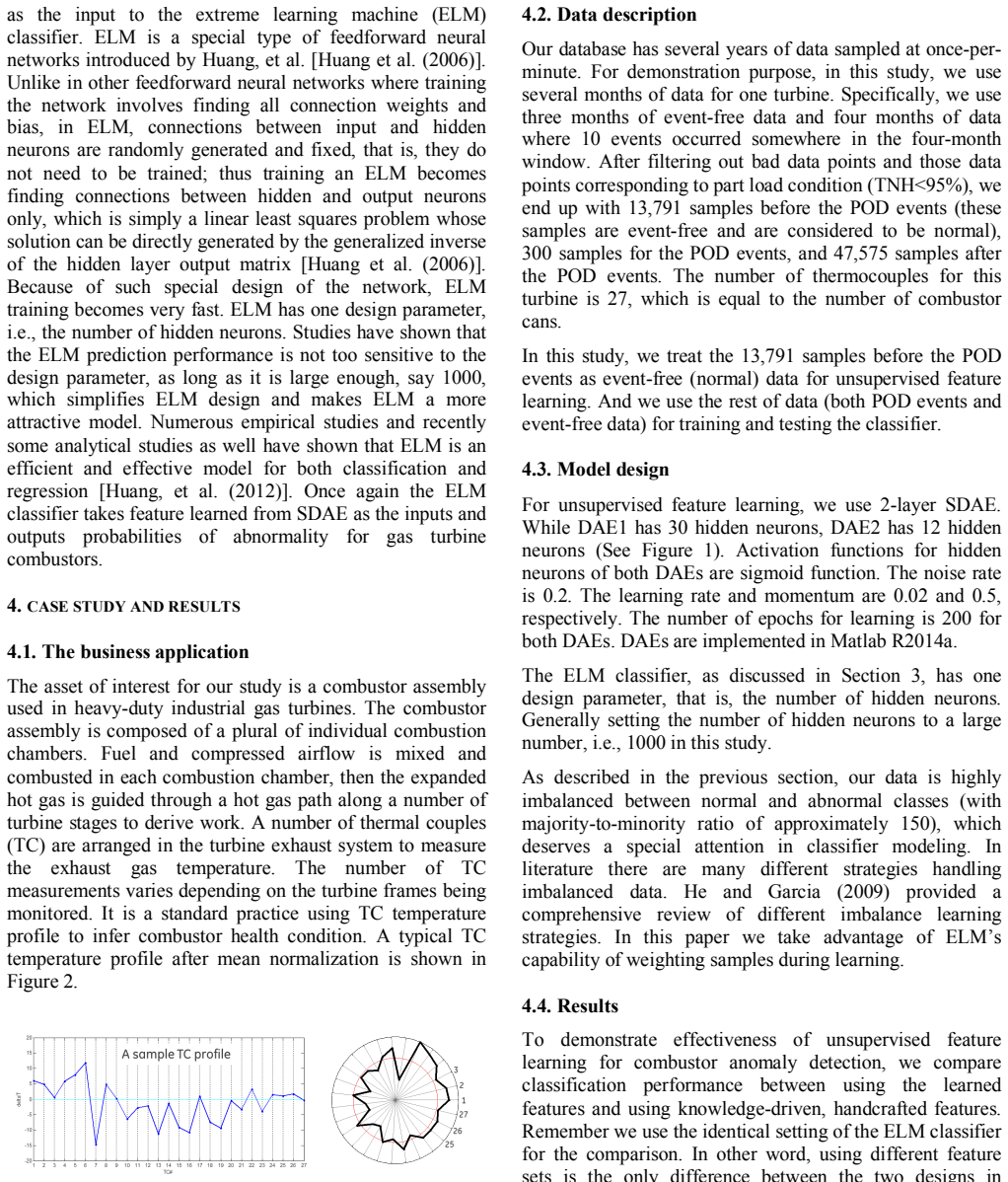
Figure 2: A sample TC profile 4.2. Data description Our database has several years of data sampled at once-per-minute. For demonstration purpose, in this study, we use several months of data for one turbine. Specifically, we use three months of event-free data and four months of data where 10 events occurred somewhere in the four-month window. After filte...
work page 2009
-
[6]
CONCLUSION Accurately detecting gas turbine combustor abnormalities is important in reducing O&M costs of power plants. Traditional rule-based anomaly detection solutions are inadequate in achieving the desired detection performance. Adopting more advanced machine learning technologies as a means of improving combustors’ detection performance is in great ...
work page 2014
-
[8]
Arel, I., Rose, D.C. and Kamowski, T.P. (2010). Deep machine learnibg – a new frontier in artificial intelligence research. IEEE Computer Intelligence Magazine, Vol.5, No. 4, pp13-18. Arranz, A., Cruz, A., Sanz-Bobi, M.A., Riuz, P. and Coutino, J. (2007). DADICO: Intelligent system for anomaly detection in a combined cycle gas turbine plant, Expert system...
work page 2010
-
[16]
Lee, H., Battle, A., Raina, R., and Ng, A.Y. (2007). Efficient sparse coding algorithms. In NIPS,
work page 2007
Show all 23 references
-
[19]
Lin, S., Liu, X., Fang, J. & Xu, Z. (2015). Is extreme learning machine feasible? A theoretical assessment (Part II), IEEE Transactions on Neural Networks and Learning Systems, Vol. 25, No. 1, January 2015, pp. 21 –
2015
-
[20]
1150–1157
pp. 1150–1157. NIPS (2014), Deep learning and representation learning workshop: NIPS 2014 (http://www.dlworkshop.org/). Ogbonnaya, E.A., Ugwu, H.U., and Theophilus Johnson, K. (2012). Gas Turbine Engine Anomaly Detection Through Computer Simulation Technique of Statistical Cor...
2014
-
[21]
and Yang, V
Tolani, D.K., Yasar, M., Ray, A. and Yang, V. (2006). Anomaly Detection in Aircraft Gas Turbine Engines, Journal of Aerospace Computing, Information, and Communication, Vol. 3, No. 2 (2006), pp. 44-51. doi: 10.2514/1.15768 Vincent, P., Larochelle, H., Lajoie, I., Bengio, Y., a...
2006 doi
-
[23]
and Iyer, N
Yan, W., Qiu, H. and Iyer, N. (2008). Feature extraction for bearing prognostics and health management (PHM) – a survey. MFPT 2008, Virginia Beach, Virginia. Zimek, A., Schubert, E., Kriegel, H.-P. (2012). A survey on unsupervised outlier detection in high-dimensional numerica...
2008 doi
-
[34]
Lowe, D. G. (1999). Object recognition from local scale-invariant features. Proceedings of the International Conference on Computer Vision
1999
-
[78]
Ferrell, B. L. (1999), JSF Prognostics and Health Management. Proceedings of IEEE Aerospace Conference. March 6-13, Big Sky, MO. doi: 10.1109/AERO.1999.793190. He, H. B. and Garcia E. A. (2009). Learning from imbalanced data. IEEE Transactions on Knowledge and Data Engineering...
1999
-
[529]
Huang, G.B., Zhu, Q.Y., and Siew, C.K. (2006). Extreme learning machine: Theory and applications, Neurocomputing, vol. 70, no. 1–3, pp. 489–501, Dec
2006
-
[1980]
Deng, L., Seltzer, M., Yu, D., Acero, A., Mohamed, A., and Hinton, G. (2010). Binary coding of speech spectrograms using a deep auto-encoder. In Interspeech 2010, Makuhari, Chiba, Japan. Domingos, P. (2012). A few useful things to know about machine learning. Communications of...
2010
-
[2006]
J., & Koehler, A
Hyndman, R. J., & Koehler, A. B. (2006). Another look at measures of forecast accuracy. International Journal of Forecasting, vol. 22, pp. 679-688. doi:10.1016/j.ijforecast.2006.03.001. ICLR (2015), International conference on learning representations. http://www.iclr.cc/doku....
2006 doi
-
[2007]
Liu, X., Lin, S., Fang, J. & Xu, Z. (2015). Is extreme learning machine feasible? A theoretical assessment (Part I), IEEE Transactions on Neural Networks and Learning Systems, Vol. 25, No. 1, January 2015, pp. 7 –
2015
-
[2009]
Nonlinear Analysis of Electronic Prognostics
Chen, W., (1991). Nonlinear Analysis of Electronic Prognostics. Doctoral dissertation. The Technical University of Napoli, Napoli, Italy. Coates, A., Lee, H., and Ng, A. Y. (2011). An analysis of single-layer networks in unsupervised feature learning. In AIS-TATS 14,
1991
-
[2011]
Collobert, R., Weston, J., Bottou, L., Karlen, M., Kavukcuoglu, K.,and Kuksa, P. (2011). Natural language processing (almost) fromscratch. Journal of Machine Learning Research, 12, 2493–2537. Davis, S.B. and Mermelstein, P. (1980). Comparison of Parametric Representations for ...
2011
-
[2013]
and Mukhopadhyay, A
Chakraborty, S., Gupta, S., Ray, A. and Mukhopadhyay, A. (2008). Data-driven fault detection and estimationin thermal pulse combustors. Proceedings of the Institution of Mechanical Engineers, Part G: Journal of Aerospace Engineering August 1, 2008 222: 1097-1108, DOI: 10.1243/...
2008 doi
-
[2014]
and Mantini, V
arXiv:1404.4679 Allegorico, C. and Mantini, V. (2014). A data-driven approach for on-line gas turbine combustion monitoring using classification models. 2nd European Conference of the Prognostics and Health Management Society 2014, Nantes, France, July 8 – 10,
2014 arXiv
-
[3408]
Wang, H., Shi, X., and Yeung, D.-Y. (2015). Relational Stacked Denoising Autoencoder for Tag Recommendation. Proceedings of AAAI ’15. Xue, F. and Yan, W. (2007). Parametric model-based anomaly detection for locomotive subsystems. Proceedings of the 2007 International Joint Con...
2015
Reviewed August 14, 2026 · model on record in the stance chip above.
Discussion (0). Continue with ORCID to comment.