REVIEW 4 major objections 6 minor 21 references
Extracting Research Instruments from Educational Literature Using LLMs
T0 review · 4 major / 6 minor · reviewed 2026-08-07 · deepseek-v4-flash
Pith's one-line read A three-step LLM prompt chain extracts research instruments from education papers with F1 up to 0.786.
desk verdict A legitimate domain application with a clean pipeline and honest error analysis, but the headline claim of significant outperformance is not backed by any reported baseline numbers or statistical tests. read the letter →
The pith
A machine-rendered reading of the paper's core claim, the machinery that carries it, and where it could break.
The reading
What carries the argument
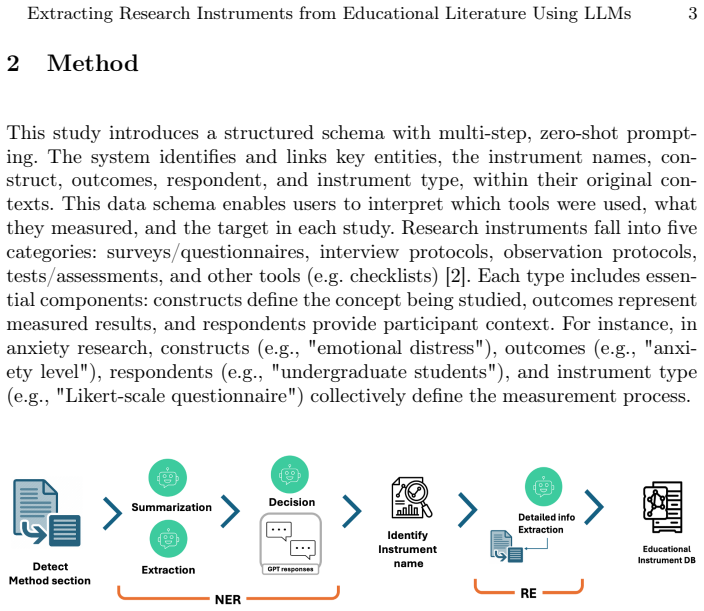
The mechanism carrying the argument is a three-step zero-shot prompt chain applied to methods-section excerpts. First, an extraction prompt asks the model to list candidate instruments using background knowledge about what research instruments are; second, a summarization prompt asks how the study collects, measures, and analyzes data with those tools; third, a decision prompt consolidates both outputs into a structured JSON record. A pre-trained PDF parser detects the methods section, text is chunked into 1000-token pieces, extracted names are standardized against a curated instrument dictionary, and a function-calling prompt fills the schema fields for name, type, respondent, construct, and outcome.
What would settle it
Take a random sample of education papers whose instruments are documented mainly in appendices or supplements; run the methods-section pipeline and count how many true instruments are missed. If recall on those papers falls well below the reported 90 percent, the methods-section focus is the cause.
Extended reading notes
Core claim
The central discovery is that targeted methods-section extraction with multi-step prompting outperforms broader approaches for instrument information extraction. The paper reports that the three-step chain—extraction, summarization, and decision—combined with a domain-specific schema for instrument name, type, target respondents, measured constructs, and outcomes achieves the highest named-entity-recognition F1 across all tested configurations. On the annotated evaluation set, recall reached about 90 percent, meaning the system finds nearly all instruments actually used; precision is lower, so the output includes false positives and redundant items. The same pipeline also standardizes instrument names against a curated dictionary, and the authors argue that restricting input to methods sections improves accuracy while cutting token use by 61 percent and processing time by 54.8 percent.
Load-bearing premise
The system's accuracy depends on the assumption that the methods section of a paper contains the relevant instrument information, so instruments described only in results, appendices, or supplements would be missed.
Editorial extensions
If this is right
- Multi-step prompting on methods excerpts gives the best F1 (0.665 for GPT-4o; 0.786 for GPT-o1), outperforming zero-shot, few-shot, and single-step configurations.
- Methods-section-only processing uses 61 percent fewer tokens and 54.8 percent less time than full-document processing while retaining high recall.
- The structured JSON output is directly usable for building instrument databases, linking each instrument to its respondents, constructs, and outcomes.
- High recall, around 90 percent, means the pipeline rarely misses an instrument actually used, but false positives would need filtering before entries are published.
- On papers that use a single multi-part battery, the system over-extracts subtests as separate instruments, indicating a need for hierarchical ontology rules.
Reading between the lines
- A natural extension is to port the same extraction-summarization-decision prompt chain to other empirical fields such as psychology or medicine by swapping the schema and dictionary; the methods-section focus is not inherently education-specific.
- Because precision lags recall, the strongest practical use is as a first-pass candidate generator in a human-in-the-loop curation workflow rather than as an unsupervised database builder.
- The dictionary standardization step suggests that a growing extracted corpus could feed back into the dictionary, letting the system recognize newly introduced instruments over time.
- A testable refinement is to add an explicit verification step for whether an instrument was actually used or only mentioned, plus a hierarchy-aware pass that groups subtests under a parent battery; both target the two main error types reported.
Editorial analysis
A structured set of objections, weighed in public.
Referee Report
Summary. The paper presents a three-step LLM-based pipeline for extracting research instruments from education literature: first detecting the methods section of a PDF, then applying multi-step prompting for named-entity recognition of instrument names, and finally using relation-extraction prompts to recover instrument type, respondents, constructs, and outcomes into a structured JSON schema. The system is evaluated on 150 manually annotated papers from the Institute of Education Sciences, with the proposed multi-step prompt on method excerpts reported as achieving F1 scores of 0.665 for GPT-4o and 0.786 for GPT-o1. The abstract claims this approach 'significantly outperforms other approaches,' particularly for instrument names. The paper also reports token and time savings versus full-document processing and includes a qualitative error analysis.
Significance. If the claimed gains are substantiated, the paper would be a useful practical contribution to automated literature review and evidence synthesis in education research, an area where manual curation is expensive and existing databases rely on labor-intensive annotation. The work has several strengths: it uses an external gold standard rather than a self-constructed evaluation set, it compares multiple LLMs, it quantifies computational cost reductions, and it includes an explicit error analysis with concrete examples such as sub-test over-extraction and false positives from merely mentioned instruments. However, the central claim of significant outperformance is currently not numerically backed, and the evaluation design risks overfitting the prompts to the evaluation corpus. These issues make the significance conditional pending additional evidence, but the approach is sufficiently plausible and practically motivated to warrant revision rather than rejection.
major comments (4)
- [Abstract; §3.1, Fig. 2] The abstract states that the system 'significantly outperforms other approaches,' but Section 3.1 does not report numeric precision, recall, or F1 for any baseline condition. Figure 2 is described as showing the comparison but is not reproduced with exact values or error bars, so the reader cannot determine whether the proposed multi-step method with method excerpts is actually better than zero-shot, few-shot, single-step, or full-document baselines on the same 150 documents. Please provide a table with exact scores for every condition, include confidence intervals or multiple-run variance, and report a statistical test (e.g., paired bootstrap or McNemar's test) for the claimed differences.
- [§2.2, §2.3] The prompt design was iterated on the same 150-document IES corpus that is used for evaluation: Section 2.2 describes iterative prompt development, and Section 2.3 says the dataset was used to test prompting strategies. Without a held-out development set or cross-validation, the reported best configuration may reflect adaptation to the evaluation corpus rather than a generalizable advantage. Please add a held-out test split or k-fold evaluation, and clarify which prompt choices were made using only development data.
- [§2.1, §3.2] The claim that focusing on methods-section excerpts 'improves accuracy' is not supported by any numeric accuracy comparison in the paper; the reported 61% token reduction and 54.8% time reduction are efficiency gains, not accuracy gains. This distinction matters because Section 3.2 reports that the system often misses instruments mentioned later in the methods and extracts sub-tests as separate instruments, which are cases where section-focusing may hurt recall. Please report method-excerpt versus full-document F1 for the same prompt and model, and discuss the trade-off in light of instruments mentioned in results, appendices, or supplementary materials.
- [Table 1, §3.1] Table 1 compares five LLMs under a single prompting condition and provides no measure of run-to-run variability. Given the stochasticity of API-based LLMs and the relatively small evaluation set (n=150), single-run F1 differences such as 0.665 versus 0.619 cannot be interpreted as meaningful. Please report mean and standard deviation over at least three runs per condition, or otherwise justify that the results are stable.
minor comments (6)
- [§3.1, Table 1] The text in Section 3.1 says GPT-o1's F1 is 0.78, while Table 1 reports 0.786; please make the decimals consistent.
- [Fig. 2] Figure 2 is not included in the provided text, and the available description lacks axis labels and a legend; if the figure is intended for publication, please add a legible version that clearly defines 'Ex', 'Sum', and 'Dec' and labels the y-axis (presumably F1 or a similar metric).
- [§2.3, Reproducibility] Details required for reproducibility are missing: please release the exact prompts (system and user messages), the PDF-to-JSON configuration, the methods-section detection parameters, and the evaluation scripts, or provide them as supplementary material.
- [§2.1] The reported '92% accuracy' for methods-section detection is not defined; please clarify whether this is document-level accuracy, how the ground truth was obtained, and what the failure cases were.
- [§2.2] The paper should clarify whether the EdInstruments dictionary overlaps with the IES evaluation labels; if the dictionary derives from the same or related sources, name standardization could inflate NER scores, and this should be checked or discussed.
- [General] There are several typographical and formatting issues, including 'T able 1' in the text and inconsistent decimal formatting; a careful proofreading pass is recommended.
Circularity Check
No circularity: evaluation uses an external IES gold standard, and the EdInstruments dictionary is used only for normalization, so the reported F1 scores are not equivalent to the system's inputs by construction.
full rationale
The paper's claimed contribution is an LLM pipeline for extracting research instruments, evaluated against a manually annotated IES gold standard (n=150). The evaluation labels are external to the system's construction: they come from IES, not from the authors, and the EdInstruments dictionary is used only for name standardization (Section 2.2), not as the scoring labels. I find no equation, definition, or fitted parameter that makes the reported F1 scores equivalent to the system's inputs by construction. The prompts and schema are inputs, not parameters fitted to the gold labels, and the paper does not state that prompts were tuned on the evaluation set, so I cannot attribute adaptation-to-test circularity without evidence. The absence of reported baseline numbers and significance tests is a serious evidential weakness, but that is a correctness and rigor issue, not circularity. No load-bearing self-citation chain is present: the EdInstruments reference is an external resource used for normalization, not an unverified premise imported to force the result. Verdict: no significant circularity.
Assumptions & free parameters
free parameters (1)
- Chunk size for text splitting =
1000 tokens
assumptions (3)
- domain assumption Instruments and their attributes are described primarily in the methods section of empirical education papers.
- domain assumption The EdInstruments dictionary covers the relevant instrument names for standardization.
- domain assumption The IES gold-standard labels are complete and correct.
Cite this review
Pith. "Pith review of Extracting Research Instruments from Educational Literature Using LLMs." pith.science (2026). https://pith.science/paper/N5PXJUUT
@misc{pith2026250521855,
  author       = {Pith},
  title        = {Pith review of: Extracting Research Instruments from Educational Literature Using LLMs},
  year         = {2026},
  howpublished = {\url{https://pith.science/paper/N5PXJUUT}},
  note         = {Machine review of arXiv:2505.21855}
}
read the original abstract
Large Language Models (LLMs) are transforming information extraction from academic literature, offering new possibilities for knowledge management. This study presents an LLM-based system designed to extract detailed information about research instruments used in the education field, including their names, types, target respondents, measured constructs, and outcomes. Using multi-step prompting and a domain-specific data schema, it generates structured outputs optimized for educational research. Our evaluation shows that this system significantly outperforms other approaches, particularly in identifying instrument names and detailed information. This demonstrates the potential of LLM-powered information extraction in educational contexts, offering a systematic way to organize research instrument information. The ability to aggregate such information at scale enhances accessibility for researchers and education leaders, facilitating informed decision-making in educational research and policy.
Figures

Reference graph
Works this paper leans on
-
[1]
eds: Using Research Instruments: a Guide for Re- searchers
Wilkinson, D., Birmingham, P. eds: Using Research Instruments: a Guide for Re- searchers. RoutledgeFalmer, London (2011)
work page 2011
-
[2]
Colton,D.,Covert,R.W.:Designingandconstructinginstrumentsforsocialresearch and evaluation. John Wiley and Sons, (2007)
work page 2007
-
[3]
Sturm, T., Ash, M.G.: Roles of Instruments in Psychological Research. History of Psychology. 8, 3–34 (2005).https://doi.org/10.1037/1093-4510.8.1.3
-
[4]
Measurement: Interdisciplinary Research and Perspectives
Schumacker,R.E.,Wind,S.A.,Holmes,L.F.:ResourcesforIdentifyingMeasurement Instruments for Social Science Research. Measurement: Interdisciplinary Research and Perspectives. 19, 250–257 (2021).https://doi.org/10.1080/15366367.2021. 1950486
-
[5]
Shaneyfelt, T., Baum, K.D., Bell, D., Feldstein, D., Houston, T.K., Kaatz, S., Whe- lan, C., Green, M.: Instruments for Evaluating Education in Evidence-Based Prac- tice: A Systematic Review. JAMA.296, 1116 (2006). https://doi.org/10.1001/ jama.296.9.1116
work page 2006
-
[6]
Institute of Education Sciences (2019)
Cox, J., Foster, B., Bamat, D.: A review of instruments for measuring social and emotional learning skills among secondary school students. Institute of Education Sciences (2019)
work page 2019
-
[7]
Han, X., Wang, L.: A Novel Document-Level Relation Extraction Method Based on BERT and Entity Information. IEEE Access. 8, 96912–96919 (2020).https: //doi.org/10.1109/ACCESS.2020.2996642
arXiv 2020
-
[8]
Gupta, P., Rajaram, S., Schütze, H., Runkler, T.: Neural Relation Extraction within and across Sentence Boundaries. AAAI. 33, 6513–6520 (2019).https://doi.org/ 10.1609/aaai.v33i01.33016513
Show all 21 references
-
[9]
Last accessed 10 Feb 2025
ERIC Homepage, https://eric.ed.gov/. Last accessed 10 Feb 2025
2025
-
[10]
Last 10 Feb 2025
EdInstrument Homepage, https://edinstruments.org/. Last 10 Feb 2025
2025
-
[11]
L., Chang, K
Chuang, S. L., Chang, K. C. C., Zhai, C. Context-aware wrapping: Synchronized data extraction. In Proceedings of the 33rd international conference on Very large data bases (pp. 699-710). VLDB, Vienna Austria (2007)
2007
- [12]
-
[13]
Nature Communica- tions
Polak, M.P., Morgan, D.: Extracting accurate materials data from research papers with conversational language models and prompt engineering. Nature Communica- tions. 15, 1569 (2024).https://doi.org/10.1038/s41467-024-45914-8
2024 doi
-
[14]
Wei, X., Cui, X., Cheng, N., Wang, X., Zhang, X., Huang, S., Xie, P., Xu, J., Chen, Y., Zhang, M., Jiang, Y., Han, W.: ChatIE: Zero-Shot Information Extraction via Chatting with ChatGPT, arXiv, (2024).https://doi.org/10.48550/arXiv.2302. 10205
2024 doi
- [15]
- [16]
-
[17]
In: 2023 6th International Con- ference on Algorithms, Computing and Artificial Intelligence
Vijayan, A.: A Prompt Engineering Approach for Structured Data Extraction from Unstructured Text Using Conversational LLMs. In: 2023 6th International Con- ference on Algorithms, Computing and Artificial Intelligence. pp. 183–189. ACM, Sanya China (2023).https://doi.org/10.114...
2023
-
[18]
Wang, X., Huang, L., Xu, S., Lu, K.: How Does a Generative Large Language Model Perform on Domain-Specific Information Extraction?—A Comparison be- tween GPT-4 and a Rule-Based Method on Band Gap Extraction. J. Chem. Inf. Model. 64, 7895–7904 (2024).https://doi.org/10.1021/acs...
2024 doi
-
[19]
https: //doi.org/10.1101/2024.09.02.24312917
Wiest, I.C., Wolf, F., Leßmann, M.-E., Van Treeck, M., Ferber, D., Zhu, J., Boehme, H., Bressem, K.K., Ulrich, H., Ebert, M.P., Kather, J.N.: LLM-AIx: An open source pipeline for Information Extraction from unstructured medical text based on privacy preserving Large Language M...
2024 doi
-
[20]
In: 2024 IEEE International Multi-Conference on Engineering, Computer and Information Sciences (SIBIRCON)
Chusova, A., Artemieva, I., Chusov, A.: A Hybrid Approach to Extraction of KnowledgeFromScientificTextsBasedonLargeLanguageModelsandDomainDic- tionaries. In: 2024 IEEE International Multi-Conference on Engineering, Computer and Information Sciences (SIBIRCON). pp. 266–271. IEE...
2024
-
[21]
GitHub Repository, (2024)
Vikas, P.: PDF to JSON converter- Pretrained model toolkit. GitHub Repository, (2024)
2024
Reviewed August 7, 2026 · model on record in the stance chip above.
Discussion (0). Sign in to comment.