Improving parameter estimation of entropic uncertainty relation in continuous-variable quantum key distribution
Pith reviewed 2026-05-25 09:46 UTC · model grok-4.3
The pith
Adapting finite-size covariance estimation and reusing every state for both tasks improves entropic uncertainty relation analysis in continuous-variable quantum key distribution.
A machine-rendered reading of the paper's core claim, the machinery that carries it, and where it could break.
Core claim
By adapting the parameter-estimation procedure to include finite-size effects on the covariance matrix and by applying double-data modulation that reuses all states for both estimation and key extraction, the leakage rate can be bounded without statistical fluctuation in the max-entropy while preserving the validity of the entropic uncertainty relation under composable security.
What carries the argument
Double-data modulation, a technique that lets every transmitted quantum state contribute to both covariance-matrix estimation and secret-key generation.
If this is right
- Finite-size fluctuations in the covariance matrix are correctly folded into the EUR leakage estimate.
- The statistical fluctuation term associated with max-entropy estimation vanishes.
- The fraction of states sacrificed solely for parameter estimation drops substantially.
- Practical key rates under the EUR security proof increase for the same total data volume.
Where Pith is reading between the lines
- The technique may shorten the block length needed to reach positive finite-size key rates.
- Similar reuse strategies could be tested in other uncertainty-relation proofs that currently discard data for estimation.
- Implementation would require confirming that the modulation pattern itself does not create detectable side channels.
Load-bearing premise
Reusing the same states for estimation and key generation leaves the entropic uncertainty relation bounds intact and introduces no new side-channel attacks.
What would settle it
An experimental run in which the secret-key rate obtained with double-data modulation falls measurably below the rate predicted by the adapted EUR bound.
Figures
read the original abstract
The entropic uncertainty relation (EUR) is of significant importance in the security proof of continuous-variable quantum key distribution under coherent attacks. The parameter estimation in the EUR method contains the estimation of the covariance matrix (CM), as well as the max-entropy. The discussions in previous works have not involved the effect of finite-size on estimating the CM, which will further affect the estimation of leakage information. In this work, we address this issue by adapting the parameter estimation technique to the EUR analysis method under composable security frameworks. We also use the double-data modulation method to improve the parameter estimation step, where all the states can be exploited for both parameter estimation and key generation; thus, the statistical fluctuation of estimating the max-entropy disappears. The result shows that the adapted method can effectively estimate parameters in EUR analysis. Moreover, the double-data modulation method can, to a large extent, save the key consumption, which further improves the performance in practical implementations of the EUR.
Editorial analysis
A structured set of objections, weighed in public.
Referee Report
Summary. The manuscript adapts finite-size parameter estimation techniques for covariance matrix analysis to the entropic uncertainty relation (EUR) security proof for continuous-variable QKD under composable security. It further proposes a double-data modulation scheme in which all transmitted states are reused for both parameter estimation and key generation, with the stated effect that statistical fluctuations in the max-entropy term vanish and overall key consumption is reduced while preserving the EUR bounds.
Significance. If the double-data modulation construction is shown to preserve the EUR bounds and composable security without additional finite-size corrections or side-channel assumptions, the work would provide a concrete route to lower the estimation overhead that currently limits practical EUR-based CV-QKD implementations.
major comments (2)
- [Section describing double-data modulation (likely §4 or §5)] The central claim that reuse of the same data set for covariance-matrix estimation and max-entropy evaluation eliminates statistical fluctuations (Abstract) requires an explicit joint bound; the manuscript must derive how the estimator for the covariance matrix and the max-entropy term remain independent of the target secret-key rate when the identical quadrature data are shared, or show the additional finite-size correction term that appears.
- [Section on adapted parameter estimation under composable security] The adaptation of the parameter-estimation procedure to the composable EUR framework must be shown to avoid circularity: the covariance-matrix elements that enter the EUR bound are themselves estimated from the same data that determine the leakage term; an equation or lemma establishing that the resulting bound remains valid under this dependence is needed.
minor comments (2)
- Notation for the estimated covariance matrix elements should be introduced once and used consistently; several symbols appear to be redefined between the covariance estimation and the EUR leakage calculation.
- The manuscript should include a short table comparing the key-consumption overhead of the standard EUR method versus the double-data modulation method for representative block sizes (e.g., 10^6 and 10^8).
Simulated Author's Rebuttal
We thank the referee for the careful reading of our manuscript and the constructive comments on the double-data modulation scheme and the adapted parameter estimation. We address each major comment below and commit to revisions that strengthen the rigor of the presentation.
read point-by-point responses
-
Referee: [Section describing double-data modulation (likely §4 or §5)] The central claim that reuse of the same data set for covariance-matrix estimation and max-entropy evaluation eliminates statistical fluctuations (Abstract) requires an explicit joint bound; the manuscript must derive how the estimator for the covariance matrix and the max-entropy term remain independent of the target secret-key rate when the identical quadrature data are shared, or show the additional finite-size correction term that appears.
Authors: In the double-data modulation construction all transmitted quadrature values are retained and employed simultaneously for covariance-matrix estimation and for direct evaluation of the max-entropy term. Because the entire data set is used without any partitioning or subsampling step, the usual finite-size statistical fluctuation that would arise from estimating the max-entropy on a separate sample is absent by construction. We acknowledge that an explicit joint bound clarifying the statistical independence of the two estimators with respect to the final secret-key rate would improve clarity. We will therefore insert a short lemma (new Lemma 4.1) that derives the joint concentration inequality under shared data and confirms that no additional finite-size correction appears in the max-entropy term. revision: yes
-
Referee: [Section on adapted parameter estimation under composable security] The adaptation of the parameter-estimation procedure to the composable EUR framework must be shown to avoid circularity: the covariance-matrix elements that enter the EUR bound are themselves estimated from the same data that determine the leakage term; an equation or lemma establishing that the resulting bound remains valid under this dependence is needed.
Authors: The adapted finite-size covariance-matrix estimator is obtained from the same quadrature data that later enter the leakage term inside the EUR. The dependence is already accounted for in the composable-security analysis because the estimator is a deterministic function of the observed data and the security proof proceeds via a worst-case bound over all possible data realizations. Nevertheless, we agree that an explicit statement is desirable. We will add a short lemma (new Lemma 3.2) that shows the overall EUR bound remains valid under this data dependence by invoking the composable definition of the smooth min-entropy and the fact that the covariance-matrix estimator is Lipschitz-continuous in the observed quadratures. revision: yes
Circularity Check
No circularity in derivation chain
full rationale
The abstract and description present an adaptation of existing parameter estimation techniques to EUR analysis under composable security, plus a double-data modulation approach that reuses states. No equations, self-definitions, fitted inputs renamed as predictions, or load-bearing self-citations are exhibited that reduce any claimed result to its own inputs by construction. The work is therefore treated as self-contained against external benchmarks with no detected circular steps.
Axiom & Free-Parameter Ledger
Reference graph
Works this paper leans on
-
[1]
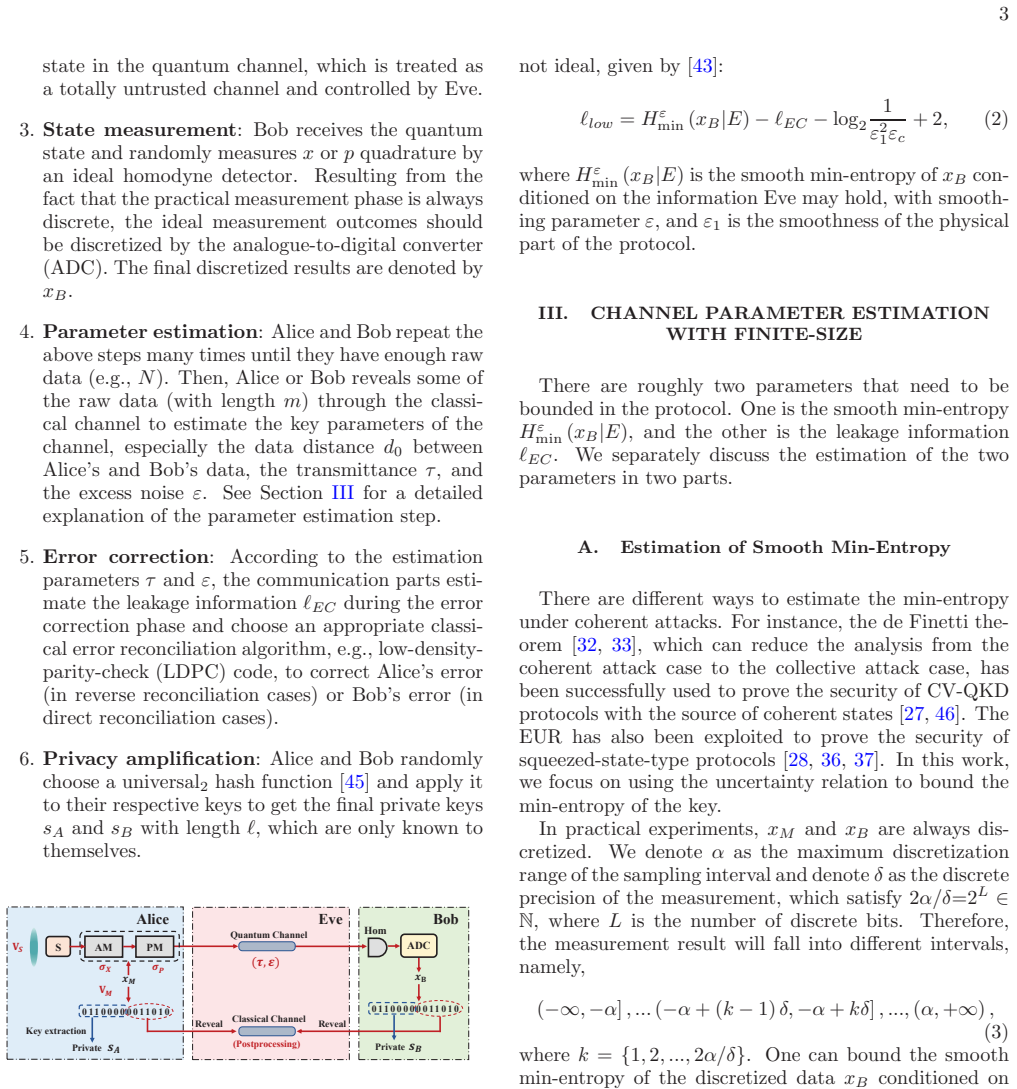
State preparation : Alice holds the squeezed states with squeezed variance VS before the pro- tocol begins, where VS ∈ (0, 1]. In every run of the protocol, Alice uses Gaussian random numbers xM to encode the displacement of quadratures by using modulators (generally containing amplitude and phase modulators), and the total modulation variance is denoted by VM
-
[2]
State transmission : Alice sends the modulated 3 state in the quantum channel, which is treated as a totally untrusted channel and controlled by Eve
-
[3]
State measurement : Bob receives the quantum state and randomly measures x or p quadrature by an ideal homodyne detector. Resulting from the fact that the practical measurement phase is always discrete, the ideal measurement outcomes should be discretized by the analogue-to-digital converter (ADC). The final discretized results are denoted by xB
-
[4]
Parameter estimation: Alice and Bob repeat the above steps many times until they have enough raw data (e.g., N ). Then, Alice or Bob reveals some of the raw data (with length m) through the classi- cal channel to estimate the key parameters of the channel, especially the data distance d0 between Alice’s and Bob’s data, the transmittance τ, and the excess ...
-
[5]
Error correction : According to the estimation parameters τ and ε, the communication parts esti- mate the leakage information ℓEC during the error correction phase and choose an appropriate classi- cal error reconciliation algorithm, e.g., low-density- parity-check (LDPC) code, to correct Alice’s error (in reverse reconciliation cases) or Bob’s error (in ...
-
[6]
Privacy amplification : Alice and Bob randomly choose a universal 2 hash function [ 45] and apply it to their respective keys to get the final private keys sA and sB with length ℓ, which are only known to themselves. Alice Eve Bob Hom ࢞۰ ܄ࡿS AM 0 11 0 0 0 0 0 0 11 0 1 0 0 11 0 0 0 0 0 0 11 0 1 0 ࢞ࡹ ADC PM ሻ Classical Channel Quantum Channel (Postprocessing)...
-
[7]
The covariance of xM and xB is: Cov (xM , x B) = √ τ VM =: cM B. (17) For obtaining the estimator of covariance ˆcM B, we also use Mi denoting the ith modulating value and Bi denot- ing the ith measurement result, for i = 1, 2, ..., m , respec- tively. According to the maximum likelihood estimation, we can get: ˆcM B = 1 m m∑ i=1 MiBi. (18) and it is easy...
-
[8]
Gisin, N.; Ribordy, G.; Tittel, W.; Zbinden, H. Quantum cryptography. Rev. Mod. Phys. 2002, 74, 145–195
work page 2002
-
[9]
The security of practical quantum key distribution
Scarani, V.; Bechmann-Pasquinucci, H.; Cerf, N.J.; Duˇ sek, M.; L¨ utkenhaus, N.; Peev, M. The security of practical quantum key distribution. Rev. Mod. Phys. 2009, 81, 1301–1350
work page 2009
-
[10]
Weedbrook, C.; Pirandola, S.; Garc ´ ıa-Patr´ on, R.; Cerf, N.J.; Ralph, T.C.; Shapiro, J.H.; Lloyd, S. Gaussian quantum information. Rev. Mod. Phys. 2012, 84, 621– 669
work page 2012
-
[11]
Distributing secret keys wi th quantum continuous variables: Principle, security and implementations
Diamanti, E.; Leverrier, A. Distributing secret keys wi th quantum continuous variables: Principle, security and implementations. Entropy 2015, 17, 6072–6092
work page 2015
-
[12]
Advances in quantum cryptography
Pirandola, S.; Andersen, U.L.; Banchi, L.; Berta, M.; Bunandar, D.; Colbeck, R.; Englund, D.; Gehring, T.; Lupo, C.; Ottaviani, C.; et al. Advances in quantum cryptography. arXiv 2019, arXiv:1906.01645
-
[13]
Continuous variable quantum cryptography
Ralph, T.C. Continuous variable quantum cryptography. Phys. Rev. A 1999, 61, 010303(R)
work page 1999
-
[14]
Quantum cryptography with squeezed states
Hillery, M. Quantum cryptography with squeezed states. Phys. Rev. A 2000, 61, 022309
work page 2000
-
[15]
Quantum distribu- tion of Gaussian keys using squeezed states
Cerf, N.J.; L´ evy, M.; Van Assche, G. Quantum distribu- tion of Gaussian keys using squeezed states. Phys. Rev. A 2001, 63, 052311
work page 2001
-
[16]
Squeezed-state quantum key dis- tribution upon imperfect reconciliation
Usenko, V.C.; Filip, R. Squeezed-state quantum key dis- tribution upon imperfect reconciliation. New J. Phys. 2011, 13, 113007
work page 2011
-
[17]
Grosshans, F.; Grangier, P.; Continuous variable quan - tum cryptography using coherent states. Phys. Rev. Lett. 2002, 88, 057902
work page 2002
-
[18]
Quantum key distribution using gaussian-modulated coherent states
Grosshans, F.; van Assche, G.; Wenger, J.; Brouri, R.; Cerf, N.J.; Grangier, P. Quantum key distribution using gaussian-modulated coherent states. Nature 2003, 421, 238–241
work page 2003
-
[19]
Quantum cryptography without switching
Weedbrook, C.; Lance, A.M.; Bowen, W.P.; Symul, T.; Ralph, T.C.; Lam, P.K. Quantum cryptography without switching. Phys. Rev. Lett. 2004, 93, 170504
work page 2004
-
[20]
Continuous-variable quantum cryptography using two- way quantum communication
Pirandola, S.; Mancini, S.; Lloyd, S.; Braunstein, S.L . Continuous-variable quantum cryptography using two- way quantum communication. Nat. Phys. 2008, 4, 726– 730
work page 2008
-
[21]
Security of a new two-way continuous-variable quantum key distribution protocol
Sun, M.; Peng, X.; Shen, Y.; Guo, H. Security of a new two-way continuous-variable quantum key distribution protocol. Int. J. Quantum Inf. 2012, 10, 1250059
work page 2012
-
[22]
Improvement of two-way continuous-variable quantum key distribution using op- tical amplifiers
Zhang, Y.-C.; Li, Z.; Weedbrook, C.; Yu, S.; Gu, W.; Sun, M.; Peng, X.; Guo, H. Improvement of two-way continuous-variable quantum key distribution using op- tical amplifiers. J. Phys. B 2014, 47, 035501
work page 2014
-
[23]
Two-way Gaus - sian quantum cryptography against coherent attacks in direct reconciliation
Ottaviani, C.; Mancini, S.; Pirandola, S. Two-way Gaus - sian quantum cryptography against coherent attacks in direct reconciliation. Phys. Rev. A 2015, 92, 062323
work page 2015
-
[24]
General immunity and su- peradditivity of two-way Gaussian quantum cryptogra- phy
Ottaviani, C.; Pirandola, S. General immunity and su- peradditivity of two-way Gaussian quantum cryptogra- phy. Sci. Rep. 2016, 6, 22225
work page 2016
-
[25]
Zhang, Y.; Li, Z.; Zhao, Y.; Yu, S.; Guo, H. Numeri- cal simulation of the optimal two-mode attacks for two- way continuous-variable quantum cryptography in re- verse reconciliation. J. Phys. B: At. Mol. Opt. Phys. 2017, 50, 035501
work page 2017
-
[26]
Leverrier, A.; Grangier, P. Unconditional security pr oof of long-distance continuous-variable quantum key distri- bution with discrete modulation. Phys. Rev. Lett. 2009, 102, 180504
work page 2009
-
[27]
Continuous-variable quantum-key-distribution protocols with a non-Gaussian modulation
Leverrier, A.; Grangier, P. Continuous-variable quantum-key-distribution protocols with a non-Gaussian modulation. Phys. Rev. A 2011, 83, 042312
work page 2011
-
[28]
User-defined quantum key distribution
Li, Z.; Zhang, Y.; Guo, H. User-defined quantum key distribution. arXiv 2018, arXiv: 1805.04249
work page internal anchor Pith review Pith/arXiv arXiv 2018
-
[29]
Continuous-variable measurement-device-independent quantum key distribution
Li, Z.; Zhang, Y.-C.; Xu, F.; Peng, X.; Guo, H. Continuous-variable measurement-device-independent quantum key distribution. Phys. Rev. A 2014, 89, 052301
work page 2014
-
[30]
Continuous-variable measurement-device- independent quantum key distribution using squeezed states
Zhang, Y.-C.; Li, Z.; Yu, S.; Gu, W.; Peng, X.; Guo, H. Continuous-variable measurement-device- independent quantum key distribution using squeezed states. Phys. Rev. A 2014, 90, 052325
work page 2014
-
[31]
High-rate measurement-device- independent quantum cryptography
Pirandola, S.; Ottaviani, C.; Spedalieri, G.; Weedbro ok, C.; Braunstein, S.L.; Lloyd, S.; Gehring, T.; Jacob- sen, C.S.; Andersen, U.L. High-rate measurement-device- independent quantum cryptography. Nat. Photon. 2015, 9, 397–402
work page 2015
-
[32]
Zhang, X.; Zhang, Y.; Zhao, Y.; Wang, X.; Yu, S.; Guo, H. Finite-size analysis of continuous-variable measurement-device-independent quantum key distribu- tion. Phys. Rev. A 2017, 96, 042334
work page 2017
-
[33]
Papanastasiou, P.; Ottaviani, C.; Pirandola, S. Finit e- size analysis of measurement-device-independent quan- tum cryptography with continuous variables. Phys. Rev. A 2017, 96, 042332
work page 2017
-
[34]
Lupo, C.; Ottaviani, C.; Papanastasiou, P.; Piran- dola, S. Continuous-variable measurement-device- inde- pendent quantum key distribution: Composable security against coherent attacks. Phys. Rev. A 2018, 97, 052327
work page 2018
-
[35]
Chen, Z.; Zhang, Y.; Wang, G.; Li, Z.; Guo, H. Composable security analysis of continuous-variable measurement-device-independent quantum key distribu- tion with squeezed states for coherent attacks. Phys. Rev. A 2018, 98, 012314
work page 2018
-
[36]
Field test of classical symmetric encryption with continuous vari- 10 ables quantum key distribution
Jouguet, P.; Kunz-Jacques, S.; Debuisschert, T.; Fos- sier, S.; Diamanti, E.; All´ eaume, R.; Tualle-Brouri, R.; Grangier, P.; Leverrier, A.; Pache, P.; et al. Field test of classical symmetric encryption with continuous vari- 10 ables quantum key distribution. Opt. Express 2012, 20, 14030–14041
work page 2012
-
[37]
Experimental demonstration of long- distance continuous-variable quantum key distribution
Jouguet, P.; Kunz-Jacques, S.; Leverrier, A.; Grangie r, P.; Diamanti, E. Experimental demonstration of long- distance continuous-variable quantum key distribution. Nat. Photon. 2013, 7, 378–381
work page 2013
-
[38]
Continuous-variable QKD over 50km commercial fiber
Zhang, Y.; Li, Z.; Chen, Z.; Weedbrook, C.; Zhao, Y.; Wang, X.; Huang, Y.; Xu, C.; Zhang, X.; Wang, Z.; et al. Continuous-variable QKD over 50km commercial fiber. Quantum Sci. Technol. 2019, 4, 035006
work page 2019
-
[39]
Composable security proof for continuou s- variable quantum key distribution with coherent states
Leverrier, A. Composable security proof for continuou s- variable quantum key distribution with coherent states. Phys. Rev. Lett. 2015, 114, 070501
work page 2015
-
[40]
Security of continuous-variable quantu m key distribution via a Gaussian de Finetti reduction
Leverrier, A. Security of continuous-variable quantu m key distribution via a Gaussian de Finetti reduction. Phys. Rev. Lett. 2017, 118, 200501
work page 2017
-
[41]
Postselection t ech- nique for quantum channels with applications to quan- tum cryptography
Christandl, M.; K¨ onig, R.; Renner,R. Postselection t ech- nique for quantum channels with applications to quan- tum cryptography. Phys. Rev. Lett. 2009, 102, 020504
work page 2009
-
[42]
Security of continuous-variable quantum key distribution against general attacks
Leverrier, A.; Garc ´ ıa-Patr´ on, R.; Renner, R.; Cerf, N.J. Security of continuous-variable quantum key distribution against general attacks. Phys. Rev. Lett. 2013, 110, 030502
work page 2013
-
[43]
Furrer, F.; Franz, T.; Berta, M.; Leverrier, A.; Scholz , V.B.; Tomamichel, M.; Werner, R.F. Continuous variable quantum key distribution: finite-key analysis of compos- able security against coherent attacks. Phys. Rev. Lett. 2012, 109, 100502
work page 2012
-
[44]
Furrer, F. Reverse-reconciliation continuous-varia ble quantum key distribution based on the uncertainty prin- ciple. Phys. Rev. A 2014, 90, 042325
work page 2014
-
[45]
Gehring, T.; H¨ andchen, V.; Duhme, J.; Furrer, F.; Franz, T.; Pacher, C.; Werner, R.F.; Schnabel. R. Implemen- tation of continuous-variable quantum key distribution with composable and one-sided-device-independent secu- rity against coherent attacks. Nat. Commun. 2015, 6, 8795
work page 2015
-
[46]
Source-dev ice- independent ultrafast quantum random number genera- tion
Marangon, D.G.; Vallone,G.; Villoresi, P. Source-dev ice- independent ultrafast quantum random number genera- tion. Phy. Rev. Lett. 2017, 118, 060503
work page 2017
-
[47]
High speed continuous vari- able source-independent quantum random number gen- eration
Xu, B.; Chen, Z.; Li, Z.; Yang, J.; Su, Q.; Huang, W.; Zhang, Y.; Guo, H. High speed continuous vari- able source-independent quantum random number gen- eration. Quantum Sci. Technol. 2019, 4, 025013
work page 2019
-
[48]
En- tropic uncertainty relations and their applications
Coles, P.J.; Berta, M.; Tomamichel, M.; Wehner, S. En- tropic uncertainty relations and their applications. Rev. Mod. Phys. 2017, 89, 015002
work page 2017
-
[49]
Long-distance continuous-variable quantum key distribution with effi- cient channel estimation
Ruppert, L.; Usenko, V.C.; Filip, R. Long-distance continuous-variable quantum key distribution with effi- cient channel estimation. Phys. Rev. A 2014, 90, 062310
work page 2014
-
[50]
Security of quantum key distribution
Renner, R. Security of quantum key distribution. Ph.D. thesis, Swiss Federal Institute of Technology (ETH) Zurich, Zurich, Swiss, 2006
work page 2006
-
[51]
Composability in quantu m cryptography
M¨ uller-Quade, J.; Renner, R. Composability in quantu m cryptography. New J. Phys. 2009, 11, 085006
work page 2009
-
[52]
Universal classes of hash functions
Carter, J.L.; Wegman, M.N. Universal classes of hash functions. J. Comput. Syst. Sci. 1979, 18, 143
work page 1979
-
[53]
Ghorai, S.; Diamanti, E.; Leverrier, A. Composable se- curity of two-way continuous-variable quantum key dis- tribution without active symmetrization. Phys. Rev. A 2019, 99, 012311
work page 2019
-
[54]
Maximal violation of Bell in- equalities by position measurements
Kiukas, J.; Werner, R.F. Maximal violation of Bell in- equalities by position measurements. J. Math. Phys. 2010, 51, 072105
work page 2010
-
[55]
Probability inequalities for the sum in s am- pling without replacement
Serfling, R.J. Probability inequalities for the sum in s am- pling without replacement. Ann. Stat. 1974, 2, 39
work page 1974
-
[56]
Grosshans, F.; Cerf, N.J.; Wenger, J.; Tualle-Brouri, R.; Grangier, P. Virtual entanglement and reconciliation pro- tocols for quantum cryptography with continuous vari- ables. Quantum Inf. Comput. 2003, 3, 535
work page 2003
-
[57]
13dB squeezed vacuum states at 1550nm from 12mW external pump power at 775nm
Sch¨ onbeck, A.; Thies, F.; Schnabel, R. 13dB squeezed vacuum states at 1550nm from 12mW external pump power at 775nm. Opt. Lett. 2018, 43, 110
work page 2018
-
[58]
Wang, X.; Zhang, Y.; Li, Z.; Xu, B.; Yu, S.; Guo, H.; Effi- cient rate-adaptive reconciliation for CV-QKD protocol. Quantum Inf. Comput. 2017, 17, 1123
work page 2017
-
[59]
Wang, X.; Zhang, Y.; Yu, S.; Guo, H. High speed error correction for continuous-variable quantum key distribu- tion with multi-edge type LDPC code. Sci. Rep. 2018, 8, 10543
work page 2018
discussion (0)
Sign in with ORCID, Apple, or X to comment. Anyone can read and Pith papers without signing in.