Classification of IGR J20084+3221 as an Intermediate Polar using X-ray and Optical Observations
Pith reviewed 2026-05-20 09:44 UTC · model grok-4.3
The pith
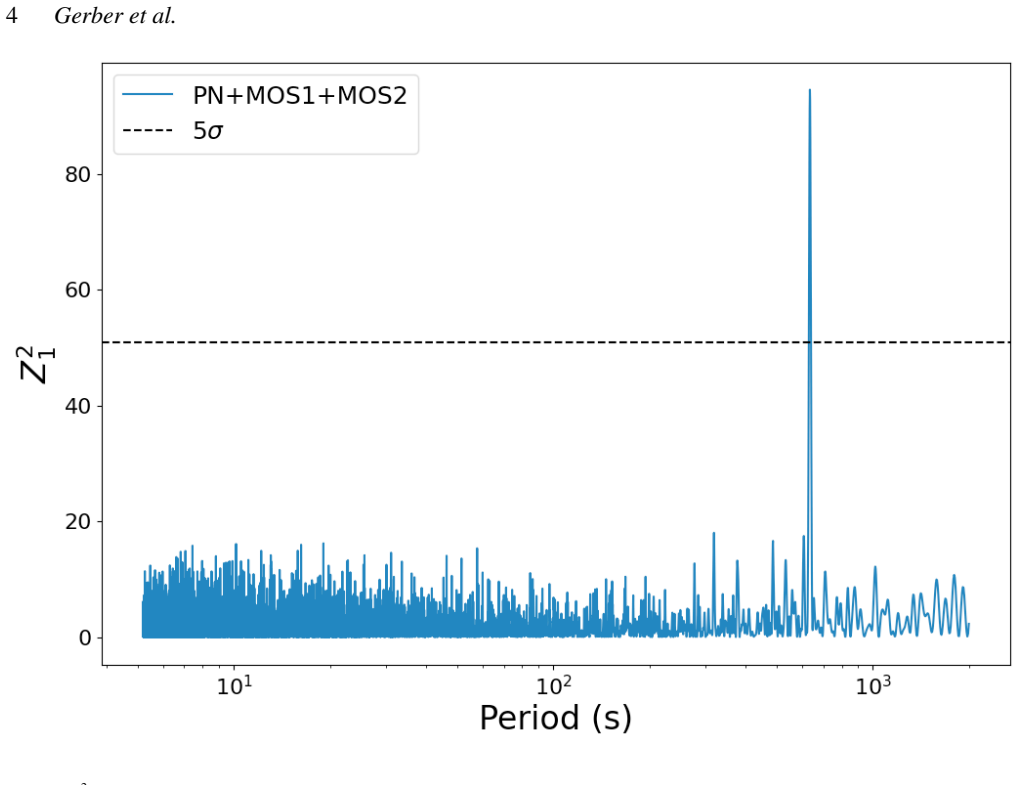
X-ray timing and spectra classify IGR J20084+3221 as an intermediate polar with a 635-second white dwarf spin period.
A machine-rendered reading of the paper's core claim, the machinery that carries it, and where it could break.
Core claim
The authors conclude that IGR J20084+3221 is an intermediate polar type magnetic cataclysmic variable. Timing analysis reveals a significant X-ray period of 635.0 ± 0.4 seconds interpreted as the white dwarf spin period. The X-ray spectrum is well described by a post-shock region model that yields a white dwarf mass of 1.09 solar masses, larger than the typical value for magnetic cataclysmic variables, while optical emission lines and infrared faintness together exclude a high-mass X-ray binary classification.
What carries the argument
The 635-second X-ray periodicity interpreted as the white dwarf spin period, together with spectral fitting to a post-shock accretion column model that estimates the white dwarf mass.
Load-bearing premise
The 635-second X-ray signal must be the white dwarf spin period rather than an orbital or beat period, and the infrared flux must be too low for a high-mass companion star despite distance and extinction uncertainties.
What would settle it
Detection of a coherent X-ray or optical periodicity at a period clearly distinct from 635 seconds that matches an orbital period, or infrared spectroscopy revealing absorption features from a massive O or B star companion, would falsify the intermediate polar classification.
Figures


read the original abstract
IGR J20084+3221 is a previously unclassified Galactic source first detected by INTEGRAL. Chandra observations led to possible classifications of either a magnetic Cataclysmic Variable (mCV) or high mass X-ray binary (HMXB) based on the hardness of its spectrum. Here, we report follow-up observations taken by XMM-Newton, NuSTAR, and the Hale Telescope at Palomar Observatory. Based on these observations, we conclude that IGR J20084+3221 is most likely an Intermediate Polar (IP) type mCV. Timing analysis of the X-ray data found a significant peak period of $P=635.0\pm0.4$ s, which we interpret to be the spin period of the white dwarf (WD). The X-ray spectrum is well fit to an absorbed Bremsstrahlung model with components accounting for partial covering, reflection, and a fluorescent Fe-line, all typical for an IP. The optical spectrum shows clear emission lines, consistent with emission dominated by an accretion disk. We find counterparts to the source across the optical and infrared (IR) bands, and, despite uncertainties in the distance and extinction, we estimate that the source is too faint in the IR to be an HMXB. Given the evidence pointing towards an IP classification, we fit the X-ray spectrum to a post-shock region model where we find a WD mass of $M=1.09^{+0.12}_{-0.11}\mathrm{M}_{\odot}$, larger than the average mass for a WD in an mCV.
Editorial analysis
A structured set of objections, weighed in public.
Referee Report
Summary. The manuscript classifies the INTEGRAL source IGR J20084+3221 as an Intermediate Polar (IP) magnetic cataclysmic variable. It reports a 635.0 ± 0.4 s X-ray periodicity from XMM-Newton and NuSTAR data, interpreted as the white dwarf spin period; an X-ray spectrum fit by absorbed bremsstrahlung with partial covering, reflection, and Fe K line; optical emission lines consistent with an accretion disk; and IR photometry showing the source is too faint to be an HMXB despite distance and extinction uncertainties. A white dwarf mass of 1.09^{+0.12}_{-0.11} M_⊙ is derived from a post-shock region model.
Significance. If the IP classification is confirmed, the work adds a new mCV with a measured white dwarf mass above the typical average, useful for population studies of magnetic CVs and accretion onto magnetized white dwarfs. The combination of timing, X-ray spectroscopy, optical spectroscopy, and IR photometry provides a multi-wavelength basis for distinguishing mCV from HMXB scenarios.
major comments (2)
- [Timing analysis] Timing analysis section: The classification as an IP rests on interpreting the sole significant 635.0 ± 0.4 s periodicity as the white dwarf spin period rather than an orbital or beat period. The manuscript does not describe the full period search range (e.g., from ~100 s to several hours) or confirm the absence of other peaks that could indicate an orbital frequency, leaving open the possibility of a slowly spinning neutron star in an HMXB.
- [IR counterpart and distance discussion] IR counterpart discussion: The claim that the source is too faint in the IR to be an HMXB depends on specific distance and extinction values. The text should state the adopted distance range, A_V, resulting luminosity, and the exact comparison sample or threshold used against known HMXBs, as these directly affect whether the HMXB alternative can be excluded.
minor comments (1)
- [Abstract and spectral analysis] Abstract and spectral analysis: Explicitly note which instrument(s) provided the timing data and list the best-fit parameters (including covering fraction and reflection strength) in a table for clarity.
Simulated Author's Rebuttal
We thank the referee for their careful and constructive review of our manuscript. The comments have helped us identify areas where additional detail will strengthen the presentation of our results. We have revised the manuscript to address both major comments.
read point-by-point responses
-
Referee: [Timing analysis] Timing analysis section: The classification as an IP rests on interpreting the sole significant 635.0 ± 0.4 s periodicity as the white dwarf spin period rather than an orbital or beat period. The manuscript does not describe the full period search range (e.g., from ~100 s to several hours) or confirm the absence of other peaks that could indicate an orbital frequency, leaving open the possibility of a slowly spinning neutron star in an HMXB.
Authors: We agree that explicitly documenting the period search strengthens the timing analysis. In the revised manuscript we now state that a Lomb-Scargle periodogram was computed over the range 100 s to 10 h on the combined, barycenter-corrected XMM-Newton and NuSTAR light curves. Only one peak exceeds the 99 % significance threshold, at 635.0 ± 0.4 s; no additional peaks are present at periods that could plausibly be orbital or beat frequencies. We have added this description and the corresponding periodogram figure to the timing section. revision: yes
-
Referee: [IR counterpart and distance discussion] IR counterpart discussion: The claim that the source is too faint in the IR to be an HMXB depends on specific distance and extinction values. The text should state the adopted distance range, A_V, resulting luminosity, and the exact comparison sample or threshold used against known HMXBs, as these directly affect whether the HMXB alternative can be excluded.
Authors: We accept that the IR discussion requires more quantitative detail. The revised text now specifies the distance range (1–4 kpc) and A_V range (4–9 mag) adopted from the X-ray column density and Galactic coordinates, reports the corresponding dereddened IR luminosities, and compares these values directly to the IR magnitudes of a reference sample of confirmed HMXBs drawn from the literature. With these numbers included, the source remains fainter than expected for an HMXB at the same distance and extinction, supporting the exclusion of that scenario. revision: yes
Circularity Check
No significant circularity; classification derives from independent observations and standard models
full rationale
The paper derives the IP classification from direct timing analysis yielding a 635 s X-ray periodicity (interpreted as WD spin), spectral fits to absorbed Bremsstrahlung plus partial covering/reflection/Fe line components typical of IPs, optical disk-like emission lines, and IR luminosity estimates (accounting for distance/extinction uncertainties) that rule out HMXB. The WD mass is obtained by applying a post-shock region model to the spectrum. These steps rely on observational data and established physical models rather than any reduction by construction, self-definition, fitted inputs renamed as predictions, or load-bearing self-citations. The derivation chain is self-contained and externally falsifiable against standard mCV/HMXB benchmarks.
Axiom & Free-Parameter Ledger
free parameters (1)
- White dwarf mass =
1.09 solar masses
axioms (2)
- domain assumption The detected 635 s X-ray periodicity corresponds to the white dwarf spin period
- domain assumption IR faintness combined with distance and extinction estimates rules out an HMXB classification
Lean theorems connected to this paper
-
IndisputableMonolith/Foundation/ArithmeticFromLogic.leanLogicNat recovery; no 8-tick or recognition periodicity unclear?
unclearRelation between the paper passage and the cited Recognition theorem.
Timing analysis ... Z^2_1 test ... period of P=635.0±0.4 s ... interpreted to be the spin period of the white dwarf
-
IndisputableMonolith/Cost/FunctionalEquation.leanJ(x)=½(x+x^{-1})−1 uniqueness; no Bremsstrahlung or PSR mapping unclear?
unclearRelation between the paper passage and the cited Recognition theorem.
Bremsstrahlung model with partial covering, reflection, and fluorescent Fe-line ... post-shock region model ... M=1.09 M_⊙
What do these tags mean?
- matches
- The paper's claim is directly supported by a theorem in the formal canon.
- supports
- The theorem supports part of the paper's argument, but the paper may add assumptions or extra steps.
- extends
- The paper goes beyond the formal theorem; the theorem is a base layer rather than the whole result.
- uses
- The paper appears to rely on the theorem as machinery.
- contradicts
- The paper's claim conflicts with a theorem or certificate in the canon.
- unclear
- Pith found a possible connection, but the passage is too broad, indirect, or ambiguous to say the theorem truly supports the claim.
Reference graph
Works this paper leans on
-
[1]
VizieR Online Data Catalog: AllWISE Data Release (Cutri+ 2013)
work page 2013
-
[2]
Handbook of X-ray and Gamma-ray Astrophysics , year = 2023, eid =
High-Mass X-ray Binaries. Handbook of X-ray and Gamma-ray Astrophysics , year = 2023, eid =. doi:10.1007/978-981-16-4544-0_95-1 , adsurl =
-
[3]
Properties of the Galactic population of cataclysmic variables in hard X-rays
Properties of the Galactic population of cataclysmic variables in hard X-rays. , keywords =. doi:10.1051/0004-6361:200810213 , archivePrefix =. 0805.2699 , primaryClass =
work page internal anchor Pith review Pith/arXiv arXiv doi:10.1051/0004-6361:200810213
-
[4]
The chemical composition of the accretion disc and donor star in ultra-compact X-ray binaries: A comprehensive X-ray analysis. , keywords =. doi:10.1093/mnras/staa3474 , archivePrefix =. 2001.00716 , primaryClass =
-
[5]
and Doroshenko, Victor and Werner, Klaus , month = jan, year =
Suleimanov, Valery F. and Doroshenko, Victor and Werner, Klaus , month = jan, year =. Hard. Monthly Notices of the Royal Astronomical Society , publisher =. doi:10.1093/mnras/sty2952 , abstract =
-
[6]
Raphael and Woodward, Charles E
Starrfield, Sumner and Bose, Maitrayee and Iliadis, Christian and Hix, W. Raphael and Woodward, Charles E. and Wagner, R. Mark , month = may, year =. Carbon–. The Astrophysical Journal , publisher =. doi:10.3847/1538-4357/ab8d23 , abstract =
-
[7]
An Extended Grid of Nova Models. II. The Parameter Space of Nova Outbursts. , keywords =. doi:10.1086/428435 , archivePrefix =. astro-ph/0503143 , primaryClass =
work page internal anchor Pith review Pith/arXiv arXiv doi:10.1086/428435
-
[8]
Post common envelope binaries from SDSS. XI. The white dwarf mass distributions of CVs and pre-CVs. , keywords =. doi:10.1051/0004-6361/201116626 , archivePrefix =. 1108.4600 , primaryClass =
work page internal anchor Pith review Pith/arXiv arXiv doi:10.1051/0004-6361/201116626
-
[9]
New hard X-ray sources discovered in the ongoing INTEGRAL Galactic plane survey after 14 yr of observations. , keywords =. doi:10.1093/mnras/stx1276 , archivePrefix =. 1704.03364 , primaryClass =
work page internal anchor Pith review Pith/arXiv arXiv doi:10.1093/mnras/stx1276
-
[10]
Chandra Observations of High-energy X-Ray Sources Discovered by INTEGRAL. , keywords =. doi:10.3847/1538-4357/ab5fd2 , archivePrefix =. 1912.03315 , primaryClass =
-
[11]
Classifying IGR J15038-6021 as a magnetic CV with a massive white dwarf. , keywords =. doi:10.1093/mnras/stad1729 , archivePrefix =. 2306.04691 , primaryClass =
-
[12]
Coughenour, Benjamin M. and Tomsick, John A. and Shaw, Aarran W. and Mukai, Koji and Clavel, Maïca and Hare, Jeremy and Krivonos, Roman and Fornasini, Francesca M. , month = apr, year =. Classifying. Monthly Notices of the Royal Astronomical Society , publisher =. doi:10.1093/mnras/stac263 , abstract =
-
[13]
Tomsick, John A. and Rahoui, Farid and Krivonos, Roman and Clavel, Maïca and Strader, Jay and Chomiuk, Laura , month = jul, year =. Identifying. Monthly Notices of the Royal Astronomical Society , publisher =. doi:10.1093/mnras/stw871 , abstract =
-
[14]
Gerber, Julian and Hare, Jeremy and Tomsick, John A. and Coughenour, Benjamin M. and Shaw, Aarran W. and Clavel, Maïca and Fornasini, Francesca and Halpern, Jules and Joens, Alyson and Krivonos, Roman and Mukai, Koji , month = may, year =. X-ray measurement of a high-mass white dwarf and its spin for the intermediate polar. Monthly Notices of the Royal As...
-
[15]
Search for pulsed -ray emission from radio pulsars in the COS-B data. , keywords =
-
[16]
Precise Timing and Phase-resolved Spectroscopy of the Young Pulsar J1617-5055 with NuSTAR. , keywords =. doi:10.3847/1538-4357/ac30e2 , archivePrefix =. 2110.08077 , primaryClass =
-
[17]
Astronomical Data Analysis Software and Systems V , year = 1996, editor =
XSPEC: The First Ten Years. Astronomical Data Analysis Software and Systems V , year = 1996, editor =
work page 1996
-
[18]
On the Absorption of X-rays in the Interstellar Medium
On the Absorption of X-Rays in the Interstellar Medium. , keywords =. doi:10.1086/317016 , archivePrefix =. astro-ph/0008425 , primaryClass =
work page internal anchor Pith review Pith/arXiv arXiv doi:10.1086/317016
-
[19]
Atomic Data for Astrophysics. II. New Analytic Fits for Photoionization Cross Sections of Atoms and Ions. , keywords =. doi:10.1086/177435 , archivePrefix =. astro-ph/9601009 , primaryClass =
work page internal anchor Pith review Pith/arXiv arXiv doi:10.1086/177435
-
[20]
X-ray Emissions from Accreting White Dwarfs: a Review
X-Ray Emissions from Accreting White Dwarfs: A Review. , keywords =. doi:10.1088/1538-3873/aa6736 , archivePrefix =. 1703.06171 , primaryClass =
work page internal anchor Pith review Pith/arXiv arXiv doi:10.1088/1538-3873/aa6736
-
[21]
American Astronomical Society Meeting Abstracts \#242 , year = 2023, series =
ATOMDB Database. American Astronomical Society Meeting Abstracts \#242 , year = 2023, series =
work page 2023
-
[22]
Suleimanov, V. and Doroshenko, V. and Ducci, L. and Zhukov, G. V. and Werner, K. , month = jun, year =. Astronomy and Astrophysics , publisher =. doi:10.1051/0004-6361/201628301 , abstract =
-
[23]
Ezuka, Hiroyuki and Ishida, Manabu , month = feb, year =. Iron. The Astrophysical Journal Supplement Series , publisher =. doi:10.1086/313181 , abstract =
-
[24]
Magdziarz, Pawel and Zdziarski, Andrzej A. , month = apr, year =. Angle-dependent. Monthly Notices of the Royal Astronomical Society , publisher =. doi:10.1093/mnras/273.3.837 , abstract =
-
[25]
, year = 1972, month = jul, volume =
Analytic Approximations to the Mass-Radius Relation and Energy of Zero-Temperature Stars. , year = 1972, month = jul, volume =. doi:10.1086/151568 , adsurl =
-
[26]
Using Chandra Localizations and Gaia Distances and Proper Motions to Classify Hard X-Ray Sources Discovered by INTEGRAL. , keywords =. doi:10.3847/1538-4357/abfa1a , archivePrefix =. 2104.09646 , primaryClass =
-
[27]
The Gaia mission. , keywords =. doi:10.1051/0004-6361/201629272 , archivePrefix =. 1609.04153 , primaryClass =
work page internal anchor Pith review Pith/arXiv arXiv doi:10.1051/0004-6361/201629272
-
[28]
Summary of the content and survey properties
Gaia Data Release 3. Summary of the content and survey properties. , keywords =. doi:10.1051/0004-6361/202243940 , archivePrefix =. 2208.00211 , primaryClass =
-
[29]
Pan-STARRS Photometric and Astrometric Calibration. , keywords =. doi:10.3847/1538-4365/abb82a , archivePrefix =. 1612.05242 , primaryClass =
-
[30]
VizieR Online Data Catalog: The Pan-STARRS release 1 (PS1) Survey - DR2 (Magnier+, 2025)
work page 2025
-
[31]
The UKIDSS Galactic Plane Survey. , keywords =. doi:10.1111/j.1365-2966.2008.13924.x , archivePrefix =. 0712.0100 , primaryClass =
-
[32]
VizieR Online Data Catalog: UKIDSS-DR6 Galactic Plane Survey (Lucas+ 2012)
work page 2012
-
[33]
VizieR Online Data Catalog: 2MASS All-Sky Catalog of Point Sources (Cutri+ 2003)
work page 2003
-
[34]
The relation between optical extinction and hydrogen column density in the Galaxy. , keywords =. doi:10.1111/j.1365-2966.2009.15598.x , archivePrefix =. 0903.2057 , primaryClass =
-
[35]
On Galactic density modeling in the presence of dust extinction
On Galactic Density Modeling in the Presence of Dust Extinction. , keywords =. doi:10.3847/0004-637X/818/2/130 , archivePrefix =. 1509.06751 , primaryClass =
work page internal anchor Pith review Pith/arXiv arXiv doi:10.3847/0004-637x/818/2/130
-
[36]
A 3D Dust Map Based on Gaia, Pan-STARRS 1 and 2MASS
A 3D Dust Map Based on Gaia, Pan-STARRS 1, and 2MASS. , keywords =. doi:10.3847/1538-4357/ab5362 , archivePrefix =. 1905.02734 , primaryClass =
work page internal anchor Pith review Pith/arXiv arXiv doi:10.3847/1538-4357/ab5362 1905
-
[37]
Estimating Distances from Parallaxes. V. Geometric and Photogeometric Distances to 1.47 Billion Stars in Gaia Early Data Release 3. , keywords =. doi:10.3847/1538-3881/abd806 , archivePrefix =. 2012.05220 , primaryClass =
work page internal anchor Pith review Pith/arXiv arXiv doi:10.3847/1538-3881/abd806 2012
-
[38]
Research Notes of the American Astronomical Society , keywords =
Catalog of X-Ray Detected Be Stars (XDBS). Research Notes of the American Astronomical Society , keywords =. doi:10.3847/2515-5172/ac8937 , archivePrefix =. 2208.14176 , primaryClass =
-
[39]
Measuring the masses of magnetic white dwarfs: a NuSTAR legacy survey. , keywords =. doi:10.1093/mnras/staa2592 , archivePrefix =. 2008.09684 , primaryClass =
-
[40]
INTEGRAL/IBIS 17-yr hard X-ray all-sky survey. , keywords =. doi:10.1093/mnras/stab3751 , archivePrefix =. 2111.02996 , primaryClass =
-
[41]
Chandra, NuSTAR, and Optical Observations of the Cataclysmic Variables IGR J17528-2022 and IGR J20063+3641. , keywords =. doi:10.3847/1538-4357/abfa96 , archivePrefix =. 2104.10503 , primaryClass =
-
[42]
When is pile-up important in the XMM-Newton EPIC cameras?. , keywords =. doi:10.1051/0004-6361/201425579 , adsurl =
-
[43]
IGR J16393-4643: a new heavily-obscured X-ray pulsar
IGR J16393-4643: a new heavily-obscured X-ray pulsar. , keywords =. doi:10.1051/0004-6361:20053809 , archivePrefix =. astro-ph/0510112 , primaryClass =
work page internal anchor Pith review Pith/arXiv arXiv doi:10.1051/0004-6361:20053809
-
[44]
Galactic Model Parameters and Spatial Density of Cataclysmic Variables in the Gaia Era: New Constraints on Population Models. , keywords =. doi:10.3847/1538-3881/acbead , archivePrefix =. 2302.11568 , primaryClass =
-
[45]
The 157 Month Swift/BAT All-sky Hard X-Ray Survey. , keywords =. doi:10.3847/1538-4357/ade676 , archivePrefix =. 2506.04109 , primaryClass =
-
[46]
Optical Studies of Thirteen Hard X-ray Selected Cataclysmic Binaries from the Swift-BAT Survey
Optical Studies of 13 Hard X-Ray Selected Cataclysmic Binaries from the Swift-BAT Survey. , keywords =. doi:10.1088/0004-6256/150/6/170 , archivePrefix =. 1510.00703 , primaryClass =
work page internal anchor Pith review Pith/arXiv arXiv doi:10.1088/0004-6256/150/6/170
-
[47]
INTEGRAL View on cataclysmic variables and symbiotic binaries. , keywords =. doi:10.1016/j.newar.2020.101547 , archivePrefix =. 2008.10665 , primaryClass =
discussion (0)
Sign in with ORCID, Apple, or X to comment. Anyone can read and Pith papers without signing in.