REVIEW 3 major objections 5 minor 39 references
A Dynamic Relaxation Framework for Global Solution of ACOPF
T0 review · 3 major / 5 minor · reviewed 2026-08-15 · deepseek-v4-flash
Pith's one-line read With enough rotation-and-fold stages, the classic SOCP relaxation of AC optimal power flow can be tightened to arbitrarily small conic violation, and the optimal value of the relaxation approaches the global optimum of the branch-flow…
desk verdict Solid relaxation-tightening machinery with provable error bounds, but the global-ACOPF claim is not supported by the model actually solved. read the letter →
The pith
A machine-rendered reading of the paper's core claim, the machinery that carries it, and where it could break.
The reading
What carries the argument
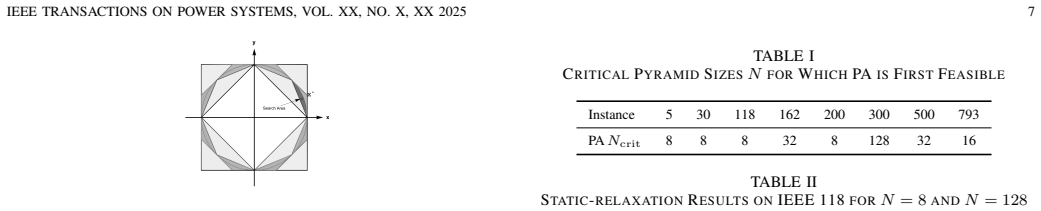
The load-bearing object is the rotation-and-fold (R&F) encoding of the 3-D second-order cone surface, which maps each point through K rotations and folds into a narrow sector and then adds either one linear facet or one or two cuts. It reduces the number of binaries from O(2^K) to O(K), and its nesting property—X_{K+1} ⊆ X_K for PR and QPR—is what allows cuts from deeper levels to be appended on the fly inside a branch-and-cut solver. The paper also proves an equivalence theorem showing the R&F system exactly encodes the direct pyramid, and a cut-generation rule that adds outer tangent cuts without introducing new binaries while inner cuts are added at minimal depth.
What would settle it
Take a small test network where the branch flow model's angle recovery condition is active, such as a tie line with voltage angle difference approaching ±π/2, solve the K-stage pyramidal and quasi-pyramidal relaxations with large K, and compare the recovered point with a global solution of the full AC OPF obtained by an independent method. If the recovered point has negligible conic error but is infeasible for the true AC OPF or has an objective gap above tolerance, then ε-feasibility for OPF-ar does not certify global optimality for AC OPF as stated.
Extended reading notes
Core claim
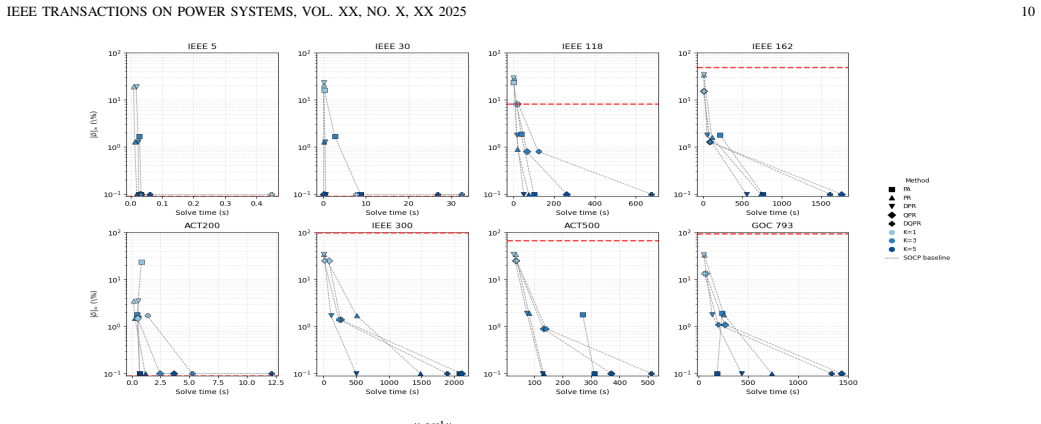
The central discovery is that the three-dimensional second-order-cone surface for each branch can be replaced by a union of wedges, encoded by a rotation-and-fold construction with only O(K) binary variables, in two different ways that are true relaxations rather than approximations, so feasibility of the AC model is never lost. Theorem 2 quantifies the error: a K-stage pyramidal relaxation is tan²(π/$2^{{K+2}}$)-feasible, a K-stage quasi-pyramidal relaxation is sin²(π/$2^{{K+2}}$)-feasible, and both errors go to zero as K increases. The paper therefore converts the inexactness of the classical SOCP relaxation into a tunable parameter, and it claims to recover globally optimal solutions of the branch-flow SOCSP model by refining K. On eight standard benchmark networks, the experiments show maximum relative conic error falling below 0.1 percent at K=5, with dynamic variants matching their static counterparts within 0.06 percent in objective while solving up to about twice as fast.
Load-bearing premise
The paper's global-optimality claim applies to the relaxed branch flow model OPF-ar, which it explicitly defines without the angle recovery condition; if matching voltage angles across branches is active in a real network, a point with tiny conic error in the relaxation can still be infeasible for the physical AC OPF, so the certificate does not transfer.
Editorial extensions
If this is right
- At a fixed stage K, PR and QPR provide guaranteed upper bounds on conic violation, so an operator can choose K from an accuracy target rather than hoping a relaxation happens to be exact.
- The dynamic methods K-DPR and K-DQPR return the same optimal solution as the static K-PR and K-QPR formulations, so the faster branch-and-cut run loses no optimality.
- Because QPR retains the SOC constraint, it achieves the smallest conic error among the static relaxations and is the option when near-zero violation is required regardless of runtime.
- Warm starts from the IV formulation give the relaxation-based methods a feasible incumbent, enabling pruning from the start, whereas the approximation-based pyramidal approximation cannot use the warm start when the point lies outside its feasible region.
- The same cut-generation architecture extends to mixed-integer AC OPF variants such as transmission switching and unit commitment by embedding extra binary decisions into the R&F wedge framework.
Reading between the lines
- The convergence theorem is about conic error, not about objective gap; a natural next question the paper leaves open is whether a point with conic error at most ε can be certified to have objective gap within a computable function of ε, which would turn ε-feasibility into an optimality certificate.
- Because the relaxation is a superset of the true SOC surface, its optimal value is a valid lower bound on the SOCSP; a practical extension would be to run the static or dynamic relaxation inside a branch-and-bound outer loop that uses both conic error and lower bound to prune, which the paper does not develop.
- The targeted cuts exploit radial symmetry of the cone, so the same rotation-and-fold idea could apply to other rank-1 or norm constraints in power systems, such as apparent-power limits or converter capacity constraints, or to low-dimensional semidefinite rank constraints.
- Angle recovery is explicitly excluded, and it is the one place where the relaxed model can disagree with the physical AC model; reintroducing virtual phase-shifters or phase-angle bounds would test whether the relaxations remain globally exact on networks where angle recovery matters.
Signed reviews
Editorial analysis
A structured set of objections, weighed in public.
Referee Report
Summary. The paper proposes a unified framework for tightening the standard SOCP relaxation of AC optimal power flow. It introduces two static piecewise relaxations, Pyramidal Relaxation (PR) and Quasi-Pyramidal Relaxation (QPR), based on a rotation-and-fold encoding of the second-order cone surface, and two dynamic branch-and-cut variants (DPR and DQPR) that generate cuts lazily. Theoretical results include an equivalence theorem for the rotation-and-fold encoding (Theorem 1), conic-error bounds for the static relaxations (Theorem 2), and consistency statements for the dynamic methods (Propositions 1 and 2). Numerical experiments on eight PGLib instances show that conic violations decrease as the partition parameter K increases, that DPR speeds up PR on larger instances, and that warm starts and LNS post-processing improve performance. The paper claims that this enables recovery of globally optimal solutions of ACOPF.
Significance. If the claims are restricted to the relaxed branch flow model OPF-ar, the paper makes a useful and credible contribution: the error bounds in Theorem 2 are derived analytically from the geometry of the cone rather than fitted to data, the rotation-and-fold encoding is logarithmic in the number of wedges, and the dynamic cut-generation mechanism is a practical way to avoid building full static models. The numerical study uses independent PGLib benchmarks and shows consistent convergence of conic error with K. However, the advertised headline result, global solution of ACOPF, is not established: the solved model explicitly excludes angle recovery, so small conic error in the relaxation does not imply feasibility for the original AC OPF in meshed networks. The core methodology appears sound for the SOCSP/OPF-ar model, but the presentation and claims must be brought in line with that scope.
major comments (3)
- [Section II-B and Section VI] The central claim in the Abstract and Conclusion, that the framework 'enabl[es] the recovery of globally optimal solutions' of ACOPF, is not supported by the model actually solved. Section II-B states that formulation (1) 'omits the angle recovery condition of the original branch flow model' and that 'angle recovery is excluded,' and the conclusion lists 'enforce nonconvex phase-angle recovery constraints which we neglect in this paper' as future work. Without angle recovery, OPF-ar is a relaxation of the full AC OPF rather than an equivalent reformulation, and a point with arbitrarily small conic error on the SOC surface need not admit a consistent voltage-angle assignment. Theorem 2 only bounds the relative conic error of the SOC-surface constraints; it says nothing about the angle recovery condition. Since most benchmark instances used in Section V are meshed, the reported objectives can lie below the true ACOPF optimum. Please reframe the title, abstract, and conclusion to claim global optimality for the SOCSP/OPF-ar model, or add the angle-recovery constraints (e.g., via the virtual phase-shifter construction of [29]) and verify AC feasibility on the meshed benchmarks.
- [Section IV-B, Proposition 1 and Appendix A-C] Proposition 1 states that K-DPR and K-DQPR produce optimal solutions to the static K-PR and K-QPR formulations, but the proof assumes that the branch-and-cut solver terminates with a global optimum of the final dynamic model and that the final incumbent has been checked against all static K-PR cuts. The experimental protocol in Section V uses a 0.1% optimality gap and a 3600 s time limit, under which neither condition is guaranteed: termination can occur with a nonzero gap and without full verification of all lazy cuts. As stated, Proposition 1 is therefore not valid for the implemented algorithm. It should be qualified as holding for exact solves, or restated in terms of the converged lazy-constraint model and the solver tolerance.
- [Section II-C and Section V-A] There is a mismatch between the theoretical error bounds and the reported numerical metric. Theorem 2 states bounds for the two decomposed 3D cones, while Section V-A explicitly states that 'all δ in this section are 4-D conic error.' The manuscript does not provide a propagation argument from the 3D decomposed-cone bounds to the 4-D relative conic error. Since the experiments are offered as validation of the theoretical guarantees, please add such an argument (for example, bounding the 4-D error by a combination of the two 3D errors under the relevant variable bounds), or report the decomposed 3D errors alongside the 4-D metric.
minor comments (5)
- [Index Terms and Introduction] There are several typos: 'dynamic relaxtion' in the Index Terms, 'relaxtation' in Section I, and 'accelerate speeds up' in Section V-C. Please proofread these passages.
- [Section III-A, Definition 3] The notation '2K+1-sided' and 'N=2K+1' appears to have lost superscripts; it should be 2^{K+1}-sided and N=2^{K+1}. Please correct the formatting for clarity.
- [Definition 2 and Theorem 2] Definition 2 defines ε-feasibility for relaxations whose feasible set is a superset of the SOC surface, but Theorem 2 also applies the term to K-PA, which is an inner approximation. Please clarify that the conic-error metric is used for any candidate feasible set, not only for supersets.
- [Figure 8 caption] The caption should state explicitly that the reported violations are 4-D relative conic errors and should define the marker and color conventions in the caption itself rather than only in the text.
- [Algorithm 4] In the ADDOUTERCUT pseudocode, the formula 'arg(ĝ_{k_i,l}, ĝ_{k_i,l}, z)' repeats the first argument; this should presumably be 'arg(ĝ_{k_i,l}, ĥ_{k_i,l}, z)'. Please fix this typo.
Circularity Check
No circular derivation: error bounds follow analytically from the wedge construction; independent PGLib benchmarks; the acknowledged angle-recovery exclusion is a scope caveat, not circularity.
full rationale
The paper's central accuracy claim is not circular: Theorem 2 is proved, not assumed, in Appendix A-B by direct trigonometry on the R&F recurrences (norm preservation g_K^2+h_K^2=x^2+y^2; Cauchy-Schwarz lower bound; explicit vertex enumeration of the PR feasible triangle), yielding the stated tan^2 theta_{K+1} and sin^2 theta_{K+1} relative-conic-error bounds. K is a user-selected discretization level, no constant is fit to the test instances, and the numerical evaluation is against the independent PGLib benchmarks, so no fitted input is renamed as a prediction. The only self-citation, [28], is used as prior work on dynamic pyramidal relaxation; the present manuscript supplies its own algorithms, pseudocode, and proofs (Propositions 1 and 2), so the citation is not load-bearing. The 'global ACOPF' wording is broader than the model actually solved: Section II-B explicitly states 'angle recovery is excluded' from OPF-ar, and the Conclusion lists 'nonconvex phase-angle recovery constraints which we neglect in this paper' as future work. This is an acknowledged scope limitation about transferring epsilon-conic feasibility to full AC feasibility in meshed networks, not a circular reduction of the derivation to its own inputs.
Assumptions & free parameters
free parameters (2)
- K (number of R&F stages) =
user-chosen per accuracy target (K=1,3,5 in experiments)
- Big-M constant for absolute-value linearization =
not specified numerically
assumptions (5)
- domain assumption The relaxed branch flow model OPF-ar with angle recovery excluded is a valid surrogate for AC OPF
- standard math The R&F construction of Ben-Tal and Nemirovski [32] and the pyramidal approximation of Zhou et al. [23] are correct and applicable to 3D SOC surfaces
- domain assumption Compactness and existence of bounds z <= z_M for each cone block
- standard math Bauer's maximum principle for convex functions over polytopes
- standard math Big-M linearization equivalence (13)
Cite this review
Pith. "Pith review of A Dynamic Relaxation Framework for Global Solution of ACOPF." pith.science (2026). https://pith.science/paper/N7WW5F3V
@misc{pith2026250613402,
  author       = {Pith},
  title        = {Pith review of: A Dynamic Relaxation Framework for Global Solution of ACOPF},
  year         = {2026},
  howpublished = {\url{https://pith.science/paper/N7WW5F3V}},
  note         = {Machine review of arXiv:2506.13402}
}
read the original abstract
Solving the Alternating Current Optimal Power Flow (AC OPF) problem to global optimality remains challenging due to its nonconvex quadratic constraints. In this paper, we present a unified framework that combines static piecewise relaxations with dynamic cut-generation mechanism to systematically tighten the classic Second-Order Cone Programming (SOCP) relaxation to arbitrarily small conic violation, thus enabling the recovery of globally optimal solutions. Two static formulations, Pyramidal Relaxation (PR) and Quasi-Pyramidal Relaxation (QPR), are introduced to tighten each branch-flow second-order cone via a finite union of wedges, providing controllable accuracy. Their dynamic counterparts, Dynamic PR (DPR) and Dynamic QPR (DQPR), embed on-the-fly cut generation within a branch-and-cut solver to improve scalability. Convergence is further accelerated through warm starts and a lightweight local-search post-processing. Extensive experiments on benchmarks demonstrate effective elimination of conic violations and flexible trade-offs between solution accuracy and runtime. Practical guidelines are derived for selecting appropriate variants based on network size and accuracy requirements.
Figures



Figures from the paper (3 more)

Reference graph
Works this paper leans on
-
[29]
Branch flow model: Relaxations and convexification-part II,
M. Farivar and S. Low, “Branch flow model: Relaxations and convexification-part II,”IEEE Transactions on Power Systems, vol. 28, no. 3, 2013
work page 2013
-
[1]
Contribution to the economic dispatch problem,
J. Carpentier, “Contribution to the economic dispatch problem,”Bulletin de la Societe Francoise des Electriciens, vol. 3, no. 8, pp. 431–447, 1962
work page 1962
-
[2]
Optimal power flow: Basic requirements for real-life problems and their solutions,
B. Stott and O. Alsac ¸, “Optimal power flow: Basic requirements for real-life problems and their solutions,” inSEPOPE XII Symposium, Rio de Janeiro, Brazil, vol. 11, 2012, pp. 1–10
work page 2012
-
[3]
Robust security constrained ACOPF via conic programming: Identifying the worst contingencies,
X. Wu, A. J. Conejo, and N. Amjady, “Robust security constrained ACOPF via conic programming: Identifying the worst contingencies,” IEEE Transactions on Power Systems, vol. 33, no. 6, pp. 5884–5891, 2018
work page 2018
-
[4]
V oltage stability constrained line- wise optimal power flow,
A. A. Mohamed and B. Venkatesh, “V oltage stability constrained line- wise optimal power flow,”IET Generation, Transmission & Distribution, vol. 13, no. 8, pp. 1332–1338, 2019
work page 2019
-
[5]
Zero duality gap in optimal power flow problem,
J. Lavaei and S. H. Low, “Zero duality gap in optimal power flow problem,”IEEE Transactions on Power Systems, vol. 27, no. 1, pp. 92–107, 2011
work page 2011
-
[6]
Optimal capacitor placement on radial distribution systems,
M. E. Baran and F. F. Wu, “Optimal capacitor placement on radial distribution systems,”IEEE Transactions on Power Delivery, vol. 4, no. 1, pp. 725–734, 1989
work page 1989
-
[7]
Branch flow model: Relaxations and convexification—Part I,
M. Farivar and S. H. Low, “Branch flow model: Relaxations and convexification—Part I,”IEEE Transactions on Power Systems, vol. 28, no. 3, pp. 2554–2564, 2013
2013
Show all 39 references
-
[8]
The IV formulation and linear approximations of the AC optimal power flow problem,
R. P. O’Neill, A. Castillo, and M. B. Cain, “The IV formulation and linear approximations of the AC optimal power flow problem,”Federal Energy Regulatory Commission, vol. 2, pp. 1–18, 2012
2012
-
[9]
A direct nonlinear predictor- corrector primal-dual interior point algorithm for optimal power flows,
Y .-C. Wu, A. S. Debs, and R. E. Marsten, “A direct nonlinear predictor- corrector primal-dual interior point algorithm for optimal power flows,” IEEE Transactions on Power Systems, vol. 9, no. 2, pp. 876–883, 1994
1994
-
[10]
Semidefinite programming for optimal power flow problems,
X. Bai, H. Wei, K. Fujisawa, and Y . Wang, “Semidefinite programming for optimal power flow problems,”International Journal of Electrical Power & Energy Systems, vol. 30, no. 6-7, pp. 383–392, 2008
2008
-
[11]
Examining the limits of the application of semidefinite programming to power flow problems,
B. C. Lesieutre, D. K. Molzahn, A. R. Borden, and C. L. DeMarco, “Examining the limits of the application of semidefinite programming to power flow problems,” in2011 49th Annual Allerton Conference on Communication, Control, and Computing (Allerton). IEEE, 2011, pp. 1492–1499
2011
-
[12]
Sparsity-exploiting moment-based relaxations of the optimal power flow problem,
D. K. Molzahn and I. A. Hiskens, “Sparsity-exploiting moment-based relaxations of the optimal power flow problem,”IEEE Transactions on Power Systems, vol. 30, no. 6, pp. 3168–3180, 2014
2014
-
[13]
Lagrangian duality and branch-and-bound algorithms for optimal power flow,
D. T. Phan, “Lagrangian duality and branch-and-bound algorithms for optimal power flow,”Operations Research, vol. 60, no. 2, pp. 275–285, 2012
2012
-
[14]
Radial distribution load flow using conic programming,
R. A. Jabr, “Radial distribution load flow using conic programming,” IEEE Transactions on Power Systems, vol. 21, no. 3, pp. 1458–1459, 2006
2006
-
[15]
The QC relaxation: A theoretical and computational study on optimal power flow,
C. Coffrin, H. L. Hijazi, and P. Van Hentenryck, “The QC relaxation: A theoretical and computational study on optimal power flow,”IEEE Transactions on Power Systems, vol. 31, no. 4, pp. 3008–3018, 2015
2015
-
[16]
Strong SOCP relaxations for the optimal power flow problem,
B. Kocuk, S. S. Dey, and X. A. Sun, “Strong SOCP relaxations for the optimal power flow problem,”Operations Research, vol. 64, no. 6, pp. 1177–1196, 2016
2016
-
[17]
DeepOPF: A deep neural network approach for security-constrained DC optimal power flow,
X. Pan, T. Zhao, M. Chen, and S. Zhang, “DeepOPF: A deep neural network approach for security-constrained DC optimal power flow,” IEEE Transactions on Power Systems, vol. 36, no. 3, pp. 1725–1735, 2020
2020
-
[18]
A survey of relaxations and approximations of the power flow equations,
D. K. Molzahn, I. A. Hiskenset al., “A survey of relaxations and approximations of the power flow equations,”Foundations and Trends® in Electric Energy Systems, vol. 4, no. 1-2, pp. 1–221, 2019
2019
-
[19]
DC power flow revisited,
B. Stott, J. Jardim, and O. Alsac ¸, “DC power flow revisited,”IEEE Transactions on Power Systems, vol. 24, no. 3, pp. 1290–1300, 2009
2009
-
[20]
A linearized OPF model with reactive power and voltage magnitude: A pathway to improve the MW-only DC OPF,
Z. Yang, H. Zhong, A. Bose, T. Zheng, Q. Xia, and C. Kang, “A linearized OPF model with reactive power and voltage magnitude: A pathway to improve the MW-only DC OPF,”IEEE Transactions on Power Systems, vol. 33, no. 2, pp. 1734–1745, 2017
2017
-
[21]
Linear approximations to AC power flow in rectangular coordinates,
S. V . Dhople, S. S. Guggilam, and Y . C. Chen, “Linear approximations to AC power flow in rectangular coordinates,” in2015 53rd Annual Allerton Conference on Communication, Control, and Computing (Allerton). IEEE, 2015, pp. 211–217
2015
-
[22]
A successive linear programming approach to solving the IV-ACOPF,
A. Castillo, P. Lipka, J.-P. Watson, S. S. Oren, and R. P. O’Neill, “A successive linear programming approach to solving the IV-ACOPF,” IEEE Transactions on Power Systems, vol. 31, no. 4, pp. 2752–2763, 2015
2015
-
[23]
Pyramidal approximation for power flow and optimal power flow,
B. Zhou, J. Fang, X. Ai, W. Yao, Z. Chen, and J. Wen, “Pyramidal approximation for power flow and optimal power flow,”IET Generation, Transmission & Distribution, vol. 14, no. 18, pp. 3774–3782, 2020
2020
-
[24]
Linear approximated formulation of AC optimal power flow using binary discretisation,
T. Akbari and M. Tavakoli Bina, “Linear approximated formulation of AC optimal power flow using binary discretisation,”IET Generation, Transmission & Distribution, vol. 10, no. 5, pp. 1117–1123, 2016. IEEE TRANSACTIONS ON POWER SYSTEMS, VOL. XX, NO. X, XX 2025 13
2016
-
[25]
Network flow and copper plate relaxations for AC transmission systems,
C. Coffrin, H. Hijazi, and P. Van Hentenryck, “Network flow and copper plate relaxations for AC transmission systems,” in2016 Power Systems Computation Conference (PSCC). IEEE, 2016, pp. 1–8
2016
-
[26]
A linear-programming approxima- tion of AC power flows,
C. Coffrin and P. Van Hentenryck, “A linear-programming approxima- tion of AC power flows,”INFORMS Journal on Computing, vol. 26, no. 4, pp. 718–734, 2014
2014
-
[27]
A multi- tree approach for global solution of ACOPF problems using piecewise outer approximations,
J. Liu, M. Bynum, A. Castillo, J.-P. Watson, and C. D. Laird, “A multi- tree approach for global solution of ACOPF problems using piecewise outer approximations,”Computers & Chemical Engineering, vol. 114, pp. 145–157, 2018
2018
-
[28]
A dynamic pyramidal relaxation method of AC OPF,
Y .-Y . Tang, L. Chen, H. Du, S.-J. Chen, C. Kou, X. Ai, and B. Zhou, “A dynamic pyramidal relaxation method of AC OPF,” in2024 9th Asia Conference on Power and Electrical Engineering (ACPEE). IEEE, 2024, pp. 345–354
2024
-
[30]
A sufficient condition on convex relaxation of AC optimal power flow in distribution networks,
S. Huang, Q. Wu, J. Wang, and H. Zhao, “A sufficient condition on convex relaxation of AC optimal power flow in distribution networks,” IEEE Transactions on Power Systems, vol. 32, no. 2, pp. 1359–1368, 2016
2016
-
[31]
L. A. Wolsey,Integer programming. John Wiley & Sons, 2020
2020
-
[32]
On polyhedral approximations of the second-order cone,
A. Ben-Tal and A. Nemirovski, “On polyhedral approximations of the second-order cone,”Mathematics of Operations Research, vol. 26, no. 2, pp. 193–205, 2001
2001
-
[33]
The power grid library for benchmarking AC optimal power flow algorithms,
S. Babaeinejadsarookolaee, A. Birchfield, R. D. Christie, C. Coffrin, C. DeMarco, R. Diao, M. Ferris, S. Fliscounakis, S. Greene, R. Huang et al., “The power grid library for benchmarking AC optimal power flow algorithms,”arXiv preprint arXiv:1908.02788, 2019
1908 arXiv
-
[34]
Powermodels. jl: An open-source framework for exploring power flow formulations,
C. Coffrin, R. Bent, K. Sundar, Y . Ng, and M. Lubin, “Powermodels. jl: An open-source framework for exploring power flow formulations,” in2018 Power Systems Computation Conference (PSCC). IEEE, 2018, pp. 1–8
2018
-
[35]
JuMP 1.0: Recent improvements to a modeling language for mathematical optimization,
M. Lubin, O. Dowson, J. Dias Garcia, J. Huchette, B. Legat, and J. P. Vielma, “JuMP 1.0: Recent improvements to a modeling language for mathematical optimization,”Mathematical Programming Computation, 2023
2023
-
[36]
Gurobi Optimizer Reference Manual,
Gurobi Optimization, LLC, “Gurobi Optimizer Reference Manual,”
-
[37]
On the implementation of an interior- point filter line-search algorithm for large-scale nonlinear programming,
A. W ¨achter and L. T. Biegler, “On the implementation of an interior- point filter line-search algorithm for large-scale nonlinear programming,” Mathematical Programming, vol. 106, pp. 25–57, 2006
2006
-
[38]
Mixed integer linear programming formulation tech- niques,
J. P. Vielma, “Mixed integer linear programming formulation tech- niques,”Siam Review, vol. 57, no. 1, pp. 3–57, 2015
2015
-
[2023]
Available: https://www.gurobi.com
[Online]. Available: https://www.gurobi.com
Reviewed August 15, 2026 · model on record in the stance chip above.
Discussion (0). Continue with ORCID to comment.