REVIEW 3 major objections 6 minor 30 references
Out the Window: A Crowd-Sourced Dataset for Activity Classification in Security Video
T0 review · 3 major / 6 minor · reviewed 2026-08-14 · deepseek-v4-flash
Pith's one-line read The paper claims that adding a crowdsourced dataset of window-view phone videos to standard surveillance training data improves activity classification accuracy by 8.3 percent, and by 12.5 percent on the hardest classes.
desk verdict The OTW dataset is a genuinely useful crowdsourced collection for security video, but the headline 8.3% LOSO improvement is undermined by early stopping on the evaluation scene and missing uncertainty estimates. read the letter →
The pith
A machine-rendered reading of the paper's core claim, the machinery that carries it, and where it could break.
The reading
What carries the argument
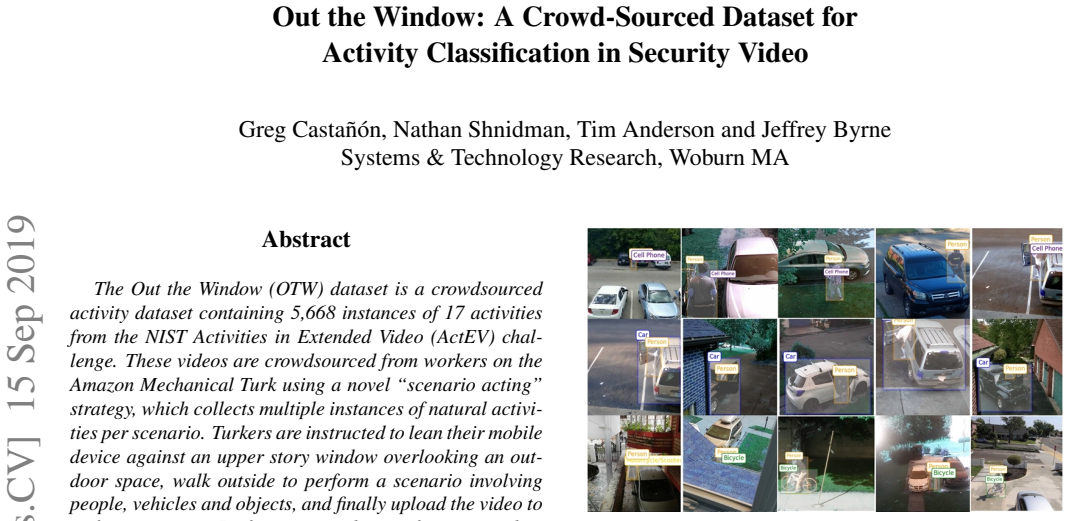
The mechanism that carries the argument is 'scenario acting': each crowd worker receives a broad everyday errand, such as going grocery shopping or going on vacation, and performs it in their own yard or driveway while their phone records from a window. Because workers are never told which discrete activities matter, the videos contain natural, varied instances of the 17 target classes without the stiffness of scripted acting. The annotation pipeline then keeps cost low: analysts mark only the first and last frame of each activity and its participating objects, and a detector plus tracker propagates boxes through the intermediate frames, with the activity bounding box defined as the convex union of object boxes. Evaluation uses a Temporal Segment Network classifier and leave-one-scene-out cross-validation, so the reported gains measure generalization to actors, viewpoints, and scenes absent from training rather than memorization of scene context.
What would settle it
Take a random sample of OTW clips, have independent annotators re-label them using the benchmark's exact activity definitions, and measure frame-level agreement with the released annotations; low agreement would show the improvement may be label noise. A complementary check is to shuffle OTW activity labels while keeping scenes fixed: if the accuracy gain survives shuffling, it comes from scene and viewpoint diversity rather than from activity semantics.
Extended reading notes
Core claim
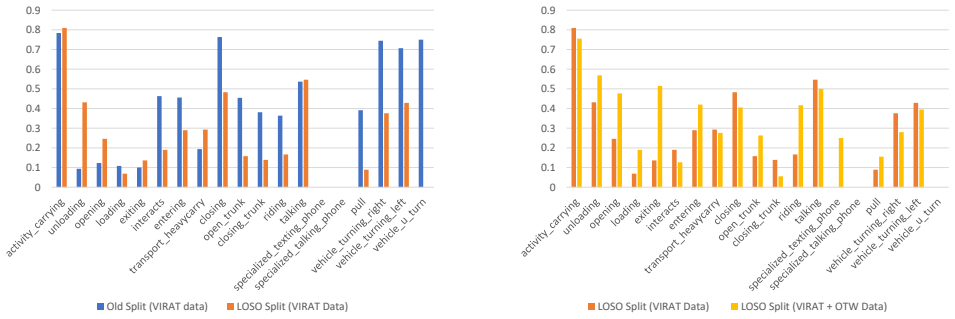
The paper's central claim is that a crowd-sourced collection protocol can supply the diversity that security-video activity models lack, and that the resulting dataset demonstrably improves a standard classifier on a standard benchmark. On the VIRAT Ground 2.0 benchmark, using the OTW dataset together with VIRAT training data raises mean classification accuracy from the VIRAT-only baseline by 8.3 percent under leave-one-scene-out cross-validation, where each model is tested on a scene it never saw in training. For the most difficult activities, those with baseline accuracies below 40 percent, the average improvement is 12.5 percent. The evaluation is closed-set classification of trimmed clips, so the reported gain is in recognizing an activity once it has been localized, not in detecting it in untrimmed video.
Load-bearing premise
The load-bearing premise is that OTW's crowd annotations are accurate and mean the same thing as the benchmark's activity definitions; if the labels are systematically wrong or systematically different, the 8.3 percent gain could be an artifact of label mismatch rather than learned activity structure.
Editorial extensions
If this is right
- OTW data plus VIRAT training improves mean accuracy by 8.3 percent over VIRAT-only training under leave-one-scene-out evaluation.
- The hardest activities, those scoring below 40 percent on the baseline, improve by 12.5 percent on average.
- The collection produced over 200 examples for every VIRAT-relevant class except pulling, riding, and cell-phone activities, cutting into the class imbalance that dominates security-video benchmarks.
- Sparse scenes and weakly trimmed clips make tracking-based annotation feasible, keeping human annotation to a few keyframes per activity while still producing spatiotemporal boxes.
- Because the gains appear under leave-one-scene-out evaluation, the benefit transfers to scenes the model has not seen, which is the setting that matters for deployed security networks.
Reading between the lines
- If the label-alignment assumption holds, the same scenario-acting recipe could be pointed at other rare or underrepresented security activities, including ones that are almost absent from social video, without studio-scale costs.
- The 15 percent gap the paper notes between OTW evaluation and VIRAT leave-one-scene-out evaluation suggests that factors other than viewpoint and actor diversity, such as camera resolution and scene clutter, still separate crowdsourced phone video from true surveillance footage; that gap is a testable target for ablation.
- The symmetric activity pairs the paper highlights (opening/closing, entering/exiting, loading/unloading) are hard because they differ mainly in temporal order, so the OTW benefit might be explained partly by restoring temporal-direction cues; flipping frame order in the OTW clips would test that.
Signed reviews
Editorial analysis
A structured set of objections, weighed in public.
Referee Report
Summary. The paper introduces the Out the Window (OTW) dataset, a crowdsourced security-video activity dataset containing 5,668 instances of 17 activities drawn from the VIRAT/ActEV taxonomy. Data is collected by instructing Amazon Mechanical Turk workers to lean a phone against an upper-story window and act out scenarios, yielding weakly trimmed clips with diverse scenes, actors, and viewpoints. Annotation combines expert keyframe labeling with Mask R-CNN detection and SORT tracking for interpolation. The authors evaluate a Temporal Segment Network on VIRAT Ground 2.0 under a default train/validation split and under Leave-One-Scene-Out cross-validation, reporting that adding OTW to VIRAT training improves mean classification accuracy by 8.3%, and by 12.5% on the most challenging activities. The dataset is released under CC BY 4.0.
Significance. If the claims hold, the OTW dataset and the ``scenario acting'' collection methodology are a meaningful contribution: they provide a security-specific activity dataset that is substantially larger and more diverse in scenes and actors than VIRAT, and the public release under CC BY 4.0 is valuable to the community. The LOSO evaluation protocol is a strong step toward controlling for scene bias, which is a well-known weakness of small security-video benchmarks. The main results, however, rest on an evaluation protocol the manuscript itself acknowledges as unfair, and the current statistical evidence is insufficient to separate the reported gains from noise or checkpoint-selection artifacts.
major comments (3)
- [Section 5 and Section 5.3] The early-stopping rule stated in Section 5 (``terminating when loss on the validation set plateaued'') is applied in LOSO cross-validation where, per Section 5.3, the left-out scene is declared to be the validation set for each fold. This means the same scene is used both to select the checkpoint and to report the final accuracy, which is a form of test-set overfitting. Because the VIRAT-only and VIRAT+OTW training sets differ in size and loss dynamics, the inflation from this selection can differ between the two compared models, so the reported 8.3% improvement may be an artifact of checkpoint selection rather than a measure of OTW's contribution. Please re-run the experiments with a nested validation split (e.g., hold out the test scene, use one of the training scenes for early stopping) and report the results obtained with checkpoints selected without any information from the left-out scene.
- [Section 5.3, Figure 8] The central comparison is reported only as a mean accuracy improvement over five LOSO folds, without per-fold numbers, error bars, confidence intervals, or significance tests. With only five folds, the 8.3% mean difference is not distinguishable from random variation. In addition, the 12.5% improvement is computed on a post-hoc subset of activities whose accuracy fell below 40%, selected from the same results that are being summarized, with no correction for multiple comparisons or a pre-specified definition of ``challenging.'' Please report the per-fold accuracy matrix, provide confidence intervals or a paired test over scenes or classes, and define the challenging subset before running the evaluation.
- [Section 4] The utility claim for OTW presupposes that OTW activity labels are semantically consistent with the VIRAT labels used for evaluation, but the manuscript only states that ``we tried to keep these definitions close'' and provides no inter-annotator agreement, no frame-level comparison of automatically interpolated boxes against human annotations, and no explicit reconciliation of the 17 OTW labels with their VIRAT counterparts. If the OTW labels are systematically noisier or semantically shifted, the reported transfer improvement could reflect label mismatch rather than learned activity structure. Please report annotation-quality statistics (e.g., temporal-boundary agreement, box IoU between interpolation and human re-annotation on a held-out sample) and describe the label alignment procedure in detail.
minor comments (6)
- [Section 1] In the bullet on efficient annotation, ``automataed object detection'' should be ``automated object detection.''
- [Section 3.1] In the description of scenario acting, ``enteirng a car'' should be ``entering a car.''
- [Section 5.3] ``classification ac curacies'' should be ``classification accuracies.''
- [Figure 6 caption] The caption states ``8 object label,'' but the table lists nine object types; this should be corrected to ``9 object labels.''
- [Section 5.2 and Figure 7] The right panel of Figure 7 reports the default-split comparison described in Section 5.2, but the caption does not state this explicitly; clarify that Figure 7 uses the train/validation split from Section 5.1, while Figure 8 uses LOSO, to avoid confusion.
- [References] References [25] and [26] both describe Temporal Segment Networks; the text in Section 5 cites [26] while the related work section cites [25]. Please cite the ECCV version consistently for the architectural details and the TPAMI version for the journal extension, or otherwise disambiguate the two references in the text.
Circularity Check
No circular derivation: the OTW utility claim rests on an external empirical benchmark, not on a fitted parameter or self-citation chain.
full rationale
The paper's central claim is that adding the externally collected OTW dataset to VIRAT training data improves mean classification accuracy under Leave-One-Scene-Out cross-validation. This is an empirical comparison between two models trained on independent data sources and evaluated on a held-out VIRAT scene. No parameter is fitted to the reported accuracy and then renamed as a prediction; the OTW dataset is not defined in terms of VIRAT performance, and the VIRAT evaluation is not derived from OTW annotations by construction. The paper contains no self-citation chain that is load-bearing for the main result. The admitted practice of terminating training when validation loss plateaus and then evaluating on that same validation set (Section 5, 'Note that this approach is a bit unfair - we terminate based on validation loss and also evaluate on the validation set') is a real methodological limitation that can bias the reported numbers, but it is not circularity: the bias applies to both compared models and does not make the 8.3% improvement equal to an input by definition. Likewise, the unverified semantic alignment between OTW and VIRAT activity definitions ('we tried to keep these definitions close to those in the VIRAT dataset') is an assumption about label quality, not a circular step. The dataset is released under an external license and the comparison is against an independent benchmark, so the honest finding is no significant circularity.
Assumptions & free parameters
assumptions (4)
- domain assumption OTW class definitions align with VIRAT definitions for shared activity names.
- domain assumption Kinetics-pretrained TSN weights are a useful initialization for the security-video domain.
- domain assumption The Mask R-CNN and SORT tracking interpolation produces annotations accurate enough for training.
- domain assumption Crowd-sourced scenario acting yields videos whose viewpoint and content overlap enough with security video for positive transfer.
Cite this review
Pith. "Pith review of Out the Window: A Crowd-Sourced Dataset for Activity Classification in Security Video." pith.science (2026). https://pith.science/paper/NA3GRB2U
@misc{pith2026190810899,
  author       = {Pith},
  title        = {Pith review of: Out the Window: A Crowd-Sourced Dataset for Activity Classification in Security Video},
  year         = {2026},
  howpublished = {\url{https://pith.science/paper/NA3GRB2U}},
  note         = {Machine review of arXiv:1908.10899}
}
read the original abstract
The Out the Window (OTW) dataset is a crowdsourced activity dataset containing 5,668 instances of 17 activities from the NIST Activities in Extended Video (ActEV) challenge. These videos are crowdsourced from workers on the Amazon Mechanical Turk using a novel scenario acting strategy, which collects multiple instances of natural activities per scenario. Turkers are instructed to lean their mobile device against an upper story window overlooking an outdoor space, walk outside to perform a scenario involving people, vehicles and objects, and finally upload the video to us for annotation. Performance evaluation for activity classification on VIRAT Ground 2.0 shows that the OTW dataset provides an 8.3% improvement in mean classification accuracy, and a 12.5% improvement on the most challenging activities involving people with vehicles.
Figures


Figures from the paper (6 more)



Reference graph
Works this paper leans on
-
[1]
Youtube-8m: A large-scale video classifi- cation benchmark
A BU-E L-H AIJA , S., K OTHARI , N., L EE, J., N ATSEV, P., T ODERICI , G., V ARADARAJAN , B., AND VIJAYA- NARASIMHAN , S. Youtube-8m: A large-scale video classifi- cation benchmark. arXiv preprint arXiv:1609.08675 (2016). 1, 3
arXiv 2016
-
[2]
Simple online and realtime tracking
B EWLEY , A., G E, Z., O TT, L., R AMOS , F., AND UP- CROFT , B. Simple online and realtime tracking. In ICIP (2016). 5
work page 2016
-
[3]
Activitynet: A large-scale video benchmark for human activity understanding
C ABA HEILBRON , F., E SCORCIA , V., G HANEM , B., AND CARLOS NIEBLES , J. Activitynet: A large-scale video benchmark for human activity understanding. In Proceed- ings of the IEEE Conference on Computer Vision and Pattern Recognition (2015), pp. 961–970. 3
work page 2015
-
[4]
Quo vadis, action recognition? a new model and the kinetics dataset
C ARREIRA , J., AND ZISSERMAN , A. Quo vadis, action recognition? a new model and the kinetics dataset. In Com- puter Vision and Pattern Recognition (CVPR), 2017 IEEE Conference on (2017), IEEE, pp. 4724–4733. 1
work page 2017
-
[5]
D UTTA, A., G UPTA, A., AND ZISSER - MANN , A. VGG image annotator (VIA). http://www.robots.ox.ac.uk/ vgg/software/via/, 2016. Version: 2.0.5, Accessed: 3/6/2019. 5
work page 2016
-
[6]
Caviar: Context aware vision using image-based active recognition, 2005
F ISHER , R., S ANTOS -VICTOR , J., AND CROWLEY, J. Caviar: Context aware vision using image-based active recognition, 2005. 2
work page 2005
-
[7]
The ActivityNet Large-Scale Activity Recognition Challenge 2018 Summary
G HANEM , B., N IEBLES , J. C., S NOEK , C., H EILBRON , F. C., A LWASSEL , H., E SCORCIA , V., K RISHNA , R., BUCH , S., AND DAO, C. D. The activitynet large- scale activity recognition challenge 2018 summary. CoRR abs/1808.03766 (2018). 1
work page Pith review arXiv 2018
-
[8]
A Proposal-Based Solution to Spatio-Temporal Action Detection in Untrimmed Videos
G LEASON , J., R ANJAN , R., S CHWARCZ , S., C ASTILLO , C., C HENG , J., AND CHELLAPPA , R. A proposal-based solution to spatio-temporal action detection in untrimmed videos. In arXiv:1811.08496 (2019). 1
work page Pith review arXiv 2019
Show all 30 references
-
[9]
Actions as space-time shapes
G ORELICK , L., B LANK , M., S HECHTMAN , E., I RANI , M., AND BASRI , R. Actions as space-time shapes. IEEE trans- actions on pattern analysis and machine intelligence 29 , 12 (2007), 2247–2253. 2, 3
2007
-
[10]
Making the v in vqa matter: Elevating the role of image understanding in visual question answering
G OYAL, Y., K HOT, T., S UMMERS -S TAY, D., B ATRA, D., AND PARIKH , D. Making the v in vqa matter: Elevating the role of image understanding in visual question answering. In CVPR (2017). 3
2017
-
[11]
A., V ONDRICK , C., P ANTO - FARU, C., L I, Y., V IJAYANARASIMHAN , S., T ODERICI , G., R ICCO , S., S UKTHANKAR , R., ET AL
G U, C., S UN, C., R OSS , D. A., V ONDRICK , C., P ANTO - FARU, C., L I, Y., V IJAYANARASIMHAN , S., T ODERICI , G., R ICCO , S., S UKTHANKAR , R., ET AL . Ava: A video dataset of spatio-temporally localized atomic visual actions. In Proceedings of the IEEE Conference on Comp...
2018
-
[12]
Mask r-cnn
H E, K., G KIOXARI , G., D OLLAR , P., AND GIRSHICK , R. Mask r-cnn. In ICCV (2017). 5
2017
-
[13]
THU- MOS challenge: Action recognition with a large number of classes, 2014
J IANG , Y.-G., L IU, J., R OSHAN ZAMIR , A., T ODERICI , G., L APTEV , I., S HAH , M., AND SUKTHANKAR , R. THU- MOS challenge: Action recognition with a large number of classes, 2014. 2
2014
-
[14]
Large-scale video classification with convolutional neural networks
K ARPATHY, A., T ODERICI , G., S HETTY , S., L EUNG , T., SUKTHANKAR , R., AND FEI-F EI, L. Large-scale video classification with convolutional neural networks. In Pro- ceedings of the IEEE conference on Computer Vision and Pattern Recognition (2014), pp. 1725–1732. 1, 3
2014
-
[15]
The kinetics hu- man action video dataset
K AY, W., C ARREIRA , J., S IMONYAN , K., Z HANG , B., H ILLIER , C., V IJAYANARASIMHAN , S., V IOLA , F., GREEN , T., BACK, T., NATSEV, P., ET AL . The kinetics hu- man action video dataset. arXiv preprint arXiv:1705.06950 (2017). 3
2017 arXiv
-
[16]
Hmdb: a large video database for human motion recognition
K UEHNE , H., J HUANG , H., G ARROTE , E., P OGGIO , T., AND SERRE , T. Hmdb: a large video database for human motion recognition. In 2011 International Conference on Computer Vision (2011), IEEE, pp. 2556–2563. 2
2011
-
[17]
Recognizing human ac- tions: a local svm approach
L APTEV , I., C APUTO , B., ET AL . Recognizing human ac- tions: a local svm approach. In null (2004), IEEE, pp. 32–36. 2, 3
2004
-
[18]
A., Y AN, T., B ROWN , L., F AN, Q., GUTFRUEND , D., V ONDRICK , C., ET AL
M ONFORT , M., A NDONIAN , A., Z HOU , B., R AMAKRISH - NAN, K., B ARGAL , S. A., Y AN, T., B ROWN , L., F AN, Q., GUTFRUEND , D., V ONDRICK , C., ET AL . Moments in time dataset: one million videos for event understanding. arXiv preprint arXiv:1801.03150 (2018). 1
2018 arXiv
-
[19]
T., M UKHERJEE , S., A GGARWAL , J., L EE, H., D AVIS, L., ET AL
O H, S., H OOGS , A., P ERERA , A., C UNTOOR , N., C HEN , C.-C., L EE, J. T., M UKHERJEE , S., A GGARWAL , J., L EE, H., D AVIS, L., ET AL . A large-scale benchmark dataset for event recognition in surveillance video. In Computer vision and pattern recognition (CVPR), 2011 IE...
2011
-
[20]
A., V AROL , G., W ANG , X., F ARHADI , A., L APTEV , I., AND GUPTA, A
S IGURDSSON , G. A., V AROL , G., W ANG , X., F ARHADI , A., L APTEV , I., AND GUPTA, A. Hollywood in homes: Crowdsourcing data collection for activity understanding. In European Conference on Computer Vision (2016), Springer, pp. 510–526. 3
2016
-
[21]
Two-stream con- volutional networks for action recognition in videos
S IMONYAN , K., AND ZISSERMAN , A. Two-stream con- volutional networks for action recognition in videos. In Advances in neural information processing systems (2014), pp. 568–576. 6 8
2014
-
[22]
R., AND SHAH , M
S OOMRO , K., Z AMIR , A. R., AND SHAH , M. Ucf101: A dataset of 101 human actions classes from videos in the wild. arXiv preprint arXiv:1212.0402 (2012). 2
2012 arXiv
-
[23]
UCF aerial action dataset
UCF. UCF aerial action dataset. http://server.cs. ucf.edu/vision/aerial/index.html, 2009. 2
2009
-
[24]
Cider: Consensus-based image description evaluation
V EDANTAM , R., L AWRENCE ZITNICK , C., AND PARIKH , D. Cider: Consensus-based image description evaluation. In Proceedings of the IEEE conference on computer vision and pattern recognition (2015), pp. 4566–4575. 3
2015
-
[25]
W ANG , L., X IONG , Y., W ANG , Z., Q IAO, Y., L IN, D., TANG , X., AND GOOL , L. V. Temporal segment networks for action recognition in videos. In TPAMI (2018). 2
2018
-
[26]
Temporal segment net- works: Towards good practices for deep action recogni- tion
W ANG , L., X IONG , Y., W ANG , Z., Q IAO, Y., L IN, D., TANG , X., AND VAN GOOL , L. Temporal segment net- works: Towards good practices for deep action recogni- tion. In European conference on computer vision (2016), Springer, pp. 20–36. 5
2016
-
[27]
Non- local neural networks
W ANG , X., G IRSHICK , R., G UPTA, A., AND HE, K. Non- local neural networks. In Proceedings of the IEEE Confer- ence on Computer Vision and Pattern Recognition (2018), pp. 7794–7803. 6
2018
-
[28]
A structured model for action detection
Z HANG , Y., T OKMAKOV , P., H EBERT , M., AND SCHMID , C. A structured model for action detection. In The IEEE Conference on Computer Vision and Pattern Recognition (CVPR) (June 2019). 1
2019
-
[29]
Tra- jectory series analysis based event rule induction for visual surveillance
Z HANG , Z., H UANG , K., T AN, T., AND WANG , L. Tra- jectory series analysis based event rule induction for visual surveillance. In 2007 IEEE Conference on Computer Vision and Pattern Recognition (2007), IEEE, pp. 1–8. 2
2007
-
[30]
Hacs: Human action clips and segments dataset for recognition and temporal localization
Z HAO, H., Y AN, Z., T ORRESANI , L., AND TORRALBA , A. Hacs: Human action clips and segments dataset for recognition and temporal localization. arXiv preprint arXiv:1712.09374 (2019). 3 9 Figure 9. Annotation examples from the OTW dataset, where each row corresponds to an act...
2019 arXiv
Reviewed August 14, 2026 · model on record in the stance chip above.
Discussion (0). Continue with ORCID to comment.