REVIEW 2 major objections 3 minor 43 references
Explanation of electron and muon g-2 anomalies in the MSSM
T0 review · 2 major / 3 minor · reviewed 2026-08-14 · deepseek-v4-flash
Pith's one-line read The MSSM can explain both the muon and electron g-2 anomalies without flavor mixing, provided selectrons and a wino-like chargino are light and smuons are heavier.
desk verdict A real existence proof that the MSSM can explain both g-2 anomalies without flavor violation, but the LHC-compatibility pillar is argued, not recast, and the 'sharp prediction' is really an inversion of the fit. read the letter →
The pith
A machine-rendered reading of the paper's core claim, the machinery that carries it, and where it could break.
The reading
What carries the argument
The central objects are the two one-loop MSSM amplitudes, the chargino-sneutrino contribution $a_{\chi^{\pm}_1}^{\chi^{\pm}}$ and the bino-slepton contribution $a_{\chi^{0}_1}^{\chi^{0}}$, given in Eqs. (5) and (6). The sign of the chargino-sneutrino term is controlled by $\mathrm{sign}(\mu M_2)$, while that of the bino-slepton term is controlled by $\mathrm{sign}(\mu M_1)$; the paper exploits $M_1 M_2 < 0$ to make the two contributions opposite in sign. The second crucial ingredient is the different decoupling behavior: the bino-slepton contribution falls roughly as $1/m_{\tilde{\ell}}^4$, while the chargino-sneutrino contribution falls more slowly (roughly $1/m_{\tilde{\nu}}^2$ or $1/(\mu M_2)$ in the relevant limits), so raising the smuon masses suppresses the negative bino-smuon term while leaving the positive chargino-sneutrino term to dominate the muon g-2. The selectron left-right mixing term $m_e(\mu\tan\beta - A_e)$ enhances the bino-selectron contribution, making a large negative electron g-2 possible with light selectrons.
What would settle it
A public recast of the ATLAS soft-lepton search (ATLAS-CONF-2019-014) applied to the exact BP-1 and BP-2 production cross-sections and decay kinematics would settle the central claim: if the recast excludes a wino-like chargino near 180 GeV (BP-1) or 120 GeV (BP-2) with splittings of 2-4 GeV, then the claimed evasion fails and the simultaneous explanation collapses.
Extended reading notes
Core claim
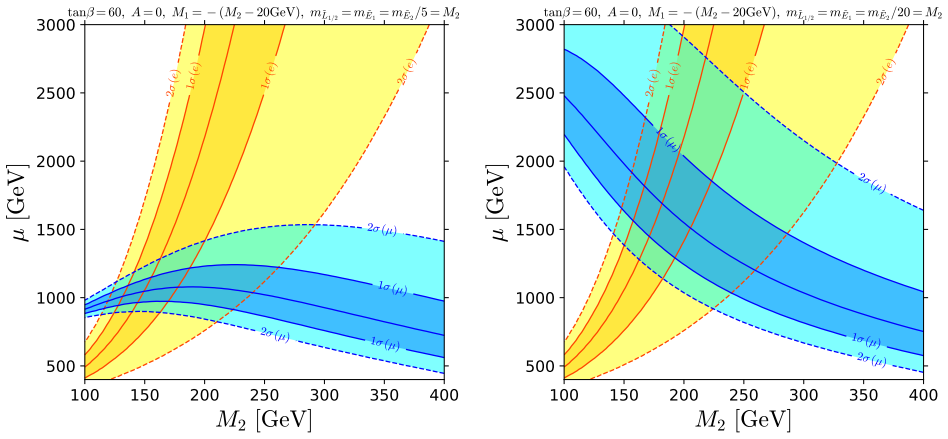
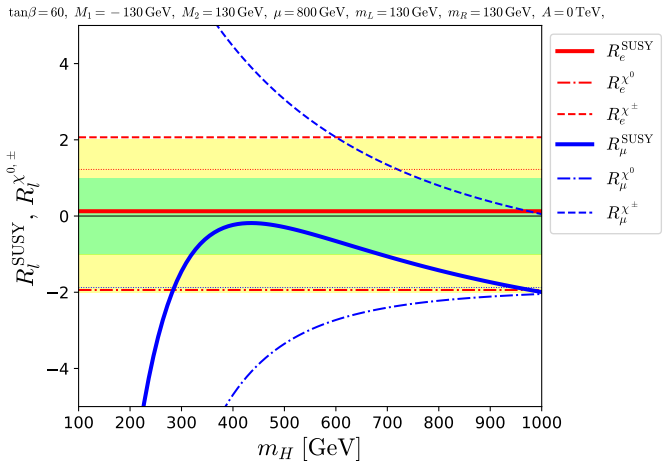
The discovery claim is that both g-2 anomalies can be fitted in the MSSM by choosing the sign relation $M_1 M_2 < 0$ while making the selectron sector light and the smuons heavier. With $\mu M_1 < 0$ the bino-selectron loop gives a negative contribution to the electron g-2, while with $\mu M_2 > 0$ the chargino-sneutrino loop gives a positive contribution to the muon g-2; if smuons are heavy enough the wrong-sign bino-smuon term is suppressed. The paper presents two viable spectra: one with a heavy right-handed smuon (BP-1), and one motivated by Higgs-mediated supersymmetry breaking with both left- and right-handed smuons heavy (BP-2). In both benchmark points the supersymmetric contributions place electron and muon g-2 within $1\sigma$ of the measured central values, with light selectrons and a wino-like chargino of masses about 120-200 GeV that evade LHC constraints because the mass splittings to the bino LSP are only a few GeV and the decay chains are three-body, soft-lepton, or electron-dominated.
Load-bearing premise
The benchmark spectra escape LHC constraints only if the existing compressed-spectrum searches genuinely miss the particular kinematics here, namely mass splittings of only 2-4 GeV, three-body decay chains, and electron-only or very soft final states; a full recast of those searches placing a stronger limit on the wino-like chargino or selectron masses would exclude the claimed parameter space.
Editorial extensions
If this is right
- A simultaneous fit requires $M_1 M_2 < 0$, so the bino and wino soft masses must have opposite signs; this is a sharp, testable prediction of the MSSM parameter space.
- Selectrons and the wino-like chargino must be below about 200 GeV (BP-1) or 150 GeV (BP-2), near the LEP bound, with smuons at least several times heavier.
- The spectra are highly compressed: the wino-like chargino and the bino LSP are split by only 2-4 GeV and sleptons are split by 25-30 GeV, so the model predicts soft-lepton and soft-photon signatures that future dedicated compressed-spectrum searches could observe.
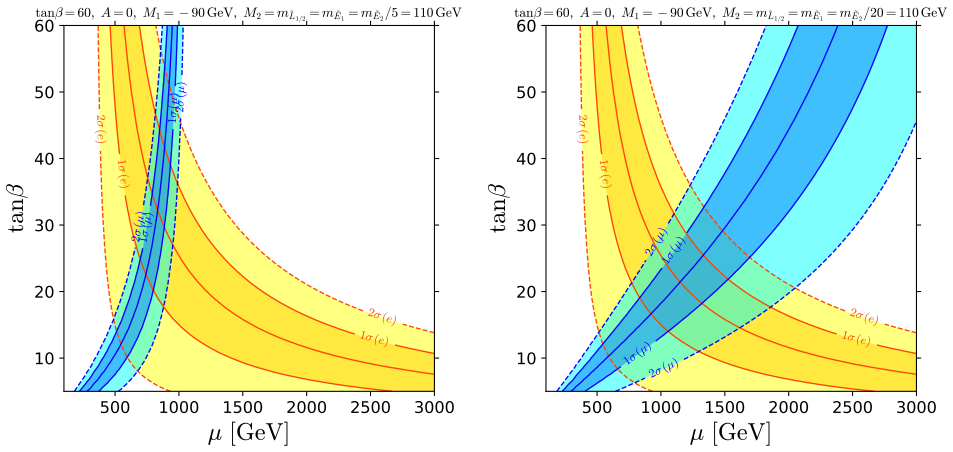
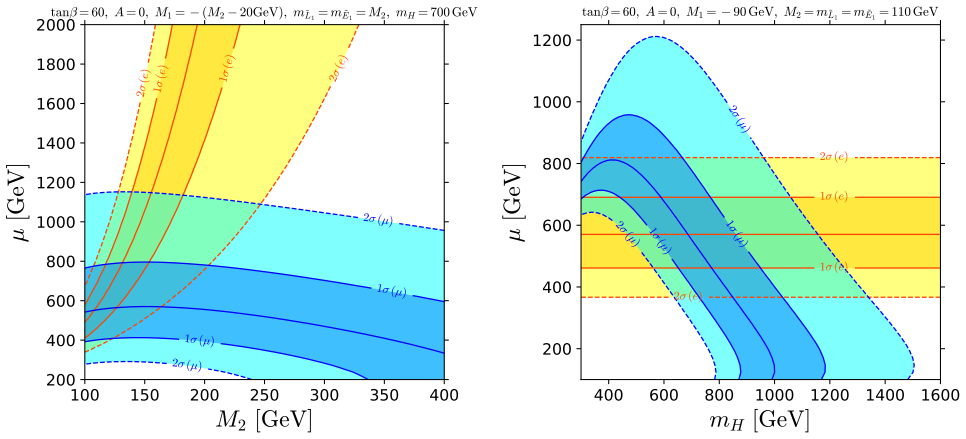
- Large $\tan\beta$ (at least 15-40 depending on the scenario) and a higgsino mass of order 1 TeV are preferred, while $A$-terms are taken to vanish.
- No explicit lepton-flavor violation is introduced; in the Higgs-mediated scenario the smuon-selectron mass splitting arises from Yukawa-proportional soft terms, which naturally suppresses $\mu\to e\gamma$.
Reading between the lines
- If the mechanism is correct, a future high-luminosity soft-lepton search at the LHC, or a dedicated search for compressed chargino production, should see an excess in exactly the mass-splitting and final-state configurations described for BP-1 and BP-2.
- The same sign-splitting trick could generalize beyond the MSSM: any new-physics model with two one-loop contributions whose signs depend on different mass parameters and which decouple at different rates can accommodate opposite-sign lepton g-2 anomalies without flavor violation.
- The preferred large $\tan\beta$ and light selectron sector may be in tension with other observables such as the Higgs mass and $B$-physics constraints; a full MSSM scan including the Higgs sector could shrink or exclude the benchmark regions.
- Even without explicit flavor mixing, the large smuon-selectron mass splitting could induce flavor-violating processes at loop level; computing $\mu\to e\gamma$ with the actual spectrum would provide a direct cross-check of the scenario against the MEG bound.
Editorial analysis
A structured set of objections, weighed in public.
Referee Report
Summary. The paper proposes a Minimal Supersymmetric Standard Model (MSSM) explanation of the simultaneous deviations in the electron and muon anomalous magnetic moments without introducing explicit lepton-flavour mixing. The key idea is to arrange the two dominant one-loop supersymmetric contributions, the bino-slepton term and the chargino-sneutrino term, so that they have opposite relative signs between the electron and muon sectors. The authors choose M1 and M2 with opposite signs, make smuons heavier than selectrons, and present two benchmark scenarios: BP-1 with a very heavy right-handed smuon, and BP-2 motivated by the Higgs-mediation mass pattern of Eq. (14). Both scenarios require very light selectrons and a wino-like chargino near the LEP bound, with compressed spectra argued to evade LHC searches. The SUSY contributions are computed at one loop following Martin and Wells and cross-checked with MicrOMEGAs; masses, branching ratios, and NLO cross sections are obtained with SuSpect, SDecay, and Prospino. The paper concludes that both g-2 anomalies can be explained within 1 sigma while remaining consistent with LHC constraints.
Significance. If the result holds, the paper provides an existence proof for a lepton-flavour-conserving MSSM parameter region that accommodates the observed electron and muon g-2 anomalies, with two different theoretically motivated mass patterns that achieve the required sign flip. The strengths are that the benchmark points are fully specified, the one-loop calculation is cross-checked against an independent code, and the relevant masses, branching ratios, and NLO cross sections are computed with standard public tools. The main weakness is the LHC-constraint analysis: the paper argues qualitatively that compressed spectra and particular decay kinematics make existing searches inapplicable, but it does not perform a recast or a quantitative acceptance estimate. Since LHC consistency is a central part of the claim, the significance is conditional on a more rigorous collider treatment.
major comments (2)
- [Sec. 3.1] The claim that BP-1 evades LHC constraints is under-supported. The paper notes that ATLAS-CONF-2019-014 quotes a lower limit near 170 GeV for a chargino with a 4 GeV mass splitting in the chi_1^+- chi_2^0 -> W* Z* chi_1^0 chi_1^0 simplified topology, and that BP-1 has m(chi_1^+-) about 179.7 GeV. However, the argument that this limit cannot be applied because BP-1 has chi_1^+ chi_1^- production and three-body decays requires quantitative verification via a recast: the ATLAS limit comes from a shape fit, and a different production and decay chain can have a different acceptance. With sigma(chi_1^+- chi_2^0) about 2.44 pb and sigma(chi_1^+ chi_1^-) about 1.21 pb, the signal is not negligible, and no estimate of the passing event rate is given. Without such an estimate, the conclusion that BP-1 is allowed by the LHC is not established.
- [Sec. 4.1] The LHC-consistency argument for BP-2 is similarly qualitative and more delicate because the masses are closer to the quoted limits. The wino-like chargino has mass 123.5 GeV with a 2 GeV splitting, and the paper quotes the ATLAS soft-dilepton limit as about 100 GeV for that splitting. The production cross sections are large: sigma(chi_1^+- chi_2^0) about 8.89 pb and sigma(chi_1^+ chi_1^-) about 4.48 pb. The paper argues that electron-only final states and mostly invisible neutralino decays make the searches inapplicable, but no recast or acceptance estimate is provided. The smuon discussion compares the total dimuon cross section (about 0.14 fb) with a cross-section limit (about 0.24 fb) without including selection efficiencies, which is not a rigorous exclusion. A full or simplified recast of the relevant soft-lepton and slepton searches is needed before BP-2 can be claimed to satisfy the LHC constraints.
minor comments (3)
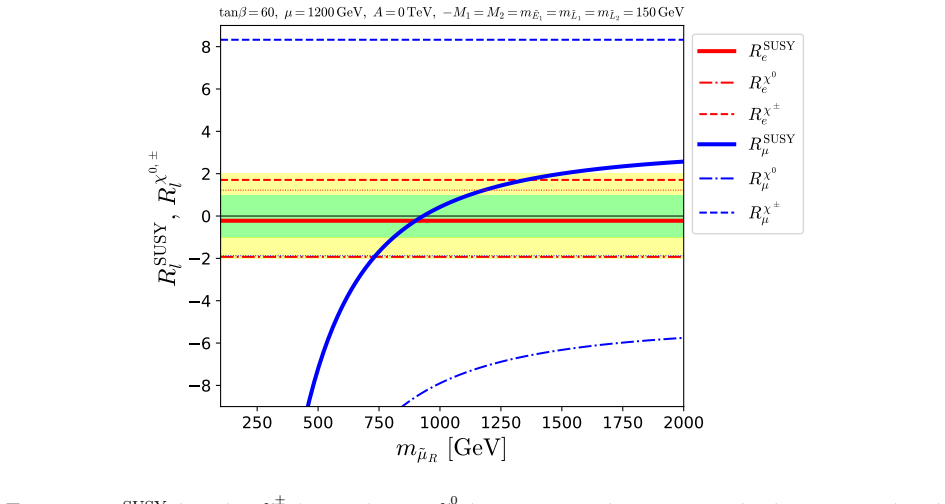
- [Sec. 2, text after Eq. (10)] The decoupling limits in the text have the wrong signs: with the definitions in Eqs. (1), (2), and (10), the no-SUSY limits are R_SUSY_mu approx -3.8 and R_SUSY_e approx +2.4, not the values '3.8' and '-2.4' as printed. The benchmark-point values and Figure 1 are consistent with the correct signs, so this appears to be an exposition error.
- [Figure 3] The caption indicates a scan in the tan beta-mu plane, but the label inside the plot still reads 'tan beta = 60', which is inconsistent with the scanned variable and should be corrected.
- [Sec. 3.1] The sentence 'The BP-1 evades this constraints' contains a grammatical error and should be rephrased.
Circularity Check
No significant circularity: the MSSM parameter choices are fitted to the g-2 data, and the paper explicitly labels the resulting spectrum as a fit, not an independent prediction.
full rationale
The paper's derivation chain is a standard MSSM parameter scan rather than a derivation of the anomalies from first principles. The benchmark points BP-1 and BP-2 explicitly list soft parameters, and the SUSY contributions a_e^SUSY and a_mu^SUSY are computed with the established one-loop formulas (Eqs. 5 and 6) and independently cross-checked with MicrOmegas. The paper does not claim to predict Delta-a_e and Delta-a_mu from unconstrained inputs; it states that the parameters are fitted to the measured anomalies, e.g., 'Fitting simultaneously (g-2)_e and (g-2)_mu leads to quite sharp prediction for the electroweak part of the MSSM spectrum.' The word 'prediction' there refers to the inferred sparticle spectrum, which is a consequence of the fit, but the central existence claim—that the MSSM can accommodate both anomalies without flavour mixing—is established by explicit computation against external experimental constraints (LEP, LHC searches). The self-citations (e.g., Ref. [31] for bino-wino mixing suppression) are peripheral remarks on mass splitting and are not load-bearing for the central result. The LHC-evasion arguments are kinematic and not based on a full recast, but that is a robustness or correctness concern, not circularity. No step in the chain is equivalent by construction to its input.
Assumptions & free parameters
free parameters (8)
- M1 (bino soft mass) =
-180 GeV (BP-1), -125 GeV (BP-2)
- M2 (wino soft mass) =
170 GeV (BP-1), 118 GeV (BP-2)
- μ (higgsino mass parameter) =
1700 GeV (BP-1), 700 GeV (BP-2)
- tanβ =
60 (both benchmarks); lower bound varies with scenario (about 15 for BP-1-like, about 40 for BP-2-like)
- m_tilde_E1 (right-handed selectron soft mass) =
200 GeV (BP-1), 120 GeV (BP-2)
- m_tilde_L1 = m_tilde_L2 (left-handed slepton soft masses) =
200 GeV (BP-1), 140 GeV (BP-2)
- m_tilde_E2 (right-handed smuon soft mass) =
2000 GeV (BP-1); 711.6 GeV physical mass in BP-2 (from m_H = 700 GeV)
- m_H (Higgs-mediation mass parameter) =
700 GeV (BP-2); not used in BP-1
assumptions (5)
- domain assumption The MSSM is the underlying framework with its standard particle content and interactions.
- standard math The one-loop SUSY contributions are given by Eqs. (5) to (8), taken from Moroi and Martin and Wells.
- domain assumption The measured deviations Δae and Δaμ in Eqs. (1) and (2) represent genuine new physics signals.
- domain assumption In the second scenario, the soft mass matrices have the Higgs-mediation form of Eqs. (14) and (15).
- domain assumption Existing LHC compressed-spectrum searches do not exclude the benchmark points.
Cite this review
Pith. "Pith review of Explanation of electron and muon g-2 anomalies in the MSSM." pith.science (2026). https://pith.science/paper/NA3HENU7
@misc{pith2026190803607,
  author       = {Pith},
  title        = {Pith review of: Explanation of electron and muon g-2 anomalies in the MSSM},
  year         = {2026},
  howpublished = {\url{https://pith.science/paper/NA3HENU7}},
  note         = {Machine review of arXiv:1908.03607}
}
read the original abstract
The current experimental values of anomalous magnetic moments of muon and electron deviate from the Standard Model predictions by few standard deviations, which might be a hint of new physics. The sizes and signs of these deviations are different and opposite between the electron and muon, which makes it difficult to explain both of these anomalies in a consistent model without introducing large flavour-violating effects. It is shown that they can be simultaneously explained in the Minimal Supersymmetric Standard Model (MSSM) by arranging the sizes of bino-slepton and chargino-sneutrino contributions differently between the electron and muon sectors. The MSSM spectrum features very light selectrons and wino-like chargino, while they can evade LHC constraints due to degenerate spectra.
Figures
Figures from the paper (2 more)
Reference graph
Works this paper leans on
-
[1]
Final Report of the Muon E821 Anoma- lous Magnetic Moment Measurement at BNL,
G. W. Bennett et al. [Muon g-2 Collaboration], “Final Report of the Muon E821 Anoma- lous Magnetic Moment Measurement at BNL,” Phys. Rev. D 73 (2006) 072003 [hep- ex/0602035]
arXiv 2006
-
[2]
Calculation of the hadronic vacuum polarization contribution to the muon anomalous magnetic moment,
T. Blum et al. [RBC and UKQCD Collaborations], “Calculation of the hadronic vacuum polarization contribution to the muon anomalous magnetic moment,” Phys. Rev. Lett. 121 (2018) no.2, 022003 [arXiv:1801.07224 [hep-lat]]
arXiv 2018
-
[3]
Measurement of the fine-structure constant as a test of the Standard Model,
R. H. Parker, C. Yu, W. Zhong, B. Estey and H. Mller, “Measurement of the fine-structure constant as a test of the Standard Model,” Science 360 (2018) 191 [arXiv:1812.04130 [physics.atom-ph]]
arXiv 2018
-
[4]
New Measurement of the Electron Mag- netic Moment and the Fine Structure Constant,
D. Hanneke, S. Fogwell and G. Gabrielse, “New Measurement of the Electron Mag- netic Moment and the Fine Structure Constant,” Phys. Rev. Lett. 100 (2008) 120801 [arXiv:0801.1134 [physics.atom-ph]]. 19
arXiv 2008
-
[5]
The Muon anomalous magnetic dipole moment in the minimal supersymmet- ric standard model,
T. Moroi, “The Muon anomalous magnetic dipole moment in the minimal supersymmet- ric standard model,” Phys. Rev. D 53 (1996) 6565 Erratum: [Phys. Rev. D 56 (1997) 4424] [hep-ph/9512396]
arXiv 1996
-
[6]
Muon Anomalous Magnetic Dipole Moment in Super- symmetric Theories,
S. P. Martin and J. D. Wells, “Muon Anomalous Magnetic Dipole Moment in Super- symmetric Theories,” Phys. Rev. D 64 (2001) 035003 [hep-ph/0103067]
arXiv 2001
-
[7]
Weak interaction corrections to the muon magnetic moment and to muonic atom energy levels,
R. Jackiw and S. Weinberg, “Weak interaction corrections to the muon magnetic moment and to muonic atom energy levels,” Phys. Rev. D 5 (1972) 2396
work page 1972
-
[8]
The Second Order Weak Correction to (G-2) of the Muon in Arbitrary Gauge Models,
J. P. Leveille, “The Second Order Weak Correction to (G-2) of the Muon in Arbitrary Gauge Models,” Nucl. Phys. B 137 (1978) 63
work page 1978
Show all 43 references
-
[9]
Secluded U(1) below the weak scale,
M. Pospelov, “Secluded U(1) below the weak scale,” Phys. Rev. D 80 (2009) 095002 [arXiv:0811.1030 [hep-ph]]
2009 arXiv
-
[10]
Combined explanations of (g− 2)µ,e and implications for a large muon EDM,
A. Crivellin, M. Hoferichter and P. Schmidt-Wellenburg, “Combined explanations of (g− 2)µ,e and implications for a large muon EDM,” Phys. Rev. D 98 (2018) no.11, 113002 [arXiv:1807.11484 [hep-ph]]
2018 arXiv
-
[11]
Testing new physics with the electron g-2,
G. F. Giudice, P. Paradisi and M. Passera, “Testing new physics with the electron g-2,” JHEP 1211 (2012) 113 [arXiv:1208.6583 [hep-ph]]
2012 arXiv
-
[12]
U-boson production in e+ e- annihilations, psi and Upsilon decays, and Light Dark Matter,
P. Fayet, “U-boson production in e+ e- annihilations, psi and Upsilon decays, and Light Dark Matter,” Phys. Rev. D 75 (2007) 115017 [hep-ph/0702176 [HEP-PH]]
2007 arXiv
-
[13]
Tale of two anomalies,
H. Davoudiasl and W. J. Marciano, “Tale of two anomalies,” Phys. Rev. D 98 (2018) no.7, 075011 [arXiv:1806.10252 [hep-ph]]
2018 arXiv
-
[14]
A light complex scalar for the electron and muon anomalous magnetic moments,
J. Liu, C. E. M. Wagner and X. P. Wang, “A light complex scalar for the electron and muon anomalous magnetic moments,” JHEP 1903 (2019) 008 [arXiv:1810.11028 [hep-ph]]
2019 arXiv
-
[15]
Axion-like particles, lepton-flavour violation and a new explanation ofaµ andae,
M. Bauer, M. Neubert, S. Renner, M. Schnubel and A. Thamm, “Axion-like particles, lepton-flavour violation and a new explanation ofaµ andae,” arXiv:1908.00008 [hep-ph]
1908 arXiv
-
[16]
Simple interpretations of lepton anomalies in the lepton-specific inert two-Higgs-doublet model,
X. F. Han, T. Li, L. Wang and Y. Zhang, “Simple interpretations of lepton anomalies in the lepton-specific inert two-Higgs-doublet model,” Phys. Rev. D 99 (2019) no.9, 095034 [arXiv:1812.02449 [hep-ph]]. 20
2019 arXiv
-
[17]
Electron g− 2 with flavor violation in MSSM,
B. Dutta and Y. Mimura, “Electron g− 2 with flavor violation in MSSM,” Phys. Lett. B 790 (2019) 563 [arXiv:1811.10209 [hep-ph]]
2019 arXiv
-
[18]
Review of Particle Physics,
M. Tanabashi et al. [Particle Data Group], “Review of Particle Physics,” Phys. Rev. D 98 (2018) no.3, 030001. A. Heister et al. [ALEPH Collaboration], “Search for scalar leptons in e+ e- collisions at center-of-mass energies up to 209-GeV,” Phys. Lett. B 526 (2002) 206 [hep-ex...
2018 arXiv
-
[19]
MicrOMEGAs 2.0: A Pro- gram to calculate the relic density of dark matter in a generic model,
G. Belanger, F. Boudjema, A. Pukhov and A. Semenov, “MicrOMEGAs 2.0: A Pro- gram to calculate the relic density of dark matter in a generic model,” Comput. Phys. Commun. 176 (2007) 367 [hep-ph/0607059]
2007 arXiv
-
[20]
Impact of muon anomalous magnetic moment on supersymmetric models,
H. Baer, C. Balazs, J. Ferrandis and X. Tata, “Impact of muon anomalous magnetic moment on supersymmetric models,” Phys. Rev. D 64 (2001) 035004 [hep-ph/0103280]
2001 arXiv
-
[21]
The Muon Magnetic Moment and Supersymmetry,
D. Stockinger, “The Muon Magnetic Moment and Supersymmetry,” J. Phys. G 34 (2007) R45 [hep-ph/0609168]
2007 arXiv
-
[22]
Probing Bino contribution to muong− 2,
M. Endo, K. Hamaguchi, T. Kitahara and T. Yoshinaga, “Probing Bino contribution to muong− 2,” JHEP 1311 (2013) 013 [arXiv:1309.3065 [hep-ph]]
2013 arXiv
-
[23]
Upper bounds on sparticle masses from muon g 2 and the Higgs mass and the complementarity of future colliders,
M. Badziak, Z. Lalak, M. Lewicki, M. Olechowski and S. Pokorski, “Upper bounds on sparticle masses from muon g 2 and the Higgs mass and the complementarity of future colliders,” JHEP 1503 (2015) 003 [arXiv:1411.1450 [hep-ph]]
2015 arXiv
-
[24]
GUT-inspired SUSY and the muon g ? 2 anomaly: prospects for LHC 14 TeV,
K. Kowalska, L. Roszkowski, E. M. Sessolo and A. J. Williams, “GUT-inspired SUSY and the muon g ? 2 anomaly: prospects for LHC 14 TeV,” JHEP 1506 (2015) 020 [arXiv:1503.08219 [hep-ph]]. 21
2015 arXiv
-
[25]
A Call for New Physics : The Muon Anomalous Magnetic Moment and Lepton Flavor Violation,
M. Lindner, M. Platscher and F. S. Queiroz, “A Call for New Physics : The Muon Anomalous Magnetic Moment and Lepton Flavor Violation,” Phys. Rept. 731 (2018) 1 [arXiv:1610.06587 [hep-ph]]
2018 arXiv
-
[26]
SuSpect: A Fortran code for the super- symmetric and Higgs particle spectrum in the MSSM,
A. Djouadi, J. L. Kneur and G. Moultaka, “SuSpect: A Fortran code for the super- symmetric and Higgs particle spectrum in the MSSM,” Comput. Phys. Commun. 176 (2007) 426 [hep-ph/0211331]
2007 arXiv
-
[27]
SDECAY: A Fortran code for the decays of the supersymmetric particles in the MSSM,
M. Muhlleitner, A. Djouadi and Y. Mambrini, “SDECAY: A Fortran code for the decays of the supersymmetric particles in the MSSM,” Comput. Phys. Commun. 168 (2005) 46 [hep-ph/0311167]
2005 arXiv
-
[28]
The Production of charginos / neutralinos and sleptons at hadron colliders,
W. Beenakker, M. Klasen, M. Kramer, T. Plehn, M. Spira and P. M. Zerwas, “The Production of charginos / neutralinos and sleptons at hadron colliders,” Phys. Rev. Lett. 83 (1999) 3780 Erratum: [Phys. Rev. Lett. 100 (2008) 029901] [hep-ph/9906298]
1999 arXiv
-
[29]
Search for disappearing tracks as a signature of new long-lived particles in proton-proton collisions at √s = 13 TeV,
A. M. Sirunyan et al. [CMS Collaboration], “Search for disappearing tracks as a signature of new long-lived particles in proton-proton collisions at √s = 13 TeV,” JHEP 1808 (2018) 016 [arXiv:1804.07321 [hep-ex]]
2018 arXiv
-
[30]
Search for long-lived charginos based on a disappearing-track signature in pp collisions at√s = 13 TeV with the ATLAS detector,
M. Aaboud et al. [ATLAS Collaboration], “Search for long-lived charginos based on a disappearing-track signature in pp collisions at√s = 13 TeV with the ATLAS detector,” JHEP 1806 (2018) 022 [arXiv:1712.02118 [hep-ex]]
2018 arXiv
-
[31]
Detecting under- abundant neutralinos,
M. Badziak, A. Delgado, M. Olechowski, S. Pokorski and K. Sakurai, “Detecting under- abundant neutralinos,” JHEP 1511 (2015) 053 [arXiv:1506.07177 [hep-ph]]
2015 arXiv
-
[32]
Precision corrections in the minimal supersymmetric standard model,
D. M. Pierce, J. A. Bagger, K. T. Matchev and R. j. Zhang, “Precision corrections in the minimal supersymmetric standard model,” Nucl. Phys. B 491 (1997) 3 [hep- ph/9606211]
1997
-
[33]
Search for new physics in events with two soft oppositely charged leptons and missing transverse momentum in proton-proton collisions at√s = 13 TeV,
A. M. Sirunyan et al. [CMS Collaboration], “Search for new physics in events with two soft oppositely charged leptons and missing transverse momentum in proton-proton collisions at√s = 13 TeV,” Phys. Lett. B 782 (2018) 440 [arXiv:1801.01846 [hep-ex]]
2018 arXiv
-
[34]
Searches for electroweak production of supersymmetric particles with compressed mass spectra in √s = 13 TeVpp collisions with the ATLAS detector,
The ATLAS collaboration [ATLAS Collaboration], “Searches for electroweak production of supersymmetric particles with compressed mass spectra in √s = 13 TeVpp collisions with the ATLAS detector,” ATLAS-CONF-2019-014. 22
2019
-
[35]
The ATLAS collaboration [ATLAS Collaboration], “Search for electroweak production of charginos and sleptons decaying in final states with two leptons and missing transverse momentum in√s = 13 TeV pp collisions using the ATLAS detector,” ATLAS-CONF- 2019-008
2019
-
[36]
Search for supersymmetric partners of electrons and muons in proton-proton collisions at √s = 13 TeV,
A. M. Sirunyan et al. [CMS Collaboration], “Search for supersymmetric partners of electrons and muons in proton-proton collisions at √s = 13 TeV,” Phys. Lett. B 790 (2019) 140 [arXiv:1806.05264 [hep-ex]]
2019 arXiv
-
[37]
Search for the lepton flavour violating decay µ+→ e+γ with the full dataset of the MEG experiment,
A. M. Baldini et al. [MEG Collaboration], “Search for the lepton flavour violating decay µ+→ e+γ with the full dataset of the MEG experiment,” Eur. Phys. J. C 76 (2016) no.8, 434 [arXiv:1605.05081 [hep-ex]]
2016 arXiv
-
[38]
Relatively Heavy Higgs Boson in More Generic Gauge Mediation,
J. L. Evans, M. Ibe and T. T. Yanagida, “Relatively Heavy Higgs Boson in More Generic Gauge Mediation,” Phys. Lett. B 705 (2011) 342 [arXiv:1107.3006 [hep-ph]]
2011 arXiv
-
[39]
Splitting mass spectra and muon g ? 2 in Higgs-anomaly mediation,
W. Yin and N. Yokozaki, “Splitting mass spectra and muon g ? 2 in Higgs-anomaly mediation,” Phys. Lett. B 762 (2016) 72 [arXiv:1607.05705 [hep-ph]]
2016 arXiv
-
[40]
Search for electroweak production of charginos and neutralinos in multilepton final states in proton-proton collisions at√s = 13 TeV,
A. M. Sirunyan et al. [CMS Collaboration], “Search for electroweak production of charginos and neutralinos in multilepton final states in proton-proton collisions at√s = 13 TeV,” JHEP 1803 (2018) 166 [arXiv:1709.05406 [hep-ex]]
2018 arXiv
-
[41]
The ATLAS collaboration [ATLAS Collaboration], “Search for direct production of elec- troweakinos in final states with one lepton, missing transverse momentum and a Higgs boson decaying into two b-jets in pp collisions at√s = 13 TeV with the ATLAS detec- tor,” ATLAS-CONF-2019-031
2019
-
[42]
Combined search for electroweak production of charginos and neutralinos in proton-proton collisions at √s = 13 TeV,
A. M. Sirunyan et al. [CMS Collaboration], “Combined search for electroweak production of charginos and neutralinos in proton-proton collisions at √s = 13 TeV,” JHEP 1803 (2018) 160 [arXiv:1801.03957 [hep-ex]]
2018 arXiv
-
[43]
Explaining electron and muon g− 2 anomaly in SUSY without lepton-flavour mixings,
M. Endo and W. Yin, “Explaining electron and muon g− 2 anomaly in SUSY without lepton-flavour mixings,” arXiv:1906.08768 [hep-ph]. 23
1906 arXiv
Reviewed August 14, 2026 · model on record in the stance chip above.
Discussion (0). Continue with ORCID to comment.