Detecting Explanatory Insufficiency in Learned Representations: A Framework for Representational Vigilance
Pith reviewed 2026-06-27 07:05 UTC · model grok-4.3
The pith
VER formalizes a diagnostic process to detect when learned representations leave persistent residual structures unexplained.
A machine-rendered reading of the paper's core claim, the machinery that carries it, and where it could break.
Core claim
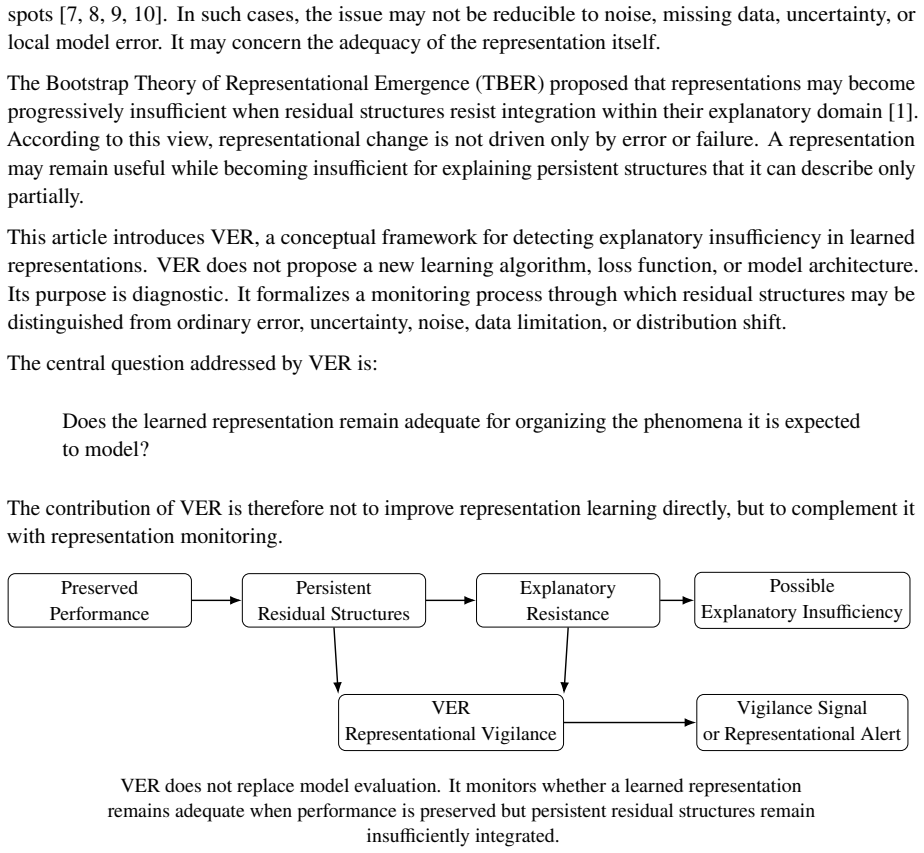
VER formalizes a diagnostic process through which persistent residual structures may be identified, analyzed, and interpreted as potential indicators of explanatory insufficiency, distinguishing representational inadequacy from ordinary prediction error, uncertainty, noise, and distribution shift. It introduces a monitoring sequence based on representation identification, explanatory-domain delimitation, residual-structure detection, explanatory-resistance evaluation, and vigilance signaling. VER is intended as a contribution to representation diagnostics in machine learning, complementing rather than replacing existing evaluation methods, with a path outlined toward empirical evaluation thr
What carries the argument
The VER monitoring sequence of representation identification, explanatory-domain delimitation, residual-structure detection, explanatory-resistance evaluation, and vigilance signaling, which carries the diagnostic argument by treating persistent residuals as potential signals of explanatory failure.
If this is right
- Representations can be evaluated for explanatory adequacy independently of predictive performance or robustness metrics.
- Persistent residual structures can serve as direct indicators of potential representational failure.
- Vigilance signaling enables ongoing monitoring of representational adequacy during model operation.
- The framework complements rather than replaces existing evaluation methods such as uncertainty estimation.
- Empirical benchmarks for representational vigilance become feasible as a next step for testing the approach.
Where Pith is reading between the lines
- VER could be applied to specific domains like image classification or language modeling to surface inadequacies not visible in accuracy scores.
- Combining the framework with existing tools for uncertainty quantification might improve separation of error types in practice.
- Development of the outlined benchmarks could standardize assessment of representational adequacy across different model types.
- The diagnostic focus might eventually inform new objectives during training that explicitly target reduction of explanatory resistance.
Load-bearing premise
Persistent residual structures exist and can be reliably separated from ordinary prediction error, uncertainty, noise, and distribution shift through the proposed monitoring sequence.
What would settle it
A controlled experiment on synthetic data where the monitoring sequence fails to separate identifiable residual structures from injected noise or distribution shift would falsify the claim that the process reliably detects explanatory insufficiency.
Figures
read the original abstract
Learned representations are central to modern machine learning and are commonly evaluated through predictive performance, robustness, uncertainty estimation, or generalization. However, a learned representation may remain operationally successful while progressively failing to organize persistent residual structures that are not fully captured by conventional evaluation metrics. This article introduces VER, the Vigilant Evaluator of Representations, a conceptual framework for monitoring representational adequacy in learned representations. VER does not propose a new learning algorithm, loss function, or model architecture. Instead, it formalizes a diagnostic process through which persistent residual structures may be identified, analyzed, and interpreted as potential indicators of explanatory insufficiency. The framework distinguishes representational inadequacy from ordinary prediction error, uncertainty, noise, and distribution shift. It introduces a monitoring sequence based on representation identification, explanatory-domain delimitation, residual-structure detection, explanatory-resistance evaluation, and vigilance signaling. VER is intended as a contribution to representation diagnostics in machine learning. Its objective is not to replace existing evaluation methods but to complement them by treating representational adequacy as an explicit object of inquiry. A path toward empirical evaluation through representational-vigilance benchmarks is also outlined.
Editorial analysis
A structured set of objections, weighed in public.
Referee Report
Summary. The paper proposes VER (Vigilant Evaluator of Representations), a conceptual framework for monitoring representational adequacy in learned representations. It claims that persistent residual structures can be identified via a five-step diagnostic sequence (representation identification, explanatory-domain delimitation, residual-structure detection, explanatory-resistance evaluation, and vigilance signaling) and interpreted as indicators of explanatory insufficiency, thereby distinguishing representational inadequacy from ordinary prediction error, uncertainty, noise, and distribution shift. VER does not introduce new algorithms or architectures but positions itself as a complement to existing evaluation methods, with an outline for future representational-vigilance benchmarks.
Significance. If the framework were formalized with operational definitions and decision criteria that reliably isolate explanatory insufficiency, it would offer a useful conceptual contribution to representation diagnostics by elevating representational adequacy to an explicit object of inquiry beyond standard predictive metrics.
major comments (1)
- [VER framework description (abstract and main text)] The central claim that the five-step monitoring sequence distinguishes representational inadequacy from prediction error, uncertainty, noise, and distribution shift is load-bearing but unsupported: the abstract and framework description supply only high-level conceptual labels for the steps with no mathematical definitions, metrics, decision criteria, or conditions under which separation is guaranteed or even operationalized.
Simulated Author's Rebuttal
We thank the referee for the constructive feedback. The comment correctly identifies that VER is presented at a conceptual level without operational metrics or decision criteria. We address this below and note that the manuscript will be revised to better reflect its scope as a high-level framework.
read point-by-point responses
-
Referee: [VER framework description (abstract and main text)] The central claim that the five-step monitoring sequence distinguishes representational inadequacy from prediction error, uncertainty, noise, and distribution shift is load-bearing but unsupported: the abstract and framework description supply only high-level conceptual labels for the steps with no mathematical definitions, metrics, decision criteria, or conditions under which separation is guaranteed or even operationalized.
Authors: We agree that the manuscript supplies only conceptual labels and does not provide mathematical definitions, metrics, or guaranteed separation conditions. VER is explicitly positioned as a conceptual framework (see abstract: 'VER does not propose a new learning algorithm... Instead, it formalizes a diagnostic process') whose purpose is to elevate representational adequacy as an object of inquiry rather than to deliver an operational test. The five steps are intended to structure interpretation of persistent residuals after conventional factors have been considered, not to algorithmically isolate explanatory insufficiency. We will revise the text to (a) explicitly state that no formal separation is claimed or guaranteed and (b) add a dedicated subsection outlining possible directions for future operationalization and benchmark design, consistent with the existing outline for representational-vigilance benchmarks. revision: partial
Circularity Check
No circularity: purely conceptual framework with no derivations or fitted quantities.
full rationale
The manuscript introduces VER as a high-level diagnostic sequence (representation identification, explanatory-domain delimitation, residual-structure detection, explanatory-resistance evaluation, vigilance signaling) without any equations, parameters, loss functions, or mathematical formalizations. No self-citations appear as load-bearing premises, no ansatzes are smuggled, and no predictions are derived from fitted inputs. The central claim is an assertion that the sequence can distinguish explanatory insufficiency from noise or shift, but this is presented as a proposed monitoring process rather than a derivation that reduces to its own inputs by construction. The paper is therefore self-contained as a descriptive proposal and carries no circularity.
Axiom & Free-Parameter Ledger
Reference graph
Works this paper leans on
-
[1]
Raynal J, Slangen P, Raynal E, Margerit J. Bootstrap Theory of Representational Emergence: Explanatory Insufficiency as a Driver of Representation Learning and World Models. arXiv. 2026. doi:10.48550/arXiv.2606.07303
work page internal anchor Pith review Pith/arXiv arXiv doi:10.48550/arxiv.2606.07303 2026
-
[2]
Bengio Y, Courville A, Vincent P. Representation Learning: A Review and New Perspec- tives. IEEE Transactions on Pattern Analysis and Machine Intelligence. 2013;35(8):1798–1828. doi:10.1109/TPAMI.2013.50
-
[3]
Deep Learning
Goodfellow I, Bengio Y, Courville A. Deep Learning. Cambridge (MA): MIT Press; 2016
2016
-
[4]
On the Opportunities and Risks of Foundation Models
Bommasani R, Hudson DA, Adeli E, Altman R, Arora S, von Arx S, et al. On the Opportunities and Risks of Foundation Models. arXiv. 2021. arXiv:2108.07258
Pith/arXiv arXiv 2021
- [5]
-
[6]
A Path Towards Autonomous Machine Intelligence
LeCun Y. A Path Towards Autonomous Machine Intelligence. OpenReview. 2022. Available from: https://openreview.net/forum?id=BZ5a1r-kVsf
2022
-
[7]
Probabilistic Machine Learning and Artificial Intelligence
Ghahramani Z. Probabilistic Machine Learning and Artificial Intelligence. Nature. 2015;521(7553):452–459. doi:10.1038/nature14541
-
[8]
Dropout as a Bayesian Approximation: Representing Model Uncertainty in Deep Learning
Gal Y, Ghahramani Z. Dropout as a Bayesian Approximation: Representing Model Uncertainty in Deep Learning. In: Proceedings of the 33rd International Conference on Machine Learning. PMLR
-
[9]
KendallA,GalY.WhatUncertaintiesDoWeNeedinBayesianDeepLearningforComputerVision? arXiv. 2017. arXiv:1703.04977
Pith/arXiv arXiv 2017
-
[10]
A Baseline for Detecting Misclassified and Out-of-Distribution Examples in Neural Networks
Hendrycks D, Gimpel K. A Baseline for Detecting Misclassified and Out-of-Distribution Examples in Neural Networks. arXiv. 2017. arXiv:1610.02136
Pith/arXiv arXiv 2017
-
[11]
Causality: Models, Reasoning and Inference
Pearl J. Causality: Models, Reasoning and Inference. 2nd ed. Cambridge: Cambridge University Press; 2009
2009
-
[12]
The Book of Why: The New Science of Cause and Effect
Pearl J, Mackenzie D. The Book of Why: The New Science of Cause and Effect. New York: Basic Books; 2018
2018
-
[13]
Attention Is All You Need
Vaswani A, Shazeer N, Parmar N, Uszkoreit J, Jones L, Gomez AN, et al. Attention Is All You Need. Advances in Neural Information Processing Systems. 2017;30
2017
-
[14]
BERT: Pre-training of Deep Bidirectional Transformers for Language Understanding
Devlin J, Chang MW, Lee K, Toutanova K. BERT: Pre-training of Deep Bidirectional Transformers for Language Understanding. Proceedings of NAACL-HLT. 2019:4171–4186. 21
2019
-
[15]
Language Models are Few-Shot Learners
Brown TB, Mann B, Ryder N, Subbiah M, Kaplan J, Dhariwal P, et al. Language Models are Few-Shot Learners. Advances in Neural Information Processing Systems. 2020;33:1877–1901
2020
-
[16]
Can You Trust Your Model’s Uncertainty? EvaluatingPredictiveUncertaintyUnderDatasetShift.AdvancesinNeuralInformation Processing Systems
Ovadia Y, Fertig E, Ren J, Nado Z, Sculley D, Nowozin S, et al. Can You Trust Your Model’s Uncertainty? EvaluatingPredictiveUncertaintyUnderDatasetShift.AdvancesinNeuralInformation Processing Systems. 2019;32. 22
2019
discussion (0)
Sign in with ORCID, Apple, or X to comment. Anyone can read and Pith papers without signing in.