REVIEW 3 major objections 5 minor 27 references
Wasserstein-regularized Conformal Prediction under General Distribution Shift
T0 review · 3 major / 5 minor · reviewed 2026-08-10 · deepseek-v4-flash
Pith's one-line read A Wasserstein-based bound splits conformal prediction's coverage gap into covariate- and concept-shift terms, yielding a training objective that keeps gaps near 3.2% while cutting prediction set size by 37% relative to worst-case baselines.
desk verdict Wasserstein bound for conformal coverage is a useful idea, but the main theorem silently drops the label noise that the paper's own model assumes, so Eq. (13) does not hold as stated. read the letter →
The pith
A machine-rendered reading of the paper's core claim, the machinery that carries it, and where it could break.
The reading
What carries the argument
The load-bearing mechanism is the triple of pushforward measures $P_V = s_P\#P_X$, $Q_{V,s_P} = s_P\#Q_X$, and $Q_V = s_Q\#Q_X$ on conformal score space, together with the triangle inequality $W(P_V,Q_V) \le W(P_V,Q_{V,s_P}) + W(Q_{V,s_P},Q_V)$. The first term is bounded by $\kappa W(P_X,Q_X)$ via a Lipschitz contraction (Theorem 2), and the second is bounded by $\eta W(Q_{Y,f_P},Q_Y)$ via a ratio bound that compares score differences to label-function differences. Importance weighting converts $P_V$ toward $Q_{V,s_P}$, which handles covariate shift; the WR-CP objective then minimizes an empirical surrogate of the remaining concept-shift term, $\min_\theta \sum_i \mathbb{E}_{D^{(i)}_{XY}}[\ell(h_\theta(x),y)] + \beta \sum_i W(\hat{D}^{(i)}_{V,s_P}, \hat{D}^{(i)}_V)$, with kernel density estimation for likelihood ratios and point-wise CDF estimation to keep the Wasserstein term differentiable. A finite-sample bound from empirical Wasserstein convergence (Weed & Bach, 2019) turns the population bound into a usable guarantee with explicit sample-size terms.
What would settle it
Construct calibration and test data with identical covariate distributions and the same true regression function $f$, but different label noise variances, e.g., $y|x \sim N(f(x), 0.1)$ for calibration and $y|x \sim N(f(x), 10)$ for test; the paper's bound in Eq. (13) then predicts a zero coverage gap, while split conformal prediction on test data will show coverage falling well below $1-\alpha$.
Extended reading notes
Core claim
The central claim is that the absolute difference between the calibration and test conformal CDFs at the chosen quantile is bounded by $\sqrt{2L(\kappa W(P_X,Q_X)+\eta W(Q_{Y,f_P},Q_Y))}$, where $L$ bounds the calibration score density, $\kappa$ is the Lipschitz constant of the score function, and $\eta$ is the maximal ratio of score differences to label-function differences. The paper obtains this by pushing the calibration and test distributions through the score function to conformal score space, then using the triangle inequality to isolate a covariate-shift term and a concept-shift term. It shows that importance weighting eliminates the covariate-shift term even when concept shift is present, and that the concept-shift term can be minimized through a regularization term during model training. The resulting WR-CP method is evaluated on multi-source domain generalization, where the test distribution is an unknown mixture of training distributions, and is reported to keep coverage close to the target while reducing prediction set size substantially.
Load-bearing premise
The proof requires the conformal score at an input $x$ to be a deterministic function of $x$, so any shift in label noise between calibration and test distributions is invisible to the bound and to WR-CP's training objective.
Editorial extensions
If this is right
- Practitioners can use the estimated Wasserstein distance between calibration and test scores as an early-warning signal for coverage violations at any specific confidence level $\alpha$.
- Because the decomposition isolates covariate and concept shifts, importance weighting can be applied safely under joint shift without losing its covariate-shift correction.
- The dependence of the bound on $\kappa$ and $\eta$ shows that model training can directly shrink the coverage gap by promoting smooth, shift-insensitive residual functions.
- The tunable parameter $\beta$ yields a Pareto front between coverage accuracy and prediction set efficiency, so WR-CP can be adapted to application-specific risk preferences.
- In multi-source settings, the bound implies that controlling the largest per-source weighted gap suffices to guarantee coverage on any unknown mixture of the source distributions.
Reading between the lines
- A direct extension would replace the deterministic score representation with a stochastic one that includes label noise; the bound would then acquire an additional term proportional to the Wasserstein distance between the noise distributions of calibration and test, which the current decomposition misses.
- The same pushforward decomposition can be coupled with direct optimal-transport estimators of $W(P_X,Q_X)$ and $W(Q_{Y,f_P},Q_Y)$, which may be more robust than the kernel-density-based proxy used for likelihood ratios.
- The empirical bound in Eq. (16) suggests a practical rule: inflate the conformal threshold by a margin proportional to the empirical Wasserstein distance plus sample-size terms, yielding a finite-sample coverage guarantee that WR-CP can then minimize.
- Because the method depends on kernel density estimation for importance weights, its behavior in high-dimensional feature spaces is an open question and is likely to require density-ratio estimators that scale better.
Editorial analysis
A structured set of objections, weighed in public.
Referee Report
Summary. The manuscript studies conformal prediction under joint covariate and concept shift. It proposes bounding the coverage gap by the Wasserstein distance between calibration and test conformal score distributions, decomposes that distance into covariate- and concept-shift terms via pushforward measures, and introduces WR-CP, an algorithm that combines importance weighting with a Wasserstein regularizer on the score distributions. Theoretical statements include a bound of the coverage gap in Eq. (13), a finite-sample empirical bound in Eq. (16), and an application to multi-source domain generalization. Experiments on six datasets compare WR-CP with vanilla CP, IW-CP, CQR, and worst-case CP, reporting reduced coverage gaps (to 3.2%) and smaller prediction sets (37%).
Significance. The high-level idea is appealing and the empirical study is substantial; if the theoretical claims were fully supported, the paper would make a useful contribution to conformal prediction under distribution shift. Strengths include a clearly stated decomposition of the Wasserstein bound, a released implementation, extensive multi-trial experiments across six datasets, and an explicit discussion of limitations in Appendix H. The main reservation is that the central bound as stated does not cover the label-noise component of the score distribution, so the theoretical support for the algorithm is incomplete.
major comments (3)
- [Section 3.2, Eq. (7) and Eq. (13)] The paper defines PV=sP#PX and QV=sQ#QX with sP(x)=|h(x)-fP(x)| and sQ(x)=|h(x)-fQ(x)|, after Section 1 assumes y|x ~ N(fP(x), epsP) and y|x ~ N(fQ(x), epsQ). The actual conformal scores are |h(x)-y|, so their distributions are convolutions of these deterministic residuals with label noise. A pure noise shift with PX=QX and fP=fQ but epsP != epsQ makes both Wasserstein terms in Eq. (13) vanish, while the true coverage gap can be large; for example, with alpha=0.2, epsP=1, epsQ=2, and Gaussian noise, the calibration quantile is about 1.28 and the test coverage is about 0.48. Thus Eq. (13) does not bound the actual coverage gap unless one adds an explicit assumption such as epsP=epsQ or epsP=epsQ=0, which is not stated in the paper. Since Algorithm 1 lines 3-7 use the actual noisy scores, the object being optimized is not the noiseless surrogate analyzed by the theory.
- [Eq. (10) and definition of eta] The constant eta = max_{x1,x2} |sP(x1)-sQ(x2)| / |fP(x1)-fQ(x2)| is not guaranteed to be finite. If fP(x1)=fQ(x2) for some pair with a nonzero numerator, or if fP=fQ on a set of positive measure, the quotient is either undefined or infinite, while the denominator term W(QY,fP,QY) may be zero. The inequality in Eq. (10) therefore requires a condition such as |fP(x1)-fQ(x2)| >= c > 0 on the support of the transport plan, or an alternative Lipschitz-style control of |sP-sQ| in terms of |fP-fQ|. Without such a condition, the bound in Eq. (13) is not well posed.
- [Section 5, Eq. (19)] The derivation of the multi-source surrogate is incomplete. Theorem 4 yields W(QV,sP,QV) <= sum_i w_i sum_j w_j W(DV,sP^j, DV^i), a double sum over all pairs of source domains. With uniform weights this is (1/k^2) sum_{i,j} W(DV,sP^j, DV^i), but the objective minimized in Eq. (19) is (1/k) sum_i W(DV,sP^i, DV^i), which is only the diagonal part. No stated inequality shows that the diagonal sum controls the double sum. The paper should either prove such an inequality, add additional assumptions on the source distributions, or explicitly state that Eq. (19) is a heuristic surrogate rather than an upper bound on the concept-shift term.
minor comments (5)
- [Definition 3] There is a typo: 'prbability' should be 'probability'.
- [Definition 4] There is a typo: 'Wassersteion dimension' should be 'Wasserstein dimension'.
- [Appendix A.4] The phrase 'definded on X' should be 'defined on X'.
- [Appendix F.1] The dataset is referred to as 'PeMSED8' in one place, while the rest of the paper consistently uses 'PeMSD8'.
- [Proof of Theorem 3] The proof says it is 'reasonable to assume' that the two concentration events are independent; this should be stated as a consequence of the empirical measures being built from independent samples rather than as an additional assumption.
Circularity Check
No circularity: the Wasserstein coverage-gap bound is derived from explicit transport inequalities, and the reported coverage gaps are measured on held-out test data rather than read off from the minimized surrogate.
full rationale
Walk of the derivation: Eq. (3) defines the coverage gap as |F_PV(tau) - F_QV(tau)|; Eq. (4) bounds any pointwise CDF gap by the Kolmogorov distance; Eq. (6) applies Ross's bound K <= sqrt(2L W); Eq. (7) is the triangle inequality on pushforward measures; Eqs. (10)-(13) combine the eta-ratio bound and the Lipschitz bound with Theorem 2. Every step is an explicit inequality over distributions that are defined independently of the reported test set. Importance weighting is used as a measure change (dQX/dPX) so that weighted PV becomes QV,sP; this is an exact transformation under the likelihood-ratio model, and the resulting coverage gap is then measured on held-out test data, not read off from the minimized Wasserstein term. Beta is a tunable hyperparameter, and performances are benchmarked against vanilla CP, IW-CP, CQR, and WC-CP, so the empirical claims are not forced by the fitted parameters. The related-work citation to Xu and Xie (2021) is not load-bearing, and no uniqueness theorem is imported from the authors' prior work. The serious caveat in the paper is a correctness/assumption gap rather than circularity: Section 3.2 defines PV = sP#PX and QV = sQ#QX, treating scores as deterministic functions of the covariate, although Section 1 models y|x as N(fP(x), epsP) and N(fQ(x), epsQ); a pure change in label noise epsP != epsQ would make both Wasserstein terms in Eq. (13) vanish while the true score distributions differ. This means the theorem is not established for the noisy scores used in Algorithm 1, but it does not make the bound equal to its own input. Appendices H.1-H.3 and G candidly state estimation errors, computational costs, calibration choices, and datasets where efficiency gains do not materialize; none of these admissions creates a circular derivation. No step renames a known result as a new prediction or derives the target conclusion from itself.
Assumptions & free parameters
free parameters (2)
- beta (WR-CP regularization weight) =
dataset- and alpha-dependent; e.g., 4.5, 9, 9, 6, 8, 20 for alpha=0.2
- KDE bandwidth =
grid-searched per dataset (log range 1e-2 to 10^0.5, 20 values)
assumptions (7)
- domain assumption y|x is Gaussian: y|x ~ N(fP(x), epsP) and N(fQ(x), epsQ)
- ad hoc to paper Conformal score is a deterministic function of x: PV=sP#PX and QV=sQ#QX with sP(x)=|h(x)-fP(x)|
- domain assumption Test distribution is an unknown mixture of k training distributions (Eq. 17)
- domain assumption Calibration distribution is the uniform mixture of training distributions
- ad hoc to paper eta = sup |sP(x1)-sQ(x2)| / |fP(x1)-fQ(x2)| is finite
- standard math Density bound L for score distributions exists
- standard math Wasserstein-1 on R equals area between CDFs; triangle inequality and pushforward properties
Cite this review
Pith. "Pith review of Wasserstein-regularized Conformal Prediction under General Distribution Shift." pith.science (2026). https://pith.science/paper/NBNIP3BB
@misc{pith2026250113430,
  author       = {Pith},
  title        = {Pith review of: Wasserstein-regularized Conformal Prediction under General Distribution Shift},
  year         = {2026},
  howpublished = {\url{https://pith.science/paper/NBNIP3BB}},
  note         = {Machine review of arXiv:2501.13430}
}
abstract
Conformal prediction yields a prediction set with guaranteed $1-\alpha$ coverage of the true target under the i.i.d. assumption, which may not hold and lead to a gap between $1-\alpha$ and the actual coverage. Prior studies bound the gap using total variation distance, which cannot identify the gap changes under distribution shift at a given $\alpha$. Besides, existing methods are mostly limited to covariate shift,while general joint distribution shifts are more common in practice but less researched.In response, we first propose a Wasserstein distance-based upper bound of the coverage gap and analyze the bound using probability measure pushforwards between the shifted joint data and conformal score distributions, enabling a separation of the effect of covariate and concept shifts over the coverage gap. We exploit the separation to design an algorithm based on importance weighting and regularized representation learning (WR-CP) to reduce the Wasserstein bound with a finite-sample error bound.WR-CP achieves a controllable balance between conformal prediction accuracy and efficiency. Experiments on six datasets prove that WR-CP can reduce coverage gaps to $3.2\%$ across different confidence levels and outputs prediction sets 37$\%$ smaller than the worst-case approach on average.
Figures


Figures from the paper (18 more)




Reference graph
Works this paper leans on
-
[1]
Adaptive conformal prediction by reweighting nonconfor- mity score
Salim I Amoukou and Nicolas JB Brunel. Adaptive conformal prediction by reweighting nonconfor- mity score. arXiv preprint arXiv:2303.12695,
-
[5]
We introduce a toy example to further illustrate that exchangeability does not hold
For efficiency, all CP methods were conducted as split conformal prediction. We introduce a toy example to further illustrate that exchangeability does not hold. Consider we have two training distributions: D(1) XY = N [0, 0], 1 0 .7 0.7 1 ; D(2) XY = N [1, 1], 1 −0.6 −0.6 1 . A calibration distribution is a mixture of these two training distributions wit...
work page 2025
-
[6]
0.0 0.2 0.4 0.6 0.8 1.0 0.0 0.5 1.0 1.5 2.0 2.5 PDF: PV and Q(1) V PV Q(1) V 0.0 0.2 0.4 0.6 0.8 1.0 0.0 0.2 0.4 0.6 0.8 1.0 CDF: PV and Q(1) V PV Q(1) V 0.0 0.2 0.4 0.6 0.8 1.0 0.0 0.5 1.0 1.5 2.0 2.5 PDF: PV and Q(2) V PV Q(2) V 0.0 0.2 0.4 0.6 0.8 1.0 0.0 0.2 0.4 0.6 0.8 1.0 CDF: PV and Q(2) V PV Q(2) V Figure 6: Comparison between total variation dist...
work page 2025
-
[8]
A review and comparative study on probabilistic object detection in autonomous driving
11 Published as a conference paper at ICLR 2025 Di Feng, Ali Harakeh, Steven L Waslander, and Klaus Dietmayer. A review and comparative study on probabilistic object detection in autonomous driving. IEEE Transactions on Intelligent Transportation Systems, 23(8):9961–9980,
work page 2025
-
[9]
Conformal prediction with conditional guarantees
Isaac Gibbs, John J Cherian, and Emmanuel J Cand `es. Conformal prediction with conditional guarantees. arXiv preprint arXiv:2305.12616,
-
[10]
Pierre Humbert, Batiste Le Bars, Aur´elien Bellet, and Sylvain Arlot
URL https://arxiv.org/abs/2206.13092. Pierre Humbert, Batiste Le Bars, Aur´elien Bellet, and Sylvain Arlot. One-shot federated conformal prediction. In International Conference on Machine Learning, pp. 14153–14177. PMLR,
-
[11]
Batch multivalid conformal prediction
Christopher Jung, Georgy Noarov, Ramya Ramalingam, and Aaron Roth. Batch multivalid conformal prediction. arXiv preprint arXiv:2209.15145,
-
[12]
An introduction to domain adaptation and transfer learning
Wouter M Kouw and Marco Loog. An introduction to domain adaptation and transfer learning. arXiv preprint arXiv:1812.11806,
Show all 27 references
-
[13]
Multi-source conformal inference under distribution shift
Yi Liu, Alexander W Levis, Sharon-Lise Normand, and Larry Han. Multi-source conformal inference under distribution shift. arXiv preprint arXiv:2405.09331,
-
[19]
Adaptive conformal classification with noisy labels
Matteo Sesia, YX Wang, and Xin Tong. Adaptive conformal classification with noisy labels. arXiv preprint arXiv:2309.05092,
-
[20]
21 Published as a conference paper at ICLR 2025 0.7 0.8 0.9 1.0Coverage Airfoil 0.8 0.9 1.0 PeMSD4 0.8 0.9 1.0 PeMSD8 0.85 0.90 0.95 Seattle 0.7 0.8 0.9 1.0 US 0.8 0.9 1.0 Japan 0.00 1.00 2.00Pred. Set Size 0.00 2.00 4.00 6.00 0.00 2.00 4.00 0.00 5.00 10.00 15.00 0.00 2.50 5.0...
2025
-
[21]
Provably robust conformal prediction with improved efficiency
Ge Yan, Yaniv Romano, and Tsui-Wei Weng. Provably robust conformal prediction with improved efficiency. arXiv preprint arXiv:2404.19651,
-
[22]
We define f × g by f × g(x1, x2) = ( f (x1), g(x2)) = ( y1, y2)
13 Published as a conference paper at ICLR 2025 A P ROOFS OF THEOREMS A.1 P ROOF OF THEOREM 1 Proof. We define f × g by f × g(x1, x2) = ( f (x1), g(x2)) = ( y1, y2). Let IdX be the identity mapping function on X , and let πi be the mapping function to the i-th marginal. The pr...
2022
-
[24]
This observation proves our first reason that importance weighting effectively reduces the Wasserstein distance between calibration and test conformal scores
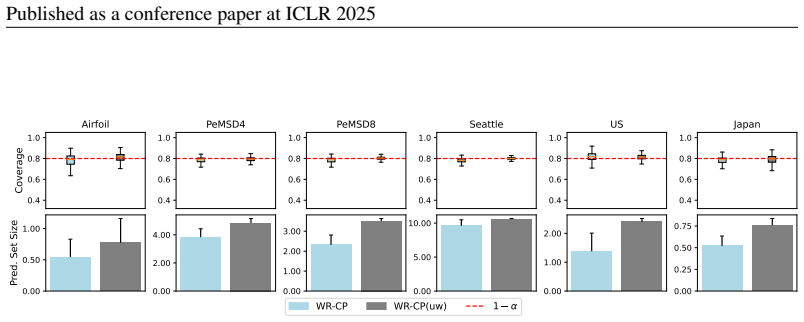
Although the average coverage gaps between WR-CP and WR-CP(uw) are quite similar, at 3.1% and 2.3% respectively, the average prediction set size for WR-CP is 28.0% smaller than that of WR-CP(uw). This observation proves our first reason that importance weighting effectively re...
2019
-
[25]
It includes 1503 instances
was intentionally modified to introduce covariate shift and concept shift among them. It includes 1503 instances. The target variable is the scaled sound pressure level of NASA airfoils, and there are 5 features: log frequency, angle of attack, chord length, free-stream veloci...
2019
-
[1969]
Conformal prediction is robust to label noise
Bat-Sheva Einbinder, Stephen Bates, Anastasios N Angelopoulos, Asaf Gendler, and Yaniv Romano. Conformal prediction is robust to label noise. arXiv preprint arXiv:2209.14295, 2, 2022a. Bat-Sheva Einbinder, Yaniv Romano, Matteo Sesia, and Yanfei Zhou. Training uncertainty-aware...
-
[2007]
David Stutz, Ali Taylan Cemgil, Arnaud Doucet, et al
URL https:// arxiv.org/abs/0706.3188. David Stutz, Ali Taylan Cemgil, Arnaud Doucet, et al. Learning optimal conformal classifiers. arXiv preprint arXiv:2110.09192,
-
[2014]
Maxime Cauchois, Suyash Gupta, and John C Duchi
DOI: https://doi.org/10.24432/C5VW2C. Maxime Cauchois, Suyash Gupta, and John C Duchi. Knowing what you know: valid and validated confidence sets in multiclass and multilabel prediction. Journal of machine learning research, 22 (81):1–42,
-
[2015]
Application of uncertainty quantification to artificial intelligence in healthcare: A review of last decade (2013–2023)
Silvia Seoni, Vicnesh Jahmunah, Massimo Salvi, Prabal Datta Barua, Filippo Molinari, and U Rajen- dra Acharya. Application of uncertainty quantification to artificial intelligence in healthcare: A review of last decade (2013–2023). Computers in Biology and Medicine, pp. 107441,
2013
-
[2016]
Statistical aspects of wasserstein distances
12 Published as a conference paper at ICLR 2025 Victor M Panaretos and Yoav Zemel. Statistical aspects of wasserstein distances. Annual review of statistics and its application, 6(1):405–431,
2025
-
[2018]
Kl guided domain adaptation
A Tuan Nguyen, Toan Tran, Yarin Gal, Philip HS Torr, and Atılım G¨unes ¸Baydin. Kl guided domain adaptation. arXiv preprint arXiv:2106.07780,
-
[2019]
Inductive confidence machines for regression
Harris Papadopoulos, Kostas Proedrou, V olodya V ovk, and Alex Gammerman. Inductive confidence machines for regression. In Machine learning: ECML 2002: 13th European conference on machine learning Helsinki, Finland, August 19–23, 2002 proceedings 13, pp. 345–356. Springer,
2002
-
[2020]
Distributionally robust neural networks for group shifts: On the importance of regularization for worst-case generalization
Shiori Sagawa, Pang Wei Koh, Tatsunori B Hashimoto, and Percy Liang. Distributionally robust neural networks for group shifts: On the importance of regularization for worst-case generalization. arXiv preprint arXiv:1911.08731,
1911 arXiv
-
[2021]
Conformal risk control
Anastasios N Angelopoulos, Stephen Bates, Adam Fisch, Lihua Lei, and Tal Schuster. Conformal risk control. arXiv preprint arXiv:2208.02814,
-
[2022]
Distributional uncertainty propagation via optimal transport
Liviu Aolaritei, Nicolas Lanzetti, Hongruyu Chen, and Florian D¨orfler. Distributional uncertainty propagation via optimal transport. arXiv preprint arXiv:2205.00343,
-
[2023]
A gentle introduction to conformal prediction and distribution-free uncertainty quantification
Anastasios N Angelopoulos and Stephen Bates. A gentle introduction to conformal prediction and distribution-free uncertainty quantification. arXiv preprint arXiv:2107.07511,
-
[2024]
Normalizing flows for conformal regression
Nicolo Colombo. Normalizing flows for conformal regression. arXiv preprint arXiv:2406.03346,
Reviewed August 10, 2026 · model on record in the stance chip above.
Discussion (0). Continue with ORCID to comment.