REVIEW 5 major objections 5 minor 43 references
MinD: Learning A Dual-System World Model for Real-Time Planning and Implicit Risk Analysis
T0 review · 5 major / 5 minor · reviewed 2026-08-15 · deepseek-v4-flash
Pith's one-line read A robot policy can plan from a single diffusion denoising step, not a full future video, and still beat slower world-model baselines on RL-Bench and a real Franka.
desk verdict MinD's core idea is a real step forward for real-time video-conditioned control, but the risk-prediction result is oversold and the abstract numbers need reconciliation. read the letter →
The pith
A machine-rendered reading of the paper's core claim, the machinery that carries it, and where it could break.
The reading
What carries the argument
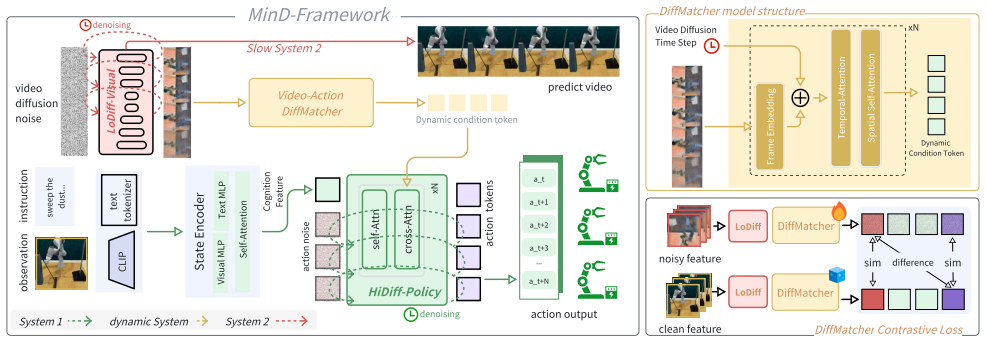
The paper's central object is the single-step denoised latent $v_{T'-1} = \text{LoDiff-Visual}(v_{T'},\, t = T'-1)$, produced by one reverse diffusion step from pure noise. The argument runs through three coupled parts: LoDiff-Visual, a latent video diffusion model that runs slowly and predicts future scenes; HiDiff-Policy, a small Diffusion Transformer that outputs actions quickly; and DiffMatcher, a temporal transformer that maps the noisy visual latent to a compact feature vector conditioning the policy. DiffMatcher is trained with a diffusion-forcing alignment loss that minimizes the L2 distance between its output on a noised clean latent and its output on the clean latent, with a stop-gradient, which is what lets the fast policy trust partially denoised features.
What would settle it
Train MinD exactly as described, decode $v_{T'-1}$ into pixels, and compare with the ground-truth future frame under FVD/PSNR; separately train a linear classifier on $v_{T'-1}$ to predict success/failure. If the decoded single-step latent is visually near-noise and the linear probe is near chance while the policy still reaches 63%, then the single-step latent is not carrying the claimed future-state semantics: the policy would be exploiting a shortcut, and the 74% failure-prediction result should be re-tested with the classifier blinded to task identity.
Extended reading notes
Core claim
The central discovery is that the intermediate latent $v_{T'-1}$ obtained after a single DDPM denoising step from pure noise—not a fully denoised frame—still functions as an effective future-state representation for control. The paper shows that conditioning a diffusion policy on this single-step latent achieves 63% success on RL-Bench and 68.75–72.5% success on a real Franka robot at 11.3 FPS, and that the corresponding generated video clips allow 74% of failures to be identified in advance.
Load-bearing premise
The load-bearing premise is that the latent $v_{T'-1}$ produced by one denoising step from pure noise encodes a semantically useful prediction of the future state, rather than being mostly noise or a re-encoding of the current observation; the DiffMatcher is trained on noised clean latents, so the model-generated single-step latent may sit out of distribution for the alignment module.
Editorial extensions
If this is right
- Video diffusion models can be used as real-time world models when only single-step latents are consumed, so visual imagination can run closed-loop during control rather than offline.
- Predicted future video serves as an interpretable safety channel: 74% of task failures were flagged in advance from generated clips, enabling human or automated intervention.
- The dual-schedule design decouples long-latency scene prediction (a 1000-step schedule) from fast action generation (a 100-step schedule), so control frequency no longer depends on full video generation speed.
- The diffusion-forcing alignment loss is a general recipe for coupling two generative processes running on different schedules and modalities.
Reading between the lines
- The paper does not directly measure how much future-state information the single-step latent carries; a natural probe is to train a linear readout on $v_{T'-1}$ to predict the future observation $v_0$ and compare against the noise floor. If the readout is near chance, the policy may be exploiting a learned bias rather than genuine predicted content.
- The causal interventions (a 20–34 point success drop when the latent is perturbed, masked, injected, or frozen) show the pathway is real, but those interventions also shift the input distribution; the out-of-distribution gap between DiffMatcher's training targets (noised clean latents) and inference inputs (model-generated single-step latents) remains the weakest link.
- If single-step features prove sufficient more broadly, the video-decoding branch could be dropped entirely at inference, letting the latent feed other downstream modules such as grasp planning or anomaly detection directly.
Signed reviews
Editorial analysis
A structured set of objections, weighed in public.
Referee Report
Summary. The paper proposes MinD, a dual-system diffusion world model for robotic manipulation. It couples a low-frequency video diffusion model (LoDiff) that predicts future visual latents with a high-frequency diffusion policy (HiDiff), joined by a DiffMatcher alignment module. The central claim is that a robot policy does not need fully denoised future frames; a single denoising step from pure noise yields a latent that is an effective future-state representation. The paper reports 63% success on seven RL-Bench tasks, 68.75% and 72.5% success on real Franka tasks in Table 2 (while the abstract states 60%), 11.3 FPS inference, ablations supporting the architecture, causal interventions in Appendix F, and a human-evaluation study claiming that 74% of potential failures can be identified in advance from generated video.
Significance. If the central representational claim holds, MinD is a practically valuable result: it shows that an intermediate latent of a video diffusion model can be used for real-time control and risk monitoring, offering a concrete way to use generative world models in closed-loop robotic systems. The paper's strengths include real-robot experiments, causal intervention experiments in Appendix F, and ablation studies in Table 3; the architecture and training objectives are described in enough detail to be reproduced, and code release is promised. However, the significance is conditional because the core claim that the single-step latent carries predictive future-state information is asserted rather than directly measured, and several reported results are internally inconsistent.
major comments (5)
- [Abstract vs. Table 2] The abstract states a 60% success rate on real-world Franka tasks, but Table 2 reports averages of 68.75% (front view) and 72.5% (wrist view). This is a direct numerical inconsistency in a headline result; please reconcile the numbers and state explicitly which value is the claimed real-world result.
- [Method, Eq. (4) and Eq. (3)] The central claim that the single-step latent v_{T'-1} encodes a semantically useful future state is not directly evidenced. DiffMatcher is trained with Lalign on noised versions of clean ground-truth latents, while at inference it receives a model-generated latent produced by a single DDPM step from pure noise; the paper provides no FID/MMD, probe classifier, or other measurement showing that these model-generated latents lie on the training manifold or carry future-state information. The causal interventions in Appendix F show that the LoDiff-to-HiDiff pathway matters, but they do not separate future-state information from conditioning or current-frame re-encoding, since random latent injection removes all structure. Please add a direct evaluation of what v_{T'-1} encodes, for example a linear probe to predict the next observation, a comparison against a noised current-frame latent, or a quantitative distribution-distance measurement.
- [Video Generation Enables Explainable Risk-Aware VLA] The failure-prediction claim rests on a small and under-described human evaluation: 100 cases (50 successful, 50 failed), with no details on rater instructions, rater agreement, case selection, or whether the raters were blind to outcomes. The reported 74% true negative rate is presented in the abstract as 'identify 74% of potential task failures in advance,' which is a narrower claim. In addition, the PCA analysis in Appendix A (Table 4) is computed on grayscale pixel values of the DDIM=1 region of generated images, not on the latent v_{T'-1}, so it does not support the statement that the single-step latent feature is a diagnostic signal. Please clarify the evaluation protocol and either provide an automated risk metric or temper the claim to match the evidence.
- [Ablation Study, Table 3] Table 3 and the surrounding text use a loss term Lsim that is never defined in Eq. (2) or elsewhere, although the ablation conclusions attribute a large FVD increase and success-rate drop to its removal. Please define Lsim and specify its role relative to Lvideo, Laction, and Lalign.
- [Ablation Study, Table 3 and text] The table and its prose do not agree. The row with FVD 378.3 and SR 64.0% is described in the text as 'A+V, LDP, and all loss terms,' but in the table this row appears to lack Lvideo, while the row with all loss terms has FVD 307.1 and SR 63.4%. The text also refers to removing Lvideo and Lsim as the 'last row,' but the last row appears to contain all loss terms. Because the ablation is a primary source of evidence for the architecture's components, please restructure the table with explicit row labels and correct the textual description.
minor comments (5)
- [Throughout] The module is called both 'DiffMatcher' and 'DiffusionMatcher' in different places; please unify the terminology.
- [Method, Eq. (4)] Equation (4) omits the conditioning inputs on LoDiff; the single-step reverse transition should be written as a function of the initial observation and language instruction as well as the noisy latent and timestep, e.g., v_{T'-1} = LoDiff(v_{T'}, v0, l, T'-1).
- [Appendix F] In the introduction to Appendix F, 'showing the affect' should read 'showing the effect.'
- [Table 1] The 'Pretrain' column entries such as 'V+A' and 'V' are not defined; please state what each modality label means.
- [Abstract and Main Text] The phrase 'identify 74% of potential task failures in advance' should be accompanied by the sample size and the exact definition of the rate (true negative rate on failed executions) in the abstract or introduction.
Circularity Check
No significant circularity: MinD's central claims are supported by external benchmarks and ablations, and the single-step latent design is an empirical choice rather than a definitional reduction.
full rationale
MinD's derivation chain is empirical rather than definitional. The single-step latent v_{T'-1} is produced by one reverse diffusion pass (Eq. 4), passed through DiffMatcher (Eq. 5), and used to condition the HiDiff policy (Eq. 6); task success is then measured against external environments (RL-Bench, real Franka), not against the training objective. The alignment loss in Eq. 3 trains DiffMatcher to be noise-invariant on noised clean latents, which raises a legitimate distribution-shift concern at inference, but this is an experimental validity issue, not a circular reduction: the paper does not define 'future-state information' in terms of the policy's success, and the causal interventions in Table 9 test the dependence empirically without assuming the conclusion. The failure-prediction result relies on human labels applied to generated video clips, which are independent of the model's supervised training signal. Self-citations such as EVA, MoLe-VLA, and ManipDreamer appear only in contextual related-work or data-construction references and are not load-bearing for the central claims. No fitted parameter is renamed as a prediction, no uniqueness theorem is invoked from the authors' own prior work, and no equation reduces to its own input by construction. The paper is self-contained against external benchmarks and baselines.
Assumptions & free parameters
free parameters (4)
- Loss weights λ_v, λ_a, λ_align =
not reported
- Diffusion schedules T', T'' and inference timestep =
T'=1000, T''=100, inference at t=T'-1
- Guidance scales =
video guidance 7.5; action guidance not specified
- RL-Bench data construction =
1000 trajectories via predefined waypoints and keyframe downsampling
assumptions (4)
- domain assumption The single denoising step latent from LoDiff contains actionable future-state information
- domain assumption The diffusion-forcing alignment loss trained on noised clean latents transfers to model-generated latents
- domain assumption Human evaluation of generated clips is a valid measurement of failure anticipation
- standard math Standard diffusion training objective and sampling are correct
Cite this review
Pith. "Pith review of MinD: Learning A Dual-System World Model for Real-Time Planning and Implicit Risk Analysis." pith.science (2026). https://pith.science/paper/NBWGXMII
@misc{pith2026250618897,
  author       = {Pith},
  title        = {Pith review of: MinD: Learning A Dual-System World Model for Real-Time Planning and Implicit Risk Analysis},
  year         = {2026},
  howpublished = {\url{https://pith.science/paper/NBWGXMII}},
  note         = {Machine review of arXiv:2506.18897}
}
read the original abstract
Video Generation Models (VGMs) have become powerful backbones for Vision-Language-Action (VLA) models, leveraging large-scale pretraining for robust dynamics modeling. However, current methods underutilize their distribution modeling capabilities for predicting future states. Two challenges hinder progress: integrating generative processes into feature learning is both technically and conceptually underdeveloped, and naive frame-by-frame video diffusion is computationally inefficient for real-time robotics. To address these, we propose Manipulate in Dream (MinD), a dual-system world model for real-time, risk-aware planning. MinD uses two asynchronous diffusion processes: a low-frequency visual generator (LoDiff) that predicts future scenes and a high-frequency diffusion policy (HiDiff) that outputs actions. Our key insight is that robotic policies do not require fully denoised frames but can rely on low-resolution latents generated in a single denoising step. To connect early predictions to actions, we introduce DiffMatcher, a video-action alignment module with a novel co-training strategy that synchronizes the two diffusion models. MinD achieves a 63% success rate on RL-Bench, 60% on real-world Franka tasks, and operates at 11.3 FPS, demonstrating the efficiency of single-step latent features for control signals. Furthermore, MinD identifies 74% of potential task failures in advance, providing real-time safety signals for monitoring and intervention. This work establishes a new paradigm for efficient and reliable robotic manipulation using generative world models.
Figures


Figures from the paper (10 more)


Reference graph
Works this paper leans on
-
[1]
, " * write output.state after.block = add.period write newline
ENTRY address archivePrefix author booktitle chapter edition editor eid eprint howpublished institution isbn journal key month note number organization pages publisher school series title type volume year label extra.label sort.label short.list INTEGERS output.state before.all mid.sentence after.sentence after.block FUNCTION init.state.consts #0 'before.a...
-
[2]
write newline
" write newline "" before.all 'output.state := FUNCTION n.dashify 't := "" t empty not t #1 #1 substring "-" = t #1 #2 substring "--" = not "--" * t #2 global.max substring 't := t #1 #1 substring "-" = "-" * t #2 global.max substring 't := while if t #1 #1 substring * t #2 global.max substring 't := if while FUNCTION word.in bbl.in capitalize " " * FUNCT...
-
[3]
Agarwal, N.; Ali, A.; Bala, M.; Balaji, Y.; Barker, E.; Cai, T.; Chattopadhyay, P.; Chen, Y.; Cui, Y.; Ding, Y.; et al. 2025. Cosmos world foundation model platform for physical ai. arXiv preprint arXiv:2501.03575
arXiv 2025
-
[5]
Black, K.; Brown, N.; Driess, D.; Esmail, A.; Equi, M.; Finn, C.; Fusai, N.; Groom, L.; Hausman, K.; Ichter, B.; et al. 2024 b . pi0: A Vision-Language-Action Flow Model for General Robot Control. arXiv preprint arXiv:2410.24164
arXiv 2024
-
[6]
Brohan, A.; Brown, N.; Carbajal, J.; Chebotar, Y.; Chen, X.; Choromanski, K.; Ding, T.; Driess, D.; Dubey, A.; Finn, C.; et al. 2023. Rt-2: Vision-language-action models transfer web knowledge to robotic control. arXiv preprint arXiv:2307.15818
arXiv 2023
-
[7]
Bu, Q.; Yang, Y.; Cai, J.; Gao, S.; Ren, G.; Yao, M.; Luo, P.; and Li, H. 2025. Univla: Learning to act anywhere with task-centric latent actions. arXiv preprint arXiv:2505.06111
arXiv 2025
-
[8]
Cheang, C.-L.; Chen, G.; Jing, Y.; Kong, T.; Li, H.; Li, Y.; Liu, Y.; Wu, H.; Xu, J.; Yang, Y.; et al. 2024. Gr-2: A generative video-language-action model with web-scale knowledge for robot manipulation. arXiv preprint arXiv:2410.06158
arXiv 2024
-
[9]
Chen, B.; Mart \' Mons \'o , D.; Du, Y.; Simchowitz, M.; Tedrake, R.; and Sitzmann, V. 2024 a . Diffusion forcing: Next-token prediction meets full-sequence diffusion. Advances in Neural Information Processing Systems, 37: 24081--24125
work page 2024
Show all 43 references
-
[10]
Chen, H.; Zhang, Y.; Cun, X.; Xia, M.; Wang, X.; Weng, C.; and Shan, Y. 2024 b . Videocrafter2: Overcoming data limitations for high-quality video diffusion models. In Proceedings of the IEEE/CVF Conference on Computer Vision and Pattern Recognition, 7310--7320
2024
-
[11]
Chi, C.; Xu, Z.; Feng, S.; Cousineau, E.; Du, Y.; Burchfiel, B.; Tedrake, R.; and Song, S. 2023. Diffusion policy: Visuomotor policy learning via action diffusion. The International Journal of Robotics Research, 02783649241273668
2023
-
[12]
Chi, X.; Zhang, H.; Fan, C.-K.; Qi, X.; Zhang, R.; Chen, A.; Chan, C.-m.; Xue, W.; Luo, W.; Zhang, S.; et al. 2024. EVA: An Embodied World Model for Future Video Anticipation. arXiv preprint arXiv:2410.15461
2024 arXiv
-
[13]
S.; Lynch, C.; Chowdhery, A.; Wahid, A.; Tompson, J.; Vuong, Q.; Yu, T.; Huang, W.; et al
Driess, D.; Xia, F.; Sajjadi, M. S.; Lynch, C.; Chowdhery, A.; Wahid, A.; Tompson, J.; Vuong, Q.; Yu, T.; Huang, W.; et al. 2023. Palm-e: An embodied multimodal language model
2023
-
[14]
Gao, S.; Zhou, S.; Du, Y.; Zhang, J.; and Gan, C. 2025. Adaworld: Learning adaptable world models with latent actions. arXiv preprint arXiv:2503.18938
2025 arXiv
-
[15]
Goyal, A.; Xu, J.; Guo, Y.; Blukis, V.; Chao, Y.-W.; and Fox, D. 2023. Rvt: Robotic view transformer for 3d object manipulation. In Conference on Robot Learning, 694--710. PMLR
2023
-
[16]
Ha, D.; and Schmidhuber, J. 2018. World models. arXiv preprint arXiv:1803.10122
2018 arXiv
-
[17]
Ho, J.; Jain, A.; and Abbeel, P. 2020. Denoising diffusion probabilistic models. Advances in neural information processing systems, 33: 6840--6851
2020
-
[18]
Ho, J.; and Salimans, T. 2022. Classifier-free diffusion guidance. arXiv preprint arXiv:2207.12598
2022 arXiv
-
[20]
Hu, Y.; Guo, Y.; Wang, P.; Chen, X.; Wang, Y.-J.; Zhang, J.; Sreenath, K.; Lu, C.; and Chen, J. 2024 b . Video Prediction Policy: A Generalist Robot Policy with Predictive Visual Representations. arXiv preprint arXiv:2412.14803
2024 arXiv
-
[21]
Huang, S.; Chen, L.; Zhou, P.; Chen, S.; Jiang, Z.; Hu, Y.; Liao, Y.; Gao, P.; Li, H.; Yao, M.; et al. 2025. Enerverse: Envisioning embodied future space for robotics manipulation. arXiv preprint arXiv:2501.01895
2025
-
[22]
R.; and Davison, A
James, S.; Ma, Z.; Arrojo, D. R.; and Davison, A. J. 2020. Rlbench: The robot learning benchmark & learning environment. IEEE Robotics and Automation Letters, 5(2): 3019--3026
2020
-
[23]
Kim, M. J.; Pertsch, K.; Karamcheti, S.; Xiao, T.; Balakrishna, A.; Nair, S.; Rafailov, R.; Foster, E.; Lam, G.; Sanketi, P.; Vuong, Q.; Kollar, T.; Burchfiel, B.; Tedrake, R.; Sadigh, D.; Levine, S.; Liang, P.; and Finn, C. 2024. OpenVLA: An Open-Source Vision-Language-Action...
2024 arXiv
-
[24]
P.; and Ba, J
Kingma, D. P.; and Ba, J. 2017. Adam: A Method for Stochastic Optimization. arXiv:1412.6980
2017 arXiv
-
[25]
Li, Q.; Liang, Y.; Wang, Z.; Luo, L.; Chen, X.; Liao, M.; Wei, F.; Deng, Y.; Xu, S.; Zhang, Y.; Wang, X.; Liu, B.; Fu, J.; Bao, J.; Chen, D.; Shi, Y.; Yang, J.; and Guo, B. 2024. CogACT: A Foundational Vision-Language-Action Model for Synergizing Cognition and Action in Roboti...
2024 arXiv
-
[26]
Li, S.; Gao, Y.; Sadigh, D.; and Song, S. 2025 a . Unified video action model. arXiv preprint arXiv:2503.00200
2025 arXiv
-
[27]
Li, Y.; Wei, X.; Chi, X.; Li, Y.; Zhao, Z.; Wang, H.; Ma, N.; Lu, M.; and Zhang, S. 2025 b . ManipDreamer: Boosting Robotic Manipulation World Model with Action Tree and Visual Guidance. arXiv preprint arXiv:2504.16464
2025 arXiv
-
[28]
Liu, J.; Chen, H.; An, P.; Liu, Z.; Zhang, R.; Gu, C.; Li, X.; Guo, Z.; Chen, S.; Liu, M.; et al. 2025. Hybridvla: Collaborative diffusion and autoregression in a unified vision-language-action model. arXiv preprint arXiv:2503.10631
2025 arXiv
-
[29]
Liu, J.; Liu, M.; Wang, Z.; An, P.; Li, X.; Zhou, K.; Yang, S.; Zhang, R.; Guo, Y.; and Zhang, S. 2024. RoboMamba: Efficient Vision-Language-Action Model for Robotic Reasoning and Manipulation. arXiv:2406.04339
2024 arXiv
-
[30]
Loshchilov, I.; and Hutter, F. 2019. Decoupled Weight Decay Regularization. arXiv:1711.05101
2019 arXiv
-
[31]
OpenAI. 2024. Video generation models as world simulators. Technical report, OpenAI
2024
-
[32]
O’Neill, A.; Rehman, A.; Maddukuri, A.; Gupta, A.; Padalkar, A.; Lee, A.; Pooley, A.; Gupta, A.; Mandlekar, A.; Jain, A.; et al. 2024. Open x-embodiment: Robotic learning datasets and rt-x models: Open x-embodiment collaboration 0. In 2024 IEEE International Conference on Robo...
2024
-
[33]
Peebles, W.; and Xie, S. 2022. Scalable Diffusion Models with Transformers. arXiv preprint arXiv:2212.09748
2022 arXiv
-
[34]
W.; Hallacy, C.; Ramesh, A.; Goh, G.; Agarwal, S.; Sastry, G.; Askell, A.; Mishkin, P.; Clark, J.; et al
Radford, A.; Kim, J. W.; Hallacy, C.; Ramesh, A.; Goh, G.; Agarwal, S.; Sastry, G.; Askell, A.; Mishkin, P.; Clark, J.; et al. 2021. Learning transferable visual models from natural language supervision. In International conference on machine learning, 8748--8763. PmLR
2021
-
[35]
Ramos, S.; Girgin, S.; Hussenot, L.; Vincent, D.; Yakubovich, H.; Toyama, D.; Gergely, A.; Stanczyk, P.; Marinier, R.; Harmsen, J.; Pietquin, O.; and Momchev, N. 2021. RLDS: an Ecosystem to Generate, Share and Use Datasets in Reinforcement Learning. arXiv:2111.02767
2021 arXiv
-
[36]
Unterthiner, T.; Van Steenkiste, S.; Kurach, K.; Marinier, R.; Michalski, M.; and Gelly, S. 2019. FVD: A new metric for video generation
2019
-
[37]
Wang, Y.; Li, X.; Wang, W.; Zhang, J.; Li, Y.; Chen, Y.; Wang, X.; and Zhang, Z. 2025. Unified Vision-Language-Action Model. arXiv preprint arXiv:2506.19850
2025 arXiv
-
[38]
Wen, J.; Zhu, Y.; Li, J.; Zhu, M.; Tang, Z.; Wu, K.; Xu, Z.; Liu, N.; Cheng, R.; Shen, C.; et al. 2025. Tinyvla: Towards fast, data-efficient vision-language-action models for robotic manipulation. IEEE Robotics and Automation Letters
2025
-
[39]
Wu, H.; Jing, Y.; Cheang, C.; Chen, G.; Xu, J.; Li, X.; Liu, M.; Li, H.; and Kong, T. 2024 a . Unleashing Large-Scale Video Generative Pre-training for Visual Robot Manipulation. In International Conference on Learning Representations
2024
-
[40]
Wu, K.; Hou, C.; Liu, J.; Che, Z.; Ju, X.; Yang, Z.; Li, M.; Zhao, Y.; Xu, Z.; Yang, G.; et al. 2024 b . Robomind: Benchmark on multi-embodiment intelligence normative data for robot manipulation. arXiv preprint arXiv:2412.13877
2024 arXiv
-
[41]
Wu, P.; Escontrela, A.; Hafner, D.; Abbeel, P.; and Goldberg, K. 2023. Daydreamer: World models for physical robot learning. In Conference on robot learning, 2226--2240. PMLR
2023
-
[42]
Xing, J.; Xia, M.; Zhang, Y.; Chen, H.; Wang, X.; Wong, T.-T.; and Shan, Y. 2023. Dynamicrafter: Animating open-domain images with video diffusion priors. arXiv preprint arXiv:2310.12190
2023 arXiv
-
[43]
Yang, M.; Du, Y.; Ghasemipour, K.; Tompson, J.; Schuurmans, D.; and Abbeel, P. 2023. Learning interactive real-world simulators. arXiv preprint arXiv:2310.06114
2023 arXiv
-
[44]
Zhang, R.; Dong, M.; Zhang, Y.; Heng, L.; Chi, X.; Dai, G.; Du, L.; Du, Y.; and Zhang, S. 2025. MoLe-VLA: Dynamic Layer-skipping Vision Language Action Model via Mixture-of-Layers for Efficient Robot Manipulation. arXiv preprint arXiv:2503.20384
2025 arXiv
-
[45]
Zhou, S.; Du, Y.; Chen, J.; Li, Y.; Yeung, D.-Y.; and Gan, C. 2024. RoboDreamer : Learning compositional world models for robot imagination. arXiv [cs.RO]
2024
Reviewed August 15, 2026 · model on record in the stance chip above.
Discussion (0). Continue with ORCID to comment.