REVIEW 4 major objections 5 minor 94 references
Structure Matters: Revisiting Boundary Refinement in Video Object Segmentation
T0 review · 4 major / 5 minor · reviewed 2026-08-15 · deepseek-v4-flash
Pith's one-line read The paper claims that refining memory-based video object segmentation with a Canny-edge structure map lifts boundary accuracy, reporting best scores on four benchmarks.
desk verdict Credible lightweight boundary-refinement extension of Cutie-style SVOS, but the 'best on all benchmarks' claim depends on a retrained Cutie baseline with no protocol; worth peer review with mandatory fixes. read the letter →
The pith
A machine-rendered reading of the paper's core claim, the machinery that carries it, and where it could break.
The reading
What carries the argument
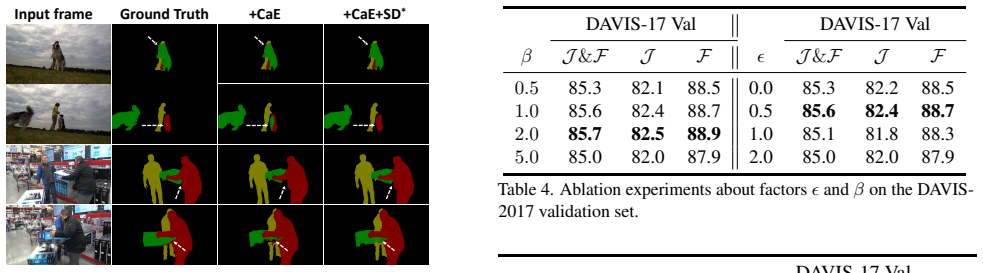
The load-bearing mechanism is the structure-refinement module operating in three steps. First, Canny edge detection produces a rough edge map $I_c$ of the current frame, and element-wise multiplication with image features $\hat{I}_i$ yields global-edge-enhanced features $\tilde{I}_i = \hat{I}_i + (\hat{I}_i \odot \epsilon I_c^{h_i,w_i})$. Second, a lightweight structure decoder takes these features plus object memory features $M$ and outputs a structure map $S'$ that is supervised with a ground-truth structure map derived from the mask. Third, the structure map in logit form multiplies the image features, $\hat{I}'_i = \hat{I}_i + (\hat{I}_i \odot \beta S')$, selectively amplifying boundary pixels. The evidential-learning loss $L_{EDL}$ built on the Dirichlet distribution is added to the cross-entropy and dice losses to suppress uncertain predictions in occlusion regions.
What would settle it
A decisive check: run OASIS and its baseline on clips where the target boundary is low contrast, e.g., a translucent object on a similarly colored background, with Canny thresholds set so the boundary produces no edge response. If the structure-refinement gain over the baseline disappears or reverses on boundary metrics, the mechanism is not generally doing the claimed work; if the gain persists, Canny misses may be tolerable.
Extended reading notes
Core claim
The central claim is that a target-specific structure map, derived from a cheap edge prior and object memory, is sufficient to refine video object segmentation without a large specialized edge network. The paper's method computes Canny edges on the current frame, multiplies them into the multi-scale image features, decodes the result together with object memory features into a structure map, and then multiplies that structure map back into the features to highlight boundaries. It adds an evidential-learning loss, based on a Dirichlet distribution over class probabilities, that reduces confident wrong predictions in overlap regions. Across four benchmarks and two training settings, the paper reports the best J&F scores among compared methods, with the largest margins on contour accuracy.
Load-bearing premise
The load-bearing premise is that the Canny edge prior, after fusion with object memory features, produces a structure map accurate enough at the target's true boundaries to improve segmentation; if Canny misses low-contrast edges, the refinement signal marks the wrong places and the reported gains would shrink.
Editorial extensions
If this is right
- The paper reports contour accuracy gains of 1.0-1.9 points on DAVIS-17 and MOSE, indicating that boundary errors, not just area overlap, drive the improvement.
- Because the extra structure decoder adds only about 2M parameters and keeps inference at 48 FPS, the design is compatible with real-time downstream applications.
- The evidential-loss term is introduced as the first use of evidential learning in semi-supervised video object segmentation, offering a template for quantifying uncertainty in overlapping regions.
- Under both training settings (with and without MOSE in the training set), OASIS remains the top scorer, suggesting the structure-refinement benefit transfers across annotation granularity and scene complexity.
Reading between the lines
- Editorial inference: the predicted structure map itself could serve as a debugging and interpretability tool, letting a user see exactly which boundaries the model trusts; the paper does not explore this use.
- Editorial inference: the same Canny-prior-plus-decoder recipe could transfer to other memory-based dense prediction tasks, such as referring segmentation or tracking-anything, but this is not tested in the paper.
- Editorial inference: because the Canny thresholds are fixed, the approach inherits Canny's sensitivity to contrast; a learned or adaptive edge prior trained jointly with the decoder might extend the gains to low-contrast boundaries.
- Editorial inference: the evidential loss is validated only through final segmentation metrics, so its claimed uncertainty-reduction effect has not been directly measured; a calibration study on occlusion pixels would test whether the loss genuinely shrinks uncertainty.
Signed reviews
Editorial analysis
A structured set of objections, weighed in public.
Referee Report
Summary. The manuscript proposes OASIS, a memory-based semi-supervised video object segmentation method that augments a Cutie-style baseline with a structure refinement module: Canny edge priors are fused with image features (Eq. 3), a lightweight structure decoder predicts an object-level structure map guided by object memory features (Eq. 4), and the predicted map is used to enhance image features (Eq. 5). An evidential learning loss (Eqs. 6 and 7) is added to reduce uncertainty in occluded regions. The method is evaluated on DAVIS-17, YouTubeVOS-2019, and MOSE under two training settings, with ablations on components, hyperparameters, and parameter efficiency, and the paper claims consistent state-of-the-art results while maintaining real-time speed of 48 FPS.
Significance. If its results are reproducible, OASIS offers a lightweight and efficient contribution: it shows that coarse edge priors can be converted into a target-specific structure map with only about 2M extra parameters, and the ablations (Tables 3 and 5) provide evidence that the gains are not merely due to increased parameter count. The paper also includes a useful ablation of the fusion factors epsilon and beta, and evaluates on four standard benchmarks, which strengthens the empirical claims. However, the central claim of consistent state-of-the-art performance is currently supported mainly by a comparison against a Cutie baseline retrained by the authors under unreported conditions, and the reported margins are small and lack error bars. The Canny-prior concern that the reader raised is partly mitigated by the paper's own ablation: raw Canny edge integration alone adds only 0.1 J&F on DAVIS-17 val (Table 3), so the main effect comes from the structure decoder and evidential loss rather than the raw edges.
major comments (4)
- [§4.3.1, Table 1] The claim that OASIS 'consistently achieves the best segmentation performance across all benchmarks' is load-bearing but rests on a Cutie baseline that was retrained by the authors without a documented protocol. The table note says Cutie was 'trained from scratch using its publicly available code and re-evaluated,' but the paper gives no training iterations, data split, crop size, loss settings, or memory-bank configuration for that run, while all other rows are taken from the original publications. Since the margins over Cutie are only 1.5 J&F on DAVIS-17 val, 0.9 J&F on MOSE, 0.4 G on YouTubeVOS, and 0.4 J&F on DAVIS-17 test-dev, an under-trained Cutie would erase the claimed advantage. Please report the official Cutie numbers alongside the retrained ones and provide the full retraining protocol, or soften the claim to the comparison as configured.
- [§3.2, Supervision Preparation] The ground-truth structure map used to train the structure decoder is generated by applying 'a pre-defined filter' to the grayscale mask, but the filter is never specified. This is not a cosmetic omission: Eq. (4) trains the decoder to predict S from fused features, and the entire refinement mechanism is only as meaningful as this supervision signal. Without specifying the filter (e.g., morphological boundary extraction, distance transform, or a learned mapping), the method is not reproducible and the claim that the structure map 'effectively highlights occlusion relationships' cannot be independently verified. Please define the filter precisely and, if possible, visualize a few examples of the resulting structure maps.
- [§3.4, Eq. (6)] The evidential loss is under-specified. The term eta is called the 'confidence function' but no definition or implementation is given; the KL divergence term is deferred to reference [80] rather than written out; and the relationship between the raw output logits q_dot_t and the Dirichlet parameters alpha = 1 + eta(q_dot_t) is not made precise (e.g., whether eta is a softplus, exp, or a learned mapping, and whether it operates on the logits or the pixel-wise probability vector). Since EDL is listed as a contribution and is credited in the ablation for a 0.2-point gain, the loss must be fully defined to be reproducible and to allow evaluation of its effect on uncertainty. Please provide the exact formula, including the KL term, and state how (if at all) the predicted uncertainty is used at inference.
- [Tables 1–3] No error bars, multiple seeds, or significance tests are reported for any main or ablation result. The differences that carry the headline claim are small (0.4–1.5 points on J&F/G), and single-run comparisons are not sufficient to establish consistent superiority in VOS, where training runs vary by about this magnitude. Please report at least three independent training runs per configuration (with mean and standard deviation) or a paired test on the validation sets. Additionally, the ablation models in Table 3 are described as trained with 'limited iterations' (§4.4.1), so the incremental gains from each added component may reflect training-length interactions rather than component contributions; please clarify the iteration count used for all rows.
minor comments (5)
- [§4.4.1, Table 3] The contribution of the raw Canny edge integration (+CaE) is only 0.1 J&F on DAVIS-17 val (84.8 to 84.9) and 0.1 on test-dev, so the paper's own ablation indicates the Canny prior alone is not the main driver; consider adding a threshold sensitivity analysis (e.g., varying the Canny thresholds) to demonstrate robustness and to preempt the concern that missed low-contrast edges could degrade performance.
- [Table 5] The FPS values are reported without stating the GPU model, CUDA version, or whether the speed is measured with the same memory-bank configuration as the baseline; please specify the hardware and measurement protocol so the real-time claim is comparable.
- [§4.1] The sentence 'point supervision is utilized with a total of 8192 sampled points' is ambiguous: it is unclear whether the 8192 points are sampled per frame or per batch, and the same ambiguity applies to the later 12544 points; please clarify.
- [§3.4] The statement 'Due to the LogSoftmax used in the cross-entropy loss function' is imprecise; cross-entropy is typically used with a softmax, and the reference to LogSoftmax is not needed for the argument.
- [References] There are a few formatting issues in the reference list, for example reference [84] contains 'Y. CHEN, , H. C. Yip' with an extra comma, and Table 1 renders the DEVA method as 'DEV A'; please clean up these typographical errors.
Circularity Check
No circularity: OASIS is an empirically evaluated supervised architecture; no claimed result reduces by construction to a fitted input or to a self-citation.
full rationale
The paper makes no first-principles or uniqueness claim; it presents a supervised segmentation architecture trained with BCE, dice, and evidential losses and evaluated on the DAVIS, YouTubeVOS, and MOSE benchmarks. The structure map S' is trained against a filtered ground-truth mask and then used as a feature-enhancement signal; this is standard supervised training with ground-truth-derived labels, not a prediction that is forced by construction. No equation reduces the reported benchmark numbers to the method's own inputs. The only self-citations in the reference list are prior works by the authors in related medical-imaging contexts; they are descriptive and do not carry any load-bearing argument for the SVOS results. The authors' retraining of the Cutie baseline from public code is a legitimate reproducibility and fairness concern for the comparison table, but it is not a circularity: the comparison remains an external, falsifiable benchmark evaluation. The unspecified 'predefined filter' for structure-map supervision is an implementation-detail gap, not a circular step. Overall, the derivation chain is self-contained with respect to circularity: the central accuracy and speed claims are benchmark measurements, and the ablations use the same external protocol. Score 0 is therefore appropriate.
Assumptions & free parameters
free parameters (4)
- epsilon (edge importance factor) =
0.5
- beta (structure map importance factor) =
1.0
- lambda (EDL loss weight) =
0.01 with annealing
- Canny lower and upper thresholds =
50 and 200
assumptions (4)
- domain assumption The Cutie memory-based framework provides a reliable backbone feature extraction and decoder, and its object memory features contain sufficient target-specific information for structure refinement.
- domain assumption Canny edge detection produces a useful rough edge prior that includes the boundaries of target objects in typical videos.
- domain assumption Ground-truth masks in the benchmarks are accurate enough to derive a meaningful object-structure map for supervision.
- domain assumption The benchmark metrics J&F and G are valid measures of segmentation quality and the reported single-run numbers are representative.
Cite this review
Pith. "Pith review of Structure Matters: Revisiting Boundary Refinement in Video Object Segmentation." pith.science (2026). https://pith.science/paper/NCC3XIJB
@misc{pith2026250718944,
  author       = {Pith},
  title        = {Pith review of: Structure Matters: Revisiting Boundary Refinement in Video Object Segmentation},
  year         = {2026},
  howpublished = {\url{https://pith.science/paper/NCC3XIJB}},
  note         = {Machine review of arXiv:2507.18944}
}
read the original abstract
Given an object mask, Semi-supervised Video Object Segmentation (SVOS) technique aims to track and segment the object across video frames, serving as a fundamental task in computer vision. Although recent memory-based methods demonstrate potential, they often struggle with scenes involving occlusion, particularly in handling object interactions and high feature similarity. To address these issues and meet the real-time processing requirements of downstream applications, in this paper, we propose a novel bOundary Amendment video object Segmentation method with Inherent Structure refinement, hereby named OASIS. Specifically, a lightweight structure refinement module is proposed to enhance segmentation accuracy. With the fusion of rough edge priors captured by the Canny filter and stored object features, the module can generate an object-level structure map and refine the representations by highlighting boundary features. Evidential learning for uncertainty estimation is introduced to further address challenges in occluded regions. The proposed method, OASIS, maintains an efficient design, yet extensive experiments on challenging benchmarks demonstrate its superior performance and competitive inference speed compared to other state-of-the-art methods, i.e., achieving the F values of 91.6 (vs. 89.7 on DAVIS-17 validation set) and G values of 86.6 (vs. 86.2 on YouTubeVOS 2019 validation set) while maintaining a competitive speed of 48 FPS on DAVIS.
Figures


Figures from the paper (2 more)

Reference graph
Works this paper leans on
-
[7]
Putting the object back into video object segmentation,
H. K. Cheng, S. W. Oh, B. Price, J.-Y . Lee, and A. Schwing, “Putting the object back into video object segmentation,” in Proceedings of the IEEE/CVF Conference on Computer Vi- sion and Pattern Recognition, 2024, pp. 3151–3161. 1, 2, 4, 5, 6, 7
2024
-
[80]
Evidential deep learning to quantify classification uncertainty,
M. Sensoy, L. Kaplan, and M. Kandemir, “Evidential deep learning to quantify classification uncertainty,” inAdvances in Neural Information Processing Systems, S. Bengio, H. Wal- lach, H. Larochelle, K. Grauman, N. Cesa-Bianchi, and R. Garnett, Eds., vol. 31. Curran Associates, Inc., 2018. 3, 5
work page 2018
-
[1]
One-shot video object segmen- tation,
S. Caelles, K.-K. Maninis, J. Pont-Tuset, L. Leal-Taixé, D. Cremers, and L. Van Gool, “One-shot video object segmen- tation,” in Proceedings of the IEEE conference on computer vision and pattern recognition, 2017, pp. 221–230. 1, 2
2017
-
[2]
A benchmark dataset and evaluation methodology for video object segmentation,
F. Perazzi, J. Pont-Tuset, B. McWilliams, L. Van Gool, M. Gross, and A. Sorkine-Hornung, “A benchmark dataset and evaluation methodology for video object segmentation,” in Proceedings of the IEEE conference on computer vision and pattern recognition, 2016, pp. 724–732. 1, 2, 6
2016
-
[3]
Xmem: Long-term video object segmentation with an atkinson-shiffrin memory model,
H. K. Cheng and A. G. Schwing, “Xmem: Long-term video object segmentation with an atkinson-shiffrin memory model,” in European Conference on Computer Vision . Springer, 2022, pp. 640–658. 1, 2, 6, 7
2022
-
[4]
Associating objects with transformers for video object segmentation,
Z. Yang, Y . Wei, and Y . Yang, “Associating objects with transformers for video object segmentation,” Advances in Neural Information Processing Systems, vol. 34, pp. 2491– 2502, 2021. 6
2021
-
[5]
Decoupling features in hierarchical propagation for video object segmentation,
Z. Yang and Y . Yang, “Decoupling features in hierarchical propagation for video object segmentation,” Advances in Neural Information Processing Systems, vol. 35, pp. 36 324– 36 336, 2022. 6, 7
2022
-
[6]
Tracking anything with decoupled video segmentation,
H. K. Cheng, S. W. Oh, B. Price, A. Schwing, and J.-Y . Lee, “Tracking anything with decoupled video segmentation,” in Proceedings of the IEEE/CVF International Conference on Computer Vision, 2023, pp. 1316–1326. 1, 6, 7
2023
Show all 94 references
-
[8]
Making accurate object detection at the edge: Review and new approach,
Z. Huang, S. Yang, M. Zhou, Z. Gong, A. Abusorrah, C. Lin, and Z. Huang, “Making accurate object detection at the edge: Review and new approach,” Artificial Intelligence Review , vol. 55, no. 3, pp. 2245–2274, 2022. 2
2022
-
[9]
An overview of edge and object contour detection,
D. Yang, B. Peng, Z. Al-Huda, A. Malik, and D. Zhai, “An overview of edge and object contour detection,”Neurocom- puting, vol. 488, pp. 470–493, 2022
2022
-
[10]
Edge boxes: Locating object proposals from edges,
C. L. Zitnick and P. Dollár, “Edge boxes: Locating object proposals from edges,” inComputer Vision–ECCV 2014: 13th European Conference, Zurich, Switzerland, September 6-12, 2014, Proceedings, Part V 13. Springer, 2014, pp. 391–405. 2
2014
-
[11]
Fast and automatic video object segmentation and tracking for content-based applications,
C. Kim and J.-N. Hwang, “Fast and automatic video object segmentation and tracking for content-based applications,” IEEE transactions on circuits and systems for video technol- ogy, vol. 12, no. 2, pp. 122–129, 2002. 2, 3
2002
-
[12]
Edge computing enabled video segmentation for real-time traffic monitoring in internet of vehicles,
S. Wan, S. Ding, and C. Chen, “Edge computing enabled video segmentation for real-time traffic monitoring in internet of vehicles,” Pattern Recognition, vol. 121, p. 108146, 2022. 2, 3
2022
-
[13]
Classifier based graph construction for video segmentation,
A. Khoreva, F. Galasso, M. Hein, and B. Schiele, “Classifier based graph construction for video segmentation,” inProceed- ings of the IEEE Conference on Computer Vision and Pattern Recognition, 2015, pp. 951–960. 2, 3
2015
-
[14]
A computational approach to edge detection,
J. Canny, “A computational approach to edge detection,”IEEE Transactions on Pattern Analysis and Machine Intelligence, vol. PAMI-8, no. 6, pp. 679–698, 1986. 2
1986
-
[15]
The 2017 davis challenge on video object segmentation,
J. Pont-Tuset, F. Perazzi, S. Caelles, P. Arbeláez, A. Sorkine- Hornung, and L. Van Gool, “The 2017 davis challenge on video object segmentation,”arXiv preprint arXiv:1704.00675,
2017 arXiv
-
[16]
Online adaptation of convolu- tional neural networks for video object segmentation,
P. V oigtlaender and B. Leibe, “Online adaptation of convolu- tional neural networks for video object segmentation,” in Pro- ceedings of the British Machine Vision Conference (BMVC). BMV A Press, September 2017, pp. 116.1–116.13
2017
-
[17]
Monet: Deep motion exploitation for video object segmentation,
H. Xiao, J. Feng, G. Lin, Y . Liu, and M. Zhang, “Monet: Deep motion exploitation for video object segmentation,” in Proceedings of the IEEE Conference on Computer Vision and Pattern Recognition, 2018, pp. 1140–1148
2018
-
[18]
Premvos: Proposal- generation, refinement and merging for video object segmen- tation,
J. Luiten, P. V oigtlaender, and B. Leibe, “Premvos: Proposal- generation, refinement and merging for video object segmen- tation,” in Asian conference on computer vision. Springer, 2018, pp. 565–580
2018
-
[19]
Maskrnn: Instance level video object segmentation,
Y .-T. Hu, J.-B. Huang, and A. Schwing, “Maskrnn: Instance level video object segmentation,” Advances in neural infor- mation processing systems, vol. 30, 2017
2017
-
[20]
Learning video object segmentation from static images,
F. Perazzi, A. Khoreva, R. Benenson, B. Schiele, and A. Sorkine-Hornung, “Learning video object segmentation from static images,” in Proceedings of the IEEE conference on computer vision and pattern recognition, 2017, pp. 2663–
2017
-
[21]
Video object segmen- tation without temporal information,
K.-K. Maninis, S. Caelles, Y . Chen, J. Pont-Tuset, L. Leal- Taixé, D. Cremers, and L. Van Gool, “Video object segmen- tation without temporal information,” IEEE transactions on pattern analysis and machine intelligence, vol. 41, no. 6, pp. 1515–1530, 2018. 2
2018
-
[22]
Segflow: Joint learning for video object segmentation and optical flow,
J. Cheng, Y .-H. Tsai, S. Wang, and M.-H. Yang, “Segflow: Joint learning for video object segmentation and optical flow,” in Proceedings of the IEEE international conference on com- puter vision, 2017, pp. 686–695. 2
2017
-
[23]
Video object segmentation with joint re-identification and attention-aware mask propagation,
X. Li and C. C. Loy, “Video object segmentation with joint re-identification and attention-aware mask propagation,” in Proceedings of the European conference on computer vision (ECCV), 2018, pp. 90–105
2018
-
[24]
Fast video object segmentation by reference-guided mask propagation,
S. W. Oh, J.-Y . Lee, K. Sunkavalli, and S. J. Kim, “Fast video object segmentation by reference-guided mask propagation,” in Proceedings of the IEEE conference on computer vision and pattern recognition, 2018, pp. 7376–7385
2018
-
[25]
Video segmentation via object flow,
Y .-H. Tsai, M.-H. Yang, and M. J. Black, “Video segmentation via object flow,” in Proceedings of the IEEE conference on computer vision and pattern recognition , 2016, pp. 3899– 3908
2016
-
[26]
Efficient regional memory network for video object segmentation,
H. Xie, H. Yao, S. Zhou, S. Zhang, and W. Sun, “Efficient regional memory network for video object segmentation,” in Proceedings of the IEEE/CVF conference on computer vision and pattern recognition, 2021, pp. 1286–1295. 2
2021
-
[27]
Efficient video object segmentation via network modulation,
L. Yang, Y . Wang, X. Xiong, J. Yang, and A. K. Katsaggelos, “Efficient video object segmentation via network modulation,” in Proceedings of the IEEE conference on computer vision and pattern recognition, 2018, pp. 6499–6507
2018
-
[28]
Sstvos: Sparse spatiotemporal transformers for video object segmentation,
B. Duke, A. Ahmed, C. Wolf, P. Aarabi, and G. W. Taylor, “Sstvos: Sparse spatiotemporal transformers for video object segmentation,” in Proceedings of the IEEE/CVF conference on computer vision and pattern recognition, 2021, pp. 5912– 5921
2021
-
[29]
Accelerating video object segmentation with compressed video,
K. Xu and A. Yao, “Accelerating video object segmentation with compressed video,” in Proceedings of the IEEE/CVF Conference on Computer Vision and Pattern Recognition , 2022, pp. 1342–1351
2022
-
[30]
Dynamic video segmentation network,
Y .-S. Xu, T.-J. Fu, H.-K. Yang, and C.-Y . Lee, “Dynamic video segmentation network,” in Proceedings of the IEEE conference on computer vision and pattern recognition, 2018, pp. 6556–6565. 2
2018
-
[31]
Blaz- ingly fast video object segmentation with pixel-wise metric learning,
Y . Chen, J. Pont-Tuset, A. Montes, and L. Van Gool, “Blaz- ingly fast video object segmentation with pixel-wise metric learning,” inProceedings of the IEEE conference on computer vision and pattern recognition, 2018, pp. 1189–1198. 2
2018
-
[32]
Videomatch: Matching based video object segmentation,
Y .-T. Hu, J.-B. Huang, and A. G. Schwing, “Videomatch: Matching based video object segmentation,” in Proceedings of the European conference on computer vision (ECCV), 2018, pp. 54–70
2018
-
[33]
Collaborative video object segmentation by multi-scale foreground-background integra- tion,
Z. Yang, Y . Wei, and Y . Yang, “Collaborative video object segmentation by multi-scale foreground-background integra- tion,” IEEE Transactions on Pattern Analysis and Machine Intelligence, vol. 44, no. 9, pp. 4701–4712, 2021
2021
-
[34]
Feelvos: Fast end-to-end embedding learning for video object segmentation,
P. V oigtlaender, Y . Chai, F. Schroff, H. Adam, B. Leibe, and L.-C. Chen, “Feelvos: Fast end-to-end embedding learning for video object segmentation,” in Proceedings of the IEEE/CVF conference on computer vision and pattern recognition, 2019, pp. 9481–9490
2019
-
[35]
Video object seg- mentation using space-time memory networks,
S. W. Oh, J.-Y . Lee, N. Xu, and S. J. Kim, “Video object seg- mentation using space-time memory networks,” in Proceed- ings of the IEEE/CVF international conference on computer vision, 2019, pp. 9226–9235. 2
2019
-
[36]
Modular in- teractive video object segmentation: Interaction-to-mask, propagation and difference-aware fusion,
H. K. Cheng, Y .-W. Tai, and C.-K. Tang, “Modular in- teractive video object segmentation: Interaction-to-mask, propagation and difference-aware fusion,” in Proceedings of the IEEE/CVF Conference on Computer Vision and Pattern Recognition, 2021, pp. 5559–5568
2021
-
[37]
Rethinking space-time networks with improved mem- ory coverage for efficient video object segmentation,
——, “Rethinking space-time networks with improved mem- ory coverage for efficient video object segmentation,” Ad- vances in Neural Information Processing Systems, vol. 34, pp. 11 781–11 794, 2021. 2, 6
2021
-
[38]
Fast video object segmentation using the global context module,
Y . Li, Z. Shen, and Y . Shan, “Fast video object segmentation using the global context module,” in Computer Vision–ECCV 2020: 16th European Conference, Glasgow, UK, August 23– 28, 2020, Proceedings, Part X 16. Springer, 2020, pp. 735– 750
2020
-
[39]
Video object seg- mentation with adaptive feature bank and uncertain-region refinement,
Y . Liang, X. Li, N. Jafari, and J. Chen, “Video object seg- mentation with adaptive feature bank and uncertain-region refinement,” Advances in Neural Information Processing Sys- tems, vol. 33, pp. 3430–3441, 2020. 2
2020
-
[40]
Swiftnet: Real-time video object segmentation,
H. Wang, X. Jiang, H. Ren, Y . Hu, and S. Bai, “Swiftnet: Real-time video object segmentation,” in Proceedings of the IEEE/CVF Conference on Computer Vision and Pattern Recognition, 2021, pp. 1296–1305. 2
2021
-
[41]
Joint inductive and transductive learning for video object segmentation,
Y . Mao, N. Wang, W. Zhou, and H. Li, “Joint inductive and transductive learning for video object segmentation,” in Pro- ceedings of the IEEE/CVF international conference on com- puter vision, 2021, pp. 9670–9679. 2
2021
-
[42]
Kernelized memory network for video object segmentation,
H. Seong, J. Hyun, and E. Kim, “Kernelized memory network for video object segmentation,” in Computer Vision–ECCV 2020: 16th European Conference, Glasgow, UK, August 23– 28, 2020, Proceedings, Part XXII 16. Springer, 2020, pp. 629–645
2020
-
[43]
Learn- ing position and target consistency for memory-based video object segmentation,
L. Hu, P. Zhang, B. Zhang, P. Pan, Y . Xu, and R. Jin, “Learn- ing position and target consistency for memory-based video object segmentation,” in Proceedings of the IEEE/CVF Con- ference on Computer Vision and Pattern Recognition, 2021, pp. 4144–4154
2021
-
[44]
Video object segmentation with episodic graph memory networks,
X. Lu, W. Wang, M. Danelljan, T. Zhou, J. Shen, and L. Van Gool, “Video object segmentation with episodic graph memory networks,” in Computer Vision–ECCV 2020: 16th European Conference, Glasgow, UK, August 23–28, 2020, Proceedings, Part III 16. Springer, 2020, pp. 661–679
2020
-
[45]
Hierarchical memory matching network for video object seg- mentation,
H. Seong, S. W. Oh, J.-Y . Lee, S. Lee, S. Lee, and E. Kim, “Hierarchical memory matching network for video object seg- mentation,” in Proceedings of the IEEE/CVF International Conference on Computer Vision, 2021, pp. 12 889–12 898
2021
-
[46]
Resurgsam2: Referring segment anything in surgical video via credible long-term tracking,
H. Liu, M. Gao, X. Luo, Z. Wang, G. Qin, J. Wu, and Y . Jin, “Resurgsam2: Referring segment anything in surgical video via credible long-term tracking,” in International Conference on Medical Image Computing and Computer-Assisted Inter- vention. Springer, 2025
2025
-
[47]
Instrument-tissue-guided surgical action triplet detection via textual-temporal trail exploration,
J. Pei, J. Zhang, G. Qin, K. Wang, Y . Jin, and P.-A. Heng, “Instrument-tissue-guided surgical action triplet detection via textual-temporal trail exploration,” IEEE Transactions on Medical Imaging, 2025. 2
2025
-
[48]
SAM 2: Segment anything in im- ages and videos,
N. Ravi, V . Gabeur, Y .-T. Hu, R. Hu, C. Ryali, T. Ma, H. Khedr, R. Rädle, C. Rolland, L. Gustafson, E. Mintun, J. Pan, K. V . Alwala, N. Carion, C.-Y . Wu, R. Girshick, P. Dol- lar, and C. Feichtenhofer, “SAM 2: Segment anything in im- ages and videos,” in The Thirteenth Int...
2025
-
[49]
Dy- namic pseudo label optimization in point-supervised nuclei segmentation,
Z. Wang, Y . Zhang, Y . Wang, L. Cai, and Y . Zhang, “Dy- namic pseudo label optimization in point-supervised nuclei segmentation,” inInternational Conference on Medical Image Computing and Computer-Assisted Intervention. Springer, 2024, pp. 220–230. 2
2024
-
[50]
Boundary-aware contrastive learning for semi- supervised nuclei instance segmentation,
Y . Zhang, Z. Wang, Y . Wang, H. Bian, L. Cai, H. Li, L. Zhang, and Y . Zhang, “Boundary-aware contrastive learning for semi- supervised nuclei instance segmentation,” inMedical Imaging with Deep Learning, 2024
2024
-
[51]
The four color theorem for cell instance segmenta- tion,
Y . Zhang, Y . Zhou, Y . Wang, J. Xiao, Z. Wang, Y . Zhang, and J. Chen, “The four color theorem for cell instance segmenta- tion,” in Forty-second International Conference on Machine Learning, 2025. 2
2025
-
[52]
Egnet: Edge guidance network for salient object detection,
J.-X. Zhao, J.-J. Liu, D.-P. Fan, Y . Cao, J. Yang, and M.-M. Cheng, “Egnet: Edge guidance network for salient object detection,” in Proceedings of the IEEE/CVF international conference on computer vision, 2019, pp. 8779–8788. 2
2019
-
[53]
Non-local deep features for salient object detection,
Z. Luo, A. Mishra, A. Achkar, J. Eichel, S. Li, and P.-M. Jodoin, “Non-local deep features for salient object detection,” in Proceedings of the IEEE Conference on computer vision and pattern recognition, 2017, pp. 6609–6617
2017
-
[54]
Boundary-guided feature aggregation network for salient object detection,
Y . Zhuge, G. Yang, P. Zhang, and H. Lu, “Boundary-guided feature aggregation network for salient object detection,” IEEE Signal Processing Letters, vol. 25, no. 12, pp. 1800– 1804, 2018
2018
-
[55]
Edge-guided non- local fully convolutional network for salient object detection,
Z. Tu, Y . Ma, C. Li, J. Tang, and B. Luo, “Edge-guided non- local fully convolutional network for salient object detection,” IEEE transactions on circuits and systems for video technol- ogy, vol. 31, no. 2, pp. 582–593, 2020
2020
-
[56]
Edge preserving and multi-scale contextual neural network for salient object detection,
X. Wang, H. Ma, X. Chen, and S. You, “Edge preserving and multi-scale contextual neural network for salient object detection,” IEEE Transactions on Image Processing, vol. 27, no. 1, pp. 121–134, 2017
2017
-
[57]
Stacked cross refinement net- work for edge-aware salient object detection,
Z. Wu, L. Su, and Q. Huang, “Stacked cross refinement net- work for edge-aware salient object detection,” in Proceedings of the IEEE/CVF international conference on computer vision, 2019, pp. 7264–7273. 2
2019
-
[58]
Instance-level salient object segmentation,
G. Li, Y . Xie, L. Lin, and Y . Yu, “Instance-level salient object segmentation,” in Proceedings of the IEEE conference on computer vision and pattern recognition , 2017, pp. 2386–
2017
-
[59]
Edgeflow: Achieving practical interactive segmentation with edge-guided flow,
Y . Hao, Y . Liu, Z. Wu, L. Han, Y . Chen, G. Chen, L. Chu, S. Tang, Z. Yu, Z. Chenet al., “Edgeflow: Achieving practical interactive segmentation with edge-guided flow,” inProceed- ings of the IEEE/CVF International Conference on Computer Vision, 2021, pp. 1551–1560
2021
-
[60]
Yolactedge: Real-time instance segmentation on the edge,
H. Liu, R. A. R. Soto, F. Xiao, and Y . J. Lee, “Yolactedge: Real-time instance segmentation on the edge,” in 2021 IEEE International Conference on Robotics and Automation (ICRA). IEEE, 2021, pp. 9579–9585
2021
-
[61]
Flow- edge guided unsupervised video object segmentation,
Y . Zhou, X. Xu, F. Shen, X. Zhu, and H. T. Shen, “Flow- edge guided unsupervised video object segmentation,” IEEE Transactions on circuits and systems for video technology , vol. 32, no. 12, pp. 8116–8127, 2021. 2, 3
2021
-
[62]
Edge assisted real-time object detection for mobile augmented reality,
L. Liu, H. Li, and M. Gruteser, “Edge assisted real-time object detection for mobile augmented reality,” in The 25th annual international conference on mobile computing and networking, 2019, pp. 1–16
2019
-
[63]
An improved moving object detection algorithm based on frame difference and edge detection,
C. Zhan, X. Duan, S. Xu, Z. Song, and M. Luo, “An improved moving object detection algorithm based on frame difference and edge detection,” in Fourth international conference on image and graphics (ICIG 2007). IEEE, 2007, pp. 519–523
2007
-
[64]
Edge- assisted online on-device object detection for real-time video analytics,
M. Hanyao, Y . Jin, Z. Qian, S. Zhang, and S. Lu, “Edge- assisted online on-device object detection for real-time video analytics,” in IEEE INFOCOM 2021-IEEE Conference on Computer Communications. IEEE, 2021, pp. 1–10. 2
2021
-
[65]
Canny edge detection based on open cv,
Z. Xu, X. Baojie, and W. Guoxin, “Canny edge detection based on open cv,” in 2017 13th IEEE international con- ference on electronic measurement & instruments (ICEMI). IEEE, 2017, pp. 53–56. 2
2017
-
[66]
An improved canny edge detection algorithm,
L. Xuan and Z. Hong, “An improved canny edge detection algorithm,” in 2017 8th IEEE international conference on software engineering and service science (ICSESS). IEEE, 2017, pp. 275–278
2017
-
[67]
An improved canny edge detection algorithm,
W. Rong, Z. Li, W. Zhang, and L. Sun, “An improved canny edge detection algorithm,” in 2014 IEEE international con- ference on mechatronics and automation. IEEE, 2014, pp. 577–582. 2
2014
-
[68]
On the canny edge detector,
L. Ding and A. Goshtasby, “On the canny edge detector,” Pattern recognition, vol. 34, no. 3, pp. 721–725, 2001. 3
2001
-
[69]
The canny edge detector revisited,
W. McIlhagga, “The canny edge detector revisited,” Inter- national Journal of Computer Vision, vol. 91, pp. 251–261, 2011
2011
-
[70]
Edge connection based canny edge detection algorithm,
R. Song, Z. Zhang, and H. Liu, “Edge connection based canny edge detection algorithm,” Pattern Recognition and Image Analysis, vol. 27, pp. 740–747, 2017
2017
-
[71]
Canny edge detection en- hancement by scale multiplication,
P. Bao, L. Zhang, and X. Wu, “Canny edge detection en- hancement by scale multiplication,” IEEE transactions on pattern analysis and machine intelligence, vol. 27, no. 9, pp. 1485–1490, 2005. 3
2005
-
[72]
Insignificant shadow detection for video segmentation,
D. Xu, J. Liu, X. Li, Z. Liu, and X. Tang, “Insignificant shadow detection for video segmentation,”IEEE Transactions on Circuits and Systems for Video Technology, vol. 15, no. 8, pp. 1058–1064, 2005. 3
2005
-
[73]
Application of uncertainty quantifica- tion to artificial intelligence in healthcare: A review of last decade (2013–2023),
S. Seoni, V . Jahmunah, M. Salvi, P. D. Barua, F. Molinari, and U. R. Acharya, “Application of uncertainty quantifica- tion to artificial intelligence in healthcare: A review of last decade (2013–2023),” Computers in Biology and Medicine, p. 107441, 2023. 3
2013
-
[74]
A framework for spatiotemporal control in the tracking of visual contours,
A. Blake, R. Curwen, and A. Zisserman, “A framework for spatiotemporal control in the tracking of visual contours,” International Journal of Computer Vision, vol. 11, pp. 127– 145, 1993. 3
1993
-
[75]
Multiscale conditional random fields for image labeling,
X. He, R. S. Zemel, and M. A. Carreira-Perpinán, “Multiscale conditional random fields for image labeling,” in Proceedings of the 2004 IEEE Computer Society Conference on Computer Vision and Pattern Recognition, 2004. CVPR 2004. , vol. 2. IEEE, 2004, pp. II–II. 3
2004
-
[76]
Premium-cnn: Propagating uncer- tainty towards robust convolutional neural networks,
D. Dera, N. C. Bouaynaya, G. Rasool, R. Shterenberg, and H. M. Fathallah-Shaykh, “Premium-cnn: Propagating uncer- tainty towards robust convolutional neural networks,”IEEE Transactions on Signal Processing, vol. 69, pp. 4669–4684,
-
[77]
Dropout as a bayesian approx- imation: Representing model uncertainty in deep learning,
Y . Gal and Z. Ghahramani, “Dropout as a bayesian approx- imation: Representing model uncertainty in deep learning,” in international conference on machine learning. PMLR, 2016, pp. 1050–1059
2016
-
[78]
What uncertainties do we need in bayesian deep learning for computer vision?
A. Kendall and Y . Gal, “What uncertainties do we need in bayesian deep learning for computer vision?” Advances in neural information processing systems, vol. 30, 2017. 3
2017
-
[79]
Pit- falls of in-domain uncertainty estimation and ensembling in deep learning,
A. Ashukha, A. Lyzhov, D. Molchanov, and D. Vetrov, “Pit- falls of in-domain uncertainty estimation and ensembling in deep learning,” in The Eighth International Conference on Learning Representations, 2020. 3
2020
-
[81]
A review of uncertainty estimation and its application in medical imaging,
K. Zou, Z. Chen, X. Yuan, X. Shen, M. Wang, and H. Fu, “A review of uncertainty estimation and its application in medical imaging,” Meta-Radiology, p. 100003, 2023
2023
-
[82]
Evidential deep learning for open set action recognition,
W. Bao, Q. Yu, and Y . Kong, “Evidential deep learning for open set action recognition,” inProceedings of the IEEE/CVF International Conference on Computer Vision , 2021, pp. 13 349–13 358. 3
2021
-
[83]
Imagenet: A large-scale hierarchical image database,
J. Deng, W. Dong, R. Socher, L.-J. Li, K. Li, and L. Fei- Fei, “Imagenet: A large-scale hierarchical image database,” in 2009 IEEE Conference on Computer Vision and Pattern Recognition, 2009, pp. 248–255. 4
2009
-
[84]
Un- certainty estimation for safety-critical scene segmentation via fine-grained reward maximization,
H. Yang, C. Chen, Y . CHEN, , H. C. Yip, and D. QI, “Un- certainty estimation for safety-critical scene segmentation via fine-grained reward maximization,” in Advances in Neu- ral Information Processing Systems , A. Oh, T. Naumann, A. Globerson, K. Saenko, M. Hardt, and S. Lev...
2023
-
[85]
Re- current dynamic embedding for video object segmentation,
M. Li, L. Hu, Z. Xiong, B. Zhang, P. Pan, and D. Liu, “Re- current dynamic embedding for video object segmentation,” in Proceedings of the IEEE/CVF Conference on Computer Vision and Pattern Recognition, 2022, pp. 1332–1341. 6
2022
-
[86]
Learning to learn better for video object segmentation,
M. Lan, J. Zhang, L. Zhang, and D. Tao, “Learning to learn better for video object segmentation,” in Proceedings of the AAAI Conference on Artificial Intelligence , vol. 37, no. 1, 2023, pp. 1205–1212. 6
2023
-
[87]
Look before you match: Instance understanding matters in video object segmentation,
J. Wang, D. Chen, Z. Wu, C. Luo, C. Tang, X. Dai, Y . Zhao, Y . Xie, L. Yuan, and Y .-G. Jiang, “Look before you match: Instance understanding matters in video object segmentation,” in Proceedings of the IEEE/CVF conference on computer vision and pattern recognition, 2023, pp....
2023
-
[88]
Hierarchical image saliency detection on extended cssd,
J. Shi, Q. Yan, L. Xu, and J. Jia, “Hierarchical image saliency detection on extended cssd,” IEEE Transactions on Pattern Analysis and Machine Intelligence, vol. 38, no. 4, pp. 717– 729, 2016. 5
2016
-
[89]
Learning to detect salient objects with image-level supervision,
L. Wang, H. Lu, Y . Wang, M. Feng, D. Wang, B. Yin, and X. Ruan, “Learning to detect salient objects with image-level supervision,” in 2017 IEEE Conference on Computer Vision and Pattern Recognition (CVPR), 2017, pp. 3796–3805
2017
-
[90]
Fss- 1000: A 1000-class dataset for few-shot segmentation,
X. Li, T. Wei, Y . P. Chen, Y .-W. Tai, and C.-K. Tang, “Fss- 1000: A 1000-class dataset for few-shot segmentation,” in 2020 IEEE/CVF Conference on Computer Vision and Pattern Recognition (CVPR), 2020, pp. 2866–2875
2020
-
[91]
Towards high-resolution salient object detection,
Y . Zeng, P. Zhang, Z. Lin, J. Zhang, and H. Lu, “Towards high-resolution salient object detection,” in 2019 IEEE/CVF International Conference on Computer Vision (ICCV), 2019, pp. 7233–7242
2019
-
[92]
Cas- cadepsp: Toward class-agnostic and very high-resolution segmentation via global and local refinement,
H. K. Cheng, J. Chung, Y .-W. Tai, and C.-K. Tang, “Cas- cadepsp: Toward class-agnostic and very high-resolution segmentation via global and local refinement,” in 2020 IEEE/CVF Conference on Computer Vision and Pattern Recognition (CVPR), 2020, pp. 8887–8896. 5
2020
-
[93]
Youtube-vos: A large-scale video object segmen- tation benchmark,
N. Xu, L. Yang, Y . Fan, D. Yue, Y . Liang, J. Yang, and T. Huang, “Youtube-vos: A large-scale video object segmen- tation benchmark,” in ECCV, 2018. 6
2018
-
[94]
MOSE: A new dataset for video object segmentation in com- plex scenes,
H. Ding, C. Liu, S. He, X. Jiang, P. H. Torr, and S. Bai, “MOSE: A new dataset for video object segmentation in com- plex scenes,” in ICCV, 2023. 6
2023
Reviewed August 15, 2026 · model on record in the stance chip above.
Discussion (0). Continue with ORCID to comment.